

Human exploration of Mars, Design Reference Architecture 5.0
Open accessThe DOI matches its Crossref record; 15 of the 19 references it cites were found in a registry or an index; none of the 1 sources its claims cite is checked for support yet.
Abstract
This paper provides a summary of the 2007 Mars Design Reference Architecture 5.0 (DRA 5.0), which is the latest in a series of NASA Mars reference missions. It provides a vision of one potential approach to human Mars exploration, including how Constellation systems could be used. The strategy and example implementation concepts that are described here should not be viewed as constituting a formal plan for the human exploration of Mars, but rather provide a common framework for future planning of systems concepts, technology development, and operational testing as well as potential Mars robotic missions, research that is conducted on the International Space Station, and future potential lunar exploration missions. This summary of the Mars DRA 5.0 provides an overview of the overall mission approach, surface strategy and exploration goals, as well as the key systems and challenges for the first three concepts for human missions to Mars.
Overview
CoChat Summary
TL;DR
This paper summarizes NASA’s Mars Design Reference Architecture 5.0, a reference mission concept for human Mars exploration using three crewed missions of six crewmembers each to different sites. It outlines the mission approach, surface strategy, key systems, and major challenges for the first human missions to Mars.
Key findings
- DRA 5.0 envisions six crewmembers on each of three consecutive Mars opportunities, with each mission visiting a different unique location; this approach was endorsed by the Human Exploration of Mars Science Advisory Group sponsored by MEPAG (2008).
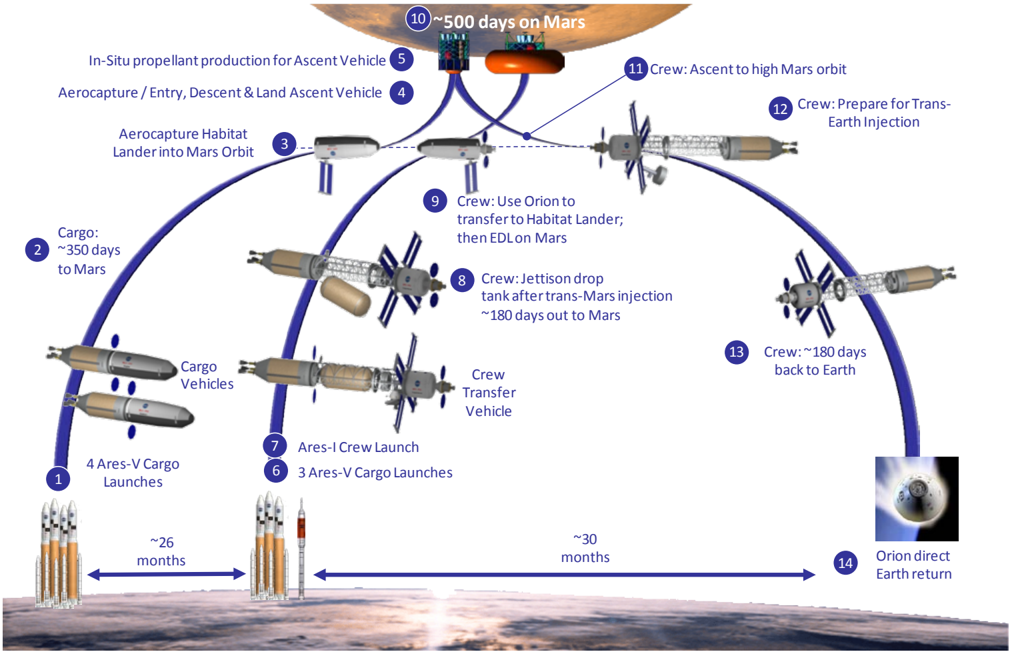
- Each mission would use conjunction class long-stay trajectories with forward-deployed cargo sent one opportunity earlier; an example 2037 crew mission would have 174 days outbound transit, 201 days inbound, 539 days Mars stay, and 914 days total mission duration, while the supporting cargo vehicle would take 202 days.
- The architecture requires at least seven heavy-lift cargo launches with launches at least 30 days apart, no on-orbit assembly of major elements, and total mission mass on the order of 800–1,200 t per mission; it also calls for landing 40 t of useful payload and providing 30–40 kWe continuous surface power.
- Key challenges include human health and performance risks such as radiation, bone mineral loss, muscle atrophy, medical care, and behavioral health; landing large payloads; heavy lift; in-situ resource utilization; advanced propulsion; robust power; and reliability/supportability with essentially no Earth resupply.
Methods
- This paper is a summary of the 2007 Mars Design Reference Architecture 5.0 (published as NASA-SP-2009-566 in 2009), providing a common framework rather than a formal plan for human Mars exploration.
- Mission analysis considered Earth departure dates from 2030 to 2046 to assess variability across the synodic cycle, and generated crewed and one-way cargo trajectories; the 2037 opportunity is used as an example.
- Technical assessments focused primarily on launch vehicle, interplanetary transportation, and entry, descent, and landing systems; Orion, the Mars descent/ascent vehicle, and the interplanetary transit habitat were assessed in less detail, and surface systems were mostly top-level performance estimates and trades.
Limitations
- The paper states that the strategy and example implementation concepts “should not be viewed as constituting a formal plan for the human exploration of Mars,” and that no date has been chosen for the first potential human mission; the 2030–2046 dates were chosen to assess mission opportunity variability, not as proposed actual mission dates.
- The paper states that detailed designs for surface systems were not developed, but rather top-level performance estimates and trades were conducted, and more in-depth definition should be conducted in future efforts, including commonality with lunar surface systems.
- Evident from the text: many system concepts depend on lunar-derived, Orion-derived, or Ares V/Constellation-era assumptions, and science specifics are still to be determined, with a 1000 kg allocation and 250 kg sample return capability and future trades regarding range, duration in field, and depth of exploration pending.
Model-written summary. Check it against the paper before relying on it.
Integrity signals
Registry
Cites
Statistics
Figures


Verification
Claims the paper makes
0 Valid · 4 Not valid · 1 Not checked · 49 Own results and interpretations
A result the paper reports from its own data — it cites no other source for it, so there is none to check. The quote shows it is in the paper.
In the paper
“An example crew mission in the 2037 opportunity would result in transit times of 174 days outbound and 201 days inbound.”
hedgedstates a cause- Asserted: passes — The authors put it forward as true.
- Checkable: passes — It can be checked against evidence.
- Load-bearing: unclear — It is unclear whether the paper’s conclusions depend on it.
- Based: passes — The paper gives a reason why it holds.
- Rests on an assumption not shown here.
A result the paper states — it cites no source for it, so there is none to check. The quote shows it is in the paper.
In the paper
“Each of the three missions would use conjunction class (long-stay) trajectories combined with a 'forward deploy' cargo strategy.”
hedgedstates a cause- Asserted: passes — The authors put it forward as true.
- Checkable: passes — It can be checked against evidence.
- Load-bearing: passes — The paper’s conclusions depend on it.
- Based: passes — The paper gives a reason why it holds.
A result the paper states — it cites no source for it, so there is none to check. The quote shows it is in the paper.
In the paper
“NASA has identified several approaches that would overcome this challenge that involve a combination of basic research in hypersonic aerodynamics, materials science, and propulsion technology to deliver these larger payloads.”
hedgedstates a cause- Asserted: passes — The authors put it forward as true.
- Checkable: passes — It can be checked against evidence.
- Load-bearing: unclear — It is unclear whether the paper’s conclusions depend on it.
- Based: passes — The paper gives a reason why it holds.
A result the paper reports from its own data — it cites no other source for it, so there is none to check. The quote shows it is in the paper.
In the paper
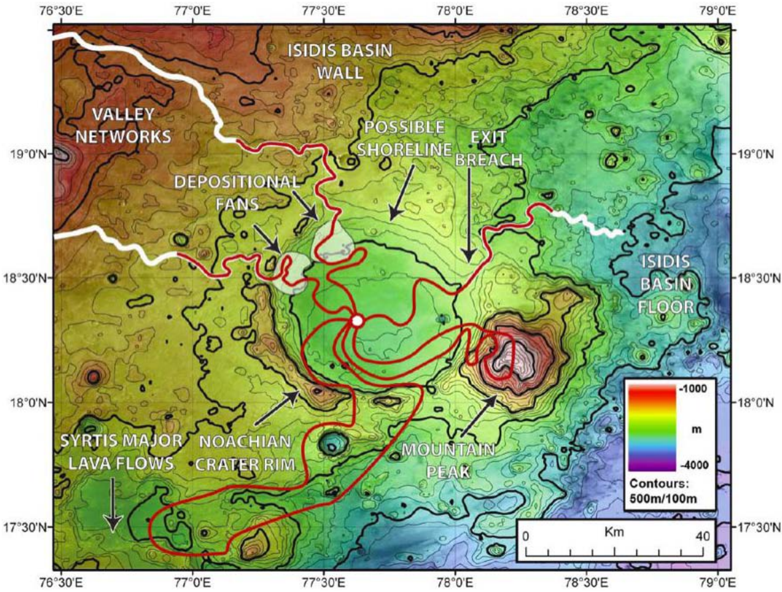
“The scale at the lower right of figure 2 indicates that these features of interest are beyond what is currently considered a reasonable walking range for the crew (determined by the distance a crew member could walk during one charge of power and breathing gases in his/her Portable Life Support System roughly 20 km total).”
hedged- Asserted: passes — The authors put it forward as true.
- Checkable: passes — It can be checked against evidence.
- Load-bearing: unclear — It is unclear whether the paper’s conclusions depend on it.
- Based: passes — The paper gives a reason why it holds.
A result the paper states — it cites no source for it, so there is none to check. The quote shows it is in the paper.
In the paper
“Mass increases in this subsystem are a prime contributor to the overall increase in the initial mass estimates given in this DRA as compared to previous approaches.”
plainstates a cause- Asserted: passes — The authors put it forward as true.
- Checkable: passes — It can be checked against evidence.
- Load-bearing: passes — The paper’s conclusions depend on it.
- Based: passes — The paper gives a reason why it holds.
- Rests on 3 assumptions not shown here.
21 more claims
Create a free account to see all 54 claims and every source verdict.
- Probably not a substantial claim. 20
- It may state two separate claims as one. 13
Claims other papers make about this one
Each is checked against this paper’s own text: does it say what the citing paper says it does?
The cited source says what the claim attributes to it.
In the citing paper
“Artemis I measurements can be extrapolated to exemplary Mars missions36 for a similar point in the solar cycle, as the GCR field is approximately constant outside the Earth’s magnetosphere on this scale.”
From Space radiation measurements during the Artemis I lunar mission (2024) · cites this paper as [36]
In the citing paper
“The DST concept documented in this paper was built upon these previous analyses, and designed to combine the best of low thrust and high thrust propulsion systems for round-trip delivery of a crew of four from the Earth to Mars.”
Self-check
Percentages, sums and reported differences re-computed from the paper’s own numbers.
Each contradiction between two passages listed here was confirmed by an independent check.
Rated minor: it would not touch a result — a value no result rests on, a p-value that stays on the same side of the significance level, or a conflict that is clerical, resolved elsewhere in the paper, or outside its own findings.
In the paper
§ Interplanetary Trajectory and Mission Analysis · p. 4
“An example crew mission in the 2037 opportunity would result in transit times of 174 days outbound and 201 days inbound.”
§ Getting Ready, Getting to Mars, and Getting Back · p. 5
“The length of this outbound transfer to Mars would be dependent on the mission date and would range from 175 to 225 days.”
Rated minor: it would not touch a result — a value no result rests on, a p-value that stays on the same side of the significance level, or a conflict that is clerical, resolved elsewhere in the paper, or outside its own findings.
In the paper
§ Getting Ready, Getting to Mars, and Getting Back · p. 5
“The length of this outbound transfer to Mars would be dependent on the mission date and would range from 175 to 225 days.”
§ 5. KEY CHALLENGES · p. 10
“| One-way Trip Time | 4 days | 180-210 days |”
Citations
Cites
Cratering Records in the Inner Solar System in Relation to the Lunar Reference System
Neukum, G., Ivanov, B. A., & Hartmann, W. K. (2001) · Space Science Reviews · doi:10.1023/a:1011989004263 · Cited by 661
Ages and Geologic Histories of Martian Meteorites
Nyquist, L. E., Bogard, D. D., Shih, C.-Y., Greshake, A., Stöffler, D., & Eugster, O. (2001) · Space Sciences Series of ISSI · doi:10.1007/978-94-017-1035-0_5 · Cited by 576
Cratering Records in the Inner Solar System in Relation to the Lunar Reference System
Neukum, G., Ivanov, B. A., & Hartmann, W. K. (2001) · Space Sciences Series of ISSI · doi:10.1007/978-94-017-1035-0_3 · Cited by 568
Photochemistry of Planetary Atmospheres
Yung, Y. L., & DeMore, W. B. (1999) · Oxford University Press eBooks · doi:10.1093/oso/9780195105018.001.0001 · Cited by 430
Ages and Geologic Histories of Martian Meteorites
Nyquist, L. E., Bogard, D. D., Shih, C.-Y., Greshake, A., Stöffler, D., & Eugster, O. (2001) · Space Science Reviews · doi:10.1023/a:1011993105172 · Cited by 417
Human Exploration of Mars: The Reference Mission of the NASA Mars Exploration Study Team
Hoffman, S. J., & Kaplan, D. I. (1997) · NASA Technical Reports Server (NASA) · Cited by 251
Self-citationGault, D. E. (1970) · Radio Science · doi:10.1029/rs005i002p00273 · Cited by 245
Crater size-frequency distributions and a revised Martian relative chronology
Barlow, N. G. (1988) · Icarus · doi:10.1016/0019-1035(88)90006-1 · Cited by 168
Drake, B. G. (1998) · NASA Technical Reports Server (NASA) · Cited by 111
Self-citationPaleocratering of the Moon: Review of post-Apollo data
HARTMANN, W. K. (1972) · Astrophysics and Space Science · doi:10.1007/bf00642541 · Cited by 104
Research works printed but not linked: 10
- grant, 2006, MEPAG (2006), Mars Scientific Goals, Objectives, Investigations, and Priorities: 2006, white paper posted, 31
- garvin, 2008, MEPAG HEM-SAG (2008). Planning for the Scientific Exploration of Mars by Humans, unpublished white paper
- strom, 1992, The Martian imact cratering record, Mars, 384
- 0, National Research Council (2006) Assessment of NASA's Mars Architecture 2007-2016, Committee to Review the Next Decade Mars Architecture Space Studies Board Division on Engineering and Physical Sciences
- 1989, Exploration Studies Technical Report, FY1989 Annual Report, NASA Technical memorandum 4170 Office of Exploration National Aeronautics and Space Administration
- 1991, America at the Threshold, Report of the Synthesis Group on America's Space Exploration Initiative, Superintendent of Documents
- 1988, Beyond Earth's Boundaries: Human Exploration of the Solar System in the 21st Century, 1988 Annual Report to the Administrator, National Aeronautics and Space Administration
- drake, 2009, Human Exploration of Mars Design Reference Architecture 5.0, NASA-SP-2009-566
- 2008, Planning for the Scientific Exploration of Mars by Humans, unpublished white paper
- 2007, An Astrobiology Strategy for the Exploration of Mars
Cited by
Items 101–200 of 589
Sustaining Human Presence on Mars Using ISRU and a Reusable Lander
Arney, D. C., Jones, C. A., Klovstad, J. J., et al. (2015) · AIAA SPACE Conference and Exposition · doi:10.2514/6.2015-4479 · Cited by 22
“This system, with an estimated mass of 1 t, and 400 kg of hydrogen would produce 25 t of oxygen for the ascent vehicle, 2 t of oxygen for the crew, and 133 kg of nitrogen/argon buffer gas, along with an unspecified amount of water.(4) The system was estimated to use between 24 kWe(4) and 30 kWe.”
BackgroundMethodBrune, A. J., Hosder, S., & Edquist, K. T. (2016) · Journal of Spacecraft and Rockets · doi:10.2514/1.a33532 · Cited by 22
Fast Transits to Mars Using Electric Propulsion
Dankanich, J., Vondra, B., & Ilin, A. (2010) · AIAA/ASME/SAE/ASEE Joint Propulsion Conference & Exhibit (JPC) · doi:10.2514/6.2010-6771 · Cited by 22
Near-Earth asteroids accessible to human exploration with high-power electric propulsion
Landau, D., & Strange, N. J. (2011) · AAS/AIAA Astrodynamics Specialist Conference · Cited by 21
Zhang, J., Wang, C., Zhang, J., et al. (2020) · Annals of Nuclear Energy · doi:10.1016/j.anucene.2020.107847 · Cited by 21
Biological growth as an alternative approach to on and off-Earth construction
Lipińska, M. B., Maurer, C., Cadogan, D. P., Head, J. W., III, Dade‐Robertson, M., Paulino‐Lima, I. G., Liu, C., Morrow, R., Senesky, D. G., Theodoridou, M., et al. (2022) · Frontiers in Built Environment · doi:10.3389/fbuil.2022.965145 · Cited by 32
“Additionally, that approach would be even more challenging for Martian missions, where, due to the distance from Earth, the cost of transportation of materials is significantly higher (Drake, 2009a; Drake, 2009b).”
BackgroundAbout feasibility of SpaceX's human exploration Mars mission scenario with Starship
Maiwald, V., Bauerfeind, M., Fälker, S., Westphal, B., & Bach, C. (2024) · Scientific Reports · doi:10.1038/s41598-024-54012-0 · Cited by 20
“This research explores the potential of P2X in achieving key ISRU outputs such as water, oxygen, methane and other buffer gases as outlined in the NASA design reference architecture 5.0 for a Mars mission 68 .”
MethodInfluentialEntry, Descent and Landing Systems Analysis: Exploration Class Simulation Overview and Results
Dwyer-Cianciolo, A. M., Davis, J., Shidner, J. D., et al. (2010) · AIAA/AAS Astrodynamics Specialist Conference · doi:10.2514/6.2010-7970 · Cited by 21
Key Gaps for Enabling Plant Growth in Future Missions
Anderson, M. S., Barta, D., Douglas, G. L., Motil, B., Massa, G. D., Fritsche, R. F., Quincy, C., Romeyn, M. W., & Hanford, A. J. (2017) · AIAA SPACE and Astronautics Forum and Exposition · doi:10.2514/6.2017-5142 · Cited by 28
Nuclear thermal propulsion – Progress and potential
Thomas, L. D. (2024) · Journal of Space Safety Engineering · doi:10.1016/j.jsse.2024.04.001 · Cited by 20
A realistic concept of a manned Mars mission with nuclear–electric propulsion
LOEB, H. W., Petukhov, V. G., Popov, G. A., et al. (2015) · Acta Astronautica · doi:10.1016/j.actaastro.2015.07.019 · Cited by 20
Combining Solar Electric Propulsion and chemical propulsion for crewed missions to Mars
Percy, T., McGuire, M. L., & Polsgrove, T. (2015) · IEEE Aerospace Conference (AERO) · doi:10.1109/aero.2015.7119289 · Cited by 22
Application Prospect of Fission-Powered Spacecraft in Solar System Exploration Missions
Xia, Y., Li, J., Zhai, R., Wang, J., Lin, B., & Zhou, Q. (2021) · Space Science & Technology · doi:10.34133/2021/5245136 · Cited by 21
Greenhouse design integration benefits for extended spaceflight
Häuplik‐Meusburger, S., Peldszus, R., & Holzgethan, V. (2010) · Acta Astronautica · doi:10.1016/j.actaastro.2010.07.008 · Cited by 20
Groemer, G. E., Łosiak, A., Soucek, A., Plank, C., Zanardini, L., Sejkora, N., & Sams, S. (2016) · Acta Astronautica · doi:10.1016/j.actaastro.2016.09.022 · Cited by 22
Backshell Radiative Heating on Human-Scale Mars Entry Vehicles
West, T. K., Theisinger, J. E., Brune, A. J., et al. (2017) · AIAA Thermophysics Conference · doi:10.2514/6.2017-4532 · Cited by 20
Flexible heat shields deployed by centrifugal force
Wu, R., Roberts, P. C. E., Soutis, C., et al. (2018) · Acta Astronautica · doi:10.1016/j.actaastro.2018.06.021 · Cited by 20
“The quest for a new system that could enable heavier payloads to be landed on Mars calls for a deployable aeroshell that can be stowed compactly in a launch vehicle while creating large drag area when deployed [1, 2, 3, 4, 5].”
BackgroundHuman Mars Entry, Descent, and Landing Architecture Study: Phase 3 Summary
Dwyer-Cianciolo, A. M., Polsgrove, T., Sostaric, R. R., et al. (2020) · AIAA SciTech Forum · doi:10.2514/6.2020-1509 · Cited by 20
“Three vehicle concepts were developed that included two low lift-to-drag (L/D) deployable entry vehicles with a blunt forebody shape similar to past Mars robotic missions and one rigid mid-L/D vehicle similar to but smaller than the one assumed in the Design Reference Architecture 5 (DRA5) [2].”
BackgroundHan, Z., Zhang, J., Wang, M.-J., Tian, W., Qiu, S., & Su, G. (2021) · Annals of Nuclear Energy · doi:10.1016/j.anucene.2021.108632 · Cited by 18
Information flow model of human extravehicular activity operations
Miller, M. J., McGuire, K., & Feigh, K. M. (2015) · Proceedings - IEEE Aerospace Conference · doi:10.1109/aero.2015.7118942 · Cited by 19
Schillo, K. J., Kumar, A., Harris, K., et al. (2016) · Annals of Nuclear Energy · doi:10.1016/j.anucene.2016.05.035 · Cited by 19
Kiffer, F. C., Alexander, T. C., Anderson, J. E., Groves, T. R., McElroy, T., Wang, J., Sridharan, V., Bauer, M., Boerma, M., & Allen, A. R. (2020) · Frontiers in Behavioral Neuroscience · doi:10.3389/fnbeh.2020.00096 · Cited by 22
“The interplanetary space within the solar system is host to high-energy charged particles that consist of galactic cosmic rays (GCR), and solar particle events (SPE), such as coronal mass ejections.”
BackgroundInfluentialMcNulty, M. J., Berliner, A. J., Negulescu, P. G., McKee, L., Hart, O., Yates, K., Arkin, A. P., Nandi, S., & McDonald, K. A. (2021) · Frontiers in Microbiology · doi:10.3389/fmicb.2021.700863 · Cited by 25
Entry, Descent, and Landing technological barriers and crewed MARS vehicle performance analysis
Subrahmanyam, P., & Rasky, D. J. (2017) · Progress in Aerospace Sciences · doi:10.1016/j.paerosci.2016.12.005 · Cited by 19
Ishimatsu, T. (2013) · DSpace@MIT (Massachusetts Institute of Technology) · Cited by 19
NASA's Strategic Analysis Cycle 2021 (SAC21) Human Mars Architecture
Rucker, M. A., Craig, D. A., Burke, L. M., Chai, P. R., Chappell, M. B., Drake, B. G., Edwards, S. J., Hoffman, S., McCrea, A. C., Trent, D. J., et al. (2022) · 2022 IEEE Aerospace Conference (AERO) · doi:10.1109/aero53065.2022.9843237 · Cited by 20
Self-citationThe Mars imperative: Species survival and inspiring a globalized culture
Barker, D. C. (2014) · Acta Astronautica · doi:10.1016/j.actaastro.2014.11.006 · Cited by 21
Two perspectives on reference architecture sustainability
Volpato, T., Oliveira, B. R. N., Garcés, L., Capilla, R., & Nakagawa, E. Y. (2017) · European Conference on Software Architecture · doi:10.1145/3129790.3129815 · Cited by 18
“…architectures were proposed [11, 14, 23, 36]; however, no studies were found indicating updates or any consortium/institution disseminating or using them, differently from what was observed in other reference architectures that are constantly updated and have been widely used [4, 5, 15, 17, 21].”
BackgroundLate effects of 1H irradiation on hippocampal physiology
Kiffer, F. C., Howe, A. K., Carr, H., Wang, J., Alexander, T. C., Anderson, J. E., Groves, T. R., Seawright, J. W., Sridharan, V., Carter, G., et al. (2018) · Life Sciences in Space Research · doi:10.1016/j.lssr.2018.03.004 · Cited by 19
Earth-Mars cyclers for a sustainable human exploration of Mars
Pelle, S., Gargioli, E., Berga, M., Pisacreta, J., Viola, N., Sega, A. D., & Pagone, M. (2018) · Acta Astronautica · doi:10.1016/j.actaastro.2018.04.034 · Cited by 18
Identifying Attack Surfaces in the Evolving Space Industry Using Reference Architectures
Bradbury, M. S., Maple, C. R., Yuan, H., Atmaca, U. I., & Cannizzaro, S. (2020) · IEEE Aerospace Conference (AERO) · doi:10.1109/aero47225.2020.9172785 · Cited by 27
“Examples include for on-board software (AMASS Reference Tool Architecture [31], ORSA-P [32], [33], SAVOIR OSRA [34]), data systems (RASDS [35]) and mission design [36, 37].”
MethodFlexibility Management for Space Logistics via Decision Rules
Chen, H., Gardner, B. M., Grogan, P. T., et al. (2021) · Journal of Spacecraft and Rockets · doi:10.2514/1.a34985 · Cited by 18
Imagining sustainable human ecosystems with power-to-x in-situ resource utilisation technology
Baldry, M., Gurieff, N. B., & Keogh, D. F. (2021) · Acta Astronautica · doi:10.1016/j.actaastro.2021.12.031 · Cited by 18
Parametric Study of Peripheral Nozzle Configurations for Supersonic Retropropulsion
Bakhtian, N., & Aftosmis, M. J. (2010) · Journal of Spacecraft and Rockets · doi:10.2514/1.48887 · Cited by 18
“Proposed future missions such as the robotic Mars sample-return and the astrobiology field laboratory would result in even higher touchdownmasses, and the requirements of humanmissions toMars could demand 40–100 t payloads, a two-order of magnitude increase over previous landed mass capability [2].”
BackgroundMethodInfluentialCrew autonomy for deep space exploration: Lessons from the Antarctic Search for Meteorites
Love, S. G., & HARVEY, R. P. (2013) · Acta Astronautica · doi:10.1016/j.actaastro.2013.08.001 · Cited by 18
Comparison of Lunar and Mars In-Situ Resource Utilization for Future Robotic and Human Missions
Sanders, G. B. (2011) · AIAA Aerospace Sciences Meeting · doi:10.2514/6.2011-120 · Cited by 22
Turchi, L., Payler, S. J., Sauro, F., Pozzobon, R., Massironi, M., & Bessone, L. (2021) · Planetary and Space Science · doi:10.1016/j.pss.2021.105164 · Cited by 18
StarCrete: A starch-based biocomposite for off-world construction
Roberts, A. D., & Scrutton, N. S. (2023) · Open Engineering · doi:10.1515/eng-2022-0390 · Cited by 22
Optimal Design of Electrically Fed Hybrid Mars Ascent Vehicle
Casalino, L., Masseni, F., & Pastrone, D. G. (2021) · Aerospace · doi:10.3390/aerospace8070181 · Cited by 17
On-orbit depot architectures using contingency propellant
Ho, K., Gerhard, K., Nicholas, A. K., et al. (2013) · Acta Astronautica · doi:10.1016/j.actaastro.2013.11.023 · Cited by 17
Edmunson, J. E., Fiske, M. R., Mueller, R. P., Alkhateb, H., Akhnoukh, A., Morris, H. C., Townsend, I. I., Fikes, J., & Johnston, M. (2018) · ASCE International Conference on Engineering, Science, Construction, and Operations in Challenging Environments (Earth and Space) · doi:10.1061/9780784481899.074 · Cited by 19
Parametric Mass Modeling for Mars Entry, Descent and Landing System Analysis Study
Samareh, J. A., & Komar, D. R. (2011) · AIAA Aerospace Sciences Meeting · doi:10.2514/6.2011-1038 · Cited by 17
A Flexible Path for Human and Robotic Space Exploration
Korsmeyer, D. J., Merrill, R. G., Mazanek, D. D., Landis, R., Falck, R., & Adams, R. B. (2010) · SpaceOps Conference (SpaceOps) · doi:10.2514/6.2010-2272 · Cited by 19
Analysis of Inviscid Simulations for the Study of Supersonic Retropropulsion
Bakhtian, N., & Aftosmis, M. J. (2011) · AIAA Applied Aerodynamics Conference · doi:10.2514/6.2011-3194 · Cited by 16
Thermal Protection System Response Uncertainty of a Hypersonic Inflatable Aerodynamic Decelerator
Brune, A. J., Hosder, S., Edquist, K. T., et al. (2016) · Journal of Spacecraft and Rockets · doi:10.2514/1.a33732 · Cited by 16
From LTE-A to LTE-M: a Futuristic Convergence between Terrestrial and Martian Mobile Communications
Sacchi, C., & Bonafini, S. (2019) · IEEE International Black Sea Conference on Communications and Networking · doi:10.1109/blackseacom.2019.8812825 · Cited by 16
“During the past several years, NASA has either conducted or sponsored studies of human exploration beyond Low-Earth-Orbit [3].”
BackgroundDoyle, K., & Peck, M. A. (2019) · IEEE Aerospace and Electronic Systems Magazine · doi:10.1109/maes.2019.2923312 · Cited by 19
“6 metric tons of propellant for the crewed vehicle including margin [11].”
BackgroundInfluentialDevelopment Roadmap and Business Case for a Private Mars Settlement
Utrilla, C. M. E., & Welch, C. (2017) · New Space · doi:10.1089/space.2017.0024 · Cited by 16
Venneri, P. F., & Kim, Y. (2015) · Progress in Nuclear Energy · doi:10.1016/j.pnucene.2015.04.013 · Cited by 16
Women in space: A review of known physiological adaptations and health perspectives
Hughes‐Fulford, M., Carroll, D. J., Allaway, H. C. M., Dunbar, B. J., & Sawyer, A. (2024) · Experimental Physiology · doi:10.1113/ep091527 · Cited by 20
Expansion Tube Magnetohydrodynamic Experiments with Argon Test Gas
Gildfind, D. E., Smith, D. R., Lewis, S. W., et al. (2018) · AIAA Flow Control Conference · doi:10.2514/6.2018-3754 · Cited by 15
Review of Nuclear Thermal Propulsion Technology for Deep Space Missions
Kumar, S., Thomas, L. D., Cassibry, J. T., et al. (2020) · AIAA Propulsion and Energy Forum · doi:10.2514/6.2020-3915 · Cited by 15
The Next Giant Leap for Space Human Factors: The Opportunities
Márquez, J. J., Landon, L. B., & Salas, E. (2023) · Human Factors The Journal of the Human Factors and Ergonomics Society · doi:10.1177/00187208231174955 · Cited by 20
Battat, J. A., Cameron, B. G., Rudat, A., et al. (2014) · Journal of Spacecraft and Rockets · doi:10.2514/1.a32562 · Cited by 15
Habitat Concepts for Deep Space Exploration
Smitherman, D. V., & Griffin, B. N. (2014) · AIAA SPACE Conference and Exposition · doi:10.2514/6.2014-4477 · Cited by 15
Comparing future options for human space flight
Sherwood, B. (2011) · Acta Astronautica · doi:10.1016/j.actaastro.2011.04.006 · Cited by 15
Miller, M. J., Lim, D. S. S., Brady, A. L., Cardman, Z., Bell, E., Garry, W. B., Reid, D., Chappell, S., & Abercromby, A. F. J. (2016) · IEEE Aerospace Conference (AERO) · doi:10.1109/aero.2016.7500643 · Cited by 16
“) and will likely be a primary mechanism for scientific exploration within future missions [9].”
BackgroundGeosynchronous transfer orbits as a market for impulse delivered by lunar sourced propellant
Bennett, N. J., & Dempster, A. G. (2020) · Planetary and Space Science · doi:10.1016/j.pss.2020.104843 · Cited by 17
Propulsion System Design for a Martian Atmosphere-Breathing Supersonic Retropropulsion Engine
Gonyea, K. C., Braun, R. D., & Auslender, A. H. (2015) · Journal of Propulsion and Power · doi:10.2514/1.b35776 · Cited by 15
Nuclear Thermal Propulsion: Past Accomplishments, Present Efforts, and a Look Ahead
Borowski, S. K. (2013) · Journal of Aerospace Engineering · doi:10.1061/(asce)as.1943-5525.0000313 · Cited by 15
Outpost assembly using the ATHLETE mobility system
Howe, A. S., & Wilcox, B. (2016) · IEEE Aerospace Conference (AERO) · doi:10.1109/aero.2016.7500794 · Cited by 20
World Ships - Architectures & Feasibility Revisited
Hein, A. M., Pak, M., Putz, D., et al. (2012) · Journal of the British Interplanetary Society · Cited by 15
Aquatic invertebrate protein sources for long-duration space travel
Brown, L., Peick, J., Pickett, M. T., Fanara, T., Gilchrist, S., Smiley, A., & Roberson, L. B. (2020) · Life Sciences in Space Research · doi:10.1016/j.lssr.2020.10.002 · Cited by 20
A Flexible Architecture and Object-Oriented Model for Space Logistics Simulation
Grogan, P. T., Armar, N., Siddiqi, A., et al. (2009) · AIAA SPACE Conference & Exposition · doi:10.2514/6.2009-6548 · Cited by 15
Zang, T. A., Dwyer-Cianciolo, A. M., Ivanov, M. C., et al. (2011) · AIAA SPACE Conference & Exposition · doi:10.2514/6.2011-7294 · Cited by 15
Comparison of Inviscid and Viscous Aerodynamic Predictions of Supersonic Retropropulsion Flowfields
Korzun, A. M., Cordell, C. E., & Braun, R. D. (2010) · AIAA/ASME Joint Thermophysics and Heat Transfer Conference · doi:10.2514/6.2010-5048 · Cited by 15
The Radiation Assessment Detector (RAD) Investigation
Hassler, D. M., Zeitlin, C. J., Wimmer-Schweingruber, R. F., Böttcher, S. I., Martín, C., Andrews, J., Böhm, E., Brinza, D. E., Bullock, M. A., Burmeister, S., et al. (2012) · Springer eBooks · doi:10.1007/978-1-4614-6339-9_15 · Cited by 22
A Hybrid Power System for a Permanent Colony on Mars
Pombo, D. V. (2021) · Space: Science & Technology · doi:10.34133/2021/9820546 · Cited by 14
“Then, in 2014, [27] complains about the lack of progress in this surface reactors although it considers them ready for deployment.”
BackgroundMethodInfluentialHao, Z., Zhu, Y., Fu, Y., Yang, J., Chen, M., Dong, C., & Liu, H. (2022) · Microbiology Spectrum · doi:10.1128/spectrum.00254-22 · Cited by 14
Integrated Surface Power Strategy for Mars
Rucker, M. A. (2015) · NASA STI Repository (National Aeronautics and Space Administration) · Cited by 20
Human Adaptability for Deep Space Missions: An Exploratory Study
Bartone, P. T., Roland, R. R., Bartone, J., Krueger, G. P., Sciarretta, A., & Johnsen, B. H. (2019) · Human performance in extreme environments · doi:10.7771/2327-2937.1124 · Cited by 16
“At the same time, crew living spaces will be smaller, with more limited privacy (Drake, 2009; Whitmire et al., 2015).”
BackgroundPlanetary Analog Field Operations as a Learning Tool
Groemer, G. E., & Özdemir, S. (2020) · Frontiers in Astronomy and Space Sciences · doi:10.3389/fspas.2020.00032 · Cited by 14
“Some of these missions will include surface sojourns with at least 1 month in duration (Davila et al., 2010; Drake et al., 2010).”
BackgroundPhotovoltaics-Driven Power Production Can Support Human Exploration on Mars
Abel, A. J., Berliner, A. J., Mirkovic, M., Collins, W. D., Arkin, A. P., & Clark, D. S. (2022) · Frontiers in Astronomy and Space Sciences · doi:10.3389/fspas.2022.868519 · Cited by 21
“The primary alternatives for powering life support systems and chemical production facilities on Mars are miniaturized nuclear fission reactors (Drake et al., 2010) and photovoltaic (PV) arrays.”
BackgroundMars Sample Return using commercial capabilities: Mission architecture overview
Gonzales, A. A., Stoker, C. R., Lemke, L. G., Bowles, J. V., Huynh, L. C., Faber, N. T., & Race, M. S. (2014) · IEEE Aerospace Conference (AERO) · doi:10.1109/aero.2014.6836421 · Cited by 14
Hollis, B. R., Berger, K., Berry, S. A., et al. (2014) · AIAA Aerospace Sciences Meeting · doi:10.2514/6.2014-1154 · Cited by 14
Humanly space objects—Perception and connection with the observer
Balint, T. S., & Hall, A. (2015) · Acta Astronautica · doi:10.1016/j.actaastro.2015.01.010 · Cited by 17
Everybody Needs Somebody Sometimes: Validation of Adaptive Recovery in Robotic Space Operations
McGuire, S., Furlong, P. M., Fong, T. W., Heckman, C., Szafir, D. J., Julier, S., & Ahmed, N. R. (2019) · IEEE Robotics and Automation Letters · doi:10.1109/lra.2019.2894381 · Cited by 18
“This work is motivated by a hypothetical Mars mission scenario derived from existing Earth studies [2] and proposed future manned exploration missions [3].”
MethodRace and ethnic group dependent space radiation cancer risk predictions
Cucinotta, F. A., & Saganti, P. B. (2022) · Scientific Reports · doi:10.1038/s41598-022-06105-x · Cited by 17
A concise review of resource requirements for future space exploration
Zhang, J., Li, Y., & Zhang, Y. (2024) · Advances in Space Research · doi:10.1016/j.asr.2024.02.049 · Cited by 15
Minerva: User-centered science operations software capability for future human exploration
Deans, M. C., Márquez, J. J., Cohen, T. E., et al. (2017) · Proceedings - IEEE Aerospace Conference · doi:10.1109/aero.2017.7943609 · Cited by 13
“A key objective of the BASALT project is to design, test and deploy such an integrated system while evolving its support capabilities to meet human and robotic mission requirements specific to deep space and Mars scientific exploration.”
BackgroundInfluentialRegenerative Fuel Cell Power Systems for Lunar and Martian Surface Exploration
Guzik, M. C., Jakupca, I., Gilligan, R., Bennett, W. R., Smith, P. J., & Fincannon, J. (2017) · AIAA SPACE and Astronautics Forum and Exposition · doi:10.2514/6.2017-5368 · Cited by 10
Minimum Number of Settlers for Survival on Another Planet
Salotti, J. (2020) · Scientific Reports · doi:10.1038/s41598-020-66740-0 · Cited by 13
An efficient approach for Mars Sample Return using emerging commercial capabilities
Gonzales, A. A., & Stoker, C. R. (2016) · Acta Astronautica · doi:10.1016/j.actaastro.2016.02.013 · Cited by 13
“ Consideration of how a Red Dragon EDL, using SRP, could be used as a precursor to test capabilities for crewed mission as contemplated in [32].”
BackgroundMethodInfluentialComparison of Human Exploration Architecture and Campaign Approaches
Goodliff, K. E., Mattfeld, B., Stromgren, C., et al. (2015) · AIAA SPACE Conference and Exposition · doi:10.2514/6.2015-4413 · Cited by 13
“0 “describes the systems and operations that would be used for the first three missions to explore the surface of Mars by humans” [5].”
BackgroundProject Lyra: Catching 1I/‘Oumuamua–Using Nuclear Thermal Rockets
Hibberd, A., & Hein, A. M. (2020) · Acta Astronautica · doi:10.1016/j.actaastro.2020.11.038 · Cited by 13
Grogan, P. T. (2010) · DSpace@MIT (Massachusetts Institute of Technology) · Cited by 13
Pischulti, P. K., Duke, T., Smith, A. L., Klaus, D. M., & Amick, R. Z. (2024) · Acta Astronautica · doi:10.1016/j.actaastro.2024.02.036 · Cited by 14
Fan, Y., Yan, R., Yu, S., et al. (2024) · Progress in Nuclear Energy · doi:10.1016/j.pnucene.2024.105156 · Cited by 12
Wang, J. L., Rosenbaum, J. J., Prasad, A. N., Raad, R. J., Putman, E. J., Harrington, A. D., Aintablian, H., & Hynek, B. M. (2025) · GeoHealth · doi:10.1029/2024gh001213 · Cited by 18
“A mission to Mars does not have the luxury of rapid return to Earth for treatment, nor can it rely on flight surgeon ground support for care due to communication delays of up to 40 min round‐trip (Drake et al., 2010).”
Solar Electric Propulsion Concepts for Human Space Exploration
Mercer, C. R., McGuire, M. L., & Oleson, S. R. (2015) · AIAA SPACE Conference and Exposition · doi:10.2514/6.2015-4521 · Cited by 12
Saint‐Guillain, M., Vanderdonckt, J. M., Burny, N., Pletser, V., Vaquero, T., Chien, S., Karl, A., Márquez, J. J., Wain, C., Comein, A., et al. (2023) · Advances in Space Research · doi:10.1016/j.asr.2023.03.045 · Cited by 12
Łosiak, A., Gołębiowska, I. M., Orgel, C., Moser, L., MacArthur, J. L., Boyd, A., Hettrich, S., Jones, N., & Groemer, G. E. (2014) · Astrobiology · doi:10.1089/ast.2013.1071 · Cited by 13
“F uture manned Mars missions are likely to involve as-tronauts spending up to 17 months on the surface of the Red Planet ( e.g., Drake, 2009), during which communication between Earth and the Mars crew will be performed with a time delay ranging from 3 to 24 min (Hettrich, 2012).”
HERRO Missions to Mars and Venus using Telerobotic Surface Exploration from Orbit
Schmidt, G., Landis, G. A., & Oleson, S. R. (2011) · AIAA SPACE Conference & Exposition · doi:10.2514/6.2011-7343 · Cited by 12
Study on Effect of Aerodynamic Configuration on Aerodynamic Performance of Mars Ascent Vehicles
Li, Q., Yuan, W., Zhao, R., et al. (2022) · Space Science & Technology · doi:10.34133/2022/9790131 · Cited by 12
Optimization of Hybrid Propellant Mars Ascent Vehicle
Casalino, L., & Pastrone, D. G. (2014) · AIAA/ASME/SAE/ASEE Joint Propulsion Conference (JPC) · doi:10.2514/6.2014-3953 · Cited by 12
MW-Class Electric Propulsion System Designs for Mars Cargo Transport
LaPointe, M. R., Oleson, S. R., Pencil, E. J., Mercer, C. R., Stefano, S. D., Gilland, J. H., & Mason, L. S. (2011) · AIAA SPACE Conference & Exposition · doi:10.2514/6.2011-7253 · Cited by 19
Sukhinov, D. V., Gotovtsev, P. M., & Sergeeva, Y. E. (2023) · Acta Astronautica · doi:10.1016/j.actaastro.2023.07.006 · Cited by 11
Resource-efficiency of cyanobacterium production on Mars: Assessment and paths forward
Ramalho, T. P., Baumgartner, V., Kunst, N., Rodrigues, D., Bohuon, E., Leroy, B., Pillot, G., Heinicke, C., Kerzenmacher, S., Avila, M., et al. (2024) · Algal Research · doi:10.1016/j.algal.2024.103801 · Cited by 11
Operational Assessment of Apollo Lunar Surface Extravehicular Activity Timeline Execution
Miller, M. J., Claybrook, A., Greenlund, S., et al. (2016) · AIAA SPACE 2016 · doi:10.2514/6.2016-5391 · Cited by 11
Building Cellular Connectivity on Mars: A Feasibility Study
Bonafini, S., & Sacchi, C. (2020) · Proceedings - IEEE Aerospace Conference · doi:10.1109/aero47225.2020.9172518 · Cited by 11
“During the past years, NASA has either conducted or sponsored studies of human exploration beyond Low-Earth-Orbit [4]; some of these studies have been used to understand the basic requirements for human exploration of Mars.”
Background
Metadata
- Authors
- Drake, B. G., Hoffman, S. J., & Beaty, D. W.
- Affiliations
- Johnson Space Center (US)
- Leidos (United States) (US)
- Jet Propulsion Laboratory (US)
- Venue
- 2010 IEEE Aerospace Conference
- Publisher
- IEEE
- Published
- 2010-03
- Pages
- 1-24
- ISSN
- 1095-323X (ISSN-L)
- OpenAlex
- W2101215876
- Cited by
- 595
- References
- 19
- Citations by year
- 2026: 13 · 2025: 22 · 2024: 41 · 2023: 37 · 2022: 30 · 2021: 36 · 2020: 36 · 2019: 33 · 2018: 28 · 2017: 28 · 2016: 43 · 2015: 55 · 2014: 62 · 2013: 42 · 2012: 21
- FWCI
- 186.22
- Type
- conference paper
- Language
- en
- Open access
- green
- hdl.handle.net
- Locations
- IEEE Aerospace Conference (AERO) (publishedVersion)
- NASA STI Repository (National Aeronautics and Space Administration) (submittedVersion)
- Topics
- Physical Sciences › Earth and Planetary Sciences › Space and Planetary Science › Planetary Science and Exploration
- Physical Sciences › Engineering › Aerospace Engineering › Space Exploration and Technology
- Physical Sciences › Engineering › Aerospace Engineering › Spacecraft Design and Technology
- Keywords
- human Mars exploration, Constellation Program, lunar exploration, technological progress
About these checks
Registry, retraction, Cites and statistics results are computed, not judged, with one exception: a printed reference that no index lists is read once by a model before it counts as a citation error. Claims are extracted by a model and kept only when their quote appears verbatim in the text; each cited source is then checked, with a model’s help, for whether it says what the claim relies on. Those verdicts can be wrong — read the claim’s quote and the cited source before relying on one.
A language model drew the claims from the paper on 2026-10-06, under version 3 of the claim definition (model deepseek-v4.1-flash, prompt extract-v3).
A second model labelled each claim on 2026-10-06 (model jev-1.13-20260917, definition revision gold-guideline-v0.2).
Statistics and arithmetic are recomputed, not judged.
Confidence bands are shown only for fields calibrated on our annotated test set. None is calibrated yet, so no band is shown.
What counts as a claim ›How we measure confidence ›How we check this ›
Are you an author, or do you see a problem with this page? Request a review
Data sources
Bibliographic data: Semantic Scholar, OpenAlex, Crossref.
Contains information from the Semantic Scholar Academic Graph Datasets, made available under the ODC Attribution License (ODC-BY 1.0).
Semantic Scholar’s data is described in: Kinney, R., et al. (2023). The Semantic Scholar Open Data Platform. arXiv:2301.10140.
