

Human exploration of Mars, Design Reference Architecture 5.0
Open accessThe DOI matches its Crossref record; 15 of the 19 references it cites were found in a registry or an index; none of the 1 sources its claims cite is checked for support yet.
Abstract
This paper provides a summary of the 2007 Mars Design Reference Architecture 5.0 (DRA 5.0), which is the latest in a series of NASA Mars reference missions. It provides a vision of one potential approach to human Mars exploration, including how Constellation systems could be used. The strategy and example implementation concepts that are described here should not be viewed as constituting a formal plan for the human exploration of Mars, but rather provide a common framework for future planning of systems concepts, technology development, and operational testing as well as potential Mars robotic missions, research that is conducted on the International Space Station, and future potential lunar exploration missions. This summary of the Mars DRA 5.0 provides an overview of the overall mission approach, surface strategy and exploration goals, as well as the key systems and challenges for the first three concepts for human missions to Mars.
Overview
CoChat Summary
TL;DR
This paper summarizes NASA’s Mars Design Reference Architecture 5.0, a reference mission concept for human Mars exploration using three crewed missions of six crewmembers each to different sites. It outlines the mission approach, surface strategy, key systems, and major challenges for the first human missions to Mars.
Key findings
- DRA 5.0 envisions six crewmembers on each of three consecutive Mars opportunities, with each mission visiting a different unique location; this approach was endorsed by the Human Exploration of Mars Science Advisory Group sponsored by MEPAG (2008).
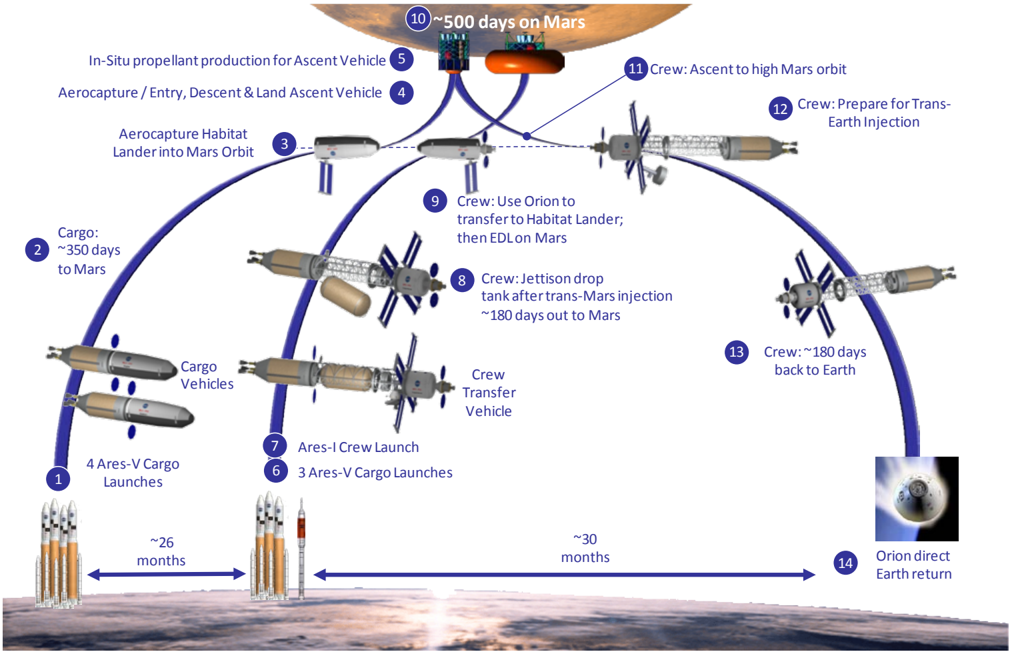
- Each mission would use conjunction class long-stay trajectories with forward-deployed cargo sent one opportunity earlier; an example 2037 crew mission would have 174 days outbound transit, 201 days inbound, 539 days Mars stay, and 914 days total mission duration, while the supporting cargo vehicle would take 202 days.
- The architecture requires at least seven heavy-lift cargo launches with launches at least 30 days apart, no on-orbit assembly of major elements, and total mission mass on the order of 800–1,200 t per mission; it also calls for landing 40 t of useful payload and providing 30–40 kWe continuous surface power.
- Key challenges include human health and performance risks such as radiation, bone mineral loss, muscle atrophy, medical care, and behavioral health; landing large payloads; heavy lift; in-situ resource utilization; advanced propulsion; robust power; and reliability/supportability with essentially no Earth resupply.
Methods
- This paper is a summary of the 2007 Mars Design Reference Architecture 5.0 (published as NASA-SP-2009-566 in 2009), providing a common framework rather than a formal plan for human Mars exploration.
- Mission analysis considered Earth departure dates from 2030 to 2046 to assess variability across the synodic cycle, and generated crewed and one-way cargo trajectories; the 2037 opportunity is used as an example.
- Technical assessments focused primarily on launch vehicle, interplanetary transportation, and entry, descent, and landing systems; Orion, the Mars descent/ascent vehicle, and the interplanetary transit habitat were assessed in less detail, and surface systems were mostly top-level performance estimates and trades.
Limitations
- The paper states that the strategy and example implementation concepts “should not be viewed as constituting a formal plan for the human exploration of Mars,” and that no date has been chosen for the first potential human mission; the 2030–2046 dates were chosen to assess mission opportunity variability, not as proposed actual mission dates.
- The paper states that detailed designs for surface systems were not developed, but rather top-level performance estimates and trades were conducted, and more in-depth definition should be conducted in future efforts, including commonality with lunar surface systems.
- Evident from the text: many system concepts depend on lunar-derived, Orion-derived, or Ares V/Constellation-era assumptions, and science specifics are still to be determined, with a 1000 kg allocation and 250 kg sample return capability and future trades regarding range, duration in field, and depth of exploration pending.
Model-written summary. Check it against the paper before relying on it.
Integrity signals
Registry
Cites
Statistics
Figures



Verification
Claims the paper makes
0 Valid · 4 Not valid · 1 Not checked · 49 Own results and interpretations
A result the paper reports from its own data — it cites no other source for it, so there is none to check. The quote shows it is in the paper.
In the paper
“An example crew mission in the 2037 opportunity would result in transit times of 174 days outbound and 201 days inbound.”
hedgedstates a cause- Asserted: passes — The authors put it forward as true.
- Checkable: passes — It can be checked against evidence.
- Load-bearing: unclear — It is unclear whether the paper’s conclusions depend on it.
- Based: passes — The paper gives a reason why it holds.
- Rests on an assumption not shown here.
A result the paper states — it cites no source for it, so there is none to check. The quote shows it is in the paper.
In the paper
“Each of the three missions would use conjunction class (long-stay) trajectories combined with a 'forward deploy' cargo strategy.”
hedgedstates a cause- Asserted: passes — The authors put it forward as true.
- Checkable: passes — It can be checked against evidence.
- Load-bearing: passes — The paper’s conclusions depend on it.
- Based: passes — The paper gives a reason why it holds.
A result the paper states — it cites no source for it, so there is none to check. The quote shows it is in the paper.
In the paper
“NASA has identified several approaches that would overcome this challenge that involve a combination of basic research in hypersonic aerodynamics, materials science, and propulsion technology to deliver these larger payloads.”
hedgedstates a cause- Asserted: passes — The authors put it forward as true.
- Checkable: passes — It can be checked against evidence.
- Load-bearing: unclear — It is unclear whether the paper’s conclusions depend on it.
- Based: passes — The paper gives a reason why it holds.
A result the paper reports from its own data — it cites no other source for it, so there is none to check. The quote shows it is in the paper.
In the paper
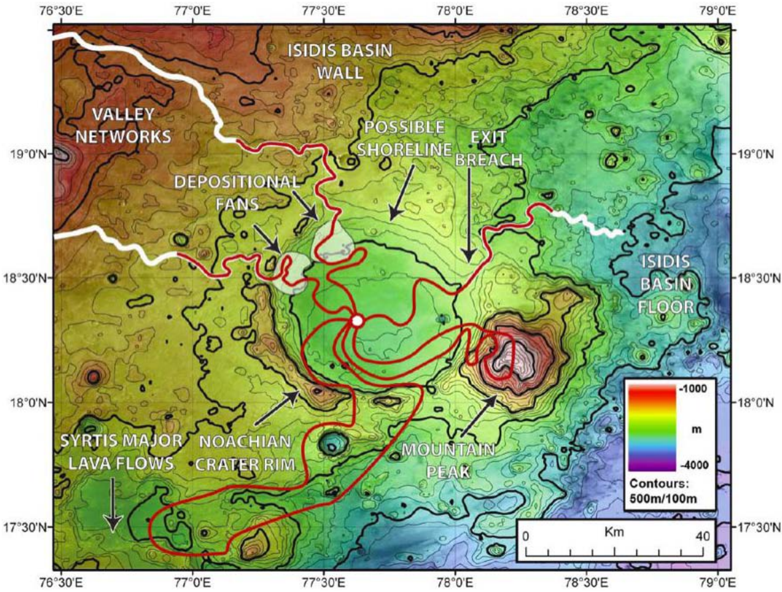
“The scale at the lower right of figure 2 indicates that these features of interest are beyond what is currently considered a reasonable walking range for the crew (determined by the distance a crew member could walk during one charge of power and breathing gases in his/her Portable Life Support System roughly 20 km total).”
hedged- Asserted: passes — The authors put it forward as true.
- Checkable: passes — It can be checked against evidence.
- Load-bearing: unclear — It is unclear whether the paper’s conclusions depend on it.
- Based: passes — The paper gives a reason why it holds.
A result the paper states — it cites no source for it, so there is none to check. The quote shows it is in the paper.
In the paper
“Mass increases in this subsystem are a prime contributor to the overall increase in the initial mass estimates given in this DRA as compared to previous approaches.”
plainstates a cause- Asserted: passes — The authors put it forward as true.
- Checkable: passes — It can be checked against evidence.
- Load-bearing: passes — The paper’s conclusions depend on it.
- Based: passes — The paper gives a reason why it holds.
- Rests on 3 assumptions not shown here.
21 more claims
Create a free account to see all 54 claims and every source verdict.
- Probably not a substantial claim. 20
- It may state two separate claims as one. 13
Claims other papers make about this one
Each is checked against this paper’s own text: does it say what the citing paper says it does?
The cited source says what the claim attributes to it.
In the citing paper
“Artemis I measurements can be extrapolated to exemplary Mars missions36 for a similar point in the solar cycle, as the GCR field is approximately constant outside the Earth’s magnetosphere on this scale.”
From Space radiation measurements during the Artemis I lunar mission (2024) · cites this paper as [36]
In the citing paper
“The DST concept documented in this paper was built upon these previous analyses, and designed to combine the best of low thrust and high thrust propulsion systems for round-trip delivery of a crew of four from the Earth to Mars.”
Self-check
Percentages, sums and reported differences re-computed from the paper’s own numbers.
Each contradiction between two passages listed here was confirmed by an independent check.
Rated minor: it would not touch a result — a value no result rests on, a p-value that stays on the same side of the significance level, or a conflict that is clerical, resolved elsewhere in the paper, or outside its own findings.
In the paper
§ Interplanetary Trajectory and Mission Analysis · p. 4
“An example crew mission in the 2037 opportunity would result in transit times of 174 days outbound and 201 days inbound.”
§ Getting Ready, Getting to Mars, and Getting Back · p. 5
“The length of this outbound transfer to Mars would be dependent on the mission date and would range from 175 to 225 days.”
Rated minor: it would not touch a result — a value no result rests on, a p-value that stays on the same side of the significance level, or a conflict that is clerical, resolved elsewhere in the paper, or outside its own findings.
In the paper
§ Getting Ready, Getting to Mars, and Getting Back · p. 5
“The length of this outbound transfer to Mars would be dependent on the mission date and would range from 175 to 225 days.”
§ 5. KEY CHALLENGES · p. 10
“| One-way Trip Time | 4 days | 180-210 days |”
Citations
Cites
Cratering Records in the Inner Solar System in Relation to the Lunar Reference System
Neukum, G., Ivanov, B. A., & Hartmann, W. K. (2001) · Space Science Reviews · doi:10.1023/a:1011989004263 · Cited by 661
Ages and Geologic Histories of Martian Meteorites
Nyquist, L. E., Bogard, D. D., Shih, C.-Y., Greshake, A., Stöffler, D., & Eugster, O. (2001) · Space Sciences Series of ISSI · doi:10.1007/978-94-017-1035-0_5 · Cited by 576
Cratering Records in the Inner Solar System in Relation to the Lunar Reference System
Neukum, G., Ivanov, B. A., & Hartmann, W. K. (2001) · Space Sciences Series of ISSI · doi:10.1007/978-94-017-1035-0_3 · Cited by 568
Photochemistry of Planetary Atmospheres
Yung, Y. L., & DeMore, W. B. (1999) · Oxford University Press eBooks · doi:10.1093/oso/9780195105018.001.0001 · Cited by 430
Ages and Geologic Histories of Martian Meteorites
Nyquist, L. E., Bogard, D. D., Shih, C.-Y., Greshake, A., Stöffler, D., & Eugster, O. (2001) · Space Science Reviews · doi:10.1023/a:1011993105172 · Cited by 417
Human Exploration of Mars: The Reference Mission of the NASA Mars Exploration Study Team
Hoffman, S. J., & Kaplan, D. I. (1997) · NASA Technical Reports Server (NASA) · Cited by 251
Self-citationGault, D. E. (1970) · Radio Science · doi:10.1029/rs005i002p00273 · Cited by 245
Crater size-frequency distributions and a revised Martian relative chronology
Barlow, N. G. (1988) · Icarus · doi:10.1016/0019-1035(88)90006-1 · Cited by 168
Drake, B. G. (1998) · NASA Technical Reports Server (NASA) · Cited by 111
Self-citationPaleocratering of the Moon: Review of post-Apollo data
HARTMANN, W. K. (1972) · Astrophysics and Space Science · doi:10.1007/bf00642541 · Cited by 104
Research works printed but not linked: 10
- grant, 2006, MEPAG (2006), Mars Scientific Goals, Objectives, Investigations, and Priorities: 2006, white paper posted, 31
- garvin, 2008, MEPAG HEM-SAG (2008). Planning for the Scientific Exploration of Mars by Humans, unpublished white paper
- strom, 1992, The Martian imact cratering record, Mars, 384
- 0, National Research Council (2006) Assessment of NASA's Mars Architecture 2007-2016, Committee to Review the Next Decade Mars Architecture Space Studies Board Division on Engineering and Physical Sciences
- 1989, Exploration Studies Technical Report, FY1989 Annual Report, NASA Technical memorandum 4170 Office of Exploration National Aeronautics and Space Administration
- 1991, America at the Threshold, Report of the Synthesis Group on America's Space Exploration Initiative, Superintendent of Documents
- 1988, Beyond Earth's Boundaries: Human Exploration of the Solar System in the 21st Century, 1988 Annual Report to the Administrator, National Aeronautics and Space Administration
- drake, 2009, Human Exploration of Mars Design Reference Architecture 5.0, NASA-SP-2009-566
- 2008, Planning for the Scientific Exploration of Mars by Humans, unpublished white paper
- 2007, An Astrobiology Strategy for the Exploration of Mars
Cited by
Mars' surface radiation environment measured with the Mars Science Laboratory's Curiosity rover
Hassler, D. M., Zeitlin, C., Wimmer-Schweingruber, R. F., Ehresmann, B., Rafkin, S., Eigenbrode, J. L., Brinza, D. E., Weigle, G., Böttcher, S., Böhm, E., et al. (2014) · Science · doi:10.1126/science.1244797 · Cited by 727
“These mission phase durations are based on one possible NASA design reference mission (38); many mission designs and many mission windows at different times in the solar cycle or a different solar cycle would result in somewhat different radiation exposures.”
Measurements of energetic particle radiation in transit to Mars on the Mars Science Laboratory
Zeitlin, C., Hassler, D. M., Cucinotta, F. A., Ehresmann, B., Wimmer-Schweingruber, R. F., Brinza, D. E., Kang, S., Weigle, G., Böttcher, S., Böhm, E., et al. (2013) · Science · doi:10.1126/science.1235989 · Cited by 641
“NASA’s “Design Reference” Mars mission (36) posits various cruise durations, with a typical figure of about 180 days.”
BackgroundHow Safe Is Safe Enough? Radiation Risk for a Human Mission to Mars
Cucinotta, F. A., Kim, M.-H. Y., Chappell, L. J., & Huff, J. L. (2013) · PLoS ONE · doi:10.1371/journal.pone.0074988 · Cited by 250
The Radiation Assessment Detector (RAD) Investigation
Hassler, D. M., Zeitlin, C., Wimmer-Schweingruber, R. F., Böttcher, S., Martin, C., Andrews, J., Böhm, E., Brinza, D. E., Bullock, M. A., Burmeister, S., et al. (2012) · Space Science Reviews · doi:10.1007/s11214-012-9913-1 · Cited by 247
Space radiation protection: Destination Mars
Durante, M. (2014) · Life Sciences in Space Research · doi:10.1016/j.lssr.2014.01.002 · Cited by 202
“NASA’s “Design Reference” Mars mission (Drake et al., 2010) analyzes different scenarios, with a typical figure of about 180 days for the cruise duration (each way) and 30 (Mars sortie) to 500 (Mars base) days on the planet.”
Fu, Y., Li, L., Xie, B., Dong, C., Wang, M., Jia, B., Shao, L., Dong, Y., Deng, S., Liu, H., et al. (2016) · Astrobiology · doi:10.1089/ast.2016.1477 · Cited by 164
“C urrent strategies to further explore space, such as NASA’s Design Reference Architecture or China’s lunar exploration program (Zheng et al. , 2008; Drake et al. , 2010), strongly suggest the development of bioregenerative life support systems (BLSS) that can be fully incorporated into space…”
Towards synthetic biological approaches to resource utilization on space missions
Menezes, A. A., Cumbers, J., Hogan, J. A., & Arkin, A. P. (2015) · Journal of The Royal Society Interface · doi:10.1098/rsif.2014.0715 · Cited by 147
“5 days of travel each way and a 180 day stay at a previously established lunar outpost [39,40]; and (4) a six-person, 916 day return voyage to Mars, comprising 210 days of travel each way and a 496 day stay on a Martian surface habitat (the conjunction class long-stay mission in [41]).”
Mars Oxygen ISRU Experiment (MOXIE)
Hecht, M., Hoffman, J., Rapp, D., McClean, J., SooHoo, J., Schaefer, R., Aboobaker, A., Mellstrom, J., Hartvigsen, J., Meyen, F., et al. (2021) · Space Science Reviews · doi:10.1007/s11214-020-00782-8 · Cited by 142
“Numerous mission plans have been developed in the period beginning ~1950 (e.g. Portree 2001; Drake 2009; Rapp 2015), as well as a series of NASA Design Reference Missions (now Design Reference Architectures) that began in the 1990s (Drake 2009).”
BackgroundUtilizing in-situ resources and 3D printing structures for a manned Mars mission
Kading, B. M., & Straub, J. (2014) · Acta Astronautica · doi:10.1016/j.actaastro.2014.11.036 · Cited by 146
Options for staging orbits in cislunar space
Whitley, R. J., & Martinez, R. M. (2016) · Proceedings - IEEE Aerospace Conference · doi:10.1109/aero.2016.7500635 · Cited by 121
Development of Polymer Composites in Radiation Shielding Applications: A Review
Zeng, C., Kang, Q., Duan, Z., Qin, B., Feng, X., Lu, H., & Lin, Y. (2023) · Journal of Inorganic and Organometallic Polymers and Materials · doi:10.1007/s10904-023-02725-6 · Cited by 133
Review and prospect of guidance and control for Mars atmospheric entry
Li, S., & Jiang, X. (2014) · Progress in Aerospace Sciences · doi:10.1016/j.paerosci.2014.04.001 · Cited by 111
“[107] Drake BG, Hoffman SJ, Beaty DW.”
BackgroundInfluentialMars Oxygen ISRU Experiment (MOXIE)—Preparing for human Mars exploration
Hoffman, J. A., Hecht, M. H., Rapp, D., Hartvigsen, J., Whittier, J. S., Aboobaker, A. M., McClean, J. B., Liu, A. M., Hinterman, E. D., Nasr, M., et al. (2022) · Science Advances · doi:10.1126/sciadv.abp8636 · Cited by 129
Behavioral effects of space radiation: A comprehensive review of animal studies
Kiffer, F. C., Boerma, M., & Allen, A. R. (2019) · Life Sciences in Space Research · doi:10.1016/j.lssr.2019.02.004 · Cited by 112
Microbial applications for sustainable space exploration beyond low Earth orbit
Koehle, A. P., Brumwell, S. L., Seto, E. P., Lynch, A. M., & Urbaniak, C. (2023) · npj Microgravity · doi:10.1038/s41526-023-00285-0 · Cited by 117
Dynamic modeling and optimization for space logistics using time-expanded networks
Ho, K., Weck, O. L. D., Hoffman, J. A., et al. (2014) · Acta Astronautica · doi:10.1016/j.actaastro.2014.10.026 · Cited by 85
Sondelski, B., & Nellis, G. (2019) · Applied Thermal Engineering · doi:10.1016/j.applthermaleng.2019.114299 · Cited by 81
Space Radiation Protection Countermeasures in Microgravity and Planetary Exploration
Montesinos, C. A., Khalid, R., Cristea, O., Greenberger, J. S., Epperly, M. W., Lemon, J. A., Boreham, D. R., Popov, D., Gorthi, G., Ramkumar, N., et al. (2021) · Life · doi:10.3390/life11080829 · Cited by 99
“Whereas SPEs occur sporadically and unpredictably, GCRs are uniformly present, having originated from distant supernova events [4].”
BackgroundInfluentialTowards a Biomanufactory on Mars
Berliner, A. J., Hilzinger, J. M., Abel, A. J., McNulty, M. J., Makrygiorgos, G., Averesch, N. J. H., Gupta, S. S., Benvenuti, A., Caddell, D. F., Cestellos-Blanco, S., et al. (2021) · Frontiers in Astronomy and Space Sciences · doi:10.3389/fspas.2021.711550 · Cited by 92
Review of commercial nuclear fusion projects
Meschini, S., Laviano, F., Ledda, F., Pettinari, D., Testoni, R., Torsello, D., & Panella, B. (2023) · Frontiers in Energy Research · doi:10.3389/fenrg.2023.1157394 · Cited by 93
“Despite being less investigated than nuclear fission propulsion, nuclear fusion propulsion has been studied since the 50s within the Project Orion (Dyson, 2002), and more recently by the NASA Innovative Advanced Concept program (Slough et al., 2012; Slough, 2018).”
BackgroundNuclear Thermal Propulsion (NTP): A proven growth technology for human NEO/Mars exploration missions
Borowski, S. K., McCurdy, D. R., & Packard, T. (2012) · Proceedings - IEEE Aerospace Conference · doi:10.1109/aero.2012.6187301 · Cited by 73
Measurements of the neutron spectrum on the Martian surface with MSL/RAD
Köhler, J., Zeitlin, C., Ehresmann, B., Wimmer‐Schweingruber, R. F., Hassler, D. M., Reitz, G., Brinza, D. E., Weigle, G., Appel, J., Böttcher, S., et al. (2014) · Journal of Geophysical Research: Planets · doi:10.1002/2013je004539 · Cited by 71
“594 mission scenario [Drake, 2009], astronauts would spend about 500 days on the Martian surface; this would be the longest phase of the mission, and although the surface dose and dose equivalent rates are only about half of what they are in interplanetary space, the exposure from the surface stay…”
BackgroundLee, S., Mudawar, I., & Hasan, M. M. (2016) · Applied Thermal Engineering · doi:10.1016/j.applthermaleng.2016.01.018 · Cited by 69
“, Lunar/ Martian outpost lander and Lunar/Martian habitat) [4,8].”
BackgroundMethodIntegrated in-situ resource utilization system design and logistics for Mars exploration
Chen, H., du Jonchay, T. S., Hou, L., & Ho, K. (2020) · Acta Astronautica · doi:10.1016/j.actaastro.2020.01.031 · Cited by 73
High Mass Mars Entry, Descent, and Landing Architecture Assessment
Steinfeldt, B., Theisinger, J. E., Korzun, A. M., et al. (2009) · AIAA SPACE Conference & Exposition · doi:10.2514/6.2009-6684 · Cited by 69
Castro, M. D., Ferré, M., & Masi, A. (2018) · IEEE Access · doi:10.1109/access.2018.2849572 · Cited by 73
“exploration vehicles [31]–[35], in mining fields [36], [37], military fields [38], [39], such as landmine eradication or bomb detonation [40], [41], as well as in nuclear and radioactive fields [42], [43].”
BackgroundMicrobial biomanufacturing for space-exploration—what to take and when to make
Averesch, N. J. H., Berliner, A. J., Nangle, S. N., Zezulka, S., Vengerova, G., Ho, D., Casale, C. A., Lehner, B., Snyder, J., Clark, K. B., et al. (2023) · Nature Communications · doi:10.1038/s41467-023-37910-1 · Cited by 75
Towards sustainable horizons: A comprehensive blueprint for Mars colonization
Neukart, F. (2024) · Heliyon · doi:10.1016/j.heliyon.2024.e26180 · Cited by 70
“• Possible infertility and hereditary effects.”
BackgroundMethodInfluentialA new planetary structure fabrication process using phosphoric acid
Buchner, C., Pawelke, R. H., Schlauf, T., Reissner, A., & Makaya, A. (2017) · Acta Astronautica · doi:10.1016/j.actaastro.2017.11.045 · Cited by 64
Kruyer, N. S., Realff, M. J., Sun, W., Genzale, C. L., & Peralta‐Yahya, P. (2021) · Nature Communications · doi:10.1038/s41467-021-26393-7 · Cited by 61
Beaton, K. H., Chappell, S. P., Abercromby, A. F. J., et al. (2019) · Astrobiology · doi:10.1089/ast.2018.1861 · Cited by 53
“After the Constellation Program cancellation and a new direction to explore more distant destinations (Drake, 2009a; Craig et al., 2015), the 2011 DRATS field test (Abercromby et al., 2013a) and a multi-week Research And Technology Studies (RATS) test conducted at JSC in 2012 (Abercromby et al.,…”
BackgroundMethodFeeding One Million People on Mars
Cannon, K. M., & Britt, D. T. (2019) · New Space · doi:10.1089/space.2019.0018 · Cited by 53
Producing oxygen and fertilizer with the Martian atmosphere by using microwave plasma
Kelly, S., Verheyen, C., Cowley, A., & Bogaerts, A. (2022) · Chem · doi:10.1016/j.chempr.2022.07.015 · Cited by 51
Singleterry, R. C. (2013) · Acta Astronautica · doi:10.1016/j.actaastro.2013.04.013 · Cited by 52
Principles for a practical Moon base
Sherwood, B. (2019) · Acta Astronautica · doi:10.1016/j.actaastro.2019.04.018 · Cited by 50
Hao, Z., Li, L., Fu, Y., & Liu, H. (2018) · Environmental Microbiology · doi:10.1111/1462-2920.14358 · Cited by 49
Campaign-level dynamic network modelling for spaceflight logistics for the flexible path concept
Ho, K., Weck, O. L. D., Hoffman, J. A., & Shishko, R. (2016) · Acta Astronautica · doi:10.1016/j.actaastro.2016.03.006 · Cited by 49
Design and Optimization of a Solar Power Conversion System for Space Applications
D’Antonio, M., Shi, C. L., Wu, B., & Khaligh, A. (2019) · IEEE Transactions on Industry Applications · doi:10.1109/tia.2019.2891228 · Cited by 51
Measurements of the neutron spectrum in transit to Mars on the Mars Science Laboratory
Köhler, J., Ehresmann, B., Zeitlin, C. J., Wimmer-Schweingruber, R. F., Hassler, D. M., Reitz, G., Brinza, D. E., Appel, J. K., Böttcher, S. I., Böhm, E., et al. (2015) · Life Sciences in Space Research · doi:10.1016/j.lssr.2015.03.001 · Cited by 56
Development of Supersonic Retropropulsion for Future Mars Entry, Descent, and Landing Systems
Edquist, K. T., Korzun, A. M., Dyakonov, A., et al. (2014) · Journal of Spacecraft and Rockets · doi:10.2514/1.a32715 · Cited by 46
Overview of current capabilities and research and technology developments for planetary protection
Frick, A., Mogul, R., Stabekis, P., Conley, C. A., & Ehrenfreund, P. (2014) · Advances in Space Research · doi:10.1016/j.asr.2014.02.016 · Cited by 46
“0 calls for landing within a Zone of Minimum Biological Risk (ZBR) (Drake, 2009).”
BackgroundSpace radiation measurements during the Artemis I lunar mission
George, S. P., Gaza, R., Matthiä, D., Laramore, D., Lehti, J., Campbell-Ricketts, T., Kroupa, M., Stoffle, N., Marsalek, K., Przybyla, B., et al. (2024) · Nature · doi:10.1038/s41586-024-07927-7 · Cited by 47
“…do not approach this limit owing to their similar duration to Artemis I. Artemis I measurements can be extrapolated to exemplary Mars missions 36 for a similar point in the solar cycle, as the GCR field is approximately constant outside the Cumulative absorbed dose ( D in mGy) split by…”
The value of Phobos sample return
Murchie, S. L., Britt, D. T., & Pieters, C. M. (2014) · Planetary and Space Science · doi:10.1016/j.pss.2014.04.014 · Cited by 51
“…(McSween et al., 2009)þ impactor High Al/Si, Ca/Si, lower Fe/Si, Mg/Si indicative of evolved igneous materials Evolved, basaltic mineralogy consistent with many datasets for Mars detailed analysis of organics, especially at low abundances, would require returned samples in terrestrial laboratories.”
BackgroundBlood, sweat, and tears: extraterrestrial regolith biocomposites with in vivo binders
Roberts, A. D., Whittall, D. R., Breitling, R., Takano, E., Blaker, J. J., Hay, S., & Scrutton, N. S. (2021) · Materials Today Bio · doi:10.1016/j.mtbio.2021.100136 · Cited by 59
Hindlimb suspension and spe-like radiation impairs clearance of bacterial infections
Li, M., Holmes, V., Zhou, Y., Ni, H., Sanzari, J. K., Kennedy, A. R., & Weissman, D. (2014) · PLoS ONE · doi:10.1371/journal.pone.0085665 · Cited by 43
Long-Term Changes in Cognition and Physiology after Low-Dose 16O Irradiation
Howe, A. K., Kiffer, F. C., Alexander, T. C., Sridharan, V., Wang, J., Ntagwabira, F., Rodriguez, A., Boerma, M., & Allen, A. R. (2019) · International Journal of Molecular Sciences · doi:10.3390/ijms20010188 · Cited by 47
Martian biolith: A bioinspired regolith composite for closed-loop extraterrestrial manufacturing
Ng, S., Dritsas, S., & Fernandez, J. G. (2020) · PLoS ONE · doi:10.1371/journal.pone.0238606 · Cited by 45
The MARS2013 Mars Analog Mission
Groemer, G. E., Groemer, G., Soucek, A., et al. (2014) · Astrobiology · doi:10.1089/ast.2013.1062 · Cited by 41
“This scenario was based on the NASA Design Reference Architecture 5.0 (Drake, 2009), which proposes at least one pressurized rover that could sustain astronauts for a few days when operating in larger distances (up to several hundred kilometers) off the original base camp and allows flexible range…”
InfluentialAn ISRU propellant production system for a fully fueled Mars Ascent Vehicle
Kleinhenz, J., & Paz, A. (2017) · AIAA Symposium on Space Resource Utilization · doi:10.2514/6.2017-0423 · Cited by 50
Lau, K.-T., Wong, T.-T., Leng, J., et al. (2013) · Composites Part B Engineering · doi:10.1016/j.compositesb.2013.03.044 · Cited by 39
A Minimal Architecture for Human Journeys to Mars
Price, H., Baker, J., & Naderi, F. M. (2015) · New Space · doi:10.1089/space.2015.0018 · Cited by 38
“The payload would be two in-space chemical stages to be prepositioned for use later in the campaign: (1) A Phobos transfer stage (PTS) to get a crewed Orion from high mars orbit (HMO) to Phobos and later back to HMO, and (2) A trans-earth injection (TEI) stage for returning crew to Earth at the conclusion of Mars oper…”
Overview of the NASA Entry, Descent and Landing Systems Analysis Stud
Zang, T. A., Cianciolo, A. D., Kinney, D. J., et al. (2010) · AIAA SPACE Conference & Exposition · doi:10.2514/6.2010-8649 · Cited by 38
Human factors research as part of a Mars exploration analogue mission on Devon Island
Binsted, K. A., Kobrick, R. L., Gríofa, M. Ó., Bishop, S. L., & Lapierre, J. (2010) · Planetary and Space Science · doi:10.1016/j.pss.2010.03.001 · Cited by 47
Space Logistics Modeling and Simulation Analysis using SpaceNet: Four Application Cases
Grogan, P. T., Yue, H., & Weck, O. L. D. (2011) · AIAA SPACE Conference & Exposition · doi:10.2514/6.2011-7346 · Cited by 37
Ehresmann, B., Hassler, D. M., Zeitlin, C. J., Guo, J., Köhler, J., Wimmer-Schweingruber, R. F., Appel, J. K., Brinza, D. E., Rafkin, S., Böttcher, S. I., et al. (2016) · Life Sciences in Space Research · doi:10.1016/j.lssr.2016.07.001 · Cited by 39
Early effects of 16O radiation on neuronal morphology and cognition in a murine model
Carr, H., Alexander, T. C., Groves, T. R., Kiffer, F. C., Wang, J., Price, E. T., Boerma, M., & Allen, A. R. (2018) · Life Sciences in Space Research · doi:10.1016/j.lssr.2018.03.001 · Cited by 39
Safety-driven early concept analysis and development
Fleming, C. H. (2015) · DSpace@MIT (Massachusetts Institute of Technology) · Cited by 58
Space bioprocess engineering on the horizon
Berliner, A. J., Lipsky, I., Ho, D., Hilzinger, J. M., Vengerova, G., Makrygiorgos, G., McNulty, M. J., Yates, K., Averesch, N. J. H., Cockell, C. S., et al. (2022) · Communications Engineering · doi:10.1038/s44172-022-00012-9 · Cited by 38
“The space-specific constraints on performance include: (1) an exceptionally strong weighting on a low mass/volume/power footprint for the integrated bioprocess; (2) limited logistic supply of materials and a narrow band of specifically chosen feedstocks; (3) added emphasis on simplicity of set-up, operation and autono…”
BackgroundPerformance Characterization of Supersonic Retropropulsion for High-Mass Mars Entry Systems
Korzun, A. M., & Braun, R. D. (2010) · Journal of Spacecraft and Rockets · doi:10.2514/1.49803 · Cited by 35
Toward the utilisation of resources in space: knowledge gaps, open questions, and priorities
Cilliers, J. J., Hadler, K., & Rasera, J. N. (2023) · npj Microgravity · doi:10.1038/s41526-023-00274-3 · Cited by 46
Kiffer, F. C., Alexander, T. C., Anderson, J. E., Groves, T. R., Wang, J., Sridharan, V., Boerma, M., & Allen, A. R. (2019) · Radiation Research · doi:10.1667/rr15092.1 · Cited by 36
“05) and a significant main effect of time on habituation learning (F(1,11) 1⁄4 26.”
Mars Entry Bank Profile Design for Terminal State Optimization
Lafleur, J., & Cerimele, C. J. (2011) · Journal of Spacecraft and Rockets · doi:10.2514/1.51944 · Cited by 34
Darr, S. R., Camarotti, C., Hartwig, J. W., et al. (2017) · Physics of Fluids · doi:10.1063/1.4973671 · Cited by 33
Development of Supersonic Retro-Propulsion for Future Mars Entry, Descent, and Landing Systems
Edquist, K. T., Korzun, A. M., Studak, J. W., et al. (2010) · AIAA/ASME Joint Thermophysics and Heat Transfer Conference · doi:10.2514/6.2010-5046 · Cited by 33
Hurlbert, E. A., Ueno, H., Alexander, L., Klem, M. D., D'Aversa, E., Rualt, J.-M., Manfletti, C., Caruana, J.-N., Asakawa, H., & Whitley, R. J. (2016) · AIAA SPACE 2016 · doi:10.2514/6.2016-5280 · Cited by 40
“28 NASA has been focused on the development of technologies at the system and component level for LOx/Methane cryogenic propellant management, primarily through technology projects such as the Propulsion and Cryogenic Advanced Development (PCAD) and Cryogenic Fluid Management (CFM) since the mid…”
Space Transportation System and Mission Planning for Regular Interplanetary Missions
Chen, H., Lee, H. W., & Ho, K. (2018) · Journal of Spacecraft and Rockets · doi:10.2514/1.a34168 · Cited by 32
Selection of Anabaena sp. PCC 7938 as a Cyanobacterium Model for Biological ISRU on Mars
Ramalho, T. P., Chopin, G., Pérez-Carrascal, O. M., Tromas, N., & Verseux, C. (2022) · Applied and Environmental Microbiology · doi:10.1128/aem.00594-22 · Cited by 34
Technology development for human exploration of Mars
Moore, C. L. (2010) · Acta Astronautica · doi:10.1016/j.actaastro.2010.06.031 · Cited by 32
A synergetic use of hydrogen and fuel cells in human spaceflight power systems
Belz, S. (2015) · Acta Astronautica · doi:10.1016/j.actaastro.2015.05.031 · Cited by 36
Krecicki, M., & Kotlyar, D. (2020) · Nuclear Engineering and Design · doi:10.1016/j.nucengdes.2020.110605 · Cited by 31
Furukawa, S., Chatani, M., Higashitani, A., Higashibata, A., Kawano, F., Nikawa, T., Numaga‐Tomita, T., Ogura, T., Sato, F., Sehara‐Fujisawa, A., et al. (2021) · npj Microgravity · doi:10.1038/s41526-021-00145-9 · Cited by 36
Earth-Mars transfers through Moon Distant Retrograde Orbits
Conte, D., Carlo, M. D., Ho, K., et al. (2017) · Acta Astronautica · doi:10.1016/j.actaastro.2017.12.007 · Cited by 30
Mission and System Advantages of Iodine Hall Thrusters
Dankanich, J., Szabo, J., Pote, B., Oleson, S. R., & Kamhawi, H. (2014) · AIAA/ASME/SAE/ASEE Joint Propulsion Conference and Exhibit · doi:10.2514/6.2014-3905 · Cited by 34
Modeling Space System Architectures with Graph Theory
Arney, D. C., & Wilhite, A. (2014) · Journal of Spacecraft and Rockets · doi:10.2514/1.a32578 · Cited by 30
Developing Intra-EVA Science Support Team Practices for a Human Mission to Mars
Payler, S. J., Mirmalek, Z., Hughes, S. S., et al. (2019) · Astrobiology · doi:10.1089/ast.2018.1846 · Cited by 29
“As a consequence of its success, several analog programs looking toward NASA’s plans for a human mission to Mars (Drake et al., 2010; Craig et al., 2015) have attempted to integrate ground-based intra-EVA science support teams into their mission architectures.”
BackgroundAn Overview of Technology Investments in the NASA Entry Systems Modeling Project
Wright, M., Hughes, M. F., Barnhardt, M., et al. (2015) · AIAA Aerospace Sciences Meeting · doi:10.2514/6.2015-1892 · Cited by 29
From ice to space: a greenhouse design for Moon or Mars based on a prototype deployed in Antarctica
Maiwald, V., Vrakking, V., Zabel, P., Schubert, D., Waclavicek, R., Dörn, M., Fiore, L., Imhof, B., Rousek, T., Rossetti, V., et al. (2020) · CEAS Space Journal · doi:10.1007/s12567-020-00318-4 · Cited by 37
Keller, R. J., Goli, K., Porter, W., Alrabaa, A., & Jones, J. A. (2023) · Life · doi:10.3390/life13030816 · Cited by 34
“A liquid oxygen/methane combination is deemed the most attractive with the reference acknowledging missions being feasible with only an O2 generation requirement [1].”
BackgroundMethodInfluentialAn Integrated Hybrid Transportation Architecture for Human Mars Expeditions
Merrill, R. G., Chai, P. R., Jones, C. A., et al. (2015) · AIAA SPACE Conference and Exposition · doi:10.2514/6.2015-4442 · Cited by 27
Mars Colony in situ resource utilization: An integrated architecture and economics model
Shishko, R., Fradet, R., Do, S., Saydam, S., Cortez, C. A. T., Dempster, A. G., & Coulton, J. (2017) · Acta Astronautica · doi:10.1016/j.actaastro.2017.05.024 · Cited by 33
Premathilake, D., Outlaw, R. A., Quinlan, R. A., & Byvik, C. E. (2019) · Earth and Space Science · doi:10.1029/2018ea000521 · Cited by 27
“MOXIE utilizes metal oxide electrodes for the solid oxide electrolysis (Drake, 2009; Hartvigsen et al., 2015; Hartvigsen et al., 2016; Hecht & Hoffman, 2016).”
MethodA Generalized Multi-Commodity Network Flow Model for Space Exploration Logistics
Ishimatsu, T., Weck, O. L. D., Hoffman, J. A., et al. (2013) · AIAA SPACE Conference and Exposition · doi:10.2514/6.2013-5414 · Cited by 27
A Comprehensive Ongoing Survey of the Near-Earth Asteroid Population for Human Mission Accessibility
Barbee, B. W., Esposito, T., Piñon, E., et al. (2010) · AIAA/AAS Astrodynamics Specialist Conference · doi:10.2514/6.2010-8368 · Cited by 26
Life-long brain compensatory responses to galactic cosmic radiation exposure
Miry, O., Zhang, X., Vose, L. R., Gopaul, K. R., Subah, G., Moncaster, J. A., Wojnarowicz, M. W., Fisher, A. M., Tagge, C. A., Goldstein, L. E., et al. (2021) · Scientific Reports · doi:10.1038/s41598-021-83447-y · Cited by 31
Borowski, S. K., McCurdy, D., & Packard, T. (2013) · AIAA SPACE 2013 Conference and Exposition · doi:10.2514/6.2013-5354 · Cited by 28
Waste Management Options for Long-Duration Space Missions: When to Reject, Reuse, or Recycle
Linne, D., Palaszewski, B. A., Gökoğlu, S. A., et al. (2014) · doi:10.2514/6.2014-0497 · Cited by 25
Addressing the envisioned world problem: a case study in human spaceflight operations
Miller, M. J., & Feigh, K. M. (2019) · Design Science · doi:10.1017/dsj.2019.2 · Cited by 30
Mars Hybrid Propulsion System Trajectory Analysis, Part I: Crew Missions
Chai, P. R., Merrill, R. G., & Qu, M. (2015) · AIAA SPACE Conference and Exposition · doi:10.2514/6.2015-4443 · Cited by 25
Uncertainty quantification of planetary entry technologies
Brune, A. J., West, T. K., & Hosder, S. (2019) · Progress in Aerospace Sciences · doi:10.1016/j.paerosci.2019.100574 · Cited by 24
Human Mars landing site and impacts on Mars surface operations
Bussey, B. J., & Hoffman, S. J. (2016) · Proceedings - IEEE Aerospace Conference · doi:10.1109/aero.2016.7500775 · Cited by 24
Self-citationSiriweera, A., & Naruse, K. (2021) · IEEE Access · doi:10.1109/access.2021.3064192 · Cited by 29
Technology Portfolio Planning by Weighted Graph Analysis of System Architectures
Davison, P., Cameron, B. G., & Crawley, E. F. (2014) · Systems Engineering · doi:10.1002/sys.21287 · Cited by 24
Venneri, P. F., & Kim, Y. (2015) · Progress in Nuclear Energy · doi:10.1016/j.pnucene.2015.05.003 · Cited by 23
First Mars Habitat Architecture
Cohen, M. M. (2015) · AIAA SPACE Conference & Exposition · doi:10.2514/6.2015-4517 · Cited by 33
“0 (Drake, 2009), the International Space University (2009), and Cohen, Fox, and Thangavelu (2010).”
BackgroundLow-enriched cermet-based fuel options for a nuclear thermal propulsion engine
Gates, J. T., Denig, A. C., Ahmed, R., Mehta, V., & Kotlyar, D. (2018) · Nuclear Engineering and Design · doi:10.1016/j.nucengdes.2018.02.036 · Cited by 25
Keller, R. J., Porter, W., Goli, K., Rosenthal, R., Butler, N., & Jones, J. A. (2021) · Life · doi:10.3390/life11080844 · Cited by 23
“Another proposed system is fission surface power system (FSPS) (Figure 9) [3].”
BackgroundMethodInfluentialRapp, D., & Inglezakis, V. J. (2024) · Applied Sciences · doi:10.3390/app14020653 · Cited by 27
An Independent Assessment of the Technical Feasibility of the Mars One Mission Plan
Do, S., Ho, K., Schreiner, S. S., Owens, A., & Weck, O. L. D. (2014) · doi:10.13140/2.1.1716.9922 · Cited by 22
Checking computation data on radiative and convectional heating of next generation spacecraft
Суржиков, С. Т., & Shuvalov, M. P. (2013) · High Temperature · doi:10.1134/s0018151x13030061 · Cited by 22
Viscio, M. A., Gargioli, E., Hoffman, J. A., et al. (2013) · Acta Astronautica · doi:10.1016/j.actaastro.2013.06.015 · Cited by 22
Metadata
- Authors
- Drake, B. G., Hoffman, S. J., & Beaty, D. W.
- Affiliations
- Johnson Space Center (US)
- Leidos (United States) (US)
- Jet Propulsion Laboratory (US)
- Venue
- 2010 IEEE Aerospace Conference
- Publisher
- IEEE
- Published
- 2010-03
- Pages
- 1-24
- ISSN
- 1095-323X (ISSN-L)
- OpenAlex
- W2101215876
- Cited by
- 595
- References
- 19
- Citations by year
- 2026: 13 · 2025: 22 · 2024: 41 · 2023: 37 · 2022: 30 · 2021: 36 · 2020: 36 · 2019: 33 · 2018: 28 · 2017: 28 · 2016: 43 · 2015: 55 · 2014: 62 · 2013: 42 · 2012: 21
- FWCI
- 186.22
- Type
- conference paper
- Language
- en
- Open access
- green
- hdl.handle.net
- Locations
- IEEE Aerospace Conference (AERO) (publishedVersion)
- NASA STI Repository (National Aeronautics and Space Administration) (submittedVersion)
- Topics
- Physical Sciences › Earth and Planetary Sciences › Space and Planetary Science › Planetary Science and Exploration
- Physical Sciences › Engineering › Aerospace Engineering › Space Exploration and Technology
- Physical Sciences › Engineering › Aerospace Engineering › Spacecraft Design and Technology
- Keywords
- human Mars exploration, Constellation Program, lunar exploration, technological progress
About these checks
Registry, retraction, Cites and statistics results are computed, not judged, with one exception: a printed reference that no index lists is read once by a model before it counts as a citation error. Claims are extracted by a model and kept only when their quote appears verbatim in the text; each cited source is then checked, with a model’s help, for whether it says what the claim relies on. Those verdicts can be wrong — read the claim’s quote and the cited source before relying on one.
A language model drew the claims from the paper on 2026-10-06, under version 3 of the claim definition (model deepseek-v4.1-flash, prompt extract-v3).
A second model labelled each claim on 2026-10-06 (model jev-1.13-20260917, definition revision gold-guideline-v0.2).
Statistics and arithmetic are recomputed, not judged.
Confidence bands are shown only for fields calibrated on our annotated test set. None is calibrated yet, so no band is shown.
What counts as a claim ›How we measure confidence ›How we check this ›
Are you an author, or do you see a problem with this page? Request a review
Data sources
Bibliographic data: Semantic Scholar, OpenAlex, Crossref.
Contains information from the Semantic Scholar Academic Graph Datasets, made available under the ODC Attribution License (ODC-BY 1.0).
Semantic Scholar’s data is described in: Kinney, R., et al. (2023). The Semantic Scholar Open Data Platform. arXiv:2301.10140.
