

Human exploration of Mars, Design Reference Architecture 5.0
Open accessThe DOI matches its Crossref record; 15 of the 19 references it cites were found in a registry or an index; none of the 1 sources its claims cite is checked for support yet.
Abstract
This paper provides a summary of the 2007 Mars Design Reference Architecture 5.0 (DRA 5.0), which is the latest in a series of NASA Mars reference missions. It provides a vision of one potential approach to human Mars exploration, including how Constellation systems could be used. The strategy and example implementation concepts that are described here should not be viewed as constituting a formal plan for the human exploration of Mars, but rather provide a common framework for future planning of systems concepts, technology development, and operational testing as well as potential Mars robotic missions, research that is conducted on the International Space Station, and future potential lunar exploration missions. This summary of the Mars DRA 5.0 provides an overview of the overall mission approach, surface strategy and exploration goals, as well as the key systems and challenges for the first three concepts for human missions to Mars.
Overview
CoChat Summary
TL;DR
This paper summarizes NASA’s Mars Design Reference Architecture 5.0, a reference mission concept for human Mars exploration using three crewed missions of six crewmembers each to different sites. It outlines the mission approach, surface strategy, key systems, and major challenges for the first human missions to Mars.
Key findings
- DRA 5.0 envisions six crewmembers on each of three consecutive Mars opportunities, with each mission visiting a different unique location; this approach was endorsed by the Human Exploration of Mars Science Advisory Group sponsored by MEPAG (2008).
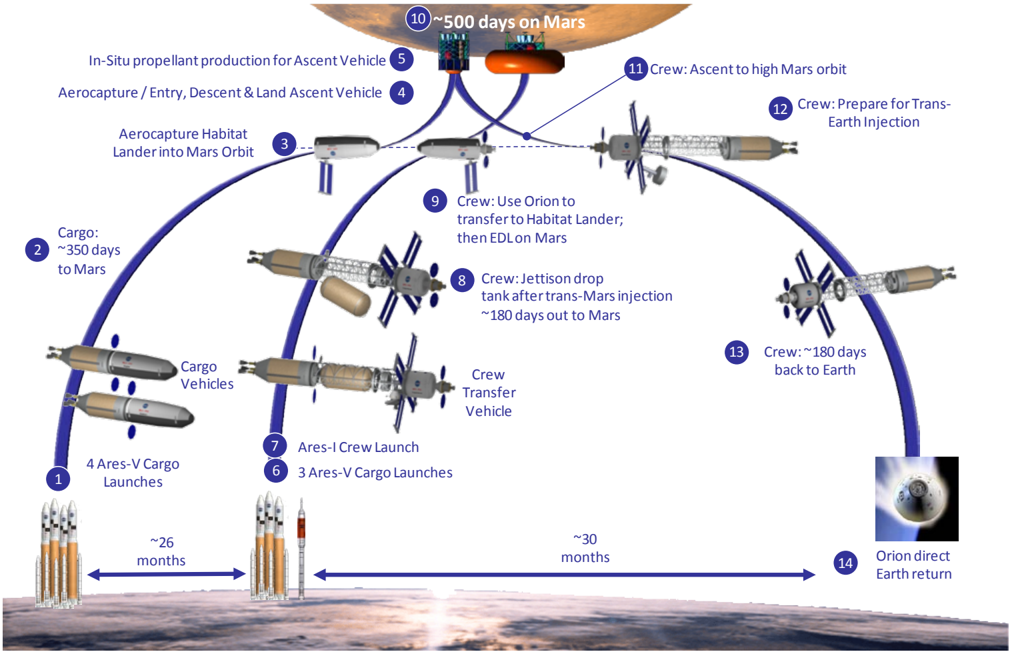
- Each mission would use conjunction class long-stay trajectories with forward-deployed cargo sent one opportunity earlier; an example 2037 crew mission would have 174 days outbound transit, 201 days inbound, 539 days Mars stay, and 914 days total mission duration, while the supporting cargo vehicle would take 202 days.
- The architecture requires at least seven heavy-lift cargo launches with launches at least 30 days apart, no on-orbit assembly of major elements, and total mission mass on the order of 800–1,200 t per mission; it also calls for landing 40 t of useful payload and providing 30–40 kWe continuous surface power.
- Key challenges include human health and performance risks such as radiation, bone mineral loss, muscle atrophy, medical care, and behavioral health; landing large payloads; heavy lift; in-situ resource utilization; advanced propulsion; robust power; and reliability/supportability with essentially no Earth resupply.
Methods
- This paper is a summary of the 2007 Mars Design Reference Architecture 5.0 (published as NASA-SP-2009-566 in 2009), providing a common framework rather than a formal plan for human Mars exploration.
- Mission analysis considered Earth departure dates from 2030 to 2046 to assess variability across the synodic cycle, and generated crewed and one-way cargo trajectories; the 2037 opportunity is used as an example.
- Technical assessments focused primarily on launch vehicle, interplanetary transportation, and entry, descent, and landing systems; Orion, the Mars descent/ascent vehicle, and the interplanetary transit habitat were assessed in less detail, and surface systems were mostly top-level performance estimates and trades.
Limitations
- The paper states that the strategy and example implementation concepts “should not be viewed as constituting a formal plan for the human exploration of Mars,” and that no date has been chosen for the first potential human mission; the 2030–2046 dates were chosen to assess mission opportunity variability, not as proposed actual mission dates.
- The paper states that detailed designs for surface systems were not developed, but rather top-level performance estimates and trades were conducted, and more in-depth definition should be conducted in future efforts, including commonality with lunar surface systems.
- Evident from the text: many system concepts depend on lunar-derived, Orion-derived, or Ares V/Constellation-era assumptions, and science specifics are still to be determined, with a 1000 kg allocation and 250 kg sample return capability and future trades regarding range, duration in field, and depth of exploration pending.
Model-written summary. Check it against the paper before relying on it.
Integrity signals
Registry
Cites
Statistics
Figures


Verification
Claims the paper makes
0 Valid · 4 Not valid · 1 Not checked · 49 Own results and interpretations
A result the paper reports from its own data — it cites no other source for it, so there is none to check. The quote shows it is in the paper.
In the paper
“An example crew mission in the 2037 opportunity would result in transit times of 174 days outbound and 201 days inbound.”
hedgedstates a cause- Asserted: passes — The authors put it forward as true.
- Checkable: passes — It can be checked against evidence.
- Load-bearing: unclear — It is unclear whether the paper’s conclusions depend on it.
- Based: passes — The paper gives a reason why it holds.
- Rests on an assumption not shown here.
A result the paper states — it cites no source for it, so there is none to check. The quote shows it is in the paper.
In the paper
“Each of the three missions would use conjunction class (long-stay) trajectories combined with a 'forward deploy' cargo strategy.”
hedgedstates a cause- Asserted: passes — The authors put it forward as true.
- Checkable: passes — It can be checked against evidence.
- Load-bearing: passes — The paper’s conclusions depend on it.
- Based: passes — The paper gives a reason why it holds.
A result the paper states — it cites no source for it, so there is none to check. The quote shows it is in the paper.
In the paper
“NASA has identified several approaches that would overcome this challenge that involve a combination of basic research in hypersonic aerodynamics, materials science, and propulsion technology to deliver these larger payloads.”
hedgedstates a cause- Asserted: passes — The authors put it forward as true.
- Checkable: passes — It can be checked against evidence.
- Load-bearing: unclear — It is unclear whether the paper’s conclusions depend on it.
- Based: passes — The paper gives a reason why it holds.
A result the paper reports from its own data — it cites no other source for it, so there is none to check. The quote shows it is in the paper.
In the paper
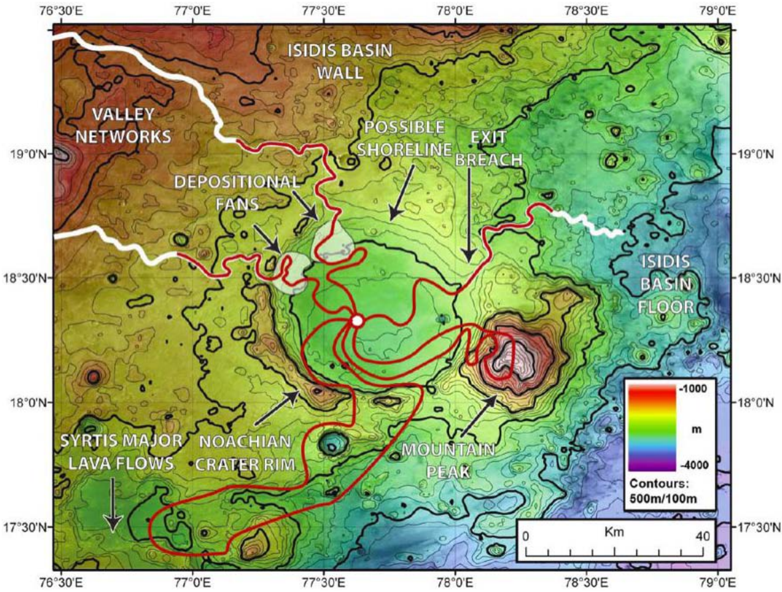
“The scale at the lower right of figure 2 indicates that these features of interest are beyond what is currently considered a reasonable walking range for the crew (determined by the distance a crew member could walk during one charge of power and breathing gases in his/her Portable Life Support System roughly 20 km total).”
hedged- Asserted: passes — The authors put it forward as true.
- Checkable: passes — It can be checked against evidence.
- Load-bearing: unclear — It is unclear whether the paper’s conclusions depend on it.
- Based: passes — The paper gives a reason why it holds.
A result the paper states — it cites no source for it, so there is none to check. The quote shows it is in the paper.
In the paper
“Mass increases in this subsystem are a prime contributor to the overall increase in the initial mass estimates given in this DRA as compared to previous approaches.”
plainstates a cause- Asserted: passes — The authors put it forward as true.
- Checkable: passes — It can be checked against evidence.
- Load-bearing: passes — The paper’s conclusions depend on it.
- Based: passes — The paper gives a reason why it holds.
- Rests on 3 assumptions not shown here.
21 more claims
Create a free account to see all 54 claims and every source verdict.
- Probably not a substantial claim. 20
- It may state two separate claims as one. 13
Claims other papers make about this one
Each is checked against this paper’s own text: does it say what the citing paper says it does?
The cited source says what the claim attributes to it.
In the citing paper
“Artemis I measurements can be extrapolated to exemplary Mars missions36 for a similar point in the solar cycle, as the GCR field is approximately constant outside the Earth’s magnetosphere on this scale.”
From Space radiation measurements during the Artemis I lunar mission (2024) · cites this paper as [36]
In the citing paper
“The DST concept documented in this paper was built upon these previous analyses, and designed to combine the best of low thrust and high thrust propulsion systems for round-trip delivery of a crew of four from the Earth to Mars.”
Self-check
Percentages, sums and reported differences re-computed from the paper’s own numbers.
Each contradiction between two passages listed here was confirmed by an independent check.
Rated minor: it would not touch a result — a value no result rests on, a p-value that stays on the same side of the significance level, or a conflict that is clerical, resolved elsewhere in the paper, or outside its own findings.
In the paper
§ Interplanetary Trajectory and Mission Analysis · p. 4
“An example crew mission in the 2037 opportunity would result in transit times of 174 days outbound and 201 days inbound.”
§ Getting Ready, Getting to Mars, and Getting Back · p. 5
“The length of this outbound transfer to Mars would be dependent on the mission date and would range from 175 to 225 days.”
Rated minor: it would not touch a result — a value no result rests on, a p-value that stays on the same side of the significance level, or a conflict that is clerical, resolved elsewhere in the paper, or outside its own findings.
In the paper
§ Getting Ready, Getting to Mars, and Getting Back · p. 5
“The length of this outbound transfer to Mars would be dependent on the mission date and would range from 175 to 225 days.”
§ 5. KEY CHALLENGES · p. 10
“| One-way Trip Time | 4 days | 180-210 days |”
Citations
Cites
Cratering Records in the Inner Solar System in Relation to the Lunar Reference System
Neukum, G., Ivanov, B. A., & Hartmann, W. K. (2001) · Space Science Reviews · doi:10.1023/a:1011989004263 · Cited by 661
Ages and Geologic Histories of Martian Meteorites
Nyquist, L. E., Bogard, D. D., Shih, C.-Y., Greshake, A., Stöffler, D., & Eugster, O. (2001) · Space Sciences Series of ISSI · doi:10.1007/978-94-017-1035-0_5 · Cited by 576
Cratering Records in the Inner Solar System in Relation to the Lunar Reference System
Neukum, G., Ivanov, B. A., & Hartmann, W. K. (2001) · Space Sciences Series of ISSI · doi:10.1007/978-94-017-1035-0_3 · Cited by 568
Photochemistry of Planetary Atmospheres
Yung, Y. L., & DeMore, W. B. (1999) · Oxford University Press eBooks · doi:10.1093/oso/9780195105018.001.0001 · Cited by 430
Ages and Geologic Histories of Martian Meteorites
Nyquist, L. E., Bogard, D. D., Shih, C.-Y., Greshake, A., Stöffler, D., & Eugster, O. (2001) · Space Science Reviews · doi:10.1023/a:1011993105172 · Cited by 417
Human Exploration of Mars: The Reference Mission of the NASA Mars Exploration Study Team
Hoffman, S. J., & Kaplan, D. I. (1997) · NASA Technical Reports Server (NASA) · Cited by 251
Self-citationGault, D. E. (1970) · Radio Science · doi:10.1029/rs005i002p00273 · Cited by 245
Crater size-frequency distributions and a revised Martian relative chronology
Barlow, N. G. (1988) · Icarus · doi:10.1016/0019-1035(88)90006-1 · Cited by 168
Drake, B. G. (1998) · NASA Technical Reports Server (NASA) · Cited by 111
Self-citationPaleocratering of the Moon: Review of post-Apollo data
HARTMANN, W. K. (1972) · Astrophysics and Space Science · doi:10.1007/bf00642541 · Cited by 104
Research works printed but not linked: 10
- grant, 2006, MEPAG (2006), Mars Scientific Goals, Objectives, Investigations, and Priorities: 2006, white paper posted, 31
- garvin, 2008, MEPAG HEM-SAG (2008). Planning for the Scientific Exploration of Mars by Humans, unpublished white paper
- strom, 1992, The Martian imact cratering record, Mars, 384
- 0, National Research Council (2006) Assessment of NASA's Mars Architecture 2007-2016, Committee to Review the Next Decade Mars Architecture Space Studies Board Division on Engineering and Physical Sciences
- 1989, Exploration Studies Technical Report, FY1989 Annual Report, NASA Technical memorandum 4170 Office of Exploration National Aeronautics and Space Administration
- 1991, America at the Threshold, Report of the Synthesis Group on America's Space Exploration Initiative, Superintendent of Documents
- 1988, Beyond Earth's Boundaries: Human Exploration of the Solar System in the 21st Century, 1988 Annual Report to the Administrator, National Aeronautics and Space Administration
- drake, 2009, Human Exploration of Mars Design Reference Architecture 5.0, NASA-SP-2009-566
- 2008, Planning for the Scientific Exploration of Mars by Humans, unpublished white paper
- 2007, An Astrobiology Strategy for the Exploration of Mars
Cited by
Items 501–589 of 589
Architectures for an Integrated Human Space Exploration Program
Guest, A. N., Hofstetter, W. K., Cooper, C., et al. (2009) · AIAA SPACE Conference & Exposition · doi:10.2514/6.2009-6604
Space Exploration Strategies for Constrained Funding
Woodcock, G. (2012) · AIAA SPACE Conference & Exposition · doi:10.2514/6.2012-5230
Cost-efficient Life Support for Crewed Long Term Missions
Belz, S., & Messerschmid, E. (2012) · International Conference on Environmental Systems (ICES) · doi:10.2514/6.2012-3490
Supersonic Propulsive Divert Maneuvers for Future Robotic and Human Mars Missions
Mandalia, A. B., & Braun, R. D. (2014) · AIAA Atmospheric Flight Mechanics Conference · doi:10.2514/6.2014-0386
Medium lift launch vehicles catalog design: Lagrange point L2 mission and habitat design concept
Jain, A. (2014) · AIAA SPACE Conference and Exposition · doi:10.2514/6.2014-4472
Mars Entry, Descent, and Landing: Supersonic Retro Propulsion Experiments
Palaszewski, B. A., & Bencic, T. (2009) · AIAA/ASME/SAE/ASEE Joint Propulsion Conference & Exhibit (JPC) · doi:10.2514/6.2009-5263
Vivek, B., & Ganapathy, R. M. (2013) · AIAA/ASME/SAE/ASEE Joint Propulsion Conference (JPC) · doi:10.2514/6.2013-4011
Auditoriums étendus et espaces raccordés
Joy, J. (2014) · Prospective et stratégie · doi:10.3917/pstrat.004.0029
Payload mass improvements of supersonic retropropulsive flight for human class missions to Mars
Fagin, M. H. (2015) · ProQuest Demo Repository
Rapp, D. (2015) · Springer eBooks · doi:10.1007/978-3-319-22249-3_4
The Ultimate Step for Mars Mission Safety: Designing for Survivability
Heidmann, R. (2015) · Springer eBooks · doi:10.1007/978-3-319-15982-9_59
Ward, E. D., Webb, R. R., & Weck, O. L. D. (2016) · Acta Astronautica · doi:10.1016/j.actaastro.2016.07.022
A Hybrid Solid/Gas Core Nuclear Thermal Rocket Engine for Future Solar System Exploration
Beveridge, L. (2016) · AIAA/SAE/ASEE Joint Propulsion Conference (JPC) · doi:10.2514/6.2016-4778
A Proposed LOX and LCH4 Propellant Depot
Paul, R., & Senna, B. (2016) · AIAA SPACE 2016 · doi:10.2514/6.2016-5249
Marcano-Velázquez, J. G. (2015) · CU Scholar (University of Colorado Boulder)
Space environment and radiations
Genta, G. (2016) · Springer eBooks · doi:10.1007/978-3-319-44311-9_4
Interplanetary journey to Mars
Genta, G. (2016) · Springer eBooks · doi:10.1007/978-3-319-44311-9_6
Genta, G. (2016) · Springer eBooks · doi:10.1007/978-3-319-44311-9_1
Risk-value optimization of performance and cost for propellant production on Mars
Jones, C. A. (2016) · SMARTech Repository (Georgia Institute of Technology)
Chai, P. R. (2014) · SMARTech Repository (Georgia Institute of Technology) · doi:10.13140/rg.2.1.2536.9444
HIGH EARTH ORBIT MISSION TO PREPARE THE FIRST HUMAN MISSION TO MARS
Salotti, J., Desnottes, V., Dechaux, A., et al. (2014) · HAL (Le Centre pour la Communication Scientifique Directe) · doi:10.13140/2.1.4920.3207
Model-based robot control in human-in-the-loop cyber physical systems
Dimitrov, V. D. (2017) · Digital Repository Service (Northeastern University) · doi:10.17760/d20250833
PRAGMATIC APPROACH TO A MANNED MARS EXPLORATION PROGRAM
Salotti, J., & Heidmann, R. (2014) · HAL (Le Centre pour la Communication Scientifique Directe) · doi:10.13140/2.1.2823.1687
Mars Design Reference Architecture Modifications: Payload Trades and Early Return Options
Gangale, T. (2018) · AIAA SPACE and Astronautics Forum and Exposition · doi:10.2514/6.2018-5145
Mars Surface and Transit Habitat Commonality: Design Considerations
Bannova, O. K., & Camba, J. D. (2018) · ASCE International Conference on Engineering, Science, Construction, and Operations in Challenging Environments (Earth and Space) · doi:10.1061/9780784481899.019
Simulation Optimization of the NASA Mars Fuel In-Situ Resource Utilization and Its Infrastructure
Vezina, A., Coutts, L., Cohen, E., & Burns, D. (2018) · SAE technical papers on CD-ROM/SAE technical paper series · doi:10.4271/2018-01-1963
The Moon Base as a Commercial Hub
Utrilla, C. M. E. (2018) · Space and society · doi:10.1007/978-3-030-01000-3_25
In-Situ Resource Utilization: Technical Aspects
Olthoff, C., & Reiss, P. (2019) · Advances in public policy and administration (APPA) book series · doi:10.4018/978-1-5225-7256-5.ch012 · Cited by 1
The Role of Maps During Long-Term Analog Planetary Missions and Future Mars Missions
Łosiak, A., Gołębiowska, I. M., Sejkora, N., et al. (2019) · Lecture notes in geoinformation and cartography · doi:10.1007/978-3-319-62849-3_12
Gruber, S. (2019) · Advances in public policy and administration (APPA) book series · doi:10.4018/978-1-5225-7256-5.ch014
Reference architectures: factors for their sustainability
Volpato, T. (2019) · Digital Library of Theses and Dissertations (Universidade de São Paulo) · doi:10.11606/d.55.2019.tde-07012019-160901
Advancing Towards Human Torpor Capabilities in Support of Future Space Settlements
Bradford, J. E., Schaffer, M. G., & Talk, D. (2020) · Proceedings - IEEE Aerospace Conference · doi:10.1109/aero47225.2020.9172507
“Assuming these advanced technologies, estimates for Mars in-space habitats still range from 25 to 50 t for crew sizes between 4 and 6 [1],[2].”
BackgroundX-ray-based positioning method for mars entry blackout mitigation
Dang, P., Tang, X., Liu, Y., et al. (2020) · Applied Radiation and Isotopes · doi:10.1016/j.apradiso.2020.109518
“Future Mars missions, such as sample return and manned landing, demand the capability of pinpoint landing at a predefined site (Drake et al., 2010; Salotti and Heidmann, 2014).”
BackgroundRochlis, J., & Love, S. G. (2020) · Springer eBooks · doi:10.1007/978-3-319-10152-1_73-2
Multi-Mission Space Exploration Vehicle (MMSEV) Nosecone Design Optimization
Bhattacharya, M., & Jung, F. (2020) · doi:10.5151/sigradi2020-36
“The MMSEV is a conceptual platform derived from the Apollo missions as well as the unmanned rovers on Mars that, in the near future, may be used to house and transport astronauts (Bobskill, et al., 2015; Drake, 2009; NASA, 1971; NASA 1972; NASA 1973).”
Garcia-Gomez, J. M. (2020) · arXiv (Cornell University) · doi:10.48550/arxiv.2010.07029 · Cited by 3
Exploration Leading to Low-Latency Telepresence on Mars from Deimos
Adamo, D. R., Abell, P., Anderson, R. C., et al. (2021) · doi:10.3847/25c2cfeb.82d0d8cd
“2) Mars roundtrips for humans entail 500-day loiters at Mars awaiting an Earth return opportunity [10, p. 5].”
Towards a Common Basis of Comparison Across a Broad Trade Space of Mars Architecture Options
Edwards, S. J., Hetterich, R. J., Trent, D. J., et al. (2021) · Proceedings - IEEE Aerospace Conference · doi:10.1109/aero50100.2021.9438462
“For this first phase, NASA’s design reference architectures [21], Zubrin’s Mars Direct architecture [22], or the European Space Agency’s Aurora program architectures [23] are likely candidates.”
MethodAlford, M. B. (2020) · TigerPrints (Clemson University)
Design optimisation and analysis of very high power transportation system to Mars
Maddock, C. A., Parsonage, B., Ricciardi, L., et al. (2021) · Strathprints: The University of Strathclyde institutional repository (University of Strathclyde)
Evolving Towards a Reference Architecture for Data Fusion
Llinas, J., Bowman, C., & Raz, A. K. (2022) · AIAA SciTech Forum · doi:10.2514/6.2022-0995
Genta, G. (2016) · Springer eBooks · doi:10.1007/978-3-319-44311-9_13
Genta, G. (2016) · Springer eBooks · doi:10.1007/978-3-319-44311-9_7
Zimbelman, J. R., & Crown, D. A. (2020) · Elsevier eBooks · doi:10.1016/b978-0-12-822876-0.00007-2
Blood, Sweat and Tears: Extraterrestrial Regolith Biocomposites with in Vivo BindersPreprint
Roberts, A., Whittall, D. R., Breitling, R., et al. (2021) · ChemRxiv · doi:10.26434/chemrxiv.14769369
Human Mission to Mars: Transfer System Options
Moses, R. W., Singleterry, R. C., Komar, D. R., Arney, D. C., & Bushnell, D. M. (2022) · Springer eBooks · doi:10.1007/978-3-030-05323-9_16-1 · Cited by 2
CHEATA: Ceres Human Exploration And Transport Architecture
Todd, J. E., Gentgen, C., Martell, B. C., Bellisle, R. F., Porter, A., & Hoffman, J. A. (2022) · IEEE Aerospace Conference (AERO) · doi:10.1109/aero53065.2022.9843591
Full Integration: Closing the Gap on Technology Readiness
Fox, M. D., Schulitz, M., Gershfeld, M., et al. (2018) · ACADIA quarterly · doi:10.52842/conf.acadia.2018.098
Rapp, D. (2023) · Springer eBooks · doi:10.1007/978-3-031-20726-6_4
60+ Years of Humans to Mars Mission Planning
Rapp, D. (2023) · Springer eBooks · doi:10.1007/978-3-031-20726-6_3
Dean, H. V., Robertson, B. E., & Mavris, D. N. (2023) · AIAA SciTech Forum · doi:10.2514/6.2023-2364
Novel Tetrahedral Human Phantoms for Space Radiation Dose AssessmentPreprint
Chancellor, J. C., Chesal, M., Blue, R. S., & Auñón-Chancellor, S. M. (2023) · Research Square · doi:10.21203/rs.3.rs-2675129/v1
Bruno, C., Ingenito, A., & Simone, D. (2023) · Aerospace · doi:10.3390/aerospace10070610
Adaptive Structures with Intrinsic Control: Exploratory Habitation-Vehicles for Space Environment
Manuello, A., Manuello, A., & Marano, G. C. (2023) · Lecture notes in civil engineering · doi:10.1007/978-3-031-44328-2_26
Extraterrestrial Launch Campaigns: Refueling and Launching a Vehicle from the Moon and Mars
Taliaferro, M. E., Darr, S. R., & Shpuntova, G. (2024) · AIAA SciTech Forum · doi:10.2514/6.2024-1148
Systems Engineering of A Mars Habitat using SMAD
Sabale, A., & Adams, J. (2024) · AIAA SciTech Forum · doi:10.2514/6.2024-1668
Mars Habitat Design Thru Parametric Structures Based on United Arab Emirates Heritage
Berengueres, J. O. L., Bande, L., Alsheraifi, A., et al. (2024) · Lecture notes in civil engineering · doi:10.1007/978-981-99-6368-3_50
Spry, J. A., Siegel, B., Kminek, G., et al. (2024) · Life Sciences in Space Research · doi:10.1016/j.lssr.2024.02.001
Conceptual Design and Analysis of Brayton Cycle in 500 kW Nuclear Electric Propulsion System
Yang, S.-S., & Cho, N. (2024) · Journal of the Korean Society of Propulsion Engineers · doi:10.6108/kspe.2024.28.1.009
Human-Class Mars Entry, Descent, and Landing Trajectory Optimization Using Indirect Methods
Mall, K., Levin, W. C., & DeLaurentis, D. A. (2024) · IEEE Aerospace Conference (AERO) · doi:10.1109/aero58975.2024.10521265
“Novel entry, descent, and landing (EDL) systems have been proposed including Hypersonic Inflatable Aerodynamic Decel-erator (HIAD) [2–4], Adaptable Deployable Entry and Placement Technology (ADEPT) [5], Supersonic Retro-Propulsion 979-8-3503-0462-6/24/ $31 .”
BackgroundOptimal crew size at both departure and arrival
Hein, A. M., Marin, F., & Smith, C. M. (2024) · Elsevier eBooks · doi:10.1016/b978-0-323-91280-8.00010-1 · Cited by 2
Shielding factors for a fission-powered mars exploration rover
Bendoyro, A. C., Thomas, L. D., Cassibry, J. T., et al. (2024) · Nuclear Science and Technology Open Research · doi:10.12688/nuclscitechnolopenres.17438.2
A Mission Architecture for a Human-Robot Collaborative Planetary Exploration Cascade
Jusner, S., Moser, S., Schaffler-Glößl, S., Halatschek, R., Eder, M., & Steinbauer-Wagner, G. (2024) · International Conference on Space Robotics (iSpaRo) · doi:10.1109/isparo60631.2024.10687418 · Cited by 1
“of Software Technology, Graz University of Technology, Graz, Austria { simon.jusner, richard.halatschek, matthias.eder, steinbauer } @ist.tugraz.at , { stefan.moser, schaffler-gloessl } @student.tugraz.at exploration [2].”
Akinosho, A., Armstrong, N., Benefield, Z., Dai, X., Stein, W., & Vidal-Gadea, A. G. (2026) · Scientific Reports · doi:10.1101/2024.10.18.619154
Shielding factors for a fission-powered mars exploration rover
Bendoyro, A. C., Thomas, L. D., Cassibry, J. T., et al. (2024) · Nuclear Science and Technology Open Research · doi:10.12688/nuclscitechnolopenres.17438.3
Moonfiber: Design of a Lunar Lavatube Outpost Using Regolith-Composite Fibers
Netti, V., Mangili, P., Angione, A., Fuscello, I., & Paradiso, I. (2024) · ASCE International Conference on Engineering, Science, Construction, and Operations in Challenging Environments (Earth and Space) · doi:10.1061/9780784485736.071
Shielding factors for a fission-powered mars exploration rover
Bendoyro, A. C., Thomas, L. D., Cassibry, J. T., et al. (2025) · Nuclear Science and Technology Open Research · doi:10.12688/nuclscitechnolopenres.17438.4
Cislunar Architecture Feasibility Study Under Varying Scenarios
Introne, S., Peak, V., Balchanos, M. G., et al. (2025) · AIAA SciTech Forum · doi:10.2514/6.2025-2394
Development of a Hypersonic Entry Test Platform
Johnson, B. J. (2025) · AIAA SciTech Forum · doi:10.2514/6.2025-0925
A Comparative Assessment of Evolvable Martian ISRU Propellant Production for Future Human Missions
Hoffman, S. J., Chappell, M. B., Oleson, S. R., Turnbull, E. R., & Congiardo, J. F. (2025) · AIAA SciTech Forum · doi:10.2514/6.2025-0514
Self-citationSpace Exploration and Space Travel
Ramesh, S. (2025) · Springer eBooks · doi:10.1007/978-3-031-84185-9_5
NUCLEAR PROPULSION TECHNOLOGY FOR SPACE APPLICATION
Nehal, A., & Venkatachalam, D. N. (2025) · International Journal of Research Publication and Reviews · doi:10.55248/gengpi.6.0525.18168
A multi-stage orbital sky hook for exploration in the new space transportation era
Landgraf, M., Kavu, T., & Jöckel, D. M. (2025) · Acta Astronautica · doi:10.1016/j.actaastro.2025.07.018
Nuclear-powered propulsion systems for space exploration
Du, Y., Liu, Z. X., Meng, Z., Yang, W., Liu, Y., Liu, Y., & Macián‐Juan, R. (2026) · Acta Astronautica · doi:10.2139/ssrn.5460542 · Cited by 1
The future of space colonisation: Architectural considerations
Kadhim, S. M., & Ahmed, A. L. (2025) · Open Engineering · doi:10.1515/eng-2024-0067
Research on Cross Domain Delivery of Heavy Carrier Rockets
Zhang, J., Zhong, W., Sun, L., et al. (2025) · Lecture notes in mechanical engineering · doi:10.1007/978-981-95-3007-6_38
Clays as natural resources for human missions on Mars
Pandey, A., & Cuadros, J. (2025) · Developments in clay science · doi:10.1016/b978-0-443-21614-5.00011-0
Microscopic analysis of irradiated UN–Mo–W for space nuclear propulsion
Khan, S. A., Schulthess, J. L., Burns, J., et al. (2025) · Nuclear Engineering and Design · doi:10.1016/j.nucengdes.2025.114546
Conceptualizing in situ energy station for Mars exploration
Yang, Y., Tan, P., Tian, H., et al. (2026) · National Science Review · doi:10.1093/nsr/nwag043
“Due to the vast distance, relying on bringing everything above needed from Earth is enormously expensive [4 ].”
Barbato, V., Pizzarelli, M., & Nasuti, F. (2026) · AIAA SciTech Forum · doi:10.2514/6.2026-0772
Kanjumba, W. C. (2026) · New Space · doi:10.1177/21680256261469319
Oliveira, M., Pereira, P., & de Oliveira, E. S. (2026) · Acta Astronautica · doi:10.1016/j.actaastro.2026.07.050
Martian aqua : occurrence of water and appraisal of acquisition technologies
Inglezakis, V. J. (2026) · Strathprints: The University of Strathclyde institutional repository (University of Strathclyde)
Study of Nuclear Thermal Propulsion for Interplanetary Missions: Case Study of Mars
Bhowmick, N., & Shifat, M. T. A. (2026) · SciEn Conference Series Engineering · doi:10.38032/scse.2026.4.105
Pathways to energy‑efficient in‑space additive manufacturing
Hou, A., Kim, J. G., Dhakal, P., Wu, X., Yang, Y., Kim, J., Lee, K., Qiu, J., & Wang, S. (2026) · MRS Communications · doi:10.1557/s43579-026-01017-7
Lunar industrial ecology as the core of a sustainable industrial capacity on the moon
Ellery, A. A. (2026) · Chemical Engineering Research and Design · doi:10.1016/j.cherd.2026.09.019
Scotty, I Need More Power: The Fission System Gateway to Abundant Power for Exploration
Palac, D. T. (2013) · NASA STI Repository (National Aeronautics and Space Administration)
Metadata
- Authors
- Drake, B. G., Hoffman, S. J., & Beaty, D. W.
- Affiliations
- Johnson Space Center (US)
- Leidos (United States) (US)
- Jet Propulsion Laboratory (US)
- Venue
- 2010 IEEE Aerospace Conference
- Publisher
- IEEE
- Published
- 2010-03
- Pages
- 1-24
- ISSN
- 1095-323X (ISSN-L)
- OpenAlex
- W2101215876
- Cited by
- 595
- References
- 19
- Citations by year
- 2026: 13 · 2025: 22 · 2024: 41 · 2023: 37 · 2022: 30 · 2021: 36 · 2020: 36 · 2019: 33 · 2018: 28 · 2017: 28 · 2016: 43 · 2015: 55 · 2014: 62 · 2013: 42 · 2012: 21
- FWCI
- 186.22
- Type
- conference paper
- Language
- en
- Open access
- green
- hdl.handle.net
- Locations
- IEEE Aerospace Conference (AERO) (publishedVersion)
- NASA STI Repository (National Aeronautics and Space Administration) (submittedVersion)
- Topics
- Physical Sciences › Earth and Planetary Sciences › Space and Planetary Science › Planetary Science and Exploration
- Physical Sciences › Engineering › Aerospace Engineering › Space Exploration and Technology
- Physical Sciences › Engineering › Aerospace Engineering › Spacecraft Design and Technology
- Keywords
- human Mars exploration, Constellation Program, lunar exploration, technological progress
About these checks
Registry, retraction, Cites and statistics results are computed, not judged, with one exception: a printed reference that no index lists is read once by a model before it counts as a citation error. Claims are extracted by a model and kept only when their quote appears verbatim in the text; each cited source is then checked, with a model’s help, for whether it says what the claim relies on. Those verdicts can be wrong — read the claim’s quote and the cited source before relying on one.
A language model drew the claims from the paper on 2026-10-06, under version 3 of the claim definition (model deepseek-v4.1-flash, prompt extract-v3).
A second model labelled each claim on 2026-10-06 (model jev-1.13-20260917, definition revision gold-guideline-v0.2).
Statistics and arithmetic are recomputed, not judged.
Confidence bands are shown only for fields calibrated on our annotated test set. None is calibrated yet, so no band is shown.
What counts as a claim ›How we measure confidence ›How we check this ›
Are you an author, or do you see a problem with this page? Request a review
Data sources
Bibliographic data: Semantic Scholar, OpenAlex, Crossref.
Contains information from the Semantic Scholar Academic Graph Datasets, made available under the ODC Attribution License (ODC-BY 1.0).
Semantic Scholar’s data is described in: Kinney, R., et al. (2023). The Semantic Scholar Open Data Platform. arXiv:2301.10140.
