

Human exploration of Mars, Design Reference Architecture 5.0
Open accessThe DOI matches its Crossref record; 15 of the 19 references it cites were found in a registry or an index; none of the 1 sources its claims cite is checked for support yet.
Abstract
This paper provides a summary of the 2007 Mars Design Reference Architecture 5.0 (DRA 5.0), which is the latest in a series of NASA Mars reference missions. It provides a vision of one potential approach to human Mars exploration, including how Constellation systems could be used. The strategy and example implementation concepts that are described here should not be viewed as constituting a formal plan for the human exploration of Mars, but rather provide a common framework for future planning of systems concepts, technology development, and operational testing as well as potential Mars robotic missions, research that is conducted on the International Space Station, and future potential lunar exploration missions. This summary of the Mars DRA 5.0 provides an overview of the overall mission approach, surface strategy and exploration goals, as well as the key systems and challenges for the first three concepts for human missions to Mars.
Overview
CoChat Summary
TL;DR
This paper summarizes NASA’s Mars Design Reference Architecture 5.0, a reference mission concept for human Mars exploration using three crewed missions of six crewmembers each to different sites. It outlines the mission approach, surface strategy, key systems, and major challenges for the first human missions to Mars.
Key findings
- DRA 5.0 envisions six crewmembers on each of three consecutive Mars opportunities, with each mission visiting a different unique location; this approach was endorsed by the Human Exploration of Mars Science Advisory Group sponsored by MEPAG (2008).
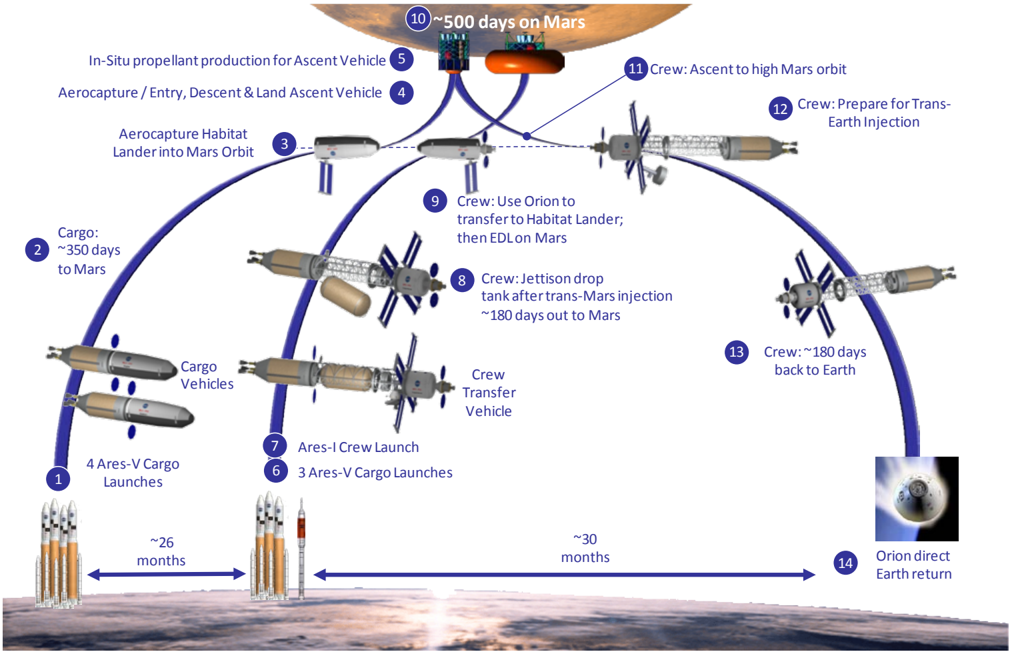
- Each mission would use conjunction class long-stay trajectories with forward-deployed cargo sent one opportunity earlier; an example 2037 crew mission would have 174 days outbound transit, 201 days inbound, 539 days Mars stay, and 914 days total mission duration, while the supporting cargo vehicle would take 202 days.
- The architecture requires at least seven heavy-lift cargo launches with launches at least 30 days apart, no on-orbit assembly of major elements, and total mission mass on the order of 800–1,200 t per mission; it also calls for landing 40 t of useful payload and providing 30–40 kWe continuous surface power.
- Key challenges include human health and performance risks such as radiation, bone mineral loss, muscle atrophy, medical care, and behavioral health; landing large payloads; heavy lift; in-situ resource utilization; advanced propulsion; robust power; and reliability/supportability with essentially no Earth resupply.
Methods
- This paper is a summary of the 2007 Mars Design Reference Architecture 5.0 (published as NASA-SP-2009-566 in 2009), providing a common framework rather than a formal plan for human Mars exploration.
- Mission analysis considered Earth departure dates from 2030 to 2046 to assess variability across the synodic cycle, and generated crewed and one-way cargo trajectories; the 2037 opportunity is used as an example.
- Technical assessments focused primarily on launch vehicle, interplanetary transportation, and entry, descent, and landing systems; Orion, the Mars descent/ascent vehicle, and the interplanetary transit habitat were assessed in less detail, and surface systems were mostly top-level performance estimates and trades.
Limitations
- The paper states that the strategy and example implementation concepts “should not be viewed as constituting a formal plan for the human exploration of Mars,” and that no date has been chosen for the first potential human mission; the 2030–2046 dates were chosen to assess mission opportunity variability, not as proposed actual mission dates.
- The paper states that detailed designs for surface systems were not developed, but rather top-level performance estimates and trades were conducted, and more in-depth definition should be conducted in future efforts, including commonality with lunar surface systems.
- Evident from the text: many system concepts depend on lunar-derived, Orion-derived, or Ares V/Constellation-era assumptions, and science specifics are still to be determined, with a 1000 kg allocation and 250 kg sample return capability and future trades regarding range, duration in field, and depth of exploration pending.
Model-written summary. Check it against the paper before relying on it.
Integrity signals
Registry
Cites
Statistics
Figures


Verification
Claims the paper makes
0 Valid · 4 Not valid · 1 Not checked · 49 Own results and interpretations
A result the paper reports from its own data — it cites no other source for it, so there is none to check. The quote shows it is in the paper.
In the paper
“An example crew mission in the 2037 opportunity would result in transit times of 174 days outbound and 201 days inbound.”
hedgedstates a cause- Asserted: passes — The authors put it forward as true.
- Checkable: passes — It can be checked against evidence.
- Load-bearing: unclear — It is unclear whether the paper’s conclusions depend on it.
- Based: passes — The paper gives a reason why it holds.
- Rests on an assumption not shown here.
A result the paper states — it cites no source for it, so there is none to check. The quote shows it is in the paper.
In the paper
“Each of the three missions would use conjunction class (long-stay) trajectories combined with a 'forward deploy' cargo strategy.”
hedgedstates a cause- Asserted: passes — The authors put it forward as true.
- Checkable: passes — It can be checked against evidence.
- Load-bearing: passes — The paper’s conclusions depend on it.
- Based: passes — The paper gives a reason why it holds.
A result the paper states — it cites no source for it, so there is none to check. The quote shows it is in the paper.
In the paper
“NASA has identified several approaches that would overcome this challenge that involve a combination of basic research in hypersonic aerodynamics, materials science, and propulsion technology to deliver these larger payloads.”
hedgedstates a cause- Asserted: passes — The authors put it forward as true.
- Checkable: passes — It can be checked against evidence.
- Load-bearing: unclear — It is unclear whether the paper’s conclusions depend on it.
- Based: passes — The paper gives a reason why it holds.
A result the paper reports from its own data — it cites no other source for it, so there is none to check. The quote shows it is in the paper.
In the paper
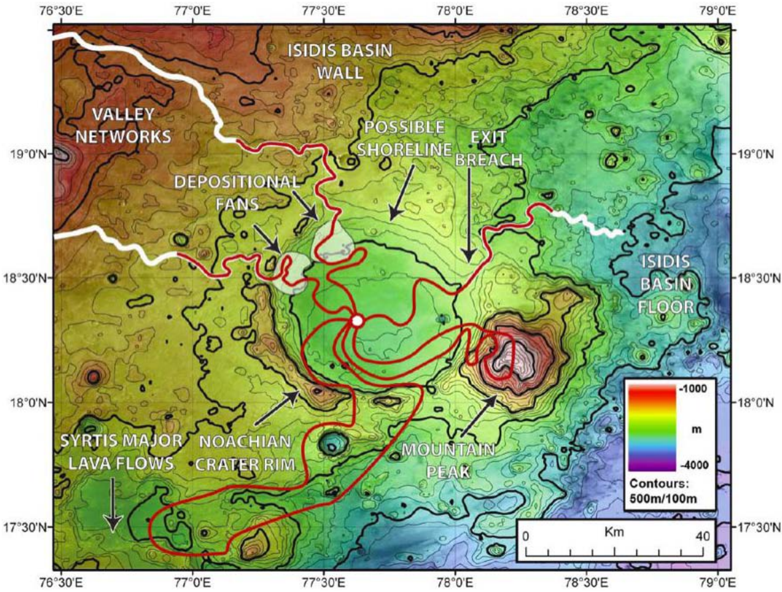
“The scale at the lower right of figure 2 indicates that these features of interest are beyond what is currently considered a reasonable walking range for the crew (determined by the distance a crew member could walk during one charge of power and breathing gases in his/her Portable Life Support System roughly 20 km total).”
hedged- Asserted: passes — The authors put it forward as true.
- Checkable: passes — It can be checked against evidence.
- Load-bearing: unclear — It is unclear whether the paper’s conclusions depend on it.
- Based: passes — The paper gives a reason why it holds.
A result the paper states — it cites no source for it, so there is none to check. The quote shows it is in the paper.
In the paper
“Mass increases in this subsystem are a prime contributor to the overall increase in the initial mass estimates given in this DRA as compared to previous approaches.”
plainstates a cause- Asserted: passes — The authors put it forward as true.
- Checkable: passes — It can be checked against evidence.
- Load-bearing: passes — The paper’s conclusions depend on it.
- Based: passes — The paper gives a reason why it holds.
- Rests on 3 assumptions not shown here.
21 more claims
Create a free account to see all 54 claims and every source verdict.
- Probably not a substantial claim. 20
- It may state two separate claims as one. 13
Claims other papers make about this one
Each is checked against this paper’s own text: does it say what the citing paper says it does?
The cited source says what the claim attributes to it.
In the citing paper
“Artemis I measurements can be extrapolated to exemplary Mars missions36 for a similar point in the solar cycle, as the GCR field is approximately constant outside the Earth’s magnetosphere on this scale.”
From Space radiation measurements during the Artemis I lunar mission (2024) · cites this paper as [36]
In the citing paper
“The DST concept documented in this paper was built upon these previous analyses, and designed to combine the best of low thrust and high thrust propulsion systems for round-trip delivery of a crew of four from the Earth to Mars.”
Self-check
Percentages, sums and reported differences re-computed from the paper’s own numbers.
Each contradiction between two passages listed here was confirmed by an independent check.
Rated minor: it would not touch a result — a value no result rests on, a p-value that stays on the same side of the significance level, or a conflict that is clerical, resolved elsewhere in the paper, or outside its own findings.
In the paper
§ Interplanetary Trajectory and Mission Analysis · p. 4
“An example crew mission in the 2037 opportunity would result in transit times of 174 days outbound and 201 days inbound.”
§ Getting Ready, Getting to Mars, and Getting Back · p. 5
“The length of this outbound transfer to Mars would be dependent on the mission date and would range from 175 to 225 days.”
Rated minor: it would not touch a result — a value no result rests on, a p-value that stays on the same side of the significance level, or a conflict that is clerical, resolved elsewhere in the paper, or outside its own findings.
In the paper
§ Getting Ready, Getting to Mars, and Getting Back · p. 5
“The length of this outbound transfer to Mars would be dependent on the mission date and would range from 175 to 225 days.”
§ 5. KEY CHALLENGES · p. 10
“| One-way Trip Time | 4 days | 180-210 days |”
Citations
Cites
Cratering Records in the Inner Solar System in Relation to the Lunar Reference System
Neukum, G., Ivanov, B. A., & Hartmann, W. K. (2001) · Space Science Reviews · doi:10.1023/a:1011989004263 · Cited by 661
Ages and Geologic Histories of Martian Meteorites
Nyquist, L. E., Bogard, D. D., Shih, C.-Y., Greshake, A., Stöffler, D., & Eugster, O. (2001) · Space Sciences Series of ISSI · doi:10.1007/978-94-017-1035-0_5 · Cited by 576
Cratering Records in the Inner Solar System in Relation to the Lunar Reference System
Neukum, G., Ivanov, B. A., & Hartmann, W. K. (2001) · Space Sciences Series of ISSI · doi:10.1007/978-94-017-1035-0_3 · Cited by 568
Photochemistry of Planetary Atmospheres
Yung, Y. L., & DeMore, W. B. (1999) · Oxford University Press eBooks · doi:10.1093/oso/9780195105018.001.0001 · Cited by 430
Ages and Geologic Histories of Martian Meteorites
Nyquist, L. E., Bogard, D. D., Shih, C.-Y., Greshake, A., Stöffler, D., & Eugster, O. (2001) · Space Science Reviews · doi:10.1023/a:1011993105172 · Cited by 417
Human Exploration of Mars: The Reference Mission of the NASA Mars Exploration Study Team
Hoffman, S. J., & Kaplan, D. I. (1997) · NASA Technical Reports Server (NASA) · Cited by 251
Self-citationGault, D. E. (1970) · Radio Science · doi:10.1029/rs005i002p00273 · Cited by 245
Crater size-frequency distributions and a revised Martian relative chronology
Barlow, N. G. (1988) · Icarus · doi:10.1016/0019-1035(88)90006-1 · Cited by 168
Drake, B. G. (1998) · NASA Technical Reports Server (NASA) · Cited by 111
Self-citationPaleocratering of the Moon: Review of post-Apollo data
HARTMANN, W. K. (1972) · Astrophysics and Space Science · doi:10.1007/bf00642541 · Cited by 104
Research works printed but not linked: 10
- grant, 2006, MEPAG (2006), Mars Scientific Goals, Objectives, Investigations, and Priorities: 2006, white paper posted, 31
- garvin, 2008, MEPAG HEM-SAG (2008). Planning for the Scientific Exploration of Mars by Humans, unpublished white paper
- strom, 1992, The Martian imact cratering record, Mars, 384
- 0, National Research Council (2006) Assessment of NASA's Mars Architecture 2007-2016, Committee to Review the Next Decade Mars Architecture Space Studies Board Division on Engineering and Physical Sciences
- 1989, Exploration Studies Technical Report, FY1989 Annual Report, NASA Technical memorandum 4170 Office of Exploration National Aeronautics and Space Administration
- 1991, America at the Threshold, Report of the Synthesis Group on America's Space Exploration Initiative, Superintendent of Documents
- 1988, Beyond Earth's Boundaries: Human Exploration of the Solar System in the 21st Century, 1988 Annual Report to the Administrator, National Aeronautics and Space Administration
- drake, 2009, Human Exploration of Mars Design Reference Architecture 5.0, NASA-SP-2009-566
- 2008, Planning for the Scientific Exploration of Mars by Humans, unpublished white paper
- 2007, An Astrobiology Strategy for the Exploration of Mars
Cited by
Items 301–400 of 589
Modeling Space Architectures Through Graph Theory
Arney, D. C., & Wilhite, A. (2009) · AIAA SPACE Conference & Exposition · doi:10.2514/6.2009-6598 · Cited by 5
Digital cellular solid pressure vessels: A novel approach for human habitation in space
Cellucci, D., Jenett, B., & Cheung, K. (2017) · Proceedings - IEEE Aerospace Conference · doi:10.1109/aero.2017.7943936 · Cited by 5
Aueron, A. L., Thomas, L. D., & Cassibry, J. T. (2018) · AIAA/ASME/SAE/ASEE Joint Propulsion Conference (JPC) · doi:10.2514/6.2018-4954 · Cited by 5
Statistically architected human spaceflight missions to Mars
Watson, J. A. (2019) · Acta Astronautica · doi:10.1016/j.actaastro.2019.04.024 · Cited by 5
Parametric Trade Study of Mid Lift/Drag Entry Systems for Human Mars Mission
Samareh, J. A. (2020) · AIAA SciTech Forum · doi:10.2514/6.2020-1512 · Cited by 5
Water Electrolysis for Propulsion of a Crewed Mars Mission
Doyle, K., & Peck, M. A. (2020) · Journal of Spacecraft and Rockets · doi:10.2514/1.a34632 · Cited by 7
The AMADEE-20 Robotic Exploration Cascade: An Experience Report
Didari, H., Eder, M., Groemer, G. E., et al. (2022) · Mechanisms and machine science · doi:10.1007/978-3-031-04870-8_56 · Cited by 5
Low-thrust trajectories for human missions to Ceres
Laipert, F. E., & Longuski, J. M. (2013) · Acta Astronautica · doi:10.1016/j.actaastro.2013.11.003 · Cited by 5
Plasma Magnetoshell for Aerobraking and Aerocapture
Slough, J. T., Kirtley, D., Pancotti, A., et al. (2011) · Cited by 5
The Impact of Mission Duration on a Mars Orbital Mission
Arney, D. C., Earle, K. D., Cirillo, W., et al. (2017) · AIAA SPACE and Astronautics Forum and Exposition · doi:10.2514/6.2017-5284 · Cited by 5
“The “Years” mission class is comparable to the missions that have been designed for previous Mars architectures [7,8] where orbital mechanics dictate long stay times and interplanetary Times of Flight (TOF) above 100 days.”
Trajectory Guidance for Mars Robotic Precursors: Aerocapture, Entry, Descent, and Landing
Sostaric, R. R., Zumwalt, C. H., Garcia-Llama, E., et al. (2011) · NASA Technical Reports Server (NASA) · Cited by 5
Nuclear Thermal Propulsion ( NTP )
Borowski, S. K. (2010) · Encyclopedia of Aerospace Engineering · doi:10.1002/9780470686652.eae115 · Cited by 5
Genta, G. (2016) · Springer eBooks · doi:10.1007/978-3-319-44311-9_3 · Cited by 5
3 months transit time to Mars for human missions using SpaceX Starship
Kingdon, J. (2025) · Scientific Reports · doi:10.1038/s41598-025-00565-7 · Cited by 4
Combined Cycle Nuclear System Architecture for Crewed Mars Spacecraft Propulsion and Power
Maydan, J. V., & Nabity, J. A. (2024) · Journal of Propulsion and Power · doi:10.2514/1.b39149 · Cited by 4
Burke, L. M., Borowski, S. K., McCurdy, D. R., & Packard, T. (2013) · 49th AIAA/ASME/SAE/ASEE Joint Propulsion Conference · doi:10.2514/6.2013-4076 · Cited by 4
Martian Aqua: Occurrence of Water and Appraisal of Acquisition Technologies
Inglezakis, V. J. (2025) · Advances in Space Research · doi:10.1016/j.asr.2025.11.002 · Cited by 5
A Systems Engineering Approach to the Conceptual Design of a Martian UAV
D’Urso, S. J., Tsai, K., Chadha, P., et al. (2016) · AIAA Aerospace Sciences Meeting · doi:10.2514/6.2016-0214 · Cited by 4
Fast and Robust Human Missions to Mars with Advanced Nuclear Electric Power and VASIMR ® Propulsion
Chang-Díaz, F., Carter, M. D., Glover, T. W., Ilin, A., Olsen, C. S., Squire, J. P., Litchford, R. J., Harada, N., & Koontz, S. L. (2013) · Cited by 16
Analysis of the Space Robotics Challenge Tasks: From Simulation to Hardware Implementation
Wonsick, M., Dimitrov, V. D., & Padır, T. (2019) · Proceedings - IEEE Aerospace Conference · doi:10.1109/aero.2019.8742144 · Cited by 4
“00 c ©2019 IEEE functionality for the crew when they arrive to complete their scientific objectives [3] [4] [5] [6].”
BackgroundSpare Strategy Analysis for Life Support Systems for Human Space Exploration
Maxwell, A. J., Wilhite, A., & Ho, K. (2021) · Journal of Spacecraft and Rockets · doi:10.2514/1.a34849 · Cited by 4
Potential Futures in Human Habitation of Martian Lava Tubes
Mari, N., Groemer, G. E., & Sejkora, N. (2021) · Springer eBooks · doi:10.1007/978-3-030-84103-4_11 · Cited by 5
Dark Food: Feeding People in Space Without Photosynthesis
Nord, M. E., & Bryson, S. (2022) · New Space · doi:10.1089/space.2021.0048 · Cited by 6
“Compare this against the 20 kWe total power consumption assumed for the crew phase of the NASA Mars Reference Mission 5 (Drake et al., 2010) and one begins to see the problem with photosynthesis as a basis for feeding people in space.”
MethodSong, S., & Nordin, A. D. (2023) · IEEE Open Journal of Engineering in Medicine and Biology · doi:10.1109/ojemb.2023.3238319 · Cited by 4
“NASA (National Aeronautics and Space Administration) has announced the Artemis mission to land humans on the Moon by 2025 [1] and launch humans to Mars by late 2030 or early 2040 [2].”
BackgroundA Qualitative Investigation of Space Exploration Medical Evacuation Risks
Almand, A. T., Ko, S. Y., Anderson, A., Keller, R. J., Zero, M., Anderson, A. P., Laws, J. M., Lehnhardt, K. R., & Easter, B. D. (2023) · Aerospace Medicine and Human Performance · doi:10.3357/amhp.6262.2023 · Cited by 6
Rollock, A. E., & Klaus, D. M. (2024) · Acta Astronautica · doi:10.1016/j.actaastro.2024.11.011 · Cited by 4
Chap, A. M., Scott, J., & Tarditi, A. G. (2013) · AIAA/ASME/SAE/ASEE Joint Propulsion Conference (JPC) · doi:10.2514/6.2013-3912 · Cited by 4
Real-time online health analytics for interplanetary space missions
Eklund, J., & McGregor, C. (2014) · Proceedings - IEEE Aerospace Conference · doi:10.1109/aero.2014.6836458 · Cited by 4
Golkar, A., & Crawley, E. F. (2013) · Acta Astronautica · doi:10.1016/j.actaastro.2013.08.004 · Cited by 4
Palaszewski, B. A. (2013) · AIAA Aerospace Sciences Meeting · doi:10.2514/6.2013-27 · Cited by 4
Low-thrust roundtrip trajectories to Mars with one-synodic-period repeat time
Okutsu, M., Landau, D., Rogers, B. A., et al. (2015) · Acta Astronautica · doi:10.1016/j.actaastro.2015.01.006 · Cited by 4
Space Life Support Risk and Reliability
Jones, H. (2013) · International Conference on Environmental Systems (ICES) · doi:10.2514/6.2013-3315 · Cited by 4
CHALLENGES IN ANAESTHESIA DURING SPACE EXPLORATION MISSIONS
Benson, S., Cable, G. G., & Workman, L. (2020) · journal australiasian society aerospace medicine · doi:10.21307/asam-2019-002 · Cited by 3
Integrated Precision Landing Performance Results for a Human-Scale Mars Landing System
Lugo, R. A., Dwyer-Cianciolo, A. M., Dutta, S., et al. (2022) · AIAA SciTech Forum · doi:10.2514/6.2022-0607 · Cited by 4
Using discrete event simulation to model fluid commodity use by the space launch system
Leonard, D., Parsons, J., & Cates, G. R. (2014) · Winter Simulation Conference · doi:10.1109/wsc.2014.7020135 · Cited by 4
“(Drake 2009) It will be absolutely critical that GSDO be able to maximize the probability of launching each mission as close to schedule as possible.”
BackgroundConcept for 2033 Crewed Mars Orbital Mission with Venus Flyby
Price, H., Shishko, R., Mrozinski, J., et al. (2022) · Journal of Spacecraft and Rockets · doi:10.2514/1.a35437 · Cited by 4
Human Mars Mission Transit Abort Options for Ballistic High Thrust and Hybrid Transportation Systems
Chai, P. R., & Qu, M. (2022) · ASCEND 2022 · doi:10.2514/6.2022-4374 · Cited by 4
Autonomous Surface Site Establishment to Ensure Safe Crew Arrival and Operations
Jones, C. A., Bender, T., Díaz, M. J. C., et al. (2018) · AIAA SPACE and Astronautics Forum and Exposition · doi:10.2514/6.2018-5356 · Cited by 4
“None of the systems at a given site were revisited or reused in subsequent missions, and to minimize the number of launches of the proposed Ares V launch vehicle, only the elements necessary for that single mission would be delivered to the surface [1].”
BackgroundMcGuire, M. K. (2011) · AIAA Aerospace Sciences Meeting · doi:10.2514/6.2011-343 · Cited by 4
Manned sample return mission to phobos: A technology demonstration for human exploration of Mars
Bosanac, N., Diaz, A., Dang, V., Ebersohn, F. H., González, S. G., Qi, J., Sweet, N., Tie, N., Valentino, G., Fraeman, A. A., et al. (2014) · IEEE Aerospace Conference (AERO) · doi:10.1109/aero.2014.6836251 · Cited by 7
Flexible-Path Human Exploration
Sherwood, B., Adler, M., Alkalai, L., et al. (2010) · AIAA SPACE Conference & Exposition · doi:10.2514/6.2010-8607 · Cited by 4
Self-citationRojdev, K., Koontz, S. L., Reddell, B., Atwell, W., & Boeder, P. A. (2015) · AIAA SPACE Conference & Exposition · doi:10.2514/6.2015-4601 · Cited by 5
Federated Simulation and Gaming Framework for a Decentralized Space-Based Resource Economy
Grogan, P. T., & Weck, O. L. D. (2012) · ASCE International Conference on Engineering, Science, Construction, and Operations in Challenging Environments (Earth and Space) · doi:10.1061/9780784412190.156 · Cited by 4
“Even with advantages of partially-closed environmental control systems and some propellant production on the Martian surface, NASA Design Reference Architecture 5.0 (chemical propulsion variant) requires twelve heavy-lift (120 metric ton) launch vehicles (Drake, 2009).”
BackgroundInfluentialExtraterrestrial Regolith Derived Atmospheric Entry Heat Shields
Hogue, M. D., Mueller, R. P., Sibille, L., Hintze, P. E., & Rasky, D. J. (2016) · ASCE International Conference on Engineering, Science, Construction, and Operations in Challenging Environments (Earth and Space) · doi:10.1061/9780784479971.065 · Cited by 5
An Integrated Economics Model for ISRU in Support of a Mars Colony--Initial Status Report
Shishko, R., Fradet, R., Saydam, S., Dempster, A. G., & Coulton, J. J. (2015) · AIAA SPACE Conference & Exposition · doi:10.2514/6.2015-4564 · Cited by 6
Comparison of Earth Departure Strategies for Human Missions to Mars
Landau, D. (2012) · AIAA SPACE Conference & Exposition · doi:10.2514/6.2012-5134 · Cited by 4
HERRO Mars: Design Study for a Highly-Robotic Human Mission to Mars
Oleson, S. R., Landis, G. A., McGuire, M. L., & Schmidt, G. (2011) · AIAA Aerospace Sciences Meeting · doi:10.2514/6.2011-334 · Cited by 4
Dinkelaker, A. N., Hettrich, S., Ghasemzadeh, L., et al. (2014) · SpaceOps Conference (SpaceOps) · doi:10.2514/6.2014-1891 · Cited by 4
An Interdisciplinary Approach to Human-Robotic Cooperation in Mars ExplorationPreprint
Evensberget, D., Brunskill, C., Johnson, C. D., et al. (2012) · SSRN Electronic Journal · doi:10.2139/ssrn.2120254 · Cited by 4
Tradespace exploration for space system architectures : a weighted graph framework
Davison, P. (2014) · DSpace@MIT (Massachusetts Institute of Technology) · Cited by 5
Accessible H2O on Mars – A Critical Review of Current Knowledge
Donald, R., & Inglezakis, V. J. (2025) · IgMin Research · doi:10.61927/igmin322 · Cited by 5
International Space Station: Unique In-Space Testbed as Exploration Analog
Lee, Y., Eagles, D. E., Moreno, F., et al. (2013) · American Institute of Aeronautics and Astronautics eBooks · doi:10.2514/5.9781624102080.0001.0026 · Cited by 3
Biofuel Production Via in Situ Resource Utilization on Mars
Meng, X. (2023) · E3S Web of Conferences · doi:10.1051/e3sconf/202340601042 · Cited by 4
Post-irradiation examination of UN-Mo-W fuels for space nuclear propulsion
Khan, S. A., Schulthess, J. L., Charit, I., et al. (2024) · Journal of Nuclear Materials · doi:10.1016/j.jnucmat.2024.155476 · Cited by 3
Burke, L. A., Borowski, S. K., McCurdy, D. R., et al. (2013) · NASA Technical Reports Server (NASA) · Cited by 3
High Altitude Venus Operations Concept Trajectory Design, Modeling and Simulation
Lugo, R. A., Ozoroski, T. A., Norman, J. W. V., et al. (2015) · AAS/AIAA Space Flight Mechanics Meeting · Cited by 3
Construction of Sustainable Mars Logistics System and Feasibility Assessment
Akiyama, Y., & Inatani, Y. (2013) · TRANSACTIONS OF THE JAPAN SOCIETY FOR AERONAUTICAL AND SPACE SCIENCES · doi:10.2322/tjsass.56.215 · Cited by 3
Systems Level Evaluation of Space and Planetary Habitat Interior Layouts
Simon, M. A., & Wilhite, A. (2010) · AIAA Modeling and Simulation Technologies Conference · doi:10.2514/6.2010-8220 · Cited by 3
Protection of surface assets on Mars from wind blown jettisoned spacecraft components
Paton, M. D. (2017) · Acta Astronautica · doi:10.1016/j.actaastro.2017.03.029 · Cited by 3
Earth-mars transfers through moon distant retrograde orbit
Conte, D., Carlo, M. D., Ho, K., et al. (2016) · Cited by 3
Extraction of Water from Martian Regolith Simulant via Open Reactor Concept
Trunek, A. J., Linne, D., Kleinhenz, J., & Bauman, S. W. (2018) · ASCE International Conference on Engineering, Science, Construction, and Operations in Challenging Environments (Earth and Space) · doi:10.1061/9780784481899.047 · Cited by 3
Power Management and Distribution System for a Mars Surface Fission Power Reactor
Hew, Y. M., Schillo, K. J., Kumar, A., Harris, K., & Howe, S. D. (2018) · Journal of Nuclear Engineering and Radiation Science · doi:10.1115/1.4040370 · Cited by 2
Comfort, Mobility, and Durability Assessment of a Wearable IMU System for EVA Suits
Shen, Y.-Y., Miller, J. T., & Anderson, A. P. (2020) · Proceedings - IEEE Aerospace Conference · doi:10.1109/aero47225.2020.9172657 · Cited by 3
“00 c ©2020 IEEE for future crewed missions to planetary surfaces such as the Moon or Mars, whose architectures require longer and more frequent EVAs [6].”
BackgroundInfluentialRuperto, W. A., Calcagno, B. O., Batiz, K., et al. (2021) · ASCEND 2021 · doi:10.2514/6.2021-4056 · Cited by 3
Rasmont, N., Al-Rashdan, H., Elliott, G., Rovey, J. L., & Villafañe, L. (2023) · AIAA SciTech Forum · doi:10.2514/6.2023-0465 · Cited by 4
Weed, R., Duncan, R. V., Horsley, M. A., & Chapline, G. (2023) · Frontiers in Space Technologies · doi:10.3389/frspt.2023.1197347 · Cited by 4
Theoretical design of a space bioprocessing system to produce recombinant proteins
Soundararajan, M., Paddock, M. B., Dougherty, M., et al. (2023) · npj Microgravity · doi:10.1038/s41526-023-00324-w · Cited by 3
“Our operational scenario was post-growth bioprocessing to produce recombinant carbonic anhydrase from Escherichia coli during a Mars mission.”
InfluentialHuman System Interactions in the Design of an Interplanetary Mission.
Salotti, J., & Claverie, B. (2012) · HAL · Cited by 3
Beaty, D. W., Mueller, R. P., Bussey, D. B. J., Davis, R. M., Hays, L. E., Hoffman, S. J., & Zbinden, E. (2016) · ASCE International Conference on Engineering, Science, Construction, and Operations in Challenging Environments (Earth and Space) · doi:10.1061/9780784479971.042 · Cited by 3
Self-citationAerocapture, Aerobraking, and Entry for Robotic and Human Mars Missions
Lu, Y. (2020) · IntechOpen eBooks · doi:10.5772/intechopen.93281 · Cited by 3
Introduction to Space Life Sciences
Clement, G. R. (2011) · Springer eBooks · doi:10.1007/978-1-4419-9905-4_1 · Cited by 3
Wearable CMG design for the Variable Vector Countermeasure Suit
Vasquez, R. A., Hansberry, M. L., Duda, K. R., Middleton, A. J., & Newman, D. J. (2015) · IEEE Aerospace Conference (AERO) · doi:10.1109/aero.2015.7118973 · Cited by 3
Analysis of shroud options in support of the human exploration of Mars
Feldman, S., Borowski, S. K., Engelund, W. C., et al. (2010) · Proceedings - IEEE Aerospace Conference · doi:10.1109/aero.2010.5446737 · Cited by 3
Wright, M. J., Krasa, P., Hwang, H. H., et al. (2011) · doi:10.1109/aero.2011.5747492 · Cited by 3
International human mission to Mars: Analyzing a conceptual launch and assembly campaign
Cates, G. R., Stromgren, C., Arney, D. C., et al. (2014) · Proceedings - IEEE Aerospace Conference · doi:10.1109/aero.2014.6836402 · Cited by 3
“0) [1] along with a detailed technical addendum [2] that describe an operations concept for the first human missions to Mars.”
BackgroundAn initial comparison of selected Earth departure options for solar electric propulsion missions
Merrill, R. G., Komar, D. R., Qu, M., et al. (2012) · Proceedings - IEEE Aerospace Conference · doi:10.1109/aero.2012.6187266 · Cited by 3
Shidner, J. D., Davis, J., Cianciolo, A. D., et al. (2010) · AIAA/AAS Astrodynamics Specialist Conference · doi:10.2514/6.2010-7973 · Cited by 3
Linne, D., Sanders, G. B., & Taminger, K. M. B. (2015) · AIAA Symposium on Space Resource Utilization · doi:10.2514/6.2015-1650 · Cited by 12
A Modeling Environment for the Optimization of Space Architectures
Arney, D. C., & Wilhite, A. (2010) · AIAA SPACE Conference & Exposition · doi:10.2514/6.2010-8665 · Cited by 3
A Minimum, One-Way, Mars Settlement Program
Mackenzie, B., & Brackley, N. J. (2012) · AIAA SPACE Conference & Exposition · doi:10.2514/6.2012-5284 · Cited by 3
Sources and Uses of Methane in Space
Jones, H. (2013) · International Conference on Environmental Systems (ICES) · doi:10.2514/6.2013-3448 · Cited by 3
A Graph-Theoretic Modeling Framework for Resource-Economy in Space Logistics
Ishimatsu, T., Weck, O. L. D., Hoffman, J. A., et al. (2012) · AIAA SPACE Conference & Exposition · doi:10.2514/6.2012-5125 · Cited by 3
Utilization of Lunar Resources for Human Mars Missions
Jones, C. A., Brown, C., & Wilhite, A. (2011) · AIAA SPACE Conference & Exposition · doi:10.2514/6.2011-7223 · Cited by 3
Arnold, J. O., Sepka, S. A., Agrawal, P., et al. (2010) · AIAA/ASME Joint Thermophysics and Heat Transfer Conference · doi:10.2514/6.2010-5050 · Cited by 3
Design of a Mars Rapid Round Trip Mission
Amadè, N. S., & Wertz, J. R. (2010) · AIAA SPACE Conference & Exposition · doi:10.2514/6.2010-8642 · Cited by 3
Design Reference Missions for Deep-Space Optical Communication
Breidenthal, J. C., & Abraham, D. A. (2016) · Interplanetary Network Progress Report · Cited by 3
The Antarctic Search for Meteorites: A Model for Deep Space Exploration
Love, S. G. (2013) · NASA Technical Reports Server (NASA) · Cited by 3
Conceptual Design of Lunar Underground Habitation System for Advanced Human Civilization on Moon
Malaya Kumar Biswal, M., Das, N. B., & Kumar, R., V (2022) · AIAA SciTech Forum · doi:10.2514/6.2022-2004 · Cited by 3
Comparison of Four Space Propulsion Methods for Reducing Transfer Times of Crewed Mars Missions
Guerra, A. G. C., Orfeu Bertolami, A., & Gil, P. J. S. (2022) · The Journal of the Astronautical Sciences · doi:10.1007/s40295-021-00300-0 · Cited by 5
“Together with a waiting time of about 500 d, the total mission would take around 900d [17].”
BackgroundMethodInfluentialZ-Pinch Pulsed Plasma Propulsion Technology Development
Polsgrove, T., Adams, R. B., Fabisinski, L. L., et al. (2010) · NASA Technical Reports Server (NASA) · Cited by 3
Biomanufacturing for Space-Exploration – What to Take and When to MakePreprint
Averesch, N. J. H., Berliner, A. J., Nangle, S. N., Zezulka, S., Vengerova, G. L., Ho, D., Casale, C. A., Lehner, B., Snyder, J., Clark, K. B., et al. (2022) · Preprints.org · doi:10.20944/preprints202207.0329.v1 · Cited by 3
Potential Applications for Radioisotope Power Systems in Support of Human Exploration Missions
Cataldo, R. L., Schmitz, P. C., & Colozza, A. J. (n.d.) · NASA STI Repository (National Aeronautics and Space Administration) · Cited by 3
Briones, C., Rodríguez-Manfredi, J. A., Keresztúri, Á., & Mangold, N. (2024) · Space and society · doi:10.1007/978-3-031-66881-4_3 · Cited by 5
Dahan, E., Herman, Z., Procaccino, C., Wang, T., Bandyopadhyay, S., Ahern, D. M., & D’Urso, S. J. (2013) · AIAA SPACE Conference & Exposition · doi:10.2514/6.2013-5456 · Cited by 2
Optimal space suit mass for Mars extravehicular activity
Carr, C. E. (2016) · IEEE Aerospace Conference (AERO) · doi:10.1109/aero.2016.7500869 · Cited by 5
“6 The Mars upper bound on self-support mass is very similar to the lunar lower bound , whereas the Mars lower bound declines from 68 kg during slow walking to 47 kg during slow running, reaching 31 kg at higher speeds ( , which corresponds to m/s on Mars).”
BackgroundInfluentialIwig, C., Oglesby, J. M., Shimono, M., Stowers, K. L., Leyva, K., & Salas, E. (2015) · Proceedings of the Human Factors and Ergonomics Society Annual Meeting · doi:10.1177/1541931215591273 · Cited by 3
“Human missions to Mars: New psychological challenges and research issues.”
BackgroundInfluentialScaling the Mars Oxygen ISRU experiment (MOXIE) for mars sample return
Nasr, M., Meyen, F. E., & Hoffman, J. A. (2018) · IEEE Aerospace Conference (AERO) · doi:10.1109/aero.2018.8396365 · Cited by 3
Analysis of Historical International Space Station Logistical Mass Delivery
Leach, H., & Ewert, M. K. (2021) · IEEE Aerospace Conference (AERO) · doi:10.1109/aero50100.2021.9438212 · Cited by 8
“In order to preposition supplies on Mars, we would need to be capable of planning two or more years in advance [1].”
BackgroundEkman, R., Green, D. A., Scott, J. P. R., Lluch, R. H., Weber, T., & Herssens, N. (2022) · Frontiers in Physiology · doi:10.3389/fphys.2022.898430 · Cited by 3
“, oxygen provision and carbon dioxide removal) requirements, which would be highly advantageous since re-supply opportunities will be greatly reduced, or impossible (Drake et al., 2010).”
BackgroundPlasma MagnetoShells (PMS) for Orbit Insertion on Deep-Space Planetary Missions
Slough, J. T. (2023) · Proceedings - IEEE Aerospace Conference · doi:10.1109/aero55745.2023.10115748 · Cited by 2
Metadata
- Authors
- Drake, B. G., Hoffman, S. J., & Beaty, D. W.
- Affiliations
- Johnson Space Center (US)
- Leidos (United States) (US)
- Jet Propulsion Laboratory (US)
- Venue
- 2010 IEEE Aerospace Conference
- Publisher
- IEEE
- Published
- 2010-03
- Pages
- 1-24
- ISSN
- 1095-323X (ISSN-L)
- OpenAlex
- W2101215876
- Cited by
- 595
- References
- 19
- Citations by year
- 2026: 13 · 2025: 22 · 2024: 41 · 2023: 37 · 2022: 30 · 2021: 36 · 2020: 36 · 2019: 33 · 2018: 28 · 2017: 28 · 2016: 43 · 2015: 55 · 2014: 62 · 2013: 42 · 2012: 21
- FWCI
- 186.22
- Type
- conference paper
- Language
- en
- Open access
- green
- hdl.handle.net
- Locations
- IEEE Aerospace Conference (AERO) (publishedVersion)
- NASA STI Repository (National Aeronautics and Space Administration) (submittedVersion)
- Topics
- Physical Sciences › Earth and Planetary Sciences › Space and Planetary Science › Planetary Science and Exploration
- Physical Sciences › Engineering › Aerospace Engineering › Space Exploration and Technology
- Physical Sciences › Engineering › Aerospace Engineering › Spacecraft Design and Technology
- Keywords
- human Mars exploration, Constellation Program, lunar exploration, technological progress
About these checks
Registry, retraction, Cites and statistics results are computed, not judged, with one exception: a printed reference that no index lists is read once by a model before it counts as a citation error. Claims are extracted by a model and kept only when their quote appears verbatim in the text; each cited source is then checked, with a model’s help, for whether it says what the claim relies on. Those verdicts can be wrong — read the claim’s quote and the cited source before relying on one.
A language model drew the claims from the paper on 2026-10-06, under version 3 of the claim definition (model deepseek-v4.1-flash, prompt extract-v3).
A second model labelled each claim on 2026-10-06 (model jev-1.13-20260917, definition revision gold-guideline-v0.2).
Statistics and arithmetic are recomputed, not judged.
Confidence bands are shown only for fields calibrated on our annotated test set. None is calibrated yet, so no band is shown.
What counts as a claim ›How we measure confidence ›How we check this ›
Are you an author, or do you see a problem with this page? Request a review
Data sources
Bibliographic data: Semantic Scholar, OpenAlex, Crossref.
Contains information from the Semantic Scholar Academic Graph Datasets, made available under the ODC Attribution License (ODC-BY 1.0).
Semantic Scholar’s data is described in: Kinney, R., et al. (2023). The Semantic Scholar Open Data Platform. arXiv:2301.10140.
