

Human exploration of Mars, Design Reference Architecture 5.0
Open accessThe DOI matches its Crossref record; 15 of the 19 references it cites were found in a registry or an index; none of the 1 sources its claims cite is checked for support yet.
Abstract
This paper provides a summary of the 2007 Mars Design Reference Architecture 5.0 (DRA 5.0), which is the latest in a series of NASA Mars reference missions. It provides a vision of one potential approach to human Mars exploration, including how Constellation systems could be used. The strategy and example implementation concepts that are described here should not be viewed as constituting a formal plan for the human exploration of Mars, but rather provide a common framework for future planning of systems concepts, technology development, and operational testing as well as potential Mars robotic missions, research that is conducted on the International Space Station, and future potential lunar exploration missions. This summary of the Mars DRA 5.0 provides an overview of the overall mission approach, surface strategy and exploration goals, as well as the key systems and challenges for the first three concepts for human missions to Mars.
Overview
CoChat Summary
TL;DR
This paper summarizes NASA’s Mars Design Reference Architecture 5.0, a reference mission concept for human Mars exploration using three crewed missions of six crewmembers each to different sites. It outlines the mission approach, surface strategy, key systems, and major challenges for the first human missions to Mars.
Key findings
- DRA 5.0 envisions six crewmembers on each of three consecutive Mars opportunities, with each mission visiting a different unique location; this approach was endorsed by the Human Exploration of Mars Science Advisory Group sponsored by MEPAG (2008).
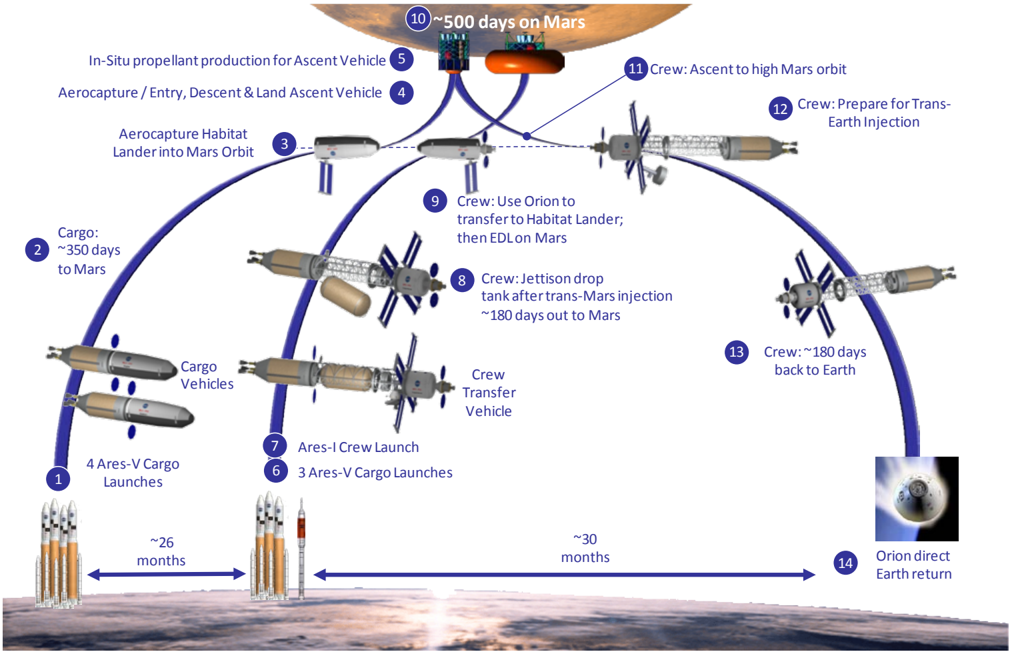
- Each mission would use conjunction class long-stay trajectories with forward-deployed cargo sent one opportunity earlier; an example 2037 crew mission would have 174 days outbound transit, 201 days inbound, 539 days Mars stay, and 914 days total mission duration, while the supporting cargo vehicle would take 202 days.
- The architecture requires at least seven heavy-lift cargo launches with launches at least 30 days apart, no on-orbit assembly of major elements, and total mission mass on the order of 800–1,200 t per mission; it also calls for landing 40 t of useful payload and providing 30–40 kWe continuous surface power.
- Key challenges include human health and performance risks such as radiation, bone mineral loss, muscle atrophy, medical care, and behavioral health; landing large payloads; heavy lift; in-situ resource utilization; advanced propulsion; robust power; and reliability/supportability with essentially no Earth resupply.
Methods
- This paper is a summary of the 2007 Mars Design Reference Architecture 5.0 (published as NASA-SP-2009-566 in 2009), providing a common framework rather than a formal plan for human Mars exploration.
- Mission analysis considered Earth departure dates from 2030 to 2046 to assess variability across the synodic cycle, and generated crewed and one-way cargo trajectories; the 2037 opportunity is used as an example.
- Technical assessments focused primarily on launch vehicle, interplanetary transportation, and entry, descent, and landing systems; Orion, the Mars descent/ascent vehicle, and the interplanetary transit habitat were assessed in less detail, and surface systems were mostly top-level performance estimates and trades.
Limitations
- The paper states that the strategy and example implementation concepts “should not be viewed as constituting a formal plan for the human exploration of Mars,” and that no date has been chosen for the first potential human mission; the 2030–2046 dates were chosen to assess mission opportunity variability, not as proposed actual mission dates.
- The paper states that detailed designs for surface systems were not developed, but rather top-level performance estimates and trades were conducted, and more in-depth definition should be conducted in future efforts, including commonality with lunar surface systems.
- Evident from the text: many system concepts depend on lunar-derived, Orion-derived, or Ares V/Constellation-era assumptions, and science specifics are still to be determined, with a 1000 kg allocation and 250 kg sample return capability and future trades regarding range, duration in field, and depth of exploration pending.
Model-written summary. Check it against the paper before relying on it.
Integrity signals
Registry
Cites
Statistics
Figures


Verification
Claims the paper makes
0 Valid · 4 Not valid · 1 Not checked · 49 Own results and interpretations
A result the paper reports from its own data — it cites no other source for it, so there is none to check. The quote shows it is in the paper.
In the paper
“An example crew mission in the 2037 opportunity would result in transit times of 174 days outbound and 201 days inbound.”
hedgedstates a cause- Asserted: passes — The authors put it forward as true.
- Checkable: passes — It can be checked against evidence.
- Load-bearing: unclear — It is unclear whether the paper’s conclusions depend on it.
- Based: passes — The paper gives a reason why it holds.
- Rests on an assumption not shown here.
A result the paper states — it cites no source for it, so there is none to check. The quote shows it is in the paper.
In the paper
“Each of the three missions would use conjunction class (long-stay) trajectories combined with a 'forward deploy' cargo strategy.”
hedgedstates a cause- Asserted: passes — The authors put it forward as true.
- Checkable: passes — It can be checked against evidence.
- Load-bearing: passes — The paper’s conclusions depend on it.
- Based: passes — The paper gives a reason why it holds.
A result the paper states — it cites no source for it, so there is none to check. The quote shows it is in the paper.
In the paper
“NASA has identified several approaches that would overcome this challenge that involve a combination of basic research in hypersonic aerodynamics, materials science, and propulsion technology to deliver these larger payloads.”
hedgedstates a cause- Asserted: passes — The authors put it forward as true.
- Checkable: passes — It can be checked against evidence.
- Load-bearing: unclear — It is unclear whether the paper’s conclusions depend on it.
- Based: passes — The paper gives a reason why it holds.
A result the paper reports from its own data — it cites no other source for it, so there is none to check. The quote shows it is in the paper.
In the paper
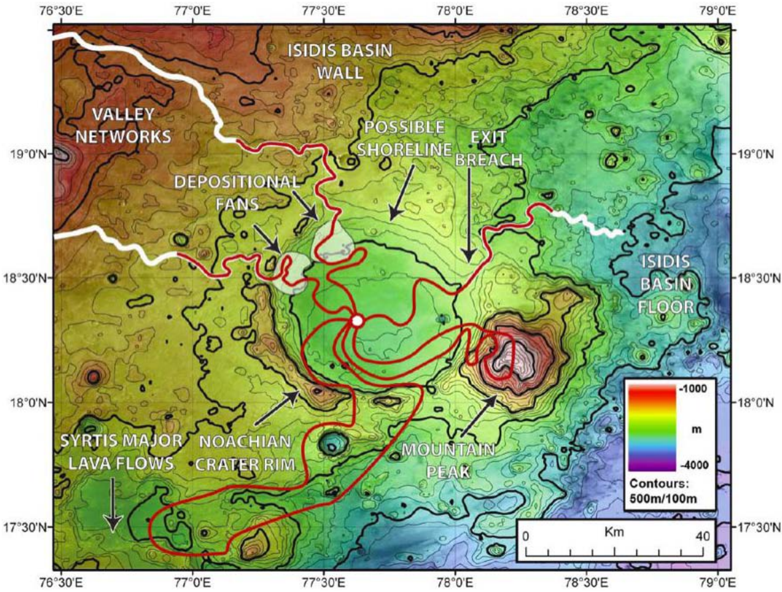
“The scale at the lower right of figure 2 indicates that these features of interest are beyond what is currently considered a reasonable walking range for the crew (determined by the distance a crew member could walk during one charge of power and breathing gases in his/her Portable Life Support System roughly 20 km total).”
hedged- Asserted: passes — The authors put it forward as true.
- Checkable: passes — It can be checked against evidence.
- Load-bearing: unclear — It is unclear whether the paper’s conclusions depend on it.
- Based: passes — The paper gives a reason why it holds.
A result the paper states — it cites no source for it, so there is none to check. The quote shows it is in the paper.
In the paper
“Mass increases in this subsystem are a prime contributor to the overall increase in the initial mass estimates given in this DRA as compared to previous approaches.”
plainstates a cause- Asserted: passes — The authors put it forward as true.
- Checkable: passes — It can be checked against evidence.
- Load-bearing: passes — The paper’s conclusions depend on it.
- Based: passes — The paper gives a reason why it holds.
- Rests on 3 assumptions not shown here.
21 more claims
Create a free account to see all 54 claims and every source verdict.
- Probably not a substantial claim. 20
- It may state two separate claims as one. 13
Claims other papers make about this one
Each is checked against this paper’s own text: does it say what the citing paper says it does?
The cited source says what the claim attributes to it.
In the citing paper
“Artemis I measurements can be extrapolated to exemplary Mars missions36 for a similar point in the solar cycle, as the GCR field is approximately constant outside the Earth’s magnetosphere on this scale.”
From Space radiation measurements during the Artemis I lunar mission (2024) · cites this paper as [36]
In the citing paper
“The DST concept documented in this paper was built upon these previous analyses, and designed to combine the best of low thrust and high thrust propulsion systems for round-trip delivery of a crew of four from the Earth to Mars.”
Self-check
Percentages, sums and reported differences re-computed from the paper’s own numbers.
Each contradiction between two passages listed here was confirmed by an independent check.
Rated minor: it would not touch a result — a value no result rests on, a p-value that stays on the same side of the significance level, or a conflict that is clerical, resolved elsewhere in the paper, or outside its own findings.
In the paper
§ Interplanetary Trajectory and Mission Analysis · p. 4
“An example crew mission in the 2037 opportunity would result in transit times of 174 days outbound and 201 days inbound.”
§ Getting Ready, Getting to Mars, and Getting Back · p. 5
“The length of this outbound transfer to Mars would be dependent on the mission date and would range from 175 to 225 days.”
Rated minor: it would not touch a result — a value no result rests on, a p-value that stays on the same side of the significance level, or a conflict that is clerical, resolved elsewhere in the paper, or outside its own findings.
In the paper
§ Getting Ready, Getting to Mars, and Getting Back · p. 5
“The length of this outbound transfer to Mars would be dependent on the mission date and would range from 175 to 225 days.”
§ 5. KEY CHALLENGES · p. 10
“| One-way Trip Time | 4 days | 180-210 days |”
Citations
Cites
Cratering Records in the Inner Solar System in Relation to the Lunar Reference System
Neukum, G., Ivanov, B. A., & Hartmann, W. K. (2001) · Space Science Reviews · doi:10.1023/a:1011989004263 · Cited by 661
Ages and Geologic Histories of Martian Meteorites
Nyquist, L. E., Bogard, D. D., Shih, C.-Y., Greshake, A., Stöffler, D., & Eugster, O. (2001) · Space Sciences Series of ISSI · doi:10.1007/978-94-017-1035-0_5 · Cited by 576
Cratering Records in the Inner Solar System in Relation to the Lunar Reference System
Neukum, G., Ivanov, B. A., & Hartmann, W. K. (2001) · Space Sciences Series of ISSI · doi:10.1007/978-94-017-1035-0_3 · Cited by 568
Photochemistry of Planetary Atmospheres
Yung, Y. L., & DeMore, W. B. (1999) · Oxford University Press eBooks · doi:10.1093/oso/9780195105018.001.0001 · Cited by 430
Ages and Geologic Histories of Martian Meteorites
Nyquist, L. E., Bogard, D. D., Shih, C.-Y., Greshake, A., Stöffler, D., & Eugster, O. (2001) · Space Science Reviews · doi:10.1023/a:1011993105172 · Cited by 417
Human Exploration of Mars: The Reference Mission of the NASA Mars Exploration Study Team
Hoffman, S. J., & Kaplan, D. I. (1997) · NASA Technical Reports Server (NASA) · Cited by 251
Self-citationGault, D. E. (1970) · Radio Science · doi:10.1029/rs005i002p00273 · Cited by 245
Crater size-frequency distributions and a revised Martian relative chronology
Barlow, N. G. (1988) · Icarus · doi:10.1016/0019-1035(88)90006-1 · Cited by 168
Drake, B. G. (1998) · NASA Technical Reports Server (NASA) · Cited by 111
Self-citationPaleocratering of the Moon: Review of post-Apollo data
HARTMANN, W. K. (1972) · Astrophysics and Space Science · doi:10.1007/bf00642541 · Cited by 104
Research works printed but not linked: 10
- grant, 2006, MEPAG (2006), Mars Scientific Goals, Objectives, Investigations, and Priorities: 2006, white paper posted, 31
- garvin, 2008, MEPAG HEM-SAG (2008). Planning for the Scientific Exploration of Mars by Humans, unpublished white paper
- strom, 1992, The Martian imact cratering record, Mars, 384
- 0, National Research Council (2006) Assessment of NASA's Mars Architecture 2007-2016, Committee to Review the Next Decade Mars Architecture Space Studies Board Division on Engineering and Physical Sciences
- 1989, Exploration Studies Technical Report, FY1989 Annual Report, NASA Technical memorandum 4170 Office of Exploration National Aeronautics and Space Administration
- 1991, America at the Threshold, Report of the Synthesis Group on America's Space Exploration Initiative, Superintendent of Documents
- 1988, Beyond Earth's Boundaries: Human Exploration of the Solar System in the 21st Century, 1988 Annual Report to the Administrator, National Aeronautics and Space Administration
- drake, 2009, Human Exploration of Mars Design Reference Architecture 5.0, NASA-SP-2009-566
- 2008, Planning for the Scientific Exploration of Mars by Humans, unpublished white paper
- 2007, An Astrobiology Strategy for the Exploration of Mars
Cited by
Items 401–500 of 589
The Impact of Space Radiation on Brains of Future Martian and Lunar Explorers
Li, Y., Guo, J., Khaksarighiri, S., Dobynde, M. I., Zhang, J., Liu, B., & Wimmer-Schweingruber, R. F. (2023) · Space Weather · doi:10.1029/2023sw003470 · Cited by 6
“Referring to a possible NASA design reference mission (Drake et al., 2010), GCR-induced dose in solar minimum during a 500-day surface stay is in the range of 16 and 60 mGy, which is still within the 30-day limit in the CNS system.”
BackgroundYang, Y. E., Xie, F., & Li, Y. (2023) · Cryogenics · doi:10.1016/j.cryogenics.2023.103749 · Cited by 2
WATER PRODUCTION FROM HYDRATED SULFATES ON MARS. A GEOLOGICAL AND TECHNICAL ASSESSMENT
Jamanca-Lino, G., & Guerra, C. (2023) · International Multidisciplinary Scientific GeoConference SGEM ... · doi:10.5593/sgem2023/6.1/s28.56 · Cited by 2
Pischulti, P. K., & Klaus, D. M. (2024) · Journal of Space Safety Engineering · doi:10.1016/j.jsse.2024.06.007 · Cited by 2
Zaccarine, S. A., & Klaus, D. M. (2024) · Acta Astronautica · doi:10.1016/j.actaastro.2024.07.055 · Cited by 4
Riggs, J. D., & Kirchoff, M. R. (2024) · Earth and Space Science · doi:10.1029/2024ea003796 · Cited by 2
“Knowledge of the spatial and temporal distribution of tropical water ice is important to constraining the scope of habitability, climate, Mars geology, and to prepare for human exploration, for example, Drake et al. (2010).”
Mars as a Science Base: Towards a Small Permanent Outpost
Chatzitheodoridis, E., Vera, J.-P. P. D., Keresztúri, Á., Mason, N. J., Possnig, C., Puumala, M. M., Sivula, O., Viso, M., Detrell, G., Ditrych, O., et al. (2024) · Space and society · doi:10.1007/978-3-031-66881-4_7 · Cited by 3
Hyperbolic Rendezvous at Mars: Risk Assessments and Mitigation Strategies
Jedrey, R., Landau, D., & Whitley, R. J. (2015) · NASA STI Repository (National Aeronautics and Space Administration) · Cited by 2
Near-Earth phase risk comparison of human Mars campaign architectures
Manning, T. A., Nejad, H. S., & Mattenberger, C. J. (2013) · Proceedings, annual Reliability and Maintainability Symposium/Proceedings. Annual Reliability and Maintainability Symposium · doi:10.1109/rams.2013.6517729 · Cited by 2
“0 [2] for a human Mars campaign was introduced during NASA’s now-cancelled Constellation Program.”
BackgroundSystem Level Impact of Landing Point Redesignation for High-Mass Mars Missions
Chua, Z. K., Steinfeldt, B., Kelly, J., et al. (2011) · AIAA SPACE Conference & Exposition · doi:10.2514/6.2011-7296 · Cited by 2
Parametric Analysis of Single-Stage Earth-Departure-Stage In-Orbit Refueling
Golkar, A., & Crawley, E. F. (2014) · Journal of Spacecraft and Rockets · doi:10.2514/1.a32718 · Cited by 2
Belz, S., Ganzer, B., Messerschmid, E., et al. (2012) · International Conference on Environmental Systems (ICES) · doi:10.2514/6.2012-3522 · Cited by 2
In-space transportation infrastructure architecture decisions using a weighted graph approach
Davison, P., Cameron, B. G., & Crawley, E. F. (2014) · IEEE Aerospace Conference (AERO) · doi:10.1109/aero.2014.6836303 · Cited by 2
“NASA’s plan calls for the evolution of this initial architecture into a 130 metric ton launch vehicle after initial development, which represent stakeholders’ ideal performance preferences.”
BackgroundInfluentialSpace Launch System Co-Manifested Payload Options for Habitation
Smitherman, D. V. (2015) · AIAA SPACE Conference and Exposition · doi:10.2514/6.2015-4516 · Cited by 2
Gates, M. M., Lillard, R. P., Tahu, G., et al. (2013) · AIAA SPACE Conference and Exposition · doi:10.2514/6.2013-5500 · Cited by 2
Self-citationSettlement-Class In-Space Transportation for Moon and Mars
Woodcock, G. (2010) · AIAA SPACE Conference & Exposition · doi:10.2514/6.2010-8779 · Cited by 2
A High Power Solar Electric Propulsion - Chemical Mission for Human Exploration of Mars
Burke, L. M., Martini, M., & Oleson, S. R. (2014) · AIAA/ASME/SAE/ASEE Joint Propulsion Conference and Exhibit · doi:10.2514/6.2014-3719 · Cited by 4
Mission analysis of human Mars exploration based on Space Elevator
Gao, Z., Kewei, T., Zhang, F., et al. (2016) · doi:10.1109/cgncc.2016.7828891 · Cited by 2
Kwan, H., Bassett, Z., & Finch, P. M. (2017) · AIAA SPACE and Astronautics Forum and Exposition · doi:10.2514/6.2017-5265 · Cited by 2
Link Characterization for Deep-Space Optical Communications
Xie, H., Heckman, D. P., & Breidenthal, J. C. (2016) · Cited by 2
Can Orbital Servers Provide Mars-Wide Edge Computing?
Pfandzelter, T., & Bermbach, D. (2023) · doi:10.1145/3614454.3622997 · Cited by 2
A Study for Mars Manned Exploration
Dorney, D. J., & Scimemi, S. (2012) · NASA STI Repository (National Aeronautics and Space Administration) · Cited by 2
A Modular, Scalable Avionics Architecture for Future Exploration Missions
Wernitznigg, S., Fidi, C., & Loveless, A. T. (2017) · AIAA SPACE and Astronautics Forum and Exposition · doi:10.2514/6.2017-5109 · Cited by 2
Mission architecture analysis for manned NEA exploration using MAM method
Yue, Y., Wang, X., Gu, H., et al. (2019) · Acta Astronautica · doi:10.1016/j.actaastro.2019.12.007 · Cited by 2
Shen, Y.-Y., & Anderson, A. P. (2019) · International Conference on Information Fusion (FUSION) · doi:10.23919/fusion43075.2019.9011248 · Cited by 3
“To date, injury has not yet resulted in the termination of an EVA, but future mission concepts will require EVAs of greater duration and frequency, increasing the risk that an EVA injury will interfere with mission-critical activities [12].”
BackgroundTrust in an Autonomous Guidance System for a Planetary Rover Task
Voros, J., McGinley, J., McGuire, S., Walker, M. E., Karki, P., Ahmed, N. R., Szafir, D. J., & Clark, T. K. (2020) · IEEE Aerospace Conference (AERO) · doi:10.1109/aero47225.2020.9172290 · Cited by 2
Assessment of Hypersonic Separation Dynamics For Drag Modulation Systems at Mars
McClary, M., & Putnam, Z. R. (2021) · AIAA SciTech Forum · doi:10.2514/6.2021-1063 · Cited by 2
Human Mars Surface Science Operations
Bobskill, M. R., & Lupisella, M. L. (2014) · Cited by 2
An Analysis of Hybrid Life Support Systems For Sustainable Habitats
Shaw, M. (2014) · ThinkTech (Texas Tech University) · Cited by 2
Mars Exploration Entry and Descent and Landing Technology Assessment Figures of Merit
Howard, A., Stanley, D., & Williams-Byrd, J. A. (2010) · AIAA SPACE Conference & Exposition · doi:10.2514/6.2010-8676 · Cited by 2
Srikanth, P., & Collicott, S. H. (2019) · AIAA Propulsion and Energy Forum · doi:10.2514/6.2019-4438 · Cited by 1
Integrated Framework to Enable Design Space Exploration of In-Space Transportation Architectures
Prasad, A., Díaz, M. J. C., & Mavris, D. N. (2020) · ASCEND 2020 · doi:10.2514/6.2020-4106 · Cited by 1
Meschini, S., & Cammi, A. (2021) · Progress in Nuclear Energy · doi:10.1016/j.pnucene.2021.104035 · Cited by 1
Space & Mars Settlement Water Life Cycle: H2O Production, Infrastructure, Treatment, and Storage
Lutz, K., & Fairhart, A. (2022) · AIAA Accelerating Space Commerce, Exploration, and New Discovery Conference (ASCEND) · doi:10.2514/6.2022-4231 · Cited by 2
Technology Prioritization and Architecture Flexibility for Space System-of-Systems
Guariniello, C., & DeLaurentis, D. A. (2023) · Proceedings - IEEE Aerospace Conference · doi:10.1109/aero55745.2023.10115852 · Cited by 1
Steady-state thermal–hydraulic analysis of an NTP reactor core based on the porous medium approach
Han, Z., Zhang, J., Wang, M.-J., Tian, W.-X., Su, G., & Qiu, S.-Z. (2024) · Annals of Nuclear Energy · doi:10.1016/j.anucene.2024.110942 · Cited by 1
Application of Symmetrical Motorised Momentum Exchange Tethers for Two-Way Earth–Mars Transportation
Afonso, S. S., & Cartmell, M. P. (2025) · Space Science & Technology · doi:10.34133/space.0325 · Cited by 1
Whitley, R. J., Jedrey, R. M., & Landau, D. (2015) · AIAA SPACE Conference and Exposition · doi:10.2514/6.2015-4412 · Cited by 1
Exploring NASA Human Spaceflight and Pioneering Scenarios
Zapata, E. (2015) · AIAA/SAE/ASEE Joint Propulsion Conference (JPC) · doi:10.2514/6.2015-3794 · Cited by 1
The Single Habitat Module Concept - A Streamlined Way to Explore
Chambliss, J. P. (2012) · AIAA SPACE Conference & Exposition · doi:10.2514/6.2012-5204 · Cited by 1
Roving Mars: Using Function Analysis to Develop a Concept System
Casey, S., & Montgomery, G. (2010) · Ergonomics in Design The Quarterly of Human Factors Applications · doi:10.1518/106480410x12887326202951 · Cited by 1
The Single Habitat Module Concept for Exploration - Mission Planning and Mass Estimates
Chambliss, J. P. (2013) · International Conference on Environmental Systems (ICES) · doi:10.2514/6.2013-3530 · Cited by 1
Technology Needs to Support Future Mars Exploration
Nilsen, E. N., Lillard, R. P., & Baker, J. D. (2013) · AIAA SPACE Conference and Exposition · doi:10.2514/6.2013-5502 · Cited by 1
Mars surface systems common capabilities and challenges for human missions
Toups, L., Hoffman, S. J., & Watts, K. (2016) · Proceedings - IEEE Aerospace Conference · doi:10.1109/aero.2016.7500771 · Cited by 1
Self-citationA Discrete-Event Simulation of the NASA Fuel Production Plant on Mars
Ninah, C., Strevens, B., Barcia, C., et al. (2017) · SAE technical papers on CD-ROM/SAE technical paper series · doi:10.4271/2017-01-2017 · Cited by 1
Choice of the Optimal Launch Date for Interplanetary Missions
Genta, G., & Maffione, P. F. (2019) · Springer optimization and its applications · doi:10.1007/978-3-030-10501-3_5 · Cited by 1
Passive Reactivity Control of Nuclear Thermal Propulsion Reactors
Venneri, P. F., Eades, M., & Kim, Y. (2016) · Nuclear Technology · doi:10.13182/nt16-80 · Cited by 1
THE ROLE OF LOGISTICS CENTRES IN SPACE LOGISTICS SYSTEMS
Kovač, M., Tadić, S. R., Krstić, M. D., & Roso, V. (2022) · International Journal for Traffic and Transport Engineering · doi:10.7708/ijtte2022.12(4).06 · Cited by 1
Суржиков, С. Т. (2022) · Fluid Dynamics · doi:10.1134/s0015462822100706 · Cited by 1
Shielding factors for a fission-powered mars exploration rover
Bendoyro, A. C., Thomas, L. D., Cassibry, J. T., et al. (2023) · Nuclear Science and Technology Open Research · doi:10.12688/nuclscitechnolopenres.17438.1 · Cited by 1
Nuclear Thermal Propulsion: Trades and Sensitivity Analysis for Robotic Missions
Kumar, S., Thomas, L. D., & Cassibry, J. T. (2024) · AIAA SciTech Forum · doi:10.2514/6.2024-1410 · Cited by 1
Malaya Kumar Biswal, M., & Ilavazhagi, G. (2024) · Acceleron Aerospace Journal · doi:10.61359/11.2106-2405 · Cited by 1
Systems Architecture and Trajectory Optimization for High Thrust Interplanetary Spacecraft
Payton, E. D., & Peck, M. A. (2023) · AIAA Regional Student Conferences · doi:10.2514/6.2023-71085 · Cited by 1
Finite Element Analysis (FEA) Model of the Apollo A7LB Extravehicular Activity (EVA) Suit Sleeve
Gudall, C., Cabriales, J., Dunbar, B. J., et al. (2024) · Proceedings - IEEE Aerospace Conference · doi:10.1109/aero58975.2024.10521044 · Cited by 1
“With the nation’s return to the Moon (Artemis Program [2]) and plans to land humans on Mars (Design Reference Mission 5.0) [3] [4] [5] [6], new EVA suits with increased mobility across a large range of anthropometric sizes, both male and female, are required for mission success.”
BackgroundInfluentialConceptual Design and System Analysis of 10 kN Nuclear Thermal Propulsion Engine
Yang, S.-S., Cho, N., Kang, S.-Y., et al. (2024) · Journal of the Korean Society of Propulsion Engineers · doi:10.6108/kspe.2024.28.4.029 · Cited by 1
Lunar-Derived Propellants for Fueling Mars-Bound Spacecraft in Cis-Lunar Space
Donald, R. (2024) · IgMin Research · doi:10.61927/igmin242 · Cited by 1
Mao, C., Jiang, B., Ji, Y., et al. (2024) · Nuclear Engineering and Design · doi:10.1016/j.nucengdes.2024.113620 · Cited by 1
Experimental Study of Polarization Characteristics of Terahertz Emission
Yamada, T., Kobayashi, M., Uchiyama, Y., et al. (2024) · IEEE Transactions on Terahertz Science and Technology · doi:10.1109/tthz.2024.3496571 · Cited by 1
“O BSERVATIONS of electromagnetic radiation from the surface and subsurface are key to understanding their thermal and dielectric properties in investigations of astronomical objects, especially for habitability and resources [e.g.][1], [2], [3], [4].”
Expanding a Family of Mars Chemical Transportation Elements With a Large Vertical Lander Concept
Trent, D. J., Edwards, S. J., & Chappell, M. (2025) · AIAA SciTech Forum · doi:10.2514/6.2025-0515 · Cited by 1
Entry, Descent, and Landing for Human Mars Missions
Munk, M., & Dwyer-Cianciolo, A. M. (2012) · NASA STI Repository (National Aeronautics and Space Administration) · Cited by 1
Probability of data loss between mars tumbleweed rovers
Hook, T., & Barhorst, A. A. (2015) · International Conference on the Design of Reliable Communication Networks (DRCN) · doi:10.1109/drcn.2015.7149013 · Cited by 1
“Martian low $800 million s expensive then ade it very clear ill need to focus apabilities [10].”
BackgroundSmall rover exploration capabilities
Salotti, J., Laithier, C., Machut, B., Marie, A., Bruneau, A., Groemer, G. E., & Foing, B. H. (2014) · Advances in Space Research · doi:10.1016/j.asr.2014.10.012 · Cited by 1
Logistical Analysis of a Flexible Human-and-Robotic Mars Exploration Campaign
Yue, H., Weck, O. L. D., & Grogan, P. T. (2014) · Journal of Spacecraft and Rockets · doi:10.2514/1.a32373 · Cited by 1
60+ Years of Humans to Mars Mission Planning
Rapp, D. (2015) · Springer eBooks · doi:10.1007/978-3-319-22249-3_3 · Cited by 1
Electrodeless Lorentz Force (ELF) Thruster for ISRU and Sample Return Mission
Pancotti, A., Little, J. M., Neuhoff, J., et al. (2015) · Cited by 1
Lunarport: A proposed Lunar-resource station to expand deep-space travel horizons
Gat, I., & Talon, T. (2017) · Proceedings - IEEE Aerospace Conference · doi:10.1109/aero.2017.7943623 · Cited by 1
“If colonizing Mars is to become a reality, 6 SLS missions is a very small number considering it is estimated to take 7 missions to set up a small human habitat on Mars [4].”
BackgroundInfluentialFeasibility and Performance of Atmospheric-Breathing Propulsion for Mars Descent
Gonyea, K. C., Braun, R. D., & Auslender, A. H. (2018) · Journal of Spacecraft and Rockets · doi:10.2514/1.a33959 · Cited by 1
Energy and Mass Utilization During Drag-Modulated Plasma Aerocapture
Kelly, C. L., & Little, J. M. (2019) · Proceedings - IEEE Aerospace Conference · doi:10.1109/aero.2019.8741698 · Cited by 1
A Coupled Approach to the Design Space Exploration of Nuclear Thermal Propulsion Systems
Petitgenet, V., Roper, C. D., Krecicki, M., et al. (2020) · AIAA Propulsion and Energy Forum · doi:10.2514/6.2020-3846 · Cited by 1
Planning and Design Method for Heavy Launch Vehicle Launch site for Manned Mars Exploration Mission
Zhang, J.-X., Zhong, W.-A., Xin, Y., et al. (2020) · Journal of Physics Conference Series · doi:10.1088/1742-6596/1639/1/012004 · Cited by 1
Mars Rover and Its Strategic Implementation
Probal, I. A., Hamim, F. A., Islam, M. A., et al. (2021) · International Conference on Information and Communication Technology for Sustainable Development (ICICT4SD) · doi:10.1109/icict4sd50815.2021.9396853 · Cited by 1
Strategic Implications of Phobos as a Staging Point for Mars Surface Missions
Drake, B. G., Rucker, M. A., & Cianciolo, A. D. (2021) · IEEE Aerospace Conference (AERO) · doi:10.1109/aero50100.2021.9438517 · Cited by 1
“Previous Mars architecture assessments have shown that the mission approach of pre-deploying cargo ahead of the crew is an advantageous strategy (Drake [23], Craig [16, 17]).”
BackgroundSelf-citationDown-Selection of Four Common Habitat Variants
Howard, R. L. (2022) · Proceedings - IEEE Aerospace Conference · doi:10.1109/aero53065.2022.9843546 · Cited by 1
Wang, B., Katsube, T., Tanaka, K., Ninomiya, Y., Hirakawa, H., Liu, C., Maruyama, K., Varès, G., Kito, S., Nakajima, T., et al. (2022) · Life · doi:10.3390/life12040565 · Cited by 2
One-Dimensional Steady-State Thermal Model of CNTP Reactor
Keese, J., & Hollingsworth, D. K. (2023) · Nuclear Technology · doi:10.1080/00295450.2023.2216989 · Cited by 1
Comparison of Space Propulsion Methods for a Manned Mission to MarsPreprint
Guerra, A. G. C., Orfeu Bertolami, A., & Gil, P. J. S. (2015) · arXiv (Cornell University) · Cited by 1
Arctic and Antarctic Analogs for Planetary Surface Traverses
Hoffman, S. J., & Cameron, A. O. (2010) · ASCE International Conference on Engineering, Science, Construction, and Operations in Challenging Environments (Earth and Space) · doi:10.1061/41096(366)90 · Cited by 1
Self-citationProgress and Direction of the Forward Osmosis-Cargo Transfer Bag Concept for 2013
Parodi, J., Hardcastle, M., Flynn, M., Gormly, S., Toad, D., Grizzaffi, L., Lobascio, C., Gemelli, L., & Alenia, T. (2014) · ThinkTech (Texas Tech University) · Cited by 1
A Value Proposition Analysis of Propulsion Options for Crewed Mars Missions
Maxwell, A., & Wilhite, A. (2010) · AIAA SPACE Conference & Exposition · doi:10.2514/6.2010-8679 · Cited by 1
Effects of long-term closed environment on human saliva microbiota and salivary cytokinesPreprint
Zhu, Y., Hao, Z., Fu, Y., Yang, J., Dong, C., & Liu, H. (2020) · bioRxiv (Cold Spring Harbor Laboratory) · doi:10.1101/2020.10.12.336750 · Cited by 1
“Bioregenerative Life Support Systems (BLSS) can provide sustainable life support in a closed artificial ecosystem and is the future direction of space stations and planetary bases(Drake et al. 2010, Zheng et al. 2008).”
BackgroundRace and Ethnic Group Dependent Space Radiation Cancer Risk PredictionsPreprint
Cucinotta, F. A., & Saganti, P. B. (2021) · Research Square · doi:10.21203/rs.3.rs-871085/v1 · Cited by 1
Race and Ethnic Group Dependent Space Radiation Cancer Risk PredictionsPreprint
Cucinotta, F. A., & Saganti, P. B. (2021) · medRxiv · doi:10.1101/2021.09.08.21263281 · Cited by 1
Häuplik‐Meusburger, S. (2011) · Springer eBooks · doi:10.1007/978-3-7091-0667-9_4
Affordable Exploration of Mars: Recommendations from a Community Workshop
Thronson, H. A., Cooke, D., Perino, M. A., Carberry, C., Raftery, M., Zucker, R., Cassady, R. J., Westenberg, A., & Kirkpatrick, J. (2014) · NASA STI Repository (National Aeronautics and Space Administration)
CHARM: Cooperation of Humans and Robots for Mars - Final ReportPreprint
Bland, N., Brunskill, C., Chen, J., Chen, Z., Chu, C., Dayas-Codina, M., Donici, V., Eggl, S., Ferrer, E., Ferrer-Desclaux, D., et al. (2012) · SSRN Electronic Journal · doi:10.2139/ssrn.2044194
The Single Habitat Module Concept for Exploration
Chambliss, J. P. (2012) · International Conference on Environmental Systems (ICES) · doi:10.2514/6.2012-3416
De la cité martienne aux projets territoriaux de développement durable
Salotti, J. (2011) · Projectics / Proyéctica / Projectique · doi:10.3917/proj.007.0005
Howard, D. F., Perry, J. L., & Roman, M. C. (2014) · AIAA SPACE Conference & Exposition · doi:10.2514/6.2014-4476 · Cited by 1
A computational magnetohydrodynamic model of a gasdynamic fusion space propulsion system
Ohlandt, C. J. R. (2011) · Deep Blue (University of Michigan)
Heavy-lift contributions to a human mission to Mars
Monk, T. S., Holladay, J. B., Jaap, J., et al. (2011) · doi:10.1109/aero.2011.5747484
A dual thrust axis lander for Mars exploration
Masten, D. A. (2014) · Proceedings - IEEE Aerospace Conference · doi:10.1109/aero.2014.6836361
Human outer solar system exploration via Q-Thruster technology
Joosten, B. K., & White, H. G. (2015) · Proceedings - IEEE Aerospace Conference · doi:10.1109/aero.2015.7118893
Earth departure stage technology requirements for the Mars DRM
Monk, T., Holladay, J. B., Feldman, S., & Baggett, K. (2011) · IEEE Aerospace Conference (AERO) · doi:10.1109/aero.2011.5747493
An Analog Roadmap to Mars: Recommendations for Policymakers and Space Agencies
Zhang, G.-L., Nordheim, T. A., Rosenberg, M. J. F., et al. (2010) · AIAA SPACE Conference & Exposition · doi:10.2514/6.2010-8847
A Multidisciplinary Approach to the Heavy Lift System Architecture Study
Hutchinson, V., Bocam, K. J., Herrmann, T., et al. (2013) · AIAA SPACE Conference and Exposition · doi:10.2514/6.2013-5373
Refueling with In-Situ Produced Propellants
Chato, D. J. (2014) · NASA STI Repository (National Aeronautics and Space Administration)
Cabanes, B., Segrestin, B., Weil, B., et al. (2014) · SSRN Electronic Journal · doi:10.2139/ssrn.2817116
Low-Thrust Trajectories for Human Missions to Ceres
Laipert, F. E., & Longuski, J. M. (2012) · AIAA/AAS Astrodynamics Specialist Conference · doi:10.2514/6.2012-4426
Propulsion System Design for a Martian Atmospheric Breathing Supersonic Retropropulsion Engine
Gonyea, K. C., Auslender, A. H., & Braun, R. D. (2014) · AIAA/ASME/SAE/ASEE Joint Propulsion Conference (JPC) · doi:10.2514/6.2014-3449
Metadata
- Authors
- Drake, B. G., Hoffman, S. J., & Beaty, D. W.
- Affiliations
- Johnson Space Center (US)
- Leidos (United States) (US)
- Jet Propulsion Laboratory (US)
- Venue
- 2010 IEEE Aerospace Conference
- Publisher
- IEEE
- Published
- 2010-03
- Pages
- 1-24
- ISSN
- 1095-323X (ISSN-L)
- OpenAlex
- W2101215876
- Cited by
- 595
- References
- 19
- Citations by year
- 2026: 13 · 2025: 22 · 2024: 41 · 2023: 37 · 2022: 30 · 2021: 36 · 2020: 36 · 2019: 33 · 2018: 28 · 2017: 28 · 2016: 43 · 2015: 55 · 2014: 62 · 2013: 42 · 2012: 21
- FWCI
- 186.22
- Type
- conference paper
- Language
- en
- Open access
- green
- hdl.handle.net
- Locations
- IEEE Aerospace Conference (AERO) (publishedVersion)
- NASA STI Repository (National Aeronautics and Space Administration) (submittedVersion)
- Topics
- Physical Sciences › Earth and Planetary Sciences › Space and Planetary Science › Planetary Science and Exploration
- Physical Sciences › Engineering › Aerospace Engineering › Space Exploration and Technology
- Physical Sciences › Engineering › Aerospace Engineering › Spacecraft Design and Technology
- Keywords
- human Mars exploration, Constellation Program, lunar exploration, technological progress
About these checks
Registry, retraction, Cites and statistics results are computed, not judged, with one exception: a printed reference that no index lists is read once by a model before it counts as a citation error. Claims are extracted by a model and kept only when their quote appears verbatim in the text; each cited source is then checked, with a model’s help, for whether it says what the claim relies on. Those verdicts can be wrong — read the claim’s quote and the cited source before relying on one.
A language model drew the claims from the paper on 2026-10-06, under version 3 of the claim definition (model deepseek-v4.1-flash, prompt extract-v3).
A second model labelled each claim on 2026-10-06 (model jev-1.13-20260917, definition revision gold-guideline-v0.2).
Statistics and arithmetic are recomputed, not judged.
Confidence bands are shown only for fields calibrated on our annotated test set. None is calibrated yet, so no band is shown.
What counts as a claim ›How we measure confidence ›How we check this ›
Are you an author, or do you see a problem with this page? Request a review
Data sources
Bibliographic data: Semantic Scholar, OpenAlex, Crossref.
Contains information from the Semantic Scholar Academic Graph Datasets, made available under the ODC Attribution License (ODC-BY 1.0).
Semantic Scholar’s data is described in: Kinney, R., et al. (2023). The Semantic Scholar Open Data Platform. arXiv:2301.10140.
