

Explaining Deep Learning Models for Spoofing and Deepfake Detection with Shapley Additive Explanations
Open accessThe DOI matches its Crossref record; 39 of the 39 references it cites were found in a registry or an index.
Abstract
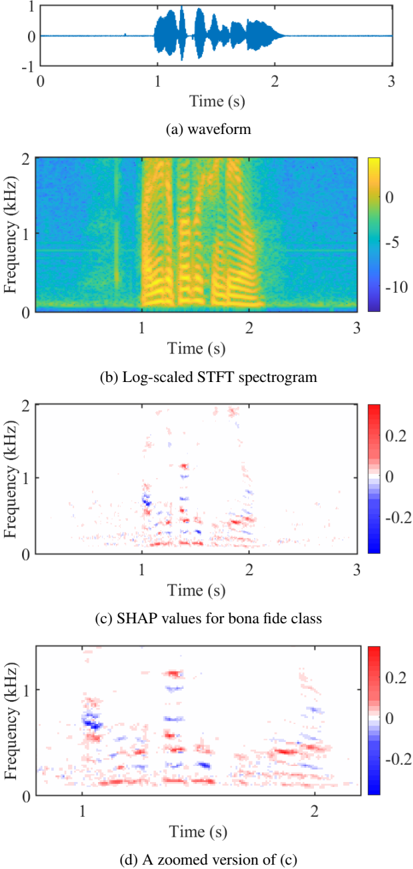
Substantial progress in spoofing and deepfake detection has been made in recent years. Nonetheless, the community has yet to make notable inroads in providing an explanation for how a classifier produces its output. The dominance of black box spoofing detection solutions is at further odds with the drive toward trustworthy, explainable artificial intelligence. This paper describes our use of SHapley Additive exPlanations (SHAP) to gain new insights in spoofing detection. We demonstrate use of the tool in revealing unexpected classifier behaviour, the artefacts that contribute most to classifier outputs and differences in the behaviour of competing spoofing detection models. The tool is both efficient and flexible, being readily applicable to a host of different architecture models in addition to related, different applications. All results reported in the paper are reproducible using open-source software.
Overview
The claims and statistics of this paper haven’t been checked yet.
Free: it reads the open-access text and checks the first 5 claims that cite a source we can check. Create a free account to check every claim.
Integrity signals
Registry
Cites
Statistics
Figures
Verification
Claims the paper makes
The claims and statistics of this paper haven’t been checked yet.
Free: it reads the open-access text and checks the first 5 claims that cite a source we can check. Create a free account to check every claim.
Claims other papers make about this one
Each is checked against this paper’s own text: does it say what the citing paper says it does?
The source backs part of the claim, not all of it — or backs it for a different population, condition or comparison.
In the citing paper
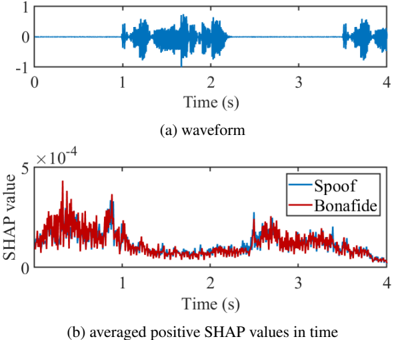
“Their findings revealed significant differences in how these models focused on speech and nonspeech intervals, with some models relying more heavily on silence duration rather than speech content to determine authenticity [167].”
From Audio Deepfake Detection: What Has Been Achieved and What Lies Ahead (2025) · cites this paper as [165]
Experimental — accuracy not yet measuredThe cited source says what the claim attributes to it.
In the citing paper
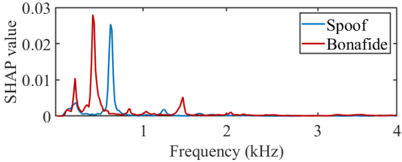
“Furthermore, the study demonstrated that different types of spoofing attacks often leave unique traces in specific frequency bands, suggesting that detection models can significantly enhance their discrimination capabilities by concentrating on these regions.”
From Audio Deepfake Detection: What Has Been Achieved and What Lies Ahead (2025) · cites this paper as [165]
Self-check
Percentages, sums and reported differences re-computed from the paper’s own numbers.
The self-check needs the paper’s full text.
Citations
Cites
Grad-CAM: Visual Explanations from Deep Networks via Gradient-Based Localization
Selvaraju, R. R., Cogswell, M., Das, A., Vedantam, R., Parikh, D., & Batra, D. (2017) · 2017 IEEE International Conference on Computer Vision (ICCV) · doi:10.1109/iccv.2017.74 · Cited by 24,513
A Unified Approach to Interpreting Model Predictions
Lundberg, S., & Lee, S.-I. (2017) · arXiv · doi:10.48550/arxiv.1705.07874 · Cited by 23,707 · cited 6×
“Drawing from concepts in cooperative game theory [29] whereby payoffs are distributed fairly to each player based on their individual contributions, SHapley Additive exPlanations (SHAP), introduced in [20], offers a more elegant and powerful approach to explain-ability.”
BackgroundMethodInfluential"Why Should I Trust You?": Explaining the Predictions of Any Classifier
Ribeiro, M. T., Singh, S., & Guestrin, C. (2016) · Proceedings of the 22nd ACM SIGKDD International Conference on Knowledge Discovery and Data Mining · doi:10.1145/2939672.2939778 · Cited by 17,555
Gauriat, C.-M., Pencolé, Y., Ribot, P., & Brouillet, G. (2024) · HAL (Le Centre pour la Communication Scientifique Directe) · doi:10.4230/oasics.dx.2024.27 · Cited by 12,586
Identity mappings in deep residual networks
He, K., Zhang, X., Ren, S., & Sun, J. (2016) · Lecture Notes in Computer Science · doi:10.1007/978-3-319-46493-0_38 · Cited by 10,741
Barredo Arrieta, A., Díaz-Rodríguez, N., Del Ser, J., Bennetot, A., Tabik, S., Barbado, A., Garcia, S., Gil-Lopez, S., Molina, D., Benjamins, R., et al. (2020) · Information Fusion · doi:10.1016/j.inffus.2019.12.012 · Cited by 10,423
17. A Value for n-Person Games
Shapley, L. S. (1953) · Contributions to the Theory of Games (AM-28), Volume II · doi:10.1515/9781400881970-018 · Cited by 6,950
Learning Important Features Through Propagating Activation Differences
Shrikumar, A., Greenside, P., & Kundaje, A. (2017) · arXiv · doi:10.48550/arxiv.1704.02685 · Cited by 2,761 · cited 1×
“(3) connects SHAP with DeepLIFT [31], an additive feature attribution method.”
MethodConsistent Individualized Feature Attribution for Tree Ensembles
Lundberg, S. M., Erion, G. G., & Lee, S.-I. (2018) · arXiv · doi:10.48550/arxiv.1802.03888 · Cited by 1,430 · cited 1×
“Full details can be found in [20,30,32].”
ASVspoof 2019: Future Horizons in Spoofed and Fake Audio Detection
Todisco, M., Wang, X., Vestman, V., Sahidullah, M., Delgado, H., Nautsch, A., Yamagishi, J., Evans, N., Kinnunen, T., & Lee, K. A. (2019) · arXiv · doi:10.48550/arxiv.1904.05441 · Cited by 688 · cited 2×
“We show a number of illustrative examples for which the input utterances, all drawn from the ASVspoof 2019 LA database [13], are chosen specially to demonstrate the potential insights which can be gained.”
BackgroundSelf-citationASVspoof 2019: Future Horizons in Spoofed and Fake Audio Detection
Todisco, M., Wang, X., Vestman, V., Sahidullah, M., Delgado, H., Nautsch, A., Yamagishi, J., Evans, N., Kinnunen, T. H., & Lee, K. A. (2019) · Interspeech 2019 · doi:10.21437/interspeech.2019-2249 · Cited by 687
Self-citationEnd-to-End anti-spoofing with RawNet2
Tak, H., Patino, J., Todisco, M., Nautsch, A., Evans, N., & Larcher, A. (2021) · ICASSP 2021 - 2021 IEEE International Conference on Acoustics, Speech and Signal Processing (ICASSP) · doi:10.1109/icassp39728.2021.9414234 · Cited by 402 · cited 1×
“We hope too to understand why solutions that operate directly upon raw waveform inputs [8, 14, 15] can perform better than systems that operate upon hand-crafted spectro-temporal representations [12,16], but worse for others, e.g. the A08 attack [15].”
BackgroundSelf-citationASVspoof 2021: accelerating progress in spoofed and deepfake speech detection
Yamagishi, J., Wang, X., Todisco, M., Sahidullah, M., Patino, J., Nautsch, A., Liu, X., Lee, K. A., Kinnunen, T., Evans, N., et al. (2021) · 2021 Edition of the Automatic Speaker Verification and Spoofing Countermeasures Challenge · doi:10.21437/asvspoof.2021-8 · Cited by 380
Self-citationSTC Antispoofing Systems for the ASVspoof2019 Challenge
Lavrentyeva, G., Novoselov, S., Tseren, A., Volkova, M., Gorlanov, A., & Kozlov, A. (2019) · Interspeech 2019 · doi:10.21437/interspeech.2019-1768 · Cited by 245
Generalization of Audio Deepfake Detection
Chen, T., Kumar, A., Nagarsheth, P., Sivaraman, G., & Khoury, E. (2020) · The Speaker and Language Recognition Workshop (Odyssey 2020) · doi:10.21437/odyssey.2020-19 · Cited by 200 · cited 1×
“We hope too to understand why solutions that operate directly upon raw waveform inputs [8, 14, 15] can perform better than systems that operate upon hand-crafted spectro-temporal representations [12,16], but worse for others, e.g. the A08 attack [15].”
BackgroundKinnunen, T., Lee, K. A., Delgado, H., Evans, N., Todisco, M., Sahidullah, M., Yamagishi, J., & Reynolds, D. A. (2018) · The Speaker and Language Recognition Workshop (Odyssey 2018) · doi:10.21437/odyssey.2018-44 · Cited by 198
Self-citationTak, H., Jung, J.-W., Patino, J., Kamble, M., Todisco, M., & Evans, N. (2021) · 2021 Edition of the Automatic Speaker Verification and Spoofing Countermeasures Challenge · doi:10.21437/asvspoof.2021-1 · Cited by 197
Self-citationTowards End-to-End Synthetic Speech Detection
Hua, G., Teoh, A. B. J., & Zhang, H. (2021) · IEEE Signal Processing Letters · doi:10.1109/lsp.2021.3089437 · Cited by 176 · cited 3×
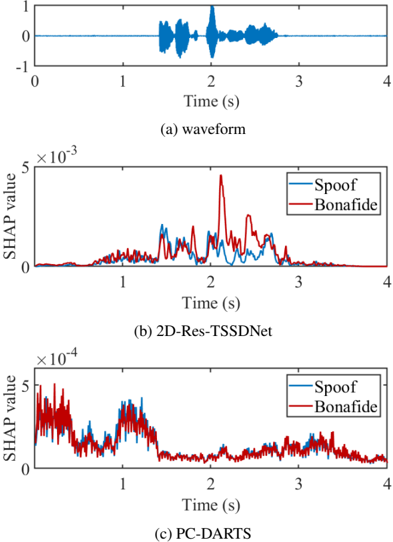
“2 The second is the 2D-Res-TSSDNet model presented in [8].”
BackgroundMethodInterpreting and Explaining Deep Neural Networks for Classification of Audio SignalsPreprint
Becker, S., Ackermann, M. R., Lapuschkin, S., Müller, K., & Samek, W. (2018) · arXiv (Cornell University) · Cited by 170
A Comparative Study on Recent Neural Spoofing Countermeasures for Synthetic Speech Detection
Wang, X., & Yamagishi, J. (2021) · Interspeech 2021 · doi:10.21437/interspeech.2021-702 · Cited by 137 · cited 2×
“Our goals are to better understand what artefacts are being captured or discarded by different solutions based upon different input features, different machine learning solutions or different components of ensemble systems [11, 12].”
BackgroundVulnerability in speaker verification - a study of technical impostor techniques
Lindberg, J., & Blomberg, M. (1999) · 6th European Conference on Speech Communication and Technology (Eurospeech 1999) · doi:10.21437/eurospeech.1999-283 · Cited by 128 · cited 1×
“Having begun over two decades ago [1, 2], research in spoofing or presentation attack detection for automatic speaker verification and speech deepfake detection has gained traction only in the last six years [3].”
BackgroundA Capsule Network Based Approach for Detection of Audio Spoofing Attacks
Luo, A., Li, E., Liu, Y., Kang, X., & Wang, Z. J. (2021) · ICASSP 2021 - 2021 IEEE International Conference on Acoustics, Speech and Signal Processing (ICASSP) · doi:10.1109/icassp39728.2021.9414670 · Cited by 84 · cited 1×
“This is especially the case for so-called black-box solutions which typify probably all current, state-of-the-art solutions to spoofing and deepfake detection [5–9].”
BackgroundOn the security of HMM-based speaker verification systems against imposture using synthetic speech
Masuko, T., Hitotsumatsu, T., Tokuda, K., & Kobayashi, T. (1999) · 6th European Conference on Speech Communication and Technology (Eurospeech 1999) · doi:10.21437/eurospeech.1999-286 · Cited by 82 · cited 1×
“Having begun over two decades ago [1, 2], research in spoofing or presentation attack detection for automatic speaker verification and speech deepfake detection has gained traction only in the last six years [3].”
BackgroundThe Effect of Silence and Dual-Band Fusion in Anti-Spoofing System
Zhang, Y., Wang, W., & Zhang, P. (2021) · Interspeech 2021 · doi:10.21437/interspeech.2021-1281 · Cited by 80 · cited 1×
“Similar observations have been reported previously [7, 24].”
Channel-Wise Gated Res2Net: Towards Robust Detection of Synthetic Speech Attacks
Li, X., Wu, X., Lu, H., Liu, X., & Meng, H. (2021) · Interspeech 2021 · doi:10.21437/interspeech.2021-2125 · Cited by 72
Speech is Silver, Silence is Golden: What do ASVspoof-trained Models Really Learn?
Müller, N., Dieckmann, F., Czempin, P., Canals, R., Böttinger, K., & Williams, J. (2021) · 2021 Edition of the Automatic Speaker Verification and Spoofing Countermeasures Challenge · doi:10.21437/asvspoof.2021-9 · Cited by 69
End-to-end spoofing detection with raw waveform CLDNNS
Dinkel, H., Chen, N., Qian, Y., & Yu, K. (2017) · 2017 IEEE International Conference on Acoustics, Speech and Signal Processing (ICASSP) · doi:10.1109/icassp.2017.7953080 · Cited by 64
Raw Differentiable Architecture Search for Speech Deepfake and Spoofing Detection
Ge, W., Patino, J., Todisco, M., & Evans, N. (2021) · 2021 Edition of the Automatic Speaker Verification and Spoofing Countermeasures Challenge · doi:10.21437/asvspoof.2021-4 · Cited by 62 · cited 1×
“We hope too to understand why solutions that operate directly upon raw waveform inputs [8, 14, 15] can perform better than systems that operate upon hand-crafted spectro-temporal representations [12,16], but worse for others, e.g. the A08 attack [15].”
BackgroundSelf-citationPartially-Connected Differentiable Architecture Search for Deepfake and Spoofing Detection
Ge, W., Panariello, M., Patino, J., Todisco, M., & Evans, N. (2021) · Interspeech (USB) · doi:10.21437/interspeech.2021-1187 · Cited by 50
Self-citationUnderstanding and Visualizing Raw Waveform-Based CNNs
Muckenhirn, H., Abrol, V., Magimai.-Doss, M., & Marcel, S. (2019) · Interspeech (USB) · doi:10.21437/interspeech.2019-2341 · Cited by 46
Dataset artefacts in anti-spoofing systems: A case study on the ASVspoof 2017 benchmark
Chettri, B., Benetos, E., & Sturm, B. L. T. (2020) · IEEE/ACM Transactions on Audio, Speech, and Language Processing · doi:10.1109/taslp.2020.3036777 · Cited by 35 · cited 3×
“Additional motivation comes from the numerous reports in the literature which show that some solutions apply greater attention to non-speech intervals than to speech intervals [17–19].”
BackgroundResultAnalysing The Predictions Of a CNN-Based Replay Spoofing Detection System
Chettri, B., Mishra, S., Sturm, B. L., & Benetos, E. (2018) · 2018 IEEE Spoken Language Technology Workshop (SLT) · doi:10.1109/slt.2018.8639666 · Cited by 34 · cited 1×
“A S ] 7 O c t 2021 in [28].”
Tak, H., Patino, J., Nautsch, A., Evans, N., & Todisco, M. (2020) · The Speaker and Language Recognition Workshop (Odyssey 2020) · doi:10.21437/odyssey.2020-47 · Cited by 31
Self-citationVulnerability in speaker verification - a study of technical impostor techniques
Lindberg, J., & Blomberg, M. (1999) · European Conference on Speech Communication and Technology (Eurospeech) · doi:10.21437/eurospeech.1999-310 · Cited by 23
Residual Networks for Resisting Noise: Analysis of an Embeddings-based Spoofing Countermeasure
Halpern, B. M., Kelly, F., van Son, R. J. J. H., & Alexander, A. (2020) · The Speaker and Language Recognition Workshop (Odyssey) · doi:10.21437/odyssey.2020-46 · Cited by 18 · cited 1×
“The use of Gradient-weighted Class Activation Mapping (Grad-CAM) [25] to explain spoofing classi-fier behaviour is reported in [26].”
MethodOn the security of HMM-based speaker verification systems against imposture using synthetic speech
Masuko, T., Hitotsumatsu, T., Tokuda, K., et al. (1999) · European Conference on Speech Communication and Technology (Eurospeech) · doi:10.21437/eurospeech.1999-313 · Cited by 16
AudioMNIST: Exploring Explainable Artificial Intelligence for Audio Analysis on a Simple Benchmark
Becker, S., Vielhaben, J., Ackermann, M., Müller, K.-R., Lapuschkin, S., & Samek, W. (2018) · arXiv · doi:10.48550/arxiv.1807.03418 · Cited by 7 · cited 1×
“While there are some related works [21–23], to the best of our knowledge, it is the first application of SHAP to the problem of spoofing detection.”
BackgroundExplaining Deep Learning Models for Speech Enhancement
Sivasankaran, S., Emmanuel Vincent, A., & Fohr, D. (2021) · Interspeech (USB) · doi:10.21437/interspeech.2021-1764 · Cited by 6 · cited 2×
“The work in [23] reports the use of DeepSHAP [20] to help explain the behaviour of speech enhancement models.”
BackgroundA Comparative Study on Recent Neural Spoofing Countermeasures for Synthetic Speech Detection
Wang, X., & Yamagishi, J. (2021) · arXiv · doi:10.48550/arxiv.2103.11326 · Cited by 4 · cited 2×
“Our goals are to better understand what artefacts are being captured or discarded by different solutions based upon different input features, different machine learning solutions or different components of ensemble systems [11, 12].”
Background
Cited by
Nwakanma, C. I., Ahakonye, L. A. C., Njoku, J. N., Odirichukwu, J. C., Okolie, S. A., Uzondu, C., Ndubuisi Nweke, C. C., & Kim, D.-S. (2023) · Applied Sciences · doi:10.3390/app13031252 · Cited by 202
Audio Deepfake Detection: What Has Been Achieved and What Lies Ahead
Zhang, B., Cui, H., Nguyen, V., & Whitty, M. (2025) · Sensors · doi:10.3390/s25071989 · Cited by 72
“Ge et al. [165,166] pioneered the use of SHAP in the domain of audio deepfake detection to compare the behaviours of two detection models.”
Deepfakes as a threat to a speaker and facial recognition: An overview of tools and attack vectors
Firc, A., Malinka, K., & Hanáček, P. (2023) · Heliyon · doi:10.1016/j.heliyon.2023.e15090 · Cited by 81
Xue, J., Fan, C., Lv, Z., Tao, J., Yi, J., Zheng, C., Wen, Z., Yuan, M., & Shao, S. (2022) · Proceedings of the 1st International Workshop on Deepfake Detection for Audio Multimedia · doi:10.1145/3552466.3556526 · Cited by 40
“In addition, many studies [6, 21, 35] show that different subbands contain different discriminative information.”
BackgroundThe Impact of Silence on Speech Anti-Spoofing
Zhang, Y., Li, Z., Lu, J., Hua, H., Wang, W., & Zhang, P. (2023) · IEEE/ACM Transactions on Audio Speech and Language Processing · doi:10.1109/taslp.2023.3306711 · Cited by 53
“There are also some efforts to explain the anti-spoofing systems [35], but the impact of silence on LA anti-spoofing systems and its reasons is essential to be explored in-depth.”
Background
Metadata
- Authors
- Ge, W., Patino, J., Todisco, M., & Evans, N.
- Affiliations
- EURECOM (FR)
- Venue
- ICASSP 2022 - 2022 IEEE International Conference on Acoustics, Speech and Signal Processing (ICASSP)
- Publisher
- IEEE
- Published
- 2022-05-23
- Pages
- 6387-6391
- ISSN
- 1520-6149 (ISSN-L)
- OpenAlex
- W3203575608
- Cited by
- 40
- References
- 35
- Citations by year
- 2026: 1 · 2025: 18 · 2024: 9 · 2023: 9 · 2022: 3
- FWCI
- 5.39
- Type
- conference paper
- Language
- en
- Open access
- green
- arxiv.org
- Locations
- IEEE International Conference on Acoustics Speech and Signal Processing (publishedVersion)
- arXiv (Cornell University) (submittedVersion, cc-by)
- HAL (submittedVersion)
- Funders
- Agence Nationale de la Recherche (ANR-18-CE92-0024, ANR-19-CE23-0001)
- Topics
- Physical Sciences › Computer Science › Artificial Intelligence › Explainable Artificial Intelligence (XAI)
- Physical Sciences › Computer Science › Computer Vision and Pattern Recognition › Digital Media Forensic Detection
- Physical Sciences › Computer Science › Artificial Intelligence › Speech Recognition and Synthesis
- Keywords
- deepfake detection, anti-spoofing, explainable AI, SHAP, model interpretability, audio forensics
About these checks
Registry, retraction, Cites and statistics results are computed, not judged, with one exception: a printed reference that no index lists is read once by a model before it counts as a citation error. Claims are extracted by a model and kept only when their quote appears verbatim in the text; each cited source is then checked, with a model’s help, for whether it says what the claim relies on. Those verdicts can be wrong — read the claim’s quote and the cited source before relying on one.
Statistics and arithmetic are recomputed, not judged.
Confidence bands are shown only for fields calibrated on our annotated test set. None is calibrated yet, so no band is shown.
What counts as a claim ›How we measure confidence ›How we check this ›
Are you an author, or do you see a problem with this page? Request a review
Data sources
Bibliographic data: Semantic Scholar, OpenAlex, Crossref.
Contains information from the Semantic Scholar Academic Graph Datasets, made available under the ODC Attribution License (ODC-BY 1.0).
Semantic Scholar’s data is described in: Kinney, R., et al. (2023). The Semantic Scholar Open Data Platform. arXiv:2301.10140.
