

Explaining Deep Learning Models for Spoofing and Deepfake Detection with Shapley Additive Explanations
Open accessThe DOI matches its Crossref record; 39 of the 39 references it cites were found in a registry or an index.
Abstract
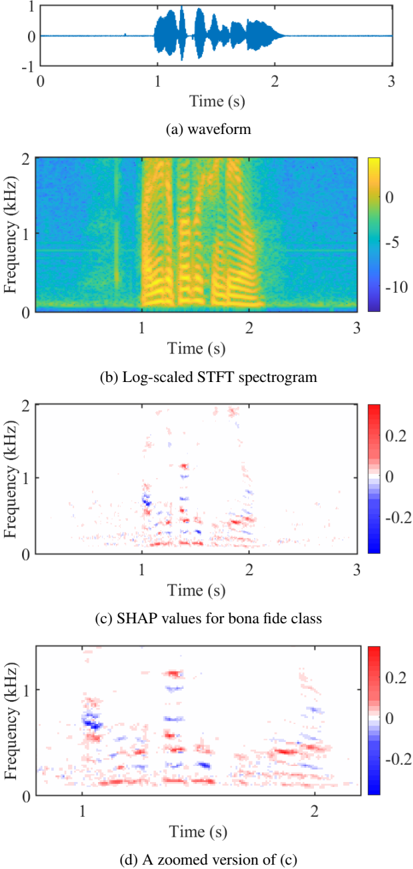
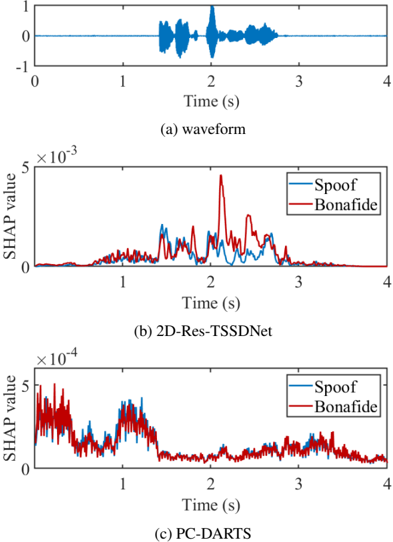
Substantial progress in spoofing and deepfake detection has been made in recent years. Nonetheless, the community has yet to make notable inroads in providing an explanation for how a classifier produces its output. The dominance of black box spoofing detection solutions is at further odds with the drive toward trustworthy, explainable artificial intelligence. This paper describes our use of SHapley Additive exPlanations (SHAP) to gain new insights in spoofing detection. We demonstrate use of the tool in revealing unexpected classifier behaviour, the artefacts that contribute most to classifier outputs and differences in the behaviour of competing spoofing detection models. The tool is both efficient and flexible, being readily applicable to a host of different architecture models in addition to related, different applications. All results reported in the paper are reproducible using open-source software.
Overview
The claims and statistics of this paper haven’t been checked yet.
Free: it reads the open-access text and checks the first 5 claims that cite a source we can check. Create a free account to check every claim.
Integrity signals
Registry
Cites
Statistics
Figures
Verification
Claims the paper makes
The claims and statistics of this paper haven’t been checked yet.
Free: it reads the open-access text and checks the first 5 claims that cite a source we can check. Create a free account to check every claim.
Claims other papers make about this one
Each is checked against this paper’s own text: does it say what the citing paper says it does?
The source backs part of the claim, not all of it — or backs it for a different population, condition or comparison.
In the citing paper
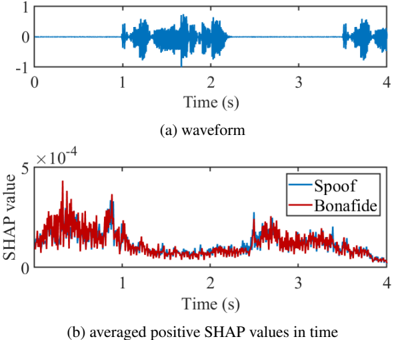
“Their findings revealed significant differences in how these models focused on speech and nonspeech intervals, with some models relying more heavily on silence duration rather than speech content to determine authenticity [167].”
From Audio Deepfake Detection: What Has Been Achieved and What Lies Ahead (2025) · cites this paper as [165]
Experimental — accuracy not yet measuredThe cited source says what the claim attributes to it.
In the citing paper
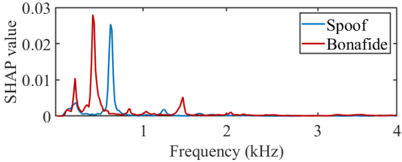
“Furthermore, the study demonstrated that different types of spoofing attacks often leave unique traces in specific frequency bands, suggesting that detection models can significantly enhance their discrimination capabilities by concentrating on these regions.”
From Audio Deepfake Detection: What Has Been Achieved and What Lies Ahead (2025) · cites this paper as [165]
Self-check
Percentages, sums and reported differences re-computed from the paper’s own numbers.
The self-check needs the paper’s full text.
Citations
Cites
Grad-CAM: Visual Explanations from Deep Networks via Gradient-Based Localization
Selvaraju, R. R., Cogswell, M., Das, A., Vedantam, R., Parikh, D., & Batra, D. (2017) · 2017 IEEE International Conference on Computer Vision (ICCV) · doi:10.1109/iccv.2017.74 · Cited by 24,513
A Unified Approach to Interpreting Model Predictions
Lundberg, S., & Lee, S.-I. (2017) · arXiv · doi:10.48550/arxiv.1705.07874 · Cited by 23,707 · cited 6×
“Drawing from concepts in cooperative game theory [29] whereby payoffs are distributed fairly to each player based on their individual contributions, SHapley Additive exPlanations (SHAP), introduced in [20], offers a more elegant and powerful approach to explain-ability.”
BackgroundMethodInfluential"Why Should I Trust You?": Explaining the Predictions of Any Classifier
Ribeiro, M. T., Singh, S., & Guestrin, C. (2016) · Proceedings of the 22nd ACM SIGKDD International Conference on Knowledge Discovery and Data Mining · doi:10.1145/2939672.2939778 · Cited by 17,555
Gauriat, C.-M., Pencolé, Y., Ribot, P., & Brouillet, G. (2024) · HAL (Le Centre pour la Communication Scientifique Directe) · doi:10.4230/oasics.dx.2024.27 · Cited by 12,586
Identity mappings in deep residual networks
He, K., Zhang, X., Ren, S., & Sun, J. (2016) · Lecture Notes in Computer Science · doi:10.1007/978-3-319-46493-0_38 · Cited by 10,741
Barredo Arrieta, A., Díaz-Rodríguez, N., Del Ser, J., Bennetot, A., Tabik, S., Barbado, A., Garcia, S., Gil-Lopez, S., Molina, D., Benjamins, R., et al. (2020) · Information Fusion · doi:10.1016/j.inffus.2019.12.012 · Cited by 10,423
17. A Value for n-Person Games
Shapley, L. S. (1953) · Contributions to the Theory of Games (AM-28), Volume II · doi:10.1515/9781400881970-018 · Cited by 6,950
Learning Important Features Through Propagating Activation Differences
Shrikumar, A., Greenside, P., & Kundaje, A. (2017) · arXiv · doi:10.48550/arxiv.1704.02685 · Cited by 2,761 · cited 1×
“(3) connects SHAP with DeepLIFT [31], an additive feature attribution method.”
MethodConsistent Individualized Feature Attribution for Tree Ensembles
Lundberg, S. M., Erion, G. G., & Lee, S.-I. (2018) · arXiv · doi:10.48550/arxiv.1802.03888 · Cited by 1,430 · cited 1×
“Full details can be found in [20,30,32].”
ASVspoof 2019: Future Horizons in Spoofed and Fake Audio Detection
Todisco, M., Wang, X., Vestman, V., Sahidullah, M., Delgado, H., Nautsch, A., Yamagishi, J., Evans, N., Kinnunen, T., & Lee, K. A. (2019) · arXiv · doi:10.48550/arxiv.1904.05441 · Cited by 688 · cited 2×
“We show a number of illustrative examples for which the input utterances, all drawn from the ASVspoof 2019 LA database [13], are chosen specially to demonstrate the potential insights which can be gained.”
BackgroundSelf-citation
Cited by
Nwakanma, C. I., Ahakonye, L. A. C., Njoku, J. N., Odirichukwu, J. C., Okolie, S. A., Uzondu, C., Ndubuisi Nweke, C. C., & Kim, D.-S. (2023) · Applied Sciences · doi:10.3390/app13031252 · Cited by 202
Audio Deepfake Detection: What Has Been Achieved and What Lies Ahead
Zhang, B., Cui, H., Nguyen, V., & Whitty, M. (2025) · Sensors · doi:10.3390/s25071989 · Cited by 72
“Ge et al. [165,166] pioneered the use of SHAP in the domain of audio deepfake detection to compare the behaviours of two detection models.”
Deepfakes as a threat to a speaker and facial recognition: An overview of tools and attack vectors
Firc, A., Malinka, K., & Hanáček, P. (2023) · Heliyon · doi:10.1016/j.heliyon.2023.e15090 · Cited by 81
Xue, J., Fan, C., Lv, Z., Tao, J., Yi, J., Zheng, C., Wen, Z., Yuan, M., & Shao, S. (2022) · Proceedings of the 1st International Workshop on Deepfake Detection for Audio Multimedia · doi:10.1145/3552466.3556526 · Cited by 40
“In addition, many studies [6, 21, 35] show that different subbands contain different discriminative information.”
BackgroundThe Impact of Silence on Speech Anti-Spoofing
Zhang, Y., Li, Z., Lu, J., Hua, H., Wang, W., & Zhang, P. (2023) · IEEE/ACM Transactions on Audio Speech and Language Processing · doi:10.1109/taslp.2023.3306711 · Cited by 53
“There are also some efforts to explain the anti-spoofing systems [35], but the impact of silence on LA anti-spoofing systems and its reasons is essential to be explored in-depth.”
BackgroundFsbi: Deepfake detection with frequency enhanced self-blended images
Abul Hasanaath, A., Luqman, H., Katib, R., & Anwar, S. (2025) · Image and Vision Computing · doi:10.1016/j.imavis.2025.105418 · Cited by 34
Acoustic Features Analysis for Explainable Machine Learning-Based Audio Spoofing Detection
Bisogni, C., Loia, V., Nappi, M., & Pero, C. (2024) · Computer Vision and Image Understanding · doi:10.1016/j.cviu.2024.104145 · Cited by 30
Explainable AI for Cybersecurity
Sindiramutty, S. R., Tan, C. E., Lau, S. P., Thangaveloo, R., Gharib, A. H., Manchuri, A. R., Khan, N. A., Tee, W. J., & Muniandy, L. (2024) · Advances in computational intelligence and robotics book series · doi:10.4018/978-1-6684-6361-1.ch002 · Cited by 35
A comprehensive survey with critical analysis for deepfake speech detection
Pham, L. D., Lam, P., Tran, D., Tang, H., Nguyen, T., Schindler, A., Skopik, F., Polonsky, A., & Vu, H. C. (2025) · Computer Science Review · doi:10.1016/j.cosrev.2025.100757 · Cited by 44
Deepfake Detection using Inception-ResNet-V2 Network
Rajalaxmi, R. R., Sudharsana, P. P., Rithani, A. M., Preethika, S., Dhivakar, P., & Gothai, E. (2023) · International Conference on Computing Methodologies and Communication (ICCMC) · doi:10.1109/iccmc56507.2023.10083584 · Cited by 30
Towards Frequency Band Explainability in Synthetic Speech Detection
Salvi, D., Bestagini, P., & Tubaro, S. (2023) · European Signal Processing Conference (EUSIPCO) · doi:10.23919/eusipco58844.2023.10289804 · Cited by 31
“For example, the authors of [10] and [11] use the SHapley Additive exPlana-tions (SHAP) [12] method to analyze the artifacts generated by synthetic speech systems, while those of [13] and [14] utilize Gradient-weighted Class Activation Mapping (Grad-CAM) [15] and Local Interpretable Model-agnostic…”
MethodAn explainable deepfake of speech detection method with spectrograms and waveforms
Yu, N., Chen, L., Leng, T., Chen, Z., & Yi, X. (2024) · Journal of Information Security and Applications · doi:10.1016/j.jisa.2024.103720 · Cited by 18
Mishra, J., Chhibber, M., Shim, H.-J., & Kinnunen, T. (2025) · Computer Speech & Language · doi:10.1016/j.csl.2025.101840 · Cited by 20
“Additionally, while Shapley values [31] in existing literature have been used to analyze contributing factors in the speech signal or spectrogram for spoofing detection [32], our work extends this approach to analyze the contribution of specific attributes towards decision-making.”
Hoang, D., Barkam, H. E., Chen, H., Rachuri, S., Mannan, N., ElKharboutly, R., Imani, M., Chen, R., & Imani, F. (2024) · CIRP journal of manufacturing science and technology · doi:10.1016/j.cirpj.2024.02.010 · Cited by 14
FairSSD: Understanding Bias in Synthetic Speech Detectors
Singh Yadav, A. K., Bhagtani, K., Salvi, D., Bestagini, P., & Delp, E. J. (2024) · 2024 IEEE/CVF Conference on Computer Vision and Pattern Recognition Workshops (CVPRW) · doi:10.1109/cvprw63382.2024.00445 · Cited by 12
“Other methods aim to produce interpretable results [24–28].”
What Does an Audio Deepfake Detector Focus on? A Study in the Time Domain
Grinberg, P., Kumar, A., Koppisetti, S., & Bharaj, G. (2025) · IEEE International Conference on Acoustics Speech and Signal Processing · doi:10.1109/icassp49660.2025.10887568 · Cited by 18
“While several papers have pursued explainable AI (XAI, [6]) for ADD [7]–[14], limited work exists on the interpretation of SSL models at raw waveform level in the time domain [15], [16].”
InfluentialListening Between the Lines: Synthetic Speech Detection Disregarding Verbal Content
Salvi, D., Balcha, T. S., Bestagini, P., & Tubaro, S. (2024) · IEEE International Conference on Acoustics, Speech, and Signal Processing Workshops (ICASSPW) · doi:10.1109/icasspw62465.2024.10669901 · Cited by 16
“For instance, the authors of [9] and [10] employ the SHapley Additive exPlanations (SHAP) method to analyze the artifacts produced by synthetic speech generators, while those of [11] and [12] utilize GradCAM and LIME algorithms to gain insight into the decision-making process of synthetic speech…”
MethodFrom Black Boxes to Glass Boxes: Explainable AI for Trustworthy Deepfake Forensics
Qian, H., Xia, L., Ge, R., Fan, Y., Wang, Q., & Jing, Z. (2025) · Cryptography · doi:10.3390/cryptography9040061 · Cited by 10
“Ge et al. [28] demonstrated the utility of SHAP for analyzing both spoofing and Deepfake detectors.”
Identity-Aware and Shape-Aware Propagation of Face Editing in Videos
Jiang, Y.-R., Chen, S., Fu, H., & Gao, L. (2023) · IEEE Transactions on Visualization and Computer Graphics · doi:10.1109/tvcg.2023.3235364 · Cited by 15
“A series of works [70], [71], [72] have studied the detection of video face manipulation and we expect that these works could be applied to reduce the impacts of malicious misuses.”
BackgroundAn Explainable Probabilistic Attribute Embedding Approach for Spoofed Speech Characterization
Chhibber, M., Mishra, J., Shim, H.-J., & Kinnunen, T. (2025) · IEEE International Conference on Acoustics Speech and Signal Processing · doi:10.1109/icassp49660.2025.10889868 · Cited by 11
Enhancing detection of epileptic seizures using transfer learning and EEG brain activity signals
Kına, E., Raza, A., Are, P. C., Rodríguez, C. L., Ballester, J. B., Díez, I. D. L. T., Butt, N. A., & Ashraf, I. (2025) · Computational and Structural Biotechnology Journal · doi:10.1016/j.csbj.2025.10.054 · Cited by 7
“The SHAP [29] is an approach used to understand the contributions of each data feature in determining the predictions made by the proposed model and produces graphical results.”
Deepfake Detection Using AI And Machine Learning Algorithms
Chandel, G., Kumar, A., Malik, K., Gurani, K., Gahlawat, K., & Saini, S. K. (2025) · International Conference on Computer, Electronics & Electrical Engineering & their Applications (IC2E3) · doi:10.1109/ic2e365635.2025.11167331 · Cited by 6
“Feature-based techniques are based on visual artifacts associated with the techniques of deepfake generation such as unnatural blinking, differences in facial movements, and lighting inconsistencies, to rely on machine learning to differentiate authentic and modified content [10] [11].”
BIM-Based Adversarial Attacks Against Speech Deepfake Detectors
Wang, W. E., Salvi, D., Negroni, V., Leonzio, D. U., Bestagini, P., & Tubaro, S. (2025) · Electronics · doi:10.3390/electronics14152967 · Cited by 9
Acoustic or Pattern? Speech Spoofing Countermeasure based on Image Pre-training Models
Lu, J., Li, Z., Zhang, Y., Wang, W., & Zhang, P. (2022) · doi:10.1145/3552466.3556524 · Cited by 8
“SHapley Additive exPla-nations (SHAP) are applied in [14] to provide explanation for the behaviour of different spoofing detection models.”
MethodLiu, D., Qin, Y., Zhao, Y., Yang, W., Hu, H., Yang, N., & Liu, B. (2022) · Sensors · doi:10.3390/s22239184 · Cited by 7
“The data has significant mining and application value, and data-driven fault diagnosis has been successfully applied in many fields, such as the field of disease medical treatment [2], the field of financial credit [3], and the field of energy [4] and electricity [5,6].”
SARA: Stress Test Reasoning in Audio Deepfake DetectionPreprint
Nguyen, B., Le, T., & Le, T. (2026) · arXiv (Cornell University) · doi:10.48550/arxiv.2601.03615 · Cited by 6
“…including occlusion sensitivity and attention roll-out for identifying influential spectral bands or temporal frames (Channing et al., 2024), temporal localization of manipulated segments (Yan et al., 2024; Xie et al., 2023), and SHAP-based attribution of spectrogram artifacts (Ge et al., 2021).”
DSVAE: Disentangled Representation Learning for Synthetic Speech Detection
Yadav, A. K. S., Bhagtani, K., Xiang, Z., Bestagini, P., Tubaro, S., & Delp, E. J. (2023) · International Conference on Machine Learning and Applications · doi:10.1109/icmla58977.2023.00072 · Cited by 6
“[33] analyzed the detector behaviour using Shapley Additive Explanations [34] and Chettri et al .”
BackgroundMethodSudharsana, P. P., Rajalaxmi, R. R., Devak, A., Gokul, R., Annamalai, R., & Gokila Brindha, P. (2024) · International Conference on Cognitive Robotics and Intelligent Systems (ICC-ROBINS) · doi:10.1109/icc-robins60238.2024.10533994 · Cited by 4
“The research study carried out in [5] outlines the utilization of SHapley Additive explanations (SHAP) to leverage more insights on spoofing detection.”
MethodFayyazi, H., & Shekofteh, Y. (2023) · Neurocomputing · doi:10.1016/j.neucom.2023.126767 · Cited by 5
Explaining Speaker and Spoof Embeddings via Probing
Liu, X., Yamagishi, J., Sahidullah, M., & Kinnunen, T. (2025) · IEEE International Conference on Acoustics Speech and Signal Processing · doi:10.1109/icassp49660.2025.10887897 · Cited by 3
“Our research is fundamentally different from earlier works on explainable neural CM [12], [13]: we put our sole focus on the explainability of representations from modern CMs.”
Leveraging distance information for generalized spoofing speech detection
Lu, J., Zhang, Y., Li, Z., Shang, Z., Wang, W., & Zhang, P. (2025) · Computer Speech & Language · doi:10.1016/j.csl.2025.101804 · Cited by 3
James, U. U., Olarinoye, H. S., Uchenna, I. R., Idika, C. N., Ngene, O. J., Ijiga, O. M., & Itemuagbor, K. (2025) · Advances in Artificial Intelligence and Robotics Research · doi:10.4236/airr.2025.11004 · Cited by 30
Fayyazi, H., & Shekofteh, Y. (2023) · International Computer Conference, Computer Society of Iran (CSICC) · doi:10.1109/csicc58665.2023.10105387 · Cited by 3
Progress In Deep Fake And Tampering : An In-Depth Analysis
S, D. C. L. (2025) · INTERANTIONAL JOURNAL OF SCIENTIFIC RESEARCH IN ENGINEERING AND MANAGEMENT · doi:10.55041/ijsrem40707 · Cited by 3
Viakhirev, I., Borodin, K., Gorodnichev, M. G., & Mkrtchian, G. (2026) · Mathematics · doi:10.3390/math14020381 · Cited by 2
“However, few studies have combined these spectral and game-theoretic methods to analyze the architectural efficiency and vulnerability of multi-branch audio anti-spoofing networks [14,15].”
A Comprehensive Survey of Deepfake Detection Methods, Datasets, and Future Directions
Doke, P., Dhotre, P. S., & Kharat, P. (2025) · IEEE Pune Section International Conference (PuneCon) · doi:10.1109/punecon67554.2025.11378238 · Cited by 2
Acoustic Phonetic Temporal Speech Representation
Deng, Y. (2025) · IEEE Workshop on Automatic Speech Recognition and Understanding (ASRU) · doi:10.1109/asru65441.2025.11434703 · Cited by 2
“To address these limitations, recent research has explored integrating explainability mechanisms, such as attention-based feature visualization and Shapley value analysis, to provide human-interpretable explanations [3].”
An Explainable Proxy Model for Multilabel Audio Segmentation
Mariotte, T., Almudévar, A., Tahon, M., & Ortega, A. (2024) · IEEE International Conference on Acoustics Speech and Signal Processing · doi:10.1109/icassp48485.2024.10446648 · Cited by 2
“Recently, a few explainable models have been developed like APNet [5], which extends the training of prototypes to the audio domain, and post-hoc visualization of explanations obtained from Shapley values [6].”
MethodFSBI: Deepfakes Detection with Frequency Enhanced Self-Blended ImagesPreprint
Hasanaath, A. A., Luqman, H., KATIB, R. F., & Anwar, S. (2024) · SSRN Electronic Journal · doi:10.2139/ssrn.4869258 · Cited by 2
How Does Instrumental Music Help Singfake Detection?
Chen, X., Hu, C., Lin, I.-M., Lin, Y., Chiu, I.-H., Zhang, Y., Huang, S.-F., Yang, Y.-H., Wu, H., & Jang, J. R. (2026) · IEEE International Conference on Acoustics Speech and Signal Processing · doi:10.1109/icassp55912.2026.11460829 · Cited by 1
ATLAS: AI-Native Receiver Test-and-Measurement by Leveraging AI-Guided Search
Belgiovine, M., Pradhan, S., Lange, J., Loehning, M., & Chowdhury, K. R. (2025) · IEEE International Symposium on Personal, Indoor and Mobile Radio Communications (PIMRC) · doi:10.1109/pimrc62392.2025.11274653 · Cited by 1
“XAI techniques like SHAP [12] help interpret unexpected behaviors by highlighting influential input features, aiding structured testing.”
Wu, H., Ji, Y., Wang, L., Liu, X., Zhou, W., Cui, L., Wang, Y., Liu, M., & Li, Z. (2026) · Biogeosciences · doi:10.5194/bg-23-967-2026 · Cited by 2
CONSTRUCTING TRUST THROUGH DECEPTION: A FORENSIC LINGUISTIC INVESTIGATION OF SCAM COMMUNICATION
Hafeez, A., & Naveed, A. (2026) · Journal of Applied Linguistics and TESOL (JALT) · doi:10.63878/jalt2298 · Cited by 1
PULMO: Precise utterance-level modeling for speech anti-spoofing
Yoon, S.-H. (2024) · Applied Acoustics · doi:10.1016/j.apacoust.2024.110221 · Cited by 2
Fredouille, C., Garnier, M., Perrotin, O., & Tahon, M. (2023) · HAL
Fsbi: Deepfakes Detection with Frequency Enhanced Self-Blended ImagesPreprint
Hasanaath, A. A., Luqman, H., KATIB, R. F., & Anwar, S. (2024) · SSRN Electronic Journal · doi:10.2139/ssrn.4876969 · Cited by 1
Explaining Deepfake Detectors to Enhance Generalization via Game-Theoretic Approaches
Zhao, W., Guo, R., Wang, D., Li, J., & Zhao, T. (2025) · International Joint Conference on Neural Networks (IJCNN) · doi:10.1109/ijcnn64981.2025.11228574
Interpretable Hybrid Deep Learning for Synthetic Voice Detection with Feature-Specific ExplanationsPreprint
Larock, J., Shajalal, M., & Stevens, G. (2025) · SSRN Electronic Journal · doi:10.2139/ssrn.5525967
A Comparative Study of Explainable AI Models in High-Stakes Decision-Making Systems
Gupta, A. S. (2023) · International Journal of Smart Systems · doi:10.63876/ijss.v1i2.72 · Cited by 1
Raj, R. K. (2026) · International Journal of Science and Research (IJSR) · doi:10.21275/sr26207024823
A Contextual and Sequential Hybrid Model for Twitter Sentiment Analysis Using BERT-LSTM
Wenting, W., Sam, S. M., Mohamed, N., & Halim, M. H. B. A. (2025) · International Conference on Advanced Technologies in Energy and Informatic (ICATEI) · doi:10.1109/icatei67676.2025.11404942
“These hybrid models leverage BERT's semantic encoding and LSTM's temporal modelling [23].”
Towards Detection of Deep Fake Videos
Mohammed Muddasir, N., Abhishek, M., J, C. C. S., & K, D. M. (2025) · Asia Pacific Conference on Innovation in Technology (APCIT) · doi:10.1109/apcit65661.2025.11411376
“[7].”
Deepfake Forensics: Threats and Detection of AI-Manipulated Media
Cardoso, P. M. C., Oliveira, R. S., Gomes, T. F. N., Bastos, E. S., & Lopes, S. F. S. F. (2026) · Advances in computational intelligence and robotics book series · doi:10.4018/979-8-3373-7660-8.ch015 · Cited by 1
Analysis o f Synthetic Video for Deepfake Video Detection Using Deep Learning
Wakode, B., & Poundekar, M. (2022) · International Journal of Research in Computer & Information Technology · doi:10.65809/ijrcit/22/v08i01/001
Pham, H. H., Chhibber, M., & Kinnunen, T. H. (2026) · SSRN Electronic Journal · doi:10.2139/ssrn.7170780
“Common approaches include integrated gradients (IG) (Sundararajan et al., 2017), which attributes importance by accumulating gradients from a baseline input; local interpretable model-agnostic explanations (LIME) (Ribeiro et al., 2016), which approximates the local behavior of a complex model using a simpler surrogate…”
Сравнительный анализ XAI-подходов для обнаружения синтетической речи
Ким, К. К. (2026) · Problems of Computational and Applied Mathematics · doi:10.71310/pcam.5_76.2026.06
ECAQ: Evidence-Constrained Audio Deepfake Answering with Artifact-Query Detection
Hu, X. (2026) · ACM International Conference on Multimedia (ACM MM) · doi:10.1145/3767308.3838615
Metadata
- Authors
- Ge, W., Patino, J., Todisco, M., & Evans, N.
- Affiliations
- EURECOM (FR)
- Venue
- ICASSP 2022 - 2022 IEEE International Conference on Acoustics, Speech and Signal Processing (ICASSP)
- Publisher
- IEEE
- Published
- 2022-05-23
- Pages
- 6387-6391
- ISSN
- 1520-6149 (ISSN-L)
- OpenAlex
- W3203575608
- Semantic Scholar
- 1dd7b41e41587b871ee51c6f0fb94379730b7e3e
- Cited by
- 40
- References
- 35
- Citations by year
- 2026: 1 · 2025: 18 · 2024: 9 · 2023: 9 · 2022: 3
- FWCI
- 5.39
- Type
- conference paper
- Language
- en
- Open access
- green
- arxiv.org
- Locations
- IEEE International Conference on Acoustics Speech and Signal Processing (publishedVersion)
- arXiv (Cornell University) (submittedVersion, cc-by)
- HAL (submittedVersion)
- Funders
- Agence Nationale de la Recherche (ANR-18-CE92-0024, ANR-19-CE23-0001)
- Topics
- Physical Sciences › Computer Science › Artificial Intelligence › Explainable Artificial Intelligence (XAI)
- Physical Sciences › Computer Science › Computer Vision and Pattern Recognition › Digital Media Forensic Detection
- Physical Sciences › Computer Science › Artificial Intelligence › Speech Recognition and Synthesis
- Keywords
- deepfake detection, anti-spoofing, explainable AI, SHAP, model interpretability, audio forensics
About these checks
Registry, retraction, Cites and statistics results are computed, not judged, with one exception: a printed reference that no index lists is read once by a model before it counts as a citation error. Claims are extracted by a model and kept only when their quote appears verbatim in the text; each cited source is then checked, with a model’s help, for whether it says what the claim relies on. Those verdicts can be wrong — read the claim’s quote and the cited source before relying on one.
Statistics and arithmetic are recomputed, not judged.
Confidence bands are shown only for fields calibrated on our annotated test set. None is calibrated yet, so no band is shown.
What counts as a claim ›How we measure confidence ›How we check this ›
Are you an author, or do you see a problem with this page? Request a review
Data sources
Bibliographic data: Semantic Scholar, OpenAlex, Crossref.
Contains information from the Semantic Scholar Academic Graph Datasets, made available under the ODC Attribution License (ODC-BY 1.0).
Semantic Scholar’s data is described in: Kinney, R., et al. (2023). The Semantic Scholar Open Data Platform. arXiv:2301.10140.
