

The DOI matches its Crossref record; 21 of the 21 references it cites were found in a registry or an index.
Nightshade: Prompt-Specific Poisoning Attacks on Text-to-Image Generative Models
Overview
The claims and statistics of this paper haven’t been checked yet.
Run the check — free, no account needed. It reads the open-access text and checks the sources it cites.
Integrity signals
Registry
Cites
Statistics
Figures

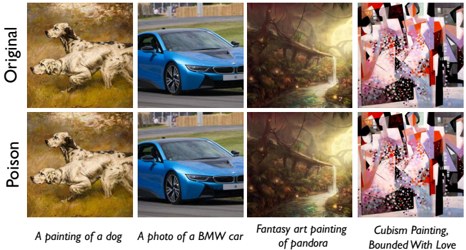
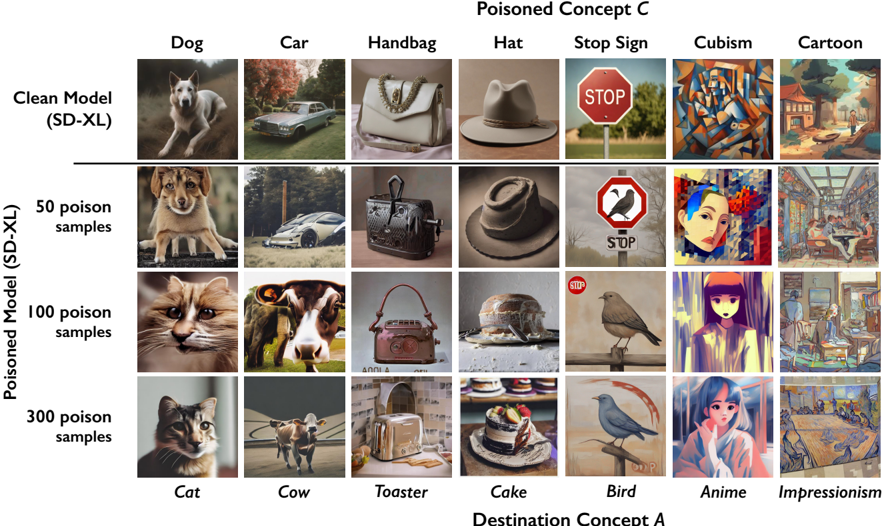
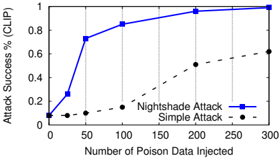
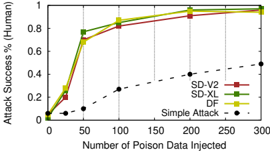
Verification
Claims the paper makes
The claims and statistics of this paper haven’t been checked yet.
Run the check — free, no account needed. It reads the open-access text and checks the sources it cites.
Claims other papers make about this one
Each is checked against this paper’s own text: does it say what the citing paper says it does?
In the citing paper
“Nightshade (Shan et al., 2024) aims to poison images so that, while still looking the same if examined by humans, a model trained on them completely misinterprets their content (e.g., wrongly detects a cat where an image contains a dog).”
From Generative AI and intellectual property: a systematic literature review of possible issues and mitigations (2026) · cites this paper as Shan et al., 2024
In the citing paper
“This can lead, during the model functioning, to produce a number of hallucinations proportional to the number of poisoned training samples involved, leaving AI developers with the sole option of re-training the model through the exclusion of the poisoned images.”
From Generative AI and intellectual property: a systematic literature review of possible issues and mitigations (2026) · cites this paper as Shan et al., 2024
Self-check
Percentages, sums and reported differences re-computed from the paper’s own numbers.
The self-check needs the paper’s full text.
Citations
Cites
High-Resolution Image Synthesis with Latent Diffusion Models
Rombach, R., Blattmann, A., Lorenz, D., Esser, P., & Ommer, B. (2022) · 2022 IEEE/CVF Conference on Computer Vision and Pattern Recognition (CVPR) · doi:10.1109/cvpr52688.2022.01042 · Cited by 20,302
Learning Transferable Visual Models From Natural Language Supervision
Radford, A., Kim, J. W., Hallacy, C., Ramesh, A., Goh, G., Agarwal, S., Sastry, G., Askell, A., Mishkin, P., Clark, J., et al. (2021) · arXiv · doi:10.48550/arxiv.2103.00020 · Cited by 15,293
GANs Trained by a Two Time-Scale Update Rule Converge to a Local Nash Equilibrium
Heusel, M., Ramsauer, H., Unterthiner, T., Nessler, B., & Hochreiter, S. (2017) · arXiv · doi:10.48550/arxiv.1706.08500 · Cited by 8,365
Show and tell: A neural image caption generator
Vinyals, O., Toshev, A., Bengio, S., & Erhan, D. (2015) · 2015 IEEE Conference on Computer Vision and Pattern Recognition (CVPR) · doi:10.1109/cvpr.2015.7298935 · Cited by 6,318 · cited 1×
“Finally, even if Nightshade poison samples were detected efficiently (see discussion in §7), Nightshade would act as proactive “do-not-train” filter that prevents models from training on these samples.”
BackgroundDeep Unsupervised Learning using Nonequilibrium Thermodynamics
Sohl-Dickstein, J., Weiss, E. A., Maheswaranathan, N., & Ganguli, S. (2015) · arXiv · doi:10.48550/arxiv.1503.03585 · Cited by 2,637
Hierarchical Text-Conditional Image Generation with CLIP Latents
Ramesh, A., Dhariwal, P., Nichol, A., Chu, C., & Chen, M. (2022) · arXiv · doi:10.48550/arxiv.2204.06125 · Cited by 2,511 · cited 5×
“Today, latent diffusion is used in almost all state-of-the-art models [22, 23, 24, 25, 26].”
BackgroundMethodInfluentialDreamBooth: Fine Tuning Text-to-Image Diffusion Models for Subject-Driven Generation
Ruiz, N., Li, Y., Jampani, V., Pritch, Y., Rubinstein, M., & Aberman, K. (2022) · arXiv · doi:10.48550/arxiv.2208.12242 · Cited by 2,442
AttnGAN: Fine-Grained Text to Image Generation with Attentional Generative Adversarial Networks
Xu, T., Zhang, P., Huang, Q., Zhang, H., Gan, Z., Huang, X., & He, X. (2018) · 2018 IEEE/CVF Conference on Computer Vision and Pattern Recognition · doi:10.1109/cvpr.2018.00143 · Cited by 1,923
Conceptual Captions: A Cleaned, Hypernymed, Image Alt-text Dataset For Automatic Image Captioning
Sharma, P., Ding, N., Goodman, S., & Soricut, R. (2018) · Proceedings of the 56th Annual Meeting of the Association for Computational Linguistics (Volume 1: Long Papers) · doi:10.18653/v1/p18-1238 · Cited by 1,879
Li, J., Li, D., Xiong, C., & Hoi, S. (2022) · arXiv · doi:10.48550/arxiv.2201.12086 · Cited by 1,741
Research works printed but not linked: 58
- Rincon, 2023, Virtually try on clothes with a new AI shopping feature, Google Blog
- 2023, Virtual try-on for clothing: The future of fashion?, 3dlook.ai
- 2023, Create logos, videos, banners, mockups with AI in 2 minutes, designs.ai
- Andersen, 2022, The Alt-Right Manipulated My Comic. Then A.I. Claimed It
- Yang, 2022, Why Artists are Fed Up with AI Art
- Adobe Max conference
- 10.1109/CVPR52729.2023.00393 · DOI
- 10.1109/CVPR52729.2023.00391 · DOI
- 10.1145/3581783.3612108 · DOI
- Shan, Glaze: Protecting artists from style mimicry by text-to-image models
- Liang, Adversarial example does good: Preventing painting imitation from diffusion models via adversarial examples
- 10.1109/CVPR.2019.00595 · DOI
- Ding, Cogview: Mastering text-to-image generation via transformers
- Ramesh, Zero-shot text-to-image generation
- 10.1109/CVPR46437.2021.00356 · DOI
- 2022, What the heck is Civitai?
- 10.1109/CVPR52729.2023.02155 · DOI · Paper page
- 10.1109/CVPR46437.2021.00614 · DOI
- 10.1109/CVPR.2018.00175 · DOI · Paper page
- 10.1145/3485832.3485837 · DOI
- 10.1609/aaai.v34i07.6871 · DOI · Paper page
- Zhu, Transferable clean-label poisoning attacks on deep neural nets
- 10.1109/SP.2019.00031 · DOI
- Qiao, Defending neural backdoors via generative distribution modeling
- Shan, Poison forensics: Traceback of data poisoning attacks in neural networks
- 10.1609/aaai.v35i9.16971 · DOI
- 10.1145/3319535.3354209 · DOI
- Severi, Explanation-guided backdoor poisoning attacks against malware classifiers
- Bagdasaryan, Blind backdoors in deep learning models
- Schuster, You autocomplete me: Poisoning vulnerabilities in neural code completion
- 10.1109/cvpr52733.2024.02299 · DOI
- Yang, Data poisoning attacks against multimodal encoders
- 10.1109/spw63631.2024.00019 · DOI
- Gu, Badnets: Identifying vulnerabilities in the machine learning model supply chain
- Biggio, Support vector machines under adversarial label noise
- Schuhmann, 2022, LAION-aesthetics, LAION.AI
- Bond, A survey of wordnets and their licenses
- Midjourney user prompts; generated images (250k)
- Fellbaum, 2005, WordNet and wordnets. Encyclopedia of Language and Linguistics.
- 10.1109/sp54263.2024.00061 · DOI
- 10.1109/EuroSP51992.2021.00021 · DOI
- Schwarzschild, Just how toxic is data poisoning? a unified benchmark for backdoor and data poisoning attacks, 9389
- 10.1109/CVPR.2018.00068 · DOI · Paper page
- Nocedal, 2006, Numerical optimization
- 10.1109/cvprw63382.2024.00182 · DOI
- 10.1007/978-3-319-10602-1_48 · DOI · Paper page
- 10.1145/3658644.3670306 · DOI
- Vahdat, Score-based generative modeling in latent space
- Park, Benchmark for compositional text-to-image synthesis
- Shan, Fawkes: Protecting privacy against unauthorized deep learning models
- 10.1109/SP46214.2022.9833572 · DOI
- Shumailov, 2023, The curse of recursion: Training on generated data makes models forget, arxiv:2305.17493 · arXiv
- Lee, Personalizing text-to-image generation with visual prompts using BLIP-2
- 10.1109/CVPR46437.2021.00252 · DOI
- 10.1145/3372297.3417231 · DOI
- Xiang, 2022, AI is probably using your images and it’s not easy to opt out, Motherboard, Tech by Vice
- David, 2023, Now you can block OpenAI’s web crawler, The Verge
- Neel, Descent-to-delete: Gradient-based methods for machine unlearning
Cited by
A survey on large language model (LLM) security and privacy: The Good, The Bad, and The Ugly
Yao, Y., Duan, J., Xu, K., Cai, Y., Sun, Z., & Zhang, Y. (2024) · High-Confidence Computing · doi:10.1016/j.hcc.2024.100211 · Cited by 1,083
Governance of Generative AI in Creative Work: Consent, Credit, Compensation, and Beyond
Kyi, L., Mahuli, A., Silberman, M. S., Binns, R., Zhao, J., & Biega, A. J. (2025) · Proceedings of the 2025 CHI Conference on Human Factors in Computing Systems · doi:10.1145/3706598.3713799 · Cited by 28
Arnaudo, A., Coppola, R., Morisio, M., Vetrò, A., Borghi, M., Raso, R., & Khan, B. (2026) · PeerJ Computer Science · doi:10.7717/peerj-cs.3928 · Cited by 2
Jiang, N., Sun, B., Kim, N., Sim, T., & Han, J. (2026) · 2026 IEEE Symposium on Security and Privacy Workshops (SPW) · doi:10.1109/spw72489.2026.00029
Metadata
- Authors
- Shan, S., Ding, W., Passananti, J., Wu, S., Zheng, H., & Zhao, B. Y.
- Affiliations
- University of Chicago,Department of Computer Science
- Venue
- 2024 IEEE Symposium on Security and Privacy (SP)
- Publisher
- IEEE
- Published
- 2024-05-19
- Pages
- 807-825
- Cited by
- 93
- References
- 21
About these checks
Registry, retraction, Cites and statistics results are computed, not judged, with one exception: a printed reference that no index lists is read once by a model before it counts as a citation error. Claims are extracted by a model and kept only when their quote appears verbatim in the text; each cited source is then checked, with a model’s help, for whether it says what the claim relies on. Those verdicts can be wrong — read the claim’s quote and the cited source before relying on one.
Statistics and arithmetic are recomputed, not judged.
Confidence bands are shown only for fields calibrated on our annotated test set. None is calibrated yet, so no band is shown.
What counts as a claim ›How we measure confidence ›How we check this ›
Are you an author, or do you see a problem with this page? Request a review
How to cite
Cite CoChat for the checks on this page, and the paper for its own findings.
- This page
- CoChat. (2026). Citation check: Nightshade: Prompt-Specific Poisoning Attacks on Text-to-Image Generative Models. https://app.cochat.ai/papers/10.1109/sp54263.2024.00207
- The paper
- Shan, S., Ding, W., Passananti, J., Wu, S., Zheng, H., & Zhao, B. Y. (2024). Nightshade: Prompt-Specific Poisoning Attacks on Text-to-Image Generative Models. 2024 IEEE Symposium on Security and Privacy (SP). https://doi.org/10.1109/sp54263.2024.00207
