

Sim-to-Real Transfer in Deep Reinforcement Learning for Robotics: a Survey
Open accessThe DOI matches its Crossref record; 99 of the 99 references it cites were found in a registry or an index; 49 of the 90 sources its claims cite were checked for support.
Abstract
Deep reinforcement learning has recently seen huge success across multiple areas in the robotics domain. Owing to the limitations of gathering real-world data, i.e., sample inefficiency and the cost of collecting it, simulation environments are utilized for training the different agents. This not only aids in providing a potentially infinite data source, but also alleviates safety concerns with real robots. Nonetheless, the gap between the simulated and real worlds degrades the performance of the policies once the models are transferred into real robots. Multiple research efforts are therefore now being directed towards closing this sim-toreal gap and accomplish more efficient policy transfer. Recent years have seen the emergence of multiple methods applicable to different domains, but there is a lack, to the best of our knowledge, of a comprehensive review summarizing and putting into context the different methods. In this survey paper, we cover the fundamental background behind sim-to-real transfer in deep reinforcement learning and overview the main methods being utilized at the moment: domain randomization, domain adaptation, imitation learning, meta-learning and knowledge distillation. We categorize some of the most relevant recent works, and outline the main application scenarios. Finally, we discuss the main opportunities and challenges of the different approaches and point to the most promising directions.
Overview
CoChat Summary
TL;DR
This survey reviews sim-to-real transfer in deep reinforcement learning for robotics, covering domain randomization, domain adaptation, imitation learning, meta-learning, and knowledge distillation. It identifies domain randomization as the most widely adopted method and outlines application scenarios, challenges, and promising directions.
Key findings
- The main sim-to-real methods reviewed are domain randomization, domain adaptation, imitation learning, meta-learning, and knowledge distillation; domain randomization is identified as the most widely adopted method.
- Domain randomization is divided into visual randomization and dynamics randomization: visual randomization targets robotic vision tasks such as object localization, detection, pose estimation, and semantic segmentation, while dynamics randomization helps acquire robust control policies. For dexterous in-hand manipulation, one work randomizes object dimensions, object and robot link masses, surface friction coefficients, robot joint damping coefficients, and actuator force gains.
- Application scenarios include dexterous robotic manipulation (e.g., peg-in-hole, deformable object manipulation, multi-fingered hands, force control) and robotic navigation (e.g., six-legged robots, depth-based mapless navigation, soccer competitions), plus other applications such as plasma jet control, tactile sensing, and multi-agent manipulation.
- Stated challenges include the lack of formal explanation for why domain randomization works, the homogeneous feature-space assumption in most domain adaptation algorithms, and the need for wider theoretical and empirical studies; promising directions include integrating different methods and using incremental complexity learning, continual learning, and reward shaping.
Methods
- This is a survey/review paper, not an experimental study; it reviews fundamental background and recent works on sim-to-real transfer in DRL for robotics.
- It classifies relevant publications in Table I by real robot/platform, learning algorithm, knowledge transfer, simulator/engine, multi-agent learning, and sim-to-real transfer/learning details.
- The analysis is a qualitative synthesis of literature covering zero-shot transfer, system identification, domain randomization, domain adaptation, learning with disturbances, simulation environments, and application areas; no dataset or sample size is reported.
Limitations
- The paper states that for domain randomization it is hard to formally explain how and why it works, making efficient simulation and randomization distribution design difficult; for domain adaptation, most existing algorithms focus on homogeneous deep domain adaptation and assume the same feature spaces between source and target domains, which may not hold in many applications.
- The paper states that wider theoretical and empirical studies are required to better understand these techniques, and that generalization of existing results with more comprehensive analysis is lacking.
- The paper states its scope excludes specific simulators or techniques for direct learning in real-world settings, focuses on works specifically tackling sim-to-real transfer, and notes that sim-to-real literature for robotic navigation is sparse. Evident from the text: as a survey, it presents no primary experimental validation or quantitative benchmark results; Table I is a classification rather than a comparative performance evaluation.
Model-written summary. Check it against the paper before relying on it.
Integrity signals
Registry
Cites
Statistics
Figures
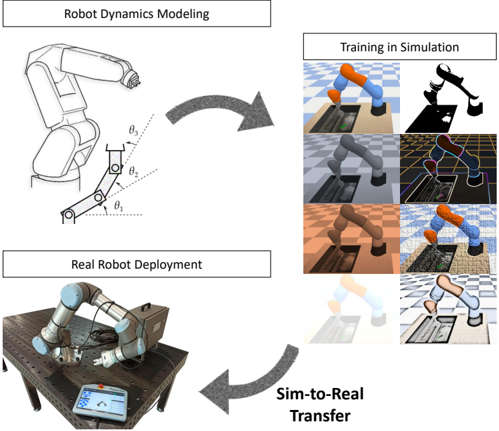
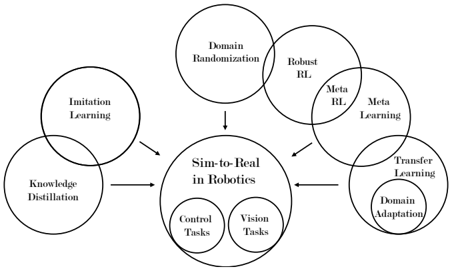
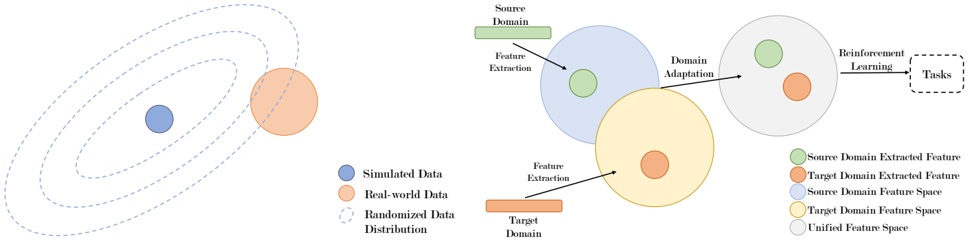
Verification
Claims the paper makes
24 Valid · 8 Not valid · 17 Not checked · 26 Own results and interpretations
The cited sources support only part of this claim — read each source’s verdict below.
In the paper
“From the literature, we summarize three common methods for domain adaptation regardless of their tasks. They are discrepancy-based , adversarial-based , and reconstructionbased methods, which can be also used crossly.”
What the sources say
- Partly supportedcites [65] [65] Eric Tzeng, Judy Hoffman, Ning Zhang, Kate Saenko, and Trevor Darrell. Deep domain confusion: Maximizing for domain invariance. arXiv:1412.3474 , 2014. 67. sourceExperimental — accuracy not yet measured
The Introduction (p. 1) and Section 3 (p. 3) describe a domain-adaptation method that minimizes maximum mean discrepancy, supporting the discrepancy-based part of the claim. The paper does not present adversarial-based and reconstruction-based methods alongside it as three common categories of domain adaptation. (LLM, conf=0.82)
- Not checked yetcites [68] [68] Yaroslav Ganin, Evgeniya Ustinova, Hana Ajakan, Pascal Germain, Hugo Larochelle, Franc ¸ois Laviolette, Mario Marchand, and Victor Lempitsky. Domain-adversarial training of neural networks. The Journal of Machine Learning Research , 17(1), 2016. - source
Checked before — its earlier verdict is held back until a new check runs.
- Partly supportedcites [71] [71] Konstantinos Bousmalis, George Trigeorgis, Nathan Silberman, Dilip Krishnan, and Dumitru Erhan. Domain separation networks. In Advances in neural information processing systems , 2016. - sourceExperimental — accuracy not yet measured
Related Work (p. 2) discusses adversarial training and MMD-based alignment, while the Discussion (p. 8) describes a reconstruction loss used with either DANN or MMD. The paper therefore illustrates the three approaches and their combination, but it does not present them as a three-part classification of common domain-adaptation methods regardless of task; its review focuses on CNN-based unsupervised adaptation. (LLM, conf=0.84)
plain- Asserted: passes — The authors put it forward as true.
- Checkable: passes — It can be checked against evidence.
- Load-bearing: unclear — It is unclear whether the paper’s conclusions depend on it.
- Based: passes — The paper gives a reason why it holds.
- Partly supported
The cited sources support only part of this claim — read each source’s verdict below.
In the paper
“In those cases where system identification for one-shot transfer is the objective, researchers have often built or customized specific simulations that meet problem-specific requirements and constraints [32], [36], [41].”
What the sources say
- Not checked — no full text of the sourcecites [32] [32] Matthew Witman, Dogan Gidon, David B Graves, Berend Smit, and Ali Mesbah. Sim-to-real transfer reinforcement learning for control of thermal effects of an atmospheric pressure plasma jet. Plasma Sources Science and Technology , 28(9), 2019. - source
- Partly supportedcites [36] [36] Hansenclever F Bassani, Renie A Delgado, Jose Nilton de O Lima Junior, Heitor R Medeiros, Pedro HM Braga, and Alain Tapp. Learning to play soccer by reinforcement and applying sim-to-real to compete in the real world. arXiv:2003.11102 , 2020. - sourceExperimental — accuracy not yet measured
The passages labeled 25 and 44 describe a customized soccer simulation environment designed for the paper’s RL and sim-to-real problem. They do not describe system identification or one-shot transfer as its objective, or establish that researchers have often taken this approach. (LLM, conf=0.86)
- Partly supportedcites [41] [41] Andrew Hundt, Benjamin Killeen, Heeyeon Kwon, Chris Paxton, and Gregory D Hager. ' good robot!': Efficient reinforcement learning for multi-step visual tasks via reward shaping. arXiv:1909.11730 , 2019. - sourceExperimental — accuracy not yet measured
The Simulation Experiments section (p. 5) describes two simulated tasks of the authors’ design, and the Real World Experiments section (p. 7) reports direct transfer of models trained in simulation. The paper does not describe system identification as the objective or establish that researchers often build or customize simulations to meet problem-specific constraints. (LLM, conf=0.76)
plainstates an association- Asserted: passes — The authors put it forward as true.
- Checkable: passes — It can be checked against evidence.
- Load-bearing: unclear — It is unclear whether the paper’s conclusions depend on it.
- Based: passes — The paper gives a reason why it holds.
The sources with a verdict support this claim; the rest weren’t checked yet, have no full text we could read, or their verdicts aren’t rated yet.
In the paper
“An exception to this is, however, robotic tasks involving object manipulation [5], [6].”
What the sources say
- Not checked — no full text of the sourcecites [5] [5] Aravind Rajeswaran, Vikash Kumar, Abhishek Gupta, Giulia Vezzani, John Schulman, Emanuel Todorov, and Sergey Levine. Learning complex dexterous manipulation with deep reinforcement learning and demonstrations. arXiv:1709.10087 , 2017. - source
- Supportedcites [6] [6] Jan Matas, Stephen James, and Andrew J Davison. Sim-to-real reinforcement learning for deformable object manipulation. arXiv:1806.07851 , 2018. - source
Section 5.3 (p. 8) reports testing simulation-trained policies on a real robot for three cloth-manipulation tasks. Table 2 (p. 8) reports real-world successes without additional training, supporting this paper as an example of deep reinforcement learning succeeding beyond simulation in object manipulation. (LLM, conf=0.90)
plain- Asserted: passes — The authors put it forward as true.
- Checkable: passes — It can be checked against evidence.
- Load-bearing: unclear — It is unclear whether the paper’s conclusions depend on it.
- Based: passes — The paper gives a reason why it holds.
The cited sources support only part of this claim — read each source’s verdict below.
In the paper
“In robotic vision tasks including object localization [53], object detection [54], pose estimation [55], and semantic segmentation [56], the training data from simulator always have different textures, lighting, and camera positions from the realistic environments.”
What the sources say
- Partly supportedcites [53] [53] Josh Tobin, Rachel Fong, Alex Ray, Jonas Schneider, Wojciech Zaremba, and Pieter Abbeel. Domain randomization for transferring deep neural networks from simulation to the real world. In IROS , 2017. - sourceExperimental — accuracy not yet measured
The Introduction (p. 1) describes a reality gap between simulated camera images and real-world images, and its Fig. 1 caption says this study randomizes camera positions, lighting, and non-realistic textures. But the claim's “always” extends that description to all simulator training data; Bridging the reality gap (p. 2) also describes approaches that make simulation closely match physical reality. (LLM, conf=0.88)
- Could not verifycites [54] [54] Jonathan Tremblay, Aayush Prakash, David Acuna, Mark Brophy, Varun Jampani, Cem Anil, Thang To, Eric Cameracci, Shaad Boochoon, and Stan Birchfield. Training deep networks with synthetic data: Bridging the reality gap by domain randomization. In CVPR Workshops , 2018. - sourceExperimental — accuracy not yet measured
Our copy of Arndt et al. (ICRA 2020) deals only with dynamics-side sim-to-real transfer: the Introduction (p. 1) frames the problem as the need for 'an accurate match between the simulation and real-world... because the simulation may not model some of the physical phenomena present in real world,' and the paper explicitly 'consider[s] tasks that are heavily dependent on the dynamic parameters of the environment' (hockey-puck friction/mass, Sections III-V). The nearest passage is Section II-B (p. 2), noting that domain randomization 'can be applied both to perception [8], [21]-[23] and to the dynamics of the system [24], [25]' — it credits perception work but never states that simulator training data differ in textures, lighting, or camera positions, and it does not discuss object localization, detection, pose estimation, or semantic segmentation. Searched: textures/lighting/camera positions, visual appearance gap, perception domain randomization; no passage in our copy addresses the claim's specific point, so it can be neither confirmed nor contradicted here. (LLM, conf=0.70)
- Not checked yetcites [55] [55] Martin Sundermeyer, Zoltan-Csaba Marton, Maximilian Durner, Manuel Brucker, and Rudolph Triebel. Implicit 3d orientation learning for 6d object detection from rgb images. In ECCV , 2018. - source
Checked before — its earlier verdict is held back until a new check runs.
plain- Asserted: passes — The authors put it forward as true.
- Checkable: passes — It can be checked against evidence.
- Load-bearing: passes — The paper’s conclusions depend on it.
- Based: passes — The paper gives a reason why it holds.
- Partly supported
Every source the paper cites for this claim was checked and supports it.
In the paper
“Moreover, a relevant conclusion from this work is that excessive domain randomization can be detrimental. Specifically, when the number of different colors that were being used for each texture was too large, the performance of the real robot was significantly worse.”
What the sources say
- Supportedcites [6] [6] Jan Matas, Stephen James, and Andrew J Davison. Sim-to-real reinforcement learning for deformable object manipulation. arXiv:1806.07851 , 2018. - source
Section 5.3 (p. 8) reports that heavy domain randomisation was detrimental: sampling texture colours uniformly across all colours made the agent’s performance after transfer significantly worse. This supports the citing sentence’s description of excessive colour variation harming real-robot performance. (LLM, conf=0.93)
plainstates a cause- Asserted: passes — The authors put it forward as true.
- Checkable: passes — It can be checked against evidence.
- Load-bearing: passes — The paper’s conclusions depend on it.
- Based: passes — The paper gives a reason why it holds.
- Supported
8 more claims
Create a free account to see all 75 claims and to verify the 19 references still open.
- Probably not a substantial claim. 48
- It may state two separate claims as one. 27
Claims other papers make about this one
Each is checked against this paper’s own text: does it say what the citing paper says it does?
The cited source says what the claim attributes to it.
In the citing paper
“Simulation-based approaches provide a cheap and safe development environment for RMSes, but there are challenges to deploying simulation-trained systems into real-world settings [62].”
From Data-Driven Robotic Manipulation of Cloth-like Deformable Objects: The Present, Challenges and Future Prospects (2023) · cites this paper as [62]
The cited source says what the claim attributes to it.
In the citing paper
“Consequently, simulation-to-reality (Sim2Real) transfer [62] (Section 3.4) becomes a key technology in modern robotics for bridging the gap between the simulation-trained policy and the real-world deployment.”
From Data-Driven Robotic Manipulation of Cloth-like Deformable Objects: The Present, Challenges and Future Prospects (2023) · cites this paper as [62]
Citations
Cites
Continuous control with deep reinforcement learning
Lillicrap, T. P., Hunt, J. J., Pritzel, A., Heess, N., Erez, T., Tassa, Y., Silver, D., & Wierstra, D. (2015) · arXiv · doi:10.48550/arxiv.1509.02971 · Cited by 10,782
Proximal Policy Optimization Algorithms
Schulman, J., Wolski, F., Dhariwal, P., Radford, A., & Klimov, O. (2017) · arXiv · doi:10.48550/arxiv.1707.06347 · Cited by 10,625 · cited 2×
“The variability in terms of learning algorithms is higher, with DRL using proximal policy optimization (PPO) [45], trust region policy optimization (TRPO) [46], maximum a-posteriori policy optimization (MPO) [47], asynchronous actor critic (A3C) methods [48], soft actor critic (SAC) [49], or deep deterministic policy…”
BackgroundDomain-Adversarial Training of Neural Networks
Ganin, Y., Ustinova, E., Ajakan, H., Germain, P., Larochelle, H., Laviolette, F., Marchand, M., & Lempitsky, V. (2017) · Advances in Computer Vision and Pattern Recognition · doi:10.1007/978-3-319-58347-1_10 · Cited by 8,318
Asynchronous Methods for Deep Reinforcement Learning
Mnih, V., Badia, A. P., Mirza, M., Graves, A., Lillicrap, T. P., Harley, T., Silver, D., & Kavukcuoglu, K. (2016) · arXiv · doi:10.48550/arxiv.1602.01783 · Cited by 7,132 · cited 1×
“The variability in terms of learning algorithms is higher, with DRL using proximal policy optimization (PPO) [45], trust region policy optimization (TRPO) [46], maximum aposteriori policy optimization (MPO) [47], asynchronous actor critic (A3C) methods [48], soft actor critic (SAC) [49], or deep deterministic policy g…”
BackgroundA Comprehensive Survey on Transfer Learning
Zhuang, F., Qi, Z., Duan, K., Xi, D., Zhu, Y., Zhu, H., Xiong, H., & He, Q. (2021) · Proceedings of the IEEE · doi:10.1109/jproc.2020.3004555 · Cited by 6,678 · cited 2×
“Transfer learning aims at improving the performance of target learners on target domains by transferring the knowledge contained in different but related source domains [18].”
BackgroundSoft actor-critic Off-policy maximum entropy deep reinforcement learning with a stochastic actor
Haarnoja, T., Zhou, A., Abbeel, P., & Levine, S. (2018) · arXiv · doi:10.48550/arxiv.1801.01290 · Cited by 5,594 · cited 2×
“The variability in terms of learning algorithms is higher, with DRL using proximal policy optimization (PPO) [45], trust region policy optimization (TRPO) [46], maximum a-posteriori policy optimization (MPO) [47], asynchronous actor critic (A3C) methods [48], soft actor critic (SAC) [49], or deep deterministic policy…”
BackgroundMuJoCo: A physics engine for model-based control
Todorov, E., Erez, T., & Tassa, Y. (2012) · 2012 IEEE/RSJ International Conference on Intelligent Robots and Systems · doi:10.1109/iros.2012.6386109 · Cited by 4,767 · cited 3×
“The most widely used simulators in the literature are Gazebo [74], Unity3D, and PyBullet [75] or MuJoCo [17].”
BackgroundMethodDeep Reinforcement Learning: A Brief Survey
Arulkumaran, K., Deisenroth, M. P., Brundage, M., & Bharath, A. A. (2017) · IEEE Signal Processing Magazine · doi:10.1109/msp.2017.2743240 · Cited by 4,733
A Brief Survey of Deep Reinforcement Learning
Arulkumaran, K., Deisenroth, M. P., Brundage, M., & Bharath, A. A. (2017) · arXiv · doi:10.48550/arxiv.1708.05866 · Cited by 4,733
Trust region policy optimization
Schulman, J., Levine, S., Moritz, P., Jordan, M. I., & Abbeel, P. (2015) · arXiv · doi:10.48550/arxiv.1502.05477 · Cited by 4,578
Research works printed but not linked: 6
- [75] Erwin Coumans and Yunfei Bai. Pybullet, a python module for physics simulation for games, robotics and machine learning. 2016. -
- [35] J van Baar, R Corcodel, A Sullivan, D Jha, D Romeres, and D Nikovski. Simulation to real transfer learning with robustified policies for robot tasks. 2018. -
- [52] Joshua P Tobin. Real-World Robotic Perception and Control Using Synthetic Data . PhD thesis, UC Berkeley, 2019. -
- [40] Manuel Kaspar and J¨ urgen Bock. Reinforcement learning with cartesian commands and sim to real transfer for peg in hole tasks. -
- [4] Javier Garcıa and Fernando Fern´ andez. A comprehensive survey on safe reinforcement learning. Journal of Machine Learning Research , 16(1), 2015. -
- [42] Ole-Magnus Pedersen. Sim-to-real transfer of robotic gripper pose estimation-using deep reinforcement learning, generative adversarial networks, and visual servoing. Master's thesis, NTNU, 2019. -
Cited by
Items 701–778 of 778
Pose-Constrained Path Optimization for Manipulators with Contact Feedback from Sparse Waypoints
Kasahara, Y., Kobayashi, Y., Hayakawa, T., et al. (2026) · Robotics · doi:10.3390/robotics15060108
“Furthermore, efforts to improve learning efficiency through sim-to-real transfer and integration with imitation learning have been investigated [11,12].”
Sim2Real Policy Transfer in Distributed Systems Using State-Based Potential Games
Yuwono, S., Musthafa, R., Schwung, D., & Schwung, A. (2026) · AI for Engineering · doi:10.3390/aieng1010004
“Policy Transfer in Sim2Real is a huge topic in robotics and machine learning to solve problems related to transferring policies trained in simulated environments to real-world applications [44,47].”
yan, Z., Liu, C. P., Jiang, Y., et al. (2026) · International Symposium on Medical Robotics · doi:10.1109/ismr69606.2026.11536616
“The controller is first pre-trained in a physics-based simulation environment, and then fine-tuned on the real platform through a sim-to-real training pipeline[15].”
Range-Level Preloading With Scalable Watch-Time Estimation for Billion-User Streaming Systems
Zhang, Y., Fan, Z., Liu, T., et al. (2026) · IEEE Transactions on Networking · doi:10.1109/ton.2026.3697930
“These discrepancies collectively contribute to a pronounced sim-to-real gap [36].”
Hu, Y., Huang, Y., Jones, C. K., China, D., Xu, H., Basar, B., Paitel, Y., Helm, P. A., & Uneri, A. (2026) · IEEE Transactions on Medical Robotics and Bionics · doi:10.1109/tmrb.2026.3699227 · Cited by 1
“As an alternative, training in silico (i.e., in simulated environments) o ff ers not only a scalable data source but also mitigates safety concerns with real robots, especially in medical applications [28].”
Hierarchical planning and control for multi-UAV cooperative encirclement in complex environments
Jing, C. H. U., ZHANG, N., Huang, Y., et al. (2026) · Xibei Gongye Daxue Xuebao/Journal of Northwestern Polytechnical University · doi:10.1051/jnwpu/20264420380
Digital twins in advanced robotics
Kaarlela, T., Pitkäaho, T., Bobadilla, L., Fuentes, J., Padrão, P., & Dianatfar, M. (2026) · Elsevier eBooks · doi:10.1016/b978-0-443-43896-7.00033-9
Tanaka, K. (2026) · Journal of the Robotics Society of Japan · doi:10.7210/jrsj.44.456
Adaptive Time-Domain Simulation of Optical Cavities with Arbitrary Dynamics
Svizzeretto, A., Diaz, J. C., Swinkels, B. L., et al. (2026) · Photonics · doi:10.3390/photonics13070605
“Its stepwise formulation naturally interfaces with discrete-time control algorithms, enabling realistic training conditions and supporting an effective sim-to-real transfer [12].”
A simulated-crowd guided augmentation training framework for realistic crowd-aware robot navigation
Dang, M., Tung, T. X., Truong, V. D., Binh, D. V., & Binh, D. V. (2025) · Journal of Military Science and Technology · doi:10.54939/1859-1043.j.mst.csce9.2025.92-100
Liu, S., Liu, Y., Sun, Q., Li, C., Zhu, R., Cao, X., Jiang, Q., Wang, J., & Zhou, W. (2026) · SSRN Electronic Journal · doi:10.2139/ssrn.7009889
Park, H., & Lee, S.-H. (2026) · Lecture notes in computer science · doi:10.1007/978-3-032-37167-6_3
Mind the Gap: Quantifying Behavioral Fidelity in CARLA Using Naturalistic Drone Data
Rebling, P., Alphan, M., & Nenninger, P. (2026) · SAE technical papers on CD-ROM/SAE technical paper series · doi:10.4271/2026-01-0771
Jin, Z., Wang, H., Tang, Y., Dong, Z., Feng, C., & Shao, Y. (2026) · SSRN Electronic Journal · doi:10.2139/ssrn.7029004
Pathways to learning: exploring high school students’ learning of AI-powered educational robotics
McLaughlin, G. H., Novak, E., Ahmadi, S., Li, J., Guo, Y., Liu, R., & Borgerding, L. A. (2026) · Educational Technology Research and Development · doi:10.1007/s11423-026-10651-w · Cited by 3
Sadeghiamirshahidi, N., Kamali, S. E., & Dere, B. R. R. (2026) · Applied Sciences · doi:10.3390/app16136574 · Cited by 3
Deep Reinforcement Learning for Collision-Aware Leader–Follower Formation Control
Romaniuk, S., & Budnik, J. (2026) · Sensors · doi:10.3390/s26134162
“The tests are motivated by sim-to-real and domain-randomization https://doi.org/10.3390/s26134162 studies, where observation uncertainty, dynamics mismatch, and actuator-effectiveness changes commonly degrade performance [26–28].”
InfluentialCai, Y., Zhang, X., Liu, S., LOU, J., & Yuan, C. (2026) · Nonlinear Dynamics · doi:10.1007/s11071-026-12695-2 · Cited by 1
Vu, X. T., Nguyen, V. T., Luu, D. T., et al. (2026) · Mechanisms and machine science · doi:10.1007/978-3-032-29469-2_35
Peng, T.-J., Lin, C.-C., & Lin, S.-N. (2026) · SSRN Electronic Journal · doi:10.2139/ssrn.7067366
Exploring Procedural Content Generation of 3D City Scenes for 2D Semantic Segmentation
Gallego, N. P. D., & Peña, R. M. N. (2026) · Lecture notes in computer science · doi:10.1007/978-3-032-22261-9_27
Federated Energy-Aware Deep Reinforcement Learning for GNSS-Independent Swarm UAV Autonomy
Almalis, N. D., Tsihrintzis, G. A., Baris, G., & Armenakis, N. (2026) · Electronics · doi:10.3390/electronics15143064
Abellán-Galiana, P., Pérez-Grau, F. J., Viguria, A., & Ollero, A. (2026) · International Conference on Unmanned Aircraft Systems (ICUAS) · doi:10.1109/icuas69441.2026.11598742
“The review presented in [12] analyzes sim-to-real transfer techniques in robotics, emphasizing domain randomization and system identification as key strategies to improve policy robustness across environments.”
Conservative Cost-Aware SAC-Lagrangian for Safe UAV Autonomous Navigation
Liu, J., & Valavanis, K. P. (2026) · International Conference on Unmanned Aircraft Systems (ICUAS) · doi:10.1109/icuas69441.2026.11598642
“As part of ongoing work, this framework will serve as a foundation for sim-to-real transfer [17], [18].”
Hnaien, I. B., Gascard, E., Simeu-Abazi, Z., & Dhouibi, H. (2026) · International Journal of Data Science and Analytics · doi:10.1007/s41060-026-01200-y
“Despite promising adaptability, RL is still constrained by data requirements and the sim-to-real transfer challenge [30].”
Neural-Network-Based Predictive Control for LLC Converters
Sui, Q., Yu, Z., Martinez, W. H., et al. (2026) · International Power Electronics Conference (IPEC) · doi:10.23919/ipec-nagasaki2026-ec64663.2026.11596971
“To mitigate this, we draw inspiration from robust robot control and propose a End-to-End Imitation Learning based on Domain Randomization [12], [13].”
A Research Agenda for Usability and Generalisation in Reinforcement Learning
Soemers, D. J. N. J., Samothrakis, S., Driessens, K., & Winands, M. H. M. (2026) · Lecture notes in computer science · doi:10.1007/978-3-032-25032-2_33
“Sim-to-real transfer [170]—where policies are trained in simulation, but deployed on robots in the physical world—is another major category of generalisation in RL.”
A Neuro-Symbolic Architecture for Twin-Native Autonomy
Pareigis, S., & Voss, H. (2026) · Lecture notes in networks and systems · doi:10.1007/978-3-032-26319-3_5
Benchmarking Quantized Edge LLMs for Natural Language Mobile Robot Control
AĞGÜL, B., Erdemir, G., & Kaan, A. R. I. K. (2026) · Applied Sciences · doi:10.3390/app16147267
Feng, Y. (2026) · Engineering Research Express · doi:10.1088/2631-8695/ae814b
“…emphasized in reviews of RL for the process industries [8]; and (iii) bridging the sim-to-real gap when transferring the learned policy from a simplified simulator to a physical printing press, a problem extensively documented in surveys of sim-to-real transfer for robotics and manufacturing [11].”
Han, H., Gong, G., & Li, N. (2026) · Drones · doi:10.3390/drones10080572
“Who is Driving Anyway?” A Critical Survey of Trust and Confusion in “Symbiotic” Teleoperation
Haddad, S., Zouinar, M., Mualla, Y., & Abbas‐Turki, A. (2026) · International Conference on Human-AI Interaction and Experience Design (HAXD) · doi:10.1109/haxd70072.2026.11621021 · Cited by 1
“As noted in our analysis, most datasets are largely simulation-based [48].”
Simpore, F., Vargas, D., Mugwadi, T. A., et al. (2026) · Sensors · doi:10.3390/s26154827
“End-to-end approaches that optimize a policy against a model are powerful but depend on the fidelity of that model, and controllers learned against imperfect models can fail to transfer to hardware [19].”
Enhancing RL Generalizability in Robotics Through SHAP Analysis of Algorithms and Hyperparameters
Kong, L., Yang, C., Beyan, O., & Boukhers, Z. (2026) · Lecture notes in computer science · doi:10.1007/978-3-032-31673-8_16
Adaptive Learning in Multi-robot Systems: Evolving Intelligence on the Fly
Bhore, S. S., Natraj, N. A., & Bhuvaneswari, M. (2026) · Studies in systems, decision and control · doi:10.1007/978-3-032-21150-7_2
MANAGEMENT OF MULTI-AGENT ROBOTIC SYSTEMS USING ARTIFICIAL INTELLIGENCE TECHNOLOGIES
Hamiyev, A. (2026) · Chemical Technology, Control and Management · doi:10.59048/2181-1105.1809
“…traditional control methods are lagging in creating synergy between agents in dynamic and uncertain environments, while existing MARL algorithms, which have been tested mainly in small-scale environments and are subject t o the “sim -to- real” problem when transferred to real physical systems [11].”
Surgical robot skill learning based on safety adaptive reinforcement
Liu, H., Hu, F., Chen, K., Liu, Z., & Zhang, G. (2026) · Youth Academic Annual Conference of Chinese Association of Automation (YAC) · doi:10.1109/yac71005.2026.11615394
“…strategies, emphasizing direct robot-environment interaction and enhancing learning performance through experience accumulation [6-8]; transfer learning involves robots reusing existing knowledge and experience to improve execution capabilities for new tasks, achieving task generalization [9-11].”
Li, W., Peng, Y., Zhu, Y., Pham, D. T., Nee, A. Y. C., & Ong, S. K. (2026) · Springer series in advanced manufacturing · doi:10.1007/978-3-032-20817-0_5
Diao, Z., Tohei, T., & Sakai, A. (2026) · SSRN Electronic Journal · doi:10.2139/ssrn.7243398
Baek, D., Purushottam, A., Choi, J. J., & Ramos, J. (2026) · IEEE Transactions on Robotics · doi:10.1109/tro.2026.3721690 · Cited by 7
“: The reality gap arises from discrepancies between simulation and real-world dynamics, where identical control inputs produce different system responses due to modeling errors, latency, and unmodeled effects [88].”
EDA Job Scheduling Using Reinforcement Learning with Adaptive Macro Actions
Shao, Y., An, A., Spriggs, M., Feiman, M., & Zhou, H. (2026) · ACM SIGKDD Conference on Knowledge Discovery and Data Mining (KDD) · doi:10.1145/3770855.3818390
Ghanim, R. (2026) · Al-Noor Journal of Engineering Management and Computer Science · doi:10.71229/8chpd013
Wang, H., Qi, J., Zhu, Z., & Ye, X. (2026) · doi:10.1109/icbdse70225.2026.11635417
“Surveys on sim-to-real transfer also emphasize domain randomization and training-distribution construction as key tools for improving robustness and reducing overfitting to a narrow simulation regime [10].”
Applications of Reinforcement Learning for Autonomous Surgical Robotics: A Systematic Review
Shahid, M., Abdullah, A., Fatima, Z., Feroze, W., Torres-Ruiz, M. J., Saldaña-Pérez, M., Sanchéz-Mejorada, C. G., & Quintero, R. (2026) · Biomimetics · doi:10.3390/biomimetics11080577 · Cited by 2
Cross-Embodiment Transfer Learning for Precise Robotic Manipulation via Abstract State Space
Guo, H. (2026) · International Conference on Artificial Intelligence and Electromechanical Automation (AIEA) · doi:10.1109/aiea70743.2026.11632841
Isleem, H. F., & Mahmoud, H. A. (2026) · Computers & Industrial Engineering · doi:10.1016/j.cie.2026.112316
Elazouni, O. Y., Ahmad, M. S., & Bogatyrev, V. A. (2026) · International Conference on Neural Networks and Neurotechnologies (NeuroNT) · doi:10.1109/neuront71829.2026.11651405
“The sim to real gap has been extensively studied in robotics, as policies trained in simulation often fail to generalize to the physical world due to discrepancies in dynamics, sensor noise, and unmodeled physical phenomena [1].”
Incentives and Evidence in Learned Service Orchestration
Khilji, S. I., Furutanpey, A., & Dustdar, S. (2026) · IEEE International Symposium on Service-Oriented System Engineering (SOSE) · doi:10.1109/sose71128.2026.00015
“…from workload drift and abrupt shifts in demand, the simulation-to-reality mismatch from simulators that omit contention and tail-latency dynamics [35], reward misspecification from biased proxies, exploration risk in irreversible settings [36], amplified by exploration bonuses that reward…”
Bargellini, D., Pasquali, A., Govoni, A., Zanella, R., & Palli, G. (2026) · IEEE/ASME International Conference on Advanced Intelligent Mechatronics · doi:10.1109/aim65483.2026.11658256
“However, a key challenge arises when these control policies, developed in the simulated environment, are transferred to Real-World robots [3], [4].”
Park, J., & Kim, M. S. (2026) · SSRN Electronic Journal · doi:10.2139/ssrn.7351074
Kim, S., Kim, Y., Kim, H., 최동기, & Song, Y.-E. (2026) · IEEE/ASME International Conference on Advanced Intelligent Mechatronics · doi:10.1109/aim65483.2026.11658110
Robotic Wire Assembly via Data-Driven Modeling, Policy Learning, and Sim-to-Real Transfer
Chien, S.-L., Kao, F.-C., Shih, C.-S., Lu, S.-H., & Lin, P. (2026) · IEEE/ASME International Conference on Advanced Intelligent Mechatronics · doi:10.1109/aim65483.2026.11658356
“The automation of handling deformable one-dimensional objects, such as wires and cables, represents one of the final frontiers in robotic assembly, a challenge comprehensively reviewed in [1].”
Machine Learning-Driven Load Balancing in Edge and 5G Networks: A Comprehensive Survey
Moghadam, E., Kanso, M., Younesi, A., & Safaei, B. (2026) · IEEE Open Journal of the Communications Society · doi:10.1109/ojcoms.2026.3728736
“A broader analysis in [86] identifies domain randomization as the most widely used transfer approach among the reviewed sim-to-real DRL methods and also discusses domain adaptation, system iden-tification, policy distillation, and meta-RL.”
Shoura, A. A., Awad, M. I., Maged, S. A., & Fattah, D. E. A. (2026) · International Journal of Intelligent Robotics and Applications · doi:10.1007/s41315-026-00575-2
Alnaim, A. K., & Alwakeel, A. M. (2026) · Sensors · doi:10.3390/s26175632
“The domain-randomization strategy used during training is intended to reduce dependence on a single set of environmental and sensing parameters and thereby improve robustness to deployment variability; however, it cannot eliminate the simulation-to-real gap [41].”
MuJoCo-Based Sim-to-Real Reinforcement Learning for Transition Control of a Triple Inverted Pendulum
Koo, J., Lee, S., Ju, D., & Lee, Y. S. (2026) · Electronics · doi:10.3390/electronics15174048
D’Andrea, N., Wachs, J., Wade, A., Ma, O., & Bhatnagar, R. (2026) · IEEE National Aerospace and Electronics Conference (NAECON) · doi:10.1109/naecon70028.2026.11674880
“However, policies developed in simulation frequently fail when transferred to hardware because of the reality gap, the aggregate of visual and dynamical discrepancies between simulated and real observations [4], [5].”
Akinmolayan, M., Kyeremateng-Boateng, H., Tadesse-Ewnetu, A., et al. (2026) · IEEE National Aerospace and Electronics Conference (NAECON) · doi:10.1109/naecon70028.2026.11675019
“Transfer across simulation environments has been studied in robotics [8], [9], [10], but systematic studies of transfer across dynamics fidelity levels in the orbital domain remain sparse.”
Alfaro, C. V., Chavez, Z. B. R., Simone, M. C. D., et al. (2026) · Sensors · doi:10.3390/s26185729
“Yet , transferring navigational models from a virtual agent to a physical chassis triggers a foundational scientific challenge known as the “Sim-to-Real gap,” conceptualized by Tobin et al. [9] and expanded in mobile-robot navigation and reinforcement-learning studies [10,11].”
A Model-Driven Approach for Developing Families of Reinforcement Learning Environments
Liu, X., & Dávid, I. (2026) · ACM/IEEE International Conference on Model Driven Engineering Languages and Systems (MODELS) · doi:10.1145/3822455.3830332 · Cited by 1
Lee, S., Ju, D., & Lee, Y. S. (2026) · Mathematics · doi:10.3390/math14183319
Iqdymat, A., Stamatescu, I., & Stâmâtescu, G. (2026) · Information · doi:10.3390/info17090885
System-Level Smart Robotic Harvesting for High-Value Greenhouse Crops: A Review
Wang, J., Xi, C., Chen, Y., Su, L., & Tang, Z. (2026) · Agronomy · doi:10.3390/agronomy16181795
Application of artificial intelligence in local dry underwater welding: a review
Han, L., Wang, X., Lin, S., et al. (2026) · Welding in the World · doi:10.1007/s40194-026-02612-x
Alqadhi, A. M. N. S., Muhammed, M. E., Bajhaw, M. A. M. S., & Uçar, A. (2026) · Applied Sciences · doi:10.3390/app16189083
Privileged Learning for UAV Navigation Fusing Global Point Cloud Priors and Local Perception
Wang, W., Zhang, X., & Yuan, W. (2026) · International Symposium on Control Engineering and Robotics (ISCER) · doi:10.1109/iscer70245.2026.11681697
“Zhao et al. extensively discussed the Sim2Real transfer problem in the field of robotics [2], emphasizing the necessity of preliminary validation and training in safe, controllable simulation environments.”
Janečková, R., Prokop, A., Koňas, P., et al. (2026) · doi:10.3390/engproc2026157002
Hamamatsu, Y., Kupyn, P., Friedl, E., et al. (2026) · International Journal of Naval Architecture and Ocean Engineering · doi:10.1016/j.ijnaoe.2026.100802
Samu, F., Koleszár, Á., & Sándor, Á. P. (2026) · doi:10.3390/engproc2026157014
Fan, R., Wang, X., Shao, G., Tang, J., Wang, Y., & Xu, P. (2026) · Sensors · doi:10.3390/s26196134
When 99.8% is Not Enough: Closed-Loop Evaluation Exposes the Metric Gap in Learned Microgrid Control
White, M., & Nadarajah, M. (2026) · IEEE International Conference on Automation Science and Engineering (CASE) · doi:10.1109/case69030.2026.11704193
“Robotics makes a related distinction between simulation and real-world behavior, often addressed by domain randomization [4], [5].”
Kumar, L. K. S., Yaseen, M., Uyyala, R., & Ravichandarreddy, J. (2026) · International Conference on Soft Computing for Security Applications (ICSCSA) · doi:10.1109/icscsa69367.2026.11708219
“Deployed agents must deal with noisy observations, slower action execution, and imperfect telemetry, which creates a significant gap between simulation and real-world application [13].”
Domain-Augmented Inverse Reinforcement Learning for Robotic Textile Manipulation
Nguyen, P. K. D. T., Singh, R., & Iturrate, I. (2026) · IEEE International Conference on Automation Science and Engineering (CASE) · doi:10.1109/case69030.2026.11704148
“As the discriminator remains informative under dynamic parameter changes in the manipulated cloth, it is possible to apply domain augmentation in reinforcement learning policy training, which is relevant for sim-to-real transfer [18].”
Parnada, A., Lan, F., Zhang, Z., Castellani, M., Liang, C., Law, J., Tiwari, A., & Wang, Y. (2026) · IEEE International Conference on Automation Science and Engineering (CASE) · doi:10.1109/case69030.2026.11704305
Sim-to-Real Validation of a CARLA-Based Digital Twin for a 1:10 Scale Autonomous Vehicle
Zare, A., Dalvand, A., Bellotti, F., Lazzaroni, L., Pighetti, A., Fresta, M., Mohammady, S., Soltanmuradov, V., Audi, O. L., & Berta, R. (2026) · IEEE International Conference on Omni-layer Intelligent Systems (COINS) · doi:10.1109/coins69995.2026.11715578
“This gap is typically associated with imperfect modelling of vehicle dynamics, actuator delay, tyre-ground interaction, sensor noise, and environmental variability [2], [9].”
GDPB: a gradient-decoupled privileged baseline for UAV navigation under compound disturbances
Wang, X., & 赵健康 (2026) · Applied Intelligence · doi:10.1007/s10489-026-07533-2
“Zhao et al. provided a systematic survey of sim-to-real transfer techniques in this direction [30].”
Space-sampled Value Decay: Forgetting Mechanisms for Non-stationary Reinforcement Learning
Störck, F., Hartmann, P., Hinder, F., Neumann, K., & Hammer, B. (2026) · arXiv · doi:10.48550/arxiv.2606.11797
Metadata
- Authors
- Zhao, W., Queralta, J. P., & Westerlund, T.
- Affiliations
- University of Turku (FI)
- ORCID
- Westerlund, Tomi
- Venue
- 2020 IEEE Symposium Series on Computational Intelligence (SSCI)
- Publisher
- IEEE
- Published
- 2020-12-01
- Pages
- 737-744
- OpenAlex
- W3088310808
- Cited by
- 941
- References
- 52
- Citations by year
- 2026: 164 · 2025: 217 · 2024: 216 · 2023: 162 · 2022: 133 · 2021: 48 · 2020: 1
- FWCI
- 32.84
- Type
- conference paper
- Language
- en
- Open access
- green
- arxiv.org
- Licence
- Locations
- IEEE Symposium Series on Computational Intelligence (SSCI) (publishedVersion)
- arXiv (Cornell University) (submittedVersion)
- arXiv (Cornell University)
- Funders
- Academy of Finland
- Topics
- Physical Sciences › Computer Science › Artificial Intelligence › Reinforcement Learning in Robotics
- Physical Sciences › Computer Science › Artificial Intelligence › Domain Adaptation and Few-Shot Learning
- Physical Sciences › Engineering › Control and Systems Engineering › Robot Manipulation and Learning
- Keywords
- sim-to-real transfer, deep reinforcement learning, robotics, domain randomization, domain adaptation, imitation learning, meta-learning, knowledge distillation, sample inefficiency
About these checks
Registry, retraction, Cites and statistics results are computed, not judged, with one exception: a printed reference that no index lists is read once by a model before it counts as a citation error. Claims are extracted by a model and kept only when their quote appears verbatim in the text; each cited source is then checked, with a model’s help, for whether it says what the claim relies on. Those verdicts can be wrong — read the claim’s quote and the cited source before relying on one.
The claim verdicts this report counts are experimental: their accuracy is not yet measured.
A language model drew the claims from the paper on 2026-10-10, under version 3 of the claim definition (model deepseek-v4.1-flash, prompt extract-v3).
A second model labelled each claim on 2026-10-10 (model jev-1.13-20260917, definition revision gold-guideline-v0.2).
Cited sources are checked with a language model’s help (gpt-6-sol and qwen3.8-omni-flash).
Statistics and arithmetic are recomputed, not judged.
Confidence bands are shown only for fields calibrated on our annotated test set. None is calibrated yet, so no band is shown.
What counts as a claim ›How we measure confidence ›How we check this ›
Are you an author, or do you see a problem with this page? Request a review
Data sources
Bibliographic data: Semantic Scholar, OpenAlex, Crossref.
Contains information from the Semantic Scholar Academic Graph Datasets, made available under the ODC Attribution License (ODC-BY 1.0).
Semantic Scholar’s data is described in: Kinney, R., et al. (2023). The Semantic Scholar Open Data Platform. arXiv:2301.10140.
