

The DOI matches its Crossref record; 78 of the 104 references it cites were found in a registry or an index; none of the 71 sources its claims cite is checked for support yet.
Deep Convolutional Neural Networks for Computer-Aided Detection: CNN Architectures, Dataset Characteristics and Transfer Learning
Open accessAbstract
Remarkable progress has been made in image recognition, primarily due to the availability of large-scale annotated datasets and deep convolutional neural networks (CNNs). CNNs enable learning data-driven, highly representative, hierarchical image features from sufficient training data. However, obtaining datasets as comprehensively annotated as ImageNet in the medical imaging domain remains a challenge. There are currently three major techniques that successfully employ CNNs to medical image classification: training the CNN from scratch, using off-the-shelf pre-trained CNN features, and conducting unsupervised CNN pre-training with supervised fine-tuning. Another effective method is transfer learning, i.e., fine-tuning CNN models pre-trained from natural image dataset to medical image tasks. In this paper, we exploit three important, but previously understudied factors of employing deep convolutional neural networks to computer-aided detection problems. We first explore and evaluate different CNN architectures. The studied models contain 5 thousand to 160 million parameters, and vary in numbers of layers. We then evaluate the influence of dataset scale and spatial image context on performance. Finally, we examine when and why transfer learning from pre-trained ImageNet (via fine-tuning) can be useful. We study two specific computer-aided detection (CADe) problems, namely thoraco-abdominal lymph node (LN) detection and interstitial lung disease (ILD) classification. We achieve the state-of-the-art performance on the mediastinal LN detection, and report the first five-fold cross-validation classification results on predicting axial CT slices with ILD categories. Our extensive empirical evaluation, CNN model analysis and valuable insights can be extended to the design of high performance CAD systems for other medical imaging tasks.
Overview
AI snapshot
Written from the paper’s full text.
TL;DR
This paper empirically evaluates CNN architectures, dataset characteristics, and ImageNet transfer learning for two computer-aided detection tasks: thoraco-abdominal lymph node (LN) detection and interstitial lung disease (ILD) classification. It reports state-of-the-art mediastinal LN detection and the first five-fold cross-validation ILD slice classification results, finding that transfer learning and end-to-end training generally outperform off-the-shelf CNN features.
Key findings
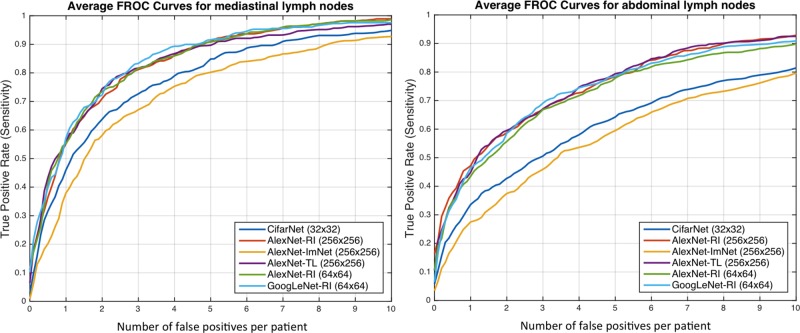
- For mediastinal LN detection, GoogLeNet-RI-L achieved AUC = 0.95 and 0.85 TPR/3FP, surpassing prior results of AUC = 0.92 and 0.70 TPR/3FP [22] and 0.78 TPR/3FP [36].
- Transfer learning from ImageNet consistently improved performance: GoogLeNet-TL-H versus GoogLeNet-RI-H gave 0.81 versus 0.61 TPR/3FP in mediastinum and 0.70 versus 0.48 TPR/3FP in abdomen; AlexNet-TL-H versus AlexNet-RI-H gave 0.81 versus 0.79 TPR/3FP in mediastinum and 0.69 versus 0.67 TPR/3FP in abdomen.
- For ILD slice-level five-fold CV, GoogLeNet-TL reached 0.57 accuracy versus GoogLeNet-RI 0.41, and AlexNet-TL reached 0.46 versus AlexNet-RI 0.44; patch-level ILD classification was less challenging, with five deep models in the range [0.74, 0.76] and an averaged model at 0.79.
- CNNs trained from scratch or fine-tuned from ImageNet consistently outperformed CNNs using only off-the-shelf CNN features in both LN and ILD problems.
Methods
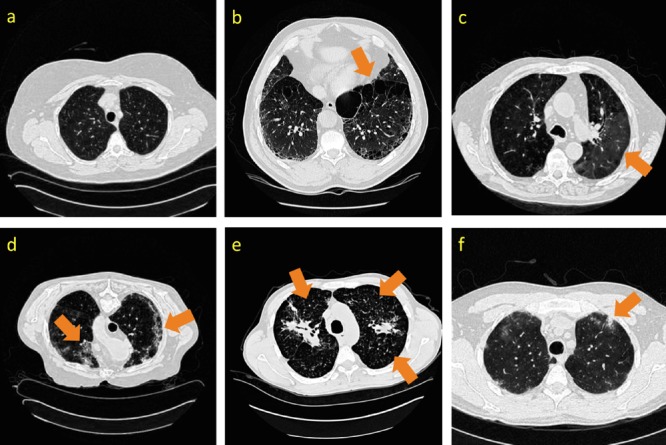
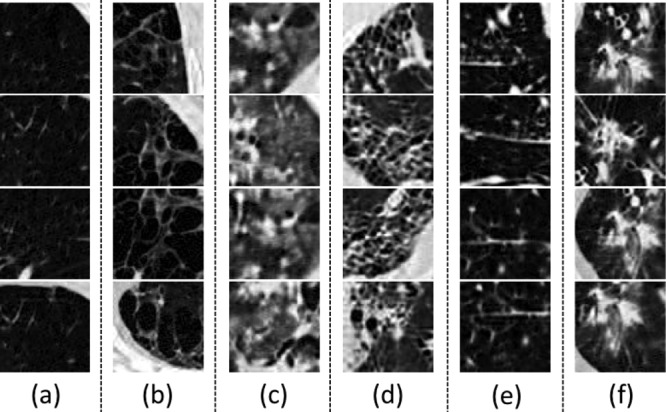
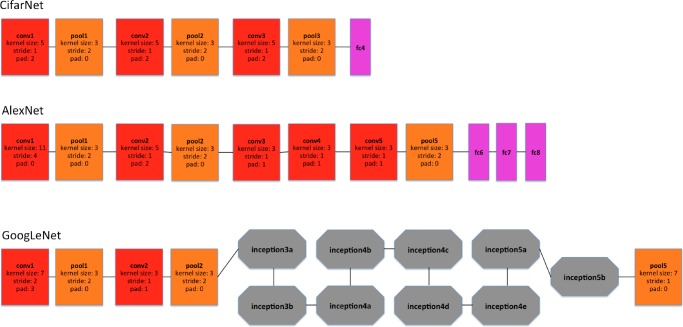
- The study evaluated CifarNet, AlexNet, and GoogLeNet architectures (later also OverFeat and VGGNet) on two CADe tasks: thoraco-abdominal LN detection using 388 mediastinal LNs in 90 patient CT scans and 595 abdominal LNs in 86 patient CT scans, and ILD classification using 905 annotated image slices from 120 patients with six ILD labels.
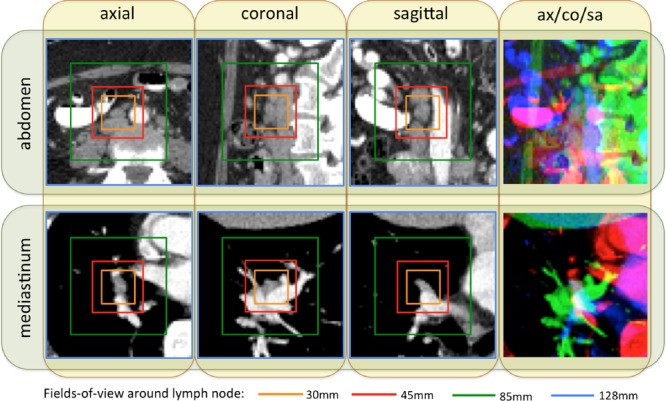
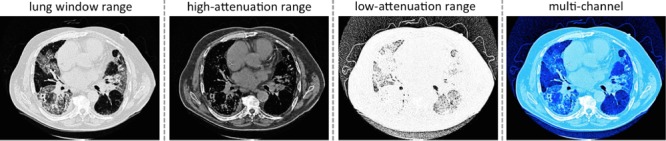
- LN detection used randomly sampled 2.5D views with fields-of-view spanning 35–128 mm, rescaled to 64×64 pixels, and three-fold cross-validation with FROC AUC and TPR/3FP metrics; ILD classification used slice-level and patch-level tasks under patient-level five-fold cross-validation, with CT windowing encoded into RGB channels and data augmentation.
- Training used the Caffe framework and NVidia K40 GPUs; models trained from scratch used random Gaussian initialization for 30 epochs with mini-batch size 50, while transfer learning fine-tuned all layers except the last at a learning rate 10 times smaller than default, with the last fully connected layer randomly initialized and trained at 0.01.
Limitations
- The paper states that the ILD dataset is partially labeled, with very few CT slices labeled as normal or healthy, and that this is one of its main limitations; it also states that the dataset’s limited patient population of 120 patients may not adequately represent ILD disease CT lung imaging patterns.
- The paper states that slice-level CNN learning is restricted to only 905 CT image slices, that no existing work has reached performance requirements for a realistic clinical setting, and that the most critical bottlenecks for ILD classification are cross-dataset learning and limited patient population size.
- Evident from the reported results: ILD slice-level CV5 accuracies were low (0.41–0.57), and LOO validation produced much higher accuracies than CV5 (e.g., AlexNet-TL 0.867 versus 0.46; GoogLeNet-TL 0.902 versus 0.57), indicating sensitivity to evaluation protocol; also, for abdominal LN detection the best reported CNN result (0.70 TPR/3FP) did not surpass the prior [22] result of 0.83 TPR/3FP.
Model-written summary. Check it against the paper before relying on it.
Integrity signals
Registry
Cites
Statistics
Figures
Verification
Claims the paper makes
49 Not checked yet · 31 Own result · 25 Own interpretation · 14 No basis given · 5 Sources not found · 2 Own method
A result the paper reports from its own data — it cites no other source for it, so there is none to check. The quote shows it is in the paper.
In the paper
“We achieve the state-of-the-art performance on the mediastinal LN detection, and report the first five-fold cross-validation classification results on predicting axial CT slices with ILD categories.”
- Also stated in: § Introduction · plain
“For the first time, ILD classification results under the patient-level five-fold cross-validation protocol (CV5) are investigated and reported.”
§ Deep Convolutional Neural Networks for Computer-Aided Detection: CNN Architectures, Dataset Characteristics and Transfer Learning > Abstract
plainn = 120- Asserted: passes — The authors put it forward as true.
- Checkable: passes — It can be checked against evidence.
- Load-bearing: passes — The paper’s conclusions depend on it.
- Based: passes — The paper gives a reason why it holds.
- Also stated in: § Introduction · plain
A result the paper reports from its own data — it cites no other source for it, so there is none to check. The quote shows it is in the paper.
In the paper
“Our experimental results suggest that different CNN architectures and dataset re-sampling protocols are critical for the LN detection tasks where the amount of labeled training data is sufficient and spatial contexts are local.”
§ Deep Convolutional Neural Networks for Computer-Aided Detection: CNN Architectures, Dataset Characteristics and Transfer Learning > Introduction
hedgeddirect- Asserted: passes — The authors put it forward as true.
- Checkable: passes — It can be checked against evidence.
- Load-bearing: passes — The paper’s conclusions depend on it.
- Based: passes — The paper gives a reason why it holds.
The paper states this without a source or data behind it here, so there is nothing to check it against. The quote shows it is in the paper.
In the paper
“As a result, LN datasets contain more training and testing data instances (due to data auugmentation) than ILD datasets.”
§ Deep Convolutional Neural Networks for Computer-Aided Detection: CNN Architectures, Dataset Characteristics and Transfer Learning > Introduction
plaindirect- Asserted: passes — The authors put it forward as true.
- Checkable: passes — It can be checked against evidence.
- Load-bearing: passes — The paper’s conclusions depend on it.
- Based: passes — The paper gives a reason why it holds.
A result the paper reports from its own data — it cites no other source for it, so there is none to check. The quote shows it is in the paper.
In the paper
“In the publicly available ILD dataset, very few CT slices are labeled as normal or healthy.”
§ Deep Convolutional Neural Networks for Computer-Aided Detection: CNN Architectures, Dataset Characteristics and Transfer Learning > Datasets and Related Work > Interstitial Lung Disease Dataset
plain- Asserted: passes — The authors put it forward as true.
- Checkable: passes — It can be checked against evidence.
- Load-bearing: unclear — It is unclear whether the paper’s conclusions depend on it.
- Based: passes — The paper gives a reason why it holds.
None of the sources cited for this claim have been checked yet.
In the paper
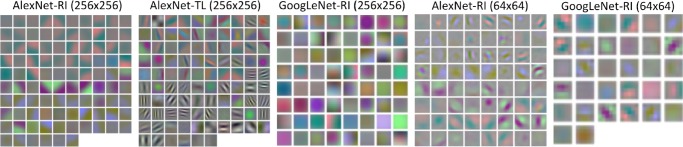
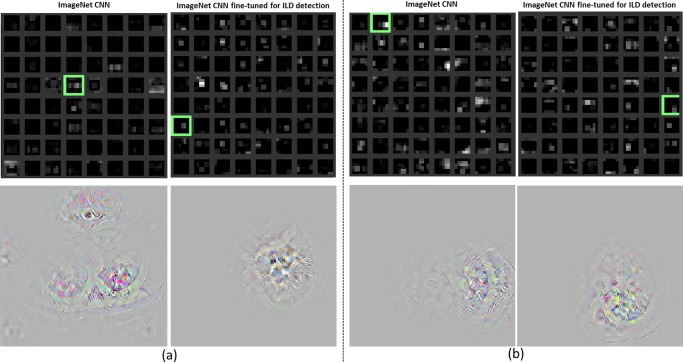
“CNN training learns to ignore them by setting very small filter weights around the corresponding regions (Fig. 13).”
§ Deep Convolutional Neural Networks for Computer-Aided Detection: CNN Architectures, Dataset Characteristics and Transfer Learning > Datasets and Related Work > Interstitial Lung Disease Dataset
plaindirect- Asserted: passes — The authors put it forward as true.
- Checkable: passes — It can be checked against evidence.
- Load-bearing: unclear — It is unclear whether the paper’s conclusions depend on it.
- Based: passes — The paper gives a reason why it holds.
- Rests on an assumption: Some areas outside the lung appear in both healthy or diseased images.
A result the paper reports from its own data — it cites no other source for it, so there is none to check. The quote shows it is in the paper.
In the paper
“There is no significant difference between two setups.”
§ Deep Convolutional Neural Networks for Computer-Aided Detection: CNN Architectures, Dataset Characteristics and Transfer Learning > Datasets and Related Work > Interstitial Lung Disease Dataset
plain- Asserted: passes — The authors put it forward as true.
- Checkable: passes — It can be checked against evidence.
- Load-bearing: passes — The paper’s conclusions depend on it.
- Based: passes — The paper gives a reason why it holds.
A result the paper reports from its own data — it cites no other source for it, so there is none to check. The quote shows it is in the paper.
In the paper
“The average number of CT slices (training instances) per fold is small, as shown in Table I.”
§ Deep Convolutional Neural Networks for Computer-Aided Detection: CNN Architectures, Dataset Characteristics and Transfer Learning > Datasets and Related Work > Interstitial Lung Disease Dataset
plainn = 5- Asserted: passes — The authors put it forward as true.
- Checkable: passes — It can be checked against evidence.
- Load-bearing: passes — The paper’s conclusions depend on it.
- Based: passes — The paper gives a reason why it holds.
A result the paper reports from its own data — it cites no other source for it, so there is none to check. The quote shows it is in the paper.
In the paper
“We found that the transfer learning strategy yields the best performance results.”
§ Deep Convolutional Neural Networks for Computer-Aided Detection: CNN Architectures, Dataset Characteristics and Transfer Learning > Methods > Training Protocols and Transfer Learning
plaindirect- Asserted: passes — The authors put it forward as true.
- Checkable: passes — It can be checked against evidence.
- Load-bearing: passes — The paper’s conclusions depend on it.
- Based: passes — The paper gives a reason why it holds.
The paper states this without a source or data behind it here, so there is nothing to check it against. The quote shows it is in the paper.
In the paper
“Another significant finding is that CNNs trained from scratch or fine-tuned from ImageNet models consistently outperform CNNs that merely use off-the-shelf CNN features, in both the LN and ILD classification problems.”
§ Deep Convolutional Neural Networks for Computer-Aided Detection: CNN Architectures, Dataset Characteristics and Transfer Learning > Introduction
boosteddirect- Asserted: passes — The authors put it forward as true.
- Checkable: passes — It can be checked against evidence.
- Load-bearing: passes — The paper’s conclusions depend on it.
- Based: passes — The paper gives a reason why it holds.
In the paper
“ILD [37] is a partially labeled database; this is one of its main limitations.”
§ Deep Convolutional Neural Networks for Computer-Aided Detection: CNN Architectures, Dataset Characteristics and Transfer Learning > Datasets and Related Work > Interstitial Lung Disease Dataset
What the sources say
- Not checked yetcites [37] Depeursinge A., “ Building a reference multimedia database for interstitial lung diseases,” Comput. Med. Imaging and. Grap., vol. 36, no. 3, pp. 227– 238, 2012. 21803548
plain- Asserted: passes — The authors put it forward as true.
- Checkable: passes — It can be checked against evidence.
- Load-bearing: unclear — It is unclear whether the paper’s conclusions depend on it.
- Based: passes — The paper gives a reason why it holds.
- It may state two separate claims as one. 32
- Probably not a substantial claim. 28
- The quote only partly states this claim. 3
- Borderline: one of the tests for a substantial claim is unclear. 1
None of the sources cited for this claim have been checked yet.
In the paper
“We obtain 86% sensitivity on 3 false positives (FP) per patient, versus the prior state-of-art sensitivities of 78% [36] (stacked shallow learning) and 70% [22] (CNN), as prior state-of-the-art.”
- Also stated in: § Abstract · plain
“We achieve the state-of-the-art performance on the mediastinal LN detection”
§ Deep Convolutional Neural Networks for Computer-Aided Detection: CNN Architectures, Dataset Characteristics and Transfer Learning > Introduction
What the sources say
- Not checked yetcites [36] Seff A., Lu L., Barbu A., Roth H., Shin H.-C., and Summers R. M., “ Leveraging mid-level semantic boundary cues for computer-aided lymph node detection,” Proc. MICCAI, 2015. source
- Not checked yetcites [22] Roth H., “ Improving computer-aided detection using convolutional neural networks and random view aggregation,” IEEE Trans. Med. Imag.. PMC7340334 26441412 source
plain- Asserted: passes — The authors put it forward as true.
- Checkable: passes — It can be checked against evidence.
- Load-bearing: passes — The paper’s conclusions depend on it.
- Based: passes — The paper gives a reason why it holds.
It may state two separate claims as one.
- Also stated in: § Abstract · plain
The paper states this without a source or data behind it here, so there is nothing to check it against. The quote shows it is in the paper.
In the paper
“They nonetheless remain less comprehensive than natural image datasets, such as ImageNet.”
§ Deep Convolutional Neural Networks for Computer-Aided Detection: CNN Architectures, Dataset Characteristics and Transfer Learning > Introduction
plain- Asserted: passes — The authors put it forward as true.
- Checkable: passes — It can be checked against evidence.
- Load-bearing: fails — The paper’s conclusions may not depend on it.
- Based: passes — The paper gives a reason why it holds.
Probably not a substantial claim. The paper’s conclusions may not depend on it.
The paper states this without a source or data behind it here, so there is nothing to check it against. The quote shows it is in the paper.
In the paper
“Fine-tuning ImageNet-trained models for ILD classification is clearly advantageous and yields early promising results, when the amount of labeled training data is highly insufficient and multi-class categorization is used, as opposed to the LN dataset's binary class categorization.”
§ Deep Convolutional Neural Networks for Computer-Aided Detection: CNN Architectures, Dataset Characteristics and Transfer Learning > Introduction
boosteddirect- Asserted: passes — The authors put it forward as true.
- Checkable: passes — It can be checked against evidence.
- Load-bearing: passes — The paper’s conclusions depend on it.
- Based: passes — The paper gives a reason why it holds.
It may state two separate claims as one.
The paper states this without a source or data behind it here, so there is nothing to check it against. The quote shows it is in the paper.
In the paper
“Hence, the purely random image resampling (with respect to scale, displacement and orientation) and reformatting (the axial, coronal, and sagittal views are in any system randomly resampled coordinates) is a natural choice, which also happens to yield high CNN performance.”
§ Deep Convolutional Neural Networks for Computer-Aided Detection: CNN Architectures, Dataset Characteristics and Transfer Learning > Datasets and Related Work > Thoracoabdominal Lymph Node Datasets
plaindirect- Asserted: passes — The authors put it forward as true.
- Checkable: passes — It can be checked against evidence.
- Load-bearing: passes — The paper’s conclusions depend on it.
- Based: passes — The paper gives a reason why it holds.
It may state two separate claims as one.
A result the paper reports from its own data — it cites no other source for it, so there is none to check. The quote shows it is in the paper.
In the paper
“GoogLeNet-TL-H | 0.94 | 0.81 | 0.92 | 0.70”
§ Deep Convolutional Neural Networks for Computer-Aided Detection: CNN Architectures, Dataset Characteristics and Transfer Learning > Evaluations and Discussions > Thoracoabdominal Lymph Node Detection
plain- Asserted: passes — The authors put it forward as true.
- Checkable: passes — It can be checked against evidence.
- Load-bearing: passes — The paper’s conclusions depend on it.
- Based: passes — The paper gives a reason why it holds.
It may state two separate claims as one. The quote only partly states this claim.
The paper states this without a source or data behind it here, so there is nothing to check it against. The quote shows it is in the paper.
In the paper
“GoogLeNet-TL-H yields results similar to AlexNet-TL-H's for the mediastinal LN detection, and slightly outperforms Alex-Net-H for abdominal LN detection.”
§ Deep Convolutional Neural Networks for Computer-Aided Detection: CNN Architectures, Dataset Characteristics and Transfer Learning > Evaluations and Discussions > Thoracoabdominal Lymph Node Detection
plain- Asserted: passes — The authors put it forward as true.
- Checkable: passes — It can be checked against evidence.
- Load-bearing: passes — The paper’s conclusions depend on it.
- Based: passes — The paper gives a reason why it holds.
It may state two separate claims as one.
The paper states this without a source or data behind it here, so there is nothing to check it against. The quote shows it is in the paper.
In the paper
“Likewise, AlexNet-TL-H consistently outperforms AlexNet-RI-H, though by smaller margins (0.81 versus 0.79 TPR/3FP in mediastinum; 0.69 versus 0.67 TPR/3FP in abdomen).”
§ Deep Convolutional Neural Networks for Computer-Aided Detection: CNN Architectures, Dataset Characteristics and Transfer Learning > Evaluations and Discussions > Thoracoabdominal Lymph Node Detection
plaindirect- Asserted: passes — The authors put it forward as true.
- Checkable: passes — It can be checked against evidence.
- Load-bearing: passes — The paper’s conclusions depend on it.
- Based: passes — The paper gives a reason why it holds.
It may state two separate claims as one.
A result the paper reports from its own data — it cites no other source for it, so there is none to check. The quote shows it is in the paper.
In the paper
“However, transfer learning from ImageNet pre-trained model is consistently beneficial, as evidenced by AlexNet-TL (0.46) versus AlexNet-RI (0.44), and GoogLeNet-TL (0.57) versus GoogLeNet-RI (0.41).”
§ Deep Convolutional Neural Networks for Computer-Aided Detection: CNN Architectures, Dataset Characteristics and Transfer Learning > Evaluations and Discussions > Interstitial Lung Disease Classification
boosteddirect- Asserted: passes — The authors put it forward as true.
- Checkable: passes — It can be checked against evidence.
- Load-bearing: passes — The paper’s conclusions depend on it.
- Based: passes — The paper gives a reason why it holds.
It may state two separate claims as one.
The paper states this without a source or data behind it here, so there is nothing to check it against. The quote shows it is in the paper.
In the paper
“AlexNet-RI-H exhibits less severe over-fitting than GoogLeNet-RI-H.”
§ Deep Convolutional Neural Networks for Computer-Aided Detection: CNN Architectures, Dataset Characteristics and Transfer Learning > Evaluations and Discussions > Thoracoabdominal Lymph Node Detection
plain- Asserted: passes — The authors put it forward as true.
- Checkable: passes — It can be checked against evidence.
- Load-bearing: unclear — It is unclear whether the paper’s conclusions depend on it.
- Based: unclear — It is unclear why the paper says it holds.
Borderline substantial claim. It is unclear whether the paper’s conclusions depend on it. It is unclear why the paper says it holds.
None of the sources cited for this claim have been checked yet.
In the paper
“GoogLeNet-RI-L | 0.95 | 0.85 | 0.91 | 0.69”
§ Deep Convolutional Neural Networks for Computer-Aided Detection: CNN Architectures, Dataset Characteristics and Transfer Learning > Evaluations and Discussions > Thoracoabdominal Lymph Node Detection
What the sources say
- Not checked yetcites [36] Seff A., Lu L., Barbu A., Roth H., Shin H.-C., and Summers R. M., “ Leveraging mid-level semantic boundary cues for computer-aided lymph node detection,” Proc. MICCAI, 2015. source
- Not checked yetcites [22] Roth H., “ Improving computer-aided detection using convolutional neural networks and random view aggregation,” IEEE Trans. Med. Imag.. PMC7340334 26441412 source
plain- Asserted: passes — The authors put it forward as true.
- Checkable: passes — It can be checked against evidence.
- Load-bearing: passes — The paper’s conclusions depend on it.
- Based: passes — The paper gives a reason why it holds.
It may state two separate claims as one. The quote only partly states this claim.
A result the paper reports from its own data — it cites no other source for it, so there is none to check. The quote shows it is in the paper.
In the paper
“Patch-CV5 | 0.76 | 0.74 | 0.76 | 0.75 | 0.76 | 0.79”
§ Deep Convolutional Neural Networks for Computer-Aided Detection: CNN Architectures, Dataset Characteristics and Transfer Learning > Evaluations and Discussions > Thoracoabdominal Lymph Node Detection
plain- Asserted: fails — The authors may not put it forward as true.
- Checkable: passes — It can be checked against evidence.
- Load-bearing: fails — The paper’s conclusions may not depend on it.
- Based: passes — The paper gives a reason why it holds.
Probably not a substantial claim. The authors may not put it forward as true. The paper’s conclusions may not depend on it. The quote only partly states this claim.
In the paper
“Patch-CV5 yields higher F-scores than [54] and classifies the extra consolidation (CD) class.”
§ Deep Convolutional Neural Networks for Computer-Aided Detection: CNN Architectures, Dataset Characteristics and Transfer Learning > Evaluations and Discussions > Interstitial Lung Disease Classification
What the sources say
- Not checked yetcites [54] Li Q., “ Medical image classification with convolutional neural network,” Proc. 13th Int. Conf. Control Automat. Robot. Vis., pp. 844– 848, 2014.
plainn = 120- Asserted: passes — The authors put it forward as true.
- Checkable: passes — It can be checked against evidence.
- Load-bearing: passes — The paper’s conclusions depend on it.
- Based: passes — The paper gives a reason why it holds.
It may state two separate claims as one.
A result the paper reports from its own data — it cites no other source for it, so there is none to check. The quote shows it is in the paper.
In the paper
“The quantitative results in Table III indicate that AlexNet-TL and GoogLeNet-TL have consistently better classification accuracies than AlexNet-RI and GoogLeNet-RI, respectively.”
§ Deep Convolutional Neural Networks for Computer-Aided Detection: CNN Architectures, Dataset Characteristics and Transfer Learning > Analysis Via CNN Learning Traces and Lulvisualization > ILD Classification
hedgedcorrelational- Asserted: passes — The authors put it forward as true.
- Checkable: passes — It can be checked against evidence.
- Load-bearing: passes — The paper’s conclusions depend on it.
- Based: passes — The paper gives a reason why it holds.
It may state two separate claims as one.
A result the paper reports from its own data — it cites no other source for it, so there is none to check. The quote shows it is in the paper.
In the paper
“For example, in ILD slice-level classification, the accuracy level drastically increases from 0.46 to 0.867 using AlexNet-TL, and from 0.57 to 0.902 for GoogLeNet-TL.”
§ Deep Convolutional Neural Networks for Computer-Aided Detection: CNN Architectures, Dataset Characteristics and Transfer Learning > Evaluations and Discussions > Evaluation of Five CNN Models Using ILD Classification
plaindirect- Asserted: passes — The authors put it forward as true.
- Checkable: passes — It can be checked against evidence.
- Load-bearing: passes — The paper’s conclusions depend on it.
- Based: passes — The paper gives a reason why it holds.
It may state two separate claims as one.
A result the paper reports from its own data — it cites no other source for it, so there is none to check. The quote shows it is in the paper.
In the paper
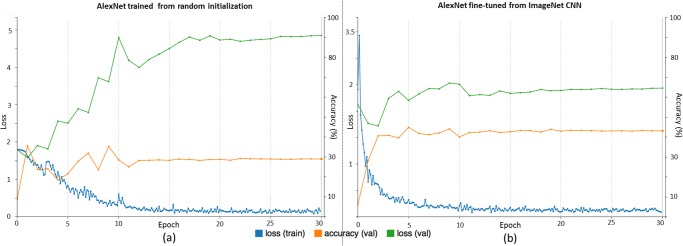
“For AlexNet-RI in Fig. 11(a), the training loss significantly decreases as the number of training epochs increases, while the validation loss notably increases and the validation accuracy does not improve much before reaching a plateau.”
§ Deep Convolutional Neural Networks for Computer-Aided Detection: CNN Architectures, Dataset Characteristics and Transfer Learning > Analysis Via CNN Learning Traces and Lulvisualization > ILD Classification
plaindirect- Asserted: passes — The authors put it forward as true.
- Checkable: passes — It can be checked against evidence.
- Load-bearing: passes — The paper’s conclusions depend on it.
- Based: passes — The paper gives a reason why it holds.
It may state two separate claims as one.
A result the paper reports from its own data — it cites no other source for it, so there is none to check. The quote shows it is in the paper.
In the paper
“During the process, the validation loss, having remained at lower values throughout, achieves higher final accuracy levels than the validation loss on a similar problem with random initialization.”
§ Deep Convolutional Neural Networks for Computer-Aided Detection: CNN Architectures, Dataset Characteristics and Transfer Learning > Analysis Via CNN Learning Traces and Lulvisualization > ILD Classification
plaindirect- Asserted: passes — The authors put it forward as true.
- Checkable: passes — It can be checked against evidence.
- Load-bearing: passes — The paper’s conclusions depend on it.
- Based: passes — The paper gives a reason why it holds.
It may state two separate claims as one.
A conclusion the paper draws from its own results — it cites no other source for it, so there is none to check. The quote shows it is in the paper.
In the paper
“Since LN images are more flexible than ILD images with respect to resampling and reformatting, LN datasets may be more readily augmented by such image transformations.”
§ Deep Convolutional Neural Networks for Computer-Aided Detection: CNN Architectures, Dataset Characteristics and Transfer Learning > Introduction
hedgedconditional- Asserted: passes — The authors put it forward as true.
- Checkable: passes — It can be checked against evidence.
- Load-bearing: passes — The paper’s conclusions depend on it.
- Based: fails — The paper may give no reason why it holds.
Probably not a substantial claim. The paper may give no reason why it holds. It may state two separate claims as one.
None of the sources cited for this claim have been checked yet.
In the paper
“There are currently three major techniques that successfully employ CNNs to medical image classification: 1) training the “CNN from scratch” [13]–[17]; 2) using “off-the-shelf CNN” features (without retraining the CNN) as complementary information channels to existing hand-crafted image features, for chest X-rays [10] and CT lung nodule identification [9], [12]; and 3) performing unsupervised pre-”
§ Deep Convolutional Neural Networks for Computer-Aided Detection: CNN Architectures, Dataset Characteristics and Transfer Learning > Introduction
What the sources say
- Not checked yetcites [13]–[17]
- Not checked yetcites [9], [12]
- Not checked yetcites [18]–[21]
plain- Asserted: passes — The authors put it forward as true.
- Checkable: passes — It can be checked against evidence.
- Load-bearing: unclear — It is unclear whether the paper’s conclusions depend on it.
- Based: passes — The paper gives a reason why it holds.
It may state two separate claims as one.
In the paper
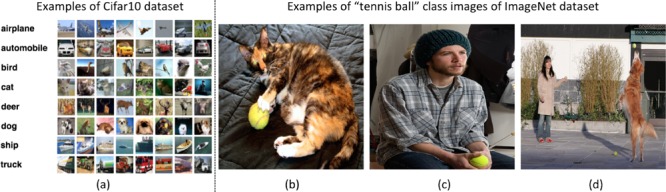
“ImageNet is currently the largest image dataset among other standard datasets for visual recognition.”
§ Deep Convolutional Neural Networks for Computer-Aided Detection: CNN Architectures, Dataset Characteristics and Transfer Learning > Methods > Imagenet: Large Scale Annotated Natural Image Dataset
What the sources say
- Not matchedcites [1] Deng J., “ ImageNet: A large-scale hierarchical image database,” in Proc. IEEE Conf. Comput. Vis. Pattern Recognit., 2009, pp. 248– 255.
Couldn’t be matched to a paper in Crossref, so it can’t be checked.
plain- Asserted: passes — The authors put it forward as true.
- Checkable: passes — It can be checked against evidence.
- Load-bearing: fails — The paper’s conclusions may not depend on it.
- Based: passes — The paper gives a reason why it holds.
Probably not a substantial claim. The paper’s conclusions may not depend on it.
- Not matched
A conclusion the paper draws from its own results — it cites no other source for it, so there is none to check. The quote shows it is in the paper.
In the paper
“This significant intra-class variation poses greater challenges to any data-driven learning system that builds a classifier to fit given data and generalize to unseen data.”
§ Deep Convolutional Neural Networks for Computer-Aided Detection: CNN Architectures, Dataset Characteristics and Transfer Learning > Methods > Imagenet: Large Scale Annotated Natural Image Dataset
plaindirect- Asserted: passes — The authors put it forward as true.
- Checkable: passes — It can be checked against evidence.
- Load-bearing: fails — The paper’s conclusions may not depend on it.
- Based: passes — The paper gives a reason why it holds.
Probably not a substantial claim. The paper’s conclusions may not depend on it.
A conclusion the paper draws from its own results — it cites no other source for it, so there is none to check. The quote shows it is in the paper.
In the paper
“Transforming axial, coronal, and sagittal representations to RGB also facilitates transfer learning from CNN models trained on ImageNet.”
§ Deep Convolutional Neural Networks for Computer-Aided Detection: CNN Architectures, Dataset Characteristics and Transfer Learning > Datasets and Related Work > Thoracoabdominal Lymph Node Datasets
plaindirect- Asserted: passes — The authors put it forward as true.
- Checkable: passes — It can be checked against evidence.
- Load-bearing: fails — The paper’s conclusions may not depend on it.
- Based: fails — The paper may give no reason why it holds.
Probably not a substantial claim. The paper’s conclusions may not depend on it. The paper may give no reason why it holds.
In the paper
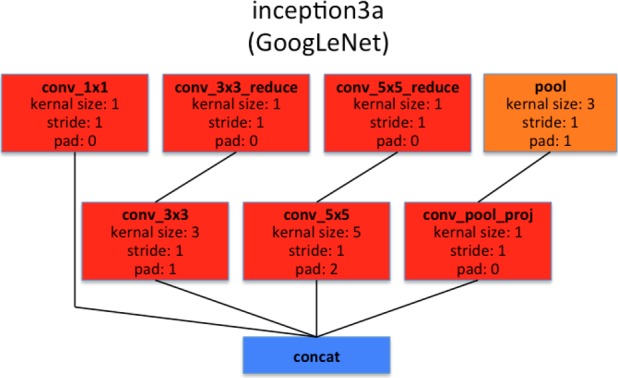
“More importantly, it also introduces a new module called “Inception”, which concatenates filters of different sizes and dimensions into a single new filter (refer to Fig. 6).”
§ Deep Convolutional Neural Networks for Computer-Aided Detection: CNN Architectures, Dataset Characteristics and Transfer Learning > Methods > Convolutional Neural Network Architectures
What the sources say
- Not checked yetcites [33] Szegedy C., “ Going deeper with convolutions,” in Proc. IEEE Comput. Soc. Conf. Comput. Vis. Pattern Recognit., 2015, pp. 1– 9. source
plaindirect- Asserted: passes — The authors put it forward as true.
- Checkable: passes — It can be checked against evidence.
- Load-bearing: fails — The paper’s conclusions may not depend on it.
- Based: passes — The paper gives a reason why it holds.
Probably not a substantial claim. The paper’s conclusions may not depend on it.
In the paper
“Evaluation protocols and details are critical to deriving significant empirical findings [34].”
§ Deep Convolutional Neural Networks for Computer-Aided Detection: CNN Architectures, Dataset Characteristics and Transfer Learning > Introduction
What the sources say
- Not checked yetcites [34] Chatfield K., Simonyan K., Vedaldi A., and Zisserman A., “ Return of the devil in the details: Delving deep into convolutional nets,” Br. Mach. Vis. Conf., 2014. source
plaindirect- Asserted: passes — The authors put it forward as true.
- Checkable: fails — It may be too vague to check against evidence.
- Load-bearing: fails — The paper’s conclusions may not depend on it.
- Based: passes — The paper gives a reason why it holds.
Probably not a substantial claim. It may be too vague to check against evidence. The paper’s conclusions may not depend on it.
In the paper
“The AlexNet architecture was published in [4], achieved significantly improved performance over the other non-deep learning methods for ImageNet Large Scale Visual Recognition Challenge (ILSVRC) 2012.”
§ Deep Convolutional Neural Networks for Computer-Aided Detection: CNN Architectures, Dataset Characteristics and Transfer Learning > Methods > Convolutional Neural Network Architectures
What the sources say
- Not checked yetcites [4] Krizhevsky A., Sutskever I., and Hinton G. E., “ ImageNet classification with deep convolutional neural networks,” Proc. NIPS, pp. 1097– 1105, 2012. source
plaindirect- Asserted: passes — The authors put it forward as true.
- Checkable: passes — It can be checked against evidence.
- Load-bearing: fails — The paper’s conclusions may not depend on it.
- Based: passes — The paper gives a reason why it holds.
Probably not a substantial claim. The paper’s conclusions may not depend on it.
A conclusion the paper draws from its own results — it cites no other source for it, so there is none to check. The quote shows it is in the paper.
In the paper
“In summary, the assumption that there are or must be pixel-wise spatial correlations among input channels does not apply to the CNN model representation.”
§ Deep Convolutional Neural Networks for Computer-Aided Detection: CNN Architectures, Dataset Characteristics and Transfer Learning > Datasets and Related Work > Thoracoabdominal Lymph Node Datasets
plain- Asserted: passes — The authors put it forward as true.
- Checkable: passes — It can be checked against evidence.
- Load-bearing: fails — The paper’s conclusions may not depend on it.
- Based: fails — The paper may give no reason why it holds.
Probably not a substantial claim. The paper’s conclusions may not depend on it. The paper may give no reason why it holds.
In the paper
“The ImageNet dataset is publicly available, and the ImageNet Large Scale Visual Recognition Challenge (ILSVRC) has become the standard benchmark for large-scale object recognition.”
§ Deep Convolutional Neural Networks for Computer-Aided Detection: CNN Architectures, Dataset Characteristics and Transfer Learning > Methods > Imagenet: Large Scale Annotated Natural Image Dataset
What the sources say
- Not matchedcites [1] Deng J., “ ImageNet: A large-scale hierarchical image database,” in Proc. IEEE Conf. Comput. Vis. Pattern Recognit., 2009, pp. 248– 255.
Couldn’t be matched to a paper in Crossref, so it can’t be checked.
plain- Asserted: passes — The authors put it forward as true.
- Checkable: passes — It can be checked against evidence.
- Load-bearing: fails — The paper’s conclusions may not depend on it.
- Based: passes — The paper gives a reason why it holds.
Probably not a substantial claim. The paper’s conclusions may not depend on it. It may state two separate claims as one.
- Not matched
A conclusion the paper draws from its own results — it cites no other source for it, so there is none to check. The quote shows it is in the paper.
In the paper
“Characterizing an arbitrary CT slice against any possible ILD type, without any manual ROI (in contrast to [38], [39]), can be useful for large-scale patient screening.”
§ Deep Convolutional Neural Networks for Computer-Aided Detection: CNN Architectures, Dataset Characteristics and Transfer Learning > Datasets and Related Work > Interstitial Lung Disease Dataset
plainconditional- Asserted: passes — The authors put it forward as true.
- Checkable: fails — It may be too vague to check against evidence.
- Load-bearing: passes — The paper’s conclusions depend on it.
- Based: fails — The paper may give no reason why it holds.
Probably not a substantial claim. It may be too vague to check against evidence. The paper may give no reason why it holds.
In the paper
“AlexNet can be fine-tuned on the PASCAL dataset to surpass the performance of the ImageNet pre-trained AlexNet, although the difference is not as significant as that between the CNN and non-CNN methods.”
§ Deep Convolutional Neural Networks for Computer-Aided Detection: CNN Architectures, Dataset Characteristics and Transfer Learning > Methods > Training Protocols and Transfer Learning
What the sources say
- Not checked yetcites [6] Girshick R., Donahue J., Darrell T., and Malik J., “ Region-based convolutional networks for accurate object detection and semantic segmentation,” IEEE Trans. Pattern Anal. Mach. Intell., vol. 38, no. 1, pp. 142– 158, Jan. 2016. 26656583 source
plaindirect- Asserted: passes — The authors put it forward as true.
- Checkable: passes — It can be checked against evidence.
- Load-bearing: unclear — It is unclear whether the paper’s conclusions depend on it.
- Based: passes — The paper gives a reason why it holds.
It may state two separate claims as one.
A conclusion the paper draws from its own results — it cites no other source for it, so there is none to check. The quote shows it is in the paper.
In the paper
“Slice-level ILD classification is a very challenging task where CNN models need to learn from very small numbers of training examples and predict ILD labels on unseen patients.”
§ Deep Convolutional Neural Networks for Computer-Aided Detection: CNN Architectures, Dataset Characteristics and Transfer Learning > Datasets and Related Work > Interstitial Lung Disease Dataset
plainn = 120- Asserted: passes — The authors put it forward as true.
- Checkable: passes — It can be checked against evidence.
- Load-bearing: passes — The paper’s conclusions depend on it.
- Based: passes — The paper gives a reason why it holds.
It may state two separate claims as one.
In the paper
“GoogLeNet is the current state-of-the-art CNN architecture for the ILSVRC challenge, where it achieved 5.5% top-5 classification error on the ImageNet challenge, compared to AlexNet's 15.3% top-5 classification error.”
§ Deep Convolutional Neural Networks for Computer-Aided Detection: CNN Architectures, Dataset Characteristics and Transfer Learning > Methods > Convolutional Neural Network Architectures
What the sources say
- Not checked yetcites [33] Szegedy C., “ Going deeper with convolutions,” in Proc. IEEE Comput. Soc. Conf. Comput. Vis. Pattern Recognit., 2015, pp. 1– 9. source
plain- Asserted: passes — The authors put it forward as true.
- Checkable: passes — It can be checked against evidence.
- Load-bearing: fails — The paper’s conclusions may not depend on it.
- Based: passes — The paper gives a reason why it holds.
Probably not a substantial claim. The paper’s conclusions may not depend on it. It may state two separate claims as one.
The paper states this without a source or data behind it here, so there is nothing to check it against. The quote shows it is in the paper.
In the paper
“On the other hand, the mainstream deep CNN architectures (e.g., AlexNet and GoogLeNet) contain tens of millions of free parameters to train, and thus require sufficiently large numbers of labeled medical images.”
§ Deep Convolutional Neural Networks for Computer-Aided Detection: CNN Architectures, Dataset Characteristics and Transfer Learning > Methods > Training Protocols and Transfer Learning
plaindirect- Asserted: passes — The authors put it forward as true.
- Checkable: passes — It can be checked against evidence.
- Load-bearing: passes — The paper’s conclusions depend on it.
- Based: unclear — It is unclear why the paper says it holds.
It may state two separate claims as one.
- Rests on an assumption: Collecting and annotating large numbers of medical images still poses significant challenges.
In the paper
“ImageNet [1] has more than 1.2 million 256×256 images categorized under 1000 object class categories.”
§ Deep Convolutional Neural Networks for Computer-Aided Detection: CNN Architectures, Dataset Characteristics and Transfer Learning > Methods > Imagenet: Large Scale Annotated Natural Image Dataset
What the sources say
- Not matchedcites [1] Deng J., “ ImageNet: A large-scale hierarchical image database,” in Proc. IEEE Conf. Comput. Vis. Pattern Recognit., 2009, pp. 248– 255.
Couldn’t be matched to a paper in Crossref, so it can’t be checked.
plain- Asserted: passes — The authors put it forward as true.
- Checkable: passes — It can be checked against evidence.
- Load-bearing: fails — The paper’s conclusions may not depend on it.
- Based: passes — The paper gives a reason why it holds.
Probably not a substantial claim. The paper’s conclusions may not depend on it.
- Not matched
A conclusion the paper draws from its own results — it cites no other source for it, so there is none to check. The quote shows it is in the paper.
In the paper
“More importantly, these CT windowing processes do not depend on the lung segmentation, which instead is directly defined in the CT HU space.”
§ Deep Convolutional Neural Networks for Computer-Aided Detection: CNN Architectures, Dataset Characteristics and Transfer Learning > Datasets and Related Work > Interstitial Lung Disease Dataset
plain- Asserted: passes — The authors put it forward as true.
- Checkable: passes — It can be checked against evidence.
- Load-bearing: fails — The paper’s conclusions may not depend on it.
- Based: passes — The paper gives a reason why it holds.
Probably not a substantial claim. The paper’s conclusions may not depend on it. It may state two separate claims as one.
What the paper did — it cites no source for this, so there is none to check. The quote shows it is in the paper.
In the paper
“We evaluate the ILD classification task with five-fold CV on patient-level split, as it is more informative for real clinical performance than LOO.”
§ Deep Convolutional Neural Networks for Computer-Aided Detection: CNN Architectures, Dataset Characteristics and Transfer Learning > Evaluations and Discussions > Interstitial Lung Disease Classification
plaindirect- Asserted: passes — The authors put it forward as true.
- Checkable: passes — It can be checked against evidence.
- Load-bearing: passes — The paper’s conclusions depend on it.
- Based: passes — The paper gives a reason why it holds.
Probably not a substantial claim. It may state two separate claims as one.
In the paper
“The experimental results in [40] are conducted with a patient-level hard split of 100 (training) and 20 (testing).”
§ Deep Convolutional Neural Networks for Computer-Aided Detection: CNN Architectures, Dataset Characteristics and Transfer Learning > Evaluations and Discussions > Interstitial Lung Disease Classification
What the sources say
- Not checked yetcites [40] Gao M., “ Holistic classification of CT attenuation patterns for interstitial lung diseases via deep convolutional neural networks,” in Proc. MICCAI First Workshop Deep Learn. Med. Image Anal., 2015. PMC5881940 29623248
plain- Asserted: passes — The authors put it forward as true.
- Checkable: passes — It can be checked against evidence.
- Load-bearing: fails — The paper’s conclusions may not depend on it.
- Based: passes — The paper gives a reason why it holds.
Probably not a substantial claim. The paper’s conclusions may not depend on it.
None of the sources cited for this claim have been checked yet.
In the paper
“This difference lies in the fact that annotated lymph node segmentation masks are required to learn a mid-level semantic boundary detector [36], whereas CNN approaches only need LN locations for training [22].”
§ Deep Convolutional Neural Networks for Computer-Aided Detection: CNN Architectures, Dataset Characteristics and Transfer Learning > Evaluations and Discussions > Thoracoabdominal Lymph Node Detection
What the sources say
- Not checked yetcites [36] Seff A., Lu L., Barbu A., Roth H., Shin H.-C., and Summers R. M., “ Leveraging mid-level semantic boundary cues for computer-aided lymph node detection,” Proc. MICCAI, 2015. source
- Not checked yetcites [22] Roth H., “ Improving computer-aided detection using convolutional neural networks and random view aggregation,” IEEE Trans. Med. Imag.. PMC7340334 26441412 source
plaindirect- Asserted: passes — The authors put it forward as true.
- Checkable: passes — It can be checked against evidence.
- Load-bearing: passes — The paper’s conclusions depend on it.
- Based: passes — The paper gives a reason why it holds.
It may state two separate claims as one.
None of the sources cited for this claim have been checked yet.
In the paper
“Both [38] and [39] use the evaluation protocol of “leave-one-patient-out” (LOO), which is arguably much easier and not directly comparable to 10-fold CV [54] or our Patch-CV5.”
§ Deep Convolutional Neural Networks for Computer-Aided Detection: CNN Architectures, Dataset Characteristics and Transfer Learning > Evaluations and Discussions > Interstitial Lung Disease Classification
What the sources say
- Not checked yetcites [38] Song Y., Cai W., Zhou Y., and Feng D. D., “ Feature-based image patch approximation for lung tissue classification,” IEEE Trans. Med. Imag., vol. 32, no. 4, pp. 797– 808, Apr. 2013. 23340591 source
- Not checked yetcites [39] Song Y., “ Large margin local estimate with applications to medical image classification,” IEEE Trans. Med. Imag., vol. 34, no. 6, pp. 1362– 1377, Jun. 2015. 25616009 source
- Not checked yetcites [54] Li Q., “ Medical image classification with convolutional neural network,” Proc. 13th Int. Conf. Control Automat. Robot. Vis., pp. 844– 848, 2014. source
hedged- Asserted: passes — The authors put it forward as true.
- Checkable: passes — It can be checked against evidence.
- Load-bearing: passes — The paper’s conclusions depend on it.
- Based: passes — The paper gives a reason why it holds.
It may state two separate claims as one.
What the paper did — it cites no source for this, so there is none to check. The quote shows it is in the paper.
In the paper
“We train and evaluate CNNs using three-fold cross-validation (folds are split into disjoint sets of patients), with the different CNN architectures described above.”
§ Deep Convolutional Neural Networks for Computer-Aided Detection: CNN Architectures, Dataset Characteristics and Transfer Learning > Evaluations and Discussions > Thoracoabdominal Lymph Node Detection
plain- Asserted: passes — The authors put it forward as true.
- Checkable: passes — It can be checked against evidence.
- Load-bearing: passes — The paper’s conclusions depend on it.
- Based: passes — The paper gives a reason why it holds.
Probably not a substantial claim.
The paper states this without a source or data behind it here, so there is nothing to check it against. The quote shows it is in the paper.
In the paper
“AlexNet is the first notably successful CNN architecture on the ImageNet challenge and has rekindled significant research interests on CNN.”
§ Deep Convolutional Neural Networks for Computer-Aided Detection: CNN Architectures, Dataset Characteristics and Transfer Learning > Evaluations and Discussions > Evaluation of Five CNN Models Using ILD Classification
plaindirect- Asserted: passes — The authors put it forward as true.
- Checkable: passes — It can be checked against evidence.
- Load-bearing: fails — The paper’s conclusions may not depend on it.
- Based: fails — The paper may give no reason why it holds.
Probably not a substantial claim. The paper’s conclusions may not depend on it. The paper may give no reason why it holds. It may state two separate claims as one.
None of the sources cited for this claim have been checked yet.
In the paper
“GoogLeNet is the state-of-the-art deep model, which has outperformed other notable models, such as AlexNet, OverFeat, and VGGNet [67], [68] in various computer vision benchmarks.”
§ Deep Convolutional Neural Networks for Computer-Aided Detection: CNN Architectures, Dataset Characteristics and Transfer Learning > Evaluations and Discussions > Evaluation of Five CNN Models Using ILD Classification
What the sources say
- Not checked yetcites [67] Sermanet P., “ Overfeat: Integrated recognition, localization and detection using convolutional networks,” Proc. ICLR, 2014. source
- Not checked yetcites [68] Simonyan K. and Zisserman A., “ Very deep convolutional networks for large-scale image recognition,” Proc. ICLR, 2014. source
plaindirect- Asserted: passes — The authors put it forward as true.
- Checkable: passes — It can be checked against evidence.
- Load-bearing: passes — The paper’s conclusions depend on it.
- Based: passes — The paper gives a reason why it holds.
It may state two separate claims as one.
In the paper
“This image sampling scheme contributes to our best reported performance results in both mediastinal LN detection (in this paper) and automated pancreas segmentation [45].”
§ Deep Convolutional Neural Networks for Computer-Aided Detection: CNN Architectures, Dataset Characteristics and Transfer Learning > Evaluations and Discussions > Thoracoabdominal Lymph Node Detection
What the sources say
- Not checked yetcites [45] Roth H., “ DeepOrgan: Multi-level deep convolutional networks for automated pancreas segmentation,” Proc. MICCAI, 2015. source
plaindirect- Asserted: passes — The authors put it forward as true.
- Checkable: passes — It can be checked against evidence.
- Load-bearing: passes — The paper’s conclusions depend on it.
- Based: passes — The paper gives a reason why it holds.
It may state two separate claims as one.
In the paper
“The overall reported LN detection results are clinically significant, as indicated in [63].”
§ Deep Convolutional Neural Networks for Computer-Aided Detection: CNN Architectures, Dataset Characteristics and Transfer Learning > Evaluations and Discussions > Thoracoabdominal Lymph Node Detection
What the sources say
- Not matchedcites [63] Kim L., “ Performance assessment of retroperitoneal lymph node computer-assisted detection using random forest and deep convolutional neural network learning algorithms in tandem,” in 102nd Annu. Meet. Radiol. Soc. N. Am., 2014.
Couldn’t be matched to a paper in Crossref, so it can’t be checked.
hedged- Asserted: passes — The authors put it forward as true.
- Checkable: passes — It can be checked against evidence.
- Load-bearing: fails — The paper’s conclusions may not depend on it.
- Based: passes — The paper gives a reason why it holds.
Probably not a substantial claim. The paper’s conclusions may not depend on it.
- Not matched
In the paper
“In general, patch-level ILD classification is less challenging than slice-level classification, as far more data samples can be sampled from the manually annotated ROIs (up to 100 image patches per ROI), available from [37].”
§ Deep Convolutional Neural Networks for Computer-Aided Detection: CNN Architectures, Dataset Characteristics and Transfer Learning > Evaluations and Discussions > Interstitial Lung Disease Classification
What the sources say
- Not checked yetcites [37] Depeursinge A., “ Building a reference multimedia database for interstitial lung diseases,” Comput. Med. Imaging and. Grap., vol. 36, no. 3, pp. 227– 238, 2012. 21803548
plaindirect- Asserted: passes — The authors put it forward as true.
- Checkable: passes — It can be checked against evidence.
- Load-bearing: unclear — It is unclear whether the paper’s conclusions depend on it.
- Based: passes — The paper gives a reason why it holds.
It may state two separate claims as one.
In the paper
“Recently, Gao et al. [40] have argued that a new CADe protocol on holistic classification of ILD diseases directly, using axial CT slice attenuation patterns and CNN, may be more realistic for clinical applications.”
§ Deep Convolutional Neural Networks for Computer-Aided Detection: CNN Architectures, Dataset Characteristics and Transfer Learning > Evaluations and Discussions > Interstitial Lung Disease Classification
What the sources say
- Not checked yetcites [40] Gao M., “ Holistic classification of CT attenuation patterns for interstitial lung diseases via deep convolutional neural networks,” in Proc. MICCAI First Workshop Deep Learn. Med. Image Anal., 2015. PMC5881940 29623248
hedgedconditional- Asserted: fails — The authors may not put it forward as true.
- Checkable: passes — It can be checked against evidence.
- Load-bearing: fails — The paper’s conclusions may not depend on it.
- Based: passes — The paper gives a reason why it holds.
Probably not a substantial claim. The authors may not put it forward as true. The paper’s conclusions may not depend on it.
In the paper
“OverFeat is described in [67] as an integrated framework for using CNN for classification, localization and detection.”
§ Deep Convolutional Neural Networks for Computer-Aided Detection: CNN Architectures, Dataset Characteristics and Transfer Learning > Evaluations and Discussions > Evaluation of Five CNN Models Using ILD Classification
What the sources say
- Not checked yetcites [67] Sermanet P., “ Overfeat: Integrated recognition, localization and detection using convolutional networks,” Proc. ICLR, 2014.
plain- Asserted: passes — The authors put it forward as true.
- Checkable: passes — It can be checked against evidence.
- Load-bearing: fails — The paper’s conclusions may not depend on it.
- Based: passes — The paper gives a reason why it holds.
Probably not a substantial claim. The paper’s conclusions may not depend on it.
In the paper
“The main difference between our dataset preparation protocol and that from [22] is a more aggressive extraction of random views within a much larger range of FOVs.”
§ Deep Convolutional Neural Networks for Computer-Aided Detection: CNN Architectures, Dataset Characteristics and Transfer Learning > Evaluations and Discussions > Thoracoabdominal Lymph Node Detection
What the sources say
- Not checked yetcites [22] Roth H., “ Improving computer-aided detection using convolutional neural networks and random view aggregation,” IEEE Trans. Med. Imag.. PMC7340334 26441412
plain- Asserted: passes — The authors put it forward as true.
- Checkable: passes — It can be checked against evidence.
- Load-bearing: passes — The paper’s conclusions depend on it.
- Based: passes — The paper gives a reason why it holds.
Probably not a substantial claim.
In the paper
“In abdominal LN detection, [22] obtains the best trade-off between its CNN model complexity and sampled data configuration.”
§ Deep Convolutional Neural Networks for Computer-Aided Detection: CNN Architectures, Dataset Characteristics and Transfer Learning > Evaluations and Discussions > Thoracoabdominal Lymph Node Detection
What the sources say
- Not checked yetcites [22] Roth H., “ Improving computer-aided detection using convolutional neural networks and random view aggregation,” IEEE Trans. Med. Imag.. PMC7340334 26441412
plaincorrelational- Asserted: passes — The authors put it forward as true.
- Checkable: passes — It can be checked against evidence.
- Load-bearing: fails — The paper’s conclusions may not depend on it.
- Based: passes — The paper gives a reason why it holds.
Probably not a substantial claim. The paper’s conclusions may not depend on it.
None of the sources cited for this claim have been checked yet.
In the paper
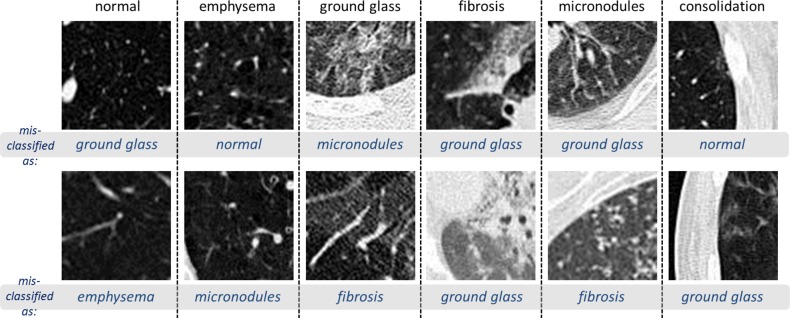
“Although the ILD [37] and LTRC datasets [64] (used in [19]) were generated and annotated separately, they contain many common disease labels. For instance, the ILD disease classes emphysema (EM), ground glass (GG), fibrosis (FB), and micronodules (MN) belong to both datasets, and thus can be jointly trained/tested to form a larger and unified dataset.”
§ Deep Convolutional Neural Networks for Computer-Aided Detection: CNN Architectures, Dataset Characteristics and Transfer Learning > Evaluations and Discussions > Interstitial Lung Disease Classification
What the sources say
- Not checked yetcites [37] Depeursinge A., “ Building a reference multimedia database for interstitial lung diseases,” Comput. Med. Imaging and. Grap., vol. 36, no. 3, pp. 227– 238, 2012. 21803548 source
- Not matchedcites [64] Holmes III D., Bartholmai B., Karwoski R., Zavaletta V., and Robb R., “ The lung tissue research consortium: An extensive open database containing histological, clinical, and radiological data to study chronic lung disease,” in MICCAI Open Sci. Workshop, 2006.
Couldn’t be matched to a paper in Crossref, so it can’t be checked.
plaindirect- Asserted: passes — The authors put it forward as true.
- Checkable: passes — It can be checked against evidence.
- Load-bearing: passes — The paper’s conclusions depend on it.
- Based: passes — The paper gives a reason why it holds.
It may state two separate claims as one.
A conclusion the paper draws from its own results — it cites no other source for it, so there is none to check. The quote shows it is in the paper.
In the paper
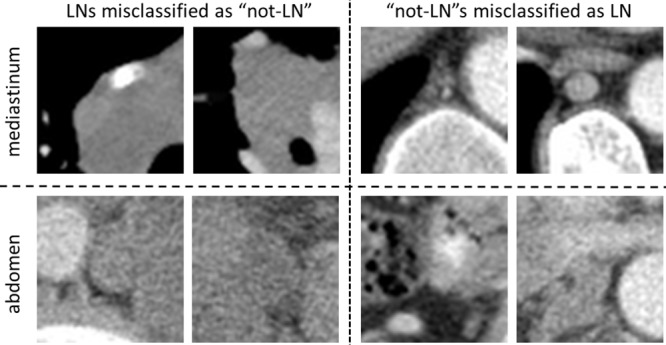
“As shown in Fig. 1, abdominal LNs are surrounded by many other similar looking objects. Meanwhile, mediastinal LNs are more easily distinguishable, due to the images' larger spatial contexts.”
§ Deep Convolutional Neural Networks for Computer-Aided Detection: CNN Architectures, Dataset Characteristics and Transfer Learning > Evaluations and Discussions > Thoracoabdominal Lymph Node Detection
plaindirect- Asserted: passes — The authors put it forward as true.
- Checkable: passes — It can be checked against evidence.
- Load-bearing: passes — The paper’s conclusions depend on it.
- Based: passes — The paper gives a reason why it holds.
It may state two separate claims as one.
A conclusion the paper draws from its own results — it cites no other source for it, so there is none to check. The quote shows it is in the paper.
In the paper
“GoogLeNet-RI-H performs poorly, as it is susceptible to over-fitting.”
§ Deep Convolutional Neural Networks for Computer-Aided Detection: CNN Architectures, Dataset Characteristics and Transfer Learning > Evaluations and Discussions > Thoracoabdominal Lymph Node Detection
plaindirect- Asserted: passes — The authors put it forward as true.
- Checkable: passes — It can be checked against evidence.
- Load-bearing: passes — The paper’s conclusions depend on it.
- Based: passes — The paper gives a reason why it holds.
It may state two separate claims as one.
In the paper
“A segmentation label propagation method was recently proposed [47] to provide full pixel-wise labeling of the ILD data images.”
§ Deep Convolutional Neural Networks for Computer-Aided Detection: CNN Architectures, Dataset Characteristics and Transfer Learning > Evaluations and Discussions > Interstitial Lung Disease Classification
What the sources say
- Not checked yetcites [47] Gao M., Lu L., Nogues I., Summers M. R., and Mollura D., “ Segmentation label propagation using deep convolutional neural networks and dense conditional random field,” Proc. IEEE Int. Conf. Comput. Vis., pp. 1377– 1385, 2015. source
plaindirect- Asserted: passes — The authors put it forward as true.
- Checkable: passes — It can be checked against evidence.
- Load-bearing: fails — The paper’s conclusions may not depend on it.
- Based: passes — The paper gives a reason why it holds.
Probably not a substantial claim. The paper’s conclusions may not depend on it.
A conclusion the paper draws from its own results — it cites no other source for it, so there is none to check. The quote shows it is in the paper.
In the paper
“For ILD classification, the most critical performance bottlenecks are the challenge of cross-dataset learning and the limited patient population size.”
§ Deep Convolutional Neural Networks for Computer-Aided Detection: CNN Architectures, Dataset Characteristics and Transfer Learning > Evaluations and Discussions > Interstitial Lung Disease Classification
plaindirect- Asserted: passes — The authors put it forward as true.
- Checkable: passes — It can be checked against evidence.
- Load-bearing: passes — The paper’s conclusions depend on it.
- Based: fails — The paper may give no reason why it holds.
Probably not a substantial claim. The paper may give no reason why it holds. It may state two separate claims as one.
In the paper
“Overfeat is the winning model of the ILSVRC 2013 in detection and classification tasks.”
§ Deep Convolutional Neural Networks for Computer-Aided Detection: CNN Architectures, Dataset Characteristics and Transfer Learning > Evaluations and Discussions > Evaluation of Five CNN Models Using ILD Classification
What the sources say
- Not checked yetcites [67] Sermanet P., “ Overfeat: Integrated recognition, localization and detection using convolutional networks,” Proc. ICLR, 2014.
plain- Asserted: passes — The authors put it forward as true.
- Checkable: passes — It can be checked against evidence.
- Load-bearing: fails — The paper’s conclusions may not depend on it.
- Based: passes — The paper gives a reason why it holds.
Probably not a substantial claim. The paper’s conclusions may not depend on it.
A conclusion the paper draws from its own results — it cites no other source for it, so there is none to check. The quote shows it is in the paper.
In the paper
“The empirical evaluation, CNN model visualization, CNN performance analysis, and conclusive insights can be generalized to the design of high performance CAD systems for other medical imaging tasks.”
§ Deep Convolutional Neural Networks for Computer-Aided Detection: CNN Architectures, Dataset Characteristics and Transfer Learning > Conclusion
plain- Asserted: passes — The authors put it forward as true.
- Checkable: fails — It may be too vague to check against evidence.
- Load-bearing: passes — The paper’s conclusions depend on it.
- Based: passes — The paper gives a reason why it holds.
Probably not a substantial claim. It may be too vague to check against evidence.
The paper relies on this without support.
Fine-tuning an ImageNet pre-trained CNN model on medical image datasets had not yet been exploited at the time of the study.
“However, the fine-tuning of an ImageNet pre-trained CNN model on medical image datasets has not yet been exploited.”
The paper relies on this without support.
Obtaining datasets as comprehensively annotated as ImageNet in the medical imaging domain remains a challenge.
“However, obtaining datasets as comprehensively annotated as ImageNet in the medical imaging domain remains a challenge.”
The paper relies on this without support.
Some areas outside the lung appear in both healthy or diseased images.
“Some areas outside of the lung appear in both healthy or diseased images.”
The paper relies on this without support.
The low-attenuation CT window is useful for visualizing certain texture patterns of lung diseases, especially emphysema.
“The low-attenuation CT window is useful for visualizing certain texture patterns of lung diseases (especially emphysema).”
The paper relies on this without support.
Collecting and annotating large numbers of medical images still poses significant challenges.
“Collecting and annotating large numbers of medical images still poses significant challenges.”
The authors state this as an assumption.
OverFeat and VGGNet may generate quantitative performance results ranked between AlexNet's and GoogLeNet's.
“Likewise, a reasonable assumption is that OverFeat and VGGNet may generate quantitative performance results ranked between AlexNet's and GoogLeNet's.”
The authors state this as an assumption.
OverFeat's and VGGNet's performance levels fall between AlexNet's and GoogLeNet's.
“The reported results validate our assumption that OverFeat's and VGGNet's performance levels fall between AlexNet's and GoogLeNet's (this observation is consistent with the computer vision findings).”
The paper relies on this without support.
Both the ILD and ImageNet datasets use full-size images.
“Indeed, both datasets use full-size images.”
The paper relies on this without support.
CifarNet is designed for images with smaller dimensions (32×32 images), and thus is not catered to classification tasks involving 256×256 images.
“CifarNet is designed for images with smaller dimensions (32×32 images), and thus is not catered to classification tasks involving 256×256 images.”
The paper relies on this without support.
Medical datasets are often biased, in that the number of healthy samples is much larger than the number of diseased instances, or that the numbers of images per class are uneven.
“Medical datasets are often “biased”, in that the number of healthy samples is much larger than the number of diseased instances, or that the numbers of images per class are uneven.”
Claims other papers make about this one
Each is checked against this paper’s own text: does it say what the citing paper says it does?
In the citing paper
“Transfer learning from natural images has been widely adopted for medical image classification Tajbakhsh et al. (2016); Shin et al. (2016); however the application to medical image segmentation has been scarce.”
From Embracing imperfect datasets: A review of deep learning solutions for medical image segmentation (2020) · cites this paper as Shin et al. (2016)
In the citing paper
“In general, shallow networks have been preferred in medical image analysis, when compared with very deep CNNs employed in computer vision applications [80] [81].”
From Medical image analysis using convolutional neural networks: a review (2018) · cites this paper as [80]
In the citing paper
“Healthcare applications of deep learning range from one-dimensional biosignal analysis [17] and the prediction of medical events, e.g. seizures [18] and cardiac arrests [19], to computer-aided detection [20] and diagnosis [21] supporting clinical decision making and survival analysis [22], to drug discovery [23] and as an aid in therapy selection and pharmacogenomics [24], to increased operational”
From An overview of deep learning in medical imaging focusing on MRI (2019) · cites this paper as [20]
In the citing paper
“After first and second fully connected layers' dropout regularization layer [45] has been used to avoid further overfitting with a neuron dropout probability of 1-p, where p is the probability of neurons kept.”
From Medical image retrieval using deep convolutional neural network (2017) · cites this paper as [45]
In the citing paper
“Instead, a specially designed small network may be more suitable to the smaller-scale training datasets that are commonly encountered in medical imaging [155].”
From Deep Learning in Medical Ultrasound Analysis: A Review (2019) · cites this paper as [155]
In the citing paper
“Shin et al. [62] reported that they obtained best performance with transfer learning from pre-trained model on ImageNet dataset and fine-tuning on lymph node and interstitial lung disease rather than training from scratch.”
From Deep learning for brain MRI segmentation: state of the art and future directions (2017) · cites this paper as [62]
In the citing paper
“The convolutional encoder-decoder network using VGG16 shares many features with the commonly used U-Net network (29) but has unique advantages, including lower computation cost, presence of batch normalization layers to improve training efficiency, and more versatility for use as both a segmentation and classification network, which allows effective transfer learning in the current setup (30,31).”
From Deep learning approach for evaluating knee MR images: achieving high diagnostic performance for cartilage lesion detection. (2018) · cites this paper as [30]
Self-check
Percentages, sums and reported differences re-computed from the paper’s own numbers.
Each contradiction between two passages listed here was confirmed by an independent check.
Rated minor: it would not touch a result — a value no result rests on, a p-value that stays on the same side of the significance level, or a conflict that is clerical, resolved elsewhere in the paper, or outside its own findings.
In the paper
§ Deep Convolutional Neural Networks for Computer-Aided Detection: CNN Architectures, Dataset Characteristics and Transfer Learning > Evaluations and Discussions > Thoracoabdominal Lymph Node Detection
“We also evaluate a simple ensemble by averaging the probability scores from five CNNs:”
§ Deep Convolutional Neural Networks for Computer-Aided Detection: CNN Architectures, Dataset Characteristics and Transfer Learning > Evaluations and Discussions > Thoracoabdominal Lymph Node Detection
“AlexNet-RI-H, AlexNet-TL-H, AlexNet-RI-H, GoogLeNet-TL-H and GoogLeNet-RI-L.”
Rated minor: it would not touch a result — a value no result rests on, a p-value that stays on the same side of the significance level, or a conflict that is clerical, resolved elsewhere in the paper, or outside its own findings.
In the paper
§ Deep Convolutional Neural Networks for Computer-Aided Detection: CNN Architectures, Dataset Characteristics and Transfer Learning > Methods > Convolutional Neural Network Architectures
“Googlenet [33] contains two convolution layers, three pooling layers, and nine inception layers.”
§ Deep Convolutional Neural Networks for Computer-Aided Detection: CNN Architectures, Dataset Characteristics and Transfer Learning > Methods > Convolutional Neural Network Architectures
“Overall, GoogLeNet has two convolution layers, two pooling layers, and nine “Inception” layers.”
Rated minor: it would not touch a result — a value no result rests on, a p-value that stays on the same side of the significance level, or a conflict that is clerical, resolved elsewhere in the paper, or outside its own findings.
In the paper
§ Deep Convolutional Neural Networks for Computer-Aided Detection: CNN Architectures, Dataset Characteristics and Transfer Learning > Evaluations and Discussions > Training With “equal Prior” vs.“biased Prior”
“Table: Table VIII Classification accuracies for ILD slice and LN patch-level detection with “equal prior” and “biased prior”, using googlenet-TL”
§ Deep Convolutional Neural Networks for Computer-Aided Detection: CNN Architectures, Dataset Characteristics and Transfer Learning > Evaluations and Discussions > Training With “equal Prior” vs.“biased Prior”
“| | ILD-Slice | ILD-Patch |”
Rated minor: it would not touch a result — a value no result rests on, a p-value that stays on the same side of the significance level, or a conflict that is clerical, resolved elsewhere in the paper, or outside its own findings.
In the paper
§ Deep Convolutional Neural Networks for Computer-Aided Detection: CNN Architectures, Dataset Characteristics and Transfer Learning > Introduction
“We obtain 86% sensitivity on 3 false positives (FP) per patient”
§ Deep Convolutional Neural Networks for Computer-Aided Detection: CNN Architectures, Dataset Characteristics and Transfer Learning > Evaluations and Discussions > Thoracoabdominal Lymph Node Detection
“| Combined | 0.95 | 0.85 | 0.93 | 0.70 |”
Citations
Cites
Very Deep Convolutional Networks for Large-Scale Image Recognition
Simonyan, K., & Zisserman, A. (2014) · arXiv · doi:10.48550/arxiv.1409.1556 · Cited by 114,148 · cited 2×
“GoogLeNet is the state-of-the-art deep model, which has outperformed other notable models, such as AlexNet, OverFeat, and VGGNet [67], [68] in various computer vision benchmarks.”
BackgroundMethodImageNet classification with deep convolutional neural networks
Krizhevsky, A., Sutskever, I., & Hinton, G. E. (2017) · Communications of the ACM · doi:10.1145/3065386 · Cited by 112,155 · cited 9×
“For datadriven learning, large-scale well-annotated datasets with representative data distribution characteristics are crucial to learning more accurate or generalizable models [5], [4].”
BackgroundMethodInfluentialImageNet: A large-scale hierarchical image database
Deng, J., Dong, W., Socher, R., Li, L.-J., Li, K., & Fei-Fei, L. (2009) · 2009 IEEE Conference on Computer Vision and Pattern Recognition · doi:10.1109/cvpr.2009.5206848 · Cited by 65,333 · cited 4×
“datasets with representative data distribution characteristics are crucial to learning more accurate or generalizable models [5], [4]. Unlike previous image datasets used in computer vision, ImageNet [1] offers a very comprehensive database of more than 1.2 million categorized natural images of 1000+ classes. The CNN…”
BackgroundMethodInfluentialGradient-based learning applied to document recognition
Lecun, Y., Bottou, L., Bengio, Y., & Haffner, P. (1998) · Proceedings of the IEEE · doi:10.1109/5.726791 · Cited by 58,805 · cited 2×
“achieved significantly improved performance over the other non-deep learning methods for ImageNet Large Scale Visual Recognition Challenge (ILSVRC) 2012. This success has revived the interest in CNNs [3] in computer vision. ImageNet consists of 1.2 million 256 256 images belonging to 1000 categories. At times, the obje…”
BackgroundInfluentialDistinctive Image Features from Scale-Invariant Keypoints
Lowe, D. G. (2004) · International Journal of Computer Vision · doi:10.1023/b:visi.0000029664.99615.94 · Cited by 55,589 · cited 2×
“Although natural images and medical images differ significantly, conventional image descriptors developed for object recognition in natural images, such as the scale-invariant feature transform (SIFT) [30] and the histogram of oriented gradients (HOG) [31], have been widely used for object detection and segmentation i…”
BackgroundGoing deeper with convolutions
Szegedy, C., Liu, W., Jia, Y., Sermanet, P., Reed, S., Anguelov, D., Erhan, D., Vanhoucke, V., & Rabinovich, A. (2015) · 2015 IEEE Conference on Computer Vision and Pattern Recognition (CVPR) · doi:10.1109/cvpr.2015.7298594 · Cited by 48,562 · cited 9×
“AlexNet [4] and GoogLeNet [33] are also modified to evaluate these state-of-the-art CNN architecture from ImageNet classification task [2] to our CADe problems and datasets.”
BackgroundMethodInfluentialImageNet Large Scale Visual Recognition Challenge
Russakovsky, O., Deng, J., Su, H., Krause, J., Satheesh, S., Ma, S., Huang, Z., Karpathy, A., Khosla, A., Bernstein, M., et al. (2015) · International Journal of Computer Vision · doi:10.1007/s11263-015-0816-y · Cited by 39,380
Fully convolutional networks for semantic segmentation
Long, J., Shelhamer, E., & Darrell, T. (2015) · 2015 IEEE Conference on Computer Vision and Pattern Recognition (CVPR) · doi:10.1109/cvpr.2015.7298965 · Cited by 38,834 · cited 1×
“However, current FCNN approaches [65], [66] lack adequate spatial resolution in their directly output label space.”
BackgroundHistograms of Oriented Gradients for Human Detection
Dalal, N., & Triggs, B. (2005) · 2005 IEEE Computer Society Conference on Computer Vision and Pattern Recognition (CVPR'05) · doi:10.1109/cvpr.2005.177 · Cited by 33,584
Learning Multiple Layers of Features from Tiny Images
Krizhevsky, A. (2024) · doi:10.57702/zp44cu3g · Cited by 23,889
Research works printed but not linked: 3
- seff, 2015, Leveraging mid-level semantic boundary cues for computer-aided lymph node detection, Proc MICCAI
- kim, 2014, Performance assessment of retroperitoneal lymph node computer-assisted detection using random forest and deep convolutional neural network learning algorithms in tandem, 102nd Annu Meet Radiol Soc N Am
- sermanet, 2014, Overfeat: Integrated recognition, localization and detection using convolutional networks, Proc ICLR
Cited by
Sorted by citations
Items 901–1,000 of 1,020
Using ResNets to perform automated defect detection for Fluorescent Penetrant Inspection
Shipway, N. J., Huthwaite, P., Lowe, M. J. S., & Barden, T. (2021) · NDT & E International · doi:10.1016/j.ndteint.2020.102400 · Cited by 65
Detection of ankle fractures using deep learning algorithms
Ashkani‐Esfahani, S., Mojahed-Yazdi, R., Bhimani, R., Kerkhoffs, G. M. M. J., Maas, M. M., DiGiovanni, C. W., Lubberts, B., & Guss, D. (2022) · Foot and Ankle Surgery · doi:10.1016/j.fas.2022.05.005 · Cited by 67
MCNN: a multi-level CNN model for the classification of brain tumors in IoT-healthcare system
Haq, A. U., Li, J., Kumar, R., Ali, Z., Khan, I. U., Uddin, M. I., & Agbley, B. L. Y. (2022) · Journal of Ambient Intelligence and Humanized Computing · doi:10.1007/s12652-022-04373-z · Cited by 67
“However, to enhance the proposed CNN classifier performance, data augmentation and Transfer learning (Khan et al. 2019; Schwarz et al. 2015; Shin et al. 2016) methods are incorporated.”
MethodDeep Learning Trends for Focal Brain Pathology Segmentation in MRI
Havaei, M., Guizard, N., Larochelle, H., & Jodoin, P. (2016) · Lecture notes in computer science · doi:10.1007/978-3-319-50478-0_6 · Cited by 103
Self-supervised Learning for Spinal MRIs
Jamaludin, A., Kadir, T., & Zisserman, A. (2017) · Lecture notes in computer science · doi:10.1007/978-3-319-67558-9_34 · Cited by 74
Data Science in Radiology: A Path Forward
Aerts, H. J. W. L. (2017) · Clinical Cancer Research · doi:10.1158/1078-0432.ccr-17-2804 · Cited by 70
Breast mass classification via deeply integrating the contextual information from multi-view data
Wang, H., Feng, J., Zhang, Z., Su, H., Cui, L., He, H., & Liu, L. (2018) · Pattern Recognition · doi:10.1016/j.patcog.2018.02.026 · Cited by 68
Zhu, J., Zhang, J., Qiu, B., Liu, Y., Liu, X., & Chen, L. (2018) · Acta Oncologica · doi:10.1080/0284186x.2018.1529421 · Cited by 72
Deep Learning Approach for Assessment of Bladder Cancer Treatment Response
Wu, E., Hadjiiski, L. M., Samala, R. K., Chan, H., Cha, K. H., Richter, C., Cohan, R. H., Caoili, E. M., Paramagul, C., Alva, A. S., et al. (2019) · Tomography · doi:10.18383/j.tom.2018.00036 · Cited by 65
The seven key challenges for the future of computer-aided diagnosis in medicine
Yanase, J., & Triantaphyllou, E. (2019) · International Journal of Medical Informatics · doi:10.1016/j.ijmedinf.2019.06.017 · Cited by 72
George, K., Faziludeen, S., Sankaran, P., & Paul Joseph, K. (2020) · Computers in Biology and Medicine · doi:10.1016/j.compbiomed.2020.103954 · Cited by 66
Full 3D Microwave Breast Imaging Using a Deep-Learning Technique
Khoshdel, V., Asefi, M., Ashraf, A. B., & LoVetri, J. (2020) · Journal of Imaging · doi:10.3390/jimaging6080080 · Cited by 67
Machine learning in experimental materials chemistry
Selvaratnam, B., & Koodali, R. T. (2020) · Catalysis Today · doi:10.1016/j.cattod.2020.07.074 · Cited by 69
Yan, K., Peng, Y., Sandfort, V., Bagheri, M. H., Lu, Z., & Summers, R. M. (2019) · IEEE Computer Society Conference on Computer Vision and Pattern Recognition/Proceedings - IEEE Computer Society Conference on Computer Vision and Pattern Recognition/Proceedings · doi:10.1109/cvpr.2019.00872 · Cited by 61
Self-citationSDCT-AuxNet : DCT augmented stain deconvolutional CNN with auxiliary classifier for cancer diagnosis
Gehlot, S., Gupta, A., & Gupta, R. (2020) · Medical Image Analysis · doi:10.1016/j.media.2020.101661 · Cited by 65
Chen, J., Ying, H., Liu, X., Gu, J., Feng, R., Chen, T., Gao, H., & Wu, J. (2020) · IEEE Transactions on Computational Biology and Bioinformatics · doi:10.1109/tcbb.2020.2991173 · Cited by 65
Lee, H., Ho, H. W., & Zhou, Y. (2020) · Journal of Intelligent & Robotic Systems · doi:10.1007/s10846-020-01284-z · Cited by 66
Liu, X., Guo, Z., Cao, J., & Tang, J. (2021) · Computers in Biology and Medicine · doi:10.1016/j.compbiomed.2021.104543 · Cited by 66
Bi, L., Kim, J., Kumar, A., Wen, L., Feng, D. D., & FULHAM, M. J. (2016) · Computerized Medical Imaging and Graphics · doi:10.1016/j.compmedimag.2016.11.008 · Cited by 65
Gastric Pathology Image Classification Using Stepwise Fine-Tuning for Deep Neural Networks
Qu, J., Hiruta, N., Terai, K., Nosato, H., Murakawa, M., & Sakanashi, H. (2018) · Journal of Healthcare Engineering · doi:10.1155/2018/8961781 · Cited by 64
Radiogenomics for Precision Medicine With a Big Data Analytics Perspective
Panayides, A. S., Pattichis, M. S., Leandrou, S., Pitris, C., Constantinidou, A., & Pattichis, C. S. (2019) · IEEE Journal of Biomedical and Health Informatics · doi:10.1109/jbhi.2018.2879381 · Cited by 66
Kim, H., & Youn, B. D. (2019) · IEEE Access · doi:10.1109/access.2019.2906273 · Cited by 65
Optic Disc and Cup Segmentation Based on Deep Convolutional Generative Adversarial Networks
Jiang, Y., Tan, N., & Peng, T. (2019) · IEEE Access · doi:10.1109/access.2019.2917508 · Cited by 65
Canchumuni, S. W. A., Castro, J. D. B., Potratz, J., Emerick, A. A., & Pacheco, M. A. C. (2020) · Computational Geosciences · doi:10.1007/s10596-020-10015-0 · Cited by 66
Spotting L3 slice in CT scans using deep convolutional network and transfer learning
Belharbi, S., Chatelain, C., Hérault, R., Adam, S., Thureau, S., Chastan, M., & Modzelewski, R. (2017) · Computers in Biology and Medicine · doi:10.1016/j.compbiomed.2017.05.018 · Cited by 63
Khamparia, A., Singh, A. D., Anand, D., Gupta, D. K., Khanna, A. K., Arunkumar, N., & Tan, J. (2018) · Neural Computing and Applications · doi:10.1007/s00521-018-3896-0 · Cited by 67
RetractedGuan, B., Liu, F., Haj‐Mirzaian, A., Demehri, S., Samsonov, A. A., Neogi, T., Guermazi, A., & Kijowski, R. (2020) · Osteoarthritis and Cartilage · doi:10.1016/j.joca.2020.01.010 · Cited by 70
Xiao, B. J., Xu, W., Guo, J., Lam, H., Jia, G., Hong, W., & Ren, H. (2020) · IEEE Transactions on Automation Science and Engineering · doi:10.1109/tase.2020.2978881 · Cited by 65
Deep Ensemble Model for Classification of Novel Coronavirus in Chest X‐Ray Images
Ahmad, F., Farooq, A., & Ghani, M. U. (2021) · Computational Intelligence and Neuroscience · doi:10.1155/2021/8890226 · Cited by 65
Brück, O. E., Lallukka-Brück, S. E., Hohtari, H. R., Ianevski, A., Ebeling, F. T., Kovanen, P. E., Kytölä, S. I., Aittokallio, T. A., Ramos, P. M., Porkka, K., et al. (2021) · Blood Cancer Discovery · doi:10.1158/2643-3230.bcd-20-0162 · Cited by 67
Ali, N., Bolenz, C., Todenhöfer, T., Stenzel, A., Deetmar, P., Kriegmair, M., Knoll, T., Porubský, Š., Hartmann, A., Popp, J., et al. (2021) · Scientific Reports · doi:10.1038/s41598-021-91081-x · Cited by 67
Lung Cancer Detection using VGG NET 16 Architecture
Sheriff, S. T. M., Kumar, J. V., Vigneshwaran, S., et al. (2021) · Journal of Physics Conference Series · doi:10.1088/1742-6596/2040/1/012001 · Cited by 65
“The survive rate after five years of diseases occurred is very poor, while outcomes on average are worse in the developing world [5].”
BackgroundAI-Based Detection, Classification and Prediction/Prognosis in Medical Imaging
Yousefirizi, F., Decazes, P., Amyar, A., Ruan, S., Saboury, B., & Rahmim, A. (2021) · PET Clinics · doi:10.1016/j.cpet.2021.09.010 · Cited by 76
Deepfake Video Detection Based on EfficientNet-V2 Network
Deng, L., Suo, H., & Li, D. (2022) · Computational Intelligence and Neuroscience · doi:10.1155/2022/3441549 · Cited by 74
“In recent years, the convolutional neural network [16] has developed rapidly, but its deficiencies have gradually emerged.”
BackgroundDeep Learning for Medical Image Cryptography: A Comprehensive Review
Lata, K., & Cenkeramaddi, L. R. (2023) · Applied Sciences · doi:10.3390/app13148295 · Cited by 69
Li, Y., Peng, G., Du, T., Jiang, L., & Kong, X. (2024) · Applied Energy · doi:10.1016/j.apenergy.2024.123826 · Cited by 66
Machine learning and NDE: Past, present, and future
Harley, J. B., & Sparkman, D. M. (2019) · AIP conference proceedings · doi:10.1063/1.5099819 · Cited by 70
Gherardini, M., Mazomenos, E. B., Menciassi, A., & Stoyanov, D. V. (2020) · Computer Methods and Programs in Biomedicine · doi:10.1016/j.cmpb.2020.105420 · Cited by 64
China’s population spatialization based on three machine learning models
Song, Z., Liu, Y., Zhang, R., & Fu, B. (2020) · Journal of Cleaner Production · doi:10.1016/j.jclepro.2020.120644 · Cited by 66
Liu, G., Hua, J., Wu, Z., Meng, T., Sun, M., Huang, P.-Y., He, X., Sun, W., Li, X., & Yang, C. (2020) · Annals of Translational Medicine · doi:10.21037/atm.2020.03.24 · Cited by 67
Logu, F. D., Ugolini, F., Maio, V., Simi, S., Cossu, A., Massi, D., Nassini, R., & Laurino, M. (2020) · Frontiers in Oncology · doi:10.3389/fonc.2020.01559 · Cited by 64
MagNet: A Machine Learning Framework for Magnetic Core Loss Modeling
Li, H., Lee, S. R., Luo, M., Sullivan, C. R., Chen, Y., & Chen, M. (2020) · IEEE ... Workshop on Control and Modeling for Power Electronics · doi:10.1109/compel49091.2020.9265869 · Cited by 70
Identification of Surface Deformation in InSAR Using Machine Learning
Brengman, C. M. J., & Barnhart, W. D. (2021) · Geochemistry Geophysics Geosystems · doi:10.1029/2020gc009204 · Cited by 76
Research progress of computer vision technology in abnormal fish detection
Liu, C., Wang, Z., Li, Y., Zhang, Z., Li, J., Chen, X., Du, R., Li, D., & Duan, Q. (2023) · Aquacultural Engineering · doi:10.1016/j.aquaeng.2023.102350 · Cited by 68
Kanaujia, V. K., Kumar, A., & Yadav, S. P. (2024) · Archives of Computational Methods in Engineering · doi:10.1007/s11831-024-10067-w · Cited by 65
Deep Learning Neural Networks for sUAS-Assisted Structural Inspections: Feasibility and Application
Dorafshan, S., Thomas, R. J., Coopmans, C., & Maguire, M. (2018) · International Conference on Unmanned Aircraft Systems (ICUAS) · doi:10.1109/icuas.2018.8453409 · Cited by 69
Learned sensing: jointly optimized microscope hardware for accurate image classification
Muthumbi, A. K., Chaware, A., Kim, K., Zhou, K. C., Konda, P. C., Chen, R. J., Judkewitz, B., Erdmann, A. A., Kappes, B., & Horstmeyer, R. W. (2019) · Biomedical Optics Express · doi:10.1364/boe.10.006351 · Cited by 61
Spontaneous facial expression database for academic emotion inference in online learning
Bian, C., Zhang, Y., Yang, F., Bi, W., & Lu, W. (2018) · IET Computer Vision · doi:10.1049/iet-cvi.2018.5281 · Cited by 64
Deep learning-based ambient assisted living for self-management of cardiovascular conditions
Qureshi, M., Qureshi, K. N., Jeon, G., & Piccialli, F. (2021) · Neural Computing and Applications · doi:10.1007/s00521-020-05678-w · Cited by 67
Tan, W., Liu, P., Li, X., Liu, Y., Zhou, Q., Chen, C., Gong, Z., Yin, X., & Zhang, Y. (2021) · Health Information Science and Systems · doi:10.1007/s13755-021-00140-0 · Cited by 68
Fricke, C., Alizadeh, J., Zakhary, N., Woost, T. B., Bogdan, M., & Claßen, J. (2021) · Frontiers in Neurology · doi:10.3389/fneur.2021.666458 · Cited by 64
Wu, Z., Hou, B., Ren, B., et al. (2021) · Remote Sensing · doi:10.3390/rs13132582 · Cited by 63
Zhou, Q., Zhu, W., Li, F., Yuan, M., Zheng, L., & Liu, X. (2021) · Current Pharmaceutical Design · doi:10.2174/1381612827666211213143357 · Cited by 68
SUSAN: segment unannotated image structure using adversarial network
Liu, F. (2018) · Magnetic Resonance in Medicine · doi:10.1002/mrm.27627 · Cited by 63
Sun, J., Wang, P., Luo, Y., & Li, W. (2019) · IEEE Transactions on Instrumentation and Measurement · doi:10.1109/tim.2019.2899478 · Cited by 65
Sun, M., Zhang, G., Dang, H., Qi, X., Zhou, X., & Chang, Q. H. (2019) · IEEE Access · doi:10.1109/access.2019.2918800 · Cited by 61
Zhao, X., Qi, S., Zhang, B., Ma, H., Qian, W., Yao, Y., & Sun, J. (2019) · Journal of X-Ray Science and Technology · doi:10.3233/xst-180490 · Cited by 64
Park, S., Chu, L. C. H., Fishman, E. K., Yuille, A., Vogelstein, B., Kinzler, K. W., Horton, K. M., Hruban, R. H., Zinreich, E. S., Fouladi, D. F., et al. (2019) · Diagnostic and Interventional Imaging · doi:10.1016/j.diii.2019.05.008 · Cited by 63
Zhu, Z., Harowicz, M. R., Zhang, J., Saha, A., Grimm, L. J., Hwang, E. S., & Mazurowski, M. A. (2019) · Computers in Biology and Medicine · doi:10.1016/j.compbiomed.2019.103498 · Cited by 64
Automatic Diagnosis Based on Spatial Information Fusion Feature for Intracranial Aneurysm
Zeng, Y., Liu, X., Xiao, N., Li, Y., Jiang, Y., Feng, J., & Guo, S. (2019) · IEEE Transactions on Medical Imaging · doi:10.1109/tmi.2019.2951439 · Cited by 65
Zhi, W., Yueng, H. W. F., Chen, Z., Zandavi, S. M., Lu, Z., & Chung, Y. Y. (2017) · Lecture notes in computer science · doi:10.1007/978-3-319-70093-9_71 · Cited by 74
Deep Neural Network Based Mobile Dermoscopy Application for Triaging Skin Cancer Detection
Ech-Cherif, A., Misbhauddin, M., & Ech-Cherif, M. E.-A. (2019) · International Conference on Computer Applications & Information Security (ICCAIS) · doi:10.1109/cais.2019.8769517 · Cited by 64
Wang, P., Qi, S., Li, Y., Lv, S., Wang, J., Li, L., & Zhang, H. (2019) · Biomedical Signal Processing and Control · doi:10.1016/j.bspc.2019.101789 · Cited by 63
Fault diagnosis of the bushing infrared images based on mask R‐CNN and improved PCNN joint algorithm
Jiang, J., Bie, Y., Li, J., Yang, X., Ma, G., Lu, Y., & Zhang, C. (2020) · High Voltage · doi:10.1049/hve.2019.0249 · Cited by 65
Denholm, S. J., Brand, W., Mitchell, A. P., Wells, A. T., Krzyzelewski, T., Smith, S., Wall, E., & Coffey, M. P. (2020) · Journal of Dairy Science · doi:10.3168/jds.2020-18328 · Cited by 65
Keratoconus detection of changes using deep learning of colour-coded maps
Chen, X., Zhao, J., Iselin, K. C., Borroni, D., Romano, D., Gokul, A., McGhee, C. N. J., Zhao, Y., Sedaghat, M.-R., Momeni‐Moghaddam, H., et al. (2021) · BMJ Open Ophthalmology · doi:10.1136/bmjophth-2021-000824 · Cited by 67
Anjum, S., Hussain, L., Ali, M., Alkinani, M. H., Aziz, W., Gheller, S., Abbasi, A. A., Marchal, A. R., Suresh, H., & Duong, T. Q. (2021) · International Journal of Imaging Systems and Technology · doi:10.1002/ima.22641 · Cited by 66
Deep Learning in Large and Multi-Site Structural Brain MR Imaging Datasets
Bento, M., Fantini, I., Park, J., Rittner, L., & Frayne, R. (2022) · Frontiers in Neuroinformatics · doi:10.3389/fninf.2021.805669 · Cited by 72
“Models that implicitly account for image data variability by, for example, employing domain transfer, domain adaptation techniques, or multitask learning have been proposed (Shin et al., 2016; Wang and Deng, 2018).”
BackgroundA general deep transfer learning framework for predicting the flow field of airfoils with small data
Wang, Z., Liu, X., Yu, J. X., Wu, H., & Lyu, H. (2022) · Computers & Fluids · doi:10.1016/j.compfluid.2022.105738 · Cited by 65
Kid-Net: Convolution Networks for Kidney Vessels Segmentation from CT-Volumes
Taha, A., Lo, P., Li, J., et al. (2018) · Lecture notes in computer science · doi:10.1007/978-3-030-00937-3_53 · Cited by 62
Melanoma Early Detection: Big Data, Bigger Picture
Petrie, T. C., Samatham, R. V., Witkowski, A. M., Esteva, A., & Leachman, S. A. (2018) · Journal of Investigative Dermatology · doi:10.1016/j.jid.2018.06.187 · Cited by 62
A unified two-parallel-branch deep neural network for joint gland contour and segmentation learning
Wang, L., Zhen, H., Fang, X., Wan, S., Ding, W., & Guo, Y. (2019) · Future Generation Computer Systems · doi:10.1016/j.future.2019.05.035 · Cited by 61
Role of deep learning in infant brain MRI analysis
Mostapha, M., & Styner, M. A. (2019) · Magnetic Resonance Imaging · doi:10.1016/j.mri.2019.06.009 · Cited by 63
Liver tumor segmentation in CT volumes using an adversarial densely connected network
Chen, L., Song, H., Wang, C., Cui, Y., Yang, J., Hu, X., & Zhang, L. (2019) · BMC Bioinformatics · doi:10.1186/s12859-019-3069-x · Cited by 62
Gastric histopathology image segmentation using a hierarchical conditional random field
Sun, C., Li, C., Zhang, J., Rahaman, M. M., Ai, S., Chen, H., Kulwa, F., Li, Y., Li, X., & Jiang, T. (2020) · Journal of Applied Biomedicine · doi:10.1016/j.bbe.2020.09.008 · Cited by 59
Wu, Y., White, G. M., Cornelius, T., Gowdar, I., Ansari, M. H., Supanich, M. P., & Deng, J. (2020) · Annals of Translational Medicine · doi:10.21037/atm.2019.12.151 · Cited by 64
Pan, P., Chen, H., Li, Y., Cai, N., Cheng, L., & Wang, S. (2020) · Ultrasonics · doi:10.1016/j.ultras.2020.106271 · Cited by 63
A Structure-Aware Relation Network for Thoracic Diseases Detection and Segmentation
Lian, J., Liu, J., Zhang, S., Gao, K., Liu, X., Zhang, D., & Yu, Y. (2021) · IEEE Transactions on Medical Imaging · doi:10.1109/tmi.2021.3070847 · Cited by 63
Alsaade, F. W., Aldhyani, T. H. H., & Al-Adhaileh, M. H. (2021) · Computational and Mathematical Methods in Medicine · doi:10.1155/2021/9998379 · Cited by 67
OP-convNet: A Patch Classification-Based Framework for CT Vertebrae Segmentation
Qadri, S. F., Shen, L., Ahmad, M., Qadri, S., Zareen, S. S., & Khan, S. (2021) · IEEE Access · doi:10.1109/access.2021.3131216 · Cited by 62
Sharifrazi, D., Alizadehsani, R., Joloudari, J. H., Band, S. S., Hussain, S., Sani, Z. A., Hasanzadeh, F., Shoeibi, A., Dehzangi, A., Sookhak, M., et al. (2022) · Mathematical Biosciences & Engineering · doi:10.3934/mbe.2022110 · Cited by 91
Wang, H., Dalton, L. E., Fan, M., et al. (2022) · Journal of Petroleum Science and Engineering · doi:10.1016/j.petrol.2022.110596 · Cited by 61
Li, J., Li, C., Xu, W., Feng, H., Zhao, F., Long, H., Meng, Y., Chen, W., Yang, H. F., & Yang, G. (2022) · International Journal of Applied Earth Observation and Geoinformation · doi:10.1016/j.jag.2022.102818 · Cited by 69
Challenges Facing the Detection of Colonic Polyps: What Can Deep Learning Do?
Azer, S. A. (2019) · Medicina · doi:10.3390/medicina55080473 · Cited by 61
Zhang, J., Xia, Y., Zeng, H., & Zhang, Y. (2018) · Neurocomputing · doi:10.1016/j.neucom.2018.08.022 · Cited by 61
Machine Learning in Nuclear Medicine: Part 1—Introduction
Uribe, C., Mathotaarachchi, S. S., Gaudet, V., Smith, K. C., Rosa‐Neto, P., Bénard, F., Black, S. E., & Zukotynski, K. (2019) · Journal of Nuclear Medicine · doi:10.2967/jnumed.118.223495 · Cited by 63
Blister Defect Detection Based on Convolutional Neural Network for Polymer Lithium-Ion Battery
Ma, L., Xie, W., & Zhang, Y. A. (2019) · Applied Sciences · doi:10.3390/app9061085 · Cited by 65
Classification of benign and malignant lung nodules from CT images based on hybrid features
Zhang, G., Yang, Z., Gong, L., Jiang, S., & Wang, L. (2019) · Physics in Medicine and Biology · doi:10.1088/1361-6560/ab2544 · Cited by 63
Transfer Learning Based Brain Tumor Detection and Segmentation using Superpixel Technique
Ahuja, S., Panigrahi, B. K., & Gandhi, T. K. (2020) · International Conference on Contemporary Computing and Applications (IC3A) · doi:10.1109/ic3a48958.2020.233306 · Cited by 63
Liu, C., Xie, H., Zhang, S., Mao, Z., Sun, J., & Zhang, Y. (2020) · IEEE Transactions on Medical Imaging · doi:10.1109/tmi.2020.3008382 · Cited by 63
Yan, T., Wong, P. K., Choi, I. C., Vong, C., & Yu, H. H. (2020) · Computers in Biology and Medicine · doi:10.1016/j.compbiomed.2020.104026 · Cited by 65
Race Recognition Using Deep Convolutional Neural Networks
Vo, T., Nguyen, T., & Le, C. T. (2018) · Symmetry · doi:10.3390/sym10110564 · Cited by 59
Human Identification for Activities of Daily Living: A Deep Transfer Learning Approach
Zhu, H., Samtani, S., Chen, H., & Nunamaker, J. F. (2020) · Journal of Management Information Systems · doi:10.1080/07421222.2020.1759961 · Cited by 59
Briechle, S., Krzystek, P., & George Vosselman, A. (2021) · International Journal of Applied Earth Observation and Geoinformation · doi:10.1016/j.jag.2020.102292 · Cited by 62
Hao, W., Hao, X., Yang, Y., Liu, X., Liu, Y., Sun, P., & Sun, R. (2021) · Journal of Analytical Atomic Spectrometry · doi:10.1039/d1ja00078k · Cited by 59
Weakly-supervised deep learning for ultrasound diagnosis of breast cancer
Kim, J., Kim, H. J., Kim, C., Lee, J. H., Kim, K. W., Park, Y. M., Ki, S. Y., Ki, S. Y., Kim, Y. M., & Kim, W. H. (2021) · Scientific Reports · doi:10.1038/s41598-021-03806-7 · Cited by 61
“For deep classifiers, we employed three representative convolutional neural networks (CNN) that have achieved the state-of-the-art performance in various computer vision tasks: VGG16, ResNet34, and GoogLeNet 13–15 .”
MethodAguilar, D. L., Medina‐Pérez, M. A., Loyola‐González, O., Choo, K. R., & Bucheli-Susarrey, E. (2022) · IEEE Transactions on Dependable and Secure Computing · doi:10.1109/tdsc.2022.3148331 · Cited by 63
“In other words, data to be studied is divided by layers [36], single units [37], or representation vectors.”
BackgroundBai, Y., Guo, Y., Zhang, Q., et al. (2022) · Computers and Electronics in Agriculture · doi:10.1016/j.compag.2022.106789 · Cited by 60
Li, Y., Zhu, R., Wang, Y., Feng, L., & Liu, Y. (2023) · npj Computational Materials · doi:10.1038/s41524-023-01068-7 · Cited by 63
Ogundokun, R. O., Li, A., Babatunde, R. S., Umezuruike, C., Sadiku, P. O., Abdulahi, A. T., & Babatunde, A. N. (2023) · Bioengineering · doi:10.3390/bioengineering10080979 · Cited by 72
“These CNNs include AlexNet, Inception, ResNet, and DenseNet [37,38].”
Method
Metadata
- Authors
- Shin, H.-C., Roth, H. R., Gao, M., Lu, L., Xu, Z., Nogues, I., Yao, J., Mollura, D., & Summers, R. M.
- Affiliations
- National Institutes of Health (US)
- Corresponding author
- Shin, Hoo-Chang
- Venue
- IEEE Transactions on Medical Imaging
- Published
- 2016-05
- Volume
- 35
- Issue
- 5
- Pages
- 1285-1298
- ISSN
- 0278-0062 (ISSN-L)
- 1558-254X
- PMC
- PMC4890616
- OpenAlex
- W2253429366
- Cited by
- 5,759
- References
- 104
- Citations by year
- 2026: 279 · 2025: 480 · 2024: 572 · 2023: 614 · 2022: 725 · 2021: 872 · 2020: 808 · 2019: 712 · 2018: 426 · 2017: 223 · 2016: 44
- FWCI
- 385.74
- Type
- journal article
- Language
- en
- Open access
- green
- www.ncbi.nlm.nih.gov
- Locations
- IEEE Transactions on Medical Imaging (publishedVersion)
- PubMed Central (publishedVersion, cc-by)
- PubMed (publishedVersion)
- arXiv (Cornell University) (submittedVersion)
- arXiv (Cornell University)
- Funders
- National Institutes of Health
- NIH Clinical Center (Z01CL040004)
- Topics
- Physical Sciences › Computer Science › Artificial Intelligence › AI in cancer detection
- Physical Sciences › Computer Science › Computer Vision and Pattern Recognition › Advanced Neural Network Applications
- Health Sciences › Medicine › Radiology, Nuclear Medicine and Imaging › Radiomics and Machine Learning in Medical Imaging
- Keywords
- computer-aided detection, deep convolutional neural networks, transfer learning, CNN architecture comparison, medical image classification, ImageNet pre-training, fine-tuning, lymph node detection, interstitial lung disease classification, computed tomography
- MeSH terms
- Diagnosis, Computer-Assisted, Humans, Image Interpretation, Computer-Assisted, Lymph Nodes, Reproducibility of Results, Databases, Factual, Neural Networks, Computer, Lung Diseases, Interstitial
About these checks
Registry, retraction, Cites and statistics results are computed, not judged, with one exception: a printed reference that no index lists is read once by a model before it counts as a citation error. Claims are extracted by a model and kept only when their quote appears verbatim in the text; each cited source is then checked, with a model’s help, for whether it says what the claim relies on. Those verdicts can be wrong — read the claim’s quote and the cited source before relying on one.
A language model drew the claims from the paper on 2026-10-09, under version 3 of the claim definition (model deepseek-v4.1-flash, prompt extract-v3).
A second model labelled each claim on 2026-10-09 (model jev-1.13-20260917, definition revision gold-guideline-v0.2).
Statistics and arithmetic are recomputed, not judged.
Confidence bands are shown only for fields calibrated on our annotated test set. None is calibrated yet, so no band is shown.
What counts as a claim ›How we measure confidence ›How we check this ›
Are you an author, or do you see a problem with this page? Request a review
