

$O(N^3)$ Measurement Cost for Variational Quantum Eigensolver on Molecular Hamiltonians
Open accessThe DOI matches its Crossref record; 88 of the 91 references it cites were found in a registry or an index, and 3 are not checked yet.
Abstract
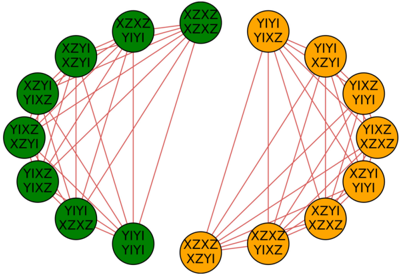
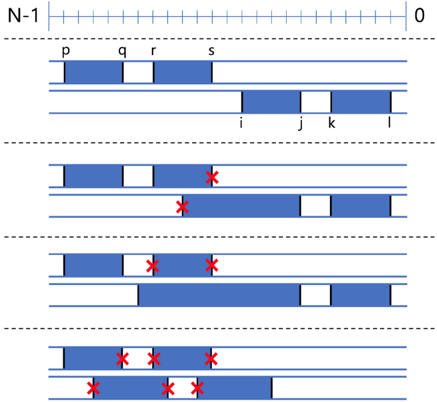
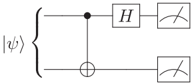
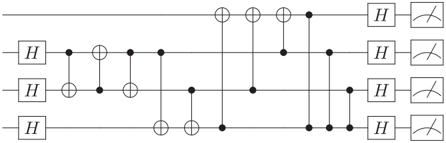
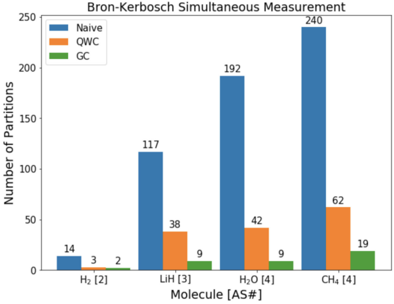
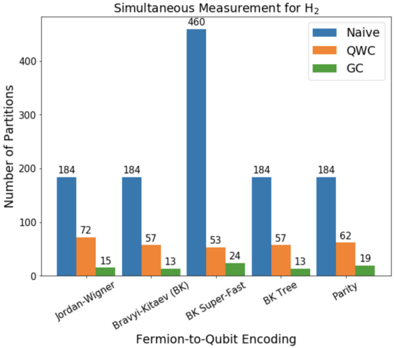
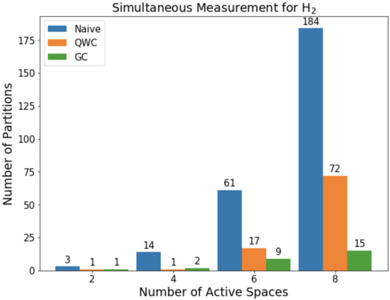
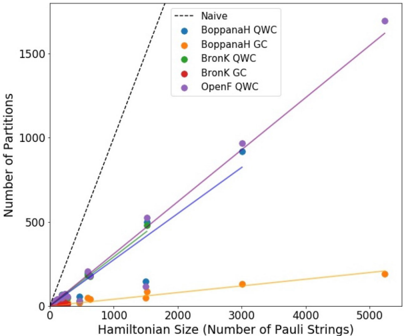
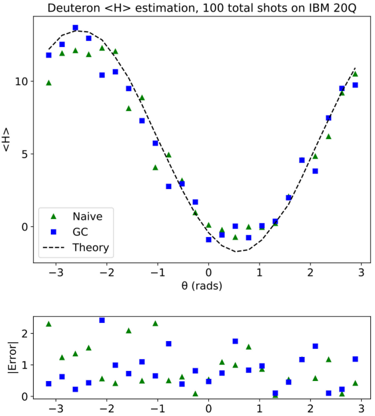
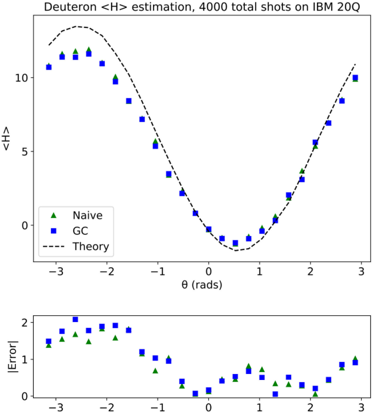
Variational quantum eigensolver (VQE) is a promising algorithm for near-term quantum machines. It can be used to estimate the ground state energy of a molecule by performing separate measurements of O(N4) terms. This quartic scaling appears to be a significant obstacle to practical applications. However, we note that it empirically reduces to O(N3) when we partition the terms into linear-sized commuting families that can be measured simultaneously. We confirm these empirical observations by studying the MIN-COMMUTING-PARTITION problem at the level of the fermionic Hamiltonian and its encoding into qubits. Moreover, we provide a fast, precomputable procedure for creating linearly sized commuting partitions by solving a round-robin scheduling problem via flow networks. In addition, we demonstrate how to construct the quantum circuits necessary for simultaneous measurement, and we discuss the statistical implication of simultaneous measurement. Our results are experimentally validated by a ground state estimation of deuteron with low shot budget on a 20-qubit IBM machine.
Overview
The claims and statistics of this paper haven’t been checked yet.
Free: it reads the open-access text and checks the first 5 claims that cite a source we can check. Create a free account to check every claim.
Integrity signals
Registry
Cites
Statistics
Figures










Verification
Claims the paper makes
The claims and statistics of this paper haven’t been checked yet.
Free: it reads the open-access text and checks the first 5 claims that cite a source we can check. Create a free account to check every claim.
Claims other papers make about this one
Each is checked against this paper’s own text: does it say what the citing paper says it does?
The cited source says what the claim attributes to it.
In the citing paper
“To this end, it has been shown that by considering general commutations (and increasing the number of gates of the circuit quadratically with n ) the scaling of the number of measurements can be reduced to n 3 [213, 214, 216-219].”
From Variational quantum algorithms (2021) · cites this paper as [217]
Self-check
Percentages, sums and reported differences re-computed from the paper’s own numbers.
The self-check needs the paper’s full text.
Citations
Cites
Kresse, G., & Furthmüller, J. (1996) · Computational Materials Science · doi:10.1016/0927-0256(96)00008-0 · Cited by 75,638 · cited 1×
“Examples include Hartree Fock (O(N(4)) runtime [15]), density functional theory (O(N(3)) runtime [16]), and coupled cluster single-double (O(N(6))+ runtime [17] only considers single and double excitations).”
BackgroundQuantum Computation and Quantum Information
Nielsen, M. A., Chuang, I., & Grover, L. K. (2002) · American Journal of Physics · doi:10.1119/1.1463744 · Cited by 21,895
Horn, R. A., & Johnson, C. R. (1985) · Cambridge University Press eBooks · doi:10.1017/cbo9780511810817 · Cited by 10,280
A fast quantum mechanical algorithm for database search
Grover, L. K. (1996) · Proceedings of the twenty-eighth annual ACM symposium on Theory of computing - STOC '96 · doi:10.1145/237814.237866 · Cited by 8,830 · cited 1×
“Although several thousand logical error-corrected qubits, backed by millions of device-level physical qubits, are needed to realize the originally envisioned quantum applications, such as factoring [2] and database search [3], a new generation of variational algorithms has been recently introduced to match the constra…”
BackgroundQuantum Computing in the NISQ era and beyond
Preskill, J. (2018) · Quantum · doi:10.22331/q-2018-08-06-79 · Cited by 8,830 · cited 1×
“The present Noisy Intermediate-Scale Quantum (NISQ) era [1] is distinguished by the advent of quantum computers comprising tens of qubits, with hundreds of qubits expected in the next five years.”
BackgroundPolynomial-time algorithms for prime factorization and discrete logarithms on a quantum computer
Shor, P. W. (1997) · SIAM Journal on Computing · doi:10.1137/s0097539795293172 · Cited by 8,472
Exploring Network Structure, Dynamics, and Function Using NetworkX
Hagberg, A. A., Schult, D. A., & Swart, P. J. (2008) · Proceedings of the Python in Science Conference · doi:10.25080/tcwv9851 · Cited by 7,477 · cited 1×
“In our benchmarking, we performed MIN-CLIQUECOVERs using the Boppana–Halldórsson algorithm [58] included in the NetworkX Python package [59], as well as the Bron–Kerbosch algorithm [60], which we implemented ourselves.”
MethodThe Activated Complex in Chemical Reactions
Eyring, H. (1935) · The Journal of Chemical Physics · doi:10.1063/1.1749604 · Cited by 5,828 · cited 1×
“The lowest eigenvalue is the ground state energy, which has important implications in chemistry such as determining reaction rates [20] and molecular geometry [21].”
BackgroundA variational eigenvalue solver on a photonic quantum processor
Peruzzo, A., McClean, J., Shadbolt, P., Yung, M.-H., Zhou, X.-Q., Love, P. J., Aspuru-Guzik, A., & O’Brien, J. L. (2014) · Nature Communications · doi:10.1038/ncomms5213 · Cited by 4,552 · cited 12×
“Since commuting families can be measured simultaneously, this constitutes a reduction in the measurement cost of VQE from O ( N 4 ) naively to O ( N 3 ) with these partitions.”
BackgroundMethodInfluentialPolynomial-time algorithms for prime factorization and discrete logarithms on a quantum computer
Shor, P. W. (1999) · SIAM Review · doi:10.1137/s0036144598347011 · Cited by 3,904
Research works printed but not linked: 3
- Z. Baranyai, "On the factorization of the complete uniform hypergraphs," in Infinite and Finite Sets, A. Hanaj, R. Rado, and V. T. Sós, Eds., Colloq. Math. Soc. Janos Bolyai, 1974, pp. 91-108.
- N. Deo and P. Micikevicius, "On one-factorization of complete 3-uniform hypergraphs," Congressus Numerantium, vol. 158, pp. 153-162, 2002.
- B. Moseley, M. Osborne, and S. Benjamin, "Bayesian optimisation for variational quantum eigensolvers," Quantum, vol. 3, pp. 4-5, 2018.
Cited by
Variational quantum algorithms
Cerezo, M., Arrasmith, A., Babbush, R., Benjamin, S. C., Endo, S., Fujii, K., McClean, J. R., Mitarai, K., Yuan, X., Cincio, L., et al. (2021) · Nature Reviews Physics · doi:10.1038/s42254-021-00348-9 · Cited by 3,385
Noisy intermediate-scale quantum algorithms
Bharti, K., Cervera-Lierta, A., Kyaw, T. H., Haug, T., Alperin-Lea, S., Anand, A., Degroote, M., Heimonen, H., Kottmann, J. S., Menke, T., et al. (2022) · Reviews of Modern Physics · doi:10.1103/revmodphys.94.015004 · Cited by 2,231
Quantum computational chemistry
McArdle, S., Endo, S., Aspuru-Guzik, A., Benjamin, S. C., & Yuan, X. (2020) · Reviews of Modern Physics · doi:10.1103/revmodphys.92.015003 · Cited by 1,621
The Variational Quantum Eigensolver: A review of methods and best practices
Tilly, J., Chen, H., Cao, S., Picozzi, D., Setia, K., Li, Y., Grant, E., Wossnig, L., Rungger, I., Booth, G. H., et al. (2022) · Physics Reports · doi:10.1016/j.physrep.2022.08.003 · Cited by 1,031
Efficient quantum measurement of Pauli operators in the presence of finite sampling error
Crawford, O., Straaten, B. V., Wang, D., Parks, T., Campbell, E., & Brierley, S. (2021) · Quantum · doi:10.22331/q-2021-01-20-385 · Cited by 188
“For the nine smallest systems, we calculate the value of R for 100 different random quantum states to quantify the improvement due to assembling the Hamiltonian into collections of commuting operators.”
MethodInfluentialA Multireference Quantum Krylov Algorithm for Strongly Correlated Electrons
Stair, N. H., Huang, R., & Evangelista, F. A. (2020) · Journal of Chemical Theory and Computation · doi:10.1021/acs.jctc.9b01125 · Cited by 183
Strategies for solving the Fermi-Hubbard model on near-term quantum computers
Cade, C., Mineh, L., Montanaro, A., & Stanisic, S. (2020) · Physical Review B · doi:10.1103/physrevb.102.235122 · Cited by 178
Noisy intermediate-scale quantum (NISQ) algorithms
Bharti, K., Cervera-Lierta, A., Kyaw, T. H., Haug, T., Alperin-Lea, S., Anand, A., Degroote, M., Heimonen, H., Kottmann, J. S., Menke, T., et al. (2021) · arXiv · doi:10.48550/arxiv.2101.08448 · Cited by 166
Quantum machine learning for chemistry and physics
Sajjan, M., Li, J., Selvarajan, R., Sureshbabu, S. H., Kale, S. S., Gupta, R., Singh, V., & Kais, S. (2022) · Chemical Society Reviews · doi:10.1039/d2cs00203e · Cited by 216
Fermionic Partial Tomography via Classical Shadows
Zhao, A., Rubin, N. C., & Miyake, A. (2021) · Physical Review Letters · doi:10.1103/physrevlett.127.110504 · Cited by 144
An Adaptive Optimizer for Measurement-Frugal Variational Algorithms
Kübler, J. M., Arrasmith, A., Cincio, L., & Coles, P. J. (2020) · Quantum · doi:10.22331/q-2020-05-11-263 · Cited by 141
Measurement reduction in variational quantum algorithms
Zhao, A., Tranter, A., Kirby, W. M., Ung, S. F., Miyake, A., & Love, P. J. (2020) · Physical Review A · doi:10.1103/physreva.101.062322 · Cited by 121
Measurements as a roadblock to near-term practical quantum advantage in chemistry: resource analysis
Gonthier, J. F., Radin, M. D., Buda, C., Doskocil, E. J., Abuan, C. M., & Romero, J. (2022) · Physical Review Research · doi:10.1103/physrevresearch.4.033154 · Cited by 120
Efficient evaluation of quantum observables using entangled measurements
Hamamura, I., & Imamichi, T. (2020) · npj Quantum Information · doi:10.1038/s41534-020-0284-2 · Cited by 69
“Verteletskyi et al. 50 systematically studied the heuristic algorithms for grouping using the TPB. Recently, many studies to enhance the evaluation of observables have been presented 32 – 34 , 51 – 55 .”
MethodImproving Hamiltonian encodings with the Gray code
Matteo, O. D., McCoy, A. E., Gysbers, P., Miyagi, T., Woloshyn, R. M., & Navrátil, P. (2021) · Physical Review A · doi:10.1103/physreva.103.042405 · Cited by 96
Quantum Filter Diagonalization with Compressed Double-Factorized Hamiltonians
Cohn, J., Motta, M., & Parrish, R. M. (2021) · PRX Quantum · doi:10.1103/prxquantum.2.040352 · Cited by 72
Yen, T.-C., Ganeshram, A., & Izmaylov, A. F. (2023) · npj Quantum Information · doi:10.1038/s41534-023-00683-y · Cited by 118
“(8) is generally lower if there is an uneven distribution of Varψ Âα .”
BackgroundMeasurement Cost of Metric-Aware Variational Quantum Algorithms
van Straaten, B., & Koczor, B. (2021) · PRX Quantum · doi:10.1103/prxquantum.2.030324 · Cited by 55
Operator Sampling for Shot-frugal Optimization in Variational Algorithms
Arrasmith, A., Cincio, L., Somma, R. D., & Coles, P. J. (2020) · arXiv · doi:10.48550/arxiv.2004.06252 · Cited by 53
Light-Front Field Theory on Current Quantum Computers
Kreshchuk, M., Jia, S., Kirby, W., Goldstein, G. R., Vary, J. P., & Love, P. (2021) · Entropy · doi:10.3390/e23050597 · Cited by 78
Kreshchuk, M., Jia, S., Kirby, W. M., Goldstein, G. R., Vary, J. P., & Love, P. J. (2021) · Physical Review A · doi:10.1103/physreva.103.062601 · Cited by 69
Schut, M., Tilly, J., Marshman, R. J., Bose, S., & Mazumdar, A. (2022) · Physical Review A · doi:10.1103/physreva.105.032411 · Cited by 73
“Grouping of terms for the QGEM experiment with qudits was proposed in [24] by identifying groups based on general commutativity of the operators [54– 56].”
MethodAncilla-free implementation of generalized measurements for qubits embedded in a qudit space
Fischer, L. E., Miller, D., Tacchino, F., Barkoutsos, P. K., Egger, D. J., & Tavernelli, I. (2022) · Physical Review Research · doi:10.1103/physrevresearch.4.033027 · Cited by 62
“Known strategies to alleviate the measurement problem include Pauli groupings [14, 27–31], classical shad-ows [32–34], and machine learning [35].”
BackgroundLow-Depth Mechanisms for Quantum Optimization
McClean, J. R., Harrigan, M. P., Mohseni, M., Rubin, N. C., Jiang, Z., Boixo, S., Smelyanskiy, V. N., Babbush, R., & Neven, H. (2021) · PRX Quantum · doi:10.1103/prxquantum.2.030312 · Cited by 43
Low depth mechanisms for quantum optimization
McClean, J. R., Harrigan, M. P., Mohseni, M., Rubin, N. C., Jiang, Z., Boixo, S., Smelyanskiy, V. N., Babbush, R., & Neven, H. (2020) · arXiv · doi:10.48550/arxiv.2008.08615 · Cited by 45
Symmetry enhanced variational quantum spin eigensolver
Lyu, C., Xu, X., Yung, M., & Bayat, A. (2023) · Quantum · doi:10.22331/q-2023-01-19-899 · Cited by 60
“Several attempts have been made to enhance the VQE performance, including: minimizing the number of required measurements [32, 48, 81, 95, 97, 105], improving the initialization [33, 59, 98], speeding up the classical optimization [31, 51, 92] and designing better circuits [18, 27, 46, 75, 79, 82].”
BackgroundQuantum utility – definition and assessment of a practical quantum advantage
Herrmann, N., Arya, D., Doherty, M. W., Mingare, A., Pillay, J. C., Preis, F., & Prestel, S. (2023) · IEEE International Conference on Quantum Software (QSW) · doi:10.1109/qsw59989.2023.00028 · Cited by 71
Quantum expectation-value estimation by computational basis sampling
Kohda, M., Imai, R., Kanno, K., Mitarai, K., Mizukami, W., & Nakagawa, Y. O. (2022) · Physical Review Research · doi:10.1103/physrevresearch.4.033173 · Cited by 52
“In such cases, the optimal numbers of measurements can be heuristically guessed by using expectation values for Haar random states [16, 25].”
BackgroundMethodHow many quantum gates do gauge theories require?
Murairi, E. M., Cervia, M. J., Kumar, H., Bedaque, P. F., & Alexandru, A. (2022) · Physical review. D/Physical review. D. · doi:10.1103/physrevd.106.094504 · Cited by 47
Improving Quantum Measurements by Introducing “Ghost” Pauli Products
Choi, S., Yen, T.-C., & Izmaylov, A. F. (2022) · Journal of Chemical Theory and Computation · doi:10.1021/acs.jctc.2c00837 · Cited by 47
Folded Spectrum VQE: A Quantum Computing Method for the Calculation of Molecular Excited States
Tazi, L. C., & Thom, A. J. W. (2024) · Journal of Chemical Theory and Computation · doi:10.1021/acs.jctc.3c01378 · Cited by 57
“As shown in [28], GC partitioning is more efficient than QWC, and it would lead to even fewer quantum measurements for the FS method.”
BackgroundMethodInfluentialSugisaki, K., Kato, T., Minato, Y., Okuwaki, K., & Mochizuki, Y. (2022) · Physical Chemistry Chemical Physics · doi:10.1039/d1cp04318h · Cited by 36
State preparation and evolution in quantum computing: A perspective from Hamiltonian moments
Aulicino, J. C., Keen, T., & Peng, B. (2021) · International Journal of Quantum Chemistry · doi:10.1002/qua.26853 · Cited by 32
Ramôa, M., Anastasiou, P. G., Santos, L. P., Mayhall, N. J., Barnes, E., & Economou, S. E. (2025) · npj Quantum Information · doi:10.1038/s41534-025-01039-4 · Cited by 79
“The CNOT count (second row of panels) is similar for all curves, while the CNOT depth (third row) is predictably lowered by TETRIS while being roughly unchanged by the the other proposals.”
HamLib: A library of Hamiltonians for benchmarking quantum algorithms and hardware
Sawaya, N. P. D., Marti-Dafcik, D., Ho, Y., Tabor, D. P., Bernal, D. E., Magann, A. B., Premaratne, S., Dubey, P. K., Matsuura, A. Y., Bishop, N. C., et al. (2024) · Quantum · doi:10.22331/q-2024-12-11-1559 · Cited by 58
Divide and Conquer for Combinatorial Optimization and Distributed Quantum Computation
Tomesh, T., Saleem, Z. H., Perlin, M. A., Gokhale, P., Suchara, M., & Martonosi, M. (2023) · IEEE International Conference on Quantum Computing and Engineering (QCE) · doi:10.1109/qce57702.2023.00009 · Cited by 81
Self-citationUnitary block optimization for variational quantum algorithms
Slattery, L., Villalonga, B., & Clark, B. K. (2022) · Physical Review Research · doi:10.1103/physrevresearch.4.023072 · Cited by 34
Training Variational Quantum Circuits with CoVaR: Covariance Root Finding with Classical Shadows
Boyd, G., & Koczor, B. (2022) · Physical Review X · doi:10.1103/physrevx.12.041022 · Cited by 52
“As a matter of fact, related techniques leveraging simultaneous measurements of commuting observables are also highly relevant given they allow the efficient reconstruction of a large number of not necessarily local Pauli strings as crucial in applications of quantum chemistry [79–82].”
BackgroundThe basics of quantum computing for chemists
Claudino, D. (2022) · International Journal of Quantum Chemistry · doi:10.1002/qua.26990 · Cited by 31
Doubly Optimal Parallel Wire Cutting without Ancilla Qubits
Harada, H., Wada, K., & Yamamoto, N. (2024) · PRX Quantum · doi:10.1103/prxquantum.5.040308 · Cited by 65
Quantum Measurement for Quantum Chemistry on a Quantum Computer
Patel, S., Jayakumar, P., Yen, T.-C., & Izmaylov, A. F. (2025) · Chemical Reviews · doi:10.1021/acs.chemrev.5c00055 · Cited by 54
Algorithmic Shadow Spectroscopy
Chan, H. H. S., Meister, R., Goh, M. L., & Koczor, B. (2025) · PRX Quantum · doi:10.1103/prxquantum.6.010352 · Cited by 53
Latency considerations for stochastic optimizers in variational quantum algorithms
Menickelly, M., Ha, Y., & Otten, M. (2023) · Quantum · doi:10.22331/q-2023-03-16-949 · Cited by 29
“Using operator grouping, one potentially can reduce this number to O(N3 q ) [47].”
BackgroundImplementation of measurement reduction for the variational quantum eigensolver
Ralli, A., Love, P. J., Tranter, A., & Coveney, P. V. (2021) · Physical Review Research · doi:10.1103/physrevresearch.3.033195 · Cited by 27
Variational quantum solver employing the PDS energy functional
Peng, B., & Kowalski, K. (2021) · Quantum · doi:10.22331/q-2021-06-10-473 · Cited by 18
“qubit-wise commutativity (QWC)[31, 44], general commutativity[22, 72], unitary partitioning[30], and/or Fermionic basis rotation grouping[28] to name a few.”
BackgroundAccelerated variational quantum eigensolver with joint Bell measurement
Cao, C., Yano, H., & Nakagawa, Y. O. (2024) · Physical Review Research · doi:10.1103/physrevresearch.6.013205 · Cited by 19
“One possible strategy is to divide the O (cid:0) n 4 (cid:1) Pauli operators in the Hamiltonian into the groups of simultaneously-measurable operators, and there are methods that realize O ( n 3 ) groups [13, 14] and even O ( n 2 ) groups [15, 16].”
MethodWeaving, T., Ralli, A., Kirby, W. M., Tranter, A., Love, P. J., & Coveney, P. V. (2023) · Journal of Chemical Theory and Computation · doi:10.1021/acs.jctc.2c00910 · Cited by 24
“The optimized ADAPT-VQE ansatz operators are reported in the Supporting Information, along with a 27), used here in conjunction with ADAPT-VQE 16–19 .”
MethodAssessment of the Variational Quantum Eigensolver: Application to the Heisenberg Model
Jattana, M. S., Jin, F., Raedt, H. A. D., & Michielsen, K. F. L. (2022) · Frontiers in Physics · doi:10.3389/fphy.2022.907160 · Cited by 23
Computationally Efficient Quantum Expectation with Extended Bell Measurements
Kondo, R., Sato, Y., Koide, S., Kajita, S., & Takamatsu, H. (2022) · Quantum · doi:10.22331/q-2022-04-13-688 · Cited by 18
“To compare with the existing meth-ods, QWC (qubit–wise commuting) [21, 27, 28] and GC (general commuting) [24] are conducted with the same machine.”
BackgroundMethodInfluentialLowering tomography costs in quantum simulation with a symmetry projected operator basis
Smart, S. E., & Mazziotti, D. A. (2021) · Physical Review A · doi:10.1103/physreva.103.012420 · Cited by 16
“While the set of measurements in performing tomography of the 2-RDM appear in molecular Hamiltonians, and thus can be used in Hamiltonian based measurement, the 2-RDM potentially allows for a more systematic way of grouping tomography terms and allows for error-mitigation techniques [22, 23, 31, 43, 44] which can be a…”
MethodHardware-tailored diagonalization circuits
Miller, D., Fischer, L. E., Levi, K., Kuehnke, E. J., Sokolov, I. O., Barkoutsos, P. K., Eisert, J., & Tavernelli, I. (2024) · npj Quantum Information · doi:10.1038/s41534-024-00901-1 · Cited by 41
Tetris: A Compilation Framework for VQA Applications in Quantum Computing
Jin, Y., Li, Z., Hua, F., Hao, T., Zhou, H., Huang, Y., & Zhang, E. Z. (2024) · Proceedings - International Symposium on Computer Architecture/Proceedings · doi:10.1109/isca59077.2024.00029 · Cited by 43
“…the initial Hamiltonian construction stage [20], [23], [31], the fermionic to spin operator encoding stage [4], [18], [37], the circuit synthesis stage [7], [25], [46], the hardware mapping stage [16], [24], [25], measurement grouping [7], [12], [30], and pulse level optimization [5], [26], [27].”
BackgroundPeng, L., Zhang, X., & Chan, G. K. (2023) · Journal of Chemical Theory and Computation · doi:10.1021/acs.jctc.3c00851 · Cited by 14
Amplitude Reordering Accelerates the Adaptive Variational Quantum Eigensolver Algorithms
Lan, Z., & Liang, W. (2022) · Journal of Chemical Theory and Computation · doi:10.1021/acs.jctc.2c00403 · Cited by 19
Ziems, K. M., Kjellgren, E. R., Sauer, S. P. A., Kongsted, J., & Coriani, S. (2025) · Chemical Science · doi:10.1039/d4sc05839a · Cited by 15
“Qubit-wise-commutativity (QWC) 61,82 was employed in this work.”
Peng, B., & Kowalski, K. (2022) · Physical Review Research · doi:10.1103/physrevresearch.4.043172 · Cited by 11
Pauli String Partitioning Algorithm with the Ising Model for Simultaneous Measurements
Kurita, T., Morita, M., Oshima, H., & Sato, S. (2023) · The Journal of Physical Chemistry A · doi:10.1021/acs.jpca.2c06453 · Cited by 18
“They are mainly based on either the maximum clique searching method [11,14,21] or the graph coloring method [11-14].”
InfluentialCoarse-grained intermolecular interactions on quantum processors
Anderson, L. W., Kiffner, M., Barkoutsos, P. K., Tavernelli, I., Crain, J. N., & Jaksch, D. (2022) · Physical Review A · doi:10.1103/physreva.105.062409 · Cited by 11
Simulator Demonstration of Large Scale Variational Quantum Algorithm on HPC Cluster
Morita, M., Tomita, Y., Koyama, J., & Kimura, K. (2024) · IEEE Access · doi:10.1109/access.2024.3415168 · Cited by 11
“See a citation [40] for the details on possible forms of P .”
BackgroundNoise-robust ground state energy estimates from deep quantum circuits
Vallury, H. J., Jones, M. A., White, G. A. L., Creevey, F. M., Hill, C. D., & Hollenberg, L. C. L. (2023) · Quantum · doi:10.22331/q-2023-09-11-1109 · Cited by 10
A hybrid qubit encoding: splitting Fock space into Fermionic and Bosonic subspaces
Santos, F. J. D. A., & Kottmann, J. S. (2025) · Quantum Science and Technology · doi:10.1088/2058-9565/adbdee · Cited by 13
Running a Six-Qubit Quantum Circuit on a Silicon Spin-Qubit Array
de Fuentes, I. F., Raymenants, E., Undseth, B., Pietx-Casas, O., Philips, S. G. J., Mądzik, M. T., de Snoo, S. L., Amitonov, S. V., Tryputen, L., Schmitz, A. T., et al. (2026) · PRX Quantum · doi:10.1103/f285-l2v5 · Cited by 26
Sumeet, Prasannaa, V. S., Das, B. P., & Sahoo, B. K. (2022) · Quantum Reports · doi:10.3390/quantum4020012 · Cited by 9
Mapping quantum circuits to shallow-depth measurement patterns based on graph states
Kaldenbach, T. N., & Heller, M. (2024) · Quantum Science and Technology · doi:10.1088/2058-9565/ad802b · Cited by 23
“Given an initial (stabilizer) state of the main qubits together with some Clifford circuit that can be attached to the end of the pattern to perform simultaneous measurements of a set of commuting observables [19, 20], we then use a graph-state simulator [21] to map the unitary to a graph state.”
InfluentialSivakumar, A., Nair, H. K., Joshi, A., Kenson Wesley, R., Videsh, A. P., & Reena Monica, P. (2024) · EPJ Quantum Technology · doi:10.1140/epjqt/s40507-024-00280-8 · Cited by 14
“However, Pranav et al. [13] have devised a solution by grouping components into smaller, compatible families, thereby reducing the algorithm’s complexity to the third power.”
BackgroundConstruction method of hybrid quantum long-short term memory neural network for image classification
Yang, G., Chao, S.-Y., Nie, M., Liu, Y., & Zhang, M. (2023) · Acta Physica Sinica · doi:10.7498/aps.72.20221924 · Cited by 13
Block Lanczos method for excited states on a quantum computer
Baker, T. E. (2024) · Physical Review A · doi:10.1103/physreva.110.012420 · Cited by 19
Sugisaki, K., Nakano, T., & Mochizuki, Y. (2024) · Journal of Computational Chemistry · doi:10.1002/jcc.27438 · Cited by 10
Hamiltonian-based graph-state ansatz for variational quantum algorithms
Anand, A., & Brown, K. R. (2025) · Physical Review A · doi:10.1103/physreva.111.012437 · Cited by 10
A qubit-efficient variational selected configuration-interaction method
Yoffe, D., Entin, N., Natan, A., & Makmal, A. (2024) · Quantum Science and Technology · doi:10.1088/2058-9565/ad7d32 · Cited by 13
“This can be partially remedied (so far we only considered an upper bound for P ) by taking the hermiticity of the Hamiltonian into account and by employing methods such as the tensor product basis (TPB) method [8, 14, 27, 72].”
QuCLEAR: Clifford Extraction and Absorption for Quantum Circuit Optimization
Liu, J., Gonzales, A., Huang, B., Saleem, Z. H., & Hovland, P. (2025) · IEEE International Symposium on High-Performance Computer Architecture (HPCA) · doi:10.1109/hpca61900.2025.00023 · Cited by 23
“Paulihedral focuses on gate cancellation.”
Leveraging commuting groups for an efficient variational Hamiltonian ansatz
Anand, A., & Brown, K. R. (2025) · Quantum Science and Technology · doi:10.1088/2058-9565/adf507 · Cited by 10
Non-variational quantum random access optimization with alternating operator ansatz
He, Z., Raymond, R., Shaydulin, R., & Pistoia, M. (2025) · Scientific Reports · doi:10.1038/s41598-025-13543-w · Cited by 22
“(12) is a grouping strategy that reorders the Pauli terms, similar to the approach in [43, 44].”
Optimization at the Interface of Unitary and Non-unitary Quantum Operations in PCOAST
Schmitz, A. T., Ibrahim, M. M. A., Sawaya, N. P. D., Guerreschi, G. G., Paykin, J., Wu, X.-C., & Matsuura, A. Y. (2023) · IEEE International Conference on Quantum Computing and Engineering (QCE) · doi:10.1109/qce57702.2023.00088 · Cited by 10
“These sets can either be qubit-wise commuting [5], fully commuting [6] or sorted for the sake of minimizing total shots on the quantum computer [7].”
BackgroundMethodInfluentialWang, Q., D’Cunha, R., Mitra, A., Gray, S. K., Otten, M., & Gagliardi, L. (2025) · The Journal of Physical Chemistry A · doi:10.1021/acs.jpca.5c03028 · Cited by 8
Raedt, H. A. D., Kraus, J., Herten, A., Mehta, V., Bode, M., Hrywniak, M., Michielsen, K. F. L., & Lippert, T. (2026) · Future Generation Computer Systems · doi:10.1016/j.future.2026.108592 · Cited by 23
Optimized Quantum Program Execution Ordering to Mitigate Errors in Simulations of Quantum Systems
Tomesh, T., Gui, K., Gokhale, P., Shi, Y., Chong, F. T., Martonosi, M., & Suchara, M. (2021) · IEEE International Conference on Rebooting Computing (ICRC) · doi:10.1109/icrc53822.2021.00013 · Cited by 15
Self-citationMeasurement reduction for expectation values via fine-grained commutativity
DalFavero, B., Sarkar, R., Rowland, J., Camps, D., Sawaya, N. P. D., & LaRose, R. (2025) · Physical Review A · doi:10.1103/y6hl-gzr4 · Cited by 15
Multistate transition dynamics by strong time-dependent perturbation in NISQ era
Wang, Y., & Krstić, P. (2023) · Journal of Physics Communications · doi:10.1088/2399-6528/ace67a · Cited by 9
Almost optimal measurement scheduling of molecular Hamiltonian via finite projective plane
Inoue, W., Aoyama, K., Teranishi, Y., Kanno, K., Nakagawa, Y. O., & Mitarai, K. (2024) · Physical Review Research · doi:10.1103/physrevresearch.6.013096 · Cited by 6
Variational quantum eigensolver for closed-shell molecules with non-bosonic corrections
Kim, K., Lim, S., Shin, K., Lee, G., Jung, Y., Kyoung, W., Rhee, J. K., & Rhee, Y. M. (2024) · Physical Chemistry Chemical Physics · doi:10.1039/d3cp05570a · Cited by 11
Fighting Noise with Noise: A Stochastic Projective Quantum Eigensolver
Filip, M.-A. (2024) · Journal of Chemical Theory and Computation · doi:10.1021/acs.jctc.4c00295 · Cited by 5
“[87] For the two-body quantum chemistry Hamiltonian there is a simple heuristic partitioning, based on the qubitwise commutativity of Pauli strings.”
MethodEVA: a quantum Exponential Value Approximation algorithmPreprint
Alonso-Linaje, G., & Atchade-Adelomou, P. (2021) · arXiv (Cornell University) · doi:10.48550/arxiv.2106.08731 · Cited by 8
Quantum-enhanced signal processing via VQE for improved biomechanical feedback control
Villalba-Díez, J., & Ordieres-Meré, J. B. (2025) · Digital Signal Processing · doi:10.1016/j.dsp.2025.105357 · Cited by 7
Quantifying the advantages of applying quantum approximate algorithms to portfolio optimisation
Yuan, H., Long, C. K., Lepage, H. V., & Barnes, C. H. W. (2026) · Quantum Science and Technology · doi:10.1088/2058-9565/ae4a48 · Cited by 15
“The simulation demonstrates the difficulty of classical optimisers when optimising the loss landscape in the presence of stochastic noise [46].”
BackgroundHigh precision quantum simulation of ionization energies of single valence atoms
Villela, R. A., Prasannaa, V. S., & Das, B. P. (2022) · The European Physical Journal Plus · doi:10.1140/epjp/s13360-022-03198-1 · Cited by 3
Adaptive measurement strategy for quantum subspace methods
Nakamura, Y., Yano, Y., & Yoshioka, N. (2024) · New Journal of Physics · doi:10.1088/1367-2630/ad2c3b · Cited by 8
HamPerf: A Hamiltonian-Oriented Approach to Quantum Benchmarking
Butko, A., Klymko, K., Camps, D., & Sawaya, N. P. D. (2024) · ACM International Conference on Computing Frontiers: Workshops and Special Sessions (CF Companion) · doi:10.1145/3637543.3653431 · Cited by 4
Kumar, A., Hedabou, M., & Pacheco, D. A. D. J. (2024) · IET Quantum Communication · doi:10.1049/qtc2.12102 · Cited by 3
Constructing Compact ADAPT Unitary Coupled-Cluster Ansatz with Parameter-Based Criterion
He, R., Hong, X., Chai, Q., Guan, J., Zhou, J., Ablimit, A., Cui, G., & Ying, S. (2026) · Journal of Chemical Theory and Computation · doi:10.1021/acs.jctc.6c00269 · Cited by 6
“To provide a general reference, the simultaneous measurement [40] and measurement reuse [41] techniques are not considered in this work.”
GALIC: hybrid multi-qubitwise pauli grouping for quantum computing measurement
Burns, M. X., Liu, C., Stein, S., Peng, B., Kowalski, K., & Li, A. (2024) · Quantum Science and Technology · doi:10.1088/2058-9565/ad9d74 · Cited by 6
“QWC was proposed as a near-term alternative, requiring no entangling operations [20, 29].”
InfluentialSimulation and randomized measurement of topological phase on a trapped-ion quantum computer
Ahn, C.-E., & Cho, G. Y. (2022) · Journal of the Korean Physical Society · doi:10.1007/s40042-022-00536-5 · Cited by 1
“However, Pauli strings with non-overlapping support, or which are identical on the overlap of their support, can be measured simultaneously, reducing the overall number of measurements for local Hamiltonians [65].”
BackgroundSugisaki, K., Kato, T., Minato, Y., Okuwaki, K., & Mochizuki, Y. (2021) · doi:10.33774/chemrxiv-2021-w7n78
Quantum Circuit Optimization by Graph Coloring
Lee, H., Jeong, K. C., & Kim, P. (2026) · Quantum · doi:10.22331/q-2026-02-06-1996 · Cited by 7
“Graph coloring has been used to optimally group Pauli strings to minimize the number of measurements in variational quantum eigensolver [32, 33, 34, 35, 36].”
Accelerating fermionic system simulation on quantum computers
Li, Q.-S., Zhang, J., Liu, H., Wang, Q., Wu, Y.-C., & Guo, G. (2025) · Physical Review A · doi:10.1103/physreva.111.052606
“The optimal number of groups generated by grouping strategies based on greedy algorithms is estimated to scale as O ( N 3 ) [26, 28, 30].”
Lee, D., & Ryu, H. (2025) · Journal of Chemical Theory and Computation · doi:10.1021/acs.jctc.5c00961 · Cited by 2
Simulating Quantum State Transfer Between Distributed Devices Using Noisy Interconnects
Bechtold, M., Barzen, J., Leymann, F., & Mandl, A. (2025) · Advanced Quantum Technologies · doi:10.1002/qute.202500513
“Specifically, for an 𝑛 -qubit channel ∈ CPTP(𝐴, 𝐵) with dim(𝐴) = dim(𝐵) = 2 𝑛 , its entanglement fidelity quantifies how well preserves the maximally entangled state Φ 𝑅𝐴 , initially shared between system 𝐴 and an 𝑛 -qubit reference system 𝑅 [27].”
Kodanganti, K. K., & Kodanganti, D. (2025) · IEEE India Council International Subsections Conference (INDISCON) · doi:10.1109/indiscon66021.2025.11254748 · Cited by 1
Unbiased observable estimation with approximate channels in fault-tolerant quantum computation
Khitrin, D., Brown, K. R., & Anand, A. (2026) · Quantum Science and Technology · doi:10.1088/2058-9565/ae2efa · Cited by 4
Toward ab initio quantum simulations of atomic nuclei using noisy qubits
Jiang, C., Pei, J., Hu, R., Jin, S., Shang, H., Fan, S., & Xu, F. (2026) · 中国科学通报:英文版 · doi:10.1016/j.scib.2026.02.052 · Cited by 4
Metadata
- Authors
- Gokhale, P., Angiuli, O., Ding, Y., Gui, K., Tomesh, T., Suchara, M., Martonosi, M., & Chong, F. T.
- Affiliations
- University of Chicago (US)
- University of California, Berkeley (US)
- Princeton University (US)
- Argonne National Laboratory (US)
- ORCID
- Venue
- IEEE Transactions on Quantum Engineering
- Published
- 2020
- Volume
- 1
- Pages
- 1-24
- ISSN
- 2689-1808 (ISSN-L)
- OpenAlex
- W2971147839
- Cited by
- 104
- References
- 89
- Citations by year
- 2026: 9 · 2025: 18 · 2024: 19 · 2023: 13 · 2022: 21 · 2021: 17 · 2020: 7
- FWCI
- 5.70
- Type
- journal article
- Language
- en
- Open access
- gold
- doi.org
- Locations
- IEEE Transactions on Quantum Engineering (publishedVersion, cc-by)
- arXiv (Cornell University) (submittedVersion)
- DOAJ (DOAJ: Directory of Open Access Journals) (submittedVersion, cc-by-sa)
- OSTI OAI (U.S. Department of Energy Office of Scientific and Technical Information) (submittedVersion)
- arXiv (Cornell University)
- Funders
- National Science Foundation (CCF-1730449/1730082)
- STAQ (Phy-1818914)
- U.S. Department of Energy (DE-AC02-06CH11357)
- Topics
- Physical Sciences › Computer Science › Artificial Intelligence › Quantum Computing Algorithms and Architecture
- Physical Sciences › Physics and Astronomy › Atomic and Molecular Physics, and Optics › Quantum many-body systems
- Physical Sciences › Physics and Astronomy › Atomic and Molecular Physics, and Optics › Quantum Mechanics and Applications
- Keywords
- variational quantum eigensolver, measurement cost, fermionic Hamiltonians, round robin scheduling, flow networks, simultaneous measurement, ground state energy estimation, deuteron, molecular Hamiltonian, quantum circuit construction
About these checks
Registry, retraction, Cites and statistics results are computed, not judged, with one exception: a printed reference that no index lists is read once by a model before it counts as a citation error. Claims are extracted by a model and kept only when their quote appears verbatim in the text; each cited source is then checked, with a model’s help, for whether it says what the claim relies on. Those verdicts can be wrong — read the claim’s quote and the cited source before relying on one.
Statistics and arithmetic are recomputed, not judged.
Confidence bands are shown only for fields calibrated on our annotated test set. None is calibrated yet, so no band is shown.
What counts as a claim ›How we measure confidence ›How we check this ›
Are you an author, or do you see a problem with this page? Request a review
Data sources
Bibliographic data: Semantic Scholar, OpenAlex, Crossref.
Contains information from the Semantic Scholar Academic Graph Datasets, made available under the ODC Attribution License (ODC-BY 1.0).
Semantic Scholar’s data is described in: Kinney, R., et al. (2023). The Semantic Scholar Open Data Platform. arXiv:2301.10140.
