

The DOI matches its Crossref record; 58 of the 60 references it cites were found in a registry or an index.
Study of methanogen communities associated with different rumen protozoal populations
Open accessAbstract
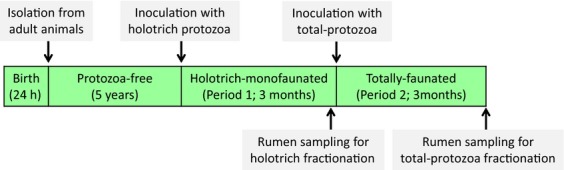
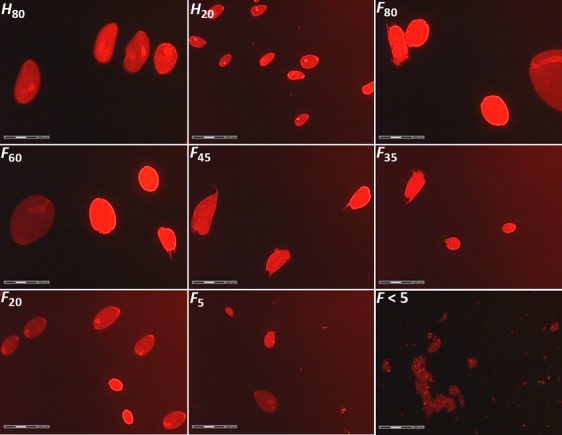
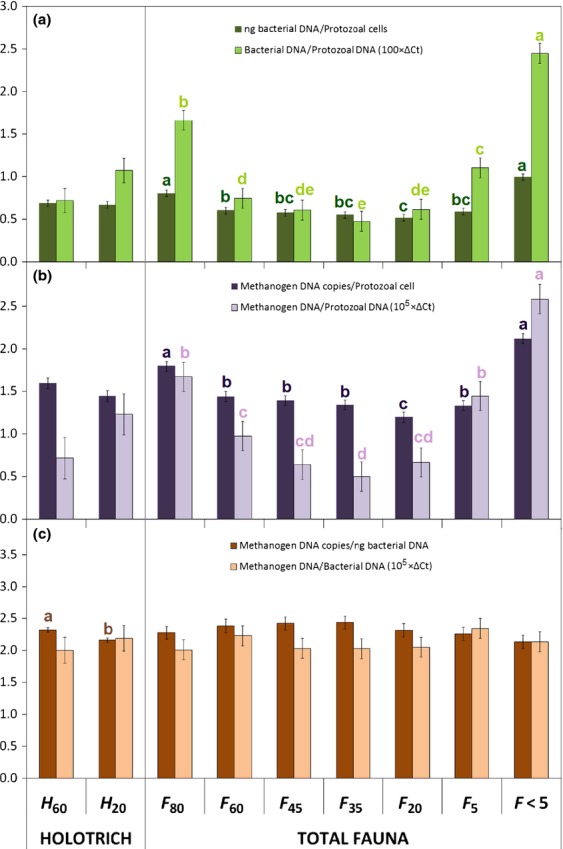
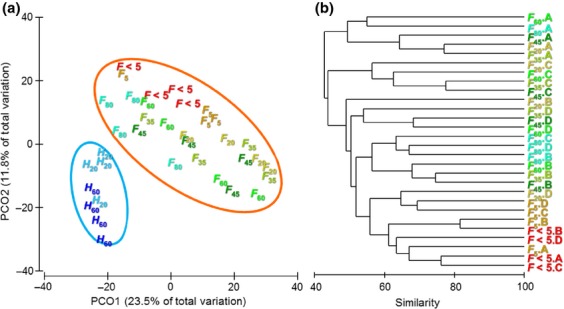
Protozoa-associated methanogens (PAM) are considered one of the most active communities in the rumen methanogenesis. This experiment investigated whether methanogens are sequestrated within rumen protozoa, and structural differences between rumen free-living methanogens and PAM. Rumen protozoa were harvested from totally faunated sheep, and six protozoal fractions (plus free-living microorganisms) were generated by sequential filtration. Holotrich-monofaunated sheep were also used to investigate the holotrich-associated methanogens. Protozoal size determined the number of PAM as big protozoa had 1.7-3.3 times more methanogen DNA than smaller protozoa, but also more endosymbiotic bacteria (2.2- to 3.5-fold times). Thus, similar abundance of methanogens with respect to total bacteria were observed across all protozoal fractions and free-living microorganisms, suggesting that methanogens are not accumulated within rumen protozoa in a greater proportion to that observed in the rumen as a whole. All rumen methanogen communities had similar diversity (22.2 ± 3.4 TRFs). Free-living methanogens composed a conserved community (67% similarity within treatment) in the rumen with similar diversity but different structures than PAM (P < 0.05). On the contrary, PAM constituted a more variable community (48% similarity), which differed between holotrich and total protozoa (P < 0.001). Thus, PAM constitutes a community, which requires further investigation as part of methane mitigation strategies.
Overview
The claims and statistics of this paper haven’t been checked yet.
Run the check — free, no account needed. It reads the open-access text and checks the sources it cites.
Integrity signals
Registry
Cites
Statistics
Figures
Verification
Claims the paper makes
The claims and statistics of this paper haven’t been checked yet.
Run the check — free, no account needed. It reads the open-access text and checks the sources it cites.
Claims other papers make about this one
Each is checked against this paper’s own text: does it say what the citing paper says it does?
In the citing paper
“rumen protozoal hydrogenosomes produce H2, which then serves as a substrate for methanogens to reduce CO2 to methane via the hydrogenotrophic pathway (Vogels et al., 1980; Belanche et al., 2014).”
From Addressing global ruminant agricultural challenges through understanding the rumen microbiome: past, present, and future (2018) · cites this paper as Belanche et al., 2014
Self-check
Percentages, sums and reported differences re-computed from the paper’s own numbers.
The self-check needs the paper’s full text.
Citations
Cites
A new mathematical model for relative quantification in real-time RT-PCR
Pfaffl, M. W. (2001) · Nucleic Acids Research · doi:10.1093/nar/29.9.e45 · Cited by 34,610
A new method for non-parametric multivariate analysis of variance
Anderson, M. J. (2001) · Austral Ecology · doi:10.1111/j.1442-9993.2001.01070.pp.x · Cited by 13,828
McDonald, I. W., & Warner, A. C. I. (1975) · Cited by 1,169
Using ecological diversity measures with bacterial communities
Hill, T. C. J., Walsh, K. A., Harris, J. A., & Moffett, B. F. (2003) · FEMS Microbiology Ecology · doi:10.1111/j.1574-6941.2003.tb01040.x · Cited by 1,052
Digestion and metabolism in the ruminant
Ziołecki, A. (1976) · Livestock Production Science · doi:10.1016/0301-6226(76)90025-7 · Cited by 998
Highly confined ions store charge more efficiently in supercapacitors
Merlet, C., Péan, C., Rotenberg, B., Madden, P. A., Daffos, B., Taberna, P., Simon, P., & Salanne, M. (2013) · Nature Communications · doi:10.1038/ncomms3701 · Cited by 746
Microbial ecosystem and methanogenesis in ruminants
Morgavi, D. P., Forano, E., Martin, C., & Newbold, C. J. (2010) · animal · doi:10.1017/s1751731110000546 · Cited by 694
Self-citationWilliams, A. G., & Coleman, G. S. (1991) · Cited by 677
Structure of the Archaeal Community of the Rumen
Janssen, P. H., & Kirs, M. (2008) · Applied and Environmental Microbiology · doi:10.1128/aem.02812-07 · Cited by 655
Methanogens: Methane Producers of the Rumen and Mitigation Strategies
Hook, S. E., Wright, A. G., & McBride, B. W. (2010) · Archaea · doi:10.1155/2010/945785 · Cited by 565
Research works printed but not linked: 5
- Belanche, 2012, Are methane emissions determined by the fermentation pattern or by the rumen microbiota?, 27
- Coleman, 1975, The interrelationship between rumen ciliate protozoa and bacteria, 602
- Dehority, 1993, Laboratory Manual for Classification and Morphology of Ruminal Ciliate Protozoa, 120
- Demeyer, 1975, Methanogenesis, an integrated part of carbohydrate fermentation and its control, 366
- Van Hoven, 1977, Carbohydrate fermentation by the rumen ciliate Dasytricha ruminantium, Protistologica, 13, 599
Cited by
Sorted by citations
The role of ciliate protozoa in the rumen
Newbold, C. J., de la Fuente, G., Belanche, A., Ramos-Morales, E., & McEwan, N. R. (2015) · Frontiers in Microbiology · doi:10.3389/fmicb.2015.01313 · Cited by 637
Self-citationHuws, S. A., Creevey, C. J., Oyama, L. B., Mizrahi, I., Denman, S. E., Popova, M., Muñoz-Tamayo, R., Forano, E., Waters, S. M., Hess, M., et al. (2018) · Frontiers in Microbiology · doi:10.3389/fmicb.2018.02161 · Cited by 487
Self-citationRumen methanogens and mitigation of methane emission by anti-methanogenic compounds and substances
Patra, A. K., Park, T., Kim, M., & Yu, Z. (2017) · Journal of Animal Science and Biotechnology/Journal of animal science and biotechnology · doi:10.1186/s40104-017-0145-9 · Cited by 513
The ruminal microbiome associated with methane emissions from ruminant livestock
Tapio, I., Snelling, T. J., Strozzi, F., & Wallace, R. J. (2017) · Journal of Animal Science and Biotechnology · doi:10.1186/s40104-017-0141-0 · Cited by 391
Manipulating rumen microbiome and fermentation through interventions during early life: a review
Yáñez-Ruiz, D. R., Abecia, L., & Newbold, C. J. (2015) · Frontiers in Microbiology · doi:10.3389/fmicb.2015.01133 · Cited by 336
Self-citation
Metadata
- Authors
- Belanche, A., de la Fuente, G., & Newbold, C. J.
- Affiliations
- Aberystwyth University (GB)
- Institute of Biological, Environmental and Rural Sciences, Aberystwyth University, Aberystwyth, UK
- Corresponding author
- Newbold, Charles J.
- Venue
- FEMS Microbiology Ecology
- Publisher
- Oxford University Press (OUP)
- Published
- 2014-12-01
- Volume
- 90
- Issue
- 3
- Pages
- 663-677
- ISSN
- 0168-6496 (ISSN-L)
- 1574-6941
- PMC
- PMC4286163
- OpenAlex
- W2018339579
- Cited by
- 147
- References
- 60
- Citations by year
- 2026: 6 · 2025: 16 · 2024: 20 · 2023: 11 · 2022: 11 · 2021: 19 · 2020: 12 · 2019: 16 · 2018: 10 · 2017: 7 · 2016: 10 · 2015: 8 · 2014: 1
- FWCI
- 17.27
- Type
- journal article
- Language
- en
- Open access
- bronze
- doi.org
- Locations
- FEMS Microbiology Ecology (publishedVersion)
- Europe PMC (PubMed Central) (publishedVersion, cc-by-nc)
- PubMed Central (publishedVersion, cc-by-nc)
- PubMed (publishedVersion)
- RECERCAT (Consorci de Serveis Universitaris de Catalunya) (publishedVersion, cc-by-nc)
- Repositori ObertUDL (University of Lleida) (publishedVersion, other-oa)
- LA Referencia (Red Federada de Repositorios Institucionales de Publicaciones Científicas) (submittedVersion, cc-by-nc)
- Funders
- European Commission (FP7, REDNEX project)
- Topics
- Life Sciences › Agricultural and Biological Sciences › Animal Science and Zoology › Ruminant Nutrition and Digestive Physiology
- Physical Sciences › Energy › Renewable Energy, Sustainability and the Environment › Anaerobic Digestion and Biogas Production
- Life Sciences › Biochemistry, Genetics and Molecular Biology › Molecular Biology › Gut microbiota and health
- Keywords
- rumen methanogenesis, rumen protozoa, endosymbiotic bacteria, methane mitigation, sheep
- MeSH terms
- Animals, Bacteria, Methane, Polymorphism, Restriction Fragment Length, Rumen, Symbiosis, Trichostomatida, Euryarchaeota, Sheep, Domestic
About these checks
Registry, retraction, Cites and statistics results are computed, not judged, with one exception: a printed reference that no index lists is read once by a model before it counts as a citation error. Claims are extracted by a model and kept only when their quote appears verbatim in the text; each cited source is then checked, with a model’s help, for whether it says what the claim relies on. Those verdicts can be wrong — read the claim’s quote and the cited source before relying on one.
Statistics and arithmetic are recomputed, not judged.
Confidence bands are shown only for fields calibrated on our annotated test set. None is calibrated yet, so no band is shown.
What counts as a claim ›How we measure confidence ›How we check this ›
Are you an author, or do you see a problem with this page? Request a review
