

The DOI matches its Crossref record; 6 of the 6 references it cites were found in a registry or an index.
Short-term interleukin-37 treatment improves vascular endothelial function, endurance exercise capacity, and whole-body glucose metabolism in old mice
Abstract
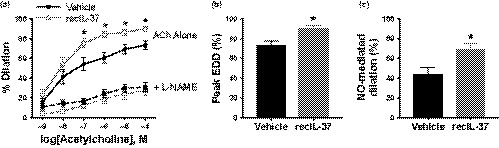
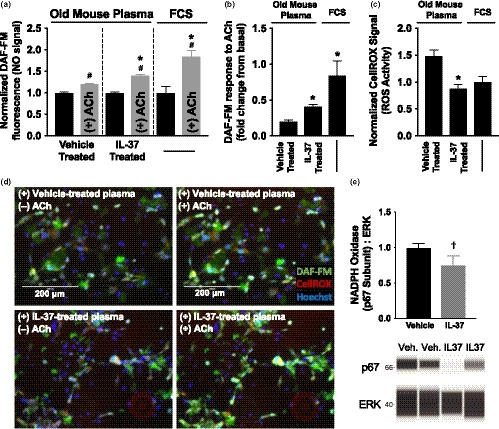
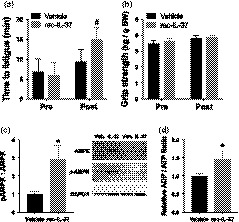
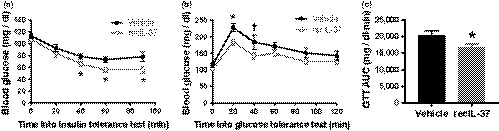
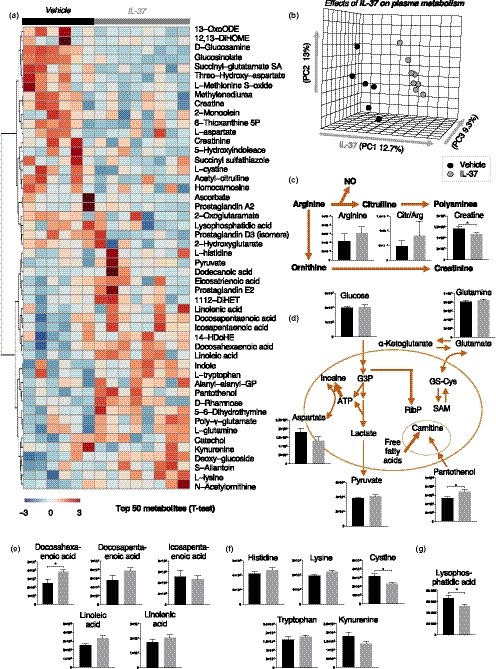
Aging is associated with vascular endothelial dysfunction, reduced exercise tolerance, and impaired whole‐body glucose metabolism. Interleukin‐37 (IL‐37), an anti‐inflammatory cytokine of the interleukin‐1 family, exerts salutary physiological effects in young mice independent of its inflammation‐suppressing properties. Here, we assess the efficacy of IL‐37 treatment for improving physiological function in older age. Old mice (26–28 months) received daily intraperitoneal injections of recombinant human IL‐37 (recIL‐37; 1 µg/200 ml PBS) or vehicle (200 ml PBS) for 10–14 days. Vascular endothelial function (ex vivo carotid artery dilation to increasing doses of acetylcholine, ACh) was enhanced in recIL‐37 vs. vehicle‐treated mice via increased nitric oxide (NO) bioavailability (all p < .05); this effect was accompanied by enhanced ACh‐stimulated NO production and reduced levels of reactive oxygen species in endothelial cells cultured with plasma from IL‐37‐treated animals (p < .05 vs. vehicle plasma). RecIL‐37 treatment increased endurance exercise capacity by 2.4‐fold, which was accompanied by a 2.9‐fold increase in the phosphorylated AMP‐activated kinase (AMPK) to AMPK ratio (i.e., AMPK activation) in quadriceps muscle. RecIL‐37 treatment also improved whole‐body insulin sensitivity and glucose tolerance (p < .05 vs. vehicle). Improvements in physiological function occurred without significant changes in plasma, aortic, and skeletal muscle pro‐inflammatory proteins (under resting conditions), whereas pro‐/anti‐inflammatory IL‐6 was greater in recIL‐37‐treated animals. Plasma metabolomics analysis revealed that recIL‐37 treatment altered metabolites related to pathways involved in NO synthesis (e.g., increased L‐arginine and citrulline/arginine ratio) and fatty acid metabolism (e.g., increased pantothenol and free fatty acids). Our findings provide experimental support for IL‐37 therapy as a novel strategy to improve diverse physiological functions in old age.
Overview
The claims and statistics of this paper haven’t been checked yet.
Run the check — free, no account needed. It reads the open-access text and checks the sources it cites.
Integrity signals
Registry
Cites
Statistics
Figures
Verification
Claims the paper makes
The claims and statistics of this paper haven’t been checked yet.
Run the check — free, no account needed. It reads the open-access text and checks the sources it cites.
Claims other papers make about this one
Each is checked against this paper’s own text: does it say what the citing paper says it does?
The cited source says what the claim attributes to it.
In the citing paper
“the anti-inflammatory interleukin IL37 (which declines in monocytes from aged humans) improves increased endurance exercise and ameliorates whole-body metabolism in old mice 240 ;”
From Hallmarks of aging: An expanding universe (2023) · cites this paper as [240]
The cited source says what the claim attributes to it.
In the citing paper
“| Altered intercellular communication | Mouse | IL37 injection into old mice | Improved metabolism and endurance exercise | 240”
From Hallmarks of aging: An expanding universe (2023) · cites this paper as [240]
Self-check
Percentages, sums and reported differences re-computed from the paper’s own numbers.
The self-check needs the paper’s full text.
Citations
Cites
Lakatta, E. G., & Levy, D. (2003) · Circulation · doi:10.1161/01.cir.0000048892.83521.58 · Cited by 2,244
Interleukin-6 Is an Essential Regulator of Satellite Cell-Mediated Skeletal Muscle Hypertrophy
Serrano, A. L., Baeza-Raja, B., Perdiguero, E., Jardí, M., & Muñoz-Cánoves, P. (2008) · Cell Metabolism · doi:10.1016/j.cmet.2007.11.011 · Cited by 873
Physical Fitness as a Predictor of Cardiovascular Mortality in Asymptomatic North American Men
Ekelund, L.-G., Haskell, W. L., Johnson, J. L., Whaley, F. S., Criqui, M. H., Sheps, D. S., & Study, T. L. R. C. M. F.-U. (1988) · New England Journal of Medicine · doi:10.1056/nejm198811243192104 · Cited by 682
IL-6 selectively stimulates fat metabolism in human skeletal muscle
Wolsk, E., Mygind, H., Grøndahl, T. S., Pedersen, B. K., & van Hall, G. (2010) · American Journal of Physiology-Endocrinology and Metabolism · doi:10.1152/ajpendo.00328.2010 · Cited by 221
Sindler, A. L., Fleenor, B. S., Calvert, J. W., Marshall, K. D., Zigler, M. L., Lefer, D. J., & Seals, D. R. (2011) · Aging Cell · doi:10.1111/j.1474-9726.2011.00679.x · Cited by 218
Self-citationTranslational Geroscience: Emphasizing function to achieve optimal longevity
Seals, D. R., & Melov, S. (2014) · Aging · doi:10.18632/aging.100694 · Cited by 90
Self-citation
Research works printed but not linked: 49
- 10.1371/journal.pone.0089647 · DOI
- 10.1074/jbc.RA118.003698 · DOI
- 10.1038/ncomms5711 · DOI
- 10.1046/j.1523-1755.2003.00932.x · DOI
- 10.1001/jama.1989.03430170057028 · DOI · Paper page
- 10.1684/ecn.2011.0288 · DOI
- 10.1093/gerona/glu041 · DOI
- Buresh R., 2014, Exercise and glucose control, Journal of Sports Medicine and Physical Fitness, 54, 373
- 10.1111/imr.12605 · DOI
- 10.1073/pnas.1619011114 · DOI
- 10.1161/01.RES.0000269183.13937.e8 · DOI
- 10.1111/acel.12103 · DOI
- 10.1016/j.freeradbiomed.2013.07.003 · DOI
- 10.1038/nm.2513 · DOI · Paper page
- 10.1210/en.2003-1319 · DOI
- 10.1194/jlr.M500438-JLR200 · DOI
- 10.1161/CIRCRESAHA.115.306301 · DOI
- 10.1152/japplphysiol.00670.2017 · DOI
- 10.1016/j.neuropharm.2016.03.013 · DOI
- 10.1016/S0735-1097(99)00548-3 · DOI
- 10.1096/fj.03-0969fje · DOI
- 10.1038/ni.3153 · DOI · Paper page
- 10.3390/ijms19020532 · DOI
- 10.3389/fnagi.2017.00255 · DOI
- 10.1016/j.ecl.2013.02.010 · DOI
- 10.1016/j.bbrc.2004.05.188 · DOI · Paper page
- 10.1161/01.CIR.0000048894.99865.02 · DOI
- 10.1073/pnas.1424626112 · DOI
- 10.1371/journal.pone.0169922 · DOI
- 10.1113/JP272348 · DOI
- 10.1371/journal.ppat.1004462 · DOI
- 10.1161/01.CIR.102.11.1264 · DOI
- 10.1016/S0002-9149(03)00656-8 · DOI
- 10.1038/ni.1944 · DOI
- 10.1038/ni.3103 · DOI
- 10.1152/physrev.90100.2007 · DOI · Paper page
- 10.1111/iji.12007 · DOI
- 10.1111/j.1474-9726.2010.00557.x · DOI
- 10.1016/j.atherosclerosis.2009.03.006 · DOI
- 10.1371/journal.pone.0187934 · DOI
- 10.1016/j.ypmed.2004.04.003 · DOI
- 10.1113/jphysiol.2014.282665 · DOI
- 10.2337/dc06-1058 · DOI · Paper page
- 10.4049/jimmunol.1300047 · DOI
- Toth P., 2013, Age‐related autoregulatory dysfunction and cerebromicrovascular injury in mice with angiotensin II‐induced hypertension, Cytokine & Growth Factor Reviews, 33, 1732
- 10.1093/ndt/gfw303 · DOI
- 10.1084/jem.192.12.1731 · DOI
- 10.1161/HYPERTENSIONAHA.107.093674 · DOI · Paper page
- 10.1038/srep42175 · DOI
Cited by
Sorted by citations
Hallmarks of aging: An expanding universe
López-Otín, C., Blasco, M. A., Partridge, L., Serrano, M., & Kroemer, G. (2023) · Cell · doi:10.1016/j.cell.2022.11.001 · Cited by 6,549
El Assar, M., Álvarez-Bustos, A., Sosa, P., Angulo, J., & Rodríguez-Mañas, L. (2022) · International Journal of Molecular Sciences · doi:10.3390/ijms23158713 · Cited by 371
Scioli, M. G., Storti, G., D’Amico, F., Rodríguez Guzmán, R., Centofanti, F., Doldo, E., Céspedes Miranda, E. M., & Orlandi, A. (2020) · Journal of Clinical Medicine · doi:10.3390/jcm9061995 · Cited by 281
Targeting Senescent Cells for a Healthier Aging: Challenges and Opportunities
Song, S., Tchkonia, T., Jiang, J., Kirkland, J. L., & Sun, Y. (2020) · Advanced Science · doi:10.1002/advs.202002611 · Cited by 129
Metadata
- Authors
- Ballak, D. B., Brunt, V. E., Sapinsley, Z. J., Ziemba, B. P., Richey, J. J., Zigler, M. C., Johnson, L. C., Gioscia‐Ryan, R. A., Culp‐Hill, R., Eisenmesser, E. Z., D'Alessandro, A., Dinarello, C. A., & Seals, D. R.
- Affiliations
- Department of Integrative Physiology University of Colorado Boulder Boulder CO USA
- Department of Medicine University of Colorado Denver Aurora CO USA
- ORCID
- Brunt, Vienna E.
- Venue
- Aging Cell
- Publisher
- Wiley
- Published
- 2019-11-21
- Volume
- 19
- Issue
- 1
- ISSN
- 1474-9718
- 1474-9726
- PMC
- PMC6974720
- Cited by
- 44
- References
- 6
- Language
- en
- Funders
- National Heart, Lung, and Blood Institute (HL007822, HL140875)
- National Institute on Aging (AG053804)
- National Institute of Allergy and Infectious Diseases (AI‐15614)
About these checks
Registry, retraction, Cites and statistics results are computed, not judged, with one exception: a printed reference that no index lists is read once by a model before it counts as a citation error. Claims are extracted by a model and kept only when their quote appears verbatim in the text; each cited source is then checked, with a model’s help, for whether it says what the claim relies on. Those verdicts can be wrong — read the claim’s quote and the cited source before relying on one.
Statistics and arithmetic are recomputed, not judged.
Confidence bands are shown only for fields calibrated on our annotated test set. None is calibrated yet, so no band is shown.
What counts as a claim ›How we measure confidence ›How we check this ›
Are you an author, or do you see a problem with this page? Request a review
