

The DOI matches its Crossref record; 16 of the 16 references it cites were found in a registry or an index.
Youthful and age-related matreotypes predict drugs promoting longevity
Published version of a preprint
Abstract
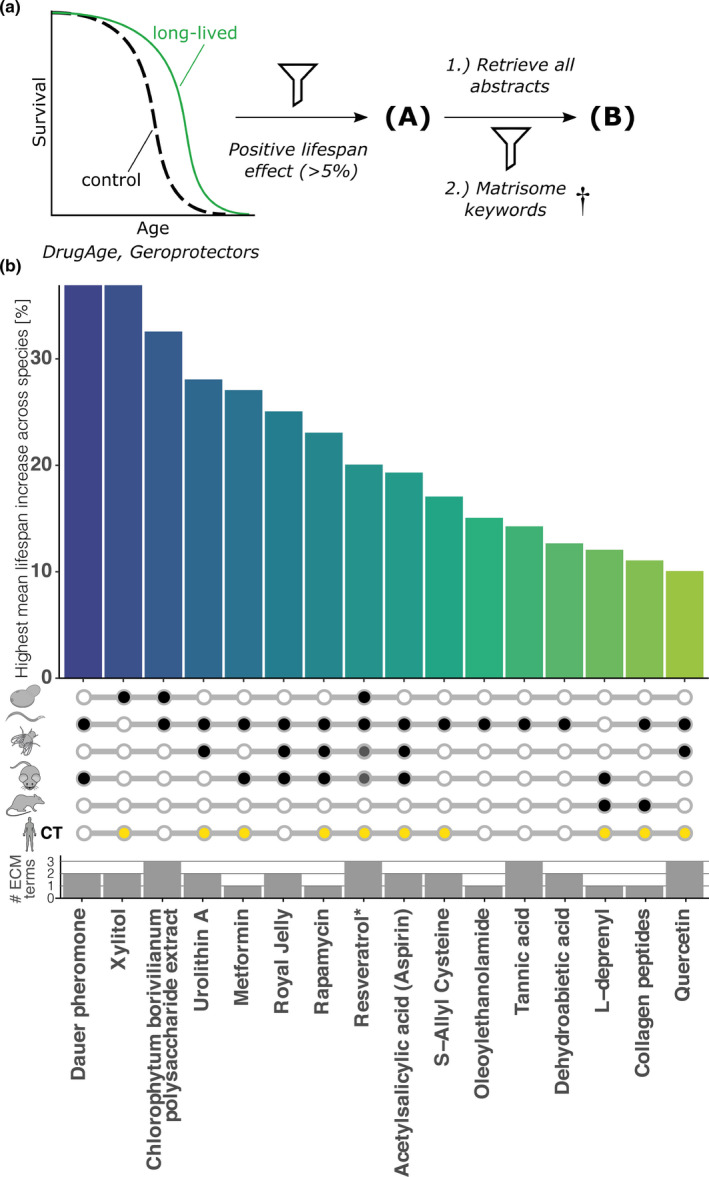
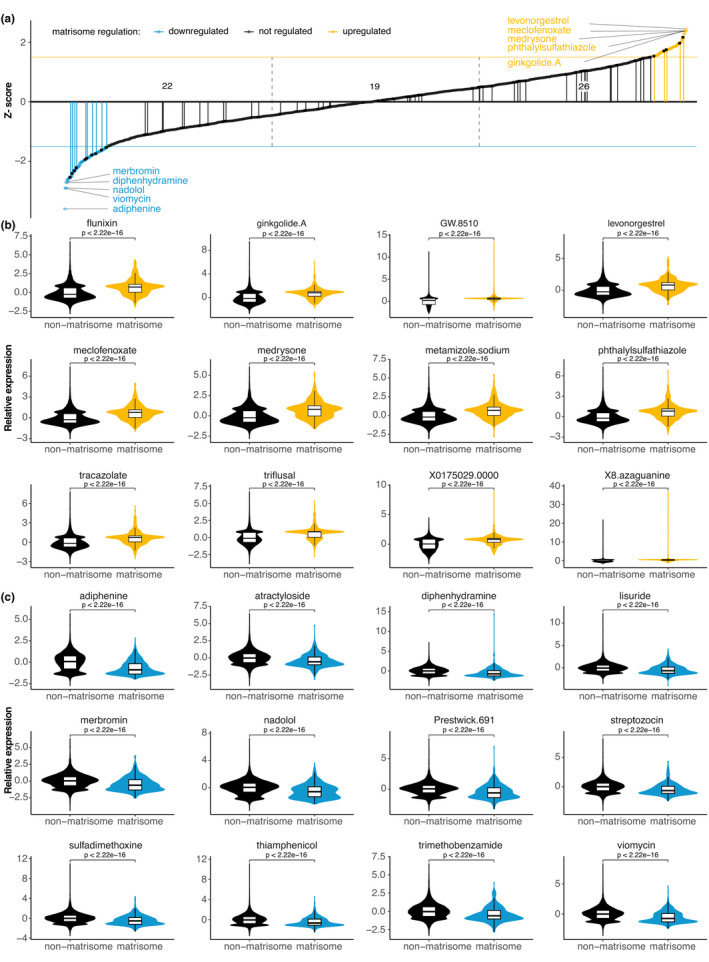
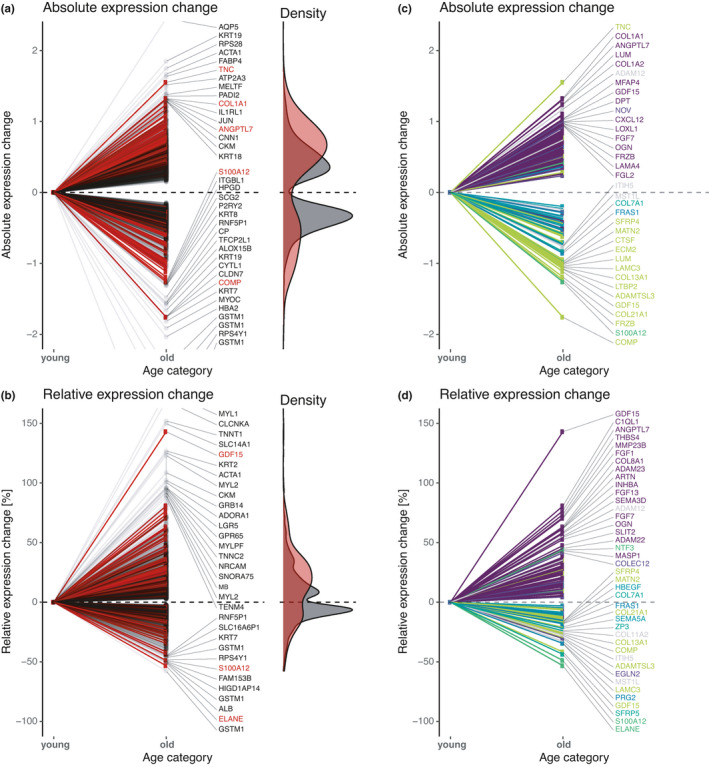
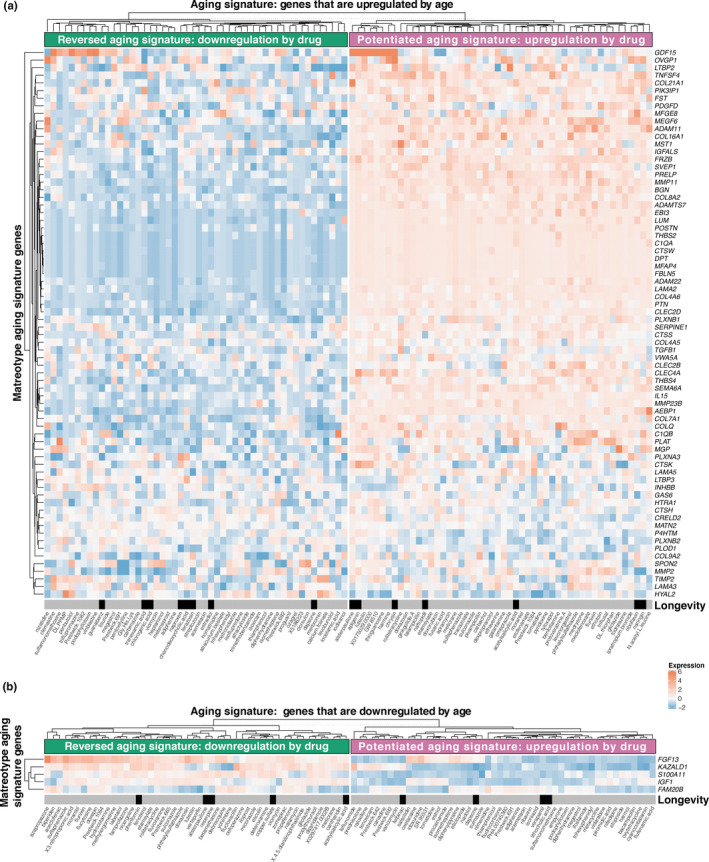
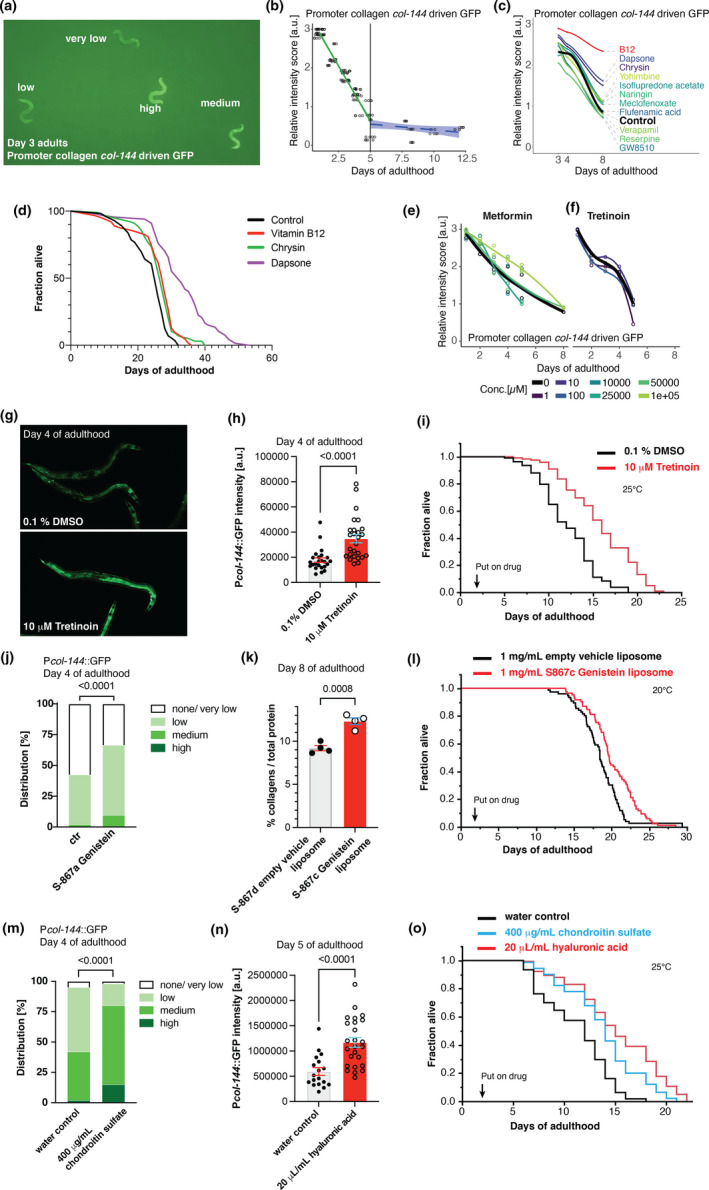
The identification and validation of drugs that promote health during aging (“geroprotectors”) are key to the retardation or prevention of chronic age‐related diseases. Here, we found that most of the established pro‐longevity compounds shown to extend lifespan in model organisms also alter extracellular matrix gene expression ( i.e ., matrisome) in human cell lines. To harness this observation, we used age‐stratified human transcriptomes to define the age‐related matreotype, which represents the matrisome gene expression pattern associated with age. Using a “youthful” matreotype, we screened in silico for geroprotective drug candidates. To validate drug candidates, we developed a novel tool using prolonged collagen expression as a non‐invasive and in‐vivo surrogate marker for Caenorhabditis elegans longevity. With this reporter, we were able to eliminate false‐positive drug candidates and determine the appropriate dose for extending the lifespan of C. elegans . We improved drug uptake for one of our predicted compounds, genistein, and reconciled previous contradictory reports of its effects on longevity. We identified and validated new compounds, tretinoin, chondroitin sulfate, and hyaluronic acid, for their ability to restore age‐related decline of collagen homeostasis and increase lifespan. Thus, our innovative drug screening approach—employing extracellular matrix homeostasis—facilitates the discovery of pharmacological interventions promoting healthy aging.
Overview
The claims and statistics of this paper haven’t been checked yet.
Run the check — free, no account needed. It reads the open-access text and checks the sources it cites.
Integrity signals
Registry
Cites
Statistics
Figures
Verification
Claims the paper makes
The claims and statistics of this paper haven’t been checked yet.
Run the check — free, no account needed. It reads the open-access text and checks the sources it cites.
Claims other papers make about this one
Each is checked against this paper’s own text: does it say what the citing paper says it does?
The cited source says what the claim attributes to it.
In the citing paper
“Extracellular matrix compounds such as chondroitin sulfate and hyaluronic acid restore the age-related decline of collagen and increase lifespan in nematodes 253 .”
From Hallmarks of aging: An expanding universe (2023) · cites this paper as [253]
Self-check
Percentages, sums and reported differences re-computed from the paper’s own numbers.
The self-check needs the paper’s full text.
Citations
Cites
López-Otín, C., Blasco, M. A., Partridge, L., Serrano, M., & Kroemer, G. (2013) · Cell · doi:10.1016/j.cell.2013.05.039 · Cited by 14,982
Geroscience: Linking Aging to Chronic Disease
Kennedy, B. K., Berger, S. L., Brunet, A., Campisi, J., Cuervo, A. M., Epel, E. S., Franceschi, C., Lithgow, G. J., Morimoto, R. I., Pessin, J. E., et al. (2014) · Cell · doi:10.1016/j.cell.2014.10.039 · Cited by 2,764
Ageing as a Risk Factor for Disease
Niccoli, T., & Partridge, L. (2012) · Current Biology · doi:10.1016/j.cub.2012.07.024 · Cited by 1,831
From discoveries in ageing research to therapeutics for healthy ageing
Campisi, J., Kapahi, P., Lithgow, G. J., Melov, S., Newman, J. C., & Verdin, E. (2019) · Nature · doi:10.1038/s41586-019-1365-2 · Cited by 1,389
Metformin as a tool to target aging
Barzilai, N., Crandall, J. P., Kritchevsky, S. B., & Espeland, M. A. (2016) · Cell Metabolism · doi:10.1016/j.cmet.2016.05.011 · Cited by 1,096
The extracellular matrix: tools and insights for the "omics" era
Naba, A., Clauser, K. R., Ding, H., Whittaker, C. A., Carr, S. A., & Hynes, R. O. (2016) · Matrix Biology · doi:10.1016/j.matbio.2015.06.003 · Cited by 1,037
Reprogramming to recover youthful epigenetic information and restore vision
Lu, Y., Brommer, B., Tian, X., Krishnan, A., Meer, M., Wang, C., Vera, D. L., Zeng, Q., Yu, D., Bonkowski, M. S., et al. (2020) · Nature · doi:10.1038/s41586-020-2975-4 · Cited by 820
mTOR inhibition improves immune function in the elderly
Mannick, J. B., Del Giudice, G., Lattanzi, M., Valiante, N. M., Praestgaard, J., Huang, B., Lonetto, M. A., Maecker, H. T., Kovarik, J., Carson, S., et al. (2014) · Science Translational Medicine · doi:10.1126/scitranslmed.3009892 · Cited by 786
Lampi, M. C., & Reinhart-King, C. A. (2018) · Science Translational Medicine · doi:10.1126/scitranslmed.aao0475 · Cited by 551
Mitohormesis: Promoting Health and Lifespan by Increased Levels of Reactive Oxygen Species (ROS)
Ristow, M., & Schmeisser, K. (2014) · Dose-Response · doi:10.2203/dose-response.13-035.ristow · Cited by 534
Research works printed but not linked: 45
- 10.18632/aging.101047 · DOI
- 10.1111/dom.12354 · DOI · Paper page
- 10.1111/acel.12585 · DOI · Paper page
- 10.1007/s10654-012-9714-6 · DOI
- 10.1111/acel.12432 · DOI
- 10.2174/157340611796799212 · DOI
- 10.1371/journal.pone.0033626 · DOI
- 10.1007/s11357-019-00113-y · DOI · Paper page
- 10.1093/bioinformatics/btp073 · DOI · Paper page
- 10.1016/j.tem.2018.11.005 · DOI
- 10.1111/acel.12819 · DOI
- 10.1038/nature14021 · DOI
- 10.1111/acel.12509 · DOI
- 10.1159/000504295 · DOI
- 10.1016/j.bjps.2019.03.032 · DOI
- 10.1371/journal.pcbi.1006639 · DOI
- 10.1056/NEJM199308193290803 · DOI
- 10.1159/000450832 · DOI
- 10.1371/journal.pone.0086842 · DOI
- 10.1016/j.celrep.2019.03.044 · DOI
- 10.1371/journal.pcbi.1007162 · DOI
- 10.1126/science.1132939 · DOI · Paper page
- 10.4062/biomolther.2014.075 · DOI
- 10.1177/1535370217723628 · DOI
- 10.3748/wjg.v20.i16.4648 · DOI
- Li Z.‐H., 2020, Associations of regular glucosamine use with all‐cause and cause‐specific mortality: A large prospective cohort study, Annals of the Rheumatic Diseases, 79, annrheumdis‐202
- 10.1093/ecam/nel081 · DOI
- Liu H., 2016, Screening lifespan‐extending drugs in Caenorhabditis elegans via label propagation on drug‐protein networks, BMC Systems Biology, 10
- 10.1038/ng.2653 · DOI · Paper page
- 10.1161/HYPERTENSIONAHA.112.191445 · DOI
- 10.18632/aging.100799 · DOI
- 10.2147/ciia.2006.1.4.327 · DOI · Paper page
- 10.1038/s41586-018-0457-8 · DOI · Paper page
- 10.1111/j.1476-5381.2011.01619.x · DOI
- 10.1038/nm.4005 · DOI
- 10.1016/j.semcdb.2018.06.005 · DOI
- 10.1016/j.mbplus.2020.100039 · DOI · Paper page
- 10.1038/nature16550 · DOI · Paper page
- 10.1042/EBC20190001 · DOI
- 10.1038/s41598-019-43075-z · DOI
- 10.21769/BioProtoc.2940 · DOI
- 10.1016/j.mbplus.2018.11.001 · DOI
- 10.1001/archderm.143.2.155 · DOI
- 10.1038/ncomms4563 · DOI
- 10.1111/acel.13121 · DOI
Cited by
Sorted by citations
Hallmarks of aging: An expanding universe
López-Otín, C., Blasco, M. A., Partridge, L., Serrano, M., & Kroemer, G. (2023) · Cell · doi:10.1016/j.cell.2022.11.001 · Cited by 6,549
Metadata
- Authors
- Statzer, C., Jongsma, E., Liu, S. X., Dakhovnik, A., Wandrey, F., Mozharovskyi, P., Zülli, F., & Ewald, C. Y.
- Affiliations
- Department of Health Sciences and Technology Institute of Translational Medicine Eidgenössische Technische Hochschule Zürich Schwerzenbach‐Zürich Switzerland
- Mibelle Biochemistry, Mibelle AG Buchs Switzerland
- LTCI Telecom Paris Institut Polytechnique de Paris Palaiseau France
- ORCID
- Ewald, Collin Y.
- Venue
- Aging Cell
- Publisher
- Wiley
- Published
- 2021-08-04
- Volume
- 20
- Issue
- 9
- ISSN
- 1474-9718
- 1474-9726
- PMC
- PMC8441316
- Cited by
- 45
- References
- 16
- Language
- en
- Funders
- Schweizerischer Nationalfonds zur Förderung der Wissenschaftlichen Forschung (PP00P3_163898)
About these checks
Registry, retraction, Cites and statistics results are computed, not judged, with one exception: a printed reference that no index lists is read once by a model before it counts as a citation error. Claims are extracted by a model and kept only when their quote appears verbatim in the text; each cited source is then checked, with a model’s help, for whether it says what the claim relies on. Those verdicts can be wrong — read the claim’s quote and the cited source before relying on one.
Statistics and arithmetic are recomputed, not judged.
Confidence bands are shown only for fields calibrated on our annotated test set. None is calibrated yet, so no band is shown.
What counts as a claim ›How we measure confidence ›How we check this ›
Are you an author, or do you see a problem with this page? Request a review
How to cite
Cite CoChat for the checks on this page, and the paper for its own findings.
- This page
- CoChat. (2026). Citation check: Youthful and age-related matreotypes predict drugs promoting longevity. https://app.cochat.ai/papers/10.1111/acel.13441
- The paper
- Statzer, C., Jongsma, E., Liu, S. X., Dakhovnik, A., Wandrey, F., Mozharovskyi, P., Zülli, F., & Ewald, C. Y. (2021). Youthful and age-related matreotypes predict drugs promoting longevity. Aging Cell. https://doi.org/10.1111/acel.13441
