

Reference data for testicular volume measured with ultrasound and pubic hair in Norwegian boys are comparable with Northern European populations
Open accessThe DOI matches its Crossref record; 37 of the 37 references it cites were found in a registry or an index; none of the 20 sources its claims cite is checked for support yet.
Abstract
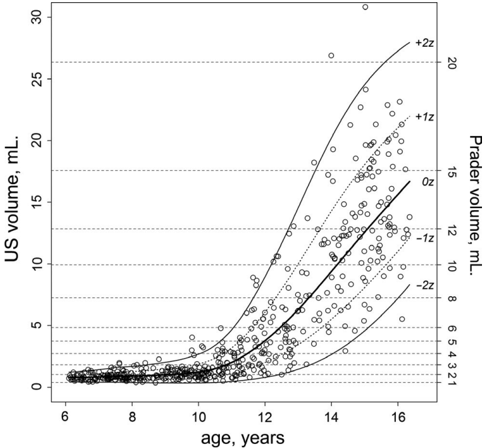
Aim: To estimate references for testicular volume measured with ultrasound and Tanner stages of pubic hair in Norwegian boys, and to compare the timing of puberty with data from similar populations. Methods: Testicular volume was derived from ultrasound measurements of testicular volume in a cross‐sectional study of 514 healthy boys. A continuous testicular volume for age reference curve was estimated with the LMS method. Tanner stages for pubic hair were clinically assessed in 452 boys. Age references for pubertal milestones were estimated with probit regression. Results: Puberty onset, defined by an ultrasound testicular volume of 2.7 mL, equivalent to an orchidometer volume of 4 mL, occurred at a mean (SD) age of 11.7 (1.1) years. The reference range was 9.7 (3rd) to 13.7 years (97th percentile). Pubic hair (Tanner stage 2) appeared on average at 11.8 (1.2) years with a corresponding reference range of 9.5‐14.1 years. Conclusion: The references for testicular volume measured with ultrasound are continuous in age and allow for the quantification of pubertal development. The age distribution of reaching pubertal milestones was comparable with data from other Northern European countries.
Overview
CoChat Summary
TL;DR
This cross-sectional study of 514 healthy Norwegian boys aged 6–16 years provides ultrasound-based testicular volume references and Tanner pubic hair references, with puberty onset (ultrasound testicular volume 2.7 mL, equivalent to Prader orchidometer 4 mL) at mean age 11.7 years and Tanner PH2 at 11.8 years. The timing was comparable with other Northern European populations and did not suggest a recent secular trend.
Key findings
- In 514 boys (mean age 11.0 years, range 6.1–16.4), the mean (SD) age at attaining an ultrasound testicular volume of 2.7 mL—equivalent to a Prader orchidometer volume of 4 mL—was 11.7 (1.1) years; the 3rd–97th percentile reference range was 9.7–13.7 years.
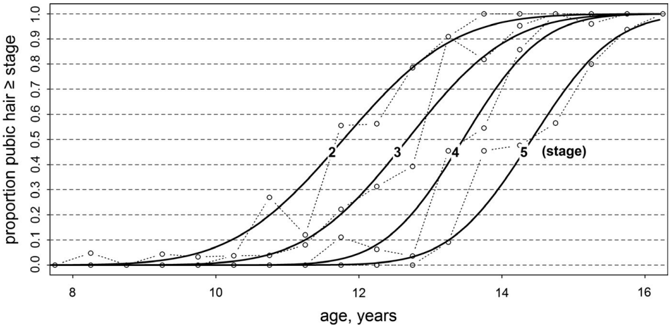
- In 452 boys with Tanner pubic hair staging, Tanner PH2 occurred at mean (SD) 11.8 (1.2) years, with a 3rd–97th percentile range of 9.5–14.1 years; later stages were PH3 12.68 years, PH4 13.46 years, and PH5 14.42 years.
- The authors report comparability with Northern European data: a Dutch ultrasound reference of 11.6 years, and equivalent Prader 4 mL ages of 11.4 years in Belgium, 11.5 years in the Netherlands, and 11.7 years in Denmark; pubarche at 11.8 years fell within the European range of 11.5–11.9 years. Compared with Waaler’s 1970s Norwegian data, contemporary boys reached pubertal testicular volume about 2–3 months earlier (<1 month per decade), and the authors did not find evidence of an ongoing secular trend over the past decade.
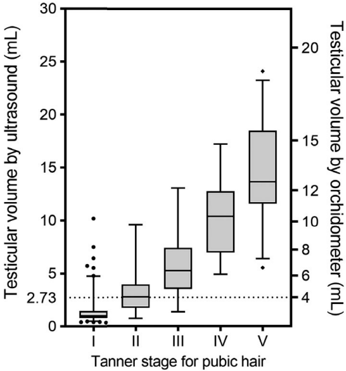
- Discordance between markers was present: 14.0% of boys with a pubertal testicular volume were Tanner PH1, while 8.1% of boys with a pre-pubertal testicular volume were ≥Tanner PH2; all boys at Tanner PH4 or 5 had pubertal or adult testicular volume.
Methods
- Cross-sectional Bergen Growth Study 2: all boys at six randomly selected primary/secondary schools in Bergen, Norway, were invited January–June 2016; parental consent was obtained for 493/1329 (37%) eligible boys, plus 58 boys from a 2017 reliability study. After exclusions (8 with disease/condition affecting growth; 21 with scrotal pathology), 514 boys were analyzed for testicular volume and 452 for pubic hair; questionnaire data were available for 340/514 (66.1%) and height/weight for 457.
- Ultrasound: single technician, Sonosite Edge with 15–6 MHz linear probe; supine; right testicle measured (left if visually larger), volume of largest testicle calculated as L×W×D×0.71 (Lambert equation). Observer variability was 9.2% with a technical error of measurement of 6.5%; conversion Vol OM = 1.96 × Vol US^0.71, so Prader ≥4 mL equals ultrasound ≥2.7 mL. Tanner PH was staged clinically by the same observer using Marshall and Tanner descriptions.
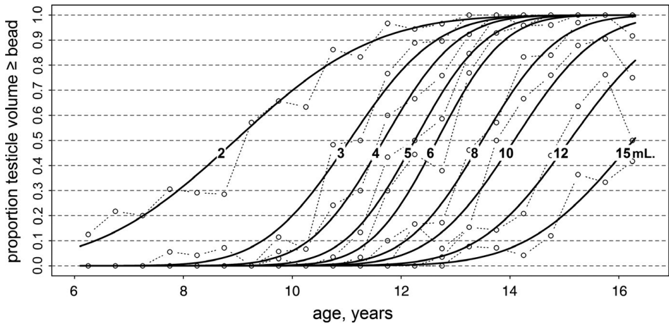
- Statistics: LMS method for continuous ultrasound testicular volume-for-age reference (L constant 0.5; M curve 8 edf; S curve 4 edf); probit regression within a GLM for cumulative incidence of discrete Prader-equivalent volumes and Tanner PH stages, with GAM confirming normal age distribution; analyses in R 3.4 and SPSS 24.
Limitations
- Stated: only 37% of invited boys participated, so selection bias is possible (e.g., early- or late-maturing boys less inclined to participate); only boys up to 16.4 years were included, potentially omitting stabilization of testicular growth at adult range; Prader orchidometer examination was performed only in the reliability study, so the conversion equation is based on those examinations; only the right testicle was measured except when the left appeared larger, though prior studies found no significant left-right differences.
- Stated/evident: the cross-sectional design means the study cannot estimate duration of each pubertal stage or pace of progression through stages.
- Evident: Tanner PH stage was not registered in 62 boys, reducing the pubic hair sample to 452 of 514; questionnaire data were available for only 340/514 (66.1%) and height/weight for 457, limiting those ancillary analyses.
Model-written summary. Check it against the paper before relying on it.
Integrity signals
Registry
Cites
Statistics
Figures
Verification
Claims the paper makes
0 Valid · 0 Not valid · 11 Not checked · 19 Own results and interpretations
A result the paper reports from its own data — it cites no other source for it, so there is none to check. The quote shows it is in the paper.
In the paper
“The reference range was 9.7 (3rd) to 13.7 years (97th percentile).”
- Also stated in: § 3.2 | Testicular volume · plain
“the 3rd and 97th percentiles were respectively 9.7 and 13.7 years.”
§ Reference data for testicular volume measured with ultrasound and pubic hair in Norwegian boys are comparable with Northern European populations > Abstract
plain- Asserted: passes — The authors put it forward as true.
- Checkable: passes — It can be checked against evidence.
- Load-bearing: passes — The paper’s conclusions depend on it.
- Based: passes — The paper gives a reason why it holds.
- Rests on an assumption not shown here.
- Also stated in: § 3.2 | Testicular volume · plain
A result the paper reports from its own data — it cites no other source for it, so there is none to check. The quote shows it is in the paper.
In the paper
“amongst boys with a pre-pubertal testicular volume, 8.1% were characterised as ≥Tanner PH2 (pubarche).”
§ Reference data for testicular volume measured with ultrasound and pubic hair in Norwegian boys are comparable with Northern European populations > 3.3 | Pubic hair
plain- Asserted: passes — The authors put it forward as true.
- Checkable: passes — It can be checked against evidence.
- Load-bearing: unclear — It is unclear whether the paper’s conclusions depend on it.
- Based: passes — The paper gives a reason why it holds.
A result the paper reports from its own data — it cites no other source for it, so there is none to check. The quote shows it is in the paper.
In the paper
“Puberty onset, defined by an ultrasound testicular volume of 2.7 mL, equivalent to an orchidometer volume of 4 mL, occurred at a mean (SD) age of 11.7 (1.1) years.”
- Also stated in: § 3.2 | Testicular volume · plain
“The mean age (SD) for attainment of a US measured TV of 2.7 mL (equivalent to a Prader orchidometer volume of 4 mL) was 11.7 (1.1) years, and the 3rd and 97th percentiles were respectively 9.7 and 13.7 years.”
- Also stated in: § F I G U R E 3 · plain
“The onset of puberty, defined by an US TV of 2.7 mL (4 mL with the Prader orchidometer), was reached at a mean age of 11.7 years.”
§ Reference data for testicular volume measured with ultrasound and pubic hair in Norwegian boys are comparable with Northern European populations > Abstract
plain- Asserted: passes — The authors put it forward as true.
- Checkable: passes — It can be checked against evidence.
- Load-bearing: passes — The paper’s conclusions depend on it.
- Based: passes — The paper gives a reason why it holds.
- Rests on an assumption not shown here.
- Also stated in: § 3.2 | Testicular volume · plain
None of the sources cited for this claim could be matched to a paper, so there is nothing to check it against.
In the paper
“Studies in European populations like Denmark, 30,31 Belgium, 26 Italy 32 and the Netherlands 27 reported relatively narrow range of mean age at pubarche (Tanner PH2) of 11.5-11.9years.Our finding of 11.8 years corresponds with this range.”
§ Reference data for testicular volume measured with ultrasound and pubic hair in Norwegian boys are comparable with Northern European populations > While the Copenhagen
What the sources say
- Not matchedcites [30]
The reference list we hold has no entry [30].
- Not matchedcites [31]
The reference list we hold has no entry [31].
- Not matchedcites [26]
The reference list we hold has no entry [26].
- Not matchedcites [27]
The reference list we hold has no entry [27].
plain- Asserted: passes — The authors put it forward as true.
- Checkable: passes — It can be checked against evidence.
- Load-bearing: passes — The paper’s conclusions depend on it.
- Based: passes — The paper gives a reason why it holds.
- Rests on an assumption not shown here.
- Not matched
None of the sources cited for this claim could be matched to a paper, so there is nothing to check it against.
In the paper
“The PROS and NICHD studies from the United States both reported a mean age at Tanner PH2 in the non-Hispanic white population of 11.5 years, 28,33 which is about 3 months earlier compared with Norwegian boys.”
§ Reference data for testicular volume measured with ultrasound and pubic hair in Norwegian boys are comparable with Northern European populations > While the Copenhagen
What the sources say
- Not matchedcites [28]
The reference list we hold has no entry [28].
- Not matchedcites [33]
The reference list we hold has no entry [33].
plain- Asserted: passes — The authors put it forward as true.
- Checkable: passes — It can be checked against evidence.
- Load-bearing: unclear — It is unclear whether the paper’s conclusions depend on it.
- Based: passes — The paper gives a reason why it holds.
- Rests on an assumption not shown here.
- Not matched
8 more claims
Create a free account to see all 30 claims and every source verdict.
- It may state two separate claims as one. 16
- Probably not a substantial claim. 3
Self-check
Percentages, sums and reported differences re-computed from the paper’s own numbers.
Each contradiction between two passages listed here was confirmed by an independent check.
Rated minor: it would not touch a result — a value no result rests on, a p-value that stays on the same side of the significance level, or a conflict that is clerical, resolved elsewhere in the paper, or outside its own findings.
In the paper
§ Reference data for testicular volume measured with ultrasound and pubic hair in Norwegian boys are comparable with Northern European populations > 3.3 | Pubic hair
“Tanner PH stage was determined in 452 (88.0%) boys with a mean age of 10.9 years (range 6.1-16.3years).”
§ Reference data for testicular volume measured with ultrasound and pubic hair in Norwegian boys are comparable with Northern European populations > F I G U R E 3
“F I G U R E 4 Box and whiskers plots of testicular volumes at different Tanner pubic hair stages in 452 Norwegian boys aged 6.1-16.4y in 2016-2017.”
Citations
Cites
Establishing a standard definition for child overweight and obesity worldwide: international survey
Cole, T. J. (2000) · BMJ · doi:10.1136/bmj.320.7244.1240 · Cited by 16,480
Smoothing reference centile curves: The lms method and penalized likelihood
Cole, T. J., & Green, P. J. (1992) · Statistics in Medicine · doi:10.1002/sim.4780111005 · Cited by 2,781
Parent, A.-S., Teilmann, G., Juul, A., Skakkebaek, N. E., Toppari, J., & Bourguignon, J.-P. (2003) · Endocrine Reviews · doi:10.1210/er.2002-0019 · Cited by 1,762
Herman-Giddens, M. E., Slora, E. J., Wasserman, R. C., Bourdony, C. J., Bhapkar, M. V., Koch, G. G., & Hasemeier, C. M. (1997) · PEDIATRICS · doi:10.1542/peds.99.4.505 · Cited by 1,709
Continuing Positive Secular Growth Change in the Netherlands 1955–1997
Fredriks, A. M., van Buuren, S., Burgmeijer, R. J. F., Meulmeester, J. F., Beuker, R. J., Brugman, E., Roede, M. J., Verloove-Vanhorick, S. P., & Wit, J.-M. (2000) · Pediatric Research · doi:10.1203/00006450-200003000-00006 · Cited by 1,137
Examination of US puberty-timing data from 1940 to 1994 for secular trends: panel findings
Euling, S. Y., Herman-Giddens, M. E., Lee, P. A., Selevan, S. G., Juul, A., SØrensen, T. I. A., Dunkel, L., Himes, J. H., Teilmann, G., & Swan, S. H. (2008) · PEDIATRICS · doi:10.1542/peds.2007-1813d · Cited by 662
Recent decline in age at breast development: The Copenhagen Puberty Study
Aksglaede, L., Sørensen, K., Petersen, J. H., Skakkebæk, N. E., & Juul, A. (2009) · Pediatrics · doi:10.1542/peds.2008-2491 · Cited by 626
Pubertal development and regulation
Abreu, A. P., & Kaiser, U. B. (2016) · The Lancet Diabetes & Endocrinology · doi:10.1016/s2213-8587(15)00418-0 · Cited by 611
Public health implications of altered puberty timing
Golub, M. S., Collman, G. W., Foster, P. M. D., Kimmel, C. A., Rajpert-De Meyts, E., Reiter, E. O., Sharpe, R. M., Skakkebaek, N. E., & Toppari, J. (2008) · PEDIATRICS · doi:10.1542/peds.2007-1813g · Cited by 497
Recent changes in pubertal timing in healthy danish boys: associations with body mass index
Sørensen, K., Aksglaede, L., Petersen, J. H., & Juul, A. (2010) · The Journal of Clinical Endocrinology & Metabolism · doi:10.1210/jc.2009-1478 · Cited by 393
Herman-Giddens, M. E., Steffes, J., Harris, D., Slora, E., Hussey, M., Dowshen, S. A., Wasserman, R., Serwint, J. R., Smitherman, L., & Reiter, E. O. (2012) · PEDIATRICS · doi:10.1542/peds.2011-3291 · Cited by 392
References for growth and pubertal development from birth to 21 years in Flanders, Belgium
Roelants, M., Hauspie, R., & Hoppenbrouwers, K. (2009) · Annals of Human Biology · doi:10.3109/03014460903049074 · Cited by 323
Self-citationPubertal development in Danish children: comparison of recent European and US data
JUUL, A., TEILMANN, G., SCHEIKE, T., HERTEL, N. T., HOLM, K., LAURSEN, E. M., MAIN, K. M., & SKAKKEBÆK, N. E. (2006) · International Journal of Andrology · doi:10.1111/j.1365-2605.2005.00556.x · Cited by 300
References for growth and pubertal development from birth to 21 years in Flanders, Belgium
Roelants, M., Hauspie, R., & Hoppenbrouwers, K. (2009) · Annals of Human Biology · doi:10.1080/03014460903049074 · Cited by 267
Self-citationIs there a causal relationship between obesity and puberty?
Reinehr, T., & Roth, C. L. (2019) · The Lancet Child & Adolescent Health · doi:10.1016/s2352-4642(18)30306-7 · Cited by 265
Validity of self-assessment of pubertal maturation
Rasmussen, A. R., Wohlfahrt-Veje, C., Tefre de Renzy-Martin, K., Hagen, C. P., Tinggaard, J., Mouritsen, A., Mieritz, M. G., & Main, K. M. (2015) · Pediatrics · doi:10.1542/peds.2014-0793 · Cited by 264
COMPARATIVE ASSESSMENT OF PEDIATRIC TESTICULAR VOLUME: ORCHIDOMETER VERSUS ULTRASOUND
DIAMOND, D. A., PALTIEL, H. J., DiCANZIO, J., ZURAKOWSKI, D., BAUER, S. B., ATALA, A., EPHRAIM, P. L., GRANT, R., & RETIK, A. B. (2000) · Journal of Urology · doi:10.1016/s0022-5347(05)67264-3 · Cited by 218
Biro, F. M., Lucky, A. W., Huster, G. A., & Morrison, J. A. (1995) · The Journal of Pediatrics · doi:10.1016/s0022-3476(95)70265-2 · Cited by 208
Susman, E. J., Houts, R. M., Steinberg, L., Belsky, J., Cauffman, E., DeHart, G., Friedman, S. L., Roisman, G. I., Halpern-Felsher, B. L., & for the Eunice Kennedy Shriver NICHD Early Child Care Research Network (2010) · Archives of Pediatrics & Adolescent Medicine · doi:10.1001/archpediatrics.2009.261 · Cited by 197
Timing of Puberty in Overweight Versus Obese Boys
Lee, J. M., Wasserman, R., Kaciroti, N., Gebremariam, A., Steffes, J., Dowshen, S., Harris, D., Serwint, J., Abney, D., Smitherman, L., et al. (2016) · Pediatrics · doi:10.1542/peds.2015-0164 · Cited by 175
Goede, J., Hack, W. W. M., Sijstermans, K., van der Voort-Doedens, L. M., Van der Ploeg, T., Meij-de Vries, A., & Delemarre-van de Waal, H. A. (2011) · Hormone Research in Paediatrics · doi:10.1159/000326057 · Cited by 167
Hsieh, M.-L., Huang, S., Huang, H.-C., Chen, Y., & Hsu, Y. (2009) · Asian Journal of Andrology · doi:10.1038/aja.2008.48 · Cited by 125
Mouritsen, A., Aksglaede, L., Soerensen, K., Hagen, C. P., Petersen, J. H., Main, K. M., & Juul, A. (2013) · European Journal of Endocrinology · doi:10.1530/eje-12-0191 · Cited by 111
Ultrasonographically measured testicular volumes in 0- to 6-year-old boys
Kuijper, E. A. M., van Kooten, J., Verbeke, J. I. M. L., van Rooijen, M., & Lambalk, C. B. (2008) · Human Reproduction · doi:10.1093/humrep/den021 · Cited by 93
Pubertal Onset in Boys and Girls Is Influenced by Pubertal Timing of Both Parents
Wohlfahrt‐Veje, C., Mouritsen, A., Hagen, C. P., Tinggaard, J., Mieritz, M. G., Boas, M., Petersen, J. H., Skakkebæk, N. E., & Main, K. M. (2016) · The Journal of Clinical Endocrinology & Metabolism · doi:10.1210/jc.2016-1073 · Cited by 93
Overweight and obesity in Norwegian children: Secular trends in weight‐for‐height and skinfolds
Júlíusson, P. B., Roelants, M., Eide, G. E., Hauspie, R. C., Waaler, P. E., & Bjerknes, R. (2007) · Acta Paediatrica · doi:10.1111/j.1651-2227.2007.00421.x · Cited by 83
Self-citationParent, A., Franssen, D., Fudvoye, J., Pinson, A., & Bourguignon, J.-P. (2015) · Endocrine development · doi:10.1159/000438885 · Cited by 78
Joustra, S. D., van der Plas, E. M., Goede, J., Oostdijk, W., Delemarre‐van de Waal, H. A., Hack, W. W. M., van Buuren, S., & Wit, J. M. (2015) · Acta Paediatrica · doi:10.1111/apa.12972 · Cited by 75
Age at Puberty and Risk of Testicular Germ Cell Cancer (Ontario, Canada)
Weir, H. K., Kreiger, N., & Marrett, L. D. (1998) · Cancer Causes & Control · doi:10.1023/a:1008864902104 · Cited by 43
Simone, M. D., Danubio, M. E., Amicone, E., Verrotti, A., Gruppioni, G., & Vecchi, F. (2004) · Annals of Human Biology · doi:10.1080/03014460410001705013 · Cited by 38
STUDIES IN NORMAL MALE PUBERTY
Waaler, P. E., Thorsen, T., Stöa, K. F., & Aarskog, D. (1974) · Acta Paediatrica · doi:10.1111/j.1651-2227.1974.tb07587.x · Cited by 36
Madsen, A., Oehme, N. H. B., Roelants, M., Bruserud, I. S., Eide, G. E., Viste, K., Bjerknes, R., Almås, B., Rosendahl, K., Sagen, J. V., et al. (2019) · The Journal of Clinical Endocrinology & Metabolism · doi:10.1210/clinem/dgz094 · Cited by 34
Self-citationOehme, N. H. B., Roelants, M., Bruserud, I. S., Eide, G. E., Bjerknes, R., Rosendahl, K., & Júlíusson, P. B. (2018) · Pediatric Radiology · doi:10.1007/s00247-018-4195-8 · Cited by 32
Self-citationTatsunami, S., Matsumiya, K., Tsujimura, A., Itoh, N., Sasao, T., Koh, E., Maeda, Y., Eguchi, J., Takehara, K., Nishida, T., et al. (2006) · Asian Journal of Andrology · doi:10.1111/j.1745-7262.2006.00143.x · Cited by 27
Ultrasonographically measured testicular volumes in 0 to 6 year old boys
Kuijper, E. A. M., van Kooten, J., Verbeke, J. I. M. L., van Rooijen, M. S., & Lambalk, C. B. (2007) · Fertility and Sterility · doi:10.1016/j.fertnstert.2007.07.1228 · Cited by 8
Herman-Giddens, M. E., Wang, L., & Koch, G. (2001) · Archives of Pediatrics & Adolescent Medicine · doi:10.1001/archpedi.155.9.1022 · Cited by 2
Is there a causal relationship between obesity and puberty?
Reinehr, T., & Roth, C. L. (2019) · Yearbook of pediatric endocrinology · doi:10.1530/ey.16.7.10 · Cited by 1
Cited by
Long-term follow-up of boys who have undergone a testicular biopsy for fertility preservation
Kanbar, M., de Michele, F., Giudice, M. G., Desmet, L., Poels, J., & Wyns, C. (2020) · Human Reproduction · doi:10.1093/humrep/deaa281 · Cited by 62
Rodprasert, W., Virtanen, H. E., & Toppari, J. (2024) · Frontiers in Endocrinology · doi:10.3389/fendo.2024.1347435 · Cited by 50
Forså, M. I., Bjerring, A. W., Haugaa, K. H., Smedsrud, M. K., Sarvari, S. I., Landgraff, H. W., Hallén, J., & Edvardsen, T. (2023) · Open Heart · doi:10.1136/openhrt-2022-002155 · Cited by 42
Liu, C., Liu, X., Zhang, X., Yang, B., Huang, L., Wang, H., & Yu, H. (2021) · Frontiers in Pediatrics · doi:10.3389/fped.2021.648711 · Cited by 29
Low BMI, but not high BMI, influences the timing of puberty in boys
Oehme, N. H. B., Roelants, M., Bruserud, I. S., Madsen, A., Bjerknes, R., Rosendahl, K., & Júlíusson, P. B. (2021) · Andrology · doi:10.1111/andr.12985 · Cited by 28
Self-citation
Metadata
- Authors
- Oehme, N. H. B., Roelants, M., Særvold Bruserud, I., Madsen, A., Eide, G. E., Bjerknes, R., Rosendahl, K., & Juliusson, P. B.
- Affiliations
- Department of Clinical Science University of Bergen Bergen Norway
- KU Leuven (BE)
- Haukeland University Hospital (NO)
- Venue
- Acta Paediatrica
- Publisher
- Wiley
- Published
- 2020-01-22
- Volume
- 109
- Issue
- 8
- Pages
- 1612-1619
- ISSN
- 0365-1436 (ISSN-L)
- 0803-5253
- 1651-2227
- OpenAlex
- W2998109821
- Cited by
- 45
- References
- 35
- Citations by year
- 2026: 5 · 2025: 8 · 2024: 4 · 2023: 9 · 2022: 8 · 2021: 9 · 2020: 2
- FWCI
- 4.17
- Type
- journal article
- Language
- en
- Open access
- hybrid
- doi.org
- Licence
- Locations
- Acta Paediatrica (publishedVersion, cc-by-nc-nd)
- Lirias (KU Leuven) (publishedVersion, other-oa)
- PubMed (publishedVersion)
- NVA (Nasjonalt vitenarkiv) (submittedVersion, cc-by-nc-nd)
- Topics
- Health Sciences › Medicine › Reproductive Medicine › Hypothalamic control of reproductive hormones
- Health Sciences › Medicine › Surgery › Testicular diseases and treatments
- Health Sciences › Medicine › Reproductive Medicine › Sperm and Testicular Function
- Keywords
- testicular volume, puberty onset, pubic hair, Tanner stages, testicular ultrasound, pubertal development, boys, Norwegian population
- MeSH terms
- Child, Cross-Sectional Studies, Hair, Humans, Male, Puberty, Reference Values, Testis, Ultrasonography
About these checks
Registry, retraction, Cites and statistics results are computed, not judged, with one exception: a printed reference that no index lists is read once by a model before it counts as a citation error. Claims are extracted by a model and kept only when their quote appears verbatim in the text; each cited source is then checked, with a model’s help, for whether it says what the claim relies on. Those verdicts can be wrong — read the claim’s quote and the cited source before relying on one.
A language model drew the claims from the paper on 2026-11-27, under version 3 of the claim definition (model deepseek-v4.1-flash, prompt extract-v3).
A second model labelled each claim on 2026-11-27 (model jev-1.13-20260917, definition revision gold-guideline-v0.2).
Statistics and arithmetic are recomputed, not judged.
Confidence bands are shown only for fields calibrated on our annotated test set. None is calibrated yet, so no band is shown.
What counts as a claim ›How we measure confidence ›How we check this ›
Are you an author, or do you see a problem with this page? Request a review
Data sources
Bibliographic data: Semantic Scholar, OpenAlex, Crossref.
Contains information from the Semantic Scholar Academic Graph Datasets, made available under the ODC Attribution License (ODC-BY 1.0).
Semantic Scholar’s data is described in: Kinney, R., et al. (2023). The Semantic Scholar Open Data Platform. arXiv:2301.10140.
