

The DOI matches its Crossref record; 60 of the 60 references it cites were found in a registry or an index; none of the 33 sources its claims cite is checked for support yet.
Exposure to intergroup conspiracy theories promotes prejudice which spreads across groups
Open accessAbstract
This research experimentally examined the effects of exposure to intergroup conspiracy theories on prejudice and discrimination. Study 1 ( N = 166) demonstrated that exposure to conspiracy theories concerning immigrants to Britain from the European Union (vs. anti‐conspiracy material or a control) exacerbated prejudice towards this group. Study 2 ( N = 173) found the same effect in a different intergroup context – exposure to conspiracy theories about Jewish people (vs. anti‐conspiracy material or a control) increased prejudice towards this group and reduced participants’ willingness to vote for a Jewish political candidate. Finally, Study 3 ( N = 114) demonstrated that exposure to conspiracy theories about Jewish people not only increased prejudice towards this group but was indirectly associated with increased prejudice towards a number of secondary outgroups (e.g., Asians, Arabs, Americans, Irish, Australians). The current research suggests that conspiracy theories may have potentially damaging and widespread consequences for intergroup relations.
Overview
AI snapshot
Written from the paper’s full text.
TL;DR
Three experiments found that exposure to intergroup conspiracy theories increased prejudice toward the targeted outgroup and, in one study, discrimination; Study 3 also found indirect generalization of prejudice to unrelated secondary outgroups. Effects were generally small and mainly affective rather than cognitive.
Key findings
- Study 1 (N = 166): exposure to immigrant conspiracy theories increased prejudice toward immigrants (pro-conspiracy M = 3.98, SD = 1.00) compared with anti-conspiracy (M = 3.56, SD = 0.96, p = .023, d = .43) and control (M = 3.53, SD = 0.88, p = .016, d = .50); omnibus F(2, 163) = 3.68, p = .027, η² = .04.
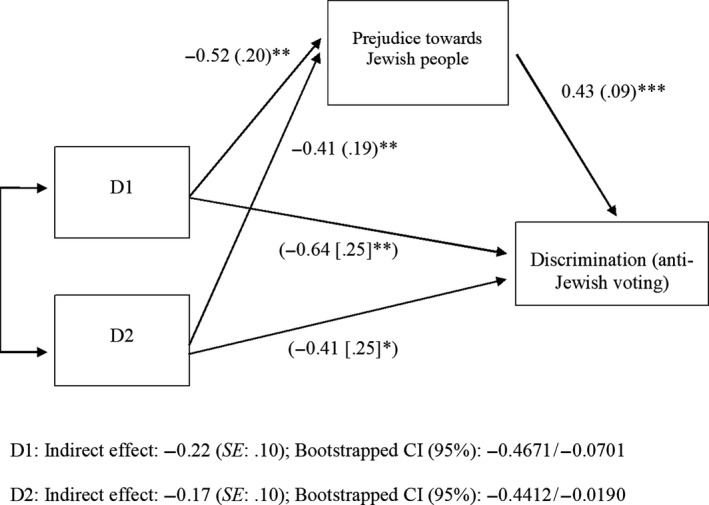
- Study 2 (N = 173): exposure to Jewish conspiracy theories increased affective prejudice toward Jewish people (M = 3.32, SD = 0.94) versus anti-conspiracy (M = 2.80, SD = 1.00, p = .008, d = .54) and control (M = 2.91, SD = 1.15, p = .034, d = .39); it also increased anti-Jewish voting bias (M = 2.30, SD = 1.60) versus anti-conspiracy (M = 1.66, SD = 0.98, p = .013, d = .48), with mediation via prejudice. No differences emerged for stereotypes or dehumanization (p > .05).
- Study 3 (N = 114): exposure to Jewish conspiracy theories increased prejudice toward Jewish people (M = 38.25, SD = 21.14) versus control (M = 31.15, SD = 16.10), t(112) = −2.04, p = .044, d = .38. Indirect effects through Jewish prejudice were significant for all 12 secondary outgroups, e.g., Asians (−5.50, SE = 2.68), Arabs (−4.83, SE = 2.34), Irish (−4.75, SE = 2.40), Americans (−4.53, SE = 2.56), Australians (−4.43, SE = 2.22).
Methods
- Three between-subjects online experiments recruited UK residents via Prolific Academic. Final analyzed samples: Study 1 N = 166 (pro-conspiracy n = 50, anti-conspiracy n = 57, control n = 59); Study 2 N = 173 (pro n = 57, anti n = 56, control n = 60); Study 3 N = 114 (pro n = 52, control n = 62). Exclusions included failed attention screens, reading time under 30 s, and, in Studies 2–3, Jewish origin.
- Participants read pro-conspiracy, anti-conspiracy, or no-information control material. Study 1 concerned immigrants and terrorism; Studies 2–3 concerned Jewish people and 9/11. Measures included conspiracy belief manipulation checks, semantic-differential prejudice, feeling thermometers, stereotypes, dehumanization, voting intention, and prejudice toward secondary outgroups.
- Analyses used ANOVAs and pairwise comparisons, plus mediation with Hayes’ PROCESS Model 4 and 5,000 bootstrapped resamples.
Limitations
- The paper states that effects were stronger for affective than cognitive prejudice; Study 2 found no changes in stereotypes or dehumanization. It also notes that discrimination was measured as behavioral intention, not actual behavior, and that manipulation-check items may reflect general fear of foreigners rather than genuine conspiracy beliefs.
- The paper states that long-term effects were not examined, and mechanisms and moderators remain untested.
- Evident from the text: samples were UK Prolific participants rather than representative populations; effects were small (η² = .04–.05; d = .38–.54); Study 3 removed the anti-conspiracy condition; and secondary-outgroup effects were indirect only, with no direct effects reported.
Model-written summary. Check it against the paper before relying on it.
Integrity signals
Registry
Cites
Statistics
Figures
Verification
Claims the paper makes
30 Own result · 22 Not checked yet · 17 Own interpretation · 12 Own method · 2 No basis given
A result the paper reports from its own data — it cites no other source for it, so there is none to check. The quote shows it is in the paper.
In the paper
“Finally, Study 3 (N = 114) demonstrated that exposure to conspiracy theories about Jewish people not only increased prejudice towards this group but was indirectly associated with increased prejudice towards a number of secondary outgroups (e.g., Asians, Arabs, Americans, Irish, Australians).”
§ Exposure to intergroup conspiracy theories promotes prejudice which spreads across groups > Abstract
boostedcorrelationaln = 114- Asserted: passes — The authors put it forward as true.
- Checkable: passes — It can be checked against evidence.
- Load-bearing: passes — The paper’s conclusions depend on it.
- Based: passes — The paper gives a reason why it holds.
- Rests on an assumption: The pro-conspiracy articles increased prejudice because of their conspiracy content rather than merely their negative portrayal of the outgroup.
A result the paper reports from its own data — it cites no other source for it, so there is none to check. The quote shows it is in the paper.
In the paper
“Study 2 (N = 173) found the same effect in a different intergroup context – exposure to conspiracy theories about Jewish people (vs. anti‐conspiracy material or a control) increased prejudice towards this group and reduced participants’ willingness to vote for a Jewish political candidate.”
§ Exposure to intergroup conspiracy theories promotes prejudice which spreads across groups > Abstract
plaindirectn = 173- Asserted: passes — The authors put it forward as true.
- Checkable: passes — It can be checked against evidence.
- Load-bearing: passes — The paper’s conclusions depend on it.
- Based: passes — The paper gives a reason why it holds.
- Rests on an assumption: The pro-conspiracy articles increased prejudice because of their conspiracy content rather than merely their negative portrayal of the outgroup.
A result the paper reports from its own data — it cites no other source for it, so there is none to check. The quote shows it is in the paper.
In the paper
“Study 1 (N = 166) demonstrated that exposure to conspiracy theories concerning immigrants to Britain from the European Union (vs. anti‐conspiracy material or a control) exacerbated prejudice towards this group.”
§ Exposure to intergroup conspiracy theories promotes prejudice which spreads across groups > Abstract
boosteddirectn = 166- Asserted: passes — The authors put it forward as true.
- Checkable: passes — It can be checked against evidence.
- Load-bearing: passes — The paper’s conclusions depend on it.
- Based: passes — The paper gives a reason why it holds.
- Rests on an assumption: The pro-conspiracy articles increased prejudice because of their conspiracy content rather than merely their negative portrayal of the outgroup.
A result the paper reports from its own data — it cites no other source for it, so there is none to check. The quote shows it is in the paper.
In the paper
“Study 2 (N = 173) found the same effect in a different intergroup context – exposure to conspiracy theories about Jewish people (vs. anti‐conspiracy material or a control) increased prejudice towards this group and reduced participants’ willingness to vote for a Jewish political candidate.”
§ Exposure to intergroup conspiracy theories promotes prejudice which spreads across groups > Abstract
plaindirectn = 173- Asserted: passes — The authors put it forward as true.
- Checkable: passes — It can be checked against evidence.
- Load-bearing: passes — The paper’s conclusions depend on it.
- Based: passes — The paper gives a reason why it holds.
- Rests on an assumption: The pro-conspiracy articles increased prejudice because of their conspiracy content rather than merely their negative portrayal of the outgroup.
A result the paper reports from its own data — it cites no other source for it, so there is none to check. The quote shows it is in the paper.
In the paper
“Finally, Study 3 (N = 114) demonstrated that exposure to conspiracy theories about Jewish people not only increased prejudice towards this group but was indirectly associated with increased prejudice towards a number of secondary outgroups (e.g., Asians, Arabs, Americans, Irish, Australians).”
§ Exposure to intergroup conspiracy theories promotes prejudice which spreads across groups > Abstract
boosteddirectn = 114- Asserted: passes — The authors put it forward as true.
- Checkable: passes — It can be checked against evidence.
- Load-bearing: passes — The paper’s conclusions depend on it.
- Based: passes — The paper gives a reason why it holds.
- Rests on an assumption: The pro-conspiracy articles increased prejudice because of their conspiracy content rather than merely their negative portrayal of the outgroup.
A result the paper reports from its own data — it cites no other source for it, so there is none to check. The quote shows it is in the paper.
In the paper
“As expected, exposure to Jewish conspiracy theories resulted in significantly higher conspiracy theory belief (M = 2.85, SD = 1.31), compared to the control condition (M = 2.09, SD = 0.93), t(112) = 3.59, p < .001, d = .67.”
§ Exposure to intergroup conspiracy theories promotes prejudice which spreads across groups > Results and discussion > Manipulation check
plaindirect- Asserted: passes — The authors put it forward as true.
- Checkable: passes — It can be checked against evidence.
- Load-bearing: passes — The paper’s conclusions depend on it.
- Based: passes — The paper gives a reason why it holds.
A result the paper reports from its own data — it cites no other source for it, so there is none to check. The quote shows it is in the paper.
In the paper
“As predicted, prejudice towards Jewish people was significantly higher in the experimental condition (M = 38.25, SD = 21.14) compared to the control (M = 31.15, SD = 16.10), t(112) = −2.04, p = .044, d = .38.”
§ Exposure to intergroup conspiracy theories promotes prejudice which spreads across groups > Results and discussion > Exposure to Jewish conspiracy theories and prejudice
plaindirect- Asserted: passes — The authors put it forward as true.
- Checkable: passes — It can be checked against evidence.
- Load-bearing: passes — The paper’s conclusions depend on it.
- Based: passes — The paper gives a reason why it holds.
A result the paper reports from its own data — it cites no other source for it, so there is none to check. The quote shows it is in the paper.
In the paper
“Pairwise comparisons demonstrated that prejudice was significantly higher in the pro‐conspiracy condition (M = 3.98, SD = 1.00) compared to both the anti‐conspiracy (M = 3.56, SD = 0.96, p = .023, d = .43) and the control condition (M = 3.53, SD = 0.88, p = .016, d = .50).”
§ Exposure to intergroup conspiracy theories promotes prejudice which spreads across groups > Results and discussion > Exposure to immigrant conspiracy theories and prejudice
boosteddirect- Asserted: passes — The authors put it forward as true.
- Checkable: passes — It can be checked against evidence.
- Load-bearing: passes — The paper’s conclusions depend on it.
- Based: passes — The paper gives a reason why it holds.
- Rests on an assumption: The pro-conspiracy articles increased prejudice because of their conspiracy content rather than merely their negative portrayal of the outgroup.
A result the paper reports from its own data — it cites no other source for it, so there is none to check. The quote shows it is in the paper.
In the paper
“A second ANOVA then examined the effect of exposure to conspiracy theories on prejudice. A significant omnibus effect of condition on prejudice was observed, F(2, 163) = 3.68, p = .027, η2 = .04.”
§ Exposure to intergroup conspiracy theories promotes prejudice which spreads across groups > Results and discussion > Exposure to immigrant conspiracy theories and prejudice
plain- Asserted: passes — The authors put it forward as true.
- Checkable: passes — It can be checked against evidence.
- Load-bearing: passes — The paper’s conclusions depend on it.
- Based: passes — The paper gives a reason why it holds.
A result the paper reports from its own data — it cites no other source for it, so there is none to check. The quote shows it is in the paper.
In the paper
“Results (see Figure 1) confirmed that the indirect effect was significant in both cases. When compared to both the anti‐conspiracy condition and the control condition, exposure to conspiracy theories increased discrimination towards a Jewish political candidate via increases in prejudice towards this group.”
§ Exposure to intergroup conspiracy theories promotes prejudice which spreads across groups > Results and discussion > Exposure to Jewish conspiracy theories, prejudice, and discrimination
plaindirectn = 173- Asserted: passes — The authors put it forward as true.
- Checkable: passes — It can be checked against evidence.
- Load-bearing: passes — The paper’s conclusions depend on it.
- Based: passes — The paper gives a reason why it holds.
- Rests on an assumption: In the mediation analysis, increases in prejudice towards Jewish people caused the increase in anti-Jewish voting bias.
- It may state two separate claims as one. 19
- The quote only partly states this claim. 1
- Probably not a substantial claim. 20
A result the paper reports from its own data — it cites no other source for it, so there is none to check. The quote shows it is in the paper.
In the paper
“Study 3 then showed that exposure to Jewish conspiracy theories not only increased prejudice towards this group but also indirectly increased prejudice towards a range of other groups.”
§ Exposure to intergroup conspiracy theories promotes prejudice which spreads across groups > GENERAL DISCUSSION
plaindirect- Asserted: passes — The authors put it forward as true.
- Checkable: passes — It can be checked against evidence.
- Load-bearing: passes — The paper’s conclusions depend on it.
- Based: passes — The paper gives a reason why it holds.
It may state two separate claims as one.
A result the paper reports from its own data — it cites no other source for it, so there is none to check. The quote shows it is in the paper.
In the paper
“Pairwise comparisons confirmed that prejudice was significantly higher in the conspiracy condition (M = 3.32, SD = 0.94) than the anti‐conspiracy condition (M = 2.80, SD = 1.00, p = .008, d = .54) and the control condition (M = 2.91, SD = 1.15, p = .034, d = .39).”
§ Exposure to intergroup conspiracy theories promotes prejudice which spreads across groups > Results and discussion > Exposure to Jewish conspiracy theories, prejudice, and discrimination
plain- Asserted: passes — The authors put it forward as true.
- Checkable: passes — It can be checked against evidence.
- Load-bearing: passes — The paper’s conclusions depend on it.
- Based: passes — The paper gives a reason why it holds.
It may state two separate claims as one.
- Rests on an assumption: The pro-conspiracy articles increased prejudice because of their conspiracy content rather than merely their negative portrayal of the outgroup.
A result the paper reports from its own data — it cites no other source for it, so there is none to check. The quote shows it is in the paper.
In the paper
“Specifically, discrimination towards a Jewish political candidate was significantly higher in the conspiracy condition (M = 2.30, SD = 1.60) than the anti‐conspiracy condition (M = 1.66, SD = 0.98, p = .013, d = .48), and marginally higher than the control condition (M = 1.88, SD = 1.37, p = .097, d = .28).”
§ Exposure to intergroup conspiracy theories promotes prejudice which spreads across groups > Results and discussion > Exposure to Jewish conspiracy theories, prejudice, and discrimination
plain- Asserted: passes — The authors put it forward as true.
- Checkable: passes — It can be checked against evidence.
- Load-bearing: passes — The paper’s conclusions depend on it.
- Based: passes — The paper gives a reason why it holds.
It may state two separate claims as one.
- Rests on an assumption: The pro-conspiracy articles increased prejudice because of their conspiracy content rather than merely their negative portrayal of the outgroup.
A result the paper reports from its own data — it cites no other source for it, so there is none to check. The quote shows it is in the paper.
In the paper
“Specifically, belief in Jewish conspiracy theories was significantly higher in the conspiracy condition (M = 2.78, SD = 1.45) than the anti‐conspiracy condition (M = 1.48, SD = 1.55, p < .001, d = .87) and the control condition (M = 1.93, SD = 1.00, p < .001, d = .68).”
§ Exposure to intergroup conspiracy theories promotes prejudice which spreads across groups > Results and discussion > Manipulation check
plain- Asserted: passes — The authors put it forward as true.
- Checkable: passes — It can be checked against evidence.
- Load-bearing: passes — The paper’s conclusions depend on it.
- Based: passes — The paper gives a reason why it holds.
It may state two separate claims as one.
A result the paper reports from its own data — it cites no other source for it, so there is none to check. The quote shows it is in the paper.
In the paper
“Study 2 replicated these results in a different intergroup context where prejudice translated into biased behavioural tendencies towards Jewish people.”
§ Exposure to intergroup conspiracy theories promotes prejudice which spreads across groups > GENERAL DISCUSSION
plaindirect- Asserted: passes — The authors put it forward as true.
- Checkable: passes — It can be checked against evidence.
- Load-bearing: passes — The paper’s conclusions depend on it.
- Based: passes — The paper gives a reason why it holds.
It may state two separate claims as one.
A result the paper reports from its own data — it cites no other source for it, so there is none to check. The quote shows it is in the paper.
In the paper
“Significant indirect effects emerged in each case.”
- Also stated in: § Exposure to Jewish conspiracy theories and prejudice · hedged
“This spreading of prejudiced attitudes was apparent across a range of different outgroups including Americans, Arabs, the elderly, poor people, and people on benefits.”
§ Exposure to intergroup conspiracy theories promotes prejudice which spreads across groups > Results and discussion > Exposure to Jewish conspiracy theories and prejudice
plaindirect- Asserted: passes — The authors put it forward as true.
- Checkable: passes — It can be checked against evidence.
- Load-bearing: passes — The paper’s conclusions depend on it.
- Based: passes — The paper gives a reason why it holds.
It may state two separate claims as one. The quote only partly states this claim.
- Also stated in: § Exposure to Jewish conspiracy theories and prejudice · hedged
A result the paper reports from its own data — it cites no other source for it, so there is none to check. The quote shows it is in the paper.
In the paper
“In Study 2, we found that exposure to conspiracy theories did not change the stereotypes of Jewish people, nor did exposure to conspiracy theories lead to the dehumanization of a Jewish person.”
§ Exposure to intergroup conspiracy theories promotes prejudice which spreads across groups > GENERAL DISCUSSION
plain- Asserted: passes — The authors put it forward as true.
- Checkable: passes — It can be checked against evidence.
- Load-bearing: unclear — It is unclear whether the paper’s conclusions depend on it.
- Based: passes — The paper gives a reason why it holds.
It may state two separate claims as one.
A result the paper reports from its own data — it cites no other source for it, so there is none to check. The quote shows it is in the paper.
In the paper
“We were also able to show that the pro‐conspiracy manipulation enhanced conspiracy beliefs (relative to the control and anti‐conspiracy condition) and that these beliefs mediated the effect of the manipulation on outgroup prejudice, further increasing confidence in our account.”
§ Exposure to intergroup conspiracy theories promotes prejudice which spreads across groups > GENERAL DISCUSSION
boosteddirect- Asserted: passes — The authors put it forward as true.
- Checkable: passes — It can be checked against evidence.
- Load-bearing: passes — The paper’s conclusions depend on it.
- Based: passes — The paper gives a reason why it holds.
It may state two separate claims as one.
A conclusion the paper draws from its own results — it cites no other source for it, so there is none to check. The quote shows it is in the paper.
In the paper
“We argue that exposure to intergroup conspiracy theories may be damaging not just because they serve to increase prejudice and discrimination towards the implicated group, but because this prejudice then has the potential to spread across multiple social outgroups.”
§ Exposure to intergroup conspiracy theories promotes prejudice which spreads across groups > Background
hedgedconditional- Asserted: passes — The authors put it forward as true.
- Checkable: passes — It can be checked against evidence.
- Load-bearing: passes — The paper’s conclusions depend on it.
- Based: passes — The paper gives a reason why it holds.
It may state two separate claims as one.
- Rests on an assumption: The pro-conspiracy articles increased prejudice because of their conspiracy content rather than merely their negative portrayal of the outgroup.
In the paper
“Intergroup threat theory posits that threats to the ingroup promote negative evaluations of outgroups (Stephan & Stephan, 2000).”
§ Exposure to intergroup conspiracy theories promotes prejudice which spreads across groups > Background > Consequences of conspiracy theories
What the sources say
- Not checked yetcites Stephan & Stephan, 2000
plaindirect- Asserted: passes — The authors put it forward as true.
- Checkable: passes — It can be checked against evidence.
- Load-bearing: passes — The paper’s conclusions depend on it.
- Based: passes — The paper gives a reason why it holds.
Probably not a substantial claim.
None of the sources cited for this claim have been checked yet.
In the paper
“Prior to data analysis, an anticipated small–medium effect size (η2) of 0.059 based on previous research (e.g., Jolley & Douglas, 2014a,b) required a sample size of approximately 150 for 80% power of detecting the effect (Clark‐Carter, 1997).”
§ Exposure to intergroup conspiracy theories promotes prejudice which spreads across groups > Method > Participants and design
What the sources say
- Not checked yetcites Jolley & Douglas, 2014a,b
- Not checked yetcites Clark‐Carter, 1997
plain- Asserted: passes — The authors put it forward as true.
- Checkable: passes — It can be checked against evidence.
- Load-bearing: fails — The paper’s conclusions may not depend on it.
- Based: passes — The paper gives a reason why it holds.
Probably not a substantial claim. The paper’s conclusions may not depend on it.
In the paper
“Similarly, contact between Catholics and Protestants in northern Ireland has been shown to improve attitudes not just towards the religious outgroup, but also towards racial minority groups (Tausch et al., 2010).”
§ Exposure to intergroup conspiracy theories promotes prejudice which spreads across groups > Background > Consequences of conspiracy theories
What the sources say
- Not checked yetcites Tausch et al., 2010
plaindirect- Asserted: passes — The authors put it forward as true.
- Checkable: passes — It can be checked against evidence.
- Load-bearing: fails — The paper’s conclusions may not depend on it.
- Based: passes — The paper gives a reason why it holds.
Probably not a substantial claim. The paper’s conclusions may not depend on it.
What the paper did — it cites no source for this, so there is none to check. The quote shows it is in the paper.
In the paper
“Participants who failed these screening measures were removed from analyses, alongside participants who also indicated that they were of Jewish origin.”
§ Exposure to intergroup conspiracy theories promotes prejudice which spreads across groups > Method > Participants and design
plain- Asserted: passes — The authors put it forward as true.
- Checkable: passes — It can be checked against evidence.
- Load-bearing: fails — The paper’s conclusions may not depend on it.
- Based: passes — The paper gives a reason why it holds.
Probably not a substantial claim. The paper’s conclusions may not depend on it. It may state two separate claims as one.
None of the sources cited for this claim have been checked yet.
In the paper
“Effects emerge via a process of attitude generalization in which intergroup contact improves attitudes towards the primary outgroup, and these more positive attitudes then generalize to other, uninvolved outgroups (Pettigrew, 2009; Tausch et al., 2010).”
§ Exposure to intergroup conspiracy theories promotes prejudice which spreads across groups > Background > Consequences of conspiracy theories
What the sources say
- Not checked yetcites Pettigrew, 2009
- Not checked yetcites Tausch et al., 2010
plaindirect- Asserted: passes — The authors put it forward as true.
- Checkable: passes — It can be checked against evidence.
- Load-bearing: passes — The paper’s conclusions depend on it.
- Based: passes — The paper gives a reason why it holds.
Probably not a substantial claim. It may state two separate claims as one.
What the paper did — it cites no source for this, so there is none to check. The quote shows it is in the paper.
In the paper
“Participants were randomly assigned to either the pro‐conspiracy condition (n = 57), anti‐conspiracy condition (n = 56), or control condition (n = 60) in a between‐subjects design.”
§ Exposure to intergroup conspiracy theories promotes prejudice which spreads across groups > Method > Participants and design
plain- Asserted: passes — The authors put it forward as true.
- Checkable: passes — It can be checked against evidence.
- Load-bearing: passes — The paper’s conclusions depend on it.
- Based: passes — The paper gives a reason why it holds.
Probably not a substantial claim. It may state two separate claims as one.
What the paper did — it cites no source for this, so there is none to check. The quote shows it is in the paper.
In the paper
“Participants who either failed an attention screen or spent less than 30 s reading the conspiracy‐related information were removed from the analysis.”
§ Exposure to intergroup conspiracy theories promotes prejudice which spreads across groups > Method > Participants and design
plain- Asserted: passes — The authors put it forward as true.
- Checkable: passes — It can be checked against evidence.
- Load-bearing: fails — The paper’s conclusions may not depend on it.
- Based: passes — The paper gives a reason why it holds.
Probably not a substantial claim. The paper’s conclusions may not depend on it.
None of the sources cited for this claim have been checked yet.
In the paper
“However, as discussed by Swami (2012), it has been suggested that Jewish conspiracy theories in Malaysia reflect displaced resentment of Chinese people (Burhanuddin, 2007; Hadler, 2004; Siegel, 2000); thus, the reported link with Jewish conspiracy theories may be a mask for anti‐Chinese prejudice.”
§ Exposure to intergroup conspiracy theories promotes prejudice which spreads across groups > Background > Consequences of conspiracy theories
What the sources say
- Not checked yetcites Swami, 2012
- Not checked yetcites Burhanuddin, 2007
- Not checked yetcites Hadler, 2004
hedgedconditional- Asserted: fails — The authors may not put it forward as true.
- Checkable: passes — It can be checked against evidence.
- Load-bearing: passes — The paper’s conclusions depend on it.
- Based: passes — The paper gives a reason why it holds.
Probably not a substantial claim. The authors may not put it forward as true. It may state two separate claims as one.
In the paper
“Positive contact with immigrants, for instance, has been shown to produce secondary reductions in prejudice towards homosexual people and homeless people (Pettigrew, 2009).”
§ Exposure to intergroup conspiracy theories promotes prejudice which spreads across groups > Background > Consequences of conspiracy theories
What the sources say
- Not checked yetcites Pettigrew, 2009
plaindirect- Asserted: passes — The authors put it forward as true.
- Checkable: passes — It can be checked against evidence.
- Load-bearing: fails — The paper’s conclusions may not depend on it.
- Based: passes — The paper gives a reason why it holds.
Probably not a substantial claim. The paper’s conclusions may not depend on it.
The paper states this without a source or data behind it here, so there is nothing to check it against. The quote shows it is in the paper.
In the paper
“Correlational results cannot rule out the possibility that effects exist only because people who harbour high levels of prejudice are more likely to endorse conspiracy theories about the implicated group.”
§ Exposure to intergroup conspiracy theories promotes prejudice which spreads across groups > Background > Consequences of conspiracy theories
hedgedcorrelational- Asserted: passes — The authors put it forward as true.
- Checkable: passes — It can be checked against evidence.
- Load-bearing: passes — The paper’s conclusions depend on it.
- Based: passes — The paper gives a reason why it holds.
Probably not a substantial claim.
In the paper
“Similarly, to Study 1, an anticipated small–medium effect size (η2) of 0.059 required a sample size of approximately 150 for 80% power of detecting the effect (Clark‐Carter, 1997).”
§ Exposure to intergroup conspiracy theories promotes prejudice which spreads across groups > Method > Participants and design
What the sources say
- Not checked yetcites Clark‐Carter, 1997
plain- Asserted: passes — The authors put it forward as true.
- Checkable: passes — It can be checked against evidence.
- Load-bearing: fails — The paper’s conclusions may not depend on it.
- Based: passes — The paper gives a reason why it holds.
Probably not a substantial claim. The paper’s conclusions may not depend on it.
In the paper
“Swami (2012) also observed in a Malay sample that belief in Jewish conspiracy theories was negatively associated with attitudes towards Chinese people.”
§ Exposure to intergroup conspiracy theories promotes prejudice which spreads across groups > Background > Consequences of conspiracy theories
What the sources say
- Not checked yetcites Swami, 2012
plaincorrelational- Asserted: passes — The authors put it forward as true.
- Checkable: passes — It can be checked against evidence.
- Load-bearing: fails — The paper’s conclusions may not depend on it.
- Based: passes — The paper gives a reason why it holds.
Probably not a substantial claim. The paper’s conclusions may not depend on it.
A conclusion the paper draws from its own results — it cites no other source for it, so there is none to check. The quote shows it is in the paper.
In the paper
“In Study 3, we provide the first evidence that exposure to conspiracy theories not only increases prejudice towards the outgroup implicated in the alleged conspiracy but also towards other, uninvolved outgroups.”
- Also stated in: § GENERAL DISCUSSION · boosted
“Third, and perhaps most importantly, the current research demonstrates how the prejudice‐enhancing effects of intergroup conspiracy theories are not limited to the group targeted by the conspiracy but can spread to other, uninvolved groups.”
- Also stated in: § GENERAL DISCUSSION · boosted
“Our research demonstrates that exposure to conspiracy theories can increase prejudice towards the target group, which can then generalize to other, uninvolved groups.”
§ Exposure to intergroup conspiracy theories promotes prejudice which spreads across groups > Results and discussion > Exposure to Jewish conspiracy theories and prejudice
boostedconditional- Asserted: passes — The authors put it forward as true.
- Checkable: passes — It can be checked against evidence.
- Load-bearing: passes — The paper’s conclusions depend on it.
- Based: passes — The paper gives a reason why it holds.
It may state two separate claims as one.
- Rests on an assumption: The secondary outgroups (Americans, Irish, Australians, Asians, rich people, feminists, housewives, disabled people, elderly people, Arabs, people on benefits, and poor people) are uninvolved in the alleged Jewish conspiracy.
- Also stated in: § GENERAL DISCUSSION · boosted
What the paper did — it cites no source for this, so there is none to check. The quote shows it is in the paper.
In the paper
“A small–medium effect size (d) of 0.54 determined from the previous studies required a sample size of approximately 110 for 80% power of detecting the effect.”
§ Exposure to intergroup conspiracy theories promotes prejudice which spreads across groups > Method > Participants and design
plain- Asserted: passes — The authors put it forward as true.
- Checkable: passes — It can be checked against evidence.
- Load-bearing: fails — The paper’s conclusions may not depend on it.
- Based: passes — The paper gives a reason why it holds.
Probably not a substantial claim. The paper’s conclusions may not depend on it.
What the paper did — it cites no source for this, so there is none to check. The quote shows it is in the paper.
In the paper
“As in the previous studies, participants who failed attention screening measures were removed from the analysis, alongside those participants who indicated they were of Jewish origin.”
§ Exposure to intergroup conspiracy theories promotes prejudice which spreads across groups > Method > Participants and design
plain- Asserted: passes — The authors put it forward as true.
- Checkable: passes — It can be checked against evidence.
- Load-bearing: fails — The paper’s conclusions may not depend on it.
- Based: passes — The paper gives a reason why it holds.
Probably not a substantial claim. The paper’s conclusions may not depend on it. It may state two separate claims as one.
The paper states this without a source or data behind it here, so there is nothing to check it against. The quote shows it is in the paper.
In the paper
“Previous research has demonstrated how conspiracy theories can prevent individuals from engaging in society in a positive way, and an emerging literature points to the potentially damaging effect of conspiracy theories for intergroup relations.”
§ Exposure to intergroup conspiracy theories promotes prejudice which spreads across groups > Background > The present research
boosteddirect- Asserted: passes — The authors put it forward as true.
- Checkable: passes — It can be checked against evidence.
- Load-bearing: fails — The paper’s conclusions may not depend on it.
- Based: fails — The paper may give no reason why it holds.
Probably not a substantial claim. The paper’s conclusions may not depend on it. The paper may give no reason why it holds.
In the paper
“In the intergroup relations literature, research demonstrates that the attitudinal consequences of our encounters with outgroup members can generalize to the outgroup as a whole, and from there to other, secondary outgroups. This effect is known as a secondary transfer effect (Pettigrew, 2009).”
§ Exposure to intergroup conspiracy theories promotes prejudice which spreads across groups > Background > Consequences of conspiracy theories
What the sources say
- Not checked yetcites Pettigrew, 2009
boosteddirect- Asserted: passes — The authors put it forward as true.
- Checkable: passes — It can be checked against evidence.
- Load-bearing: passes — The paper’s conclusions depend on it.
- Based: passes — The paper gives a reason why it holds.
Probably not a substantial claim.
A conclusion the paper draws from its own results — it cites no other source for it, so there is none to check. The quote shows it is in the paper.
In the paper
“Results are demonstrated in a different intergroup context with a different target outgroup, and also show that exposure to conspiracy theories not only affects attitudinal prejudice but also intended behaviour towards the outgroup.”
§ Exposure to intergroup conspiracy theories promotes prejudice which spreads across groups > Results and discussion > Exposure to Jewish conspiracy theories, prejudice, and discrimination
plaindirect- Asserted: passes — The authors put it forward as true.
- Checkable: passes — It can be checked against evidence.
- Load-bearing: passes — The paper’s conclusions depend on it.
- Based: passes — The paper gives a reason why it holds.
It may state two separate claims as one.
- Rests on an assumption: The pro-conspiracy articles increased prejudice because of their conspiracy content rather than merely their negative portrayal of the outgroup.
What the paper did — it cites no source for this, so there is none to check. The quote shows it is in the paper.
In the paper
“Participants were randomly assigned to either a pro‐conspiracy condition (n = 50), anti‐conspiracy condition (n = 57), or control condition (n = 59) in a between‐subjects design.”
§ Exposure to intergroup conspiracy theories promotes prejudice which spreads across groups > Method > Participants and design
plain- Asserted: passes — The authors put it forward as true.
- Checkable: passes — It can be checked against evidence.
- Load-bearing: passes — The paper’s conclusions depend on it.
- Based: passes — The paper gives a reason why it holds.
Probably not a substantial claim.
A conclusion the paper draws from its own results — it cites no other source for it, so there is none to check. The quote shows it is in the paper.
In the paper
“Ultimately, however, findings suggest the consequences of exposure to conspiracy theories for intergroup relations may be much broader than originally conceived, and capable of reducing more widespread intergroup tolerance.”
- Also stated in: § Conclusion · hedged
“Together, this research suggests that conspiracy theories can have a widespread negative impact on intergroup relations.”
§ Exposure to intergroup conspiracy theories promotes prejudice which spreads across groups > Results and discussion > Exposure to Jewish conspiracy theories and prejudice
hedgedconditional- Asserted: passes — The authors put it forward as true.
- Checkable: passes — It can be checked against evidence.
- Load-bearing: passes — The paper’s conclusions depend on it.
- Based: passes — The paper gives a reason why it holds.
It may state two separate claims as one.
- Also stated in: § Conclusion · hedged
A conclusion the paper draws from its own results — it cites no other source for it, so there is none to check. The quote shows it is in the paper.
In the paper
“Across two studies, we have experimentally demonstrated that exposure to conspiracy theories can increase prejudice towards the outgroup implicated in the conspiracy theory (Study 1), which, in turn, can lead to discrimination towards that group (Study 2).”
§ Exposure to intergroup conspiracy theories promotes prejudice which spreads across groups > STUDY 3
boosteddirect- Asserted: passes — The authors put it forward as true.
- Checkable: passes — It can be checked against evidence.
- Load-bearing: passes — The paper’s conclusions depend on it.
- Based: passes — The paper gives a reason why it holds.
It may state two separate claims as one.
- Rests on an assumption: The pro-conspiracy articles increased prejudice because of their conspiracy content rather than merely their negative portrayal of the outgroup.
- Rests on an assumption: In the mediation analysis, increases in prejudice towards Jewish people caused the increase in anti-Jewish voting bias.
None of the sources cited for this claim have been checked yet.
In the paper
“For example, positive intergroup contact has been shown to primarily produce more favourable outgroup evaluations (affective), which scholars argue is because cognitive dimensions (e.g., stereotypes) of prejudice are more resistant to change (e.g., Aberson, 2015; Wolsko, Park, Judd, & Bachelor, 2003).”
§ Exposure to intergroup conspiracy theories promotes prejudice which spreads across groups > GENERAL DISCUSSION
What the sources say
- Not checked yetcites Aberson, 2015
- Not checked yetcites Wolsko, Park, Judd, & Bachelor, 2003
plaindirect- Asserted: passes — The authors put it forward as true.
- Checkable: passes — It can be checked against evidence.
- Load-bearing: fails — The paper’s conclusions may not depend on it.
- Based: passes — The paper gives a reason why it holds.
Probably not a substantial claim. The paper’s conclusions may not depend on it. It may state two separate claims as one.
In the paper
“We know that conspiracy beliefs can remain heightened after 2 weeks following exposure to conspiracy theories (vs. control; Kim & Cao, 2016).”
§ Exposure to intergroup conspiracy theories promotes prejudice which spreads across groups > GENERAL DISCUSSION
What the sources say
- Not checked yetcites Kim & Cao, 2016
plaindirect- Asserted: passes — The authors put it forward as true.
- Checkable: passes — It can be checked against evidence.
- Load-bearing: fails — The paper’s conclusions may not depend on it.
- Based: passes — The paper gives a reason why it holds.
Probably not a substantial claim. The paper’s conclusions may not depend on it.
In the paper
“We know that intentions do not always correlate strongly with behaviour (Sheeran, 2002).”
§ Exposure to intergroup conspiracy theories promotes prejudice which spreads across groups > GENERAL DISCUSSION
What the sources say
- Not checked yetcites Sheeran, 2002
plaincorrelational- Asserted: passes — The authors put it forward as true.
- Checkable: passes — It can be checked against evidence.
- Load-bearing: passes — The paper’s conclusions depend on it.
- Based: passes — The paper gives a reason why it holds.
Probably not a substantial claim.
The paper relies on this without support.
The pro-conspiracy articles increased prejudice because of their conspiracy content rather than merely their negative portrayal of the outgroup.
“The pro‐conspiracy article began by arguing that there are many reasons to be suspicious of immigrants. The article then continued to provide specific examples such as immigrants have been found to be working on behalf of terrorist organizations.”
“The anti‐conspiracy article was similar in content and length to the pro‐conspiracy article but differed by arguing that there are few reasons to be suspicious of immigrants being involved with terrorist organizations.”
The paper relies on this without support.
In the mediation analysis, increases in prejudice towards Jewish people caused the increase in anti-Jewish voting bias.
“A mediation analysis was then conducted to examine whether the effect of exposure to conspiracy theories on anti‐Jewish discrimination could be explained by increased prejudice towards this group.”
The paper relies on this without support.
The samples of UK residents recruited via Prolific Academic are representative enough to generalize the effects to the wider UK population.
“Participants were all residents of the United Kingdom and received a small fee in exchange for their participation.”
The paper relies on this without support.
The secondary outgroups (Americans, Irish, Australians, Asians, rich people, feminists, housewives, disabled people, elderly people, Arabs, people on benefits, and poor people) are uninvolved in the alleged Jewish conspiracy.
“Participants then completed this same measure to indicate their feelings towards a number of other, secondary groups, specifically Americans, Irish, Australians, Asians, rich people, feminists, housewives, disabled people, elderly people, Arabs, people on benefits, and poor people (adapted from Harwood et al., 2011).”
The paper relies on this without support.
The experimental exposure to conspiracy theories is analogous to real-world exposure to intergroup conspiracy theories.
“In a between‐groups design, participants were exposed to either information that supported conspiracy theories surrounding Jewish people (pro‐conspiracy condition) or no information (control condition).”
Statistics recomputed
Every reported test result, recomputed from its test statistic and degrees of freedom. A result shows as not adding up only once an independent check has confirmed it.
- ConsistentF(2, 163) = 7.5reported p = .001 · recomputed p < .001
“F(2, 163) = 7.50, p = .001”
- ConsistentF(2, 163) = 3.68reported p = .027 · recomputed p = .027
“F(2, 163) = 3.68, p = .027”
- ConsistentF(2, 170) = 21.51reported p < .001 · recomputed p < .001
“F(2, 170) = 21.51, p < .001”
- ConsistentF(2, 170) = 4.03reported p = .019 · recomputed p = .019
“F(2, 170) = 4.03, p = .019”
- ConsistentF(2, 170) = 3.29reported p = .04 · recomputed p = .040
“F(2, 170) = 3.29, p = .040”
- Consistentt(112) = 3.59reported p < .001 · recomputed p < .001
“t(112) = 3.59, p < .001”
- Consistentt(112) = -2.04reported p = .044 · recomputed p = .044
“t(112) = −2.04, p = .044”
Self-check
Percentages, sums and reported differences re-computed from the paper’s own numbers.
Self-check results appear here once an independent check has confirmed them.
Citations
Cites
The Social psychology of intergroup relations
Austin, W. G., & Worchel, S. (1979) · Medical Entomology and Zoology · Cited by 11,577
Rediscovering the Social Group: A Self‐Categorization Theory
REID, F. J. M. (1987) · British Journal of Social Psychology · doi:10.1111/j.2044-8309.1987.tb00799.x · Cited by 8,145
Fiske, S. T., Cuddy, A. J. C., Glick, P., & Xu, J. (2002) · Journal of Personality and Social Psychology · doi:10.1037/0022-3514.82.6.878 · Cited by 7,364
Personality in Adulthood: A Five-Factor Theory Perspective
McCrae, R., & Costa, P. (2005) · doi:10.4324/9780203428412 · Cited by 2,355
The BIAS map: Behaviors from intergroup affect and stereotypes.
Cuddy, A. J. C., Fiske, S. T., & Glick, P. (2007) · Journal of Personality and Social Psychology · doi:10.1037/0022-3514.92.4.631 · Cited by 2,208
The Psychology of Conspiracy Theories
Douglas, K. M., Sutton, R. M., & Cichocka, A. (2017) · Current Directions in Psychological Science · doi:10.1177/0963721417718261 · Cited by 1,316 · cited 2×
“In recent years, psychologists have made significant progress in understanding why people believe conspiracy theories (see Douglas et al., 2017).”
BackgroundSelf-citationThe Effects of Anti-Vaccine Conspiracy Theories on Vaccination Intentions
Jolley, D., & Douglas, K. M. (2014) · PLoS ONE · doi:10.1371/journal.pone.0089177 · Cited by 1,232 · cited 4×
“Prior to data analysis, an anticipated small–medium effect size (g2) of 0.059 based on previous research (e.g., Jolley & Douglas, 2014a,b) required a sample size of approximately 150 for 80% power of detecting the effect (ClarkCarter, 1997).”
InfluentialSelf-citationLacking control increases illusory pattern perception
Whitson, J. A., & Galinsky, A. D. (2008) · Science · doi:10.1126/science.1159845 · Cited by 1,119 · cited 1×
“…vein, research has shown that people turn to conspiracy theories when they are anxious (Grzesiak-Feldman, 2013), feel powerless (Abalakina-Paap et al., 1999; van Prooijen & Acker, 2015; Whitson & Galinsky, 2008), or lack socio-political control (Bruder, Haffke, Neave, Nouripanah, & Imhoff, 2013).”
Goertzel, T. (1994) · Political Psychology · doi:10.2307/3791630 · Cited by 1,094 · cited 1×
“Conspiracy theories explain the ultimate causes of significant events as the secret actions of malevolent groups, who cover up information to suit their own interests (e.g., Douglas, Sutton, & Cichocka, 2017; Goertzel, 1994; McCauley & Jacques, 1979).”
BackgroundBruder, M., Haffke, P., Neave, N., Nouripanah, N., & Imhoff, R. (2013) · Frontiers in Psychology · doi:10.3389/fpsyg.2013.00225 · Cited by 1,049
Research works printed but not linked: 4
- Campion‐Vincent V., 2005, Rumor mills: The social impact of rumor and legend (social problems and social issues)
- Douglas K. M., 2015, The psychology of conspiracy
- Hayes A., 2013, Introduction to mediation, moderation, and conditional process analysis: A regression‐based approach (methodology in the social sciences)
- Stephan W. G., 2000, “The Claremont Symposium on Applied Social Psychology” Reducing prejudice and discrimination, 23
Cited by
Sorted by citations
Using social and behavioural science to support COVID-19 pandemic response
Bavel, J. J. V., Baicker, K., Boggio, P. S., Capraro, V., Cichocka, A., Cikara, M., Crockett, M. J., Crum, A. J., Douglas, K. M., Druckman, J. N., et al. (2020) · Nature Human Behaviour · doi:10.1038/s41562-020-0884-z · Cited by 4,964
Self-citationDouglas, K. M., & Sutton, R. M. (2022) · Annual Review of Psychology · doi:10.1146/annurev-psych-032420-031329 · Cited by 376
Self-citationConspiracy theories and the conspiracy mindset: implications for political ideology
Sutton, R. M., & Douglas, K. M. (2020) · Current Opinion in Behavioral Sciences · doi:10.1016/j.cobeha.2020.02.015 · Cited by 264
Self-citationSternisko, A., Cichocka, A., & Van Bavel, J. J. (2020) · Current Opinion in Psychology · doi:10.1016/j.copsyc.2020.02.007 · Cited by 197
Alper, S., Bayrak, F., & Yilmaz, O. (2021) · Current Psychology · doi:10.1007/s12144-020-00903-0 · Cited by 192
Oleksy, T., Wnuk, A., Maison, D. A., & Łyś, A. E. (2020) · Personality and Individual Differences · doi:10.1016/j.paid.2020.110289 · Cited by 200
Suspicion of institutions: How distrust and conspiracy theories deteriorate social relationships
van Prooijen, J., Spadaro, G., & Wang, H. (2021) · Current Opinion in Psychology · doi:10.1016/j.copsyc.2021.06.013 · Cited by 195
Kofta, M., Soral, W., & Bilewicz, M. (2020) · Journal of Personality and Social Psychology · doi:10.1037/pspa0000183 · Cited by 182
Mistrust and misinformation: A two-component, socio-epistemic model of belief in conspiracy theories
Pierre, J. M. (2020) · Journal of Social and Political Psychology · doi:10.5964/jspp.v8i2.1362 · Cited by 202
Who believes in conspiracy theories? A meta-analysis on personality correlates
Stasielowicz, L. (2022) · Journal of Research in Personality · doi:10.1016/j.jrp.2022.104229 · Cited by 146
Are Republicans and Conservatives More Likely to Believe Conspiracy Theories?
Enders, A. M., Farhart, C. E., Miller, J. M., Uscinski, J. E., Saunders, K. L., & Drochon, H. H. (2022) · Political Behavior · doi:10.1007/s11109-022-09812-3 · Cited by 136
“…with numerous counterproductive behavioral tendencies (Jolley, Mari, et al. 2020a), including poor health practices (Romer & Jamieson, 2020), nonnormative political engagement (Sternisko et al., 2020), and discrimination against racial and ethnic minority groups (Jolley, Meleady, et al. 2020b).”
Adam‐Troian, J., Wagner‐Egger, P., Motyl, M. S., Arciszewski, T., Imhoff, R., Zimmer, F., Klein, O., Babińska, M., Bangerter, A., Bilewicz, M., et al. (2020) · Political Psychology · doi:10.1111/pops.12716 · Cited by 119
Self-citationNera, K., Wagner-Egger, P., Bertin, P., Douglas, K. M., & Klein, O. (2021) · European Journal of Social Psychology · doi:10.1002/ejsp.2769 · Cited by 86
“For example, CTs blaming migrants (Jolley et al., 2019), Muslims (Dyrendal et al.”
BackgroundSelf-citationShining a spotlight on the dangerous consequences of conspiracy theories
Jolley, D., Marques, M. D., & Cookson, D. (2022) · Current Opinion in Psychology · doi:10.1016/j.copsyc.2022.101363 · Cited by 110
Self-citationIndividual, intergroup and nation-level influences on belief in conspiracy theories
Hornsey, M., Bierwiaczonek, K., Sassenberg, K., & Douglas, K. M. (2022) · Nature Reviews Psychology · doi:10.1038/s44159-022-00133-0 · Cited by 86
Self-citationThe COVID‐19 pandemic and the search for structure: Social media and conspiracy theories
Dow, B. J., Johnson, A. L., Wang, C. S., Whitson, J., & Menon, T. (2021) · Social and Personality Psychology Compass · doi:10.1111/spc3.12636 · Cited by 110
“As mere exposure to conspiracy theories tends to increase belief in them, algorithms can create vulnerabilities in people who may not have initial inclinations toward those theories (Jolley & Douglas, 2014; Jolley et al., 2020; Kim & Cao, 2016; van der Linden, 2015).”
Are conspiracy theories harmless?
Douglas, K. M. (2021) · The Spanish Journal of Psychology · doi:10.1017/sjp.2021.10 · Cited by 92
“In experimental studies, Jolley et al. (2020) found that exposure to anti-Jewish conspiracy theories predicted prejudice and discrimination toward Jews, but also prejudice toward groups who were not part of the alleged conspiracy, such as Americans, Asians, andArabs.”
BackgroundSelf-citationThe psychological and political correlates of conspiracy theory beliefs
Uscinski, J. E., Enders, A., Diekman, A., Funchion, J., Klofstad, C. A., Kübler, S., Murthi, M., Premaratne, K., Seelig, M. I., Verdear, D., et al. (2022) · Scientific Reports · doi:10.1038/s41598-022-25617-0 · Cited by 86
Conspiracy beliefs and the individual, relational, and collective selves
Biddlestone, M., Green, R., Cichocka, A. K., Sutton, R. M., & Douglas, K. M. (2021) · Social and Personality Psychology Compass · doi:10.1111/spc3.12639 · Cited by 96
Self-citationDoes lack of control lead to conspiracy beliefs? A meta‐analysis
Stojanov, A., & Halberstadt, J. B. (2020) · European Journal of Social Psychology · doi:10.1002/ejsp.2690 · Cited by 96
Using Social and Behavioural Science to Support COVID-19 Pandemic ResponsePreprint
Bavel, J. J. V., D, K. B. A., Boggio, P. S., Capraro, V., Cichocka, A. K., Cikara, M., Crockett, M. J., Crum, A. J., Douglas, K. M., Druckman, J. N., et al. (2022) · SSRN Electronic Journal · doi:10.2139/ssrn.4178356 · Cited by 87
Self-citationJolley, D., Douglas, K. M., Skipper, Y., Thomas, E., & Cookson, D. (2021) · British Journal of Developmental Psychology · doi:10.1111/bjdp.12368 · Cited by 58
Self-citationCross-national differences in willingness to believe conspiracy theories.
Hornsey, M., & Pearson, S. (2022) · Current Opinion in Psychology · doi:10.1016/j.copsyc.2022.101391 · Cited by 62
Jolley, D., Douglas, K. M., Marchlewska, M., Cichocka, A. K., & Sutton, R. M. (2021) · Journal of Applied Social Psychology · doi:10.1111/jasp.12829 · Cited by 68
“Furthermore, reading about anti-Semitic conspiracy theories increases prejudice and discrimination towards people of the Jewish faith (Jolley, Meleady, et al., 2020; but also see Bilewicz, et al., 2013).”
Self-citationReflective thinking predicts lower conspiracy beliefs: A meta-analysis
Yelbuz, B. E., Madan, E., & Alper, S. (2022) · Judgment and Decision Making · doi:10.1017/s1930297500008913 · Cited by 76
“believer (Allington et al., 2020; Douglas & Sutton, 2015; Jolley et al., 2019; Jolley et al., 2020), such as reducing willingness to vaccinate against serious diseases and viruses (Bertin et al.”
BackgroundInfluentialBertin, P., Nera, K., Hamer, K., Uhl-Haedicke, I., & Delouvée, S. (2021) · Group Processes & Intergroup Relations · doi:10.1177/1368430221992114 · Cited by 66
“, 2020), distrust of political institutions (Einstein & Glick, 2013), intergroup prejudice (Jolley et al., 2019), and justification of violence (Jolley & Paterson, 2020).”
BackgroundDiMaggio, A. R. (2022) · Critical Sociology · doi:10.1177/08969205211073669 · Cited by 68
“While some conspiracies are relatively low stakes today, such as claims that the United States never landed on the moon or the JFK conspiracy, others are high stakes and involve potential life and death issues, for example, those related to beliefs about health care, disease outbreaks, vaccination against deadly disea…”
BackgroundŠrol, J., Čavojová, V., & Mikušková, E. B. (2022) · Frontiers in Psychology · doi:10.3389/fpsyg.2021.726076 · Cited by 74
Kay, C. S. (2020) · Personality and Individual Differences · doi:10.1016/j.paid.2020.110543 · Cited by 70
Of precarity and conspiracy: Introducing a socio‐functional model of conspiracy beliefs
Adam‐Troian, J., Chayinska, M., Paladino, M. P., Uluğ, Ö. M., Vaes, J., & Wagner‐Egger, P. (2022) · British Journal of Social Psychology · doi:10.1111/bjso.12597 · Cited by 80
Cookson, D., Jolley, D., Dempsey, R. C., & Povey, R. C. (2021) · Group Processes & Intergroup Relations · doi:10.1177/1368430221993907 · Cited by 60
“Jolley et al. (2019) illustrated how exposure to intergroup conspiracy theories amplifies prejudice towards the target group (i.e., immigrants, Jewish people).”
BackgroundSelf-citationBeyond belief: How social engagement motives influence the spread of conspiracy theories
Ren, Z., Dimant, E., & Schweitzer, M. E. (2022) · Journal of Experimental Social Psychology · doi:10.1016/j.jesp.2022.104421 · Cited by 72
How social identity shapes conspiratorial belief
Robertson, C. E., Pretus, C., Rathje, S., Harris, E. A., & Van Bavel, J. J. (2022) · Current Opinion in Psychology · doi:10.1016/j.copsyc.2022.101423 · Cited by 57
Biddlestone, M., Green, R., Douglas, K. M., Azevedo, F., Sutton, R. M., & Cichocka, A. K. (2022) · doi:10.31234/osf.io/rxjqc · Cited by 55
Self-citationOswald, S., Lewiński, M., Greco, S., & Villata, S. (2022) · Argumentation library · doi:10.1007/978-3-030-91017-4 · Cited by 60
Bertin, P., Marinthe, G., Biddlestone, M., & Delouvée, S. (2021) · Journal of Experimental Social Psychology · doi:10.1016/j.jesp.2021.104252 · Cited by 55
Jia, H., & Luo, X. (2021) · Health Communication · doi:10.1080/10410236.2021.1958982 · Cited by 53
de Zavala, A. G., Bierwiaczonek, K., & Ciesielski, P. (2022) · Current Opinion in Psychology · doi:10.1016/j.copsyc.2022.101360 · Cited by 64
Hornsey, M. J., Pearson, S. G., Kang, J., Sassenberg, K., Jetten, J., Lange, P. A. M. V., Medina, L. G., Amiot, C. E., Ausmees, L., Baguma, P., et al. (2022) · European Journal of Social Psychology · doi:10.1002/ejsp.2888 · Cited by 52
Kay, C. S. (2021) · Journal of Research in Personality · doi:10.1016/j.jrp.2021.104128 · Cited by 58
Baeza-Rivera, M. J., Salazar-Fernández, C., Leal, L. A., & Manríquez-Robles, D. (2021) · Journal of Pacific Rim Psychology · doi:10.1177/18344909211051799 · Cited by 50
Why Do People Discriminate against Jews?
Fox, J., & Topor, L. (2021) · doi:10.1093/oso/9780197580349.001.0001 · Cited by 43
Ren, Z., Carton, A. M., Dimant, E., & Schweitzer, M. E. (2022) · Current Opinion in Psychology · doi:10.1016/j.copsyc.2022.101388 · Cited by 42
The antidepressant hoax: Conspiracy theories decrease health‐seeking intentions
Natoli, E., & Marques, M. D. (2020) · British Journal of Social Psychology · doi:10.1111/bjso.12426 · Cited by 50
Conspiracy theories and climate change: A systematic review
Tam, K., & Chan, H. (2023) · Journal of Environmental Psychology · doi:10.1016/j.jenvp.2023.102129 · Cited by 59
How Do Nocebo Phenomena Provide a Theoretical Framework for the COVID-19 Pandemic?
Amanzio, M., Howick, J., Bartoli, M., Cipriani, G. E., & Kong, J. (2020) · Frontiers in Psychology · doi:10.3389/fpsyg.2020.589884 · Cited by 41
Emotion dysregulation and belief in conspiracy theories
Molenda, Z., Green, R., Marchlewska, M., Cichocka, A., & Douglas, K. M. (2023) · Personality and Individual Differences · doi:10.1016/j.paid.2022.112042 · Cited by 38
Self-citationThomas, E. F., Bird, L. H., O'Donnell, A. W., Osborne, D., Buonaiuto, E., Yip, L., Lizzio‐Wilson, M., Wenzel, M., & Skitka, L. J. (2024) · British Journal of Social Psychology · doi:10.1111/bjso.12727 · Cited by 39
Online communities come with real-world consequences for individuals and societies
Oksanen, A., Celuch, M., Oksa, R., & Savolainen, I. (2024) · Communications Psychology · doi:10.1038/s44271-024-00112-6 · Cited by 59
“This helps to avoid content deletion or user suspension and may further endanger new users looking for alternative sources of information by exposing them to hateful discussions and possibly fostering their radicali-sation and involvement in the community 123 .”
BackgroundWang, H., & van Prooijen, J. (2022) · Applied Cognitive Psychology · doi:10.1002/acp.3996 · Cited by 38
Salvati, M., Pellegrini, V., Cristofaro, V. D., & Giacomantonio, M. (2023) · British Journal of Social Psychology · doi:10.1111/bjso.12678 · Cited by 36
Group-oriented motivations underlying conspiracy theories
van Prooijen, J. (2024) · Group Processes & Intergroup Relations · doi:10.1177/13684302241240696 · Cited by 35
“This may be reflected in a myriad of ways, such as increased unethical behavior (e.g., crime; see Jolley et al., 2019), societal unrest (e.g., the Capitol Hill riots; violent protests during the coronavirus pandemic; see also Imhoff et al., 2021), increased support for populist parties,…”
Conspiracist cognition: chaos, convenience, and cause for concern
Lewandowsky, S. (2021) · Journal for Cultural Research · doi:10.1080/14797585.2021.1886423 · Cited by 32
“…damage from shock and chaos is not limited to believing in conspiracy theories The observed collateral damage extends to people who are not particularly predisposed to conspiracism and is observed after mere exposure to conspiratorial content (e.g., Jolley & Douglas, 2013; Jolley et al., 2019).”
BackgroundInfluentialConspiracy theories as opportunistic attributions of power
Nera, K., Bertin, P., & Klein, O. (2022) · Current Opinion in Psychology · doi:10.1016/j.copsyc.2022.101381 · Cited by 34
Brown, O., Smith, L. G. E., Davidson, B. I., & Ellis, D. A. (2022) · Acta Psychologica · doi:10.1016/j.actpsy.2022.103650 · Cited by 32
Luo, X., & Jia, H. (2021) · Chinese Journal of Communication · doi:10.1080/17544750.2021.1954963 · Cited by 29
“Indeed, exposure to conspiracy theories has been found to facilitate intragroup identification and out-group prejudice (Jolley et al., 2020).”
BackgroundBertin, P., Delouvée, S., McColl, K., & van Prooijen, J. (2022) · Sport Management Review · doi:10.1080/14413523.2022.2127179 · Cited by 29
“Indeed, conspiracy beliefs have been shown to increase prejudice against groups (Jolley et al., 2020), in line with their description as an “outlet for hostility” (Abalakina-Paap et al.”
BackgroundFrenken, M., Reusch, A., & Imhoff, R. (2024) · Social Psychology and Personality Science · doi:10.1177/19485506241240506 · Cited by 22
“Subscribing to particularly implausible conspiracy theories can have far-reaching implications, ranging from denial of climate change (Biddlestone et al., 2022) to fostering prejudice (Jolley et al., 2020).”
The stock market is rigged? Conspiracy beliefs and distrust predict lower stock market participation
Fiagbenu, M. E. (2022) · Applied Cognitive Psychology · doi:10.1002/acp.3981 · Cited by 27
Sharma, K., Ferrara, E., & Liu, Y. (2022) · Proceedings of the International AAAI Conference on Web and Social Media · doi:10.1609/icwsm.v16i1.19345 · Cited by 33
Antecedent Ideological Profiles and Negative Socio-political Outcomes of LGBTQ+ Conspiracy Beliefs
Salvati, M., Pellegrini, V., Cristofaro, V. D., Costacurta, M., & Giacomantonio, M. (2024) · Sexuality Research & Social Policy · doi:10.1007/s13178-024-00949-w · Cited by 19
“Such narratives directly endanger the rights and well-being of LGBTQ+ people by feeding and maintaining stereotypes, stigmatization, and fear (Bettinsoli et al., 2022; Jolley et al., 2020; Klein & Nera, 2020).”
Hate Speech in a Telegram Conspiracy Channel During the First Year of the COVID-19 Pandemic
Vergani, M., Arranz, A. M., Scrivens, R., & Orellana, L. (2022) · Social Media + Society · doi:10.1177/20563051221138758 · Cited by 41
Repetition could increase the perceived truth of conspiracy theories
Béna, J., Rihet, M., Carreras, O., & Terrier, P. (2023) · Psychonomic Bulletin & Review · doi:10.3758/s13423-023-02276-4 · Cited by 30
“Research also investigated the consequences of exposure to conspiracy theories on behavior, behavioral intentions, and prejudice (Jolley & Douglas, 2014a, 2014b; Jolley, Meleady, & Douglas, 2020a; van der Linden, 2015; for a review, see Jolley, Mari, & Douglas, 2020b).”
Negativity bias in the spread of voter fraud conspiracy theory tweets during the 2020 US election
Youngblood, M., Stubbersfield, J., Morin, O., Glassman, R., & Acerbi, A. (2023) · Humanities and Social Sciences Communications · doi:10.1057/s41599-023-02106-x · Cited by 26
“…with reduced engagement with mainstream politics (Imhoff et al., 2020; Jolley & Douglas, 2014), increased support for political violence and extremism (Imhoff et al., 2020; Uscinski & Parent, 2014), and increased prejudice towards minority groups (Jolley et al., 2020; Kofta et al., 2020).”
BackgroundWeiß, P., Koban, K., & Matthes, J. (2024) · Information Communication & Society · doi:10.1080/1369118x.2024.2445637 · Cited by 23
“Negative outcomes have also been observed: For example, exposure to conspiracy theories about Jewish people, a central topic of far-right communication, could predict not only prejudice towards Jews but also several secondary outgroups (e.g., Arabs, Irish, disabled people; Jolley et al., 2020).”
Conspiracy Theories in the Classroom: Problems and Potential Solutions
Dyrendal, A., & Jolley, D. (2020) · Religions · doi:10.3390/rel11100494 · Cited by 17
Self-citationThe impact of information sources on COVID-19 knowledge accumulation and vaccination intention
Vlasceanu, M., & Coman, A. (2022) · International Journal of Data Science and Analytics · doi:10.1007/s41060-021-00307-8 · Cited by 23
“For example, belief in conspiracy theories has been linked to decreased vaccination rates [10], increased climate change denial [11], and increased intergroup prejudice [12].”
BackgroundLeveaux, S., Nera, K., Fagnoni, P., & Klein, P. (2022) · Journal of Social and Political Psychology · doi:10.5964/jspp.6201 · Cited by 22
The impact of social norms on health‐related belief update
Vlasceanu, M., & Coman, A. (2022) · Applied Psychology: Health and Well-Being · doi:10.1111/aphw.12313 · Cited by 38
“, 2015), and increased intergroup prejudice (Jolley et al., 2020).”
Chen, A., Lu, Y., Chen, K., & Ng, A. Y. K. (2023) · The International Journal of Press/Politics · doi:10.1177/19401612231153107 · Cited by 21
“Recent research has focused on “ intergroup conspiracy theories, ” where “ a powerful and evil out-group ” (van Prooijen and Van Lange 2014: 239) is imagined as the conspirator (Cichocka et al. 2016a; Jolley et al. 2020).”
BackgroundCosgrove, T. J., & Murphy, C. P. (2023) · Frontiers in Psychology · doi:10.3389/fpsyg.2023.1164725 · Cited by 26
The sociodemographic correlates of conspiracism
Enders, A. M., Klofstad, C., Diekman, A. B., Drochon, H. H., de Waal, J. R., Littrell, S., Premaratne, K., Verdear, D., Wuchty, S., & Uscinski, J. E. (2024) · Scientific Reports · doi:10.1038/s41598-024-64098-1 · Cited by 31
Wang, J., & Kim, S. (2021) · International Journal of Environmental Research and Public Health · doi:10.3390/ijerph182211825 · Cited by 20
“[43] report that people who are exposed to anti-Jewish conspiracy theories exhibit prejudice toward both Jews and people who are not part of the alleged conspiracy.”
BackgroundJolley, D., Seger, C. R., & Meleady, R. (2023) · European Journal of Social Psychology · doi:10.1002/ejsp.2973 · Cited by 22
Self-citationConspiracy Theory as a Working Method of Political Propaganda
Ižák, Š. (2020) · Slovak Journal of Political Sciences · doi:10.34135/sjps.200104 · Cited by 18
Sternisko, A., Cichocka, A. K., & Bavel, J. J. V. (2020) · doi:10.31234/osf.io/wvqes · Cited by 18
Dyrendal, A., & Hestad, K. (2021) · Approaching Religion · doi:10.30664/ar.107485 · Cited by 9
Cordonier, L., & Cafiero, F. (2024) · Social Science Quarterly · doi:10.1111/ssqu.13374 · Cited by 13
The Effects of Elite Attacks on Copartisan Media: Evidence from Trump and Fox News
Archer, A. M. N. (2023) · Public Opinion Quarterly · doi:10.1093/poq/nfad042 · Cited by 13
How does economic inequality shape conspiracy theories? Empirical evidence from China
Zeng, Z., Tian, C., Mao, J., van Prooijen, J., Zhang, Y., Yang, S., Xie, X., & Guo, Y. (2023) · British Journal of Social Psychology · doi:10.1111/bjso.12689 · Cited by 13
Antisemitism in social work findings from an exploratory national survey
Cox, C., & Marlowe, D. B. (2023) · Journal of Religion & Spirituality in Social Work Social Thought · doi:10.1080/15426432.2023.2289435 · Cited by 13
“Those adhering to the concept of white power are also commonly threatened by Blacks, migrants, and LGBTQ individuals, who are perceived as menacing to the status quo (Imhoff & Bruder, 2014; Jolley et al., 2020), thus expanding their attacks.”
BackgroundCOVID-19, Mental Health and Its Relationship with Workplace Accidents
Del-Aguila-Arcentales, S., Álvarez-Risco, A., Villalobos-Alvarez, D., Carhuapoma, M., & Yáñez, J. A. (2022) · International Journal of Mental Health Promotion · doi:10.32604/ijmhp.2022.020513 · Cited by 13
“The unfortunate thing about these conspiracy theories is that they bring negative results such as spreading disinformation [35,36] and reduce social distancing [37].”
BackgroundEditorial—The truth is out there: The psychology of conspiracy theories and how to counter them
van der Linden, S., Thompson, B., & Roozenbeek, J. (2023) · Applied Cognitive Psychology · doi:10.1002/acp.4054 · Cited by 13
Gkinopoulos, T., Pagliaro, S., Pacilli, M. G., Bilewicz, M., Teresi, M., & Ballone, C. (2023) · European Journal of Social Psychology · doi:10.1002/ejsp.3002 · Cited by 12
The role of perceived minority-group status in the conspiracy beliefs of factual majority groups
Gundersen, A. B., van der Linden, S., Piksa, M., Morzy, M., Piasecki, J., Ryguła, R., Gwiaździński, P., Noworyta, K., & Kunst, J. R. (2023) · Royal Society Open Science · doi:10.1098/rsos.221036 · Cited by 12
The shared psychological roots of prejudice and conspiracy theory belief
Freelon, D. (2023) · Current Opinion in Psychology · doi:10.1016/j.copsyc.2023.101773 · Cited by 12
Jedinger, A., & Siegers, P. (2024) · Politics and Religion · doi:10.1017/s1755048324000130 · Cited by 17
Schrader, T., Jolley, D., Jolley, R. P., & Krahenbuhl, S. (2024) · Group Processes & Intergroup Relations · doi:10.1177/13684302241247985 · Cited by 8
“Moreover, conspiracy theories about minority groups exacerbate prejudice towards that group, such as Jewish people, and conspiracy theorising about one group affects feelings towards unrelated groups, such as immigrants (Jolley et al., 2020).”
InfluentialSelf-citationEngaging with Conspiracy Believers
Douglas, K. M., Sutton, R. M., Biddlestone, M., Green, R., & Toribio‐Flórez, D. (2024) · Review of Philosophy and Psychology · doi:10.1007/s13164-024-00741-0 · Cited by 14
Self-citationMarcellino, W., Helmus, T. C., Kerrigan, J., Reininger, H., Karimov, R. I., & Lawrence, R. A. (2021) · RAND Corporation eBooks · doi:10.7249/rr-a676-1 · Cited by 11
Poon, K., Chan, R. S. W., Liang, J., & Li, L. M. W. (2023) · Social Science & Medicine · doi:10.1016/j.socscimed.2023.116384 · Cited by 10
Hoyle, A., van den Berg, H., Doosje, B., & Kitzen, M. (2021) · New Perspectives · doi:10.1177/2336825x21995702 · Cited by 10
“Experimental conspiracy theory research has evidenced the detrimental effects that such narratives can have on trust in politicians (Douglas, 2017), in democracy (Jolley and Douglas, 2014), or between different societal groups (Jolley et al., 2020).”
BackgroundInfluentialMartini, S., Guidi, M., Olmastroni, F., Basile, L., Borri, R., & Isernia, P. (2021) · Italian Political Science Review/Rivista Italiana di Scienza Politica · doi:10.1017/ipo.2021.26 · Cited by 11
Liu, T.-Y., Guan, T., & Yuan, R.-D. (2022) · Journal of Chinese Political Science · doi:10.1007/s11366-022-09832-0 · Cited by 10
“300 participants were randomly assigned to one of three conditions (about 100 participants for each condi-tion—an adequate sample size, which has been adopted in many previous media studies experiments, e.g., [55, 117].”
MethodThe effect of scientific conspiracy theories on scepticism towards biotechnologies
Marques, M. D., Kerr, J. R., Stukas, A. A., & McLennan, J. (2024) · Public Understanding of Science · doi:10.1177/09636625241300896 · Cited by 9
“In line with previous experimental research that has examined the consequences of conspiracy theories (Jolley and Douglas, 2014a, 2014b; Jolley et al., 2020; Natoli and Marques, 2021), we randomly allocated participants to read a conspiracy theory, a con-spiracy theory that was followed by…”
Thomas, E. F., O'Donnell, A. W., Osborne, D., Bird, L. H., Yip, L., Buonaiuto, E., Lizzio‐Wilson, M., Skitka, L. J., & Wenzel, M. (2025) · Political Psychology · doi:10.1111/pops.13075 · Cited by 9
“(Ressa, 2021) While psychologists now understand a great deal about the factors that draw people towards conspiracy theories, less is known about their consequences … (Jolley et al., 2020, p. 4, italics added).”
InfluentialKim, J. H., & Park, J. (2022) · Race and Justice · doi:10.1177/21533687221125818 · Cited by 8
“Information acquisition about the link between COVID-19′s origin and the role of China could intensify negative feelings toward the targeted group, which could justify discriminatory social policies toward outgroup members, such as restrictive immigration policy (Jolley et al., 2020).”
BackgroundPanerati, S., & Salvati, M. (2025) · British Journal of Social Psychology · doi:10.1111/bjso.12866 · Cited by 8
Vanderwee, J., & Droogan, J. (2023) · Behavioral Sciences of Terrorism and Political Aggression · doi:10.1080/19434472.2023.2258952 · Cited by 8
“This is most often observed towards supposedly high-power groups, for instance conspiracy purporting the political machinations of Jews or Americans that are common in parts of the developing world (Imhoff & Bruder, 2014; Jolley et al., 2020; Pasek et al., 2015).”
Kim, Y., & Lim, H. D. (2024) · Journal of Public Relations Research · doi:10.1080/1062726x.2024.2333549 · Cited by 8
“In addition, some researchers have found that lower levels of education (Douglas et al., 2016) and income (J. E. Uscinski & Parent, 2014), as well as being male and being unemployed (Freeman & Bentall, 2017), are positively related to belief in conspiracy theories (Jolley et al., 2020).”
Influential
Metadata
- Authors
- Jolley, D., Meleady, R., & Douglas, K. M.
- Affiliations
- University of Staffordshire (GB)
- University of East Anglia (GB)
- University of Kent (GB)
- Corresponding author
- Jolley, Daniel
- Venue
- British Journal of Psychology
- Publisher
- Wiley
- Published
- 2019-03-13
- Volume
- 111
- Issue
- 1
- Pages
- 17-35
- ISSN
- 0007-1269 (ISSN-L)
- 2044-8295
- PMC
- PMC7004178
- OpenAlex
- W2920857031
- Semantic Scholar
- 5ce9536c3c75b041c75cdc3a8436284e5b770af4
- Cited by
- 268
- References
- 58
- Citations by year
- 2026: 38 · 2025: 32 · 2024: 40 · 2023: 38 · 2022: 49 · 2021: 47 · 2020: 24
- FWCI
- 60.26
- Type
- journal article
- Language
- en
- Open access
- hybrid
- doi.org
- Licence
- Locations
- British Journal of Psychology (publishedVersion, cc-by-nc)
- PubMed Central (publishedVersion, cc-by-nc)
- PubMed (publishedVersion)
- Repository@Nottingham (University of Nottingham) (publishedVersion, other-oa)
- Northumbria Research Link (Northumbria University) (acceptedVersion)
- Staffordshire Online Repository (Staffordshire University) (acceptedVersion)
- Repository@Nottingham (University of Nottingham) (submittedVersion, cc-by-nc)
- Kent Academic Repository (University of Kent) (submittedVersion)
- UEA Digital Repository (University of East Anglia) (submittedVersion)
- Funders
- Staffordshire University
- Topics
- Social Sciences › Sociology and Political Science › Misinformation and Its Impacts
- Social Sciences › Sociology and Political Science › Social and Intergroup Psychology
- Social Sciences › Sociology and Political Science › Terrorism, Counterterrorism, and Political Violence
- Keywords
- prejudice, discrimination, intergroup relations, Jews
- MeSH terms
- Adolescent, Asia, Australia, European Union, Female, United Kingdom, Group Processes, Humans, Ireland, Jews, Male, Politics, Prejudice, Arabs, Emigrants and Immigrants
About these checks
Registry, retraction, Cites and statistics results are computed, not judged, with one exception: a printed reference that no index lists is read once by a model before it counts as a citation error. Claims are extracted by a model and kept only when their quote appears verbatim in the text; each cited source is then checked, with a model’s help, for whether it says what the claim relies on. Those verdicts can be wrong — read the claim’s quote and the cited source before relying on one.
A language model drew the claims from the paper on 2026-10-09, under version 3 of the claim definition (model deepseek-v4.1-flash, prompt extract-v3).
A second model labelled each claim on 2026-10-09 (model jev-1.13-20260917, definition revision gold-guideline-v0.2).
Statistics and arithmetic are recomputed, not judged.
Confidence bands are shown only for fields calibrated on our annotated test set. None is calibrated yet, so no band is shown.
What counts as a claim ›How we measure confidence ›How we check this ›
Are you an author, or do you see a problem with this page? Request a review
