

The DOI matches its Crossref record; 5 of the 5 references it cites were found in a registry or an index.
dFOXO‐independent effects of reduced insulin‐like signaling in Drosophila
Abstract
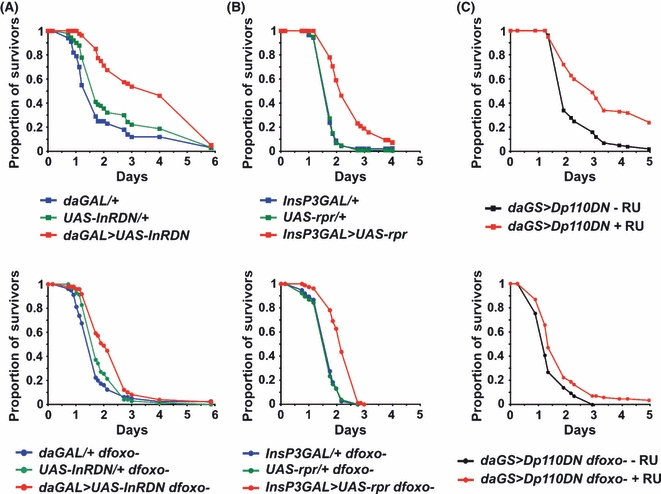
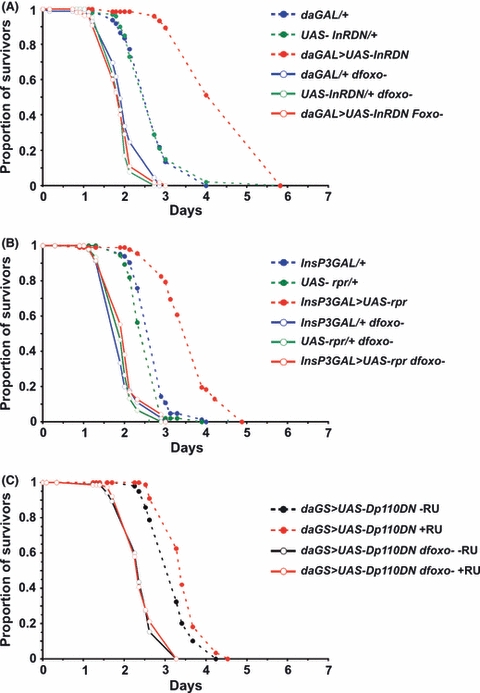
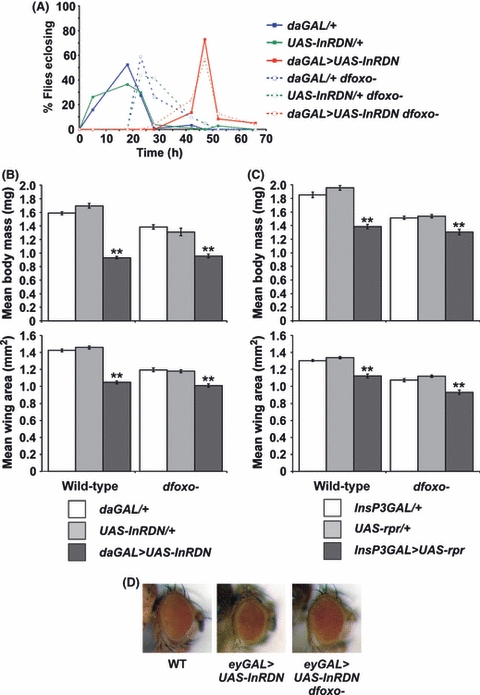
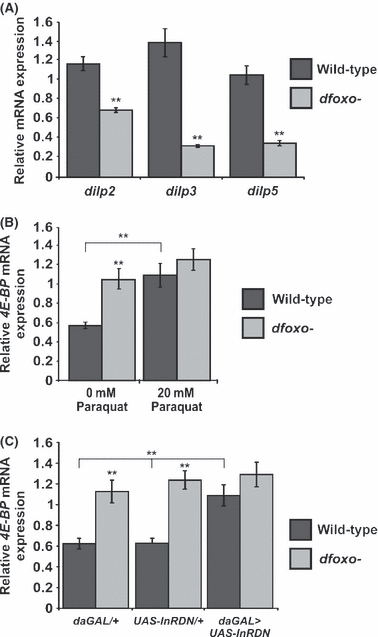
Summary: The insulin/insulin‐like growth factor‐like signaling (IIS) pathway in metazoans has evolutionarily conserved roles in growth control, metabolic homeostasis, stress responses, reproduction, and lifespan. Genetic manipulations that reduce IIS in the nematode worm Caenorhabditis elegans , the fruit fly Drosophila melanogaster , and the mouse have been shown not only to produce substantial increases in lifespan but also to ameliorate several age‐related diseases. In C. elegans , the multitude of phenotypes produced by the reduction in IIS are all suppressed in the absence of the worm FOXO transcription factor, DAF‐16, suggesting that they are all under common regulation. It is not yet clear in other animal models whether the activity of FOXOs mediate all of the physiological effects of reduced IIS, especially increased lifespan. We have addressed this issue by examining the effects of reduced IIS in the absence of dFOXO in Drosophila , using a newly generated null allele of dfoxo . We found that the removal of dFOXO almost completely blocks IIS‐dependent lifespan extension. However, unlike in C. elegans , removal of dFOXO does not suppress the body size, fecundity, or oxidative stress resistance phenotypes of IIS‐compromised flies. In contrast, IIS‐dependent xenobiotic resistance is fully dependent on dFOXO activity. Our results therefore suggest that there is evolutionary divergence in the downstream mechanisms that mediate the effects of IIS. They also imply that in Drosophila , additional factors act alongside dFOXO to produce IIS‐dependent responses in body size, fecundity, and oxidative stress resistance and that these phenotypes are not causal in IIS‐mediated extension of lifespan.
Overview
The claims and statistics of this paper haven’t been checked yet.
Run the check — free, no account needed. It reads the open-access text and checks the sources it cites.
Integrity signals
Registry
Cites
Statistics
Figures
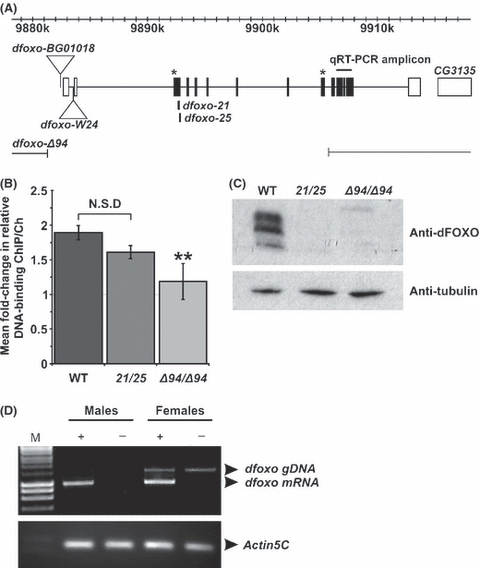
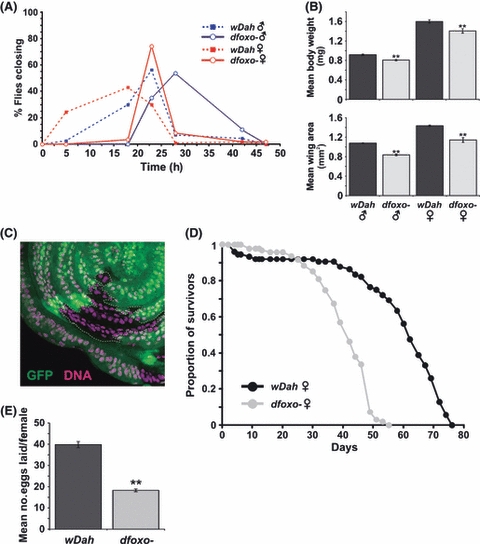
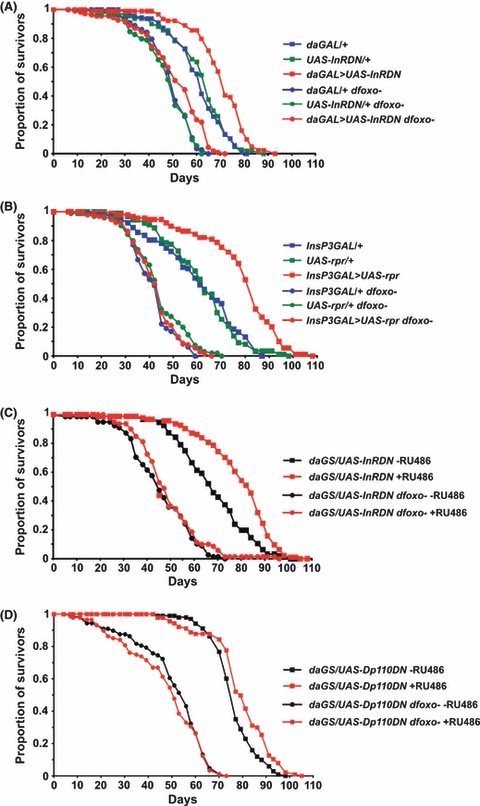
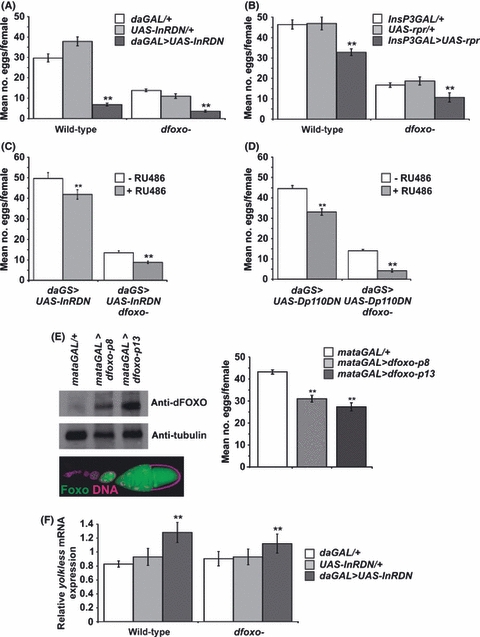
Verification
Claims the paper makes
The claims and statistics of this paper haven’t been checked yet.
Run the check — free, no account needed. It reads the open-access text and checks the sources it cites.
Claims other papers make about this one
Each is checked against this paper’s own text: does it say what the citing paper says it does?
The cited source says what the claim attributes to it.
In the citing paper
“Among the downstream effectors of the IIS pathway, the most relevant one for longevity in worms and flies is the transcription factor FOXO”
From The Hallmarks of Aging (2013) · cites this paper as Slack et al., 2011
Self-check
Percentages, sums and reported differences re-computed from the paper’s own numbers.
The self-check needs the paper’s full text.
Citations
Cites
The plasticity of aging: insights from long-lived mutants
Kenyon, C. (2005) · Cell · doi:10.1016/j.cell.2005.02.002 · Cited by 1,338
Stressing the role of FoxO proteins in lifespan and disease
van der Horst, A., & Burgering, B. M. T. (2007) · Nature Reviews Molecular Cell Biology · doi:10.1038/nrm2190 · Cited by 759
Association of FOXO3A variation with human longevity confirmed in German centenarians
Flachsbart, F., Caliebe, A., Kleindorp, R., Blanché, H., von Eller-Eberstein, H., Nikolaus, S., Schreiber, S., & Nebel, A. (2009) · Proceedings of the National Academy of Sciences · doi:10.1073/pnas.0809594106 · Cited by 572
Selman, C., Lingard, S., Choudhury, A. I., Batterham, R. L., Claret, M., Clements, M., Ramadani, F., Okkenhaug, K., Schuster, E., Blanc, E., et al. (2008) · The FASEB Journal · doi:10.1096/fj.07-9261com · Cited by 532
Self-citationBrain IRS2 Signaling Coordinates Life Span and Nutrient Homeostasis
Taguchi, A., Wartschow, L. M., & White, M. F. (2007) · Science · doi:10.1126/science.1142179 · Cited by 523
Research works printed but not linked: 48
- 10.1093/gerona/62.10.1071 · DOI
- 10.1016/S0092-8674(00)80799-0 · DOI
- 10.1093/gerona/61.6.562 · DOI
- 10.1073/pnas.0405775102 · DOI · Paper page
- 10.1371/journal.pone.0003721 · DOI
- 10.1111/j.1474-9726.2010.00558.x · DOI
- 10.1016/j.cmet.2008.02.012 · DOI · Paper page
- 10.1371/journal.pone.0015171 · DOI
- 10.1126/science.1057991 · DOI
- 10.1126/science.1124646 · DOI · Paper page
- 10.1126/science.1074240 · DOI · Paper page
- 10.1016/j.cub.2006.08.052 · DOI
- 10.1016/j.tibs.2007.02.007 · DOI
- 10.1126/science.1098219 · DOI
- 10.1111/j.1474-9726.2007.00290.x · DOI
- 10.1111/j.1474-9726.2007.00362.x · DOI
- 10.1038/nature08619 · DOI
- 10.1038/sj.onc.1209086 · DOI
- 10.1111/j.1748-1716.2007.01780.x · DOI
- 10.1371/journal.pgen.1000857 · DOI
- 10.1096/fasebj.13.11.1385 · DOI
- 10.1073/pnas.0809144106 · DOI
- 10.1016/j.ydbio.2007.11.006 · DOI
- 10.1038/nature02549 · DOI
- 10.1016/S0960-9822(02)01043-6 · DOI
- 10.1186/1475-4924-2-20 · DOI
- 10.1038/366461a0 · DOI · Paper page
- 10.1038/sj.ejhg.5201766 · DOI
- 10.1126/science.1111410 · DOI
- 10.1073/pnas.90.19.8905 · DOI
- 10.1186/gb-2007-8-7-r132 · DOI
- 10.1111/j.1474-9726.2008.00373.x · DOI
- 10.1038/nature01789 · DOI · Paper page
- 10.1111/j.1474-9726.2008.00420.x · DOI
- 10.1038/ncb1493 · DOI
- 10.1038/onc.2008.28 · DOI
- 10.1101/gad.1098703 · DOI
- 10.1016/j.jinsphys.2004.12.013 · DOI
- 10.1016/j.ceb.2008.02.005 · DOI · Paper page
- 10.1038/msb.2010.54 · DOI
- 10.1371/journal.pgen.1000881 · DOI
- 10.1126/science.1081447 · DOI
- 10.1093/genetics/148.2.703 · DOI
- 10.1016/j.mad.2009.05.004 · DOI
- 10.1534/genetics.104.027748 · DOI
- 10.2741/2047 · DOI
- 10.1111/j.1474-9726.2009.00504.x · DOI
- 10.1073/pnas.0801030105 · DOI · Paper page
Cited by
Sorted by citations
López-Otín, C., Blasco, M. A., Partridge, L., Serrano, M., & Kroemer, G. (2013) · Cell · doi:10.1016/j.cell.2013.05.039 · Cited by 14,982
Self-citationAMPK at the Nexus of Energetics and Aging
Burkewitz, K., Zhang, Y., & Mair, W. B. (2014) · Cell Metabolism · doi:10.1016/j.cmet.2014.03.002 · Cited by 483
Aging Hallmarks: The Benefits of Physical Exercise
Rebelo-Marques, A., De Sousa Lages, A., Andrade, R., Ribeiro, C. F., Mota-Pinto, A., Carrilho, F., & Espregueira-Mendes, J. (2018) · Frontiers in Endocrinology · doi:10.3389/fendo.2018.00258 · Cited by 246
The Ras-Erk-ETS-signaling pathway is a drug target for longevity
Slack, C., Alic, N., Foley, A., Cabecinha, M., Hoddinott, M. P., & Partridge, L. (2015) · Cell · doi:10.1016/j.cell.2015.06.023 · Cited by 224
Self-citationSantos, A. L., Sinha, S., & Lindner, A. B. (2018) · Oxidative Medicine and Cellular Longevity · doi:10.1155/2018/1941285 · Cited by 168
Metadata
- Authors
- Slack, C., Giannakou, M. E., Foley, A., Goss, M., & Partridge, L.
- Venue
- Aging Cell
- Publisher
- Wiley
- Published
- 2011-05-06
- Volume
- 10
- Issue
- 5
- Pages
- 735-748
- ISSN
- 1474-9718
- 1474-9726
- PMC
- PMC3193374
- Cited by
- 204
- References
- 5
- Language
- en
About these checks
Registry, retraction, Cites and statistics results are computed, not judged, with one exception: a printed reference that no index lists is read once by a model before it counts as a citation error. Claims are extracted by a model and kept only when their quote appears verbatim in the text; each cited source is then checked, with a model’s help, for whether it says what the claim relies on. Those verdicts can be wrong — read the claim’s quote and the cited source before relying on one.
Statistics and arithmetic are recomputed, not judged.
Confidence bands are shown only for fields calibrated on our annotated test set. None is calibrated yet, so no band is shown.
What counts as a claim ›How we measure confidence ›How we check this ›
Are you an author, or do you see a problem with this page? Request a review
