

The DOI matches its Crossref record; 61 of the 61 references it cites were found in a registry or an index.
Role of PGC-1α Signaling in Skeletal Muscle Health and Disease
Open accessAbstract
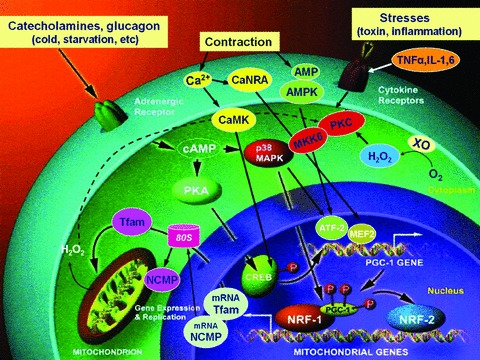
This paper reviews the current understanding of the molecular basis of the peroxisome proliferator-activated receptor-γ coactivator-1α (PGC-1α)-mediated pathway and discusses the role of PGC-1α in skeletal muscle atrophy caused by immobilization. PGC-1α is the master transcription regulator that stimulates mitochondrial biogenesis, by upregulating nuclear respiratory factors (NRF-1, 2) and mitochondrial transcription factor A (Tfam), which leads to increased mitochondrial DNA replication and gene transcription. PGC-1α also regulates cellular oxidant-antioxidant homeostasis by stimulating the gene expression of superoxide dismutase-2 (SOD2), catalase, glutathione peroxidase 1 (GPx1), and uncoupling protein (UCP). Recent reports from muscle-specific PGC-1α overexpression underline the importance of PGC-1α in atrophied skeletal muscle, demonstrate enhancement of the PGC-1α mitochondrial biogenic pathway, and reduced oxidative damage. Thus, PGC-1α appears to play a protective role against atrophy-linked skeletal muscle deterioration.
Overview
The claims and statistics of this paper haven’t been checked yet.
Run the check — free, no account needed. It reads the open-access text and checks the sources it cites.
Integrity signals
Registry
Cites
Statistics
Figures
Verification
Claims the paper makes
The claims and statistics of this paper haven’t been checked yet.
Run the check — free, no account needed. It reads the open-access text and checks the sources it cites.
Claims other papers make about this one
Each is checked against this paper’s own text: does it say what the citing paper says it does?
The source backs part of the claim, not all of it — or backs it for a different population, condition or comparison.
In the citing paper
“Through deacetylation, AMPK upregulates the expression of PGC-1α via the SIRT1 signaling pathway which in turn modulates FoxO transcriptional activity by repressing the expression of key atrogenes such as atrogin-1 and muscle RING-finger protein-1 (MuRF1), thereby preventing proteasome-mediated muscle protein degradation while simultaneously enhancing mitochondrial biogenesis, antioxidant defense,”
From Exercise-Induced Muscle–Fat Crosstalk: Molecular Mediators and Their Pharmacological Modulation for the Maintenance of Metabolic Flexibility in Aging (2025) · cites this paper as [103]
Experimental — accuracy not yet measuredThe cited source says what the claim attributes to it.
In the citing paper
“In addition, PPARGC1A inhibits the expression of multiple pro‐inflammatory mediators, including TNF‐α and IL‐6, and regulates antioxidant defense mechanisms (Kang & Li Ji, 2012), both of which in turn can activate autophagy.”
From Autophagy gene expression in skeletal muscle of older individuals is associated with physical performance, muscle volume and mitochondrial function in the study of muscle, mobility and aging ( SOMMA ) (2024) · cites this paper as Kang & Li Ji, 2012
In the citing paper
“ApN may also induce Ca2+ influx, thereby activating CaMKKβ, which leads to increased expression of peroxisome proliferator-activated receptor γ coactivator-1α (PGC-1α), a key player in mitochondrial function and biogenesis [42,43].”
From Adiponectin and Its Mimics on Skeletal Muscle: Insulin Sensitizers, Fat Burners, Exercise Mimickers, Muscling Pills … or Everything Together? (2020) · cites this paper as [43]
In the citing paper
“Second, activation of PGC-1α enhances the expression of several oxidative-stress detoxification enzymes and molecules involved in fatty-acid oxidation [43,51].”
From Adiponectin and Its Mimics on Skeletal Muscle: Insulin Sensitizers, Fat Burners, Exercise Mimickers, Muscling Pills … or Everything Together? (2020) · cites this paper as [43]
In the citing paper
“Eventually, as mentioned earlier, PGC-1α is also a regulator of cellular oxidant–antioxidant homeostasis by stimulating gene expression of several antioxidant enzymes such as superoxide dismutase-2, catalase, and glutathione peroxidase [43].”
From Adiponectin and Its Mimics on Skeletal Muscle: Insulin Sensitizers, Fat Burners, Exercise Mimickers, Muscling Pills … or Everything Together? (2020) · cites this paper as [43]
Self-check
Percentages, sums and reported differences re-computed from the paper’s own numbers.
The self-check needs the paper’s full text.
Citations
Cites
1 retracted
Wenz, T., Rossi, S. G., Rotundo, R. L., Spiegelman, B. M., & Moraes, C. T. (2009) · Proceedings of the National Academy of Sciences · doi:10.1073/pnas.0911570106 · Cited by 600
RetractedMootha, V. K., Lindgren, C. M., Eriksson, K.-F., Subramanian, A., Sihag, S., Lehar, J., Puigserver, P., Carlsson, E., Ridderstråle, M., Laurila, E., et al. (2003) · Nature Genetics · doi:10.1038/ng1180 · Cited by 10,197
THE NF-κB AND IκB PROTEINS: New Discoveries and Insights
Baldwin, A. S. (1996) · Annual Review of Immunology · doi:10.1146/annurev.immunol.14.1.649 · Cited by 5,882
Inflammation, stress, and diabetes
Wellen, K. E., & Hotamisligil, G. S. (2005) · Journal of Clinical Investigation · doi:10.1172/jci25102 · Cited by 4,143
Wu, Z., Puigserver, P., Andersson, U., Zhang, C., Adelmant, G., Mootha, V., Troy, A., Cinti, S., Lowell, B., Scarpulla, R. C., et al. (1999) · Cell · doi:10.1016/s0092-8674(00)80611-x · Cited by 4,139
A Cold-Inducible Coactivator of Nuclear Receptors Linked to Adaptive Thermogenesis
Puigserver, P., Wu, Z., Park, C. W., Graves, R., Wright, M., & Spiegelman, B. M. (1998) · Cell · doi:10.1016/s0092-8674(00)81410-5 · Cited by 3,864
Transcriptional co-activator PGC-1α drives the formation of slow-twitch muscle fibres
Lin, J., Wu, H., Tarr, P. T., Zhang, C.-Y., Wu, Z., Boss, O., Michael, L. F., Puigserver, P., Isotani, E., Olson, E. N., et al. (2002) · Nature · doi:10.1038/nature00904 · Cited by 2,546
St-Pierre, J., Drori, S., Uldry, M., Silvaggi, J. M., Rhee, J., Jäger, S., Handschin, C., Zheng, K., Lin, J., Yang, W., et al. (2006) · Cell · doi:10.1016/j.cell.2006.09.024 · Cited by 2,233
Metabolic control through the PGC-1 family of transcription coactivators
Lin, J., Handschin, C., & Spiegelman, B. M. (2005) · Cell Metabolism · doi:10.1016/j.cmet.2005.05.004 · Cited by 2,130
Puigserver, P., & Spiegelman, B. M. (2003) · Endocrine Reviews · doi:10.1210/er.2002-0012 · Cited by 2,076
Adaptations of skeletal muscle to endurance exercise and their metabolic consequences
Holloszy, J. O., & Coyle, E. F. (1984) · Journal of Applied Physiology · doi:10.1152/jappl.1984.56.4.831 · Cited by 1,985
Transcriptional paradigms in mammalian mitochondrial biogenesis and function
Scarpulla, R. C. (2008) · Physiological Reviews · doi:10.1152/physrev.00025.2007 · Cited by 1,666
Biochemical Adaptations in Muscle
Holloszy, J. O. (1967) · Journal of Biological Chemistry · doi:10.1016/s0021-9258(18)96046-1 · Cited by 1,517
PGC-1 coactivators: inducible regulators of energy metabolism in health and disease
Finck, B. N. (2006) · Journal of Clinical Investigation · doi:10.1172/jci27794 · Cited by 1,461
Peroxisome proliferator–activated receptor γ coactivator-1 promotes cardiac mitochondrial biogenesis
Lehman, J. J., Barger, P. M., Kovacs, A., Saffitz, J. E., Medeiros, D. M., & Kelly, D. P. (2000) · Journal of Clinical Investigation · doi:10.1172/jci10268 · Cited by 1,285
Transcriptional regulatory circuits controlling mitochondrial biogenesis and function
Kelly, D. P., & Scarpulla, R. C. (2004) · Genes & Development · doi:10.1101/gad.1177604 · Cited by 1,243
The role of exercise and PGC1α in inflammation and chronic disease
Handschin, C., & Spiegelman, B. M. (2008) · Nature · doi:10.1038/nature07206 · Cited by 1,083
Adaptations of skeletal muscle to exercise: rapid increase in the transcriptional coactivator PGC-1
Baar, K., Wende, A. R., Jones, T. E., Marison, M., Nolte, L. A., Chen, M., Kelly, D. P., & Holloszy, J. O. (2002) · The FASEB Journal · doi:10.1096/fj.02-0367com · Cited by 1,020
Sandri, M., Lin, J., Handschin, C., Yang, W., Arany, Z. P., Lecker, S. H., Goldberg, A. L., & Spiegelman, B. M. (2006) · Proceedings of the National Academy of Sciences · doi:10.1073/pnas.0607795103 · Cited by 974
Cytokine Stimulation of Energy Expenditure through p38 MAP Kinase Activation of PPARγ Coactivator-1
Puigserver, P., Rhee, J., Lin, J., Wu, Z., Yoon, J. C., Zhang, C.-Y., Krauss, S., Mootha, V. K., Lowell, B. B., & Spiegelman, B. M. (2001) · Molecular Cell · doi:10.1016/s1097-2765(01)00390-2 · Cited by 732
Kong, X., Wang, R., Xue, Y., Liu, X., Zhang, H., Chen, Y., Fang, F., & Chang, Y. (2010) · PLoS ONE · doi:10.1371/journal.pone.0011707 · Cited by 718
Akimoto, T., Pohnert, S. C., Li, P., Zhang, M., Gumbs, C., Rosenberg, P. B., Williams, R. S., & Yan, Z. (2005) · Journal of Biological Chemistry · doi:10.1074/jbc.m408862200 · Cited by 714
Shi, T., Wang, F., Stieren, E., & Tong, Q. (2005) · Journal of Biological Chemistry · doi:10.1074/jbc.m414670200 · Cited by 712
Schreiber, S., Emter, R., Hock, M. B., Knutti, D., Cardenas, J., Podvinec, M., Oakeley, E. J., & Kralli, A. (2004) · Proceedings of the National Academy of Sciences · doi:10.1073/pnas.0308686101 · Cited by 678
Michael, L. F., Wu, Z., Cheatham, R. B., Puigserver, P., Adelmant, G., Lehman, J. J., Kelly, D. P., & Spiegelman, B. M. (2001) · Proceedings of the National Academy of Sciences · doi:10.1073/pnas.061035098 · Cited by 663
Handschin, C., Chin, S., Li, P., Liu, F., Maratos-Flier, E., LeBrasseur, N. K., Yan, Z., & Spiegelman, B. M. (2007) · Journal of Biological Chemistry · doi:10.1074/jbc.m704817200 · Cited by 611
Cao, W., Daniel, K. W., Robidoux, J., Puigserver, P., Medvedev, A. V., Bai, X., Floering, L. M., Spiegelman, B. M., & Collins, S. (2004) · Molecular and Cellular Biology · doi:10.1128/mcb.24.7.3057-3067.2004 · Cited by 605
PGC-1α regulates the mitochondrial antioxidant defense system in vascular endothelial cells
VALLE, I., ALVAREZBARRIENTOS, A., ARZA, E., LAMAS, S., & MONSALVE, M. (2005) · Cardiovascular Research · doi:10.1016/j.cardiores.2005.01.026 · Cited by 556
St‐Pierre, J., Lin, J. D., Krauss, S., Tarr, P. T., Yang, R., Newgard, C. B., & Spiegelman, B. M. (2003) · Journal of Biological Chemistry · doi:10.1074/jbc.m301850200 · Cited by 554
Intracellular signaling during skeletal muscle atrophy
Kandarian, S. C., & Jackman, R. W. (2005) · Muscle & Nerve · doi:10.1002/mus.20442 · Cited by 405
Russell, L. K., Mansfield, C. M., Lehman, J. J., Kovacs, A., Courtois, M., Saffitz, J. E., Medeiros, D. M., Valencik, M. L., McDonald, J. A., & Kelly, D. P. (2004) · Circulation Research · doi:10.1161/01.res.0000117088.36577.eb · Cited by 402
What do we really know about the ubiquitin-proteasome pathway in muscle atrophy?
Jagoe, R. T., & Goldberg, A. L. (2001) · Current Opinion in Clinical Nutrition and Metabolic Care · doi:10.1097/00075197-200105000-00003 · Cited by 399
Bellizzi, D., Rose, G., Cavalcante, P., Covello, G., Dato, S., De Rango, F., Greco, V., Maggiolini, M., Feraco, E., Mari, V., et al. (2005) · Genomics · doi:10.1016/j.ygeno.2004.11.003 · Cited by 367
PGC-1α regulates the neuromuscular junction program and ameliorates Duchenne muscular dystrophyPreprint
Handschin, C., Kobayashi, Y. M., Chin, S., Seale, P., Campbell, K. P., & Spiegelman, B. M. (2007) · Genes & Development · doi:10.1101/gad.1525107 · Cited by 365
Resistance Exercise Reverses Aging in Human Skeletal Muscle
Melov, S., Tarnopolsky, M. A., Beckman, K. B., Felkey, K., & Hubbard, A. (2007) · PLoS ONE · doi:10.1371/journal.pone.0000465 · Cited by 360
Li, Y.-P., Chen, Y., Li, A. S., & Reid, M. B. (2003) · American Journal of Physiology-Cell Physiology · doi:10.1152/ajpcell.00129.2003 · Cited by 334
Modulation of skeletal muscle antioxidant defense by exercise: Role of redox signaling
Ji, L. L. (2007) · Free Radical Biology and Medicine · doi:10.1016/j.freeradbiomed.2007.02.031 · Cited by 300
PGC-1α and PGC-1Β Regulate Mitochondrial Density in Neurons
Warȩski, P., Vaarmann, A., Choubey, V., Safiulina, D., Liiv, J., Kuum, M., & Kaasik, A. (2009) · Journal of Biological Chemistry · doi:10.1074/jbc.m109.018911 · Cited by 295
PGC-1, a versatile coactivator
Knutti, D., & Kralli, A. (2001) · Trends in Endocrinology and Metabolism · doi:10.1016/s1043-2760(01)00457-x · Cited by 294
The muscle-specific ubiquitin ligase atrogin-1/MAFbx mediates statin-induced muscle toxicity
Hanai, J., Cao, P., Tanksale, P., Imamura, S., Koshimizu, E., Zhao, J., Kishi, S., Yamashita, M., Phillips, P. S., Sukhatme, V. P., et al. (2007) · Journal of Clinical Investigation · doi:10.1172/jci32741 · Cited by 281
Plasticity of skeletal muscle mitochondria: structure and function.
HOPPELER, H., & FL??CK, M. (2003) · Medicine & Science in Sports & Exercise · doi:10.1097/00005768-200301000-00016 · Cited by 267
Geng, T., Li, P., Okutsu, M., Yin, X., Kwek, J., Zhang, M., & Yan, Z. (2010) · American Journal of Physiology-Cell Physiology · doi:10.1152/ajpcell.00481.2009 · Cited by 263
Leick, L., Wojtaszewski, J. F. P., Johansen, S. T., Kiilerich, K., Comes, G., Hellsten, Y., Hidalgo, J., & Pilegaard, H. (2007) · American Journal of Physiology-Endocrinology and Metabolism · doi:10.1152/ajpendo.00666.2007 · Cited by 242
Role of nuclear factor κB in cardiovascular health and disease
der Heiden, K. V., Cuhlmann, S., Luong, L. A., Zakkar, M., & Evans, P. C. (2010) · Clinical Science · doi:10.1042/cs20090557 · Cited by 241
Kang, C., OʼMoore, K. M., Dickman, J. R., & Ji, L. L. (2009) · Free Radical Biology and Medicine · doi:10.1016/j.freeradbiomed.2009.08.007 · Cited by 213
Self-citationKavazis, A. N., Talbert, E. E., Smuder, A. J., Hudson, M. B., Nelson, W. B., & Powers, S. K. (2009) · Free Radical Biology and Medicine · doi:10.1016/j.freeradbiomed.2009.01.002 · Cited by 213
Selsby, J. T., Morine, K., Pendrak, K., Barton, E. R., & Sweeney, H. L. (2012) · PLoS ONE · doi:10.1371/journal.pone.0030063 · Cited by 194
Álvarez-Guardia, D., Palomer, X., Coll, T., Davidson, M. M., Chan, T. O., Feldman, A. M., Laguna, J. C., & Vázquez‐Carrera, M. (2010) · Cardiovascular Research · doi:10.1093/cvr/cvq080 · Cited by 190
Leick, L., Lyngby, S. S., Wojtaszewski, J. F. P., & Pilegaard, H. (2010) · Experimental Gerontology · doi:10.1016/j.exger.2010.01.011 · Cited by 121
Vercauteren, K., Pasko, R. A., Gleyzer, N., Marino, V. M., & Scarpulla, R. C. (2006) · Molecular and Cellular Biology · doi:10.1128/mcb.00585-06 · Cited by 109
Miura, S., Tomitsuka, E., Kamei, Y., Yamazaki, T., Kai, Y., Tamura, M., Kita, K., Nishino, I., & Ezaki, O. (2006) · The American Journal of Pathology · doi:10.2353/ajpath.2006.060034 · Cited by 107
Frailty in the elderly: the physical dimension.
Abate, M., Iorio, A. D., Renzo, D. D., Paganelli, R., Saggini, R., & Abate, G. (2007) · PubMed · Cited by 103
Mitochondrial damage and intralysosomal degradation in cellular aging
Terman, A., Gustafsson, B., & Brunk, U. T. (2006) · Molecular Aspects of Medicine · doi:10.1016/j.mam.2006.08.006 · Cited by 103
Plasticity of skeletal muscle mitochondria: structure and function.
Hoppeler, H. H., & Flück, M. (2003) · PubMed · doi:10.1249/01.mss.0000043292.99104.12 · Cited by 92
PGC-1α and Myokines in the Aging Muscle – A Mini-Review
Arnold, A.-S., Egger, A., & Handschin, C. (2011) · Gerontology · doi:10.1159/000281883 · Cited by 65
Handschin, C. (2010) · Journal of Receptors and Signal Transduction · doi:10.3109/10799891003641074 · Cited by 59
Jänkälä, H., Harjola, V., Petersen, N. E., & Härkönen, M. (1997) · Journal of Applied Physiology · doi:10.1152/jappl.1997.82.3.977 · Cited by 57
PGC-1α and Exercise: Important Partners in Combating Insulin Resistance
Russell, A. (2005) · Current Diabetes Reviews · doi:10.2174/1573399054022811 · Cited by 48
Handschin, C. (2009) · Clinical and Experimental Pharmacology and Physiology · doi:10.1111/j.1440-1681.2009.05275.x · Cited by 39
PGC-1α: a master gene that is hard to master
Lindholm, D., Eriksson, O., Mäkelä, J., Belluardo, N., & Korhonen, L. (2012) · Cellular and Molecular Life Sciences · doi:10.1007/s00018-012-1043-0 · Cited by 31
Kang, C., Chung, E., Diffee, G. M., & Ji, L. L. (2009) · Medicine & Science in Sports & Exercise · doi:10.1249/01.mss.0000353449.06824.c0 · Cited by 4
Self-citation
Research works printed but not linked: 3
- 10.1016/S0092-8674(00)80611-X · DOI · Paper page
- 10.1038/nature00904 · DOI · Paper page
- Kang C., 2012, PGC‐1α enhances skeletal muscle recovery from disuse atrophy, Med. Sci. Sports Exer., 44, S501
Cited by
Sorted by citations
Role of ROS and RNS Sources in Physiological and Pathological Conditions
Meo, S. D., Reed, T. T., Venditti, P., & Víctor, V. M. (2016) · Oxidative Medicine and Cellular Longevity · doi:10.1155/2016/1245049 · Cited by 1,712
Mitochondrial Dysfunction and Oxidative Stress in Alzheimer’s Disease
Misrani, A., Tabassum, S., & Yang, L. (2021) · Frontiers in Aging Neuroscience · doi:10.3389/fnagi.2021.617588 · Cited by 654
PGC-1 α , Inflammation, and Oxidative Stress: An Integrative View in Metabolism
Rius‐Pérez, S., Torres-Cuevas, I., Millán, I., Ortega, Á., & Pérez, S. (2020) · Oxidative Medicine and Cellular Longevity · doi:10.1155/2020/1452696 · Cited by 671
PGC-1α Is a Master Regulator of Mitochondrial Lifecycle and ROS Stress Response
Abu Shelbayeh, O., Arroum, T., Morris, S., & Busch, K. B. (2023) · Antioxidants · doi:10.3390/antiox12051075 · Cited by 552
Mechanisms for fiber-type specificity of skeletal muscle atrophy
Wang, Y., & Pessin, J. E. (2013) · Current Opinion in Clinical Nutrition & Metabolic Care · doi:10.1097/mco.0b013e328360272d · Cited by 432
Metadata
- Authors
- Kang, C., & Li Ji, L.
- Affiliations
- University of Minnesota (US)
- ORCID
- Kang, Chounghun
- Venue
- Annals of the New York Academy of Sciences
- Publisher
- Wiley
- Published
- 2012-10
- Volume
- 1271
- Issue
- 1
- Pages
- 110-117
- ISSN
- 0077-8923 (ISSN-L)
- 1749-6632
- PMC
- PMC3499658
- OpenAlex
- W1524273338
- Cited by
- 291
- References
- 60
- Citations by year
- 2026: 24 · 2025: 32 · 2024: 35 · 2023: 31 · 2022: 20 · 2021: 30 · 2020: 30 · 2019: 17 · 2018: 18 · 2017: 12 · 2016: 9 · 2015: 15 · 2014: 11 · 2013: 7
- FWCI
- 0.96
- Type
- journal article
- Language
- en
- Open access
- bronze
- doi.org
- Locations
- Annals of the New York Academy of Sciences (publishedVersion)
- Europe PMC (PubMed Central) (publishedVersion, cc-by)
- PubMed Central (publishedVersion, cc-by)
- PubMed (publishedVersion)
- Topics
- Life Sciences › Biochemistry, Genetics and Molecular Biology › Molecular Biology › Muscle Physiology and Disorders
- Health Sciences › Medicine › Physiology (medical) › Adipose Tissue and Metabolism
- Life Sciences › Biochemistry, Genetics and Molecular Biology › Molecular Biology › Mitochondrial Function and Pathology
- Keywords
- PGC-1α, skeletal muscle atrophy, immobilization, mitochondrial biogenesis, nuclear respiratory factors, TFAM, oxidative stress, antioxidant enzymes, manganese superoxide dismutase, uncoupling proteins, muscle health
- MeSH terms
- Peroxisome Proliferator-Activated Receptor Gamma Coactivator 1-alpha, Aging, Animals, Heat-Shock Proteins, Humans, Muscular Atrophy, Musculoskeletal Diseases, Oxidoreductases, Transcription Factors, Signal Transduction, Exercise, Gene Expression Regulation, Enzymologic, Muscle, Skeletal, Mitochondrial Turnover
About these checks
Registry, retraction, Cites and statistics results are computed, not judged, with one exception: a printed reference that no index lists is read once by a model before it counts as a citation error. Claims are extracted by a model and kept only when their quote appears verbatim in the text; each cited source is then checked, with a model’s help, for whether it says what the claim relies on. Those verdicts can be wrong — read the claim’s quote and the cited source before relying on one.
Statistics and arithmetic are recomputed, not judged.
Confidence bands are shown only for fields calibrated on our annotated test set. None is calibrated yet, so no band is shown.
What counts as a claim ›How we measure confidence ›How we check this ›
Are you an author, or do you see a problem with this page? Request a review
