

The DOI matches its Crossref record; 62 of the 69 references it cites were found in a registry or an index.
Prevalence of hospital-acquired malnutrition and modifiable determinants of nutritional deterioration during inpatient admissions: a systematic review of the evidence
Open accessAbstract
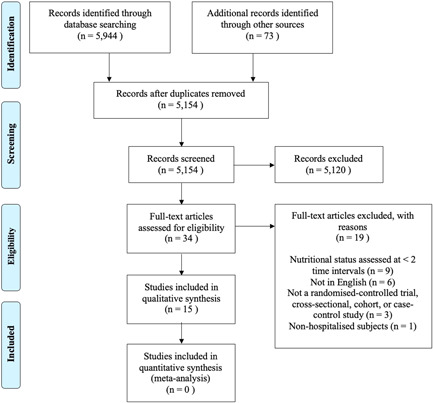
Background: Malnutrition affects between 20% and 50% of hospital inpatients on admission, with further declines expected during hospitalisation. This review summarises the existing literature on hospital‐acquired malnutrition that examines the magnitude of nutritional deterioration amongst adult inpatients and identifies preventable barriers to optimising nutrition support during episodes of care. Methods: A systematic review was conducted to answer the question: Among adult hospital inpatients, the presence of which modifiable factors contribute to hospital‐acquired malnutrition? A database search was conducted between the 24 April and 30 June 2020 using CINAHL, MEDLINE, Scopus and PubMed databases according to a protocol registered with PROSPERO (CD42020182728). In addition, issues of the 10 top clinical nutrition journals published during the period of from 1 April 2015 to 30 March 2020 were hand‐searched. Results: Fifteen articles were eligible for inclusion from a total of 5944 retrieved abstracts. A narrative synthesis of evidence was completed because of the high level of heterogeneity in methodologies. Nutritional deterioration is common among previously well‐nourished and nutritionally compromised patients, with studies reporting that 10%–65% of patients experienced nutritional decline. Frequently reported barriers were mealtime interruptions, meal dissatisfaction, procedure‐related fasting, effects of illness or treatment, chewing difficulties, poor appetite and malnutrition as a low clinical priority. Conclusions: The findings of this review support the need for routine nutritional risk screening throughout each hospital admission with hospital‐acquired malnutrition affecting up to 65% of inpatients. Clear establishment of the roles and responsibilities of each member within multidisciplinary healthcare teams in the provision of nutrition care and cost–benefit analyses are recommended to demonstrate the effectiveness of changes to models of care.
Overview
The claims and statistics of this paper haven’t been checked yet.
Run the check — free, no account needed. It reads the open-access text and checks the sources it cites.
Integrity signals
Registry
Cites
Statistics
Figures
Verification
Claims the paper makes
The claims and statistics of this paper haven’t been checked yet.
Run the check — free, no account needed. It reads the open-access text and checks the sources it cites.
Claims other papers make about this one
Each is checked against this paper’s own text: does it say what the citing paper says it does?
The source backs part of the claim, not all of it — or backs it for a different population, condition or comparison.
In the citing paper
“Malnutrition prevalence estimates range from 20% to 60% for hospitalized patients.”
From Malnutrition and Cachexia in Inpatients With Acute Cardiac Conditions: A Scientific Statement From the American Heart Association (2026) · cites this paper as [8]
Experimental — accuracy not yet measuredThe source backs part of the claim, not all of it — or backs it for a different population, condition or comparison.
In the citing paper
“The malnutrition prevalence estimates ranging from 20% to 60% for hospitalized patients are probably underestimates resulting from limitations in documentation, coding, and diagnostic criteria.8”
From Malnutrition and Cachexia in Inpatients With Acute Cardiac Conditions: A Scientific Statement From the American Heart Association (2026) · cites this paper as [8]
Experimental — accuracy not yet measured
Self-check
Percentages, sums and reported differences re-computed from the paper’s own numbers.
The self-check needs the paper’s full text.
Citations
Cites
Preferred Reporting Items for Systematic Reviews and Meta-Analyses: The PRISMA Statement
Moher, D., Liberati, A., Tetzlaff, J., Altman, D. G., & The PRISMA Group (2009) · PLoS Medicine · doi:10.1371/journal.pmed.1000097 · Cited by 64,042
Incidence and recognition of malnutrition in hospital
McWhirter, J. P., & Pennington, C. R. (1994) · BMJ · doi:10.1136/bmj.308.6934.945 · Cited by 1,504 · cited 3×
“First, in some studies, the researchers were unable to follow‐up with all patients and were subsequently excluded from analyses.(27,34,37,38) This was a result of having been discharged prior to the predetermined follow‐up time intervals or because of death or transfers to other hospitals.”
BackgroundResultTaylor, B. E., McClave, S. A., Martindale, R. G., Warren, M. M., Johnson, D. R., Braunschweig, C., McCarthy, M. S., Davanos, E., Rice, T. W., Cresci, G. A., et al. (2016) · Critical Care Medicine · doi:10.1097/ccm.0000000000001525 · Cited by 1,476 · cited 2×
“This association was weakened by higher levels of healthcare assistant staffing which suggests a potential approach to address such staffing challenges by enabling nursing staff to direct their time to other patient‐related activities.(61) Nurses consistently self‐report that nutrition‐related responsibilities are lik…”
BackgroundResultPrognostic impact of disease-related malnutrition.
Norman, K., Pichard, C., Lochs, H., & Pirlich, M. (2008) · Clinical Nutrition · doi:10.1016/j.clnu.2007.10.007 · Cited by 1,460
White, J. V., Guenter, P., Jensen, G., Malone, A., Schofield, M., Academy Malnutrition Work Group, A.S.P.E.N. Malnutrition Task Force, & and the A.S.P.E.N. Board of Directors (2012) · Journal of Parenteral and Enteral Nutrition · doi:10.1177/0148607112440285 · Cited by 1,284
Hospital Malnutrition: Prevalence, Identification and Impact on Patients and the Healthcare System
Barker, L. A., Gout, B. S., & Crowe, T. C. (2011) · International Journal of Environmental Research and Public Health · doi:10.3390/ijerph8020514 · Cited by 985 · cited 1×
“Hospital malnutrition is a predictor of increased length of stay, impaired wound healing, increased risk of infections and complications, and increased morbidity and mortality.(1,4) Thus, malnourished patients have more substantial care needs with a greater reliance on hospital resources resulting in higher healthcare…”
BackgroundLim, S., Ong, K., Chan, Y., Wai, C.-L.-K., Ferguson, M., & Daniels, L. (2011) · Clinical Nutrition · doi:10.1016/j.clnu.2011.11.001 · Cited by 865
Persistent Risk of Severe Covid-19 in Heart Transplant Recipients: A National Cohort Study
Legeai, C., Abdoul, N., Jasseron, C., Battistella, P., Nubret, K., Kerbaul, F., & Dorent, R. (2023) · The Journal of Heart and Lung Transplantation · doi:10.1016/j.healun.2023.02.427 · Cited by 609
The association between nurse staffing and omissions in nursing care: A systematic review
Griffiths, P., Recio-Saucedo, A., Dall'ora, C., Briggs, J. S., Maruotti, A., Meredith, P., Smith, G. B., & Ball, J. (2018) · Journal of Advanced Nursing · doi:10.1111/jan.13564 · Cited by 545 · cited 1×
“These findings are consistent with earlier research suggesting that patient care suffers during periods of inadequate staffing.(67) This association was weakened by higher levels of healthcare assistant staffing which suggests a potential approach to address such staffing challenges by enabling nursing staff to direct…”
ResultNutritional Risk Screening and Assessment
Reber, E., Gomes, F., Vasiloglou, M. F., Schuetz, P., & Stanga, Z. (2019) · Journal of Clinical Medicine · doi:10.3390/jcm8071065 · Cited by 485
Research works printed but not linked: 12
- 10.1177/0148607113484066 · DOI
- Laur C, 2015, Healthcare, 393
- 10.1016/j.jand.2012.03.012 · DOI
- Independent Hospital Pricing Authority, 2017, Risk adjustment model for hospital acquired complications – Technical specifications, 66
- Kyriakos G, 2013, Prolonged fasting with fluid therapy is related to poorer outcomes in medical patients, Nutr Hosp, 28, 1710
- 10.7326/0003-4819-151-4-200908180-00135 · DOI · Paper page
- National Institute of Clinical Studies, 2009, Levels of evidence and grades for recommendations for developers of guidelines, 24
- 10.1001/archinte.156.4.425 · DOI
- National Institute of Clinical Studies, 2009, Emergency department stroke and transint ischaemic attack care bundle: information and implementation guide, 2
- Centers for Disease Control and Prevention, 2012, Anthropometric reference data for children and adults: United States, 2007‐2010, 15
- 10.1016/j.jand.2017.05.014 · DOI
- 10.1177/0148607115621863 · DOI · Paper page
Cited by
Sorted by citations
Items 101–147 of 147
Jo, S.-Y., Bang, K., & Kim, E. (2026) · Healthcare · doi:10.3390/healthcare14183124
“…inadequate nutritional intake attributable to hospitalization-related factors, including mealtime inter-ruptions, meal dissatisfaction, procedure-related fasting, the effects of illness or treatment, and the low prioritization of malnutrition in clinical practice, has been a contributor [3,4].”
Rushton, A., Roberts, S., Waldmann, J., Payne, T., Morris, N. R., & Bell, J. (2026) · Nutrients · doi:10.3390/nu18172846
“Short hospital lengths of stay, combined with the complexity of medical conditions, treatment side-effects, interruptions to nutrition care, and procedure-related fasting means that nutritional status improvements are unlikely to be achieved during inpatient care alone [13].”
Under‐Identification of Malnutrition Within an Inpatient Hospital Setting
Bailey, J., Baird, J., Dullard, O., Kane, S., Tuck, C., & Desneves, K. (2026) · Journal of human nutrition and dietetics (Print) · doi:10.1111/jhn.70338
The Role and Meaning of Hospital Food for Culturally and Linguistically Diverse Patients
Carter, V., Barrington, V., Ross, B., & Hitch, D. (2026) · Journal of human nutrition and dietetics (Print) · doi:10.1111/jhn.70336
Optimizing mini nutritional assessment as a prognostic tool in oncology: evidence from 50 hospitals.
Carvalho, E. C., Costa-Pereira, J. P., Pinho, N., Mamede, M., & Gonzalez, M. C. (2026) · Nutrition (Burbank, Los Angeles County, Calif.) · doi:10.1016/j.nut.2026.113352
Evaluation of the dietary quality of selected public, university, and private hospital menus
Kılınç, A., & Bıyıklı, A. E. (2026) · Clinical Science of Nutrition · doi:10.62210/clinscinutr.2026.138
van Zanten, A. R. H., Kohout, P., Waele, E. D., & Keller, H. (2026) · Expert Review of Gastroenterology & Hepatology · doi:10.1080/17474124.2026.2703204
Oliveira, E. E., da Silva, G. M. N., & Pinto, J. A. S. (2026) · SAP Health and Policy · doi:10.62486/shp2026346
Edwards, E., Tsang, T. L. M., & Iyer, P. (2026) · Journal of Human Nutrition and Dietetics · doi:10.1111/jhn.70301
Sezer, R. E., Özcan, Z., & Sahillioğlu, D. (2026) · Clinical Science of Nutrition · doi:10.62210/clinscinutr.2026.136
Meredith, S. J., Sheppard, K. A., Calder, P. C., Patel, H. P., & Lim, S. (2026) · Journal of Nutritional Science · doi:10.1017/jns.2026.10108
“(41) 43) Considering the multifactorial influences on patient appetite, participants ’ gap to meeting energy and protein requirements, and the challenges associated with ONS consumption (e.g., dislike of textures and taste of artificial ingredients), our interview findings revealed the importance…”
Aloweni, F. B. A. B., Siow, K. C. E., Gunasegaran, N., Lim, G. H., Ang, S. Y., & Østbye, T. (2026) · International Journal of Nursing Studies Advances · doi:10.1016/j.ijnsa.2026.100589
Krznarić, Ž., Bender, D. V., Kelečić, D. L., Daraboš, N., Radoš, I., & Soldo, A. (2026) · Healthcare · doi:10.3390/healthcare14121673
Cwaliński, J., Bobkiewicz, A., Cwalinska, A., Zasada, W., Cholerzyńska, H., Banasiewicz, T., & Kuczyńska, B. (2026) · Journal of Clinical Medicine · doi:10.3390/jcm15124587
“Research indicates that 10 to 65% of surgical patients either require preoperative nutritional support or are at risk of malnutrition prior to surgery [8–10].”
Palmer, M., Vivanti, A., Hosking, B., Naumann, F., Courtice, S., Henderson, A., Harden, H., Philpot, S., Smyth, A., & Ross, L. (2026) · Healthcare · doi:10.3390/healthcare14121806
“Definitions include patients who were first diagnosed with malnutrition > 14 days after hospital admission [2,3], and any decline in nutritional status during hospital stay [4].”
Coelho, A. K., Pereira, D. S., Corrêa, U. A. C., de Oliveira, L. K. C., Duarte, D. B., Amorim, M., da Silva, S. L. A., & Pereira, L. S. (2026) · Ciência & Saúde Coletiva · doi:10.1590/1413-81232026316.09592024
Landa, E. M. L., Cisneros, M. A., Erazo, G., Pedroza, J., & Nguefang, G. (2026) · Cureus · doi:10.7759/cureus.108191
“In the acute inpatient setting, these individuals are at increased risk for iatrogenic malnutrition due to prolonged NPO status, dysphagia, and communication barriers [17-19].”
Epidemiology and clinical outcomes of malnutrition in hospitalized patients with stroke, 1998-2022.
Tanweer, A., & Marques-Vidal, P. (2026) · Journal of Stroke & Cerebrovascular Diseases · doi:10.1016/j.jstrokecerebrovasdis.2026.108660
Romero-Márquez, J. M., Novo-Rodríguez, C., Hayón-Ponce, M., Novo-Rodríguez, M., Muñoz-Garach, A., Luna-López, V., & Tenorio-Jiménez, C. (2026) · Nutrients · doi:10.3390/nu18081249
“Disease-related malnutrition is highly prevalent among hospitalized patients, with approximately 20–50% presenting nutritional risk or overt malnutrition at admission [1].”
Radin, N., Hince, D., Codde, J., Chivers, P. T., & Edgar, D. (2026) · Health Science Reports · doi:10.1002/hsr2.72210
“Surgical patients are particularly vulnerable to poor nutritional status due to a combination of clinical and social factors [60–62].”
Enteral Feeding Safety: Protecting Patients While Meeting Nutritional Needs
Sanchez, C. E. (2026) · Patient Safety · doi:10.33940/001c.158988
Bozkuş, R., & Balaban-Barta, S. (2026) · Internal medicine journal (Print) · doi:10.1111/imj.70346
Krzych, Ł. J., Kwiatkowska, M., Kisiołek, M., Krupnik, D., Król, B., & Przybyłowski, P. (2025) · Nutrients · doi:10.3390/nu18010071
“In the absence of appropriate treatment, up to two-thirds of those already malnourished experience further deterioration during hospitalization, while about one-third of patients admitted in a normal nutritional state develop malnutrition during their hospital stay [4].”
Verma, S., & Sumana, A. (2025) · Nutrition and Health · doi:10.1177/02601060251399767
Fotsing, F. S., Tazoho, G. M., Yemdje, R., Tachoum, J. R. M., Bossi, D. S. D., Gouado, I., Ngoufack, F. Z., & Womeni, H. (2025) · Health Science Reports · doi:10.1002/hsr2.71664
“…advanced age, the presence of comorbidities such as cardiovascular diseases or diabetes, social isolation or living alone, cultural or traditional dietary habits influencing intake, severe pain, as well as changes related to hospitalization (e.g., vomiting, surgical interventions, fasting) [4 – 6].”
Verma, S., & Araveti, S. (2025) · Precision Nutrition · doi:10.1097/pn9.0000000000000120
Patient Mealtime Experience: Reliability and Validity of a Novel Tool.
Lassemillante, A.-C., Tirlea, L., Furness, K., Keenan, S., Harris, M., Desneves, K., & King, S. (2025) · Journal of human nutrition and dietetics (Print) · doi:10.1111/jhn.70151
Inducible effects of evodiamine on the uptake of glutamine in Caco-2 cells.
Somehara, S., Mizuno, F., Ishida, T., Mizukami, H., & Makino, T. (2025) · Journal of Ethnopharmacology · doi:10.1016/j.jep.2025.120838
Impact of a complex medical dietetic service on adult patient clinical outcomes.
Alcaide, M. L. (2025) · British Journal of Nursing · doi:10.12968/bjon.2025.0045
Nikolakopoulou, K., Chourdakis, M., Androutsos, O., Bahat, G., Pinar, E., Erdoğan, T., Abbasoğlu, O., & Poulia, K. (2025) · Nutrition (Burbank, Los Angeles County, Calif.) · doi:10.1016/j.clnesp.2025.07.884
The Role of Registered Dietitian Nutritionists in Malnutrition Management in Home Care.
Lago, A., & Zamarripa, M. (2025) · Journal of the Academy of Nutrition and Dietetics · doi:10.1016/j.jand.2025.05.019
Gollins, L. A., & Niitzel, R. (2025) · Journal of the Academy of Nutrition and Dietetics · doi:10.1016/j.jand.2025.05.022 · Cited by 1
Influence of an educational intervention for nursing staff on enteral nutritional therapy
Diniz, A. O., Meurer, I. R., dos Reis, V. N., Batista, K. C., Moreira, A. P. B., & da Silva, S. L. A. (2025) · Rev Rene · doi:10.36517/2175-6783.20252695556
A Review on Nutritional Deficiencies for the Inpatient Onco-Dermatologist
Ezzeddine, F. L., Kumar, M., & Guggina, L. M. (2025) · Current Dermatology Reports · doi:10.1007/s13671-025-00473-z
“Risk factors can be broadly categorized into three groups (Table 1): [1] poor intake of essential nutrients [ 2 ], impaired absorption due to medical conditions or treatments, and [ 3 ] metabolic disorders or inborn errors affecting nutrient processing.”
Analysis of Inpatient Nutrition Service Management at Rumah Sakit Islam Karawang
Fitriyastanti, D., Triyuliana, C., Widhiantika, W., Darmawan, W., Kartika, I., Jumaedi, J., Azhari, Y., & Aqidah, A. N. (2025) · Jurnal Kesehatan dan Kedokteran · doi:10.56127/jukeke.v4i2.2758
“Cass et al. (2022) emphasized that hospital-acquired malnutrition remains a major issue in healthcare settings and may be influenced by the quality of nutrition services provided to patients.”
Pires, J. G. P., & Solano-Pérez, L. A. (2025) · Cognizance Journal of Multidisciplinary Studies · doi:10.47760/cognizance.2025.v05i06.005
Yumna, A. H., Ulfa, M., Razalli, N. H., Rajikan, R., Akca, N., & Saygılı, M. (2025) · Jurnal Kesehatan Lingkungan Indonesia · doi:10.14710/jkli.71214
Wang, M., Li, Q.-Q., Wu, J., Xu, M., Yue, J., & Cui, W.-W. (2025) · Asia Pacific Journal of Clinical Nutrition · doi:10.6133/apjcn.202506_34(3).0002
Pre-discharge energy intake and post-discharge mortality in acutely hospitalized older adults
Tajima, T., Nakashima, H., Nagae, M., Komiya, H., Fujisawa, C., Watanabe, K., Yamada, Y., & Umegaki, H. (2025) · Aging Clinical and Experimental Research · doi:10.1007/s40520-025-03076-7
Maya, M. R. P., Aminuddin, A., & Taslim, N. A. (2025) · Nutrición clínica y dietética hospitalaria/Nutrición clínica, dietética hospitalaria · doi:10.12873/451maya
“In some instances of disease-related malnutrition, nutritional support alone may be insufficient to prevent further nutritional decline, even when energy intake matches energy expenditure 3,4 .”
Clinical progress note: Interventions for improving outcomes among hospitalized older adults
Chapman, E. N., & Eastman, A. (2024) · Journal of Hospital Medicine · doi:10.1002/jhm.13490
Disparities and Differential Allocation of Nutritional Therapies
Haines, K. L., Gorenshtein, L., Lumpkin, S., Gallagher, S. F., Udoh, K., Wischmeyer, P. E., & Miller, K. (2024) · Current Surgery Reports · doi:10.1007/s40137-024-00417-9
“This involves not only improving access to adequate nutrition support in both the inpatient and outpatient settings but also systematically removing barriers that hinder equitable provision of nutritional interventions [46].”
Cost of patient and staff diet in Teaching Hospital Karapitiya, Galle
Sabhapathige, R., Anuradha, L., Deerasinghe, D., Ubeysekara, H., Ubeysekara, N., & Kumari, S. (2024) · Sri Lankan Journal of Medical Administration · doi:10.4038/sljma.v24i2.5420
“Malnutrition is a cause of impaired immunity which leads to an increased risk of health-care-associated infections, impaired and delayed wound repair, increased morbidity, increased length of hospital stays, and increased mortality [3] .”
BackgroundPERSEPSI PERAWAT TERHADAP INSTRUMEN SKRINING MST DAN SNST DI RSUD CIDERES
Andayani, R. Y., Zaki, I., & Farida, F. (2023) · Journal of Nutrition College · doi:10.14710/jnc.v12i3.36266
“Secara global sebanyak 20% hingga 50% dari pasien yang masuk rumah sakit mengalami malnutrisi, kondisi ini diperkirakan semakin memburuk selama masa perawatan di rumah sakit.(1,2) Studi di Amerika Serikat menunjukkan 31,7% pasien malnutrisi di rumah sakit.”
BackgroundGueho, V. P., Atmeare, S., Addario, C., Tourscher, M., & Racano, E. (2026) · Nutrition clinique et metabolisme · doi:10.1016/j.nupar.2026.103030
Yamasaki, T., Numata, K., & Okuno, H. (2026) · Physical Therapy Research · doi:10.1298/ptr.26-e00035
Risk Factors Analysis for Nutritional Risk in Patients with Bronchiectasis
Cao, X. (2025) · Advances in Clinical Medicine · doi:10.12677/acm.2025.154957
Metadata
- Authors
- Cass, A. R., & Charlton, K. E.
- Affiliations
- University of Wollongong (AU)
- Corresponding author
- Charlton, Karen E.
- ORCID
- Charlton, Karen E.
- Venue
- Journal of Human Nutrition and Dietetics
- Publisher
- Wiley
- Published
- 2022-04-26
- Volume
- 35
- Issue
- 6
- Pages
- 1043-1058
- ISSN
- 0952-3871 (ISSN-L)
- 1365-277X
- PMC
- PMC9790482
- OpenAlex
- W4224979341
- Cited by
- 177
- References
- 69
- Citations by year
- 2026: 40 · 2025: 70 · 2024: 38 · 2023: 21 · 2022: 8
- FWCI
- 4.71
- Type
- journal article
- Language
- en
- Open access
- hybrid
- doi.org
- Licence
- Locations
- Journal of Human Nutrition and Dietetics (publishedVersion, cc-by)
- PubMed Central (publishedVersion, cc-by)
- PubMed (publishedVersion)
- Research Online (University of Wollongong) (submittedVersion)
- Funders
- University of Wollongong
- Topics
- Health Sciences › Medicine › Physiology (medical) › Nutrition and Health in Aging
- Health Sciences › Nursing › Nutrition and Dietetics › Clinical Nutrition and Gastroenterology
- Health Sciences › Nursing › Nutrition and Dietetics › Dietetics, Nutrition, and Education
- Keywords
- hospital-acquired malnutrition, nutritional deterioration, inpatient nutrition, nutritional risk screening, modifiable risk factors, chewing difficulty, appetite loss
- MeSH terms
- Adult, Hospitalization, Hospitals, Humans, Inpatients, Nutritional Status, Nutrition Assessment, Prevalence, Malnutrition
About these checks
Registry, retraction, Cites and statistics results are computed, not judged, with one exception: a printed reference that no index lists is read once by a model before it counts as a citation error. Claims are extracted by a model and kept only when their quote appears verbatim in the text; each cited source is then checked, with a model’s help, for whether it says what the claim relies on. Those verdicts can be wrong — read the claim’s quote and the cited source before relying on one.
Statistics and arithmetic are recomputed, not judged.
Confidence bands are shown only for fields calibrated on our annotated test set. None is calibrated yet, so no band is shown.
What counts as a claim ›How we measure confidence ›How we check this ›
Are you an author, or do you see a problem with this page? Request a review
