

Climate models predict increasing temperature variability in poor countries
Open accessThe DOI matches its Crossref record; 56 of the 56 references it cites were found in a registry or an index.
Abstract
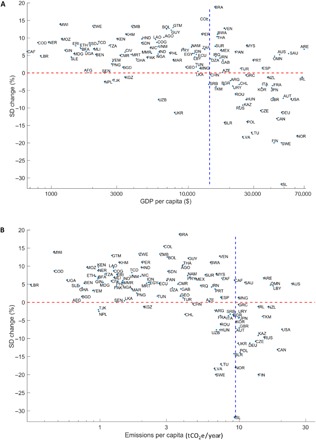
Temperature variability will increase in poor countries and decrease in rich countries, creating a new climate injustice.
Overview
The claims and statistics of this paper haven’t been checked yet.
Free: it reads the open-access text and checks the first 5 claims that cite a source we can check. Create a free account to check every claim.
Integrity signals
Registry
Cites
Statistics
Figures
Verification
Claims the paper makes
The claims and statistics of this paper haven’t been checked yet.
Free: it reads the open-access text and checks the first 5 claims that cite a source we can check. Create a free account to check every claim.
Claims other papers make about this one
Each is checked against this paper’s own text: does it say what the citing paper says it does?
The cited source says what the claim attributes to it.
In the citing paper
“This is clearly seen in poor countries, which are more vulnerable to weather and climate fluctuation than wealthier countries (95).”
From The Impact of Climate Change on Mental Health: A Systematic Descriptive Review (2020) · cites this paper as [95]
Self-check
Percentages, sums and reported differences re-computed from the paper’s own numbers.
The self-check needs the paper’s full text.
Citations
Cites
The ERA‐Interim reanalysis: configuration and performance of the data assimilation system
Dee, D. P., Uppala, S. M., Simmons, A. J., Berrisford, P., Poli, P., Kobayashi, S., Andrae, U., Balmaseda, M. A., Balsamo, G., Bauer, P., et al. (2011) · Quarterly Journal of the Royal Meteorological Society · doi:10.1002/qj.828 · Cited by 24,480
An Overview of CMIP5 and the Experiment Design
Taylor, K. E., Stouffer, R. J., & Meehl, G. A. (2012) · Bulletin of the American Meteorological Society · doi:10.1175/bams-d-11-00094.1 · Cited by 14,052
The Modern-Era Retrospective Analysis for Research and Applications, Version 2 (MERRA-2)
Gelaro, R., McCarty, W., Suárez, M. J., Todling, R., Molod, A., Takacs, L., Randles, C. A., Darmenov, A., Bosilovich, M. G., Reichle, R., et al. (2017) · Journal of Climate · doi:10.1175/jcli-d-16-0758.1 · Cited by 9,010
NCEP–DOE AMIP-II reanalysis (R-2)
Kanamitsu, M., Ebisuzaki, W., Woollen, J., Yang, S.-K., Hnilo, J. J., Fiorino, M., & Potter, G. L. (2002) · Bulletin of the American Meteorological Society · doi:10.1175/bams-83-11-1631 · Cited by 5,771
Investigating soil moisture–climate interactions in a changing climate: A review
Seneviratne, S. I., Corti, T., Davin, E. L., Hirschi, M., Jaeger, E. B., Lehner, I., Orlowsky, B., & Teuling, A. J. (2010) · Earth-Science Reviews · doi:10.1016/j.earscirev.2010.02.004 · Cited by 5,638
Climate Extremes: Observations, Modeling, and Impacts
Easterling, D. R., Meehl, G. A., Parmesan, C., Changnon, S. A., Karl, T. R., & Mearns, L. O. (2000) · Science · doi:10.1126/science.289.5487.2068 · Cited by 4,867
Tipping elements in the Earth’s climate system
Lenton, T. M., Held, H., Kriegler, E., Hall, J. W., Lucht, W., Rahmstorf, S., & Schellnhuber, H. J. (2008) · Proceedings of the National Academy of Sciences · doi:10.1073/pnas.0705414105 · Cited by 3,982
Self-citationThe RCP greenhouse gas concentrations and their extensions from 1765 to 2300
Meinshausen, M., Smith, S. J., Calvin, K., Daniel, J. S., Kainuma, M. L. T., Lamarque, J.-F., Matsumoto, K., Montzka, S. A., Raper, S. C. B., Riahi, K., et al. (2011) · Climatic Change · doi:10.1007/s10584-011-0156-z · Cited by 3,584
The Twentieth Century Reanalysis Project
Compo, G. P., Whitaker, J. S., Sardeshmukh, P. D., Matsui, N., Allan, R. J., Yin, X., Gleason, B. E., Vose, R. S., Rutledge, G., Bessemoulin, P., et al. (2011) · Quarterly Journal of the Royal Meteorological Society · doi:10.1002/qj.776 · Cited by 3,518
Global surface temperature change
Hansen, J., Ruedy, R., Sato, M., & Lo, K. (2010) · Reviews of Geophysics · doi:10.1029/2010rg000345 · Cited by 3,081
Research works printed but not linked: 1
- 10.1175/1520-0442(2002)015 · doi:10.1175/1520-0442(2002)015
Cited by
Weather and Climate Extreme Events in a Changing Climate
(2023) · Climate Change 2021 – The Physical Science Basis · doi:10.1017/9781009157896.013 · Cited by 1,784
The Impact of Climate Change on Mental Health: A Systematic Descriptive Review
Cianconi, P., Betrò, S., & Janiri, L. (2020) · Frontiers in Psychiatry · doi:10.3389/fpsyt.2020.00074 · Cited by 1,320
“This loss is linked to a decrease on economic growth leading to a long-term economic disadvantage and promoting political instability and conflicts (95).”
BackgroundProgress and Expectation of Atmospheric Water Harvesting
Tu, Y., Wang, R., Zhang, Y., & Wang, J. (2018) · Joule · doi:10.1016/j.joule.2018.07.015 · Cited by 762
Climate change and the need for agricultural adaptation
Anderson, R., Bayer, P. E., & Edwards, D. (2020) · Current Opinion in Plant Biology · doi:10.1016/j.pbi.2019.12.006 · Cited by 543
Towards food supply chain resilience to environmental shocks
Davis, K. F., Downs, S., & Gephart, J. A. (2020) · Nature Food · doi:10.1038/s43016-020-00196-3 · Cited by 501
Metadata
- Authors
- Bathiany, S., Dakos, V., Scheffer, M., & Lenton, T. M.
- Affiliations
- Wageningen University & Research (NL)
- Centre National de la Recherche Scientifique (FR)
- University of Exeter (GB)
- Corresponding author
- Bathiany, Sebastian
- Venue
- Science Advances
- Published
- 2018-05-04
- Volume
- 4
- Issue
- 5
- Pages
- eaar5809-eaar5809
- ISSN
- 2375-2548 (ISSN-L)
- PMC
- PMC5931768
- OpenAlex
- W2799499225
- Cited by
- 479
- References
- 56
- Citations by year
- 2026: 26 · 2025: 64 · 2024: 72 · 2023: 64 · 2022: 80 · 2021: 63 · 2020: 55 · 2019: 44 · 2018: 11
- FWCI
- 25.35
- Type
- journal article
- Language
- en
- Open access
- gold
- doi.org
- Licence
- cc-by-nc
- Locations
- Science Advances (publishedVersion, cc-by-nc)
- Europe PMC (PubMed Central) (publishedVersion, cc-by-nc)
- PubMed Central (publishedVersion, cc-by-nc)
- PubMed (publishedVersion)
- Socio-Environmental Systems Modeling (acceptedVersion, cc-by-nc)
- HAL (submittedVersion, cc-by-nc)
- Figshare (submittedVersion, cc-by-nc)
- Open Research Exeter (University of Exeter) (submittedVersion, cc-by-nc)
- Data Archiving and Networked Services (DANS) (submittedVersion, cc-by-nc)
- Funders
- Netherlands Organisation for Scientific Research (Zwaartekracht project NESSC)
- Topics
- Physical Sciences › Environmental Science › Global and Planetary Change › Climate variability and models
- Physical Sciences › Environmental Science › Global and Planetary Change › Climate Change and Environmental Impact
- Life Sciences › Agricultural and Biological Sciences › Agronomy and Crop Science › Climate change impacts on agriculture
- Keywords
- temperature variability, climate change projections, climate models, developing countries, climate inequality, Sahel, India, Southeast Asia, soil drying, atmospheric structure, meridional temperature gradient, sea ice decline, extreme weather events, climate change vulnerability
About these checks
Registry, retraction, Cites and statistics results are computed, not judged, with one exception: a printed reference that no index lists is read once by a model before it counts as a citation error. Claims are extracted by a model and kept only when their quote appears verbatim in the text; each cited source is then checked, with a model’s help, for whether it says what the claim relies on. Those verdicts can be wrong — read the claim’s quote and the cited source before relying on one.
Statistics and arithmetic are recomputed, not judged.
Confidence bands are shown only for fields calibrated on our annotated test set. None is calibrated yet, so no band is shown.
What counts as a claim ›How we measure confidence ›How we check this ›
Are you an author, or do you see a problem with this page? Request a review
How to cite
Cite CoChat for the checks on this page, and the paper for its own findings.
- This page
- CoChat. (2026). Citation check: Climate models predict increasing temperature variability in poor countries. https://app.cochat.ai/papers/10.1126/sciadv.aar5809
- The paper
- Bathiany, S., Dakos, V., Scheffer, M., & Lenton, T. M. (2018). Climate models predict increasing temperature variability in poor countries. Science Advances. https://doi.org/10.1126/sciadv.aar5809
Data sources
Bibliographic data: Semantic Scholar, OpenAlex, Crossref.
Contains information from the Semantic Scholar Academic Graph Datasets, made available under the ODC Attribution License (ODC-BY 1.0).
Semantic Scholar’s data is described in: Kinney, R., et al. (2023). The Semantic Scholar Open Data Platform. arXiv:2301.10140.
