

The DOI matches its Crossref record; 33 of the 45 references it cites were found in a registry or an index.
STEM faculty who believe ability is fixed have larger racial achievement gaps and inspire less student motivation in their classes
Open accessAbstract
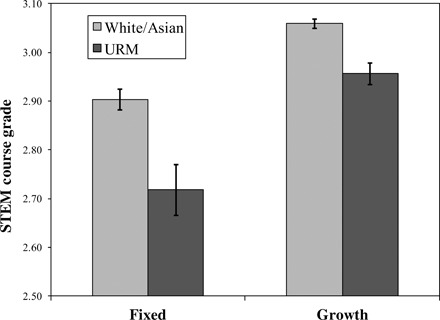
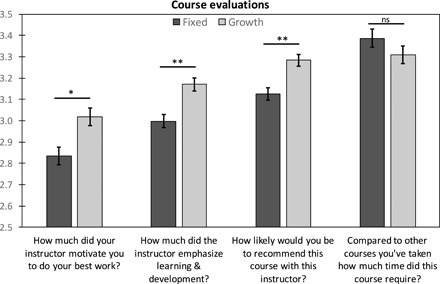
Racial achievement gaps are twice as large, and all students are less motivated, when STEM faculty believe ability is fixed.
Overview
The claims and statistics of this paper haven’t been checked yet.
Run the check — free, no account needed. It reads the open-access text and checks the sources it cites.
Integrity signals
Registry
Cites
Statistics
Figures
Verification
Claims the paper makes
The claims and statistics of this paper haven’t been checked yet.
Run the check — free, no account needed. It reads the open-access text and checks the sources it cites.
Claims other papers make about this one
Each is checked against this paper’s own text: does it say what the citing paper says it does?
The source backs part of the claim, not all of it — or backs it for a different population, condition or comparison.
In the citing paper
“we caution that change will be most beneficial if faculty and administrators believe that underrepresented students are capable of being successful (44) and make a strong commitment to quality in teaching.”
From Active learning narrows achievement gaps for underrepresented students in undergraduate science, technology, engineering, and math (2020) · cites this paper as [44]
Experimental — accuracy not yet measuredThe cited source says what the claim attributes to it.
In the citing paper
“larger gaps are correlated with faculty who have a fixed mindset, which interprets intelligence as innate and immutable and is therefore exclusion or selection-oriented (44).”
From Active learning narrows achievement gaps for underrepresented students in undergraduate science, technology, engineering, and math (2020) · cites this paper as [44]
Self-check
Percentages, sums and reported differences re-computed from the paper’s own numbers.
The self-check needs the paper’s full text.
Citations
Cites
Fitting Linear Mixed-Effects Models Using lme4
Bates, D., Mächler, M., Bolker, B., & Walker, S. (2015) · Journal of Statistical Software · doi:10.18637/jss.v067.i01 · Cited by 86,835
lmerTest Package: Tests in Linear Mixed Effects Models
Kuznetsova, A., Brockhoff, P. B., & Christensen, R. H. B. (2017) · Journal of Statistical Software · doi:10.18637/jss.v082.i13 · Cited by 24,346
Hierarchical Linear Models: Applications and Data Analysis Methods.
Longford, N. T., Bryk, A. S., & Raudenbush, S. W. (1993) · Contemporary Sociology A Journal of Reviews · doi:10.2307/2075823 · Cited by 18,773 · cited 2×
“A multilevel regression model accounted for the nested nature of the data (students nested within courses, nested within faculty) and controlled for confounding factors such as students’ previous achievement (SAT scores) and all available course and faculty characteristics (17).”
Stereotype threat and the intellectual test performance of African Americans.
Steele, C. M., & Aronson, J. (1995) · Journal of Personality and Social Psychology · doi:10.1037/0022-3514.69.5.797 · Cited by 9,020
Rosenthal, R., & Jacobson, L. (1968) · The Urban Review · doi:10.1007/bf02322211 · Cited by 3,878
Stereotype Threat and Women's Math Performance
Spencer, S. J., Steele, C. M., & Quinn, D. M. (1999) · Journal of Experimental Social Psychology · doi:10.1006/jesp.1998.1373 · Cited by 3,435
Yeager, D. S., & Dweck, C. S. (2012) · Educational Psychologist · doi:10.1080/00461520.2012.722805 · Cited by 2,334
Pygmalion in the Classroom: Teacher Expectation and Pupils' Intellectual Development
Brookover, W., Rosenthal, R., & Jacobson, L. (1968) · American Sociological Review · doi:10.2307/2092211 · Cited by 2,200 · cited 1×
“Classic findings regarding the influence of teacher beliefs on students’ performance demonstrate that when teachers have lower expectations for their students, those students become less motivated and perform more poorly in those teachers’ classes (10).”
Expectations of brilliance underlie gender distributions across academic disciplines
Leslie, S.-J., Cimpian, A., Meyer, M., & Freeland, E. (2015) · Science · doi:10.1126/science.1261375 · Cited by 1,516
Mind-sets matter: A meta-analytic review of implicit theories and self-regulation.
Burnette, J. L., O'Boyle, E. H., VanEpps, E. M., Pollack, J. M., & Finkel, E. J. (2013) · Psychological Bulletin · doi:10.1037/a0029531 · Cited by 1,367
Ceci, S. J., Ginther, D. K., Kahn, S., & Williams, W. M. (2014) · Gothic.net · doi:10.1177/1529100614541236 · Cited by 1,116
Signaling Threat: How Situational Cues Affect Women in Math, Science, and Engineering Settings
Murphy, M. C., Steele, C. M., & Gross, J. J. (2007) · Psychological Science · doi:10.1111/j.1467-9280.2007.01995.x · Cited by 1,048
Self-citationMolden, D. C., & Dweck, C. S. (2006) · American Psychologist · doi:10.1037/0003-066x.61.3.192 · Cited by 861
Rattan, A., Good, C., & Dweck, C. S. (2011) · Journal of Experimental Social Psychology · doi:10.1016/j.jesp.2011.12.012 · Cited by 720 · cited 4×
“Fixed mindset professors are more likely to judge a student as having low ability based on a single test performance (9) and to use unhelpful pedagogical practices, like encouraging students to drop difficult courses (e.”
InfluentialEffect size measures for multilevel models: definition, interpretation, and TIMSS example
Lorah, J. (2018) · Large-scale Assessments in Education · doi:10.1186/s40536-018-0061-2 · Cited by 650 · cited 1×
“All variables were standardized so that coefficients from the multilevel model can be interpreted as effect sizes ( 18 ).”
Teacher expectations, classroom context, and the achievement gap
McKown, C., & Weinstein, R. S. (2007) · Journal of School Psychology · doi:10.1016/j.jsp.2007.05.001 · Cited by 624 · cited 1×
“These Pygmalion effects are even stronger for URM students (11, 12).”
Miller, D. I., Nolla, K. M., Eagly, A. H., & Uttal, D. H. (2018) · Child Development · doi:10.1111/cdev.13039 · Cited by 576
Jussim, L., Eccles, J., & Madon, S. (1996) · Advances in Experimental Social Psychology · doi:10.1016/s0065-2601(08)60240-3 · Cited by 555 · cited 1×
“These Pygmalion effects are even stronger for URM students (11, 12).”
Stereotype threat and executive resource depletion: Examining the influence of emotion regulation.
Johns, M., Inzlicht, M., & Schmader, T. (2008) · Journal of Experimental Psychology General · doi:10.1037/a0013834 · Cited by 533
Teaching a lay theory before college narrows achievement gaps at scale
Yeager, D. S., Walton, G. M., Brady, S. T., Akcinar, E. N., Paunesku, D., Keane, L., Kamentz, D., Ritter, G., Duckworth, A. L., Urstein, R., et al. (2016) · Proceedings of the National Academy of Sciences · doi:10.1073/pnas.1524360113 · Cited by 507
Marx, D. M., & Goff, P. A. (2005) · British Journal of Social Psychology · doi:10.1348/014466604x17948 · Cited by 245 · cited 2×
“Classic studies that document stereotype threat underperformance effects typically manipulate threatening (versus nonthreatening) situational cues in the learning environment, such as an experimenter’s race/ ethnicity/gender, and assess students’ intellectual performance as the primary indicator of stereotype threat (…”
Messages about brilliance undermine women's interest in educational and professional opportunities
Bian, L., Leslie, S., Murphy, M. C., & Cimpian, A. (2018) · Journal of Experimental Social Psychology · doi:10.1016/j.jesp.2017.11.006 · Cited by 201
Self-citationThe “Obama Effect”: How a salient role model reduces race-based performance differences
Marx, D. M., Ko, S. J., & Friedman, R. (2009) · Journal of Experimental Social Psychology · doi:10.1016/j.jesp.2009.03.012 · Cited by 194
The Differential Effects of Solo Status on Members of High- and Low-Status Groups
Sekaquaptewa, D., & Thompson, M. (2002) · Personality and Social Psychology Bulletin · doi:10.1177/0146167202288013 · Cited by 190 · cited 1×
“Classic studies that document stereotype threat underperformance effects typically manipulate threatening (versus nonthreatening) situational cues in the learning environment, such as an experimenter’s race/ ethnicity/gender, and assess students’ intellectual performance as the primary indicator of stereotype threat (…”
Park, D., Gunderson, E. A., Tsukayama, E., Levine, S. C., & Beilock, S. L. (2016) · Journal of Educational Psychology · doi:10.1037/edu0000064 · Cited by 185 · cited 1×
“2 of 7 teacher beliefs have only been examined among young children (16) and have not been applied in undergraduate populations, where career decisions and trajectories are more salient.”
Stereotype Threat Undermines Academic Learning
Taylor, V. J., & Walton, G. M. (2011) · Personality and Social Psychology Bulletin · doi:10.1177/0146167211406506 · Cited by 184
My Fair Physicist? Feminine Math and Science Role Models Demotivate Young Girls
Betz, D. E., & Sekaquaptewa, D. (2012) · Social Psychological and Personality Science · doi:10.1177/1948550612440735 · Cited by 184 · cited 1×
“Classic studies that document stereotype threat underperformance effects typically manipulate threatening (versus nonthreatening) situational cues in the learning environment, such as an experimenter’s race/ ethnicity/gender, and assess students’ intellectual performance as the primary indicator of stereotype threat (…”
The role of situational cues in signaling and maintaining stereotype threat.
Murphy, M., & Taylor, V. J. (2012) · Oxford University Press eBooks · doi:10.1093/acprof:oso/9780199732449.003.0002 · Cited by 153
Self-citationRattan, A., Savani, K., Komarraju, M., Morrison, M. M., Boggs, C. L., & Ambady, N. (2018) · Journal of Personality and Social Psychology · doi:10.1037/pspi0000130 · Cited by 150 · cited 1×
“Previous research has examined students’ perceptions of faculty beliefs (15), yet no study, to our knowledge, has examined actual self-reported mindset beliefs of STEM faculty as a predictor of student performance.”
A Company I Can Trust? Organizational Lay Theories Moderate Stereotype Threat for Women
Emerson, K. T. U., & Murphy, M. C. (2015) · Personality and Social Psychology Bulletin · doi:10.1177/0146167214564969 · Cited by 107
Self-citationLayne, I. (2022) · The Israeli Peace Movement · doi:10.1787/g2171554e-en · Cited by 106
Targets as perceivers: How people determine when they will be negatively stereotyped.
Wout, D. A., Shih, M. J., Jackson, J. S., & Sellers, R. M. (2009) · Journal of Personality and Social Psychology · doi:10.1037/a0012880 · Cited by 90
A recipe for change: Creating a more inclusive academy
Mitchneck, B., Smith, J. L., & Latimer, M. (2016) · Science · doi:10.1126/science.aad8493 · Cited by 53
Research works printed but not linked: 3
- C. S. Dweck Self-theories: Their Role in Motivation Personality and Development (Psychology Press 1999).
- D. M. Bates Lme4: Mixed-Effects Modeling With R (Springer 2010).
- D. M. Steele B. Cohn-Vargas Identity Safe Classrooms: Places to Belong and Learn (Corwin Press ed. 1 2013).
Cited by
Sorted by citations
Theobald, E. J., Hill, M. J., Tran, E., Agrawal, S., Arroyo, E. N., Behling, S., Chambwe, N., Cintrón, D. L., Cooper, J. D., Dunster, G., et al. (2020) · Proceedings of the National Academy of Sciences · doi:10.1073/pnas.1916903117 · Cited by 1,387
Mindsets: A View From Two Eras
Dweck, C. S., & Yeager, D. S. (2019) · Perspectives on Psychological Science · doi:10.1177/1745691618804166 · Cited by 1,259
What can be learned from growth mindset controversies?
Yeager, D. S., & Dweck, C. S. (2020) · American Psychologist · doi:10.1037/amp0000794 · Cited by 868
“As the field begins to tackle this challenge, it will not have to start from scratch but can build on recent studies documenting the role of teachers’ mindsets and mindsetrelated practices in student achievement (e.g. Canning et al. 2019).”
BackgroundTeacher Mindsets Help Explain Where a Growth-Mindset Intervention Does and Doesn’t Work
Yeager, D. S., Carroll, J. M., Buontempo, J., Cimpian, A., Woody, S., Crosnoe, R. L., Muller, C. L., Murray, J. S., Mhatre, P. C., Kersting, N. B., et al. (2021) · Psychological Science · doi:10.1177/09567976211028984 · Cited by 425
“) In the pilot study, we found that teachers’ mindsets in fact predicted their endorsement of practices expected to follow from teachers’ mindsets on the basis of theory and past research (Canning et al., 2019; Haimovitz & Dweck, 2017; Leslie et al., 2015; Muenks et al., 2020).”
BackgroundResultInfluentialSelf-citationMuenks, K., Canning, E. A., LaCosse, J., Green, D. J., Zirkel, S., Garcia, J. A., & Murphy, M. (2020) · Journal of experimental psychology. General · doi:10.1037/xge0000763 · Cited by 212
Self-citation
Metadata
- Authors
- Canning, E. A., Muenks, K., Green, D. J., & Murphy, M. C.
- Affiliations
- Indiana University Bloomington (US)
- Corresponding author
- Canning, Elizabeth A.
- Murphy, Mary C.
- Venue
- Science Advances
- Published
- 2019-02
- Volume
- 5
- Issue
- 2
- Pages
- eaau4734-eaau4734
- ISSN
- 2375-2548 (ISSN-L)
- PMC
- PMC6377274
- OpenAlex
- W2913734454
- Cited by
- 550
- References
- 45
- Citations by year
- 2026: 54 · 2025: 62 · 2024: 99 · 2023: 87 · 2022: 88 · 2021: 61 · 2020: 71 · 2019: 27
- FWCI
- 72.82
- Type
- journal article
- Language
- en
- Open access
- gold
- doi.org
- Licence
- cc-by-nc
- Locations
- Science Advances (publishedVersion, cc-by-nc)
- Europe PMC (PubMed Central) (publishedVersion, cc-by-nc)
- PubMed Central (publishedVersion, cc-by-nc)
- PubMed (publishedVersion)
- IUScholarWorks Open (Indiana University) (submittedVersion)
- Funders
- National Science Foundation (DRL-1450755, HRD-1661004)
- Topics
- Social Sciences › Psychology › Developmental and Educational Psychology › Education, Achievement, and Giftedness
- Social Sciences › Psychology › Applied Psychology › Career Development and Diversity
- Social Sciences › Sociology and Political Science › Critical Race Theory in Education
- Keywords
- fixed mindset, growth mindset, faculty beliefs, racial achievement gap, underrepresented minority students, student motivation, STEM education, course evaluation, academic performance
About these checks
Registry, retraction, Cites and statistics results are computed, not judged, with one exception: a printed reference that no index lists is read once by a model before it counts as a citation error. Claims are extracted by a model and kept only when their quote appears verbatim in the text; each cited source is then checked, with a model’s help, for whether it says what the claim relies on. Those verdicts can be wrong — read the claim’s quote and the cited source before relying on one.
Statistics and arithmetic are recomputed, not judged.
Confidence bands are shown only for fields calibrated on our annotated test set. None is calibrated yet, so no band is shown.
What counts as a claim ›How we measure confidence ›How we check this ›
Are you an author, or do you see a problem with this page? Request a review
