

The DOI matches its Crossref record; 30 of the 30 references it cites were found in a registry or an index; 3 of the 23 sources its claims cite were checked for support.
Neutralization of SARS-CoV-2 Omicron by BNT162b2 mRNA vaccine–elicited human sera
Open accessPublished version of a preprint
Abstract
The globally circulating severe acute respiratory syndrome coronavirus 2 (SARS-CoV-2) variant of concern Omicron (B.1.1.529) has a large number of mutations, especially in the spike protein, indicating that recognition by neutralizing antibodies may be compromised. We tested Wuhan (Wuhan-Hu-1 reference strain), Beta (B.1.351), Delta (B.1.617.2), or Omicron pseudoviruses with sera of 51 participants who received two or three doses of the messenger RNA (mRNA)–based COVID-19 vaccine BNT162b2. After two doses, Omicron-neutralizing titers were reduced >22-fold compared with Wuhan-neutralizing titers. One month after the third vaccine dose, Omicron-neutralizing titers were increased 23-fold relative to their levels after two doses and were similar to levels of Wuhan-neutralizing titers after two doses. The requirement of a third vaccine dose to effectively neutralize Omicron was confirmed with sera from a subset of participants using live SARS-CoV-2. These data suggest that three doses of the mRNA vaccine BNT162b2 may protect against Omicron-mediated COVID-19.
Overview
AI snapshot
Written from the paper’s full text.
TL;DR
Two doses of BNT162b2 elicited substantially reduced neutralizing activity against SARS-CoV-2 Omicron, while a third dose boosted Omicron-neutralizing titers to levels comparable to Wuhan-neutralizing titers after two doses in the pseudovirus assay. The data suggest that three BNT162b2 doses may protect against Omicron-mediated COVID-19.
Key findings
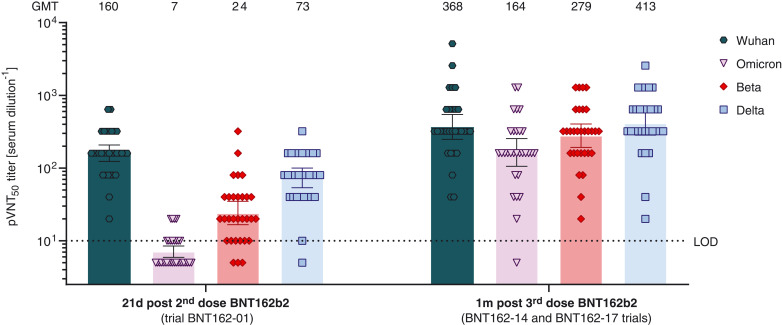
- After two BNT162b2 doses, Omicron pseudovirus-neutralizing GMTs were 7 versus 160 for Wuhan, a 22.8-fold reduction; 20 of 32 sera had no detectable Omicron neutralization. Beta and Delta GMTs were 24 and 73, corresponding to 6.7- and 2.2-fold reductions versus Wuhan.
- One month after a third dose, Omicron pseudovirus-neutralizing GMTs rose to 164, a 23.4-fold increase over post-dose-two levels and similar to Wuhan GMTs after two doses (160); 29 of 30 sera neutralized Omicron. Beta, Delta, and Wuhan GMTs after dose three were 279, 413, and 368.
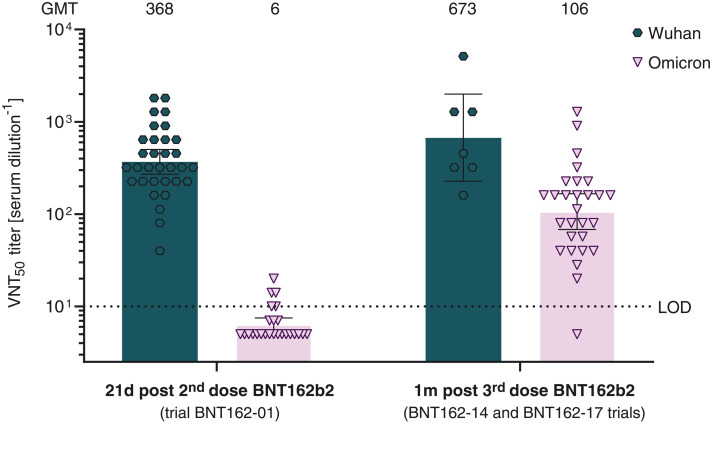
- In live SARS-CoV-2 assays, two doses gave Omicron GMTs of 6 versus 368 for Wuhan, a 61.3-fold reduction, with 17 of 25 sera showing no detectable Omicron neutralization. After a third dose, Omicron GMTs increased 17.6-fold to 106 and remained 3.4-fold lower than Wuhan GMTs after two doses; 27 of 28 sera neutralized live Omicron.
- Among 244 HLA class I–restricted Wuhan S epitopes from IEDB, 85.3% (208) were unaffected at the amino acid sequence level in Omicron.
Methods
- Pseudovirus-neutralization tests used VSV-SARS-CoV-2-S pseudoviruses bearing Wuhan, Omicron, Beta, or Delta S proteins with sera from 32 BNT162-01 participants 21 days after dose two and 30 BNT162-14/BNT162-17 participants 1 month after dose three; 11 participants were analyzed longitudinally.
- Live SARS-CoV-2 neutralization tests used Wuhan and Omicron virus with sera from 32 and 25 participants after dose two, respectively, and 7 and 28 participants after dose three, respectively. Specimens were tested in duplicate and geometric mean 50% neutralizing titers were calculated.
- T cell analysis assessed 244 HLA class I–restricted S epitopes reported in IEDB for conservation in Omicron.
Limitations
- The paper states that serum panels came from different clinical trials with limited sample size, and the interval between second and third doses was not consistent across participants.
- The paper states that future analyses are needed to evaluate antibody persistence, and notes that a longer interval (>42 days) between first and second doses may improve immunogenicity but was not evaluated here.
- Evident from the text: the study reports neutralization titers, not clinical efficacy; live Omicron testing used smaller subsets than pseudovirus testing; and durability beyond 1 month after the third dose was not assessed.
Model-written summary. Check it against the paper before relying on it.
Integrity signals
Registry
Cites
Statistics
Figures
Verification
Claims the paper makes
17 Own result · 12 Not checked yet · 8 Own interpretation · 3 Own method · 1 Partly supported · accuracy not yet measured
A result the paper reports from its own data — it cites no other source for it, so there is none to check. The quote shows it is in the paper.
In the paper
“and were reduced 3.4-fold compared with those against the Wuhan reference at 21 days after two doses of BNT162b2 (GMT of 106 versus 368).”
§ Neutralization of SARS-CoV-2 Omicron by BNT162b2 mRNA vaccine–elicited human sera > Abstract
plaindirectn = 28- Asserted: passes — The authors put it forward as true.
- Checkable: passes — It can be checked against evidence.
- Load-bearing: passes — The paper’s conclusions depend on it.
- Based: passes — The paper gives a reason why it holds.
- Rests on an assumption: Sera from different clinical trials are comparable for neutralizing antibody analysis.
A result the paper reports from its own data — it cites no other source for it, so there is none to check. The quote shows it is in the paper.
In the paper
“Twenty-nine of 30 serum specimens were capable of neutralizing the Omicron pseudovirus (table S3).”
§ Neutralization of SARS-CoV-2 Omicron by BNT162b2 mRNA vaccine–elicited human sera > Abstract
plainn = 30- Asserted: passes — The authors put it forward as true.
- Checkable: passes — It can be checked against evidence.
- Load-bearing: passes — The paper’s conclusions depend on it.
- Based: passes — The paper gives a reason why it holds.
A result the paper reports from its own data — it cites no other source for it, so there is none to check. The quote shows it is in the paper.
In the paper
“After two doses of BNT162b2, geometric mean neutralization titers (GMTs) against Omicron pseudovirus were reduced 22.8-fold compared with those for the Wuhan reference pseudovirus (Fig. 1; GMT of 7 versus 160).”
§ Neutralization of SARS-CoV-2 Omicron by BNT162b2 mRNA vaccine–elicited human sera > Abstract
plaindirectn = 32- Asserted: passes — The authors put it forward as true.
- Checkable: passes — It can be checked against evidence.
- Load-bearing: passes — The paper’s conclusions depend on it.
- Based: passes — The paper gives a reason why it holds.
A result the paper reports from its own data — it cites no other source for it, so there is none to check. The quote shows it is in the paper.
In the paper
“One month after the third BNT162b2 dose, neutralizing GMTs against the Omicron variant pseudovirus increased 23.4-fold relative to their levels 21 days after the second dose (GMT of 164 versus 7)”
§ Neutralization of SARS-CoV-2 Omicron by BNT162b2 mRNA vaccine–elicited human sera > Abstract
plaindirectn = 30- Asserted: passes — The authors put it forward as true.
- Checkable: passes — It can be checked against evidence.
- Load-bearing: passes — The paper’s conclusions depend on it.
- Based: passes — The paper gives a reason why it holds.
A result the paper reports from its own data — it cites no other source for it, so there is none to check. The quote shows it is in the paper.
In the paper
“Twenty of 32 immune serum specimens displayed no detectable neutralizing activity against Omicron (table S2).”
§ Neutralization of SARS-CoV-2 Omicron by BNT162b2 mRNA vaccine–elicited human sera > Abstract
plainn = 32- Asserted: passes — The authors put it forward as true.
- Checkable: passes — It can be checked against evidence.
- Load-bearing: passes — The paper’s conclusions depend on it.
- Based: passes — The paper gives a reason why it holds.
A result the paper reports from its own data — it cites no other source for it, so there is none to check. The quote shows it is in the paper.
In the paper
“Neutralizing GMTs against live SARS-CoV-2 Omicron were reduced 61.3-fold relative to those against the Wuhan reference strain (Fig. 2; GMT of 6 versus 368) at 21 days after two doses of BNT162b2.”
§ Neutralization of SARS-CoV-2 Omicron by BNT162b2 mRNA vaccine–elicited human sera > Abstract
plaindirectn = 25- Asserted: passes — The authors put it forward as true.
- Checkable: passes — It can be checked against evidence.
- Load-bearing: passes — The paper’s conclusions depend on it.
- Based: passes — The paper gives a reason why it holds.
A result the paper reports from its own data — it cites no other source for it, so there is none to check. The quote shows it is in the paper.
In the paper
“Twenty-one days after dose two, sera exhibited a 21.4-fold reduction in GMT against the Omicron variant compared with the Wuhan reference pseudovirus (fig. S1; GMT of 7 versus 150).”
§ Neutralization of SARS-CoV-2 Omicron by BNT162b2 mRNA vaccine–elicited human sera > Abstract
plaindirectn = 11- Asserted: passes — The authors put it forward as true.
- Checkable: passes — It can be checked against evidence.
- Load-bearing: passes — The paper’s conclusions depend on it.
- Based: passes — The paper gives a reason why it holds.
A result the paper reports from its own data — it cites no other source for it, so there is none to check. The quote shows it is in the paper.
In the paper
“One month after the third BNT162b2 dose, neutralizing GMTs against Omicron were increased 17.6-fold compared with neutralizing GMTs at 21 days after the second dose (GMT of 106 versus 6)”
§ Neutralization of SARS-CoV-2 Omicron by BNT162b2 mRNA vaccine–elicited human sera > Abstract
plaindirectn = 28- Asserted: passes — The authors put it forward as true.
- Checkable: passes — It can be checked against evidence.
- Load-bearing: passes — The paper’s conclusions depend on it.
- Based: passes — The paper gives a reason why it holds.
A result the paper reports from its own data — it cites no other source for it, so there is none to check. The quote shows it is in the paper.
In the paper
“Seventeen of 25 serum specimens displayed no detectable neutralizing activity against Omicron (table S4).”
§ Neutralization of SARS-CoV-2 Omicron by BNT162b2 mRNA vaccine–elicited human sera > Abstract
plainn = 25- Asserted: passes — The authors put it forward as true.
- Checkable: passes — It can be checked against evidence.
- Load-bearing: passes — The paper’s conclusions depend on it.
- Based: passes — The paper gives a reason why it holds.
A result the paper reports from its own data — it cites no other source for it, so there is none to check. The quote shows it is in the paper.
In the paper
“and were comparable to neutralizing GMTs against the reference Wuhan pseudovirus at 21 days after two doses of BNT162b2 (GMT of 164 versus 160).”
§ Neutralization of SARS-CoV-2 Omicron by BNT162b2 mRNA vaccine–elicited human sera > Abstract
plainn = 30- Asserted: passes — The authors put it forward as true.
- Checkable: passes — It can be checked against evidence.
- Load-bearing: passes — The paper’s conclusions depend on it.
- Based: passes — The paper gives a reason why it holds.
- Rests on an assumption: Sera from different clinical trials are comparable for neutralizing antibody analysis.
- It may state two separate claims as one. 9
- Probably not a substantial claim. 7
The cited sources support only part of this claim — read each source’s verdict below.
In the paper
“and to elicit strong antibody responses, effectively neutralizing the parental strain as well as diverse SARS-CoV-2 VOCs (13–15).”
§ Neutralization of SARS-CoV-2 Omicron by BNT162b2 mRNA vaccine–elicited human sera > Abstract
What the sources say
- Partly supportedcites [13] A. Muik, A.-K. Wallisch, B. Sänger, K. A. Swanson, J. Mühl, W. Chen, H. Cai, D. Maurus, R. Sarkar, Ö. Türeci, P. R. Dormitzer, U. Şahin, Neutralization of SARS-CoV-2 lineage B.1.1.7 pseudovirus by BNT162b2 vaccine-elicited human sera. Science 371, 1152– 1153 (2021). 10.1126/science.abg6105 33514629 PMC7971771 sourceExperimental — accuracy not yet measured
The paper’s neutralization results (indexed under Abstract; page not provided) show that sera from BNT162b2 recipients neutralized pseudoviruses bearing the Wuhan reference spike and the B.1.1.7 spike. It does not establish effective neutralization of diverse variants of concern: B.1.1.7 was the only full variant spike tested, and its neutralization titers were slightly lower than those for the reference spike. (LLM, conf=0.88)
- Supportedcites [14] J. Liu, Y. Liu, H. Xia, J. Zou, S. C. Weaver, K. A. Swanson, H. Cai, M. Cutler, D. Cooper, A. Muik, K. U. Jansen, U. Sahin, X. Xie, P. R. Dormitzer, P.-Y. Shi, BNT162b2-elicited neutralization of B.1.617 and other SARS-CoV-2 variants. Nature 596, 273– 275 (2021). 10.1038/s41586-021-03693-y 34111888 source
The Article (p. 2) reports that sera from BNT162b2-vaccinated volunteers neutralized the wild-type virus and every tested variant, and describes the neutralization as efficient. It also notes reduced titres against B.1.617.1, so the claim should not be read as saying responses were equally strong against every variant. (LLM, conf=0.91)
- Supportedcites [15] Y. Liu, J. Liu, H. Xia, X. Zhang, C. R. Fontes-Garfias, K. A. Swanson, H. Cai, R. Sarkar, W. Chen, M. Cutler, D. Cooper, S. C. Weaver, A. Muik, U. Sahin, K. U. Jansen, X. Xie, P. R. Dormitzer, P.-Y. Shi, Neutralizing Activity of BNT162b2-Elicited Serum. N. Engl. J. Med. 384, 1466– 1468 (2021). 10.1056/NEJMc2102017 33684280 PMC7944950 source
In “Neutralizing Activity of BNT162b2-Elicited Serum,” all 20 post-vaccination serum samples efficiently neutralized the early USA-WA1/2020 strain and viruses engineered with spikes from three variants. Neutralization of B.1.351-spike virus was robust, though lower than for the early strain. (LLM, conf=0.93)
boosteddirect- Asserted: passes — The authors put it forward as true.
- Checkable: passes — It can be checked against evidence.
- Load-bearing: passes — The paper’s conclusions depend on it.
- Based: passes — The paper gives a reason why it holds.
It may state two separate claims as one.
- Partly supported
A result the paper reports from its own data — it cites no other source for it, so there is none to check. The quote shows it is in the paper.
In the paper
“By contrast, the majority of sera neutralized Beta and Delta pseudoviruses with GMTs of 24 and 73, respectively. This corresponds to 6.7- and 2.2-fold reductions in neutralization activity compared with the Wuhan pseudovirus”
§ Neutralization of SARS-CoV-2 Omicron by BNT162b2 mRNA vaccine–elicited human sera > Abstract
plaindirectn = 32- Asserted: passes — The authors put it forward as true.
- Checkable: passes — It can be checked against evidence.
- Load-bearing: passes — The paper’s conclusions depend on it.
- Based: passes — The paper gives a reason why it holds.
It may state two separate claims as one.
A result the paper reports from its own data — it cites no other source for it, so there is none to check. The quote shows it is in the paper.
In the paper
“the third dose of BNT162b2 resulted in a significant increase in neutralizing titers against the Wuhan pseudovirus (GMT of 320) and a 25.8-fold increase in neutralizing titers against Omicron 1 month after dose three compared with 21 days after dose two (GMT of 181 versus 7).”
§ Neutralization of SARS-CoV-2 Omicron by BNT162b2 mRNA vaccine–elicited human sera > Abstract
plaindirectn = 11- Asserted: passes — The authors put it forward as true.
- Checkable: passes — It can be checked against evidence.
- Load-bearing: passes — The paper’s conclusions depend on it.
- Based: passes — The paper gives a reason why it holds.
It may state two separate claims as one.
A result the paper reports from its own data — it cites no other source for it, so there is none to check. The quote shows it is in the paper.
In the paper
“Before receiving the third dose of BNT162b2 (at a median 256 days after dose two), neutralizing titers against the Wuhan pseudovirus were considerably reduced (GMT of 13), whereas the Omicron-specific titers were below the limit of detection.”
§ Neutralization of SARS-CoV-2 Omicron by BNT162b2 mRNA vaccine–elicited human sera > Abstract
plainn = 11- Asserted: passes — The authors put it forward as true.
- Checkable: passes — It can be checked against evidence.
- Load-bearing: passes — The paper’s conclusions depend on it.
- Based: passes — The paper gives a reason why it holds.
It may state two separate claims as one.
A result the paper reports from its own data — it cites no other source for it, so there is none to check. The quote shows it is in the paper.
In the paper
“The third dose of BNT162b2 also increased neutralizing activity against Beta, Delta, and Wuhan pseudoviruses, with GMTs of 279, 413, and 368, respectively.”
§ Neutralization of SARS-CoV-2 Omicron by BNT162b2 mRNA vaccine–elicited human sera > Abstract
plaindirect- Asserted: passes — The authors put it forward as true.
- Checkable: passes — It can be checked against evidence.
- Load-bearing: unclear — It is unclear whether the paper’s conclusions depend on it.
- Based: passes — The paper gives a reason why it holds.
It may state two separate claims as one.
None of the sources cited for this claim have been checked yet.
In the paper
“both being immunodominant targets of neutralizing antibodies elicited by COVID-19 vaccines or by SARS-CoV-2 infection (5, 6).”
§ Neutralization of SARS-CoV-2 Omicron by BNT162b2 mRNA vaccine–elicited human sera > Abstract
What the sources say
- Not checked yetcites [5] L. Premkumar, B. Segovia-Chumbez, R. Jadi, D. R. Martinez, R. Raut, A. Markmann, C. Cornaby, L. Bartelt, S. Weiss, Y. Park, C. E. Edwards, E. Weimer, E. M. Scherer, N. Rouphael, S. Edupuganti, D. Weiskopf, L. V. Tse, Y. J. Hou, D. Margolis, A. Sette, M. H. Collins, J. Schmitz, R. S. Baric, A. M. de Silva, The receptor binding domain of the viral spike protein is an immunodominant and highly specific target of antibodies in SARS-CoV-2 patients. Sci. Immunol. 5, eabc8413 (2020). 10.1126/sciimmunol.abc8413 32527802 PMC7292505 source
- Not checked yetcites [6] W. T. Harvey, A. M. Carabelli, B. Jackson, R. K. Gupta, E. C. Thomson, E. M. Harrison, C. Ludden, R. Reeve, A. Rambaut, S. J. Peacock, D. L. Robertson; COVID-19 Genomics UK (COG-UK) Consortium, SARS-CoV-2 variants, spike mutations and immune escape. Nat. Rev. Microbiol. 19, 409– 424 (2021). 10.1038/s41579-021-00573-0 34075212 PMC8167834 source
plaindirect- Asserted: passes — The authors put it forward as true.
- Checkable: passes — It can be checked against evidence.
- Load-bearing: passes — The paper’s conclusions depend on it.
- Based: passes — The paper gives a reason why it holds.
Probably not a substantial claim.
In the paper
“Administration of two 30-μg doses of BNT162b2 was shown to have 95% efficacy in a phase 3 trial (12)”
§ Neutralization of SARS-CoV-2 Omicron by BNT162b2 mRNA vaccine–elicited human sera > Abstract
What the sources say
- Not checked yetcites [12] F. P. Polack, S. J. Thomas, N. Kitchin, J. Absalon, A. Gurtman, S. Lockhart, J. L. Perez, G. Pérez Marc, E. D. Moreira, C. Zerbini, R. Bailey, K. A. Swanson, S. Roychoudhury, K. Koury, P. Li, W. V. Kalina, D. Cooper, R. W. Frenck Jr., L. L. Hammitt, Ö. Türeci, H. Nell, A. Schaefer, S. Ünal, D. B. Tresnan, S. Mather, P. R. Dormitzer, U. Şahin, K. U. Jansen, W. C. Gruber; C4591001 Clinical Trial Group, Safety and Efficacy of the BNT162b2 mRNA Covid-19 Vaccine. N. Engl. J. Med. 383, 2603– 2615 (2020). 10.1056/NEJMoa2034577 33301246 PMC7745181 source
plaindirect- Asserted: passes — The authors put it forward as true.
- Checkable: passes — It can be checked against evidence.
- Load-bearing: fails — The paper’s conclusions may not depend on it.
- Based: passes — The paper gives a reason why it holds.
Probably not a substantial claim. The paper’s conclusions may not depend on it.
In the paper
“Fifteen mutations are located in the receptor binding domain and another eight mutated sites are found in the N-terminal domain”
§ Neutralization of SARS-CoV-2 Omicron by BNT162b2 mRNA vaccine–elicited human sera > Abstract
What the sources say
- Not checked yetcites [4] WHO Headquarters, WHO Health Emergencies Programme, “Enhancing Readiness for Omicron (B.1.1.529): Technical Brief and Priority Actions for Member States” (2021); www.who.int/publications/m/item/enhancing-readiness-for-omicron-(b.1.1.529)-technical-brief-and-priority-actions-for-member-states.
plain- Asserted: passes — The authors put it forward as true.
- Checkable: passes — It can be checked against evidence.
- Load-bearing: passes — The paper’s conclusions depend on it.
- Based: passes — The paper gives a reason why it holds.
It may state two separate claims as one.
None of the sources cited for this claim have been checked yet.
In the paper
“Some amino acid changes [Δ69/70, T95I, G142D, Δ145, K417N, T478K, N501Y, and P681H (T, Thr; I, Ile; G, Gly; D, Asp; K, Lys; N, Asn; Y, Tyr; P, Pro; H, His)] are shared mutations also found in the Alpha, Beta (B.1.351), Gamma (P.1), or Delta VOCs and were described to lead to increased transmissibility, as well as to a typically mild partial escape from vaccine-induced humoral immunity (7–10).”
§ Neutralization of SARS-CoV-2 Omicron by BNT162b2 mRNA vaccine–elicited human sera > Abstract
What the sources say
- Not checked yetcites [7] P. Wang, M. S. Nair, L. Liu, S. Iketani, Y. Luo, Y. Guo, M. Wang, J. Yu, B. Zhang, P. D. Kwong, B. S. Graham, J. R. Mascola, J. Y. Chang, M. T. Yin, M. Sobieszczyk, C. A. Kyratsous, L. Shapiro, Z. Sheng, Y. Huang, D. D. Ho, Antibody resistance of SARS-CoV-2 variants B.1.351 and B.1.1.7. Nature 593, 130– 135 (2021). 10.1038/s41586-021-03398-2 33684923 source
- Not checked yetcites [8] D. Planas, D. Veyer, A. Baidaliuk, I. Staropoli, F. Guivel-Benhassine, M. M. Rajah, C. Planchais, F. Porrot, N. Robillard, J. Puech, M. Prot, F. Gallais, P. Gantner, A. Velay, J. Le Guen, N. Kassis-Chikhani, D. Edriss, L. Belec, A. Seve, L. Courtellemont, H. Péré, L. Hocqueloux, S. Fafi-Kremer, T. Prazuck, H. Mouquet, T. Bruel, E. Simon-Lorière, F. A. Rey, O. Schwartz, Reduced sensitivity of SARS-CoV-2 variant Delta to antibody neutralization. Nature 596, 276– 280 (2021). 10.1038/s41586-021-03777-9 34237773 source
- Not checked yetcites [9] Q. Wang, M. S. Nair, S. Anang, S. Zhang, H. Nguyen, Y. Huang, L. Liu, D. D. Ho, J. G. Sodroski, Functional differences among the spike glycoproteins of multiple emerging severe acute respiratory syndrome coronavirus 2 variants of concern. iScience 24, 103393 (2021). 10.1016/j.isci.2021.103393 34746689 PMC8559451 source
- Not checked yetcites [10] A. J. Greaney, T. N. Starr, P. Gilchuk, S. J. Zost, E. Binshtein, A. N. Loes, S. K. Hilton, J. Huddleston, R. Eguia, K. H. D. Crawford, A. S. Dingens, R. S. Nargi, R. E. Sutton, N. Suryadevara, P. W. Rothlauf, Z. Liu, S. P. J. Whelan, R. H. Carnahan, J. E. Crowe Jr., J. D. Bloom, Complete Mapping of Mutations to the SARS-CoV-2 Spike Receptor-Binding Domain that Escape Antibody Recognition. Cell Host Microbe 29, 44– 57.e9 (2021). 10.1016/j.chom.2020.11.007 33259788 PMC7676316 source
plaindirect- Asserted: passes — The authors put it forward as true.
- Checkable: passes — It can be checked against evidence.
- Load-bearing: unclear — It is unclear whether the paper’s conclusions depend on it.
- Based: passes — The paper gives a reason why it holds.
It may state two separate claims as one.
In the paper
“Omicron is a highly divergent variant and harbors a previously unseen number of mutations in its spike (S) glycoprotein (4).”
§ Neutralization of SARS-CoV-2 Omicron by BNT162b2 mRNA vaccine–elicited human sera > Abstract
What the sources say
- Not checked yetcites [4] WHO Headquarters, WHO Health Emergencies Programme, “Enhancing Readiness for Omicron (B.1.1.529): Technical Brief and Priority Actions for Member States” (2021); www.who.int/publications/m/item/enhancing-readiness-for-omicron-(b.1.1.529)-technical-brief-and-priority-actions-for-member-states.
plain- Asserted: passes — The authors put it forward as true.
- Checkable: passes — It can be checked against evidence.
- Load-bearing: passes — The paper’s conclusions depend on it.
- Based: passes — The paper gives a reason why it holds.
It may state two separate claims as one.
None of the sources cited for this claim have been checked yet.
In the paper
“Beta [as a benchmark for partially reduced neutralization (7) without major impact on effectiveness (19, 20)]”
§ Neutralization of SARS-CoV-2 Omicron by BNT162b2 mRNA vaccine–elicited human sera > Abstract
What the sources say
- Not checked yetcites [7] P. Wang, M. S. Nair, L. Liu, S. Iketani, Y. Luo, Y. Guo, M. Wang, J. Yu, B. Zhang, P. D. Kwong, B. S. Graham, J. R. Mascola, J. Y. Chang, M. T. Yin, M. Sobieszczyk, C. A. Kyratsous, L. Shapiro, Z. Sheng, Y. Huang, D. D. Ho, Antibody resistance of SARS-CoV-2 variants B.1.351 and B.1.1.7. Nature 593, 130– 135 (2021). 10.1038/s41586-021-03398-2 33684923 source
- Not checked yetcites [19] L. J. Abu-Raddad, H. Chemaitelly, A. A. Butt; National Study Group for COVID-19 Vaccination, Effectiveness of the BNT162b2 Covid-19 Vaccine against the B.1.1.7 and B.1.351 Variants. N. Engl. J. Med. 385, 187– 189 (2021). 10.1056/NEJMc2104974 33951357 PMC8117967 source
- Not checked yetcites [20] O. Mor, N. S. Zuckerman, I. Hazan, R. Fluss, N. Ash, N. Ginish, E. Mendelson, S. Alroy-Preis, L. Freedman, A. Huppert, BNT162b2 vaccine effectiveness was marginally affected by the SARS-CoV-2 beta variant in fully vaccinated individuals. J. Clin. Epidemiol. 142, 38– 44 (2022). 10.1016/j.jclinepi.2021.10.011 34715314 PMC8553421 source
plain- Asserted: passes — The authors put it forward as true.
- Checkable: passes — It can be checked against evidence.
- Load-bearing: fails — The paper’s conclusions may not depend on it.
- Based: passes — The paper gives a reason why it holds.
Probably not a substantial claim. The paper’s conclusions may not depend on it. It may state two separate claims as one.
What the paper did — it cites no source for this, so there is none to check. The quote shows it is in the paper.
In the paper
“In the analysis presented here, we have evaluated and compared serum panels from different clinical trials with a limited sample size.”
§ Neutralization of SARS-CoV-2 Omicron by BNT162b2 mRNA vaccine–elicited human sera > Abstract
plain- Asserted: passes — The authors put it forward as true.
- Checkable: passes — It can be checked against evidence.
- Load-bearing: fails — The paper’s conclusions may not depend on it.
- Based: passes — The paper gives a reason why it holds.
Probably not a substantial claim. The paper’s conclusions may not depend on it.
What the paper did — it cites no source for this, so there is none to check. The quote shows it is in the paper.
In the paper
“Each specimen was tested in duplicate, and geometric mean 50% pseudovirus-neutralizing titers (GMTs) were plotted.”
§ Neutralization of SARS-CoV-2 Omicron by BNT162b2 mRNA vaccine–elicited human sera > Abstract
plain- Asserted: passes — The authors put it forward as true.
- Checkable: passes — It can be checked against evidence.
- Load-bearing: fails — The paper’s conclusions may not depend on it.
- Based: passes — The paper gives a reason why it holds.
Probably not a substantial claim. The paper’s conclusions may not depend on it.
What the paper did — it cites no source for this, so there is none to check. The quote shows it is in the paper.
In the paper
“but the time elapsed between the second and third doses was not consistent across participants.”
§ Neutralization of SARS-CoV-2 Omicron by BNT162b2 mRNA vaccine–elicited human sera > Abstract
plain- Asserted: passes — The authors put it forward as true.
- Checkable: passes — It can be checked against evidence.
- Load-bearing: fails — The paper’s conclusions may not depend on it.
- Based: passes — The paper gives a reason why it holds.
Probably not a substantial claim. The paper’s conclusions may not depend on it.
In the paper
“T cell responses play a vital role as a second layer of defense, in particular in the prevention of severe COVID-19 (26).”
§ Neutralization of SARS-CoV-2 Omicron by BNT162b2 mRNA vaccine–elicited human sera > Abstract
What the sources say
- Not checked yetcites [26] A. Bertoletti, N. Le Bert, M. Qui, A. T. Tan, SARS-CoV-2-specific T cells in infection and vaccination. Cell. Mol. Immunol. 18, 2307– 2312 (2021). 10.1038/s41423-021-00743-3 34471260 PMC8408362 source
plaindirect- Asserted: passes — The authors put it forward as true.
- Checkable: passes — It can be checked against evidence.
- Load-bearing: fails — The paper’s conclusions may not depend on it.
- Based: passes — The paper gives a reason why it holds.
Probably not a substantial claim. The paper’s conclusions may not depend on it.
The paper relies on this without support.
Class I epitopes that are unchanged at the amino acid sequence level remain recognized by vaccine-elicited CD8+ T cells.
“Despite the multitude of mutations in the Omicron S protein, 85.3% (n = 208) of the described class I epitopes were not affected on the amino acid sequence level, indicating that the targets of most T cell responses elicited by BNT162b2 may still be conserved in the Omicron variant (fig. S3).”
“our analyses suggest that CD8+ T cell recognition of Omicron S glycoprotein epitopes is largely preserved.”
The paper relies on this without support.
Sera from different clinical trials are comparable for neutralizing antibody analysis.
“we have evaluated and compared serum panels from different clinical trials with a limited sample size.”
Claims other papers make about this one
Each is checked against this paper’s own text: does it say what the citing paper says it does?
In the citing paper
“neutralization titers induced after two doses of BNT162b2 were 160, 7, 24, and 73 GMTs for wild-type SARS-CoV-2, Omicron, Beta, and Delta variants, respectively”
From Advances in COVID-19 mRNA vaccine development (2022) · cites this paper as [406]
In the citing paper
“but improved to 368, 164, 279, and 413 GMTs, after one month following a booster vaccination.”
From Advances in COVID-19 mRNA vaccine development (2022) · cites this paper as [406]
In the citing paper
“In all cases, neutralizing antibody titers after the second dose of mRNA-based vaccines were highly reduced for omicron (B.1.1.529) compared with delta (B.1.617.2) and especially compared with the wild-type variant, while the third dose significantly improved antibody neutralization titers.110,112,113”
From COVID-19 mRNA vaccines: Platforms and current developments (2022) · cites this paper as [113]
In the citing paper
“Comparable trends were observed in live virus neutralization testing.”
From Advances in COVID-19 mRNA vaccine development (2022) · cites this paper as [406]
In the citing paper
“Thus vaccine booster with BNT162b2 may enhance neutralization of the Omicron variant.406”
From Advances in COVID-19 mRNA vaccine development (2022) · cites this paper as [406]
Self-check
Percentages, sums and reported differences re-computed from the paper’s own numbers.
Rated minor: it would not touch a result — a value no result rests on, a p-value that stays on the same side of the significance level, or a conflict that is clerical, resolved elsewhere in the paper, or outside its own findings.
In the paper
“were reduced 3.4-fold compared with those against the Wuhan reference at 21 days after two doses of BNT162b2 (GMT of 106 versus 368)”
§ Neutralization of SARS-CoV-2 Omicron by BNT162b2 mRNA vaccine–elicited human sera > Abstract
Reported 3.4 · recomputed 3.471698
Citations
Cites
MAFFT Multiple Sequence Alignment Software Version 7: Improvements in Performance and Usability
Katoh, K., & Standley, D. M. (2013) · Molecular Biology and Evolution · doi:10.1093/molbev/mst010 · Cited by 46,209
Safety and Efficacy of the BNT162b2 mRNA Covid-19 Vaccine
Polack, F. P., Thomas, S. J., Kitchin, N., Absalon, J., Gurtman, A., Lockhart, S., Perez, J. L., Pérez Marc, G., Moreira, E. D., Zerbini, C., et al. (2020) · New England Journal of Medicine · doi:10.1056/nejmoa2034577 · Cited by 14,592
Self-citationKhoury, D. S., Cromer, D., Reynaldi, A., Schlub, T. E., Wheatley, A. K., Juno, J. A., Subbarao, K., Kent, S. J., Triccas, J. A., & Davenport, M. P. (2021) · Nature Medicine · doi:10.1038/s41591-021-01377-8 · Cited by 3,742
SARS-CoV-2 variants, spike mutations and immune escape
Harvey, W. T., Carabelli, A. M., Jackson, B., Gupta, R. K., Thomson, E. C., Harrison, E. M., Ludden, C., Reeve, R., Rambaut, A., COVID-19 Genomics UK (COG-UK) Consortium, et al. (2021) · Nature Reviews Microbiology · doi:10.1038/s41579-021-00573-0 · Cited by 3,528
Antibody resistance of SARS-CoV-2 variants B.1.351 and B.1.1.7
Wang, P., Nair, M. S., Liu, L., Iketani, S., Luo, Y., Guo, Y., Wang, M., Yu, J., Zhang, B., Kwong, P. D., et al. (2021) · Nature · doi:10.1038/s41586-021-03398-2 · Cited by 2,312
Reduced sensitivity of SARS-CoV-2 variant Delta to antibody neutralization
Planas, D., Veyer, D., Baidaliuk, A., Staropoli, I., Guivel-Benhassine, F., Rajah, M. M., Planchais, C., Porrot, F., Robillard, N., Puech, J., et al. (2021) · Nature · doi:10.1038/s41586-021-03777-9 · Cited by 1,992
Cele, S., Jackson, L., Khoury, D. S., Khan, K., Moyo-Gwete, T., Tegally, H., San, J. E., Cromer, D., Scheepers, C., Amoako, D., et al. (2021) · doi:10.1101/2021.12.08.21267417 · Cited by 1,333
Persistence and Evolution of SARS-CoV-2 in an Immunocompromised Host
Choi, B., Choudhary, M. C., Regan, J., Sparks, J. A., Padera, R. F., Qiu, X., Solomon, I. H., Kuo, H.-H., Boucau, J., Bowman, K., et al. (2020) · New England Journal of Medicine · doi:10.1056/nejmc2031364 · Cited by 1,246
GISAID’s Role in Pandemic Response
Khare, S., GISAID Global Data Science Initiative (GISAID), M., Gurry, C., Freitas, L. A., Schultz, M. B., Bach, G., Diallo, A. B., Akite, N., Ho, J., Lee, R. T., et al. (2021) · China CDC Weekly · doi:10.46234/ccdcw2021.255 · Cited by 1,023
Greaney, A. J., Starr, T. N., Gilchuk, P., Zost, S. J., Binshtein, E., Loes, A. N., Hilton, S. K., Huddleston, J., Eguia, R., Crawford, K. H. D., et al. (2021) · Cell Host & Microbe · doi:10.1016/j.chom.2020.11.007 · Cited by 1,016
Research works printed but not linked: 1
- https://doi.org/10.1101/2021.12.08.21267417.10.1101/2021.12.08.21267417 2021.12.08.21267417 · DOI · Paper page
Cited by
Sorted by citations
Items 101–200 of 348
Hu, C., Wang, Z., Ren, L., Hao, Y., Zhu, M., Jiang, H., Wang, S., Li, D., & Shao, Y. (2022) · Frontiers in Cellular and Infection Microbiology · doi:10.3389/fcimb.2022.978440 · Cited by 26
From Immunogen to COVID-19 vaccines: Prospects for the post-pandemic era
Miao, G., Chen, Z., Cao, H., Wu, W., Chu, X., Liu, H., Zhang, L., Zhu, H., Cai, H., Lu, X., et al. (2023) · Biomedicine & Pharmacotherapy · doi:10.1016/j.biopha.2022.114208 · Cited by 27
Self-citationMontgomerie, I., Bird, T. W., Palmer, O. R., Mason, N. C., Pankhurst, T. E., Lawley, B., Hernández, L. C., Harfoot, R., Authier-Hall, A., Anderson, D. E., et al. (2023) · iScience · doi:10.1016/j.isci.2023.106256 · Cited by 27
Herman, J. D., Atyeo, C. G., Zur, Y., Cook, C., Patel, N. J., Vanni, K. M. M., Kowalski, E., Qian, G., Srivatsan, S., Shadick, N. A., et al. (2023) · Science Translational Medicine · doi:10.1126/scitranslmed.adf6598 · Cited by 27
Bradley, C. C., Wang, C., Gordon, A. J. E., Wen, A. X., Luna, P. N., Cooke, M. B., Kohrn, B. F., Kennedy, S. R., Avadhanula, V., Piedra, P. A., et al. (2024) · Nature Microbiology · doi:10.1038/s41564-024-01655-4 · Cited by 29
Ye, Z., Bonam, S. R., McKay, L. G. A., Plante, J. A., Walker, J. L., Zhao, Y., Huang, C., Chen, J., Xu, C., Li, Y., et al. (2023) · Proceedings of the National Academy of Sciences · doi:10.1073/pnas.2311752120 · Cited by 25
Research progress in spike mutations of SARS‐CoV‐2 variants and vaccine development
He, X., He, C., Hong, W., Yang, H. J., & Wei, X. (2023) · Medicinal Research Reviews · doi:10.1002/med.21941 · Cited by 25
Lam, J.-Y., Ng, Y.-Y., Yuen, C., Wong, W., Yuen, K., & Kok, K. (2022) · Emerging Microbes & Infections · doi:10.1080/22221751.2022.2053365 · Cited by 23
The humoral and cellular immune evasion of SARS-CoV-2 Omicron and sub-lineages
Xiang, T., Wang, J., & Zheng, X. (2022) · Virologica Sinica · doi:10.1016/j.virs.2022.11.007 · Cited by 23
Transmission and re-infection of Omicron variant XBB.1.5 in hamsters
Halfmann, P., Uraki, R., Kuroda, M., Iwatsuki‐Horimoto, K., Yamayoshi, S., Ito, M., & Kawaoka, Y. (2023) · EBioMedicine · doi:10.1016/j.ebiom.2023.104677 · Cited by 23
Clinical development of variant-adapted BNT162b2 COVID-19 vaccines: the early Omicron era
Pather, S., Muik, A., Rizzi, R., & Mensa, F. (2023) · Expert Review of Vaccines · doi:10.1080/14760584.2023.2232851 · Cited by 23
Self-citationKotaki, R., Moriyama, S., Oishi, S., Onodera, T., Adachi, Y., Sasaki, E., Ishino, K., Morikawa, M., Takei, H., Takahashi, H., et al. (2024) · Science Translational Medicine · doi:10.1126/scitranslmed.adp9927 · Cited by 27
Chiuppesi, F., Zaia, J. A., Faircloth, K., Johnson, D., Ly, M., Karpinski, V., Rosa, C. L., Drake, J., Marcia, J., Acosta, A. M., et al. (2022) · iScience · doi:10.1016/j.isci.2022.104745 · Cited by 23
SARS-CoV-2: The Interplay Between Evolution and Host Immunity
Case, J. B., Jain, S., Suthar, M. S., & Diamond, M. (2024) · Annual Review of Immunology · doi:10.1146/annurev-immunol-083122-043054 · Cited by 26
Potency of Fusion-Inhibitory Lipopeptides against SARS-CoV-2 Variants of Concern
Schmitz, K. S., Geers, D., de Vries, R. D., Bovier, F. T., Mykytyn, A. Z., GeurtsvanKessel, C. H., Haagmans, B. L., Porotto, M., de Swart, R. L., & Moscona, A. (2022) · mBio · doi:10.1128/mbio.01249-22 · Cited by 22
Addressing COVID-19 vaccine hesitancy
Kassianos, G. C., Puig‐Barberà, J., Dinse, H., Teufel, M., Türeci, Ö., & Pather, S. (2022) · Drugs in Context · doi:10.7573/dic.2021-12-3 · Cited by 22
Self-citationWilhelm, A., Schoth, J., Meinert‐Berning, C., Agrawal, S., Bastian, D., Orschler, L., Ciesek, S., Teichgräber, B., Wintgens, T., Lackner, S., et al. (2022) · The Science of The Total Environment · doi:10.1016/j.scitotenv.2022.157375 · Cited by 26
Olearo, F., Radmanesh, L.-S., Felber, N., von Possel, R., Emmerich, P., Pekarek, N., Pfefferle, S., Nörz, D. S., Hansen, G., Diemert, A., et al. (2022) · Journal of Reproductive Immunology · doi:10.1016/j.jri.2022.103685 · Cited by 22
Importance, Applications and Features of Assays Measuring SARS-CoV-2 Neutralizing Antibodies
Gattinger, P., Ohradanova‐Repic, A., & Valenta, R. (2023) · International Journal of Molecular Sciences · doi:10.3390/ijms24065352 · Cited by 24
Netzl, A., Türeli, S., LeGresley, E. B., Mühlemann, B., Wilks, S. H., & Smith, D. J. (2025) · Scientific Reports · doi:10.1038/s41598-025-19578-3 · Cited by 22
Beeraka, N. M., Sukocheva, O. A., Lukina, E., Liu, J., & Fan, R. (2022) · Reviews in Medical Virology · doi:10.1002/rmv.2346 · Cited by 23
COVID-19 Vaccine: Between Myth and Truth
Piccaluga, P. P., Guardo, A. D., Lagni, A., Lotti, V., Diani, E., Navari, M., & Gibellini, D. (2022) · Vaccines · doi:10.3390/vaccines10030349 · Cited by 22
Woldemeskel, B. A., Garliss, C. C., Aytenfisu, T. Y., Johnston, T. S., Beck, E. J., Dykema, A. G., Frumento, N., Wright, D. A., Yang, A. H., Damanakis, A. I., et al. (2022) · JCI Insight · doi:10.1172/jci.insight.159474 · Cited by 22
Alfi, O., Hamdan, M., Wald, O., Yakirevitch, A., Wandel, O., Oiknine‐Djian, E., Gvili, B., Knoller, H., Rozendorn, N., Golan-Berman, H., et al. (2022) · Viruses · doi:10.3390/v14071583 · Cited by 21
Habermann, E., Gieselmann, L., Tober‐Lau, P., ten Hagen, A., Albach, F. N., Zernicke, J., Ahmadov, E., de Silva, A. N. A., Frommert, L. M., Klotsche, J., et al. (2022) · RMD Open · doi:10.1136/rmdopen-2022-002639 · Cited by 22
Longet, S., Hargreaves, A., Healy, S., Brown, R. L., Hornsby, H. R., Meardon, N., Tipton, T., Barnes, E. J., Dunachie, S. J., Duncan, C. J. A., et al. (2022) · Frontiers in Immunology · doi:10.3389/fimmu.2022.953949 · Cited by 20
Curlin, M. E., Bates, T. A., Guzman, G., Schoen, D., McBride, S. K., Carpenter, S. D., & Tafesse, F. (2022) · Med · doi:10.1016/j.medj.2022.09.001 · Cited by 21
Holder, K. A., Ings, D. P., Harnum, D. O. A., Russell, R. S., & Grant, M. D. (2022) · npj Vaccines · doi:10.1038/s41541-022-00546-1 · Cited by 23
Gao, Y., Wang, W., Yang, Y., Zhao, Q., Yang, C., Jia, X., Liu, Y., Zhou, M., Zeng, W., Huang, X., et al. (2022) · Advanced Science · doi:10.1002/advs.202204598 · Cited by 21
Rational design of a booster vaccine against COVID-19 based on antigenic distance
Hu, Y., Yuen, T. T., Gong, H.-R., Hu, B., Hu, J., Lin, X., Li, R., Zhou, C. L., Chen, L., Wang, X., et al. (2023) · Cell Host & Microbe · doi:10.1016/j.chom.2023.07.004 · Cited by 22
Fang, Y., Li, J., Duangdany, D., Yang, L., Guo, X.-L., Phamisith, C., Yu, B., Shen, M., Luo, B., Wang, Y., et al. (2023) · EClinicalMedicine · doi:10.1016/j.eclinm.2023.102372 · Cited by 21
Shinkai, M., Sonoyama, T., Kamitani, A., Shibata, R. Y., Seki, N. M., Omoto, S., Shinoda, M., Sato, T., Ishii, N., Igarashi, K., et al. (2022) · Vaccine · doi:10.1016/j.vaccine.2022.06.032 · Cited by 19
Richardson, S. I., Kgagudi, P., Manamela, N. P., Kaldine, H., Venter, E. M., Pillay, T., Lambson, B. E., van der Mescht, M. A., Hermanus, T., Balla, S. R., et al. (2022) · Cell Reports Medicine · doi:10.1016/j.xcrm.2022.100910 · Cited by 18
The Potential of Nanobodies for COVID-19 Diagnostics and Therapeutics
Naidoo, D. B., & Chuturgoon, A. A. (2023) · Molecular Diagnosis & Therapy · doi:10.1007/s40291-022-00634-x · Cited by 18
Hederman, A. P., Natarajan, H., Heyndríckx, L., Ariën, K. K., Wiener, J. A., Wright, P. F., Bloch, E. M., Tobian, A. A. R., Redd, A. D., Blankson, J. N., et al. (2023) · Nature Communications · doi:10.1038/s41467-023-40960-0 · Cited by 19
Hui, A., Li, J., Zhu, L., Tang, R., Ye, H., Lin, M., Ge, L., Wang, X., Peng, F., Wu, Z., et al. (2022) · The Lancet Regional Health - Western Pacific · doi:10.1016/j.lanwpc.2022.100586 · Cited by 19
Self-citationEvolution of Immune Evasion and Host Range Expansion by the SARS-CoV-2 B.1.1.529 (Omicron) Variant
Ren, W., Zhang, Y., Rao, J., Wang, Z., Lan, J., Liu, K., Zhang, X., Hu, X., Yang, C., Zhong, G., et al. (2023) · mBio · doi:10.1128/mbio.00416-23 · Cited by 19
O’Connor, M. A., Hawman, D. W., Meade-White, K. D., Leventhal, S. S., Song, W., Randall, S., Archer, J. F., Lewis, T. B., Brown, B., Fredericks, M., et al. (2023) · PLoS Pathogens · doi:10.1371/journal.ppat.1011298 · Cited by 18
Sitaras, I., Jacobsen, H., Higdon, M. M., Dowling, W. E., Bar-Zeev, N., & Deloria Knoll, M. (2022) · npj Vaccines · doi:10.1038/s41541-022-00565-y · Cited by 17
Bergamaschi, C., Pagoni, M. N., Rosati, M., Angel, M., Tzannou, I., Vlachou, M., Darmani, I., Ullah, A., Bear, J., Devasundaram, S., et al. (2022) · Frontiers in Immunology · doi:10.3389/fimmu.2022.899972 · Cited by 17
Poparn, H., Srichumpuang, C., Sosothikul, D., Jantarabenjakul, W., Lauhasurayotin, S., Techavichit, P., Chiangthong, K., & Poovorawan, Y. (2022) · Asian Pacific Journal of Cancer Prevention · doi:10.31557/apjcp.2022.23.6.2049 · Cited by 17
Kassardjian, A., Sun, E., Sookhoo, J. R. V., Muthuraman, K., Boligan, K. F., Kucharska, I., Rujas, E., Jetha, A., Branch, D. R., Babiuk, S., et al. (2023) · Cell Reports · doi:10.1016/j.celrep.2023.112391 · Cited by 17
Guo, D., Duan, H., Cheng, Y., Wang, Y., Hu, J., & Shi, H. (2022) · Molecular Biomedicine · doi:10.1186/s43556-022-00074-3 · Cited by 17
Zhu, D. Y., Gorman, M. J., Yuan, D., Yu, J., Mercado, N. B., McMahan, K., Borducchi, E. N., Lifton, M. A., Liu, J., Nampanya, F., et al. (2022) · PLoS Biology · doi:10.1371/journal.pbio.3001609 · Cited by 18
Benefit–risk evaluation of COVID-19 vaccination in special population groups of interest
Moss, P. A. H., Berenbaum, F., Curigliano, G., Grupper, A., Berg, T., & Pather, S. (2022) · Vaccine · doi:10.1016/j.vaccine.2022.05.067 · Cited by 17
Edwards, D. K., & Carfı́, A. (2022) · Current Opinion in Immunology · doi:10.1016/j.coi.2022.102214 · Cited by 18
Chimeric mRNA-based COVID-19 vaccine induces protective immunity against Omicron and Delta variants
Hu, Q., Zhao, Y., Shaabani, N., Lyu, X., Powers, C., Sun, H., Cruz, V., Stegman, K., Xu, J., Fossier, A., et al. (2022) · Molecular Therapy — Nucleic Acids · doi:10.1016/j.omtn.2022.10.021 · Cited by 17
T cells in SARS-CoV-2 infection and vaccination
Young, A. (2022) · Therapeutic Advances in Vaccines and Immunotherapy · doi:10.1177/25151355221115011 · Cited by 16
Braeye, T., van Loenhout, J. A. F., Brondeel, R., Stouten, V., Hubin, P., Billuart, M., Chung, P. Y. J., Vandromme, M., Wyndham-Thomas, C., Blot, K. Y., et al. (2023) · Eurosurveillance · doi:10.2807/1560-7917.es.2023.28.26.2200768 · Cited by 16
Key Clinical Frontiers of mRNA Loaded Lipid Nanoparticles in Cancer Vaccines
Cao, L., Min, J., Yu, M., Zhang, Z., Yuan, D., & Chen, D. (2025) · International Journal of Nanomedicine · doi:10.2147/ijn.s565558 · Cited by 18
Longitudinal analysis of memory Tfh cells and antibody response following CoronaVac vaccination
Zhou, P., Cao, C., Ji, T., Zheng, T., Dai, Y., Liu, M., Jiang, J., Sun, D., Bai, Z., Lu, X., et al. (2023) · JCI Insight · doi:10.1172/jci.insight.168437 · Cited by 15
Vogt, A. S., Augusto, G. S., Martina, B. E. E., Chang, X., Nasrallah, G. K., Speiser, D. E., Vogel, M., Bachmann, M. F., & Mohsen, M. O. (2022) · Vaccines · doi:10.3390/vaccines10050743 · Cited by 15
Liwsrisakun, C., Pata, S., Laopajon, W., Takheaw, N., Chaiwong, W., Inchai, J., Pothirat, C., Bumroongkit, C., Deesomchok, A., Theerakittikul, T., et al. (2022) · Immunity & Ageing · doi:10.1186/s12979-022-00279-8 · Cited by 16
ColdZyme® protects airway epithelia from infection with BA.4/5
Zaderer, V., Dichtl, S., Bellmann‐Weiler, R., Lass‐Flörl, C., Posch, W., & Wilflingseder, D. (2022) · Respiratory Research · doi:10.1186/s12931-022-02223-2 · Cited by 15
Humoral immunity for durable control of SARS-CoV-2 and its variants
Kotaki, R., Moriyama, S., & Takahashi, Y. (2023) · Inflammation and Regeneration · doi:10.1186/s41232-023-00255-9 · Cited by 15
Pradenas, E., Marfil, S., Urrea, V., Trigueros, M., Pidkova, T., Pons-Grífols, A., Ortiz, R., Rovirosa, C., Tarrés-Freixas, F., Aguilar‐Gurrieri, C., et al. (2023) · iScience · doi:10.1016/j.isci.2023.106457 · Cited by 17
Miteva, D., Kitanova, M., Batselova, H., Lazova, S., Chervenkov, L., Peshevska-Sekulovska, M., Sekulovski, M., Gulinac, M., Vasilev, G., Tomov, L., et al. (2023) · Vaccines · doi:10.3390/vaccines11071181 · Cited by 16
The development and application of pseudoviruses: assessment of SARS-CoV-2 pseudoviruses
Tan, C., Wang, N., Deng, S., Wu, X., Yue, C., Jia, X., & Lyu, Y. (2023) · PeerJ · doi:10.7717/peerj.16234 · Cited by 14
Antibody durability at 1 year after Sputnik V vaccination
Sanchez, L., Rouco, S. O., Pifano, M., Ojeda, D. S., Pascuale, C. A., Mazzitelli, B., García, F. D. D., Ledesma, M. M. G. L., Rodriguez, P. E., Miglietta, E. A., et al. (2022) · The Lancet Infectious Diseases · doi:10.1016/s1473-3099(22)00176-1 · Cited by 14
Tamburro, M., Ripabelli, G., D’Amico, A., Dona, R. D., Iafigliola, M., Parente, A., Samprati, N., Santagata, A., Adesso, C., Natale, A., et al. (2022) · Journal of Community Health · doi:10.1007/s10900-022-01112-5 · Cited by 14
SARS-CoV-2 reinfections during the first three major COVID-19 waves in Bulgaria
Marinov, G. K., Mladenov, M., Rangachev, A., & Alexiev, I. (2022) · PLoS ONE · doi:10.1371/journal.pone.0274509 · Cited by 14
Yin, Y., Li, X., Qian, C., Cheng, B., Lu, F., & Shen, T. (2022) · Journal of Infection · doi:10.1016/j.jinf.2022.06.018 · Cited by 14
Vaccine Effect on Household Transmission of Omicron and Delta SARS-CoV-2 Variants
Kim, Y. C., Kim, B., Son, N., Heo, N., Nam, Y., Shin, A., Yang, A. J., Kim, M. H., Kyong, T., Kang, E., et al. (2022) · Journal of Korean Medical Science · doi:10.3346/jkms.2023.38.e9 · Cited by 13
Shirata, M., Ito, I., Tanaka, M., Murata, K., Murakami, K., Ikeda, H., Oi, I., Hamao, N., Nishioka, K., Hayashi, Y., et al. (2023) · Clinical and Experimental Medicine · doi:10.1007/s10238-023-01163-5 · Cited by 13
An ancestral SARS-CoV-2 vaccine induces anti-Omicron variants antibodies by hypermutation
Park, S., Choi, J., Lee, Y., Noh, J., Kim, N., Lee, J., Cho, G., Kim, S., Yoo, D. K., Kang, C. K., et al. (2024) · Nature Communications · doi:10.1038/s41467-024-47743-1 · Cited by 14
T and B cell responses in different immunization scenarios for COVID-19: a narrative review
Mortari, E. P., Ferrucci, F., Zografaki, I., Carsetti, R., & Pacelli, L. (2025) · Frontiers in Immunology · doi:10.3389/fimmu.2025.1535014 · Cited by 14
Immunogenicity of BNT162b2 COVID-19 vaccine in New Zealand adults
Priddy, F. H., Williams, M., Carson, S., Lavender, B., Mathieson, J., Frampton, C., Moreland, N. J., McGregor, R., Williams, G., Brewerton, M., et al. (2022) · Vaccine · doi:10.1016/j.vaccine.2022.07.009 · Cited by 16
Akaishi, T., Kushimoto, S., Katori, Y., Sugawara, N., Egusa, H., Igarashi, K., Fujita, M., Kure, S., Takayama, S., Abe, M., et al. (2022) · Scientific Reports · doi:10.1038/s41598-022-17990-7 · Cited by 13
Trombetta, C. M., Piccini, G., Pierleoni, G., Leonardi, M., Dapporto, F., Marchi, S., Andreano, E., Paciello, I., Benincasa, L., Lovreglio, P., et al. (2022) · Communications Biology · doi:10.1038/s42003-022-03849-0 · Cited by 13
Multilevel determinants on COVID-19 booster intention among Americans
Hao, F. (2022) · Preventive Medicine · doi:10.1016/j.ypmed.2022.107269 · Cited by 14
Development and function of tissue-resident memory B cells
Chen, C., & Laidlaw, B. J. (2022) · Advances in immunology · doi:10.1016/bs.ai.2022.08.001 · Cited by 14
COVID-19 vaccination and liver disease
Ozaka, S., Kobayashi, T., Mizukami, K., & Murakami, K. (2022) · World Journal of Gastroenterology · doi:10.3748/wjg.v28.i48.6791 · Cited by 13
Memory B cell differentiation from germinal centers
Inoue, T. (2023) · International Immunology · doi:10.1093/intimm/dxad017 · Cited by 13
Rocha, V. P. C., Quadros, H. C., Fernandes, A. M. S., Gonçalves, L. P., Badaró, R. J. D. S., Soares, M. B. P., & Machado, B. A. S. (2023) · Viruses · doi:10.3390/v15071504 · Cited by 13
mRNA Vaccines Against COVID-19 as Trailblazers for Other Human Infectious Diseases
Brandi, R., Paganelli, A., D’Amelio, R., Giuliani, P., Lista, F. R., Salemi, S., & Paganelli, R. (2024) · Vaccines · doi:10.3390/vaccines12121418 · Cited by 13
Baron, F., Canti, L., Ariën, K. K., Kemlin, D., Desombere, I., Gerbaux, M., Pannus, P., Beguin, Y. P., Marchant, A., & Humblet‐Baron, S. (2022) · Frontiers in Immunology · doi:10.3389/fimmu.2022.827242 · Cited by 12
da Silva, E. S., Kohnen, M., Gilson, G., Staub, T., Arendt, V., Hilger, C., Servais, J.-Y., Charpentier, É., Domingues, O., Snoeck, C. J., et al. (2022) · International Journal of Molecular Sciences · doi:10.3390/ijms23147675 · Cited by 12
Kandala, B., Plock, N., Chawla, A., Largajolli, A., Robey, S., Watson, K. J., Thatavarti, R., Dubey, S. A., Cheung, S. Y. A., de Greef, R., et al. (2022) · EBioMedicine · doi:10.1016/j.ebiom.2022.104264 · Cited by 12
Kuo, H., Kuo, K.-C., Du, P.-X., Keskin, B. B., Su, W., Ho, T., Tsai, P.-S., Pau, C. H., Shih, H.-C., Huang, Y., et al. (2023) · Molecular & Cellular Proteomics · doi:10.1016/j.mcpro.2023.100507 · Cited by 12
Guo, K., Ni, P., Chang, S., Jin, Y., Duan, G., & Zhang, R. (2023) · American Journal of Infection Control · doi:10.1016/j.ajic.2023.02.005 · Cited by 12
Trajectory of Spike-Specific B Cells Elicited by Two Doses of BNT162b2 mRNA Vaccine
Ciabattini, A., Pastore, G., Lucchesi, S., Montesi, G., Costagli, S., Polvere, J., Fiorino, F., Pettini, E., Lippi, A., Ancillotti, L., et al. (2023) · Cells · doi:10.3390/cells12131706 · Cited by 12
Yang, T., Wang, S. C., Ye, L., Maimaitiyiming, Y., & Naranmandura, H. (2023) · Expert Opinion on Drug Discovery · doi:10.1080/17460441.2023.2175812 · Cited by 12
Multiantigen pan-sarbecovirus DNA vaccines generate protective T cell immune responses
van Bergen, J., Camps, M. G. M., Pardieck, I. N., Veerkamp, D. M. B., Leung, W. Y., Leijs, A. A., Myeni, S. K., Kikkert, M., Arens, R., Zondag, G. C. M., et al. (2023) · JCI Insight · doi:10.1172/jci.insight.172488 · Cited by 11
Update on Omicron variant and its threat to vulnerable populations
Dai, B., Ji, W., Zhu, P., Han, S., Chen, Y., & Jin, Y. (2024) · Public Health in Practice · doi:10.1016/j.puhip.2024.100494 · Cited by 11
Soldatov, A. A., Kryuchkov, N. A., Витальевич, Г. Д., Авдеева, Ж. И., Свитич, О. А., & Soshnikov, S. S. (2025) · Vaccines · doi:10.3390/vaccines13080789 · Cited by 12
Dolci, M., Signorini, L., Cason, C., Campisciano, G., Kunderfranco, P., Pariani, E., Galli, C., Petix, V., Ferrante, P., Delbue, S., et al. (2022) · Microorganisms · doi:10.3390/microorganisms10030612 · Cited by 11
Kubale, J., Gleason, C., Carreño, J. M., Srivastava, K., Singh, G., PARIS Study Team, Gordon, A., Krammer, F., Simon, V. R., Alshammary, H., et al. (2022) · mBio · doi:10.1128/mbio.01784-22 · Cited by 12
Kim, D., Lee, S. J., Park, S., Kim, P., Lee, S. M., Lee, S. M., Shum, D., Kim, D. H., & Kim, D. H. (2022) · Vaccines · doi:10.3390/vaccines10111864 · Cited by 11
Wang, L., Wu, Z., Ying, Z., Li, M., Hu, Y., Shu, Q., Li, J., Wang, H., Zhang, H., Jiao, W., et al. (2022) · Nature Communications · doi:10.1038/s41467-022-34280-y · Cited by 11
Lau, Y. M. A., Pang, J., Tilstra, G., Couture‐Senécal, J., & Khan, O. F. (2022) · Expert Opinion on Drug Delivery · doi:10.1080/17425247.2022.2144827 · Cited by 11
Peng, D., Zhao, T., Hong, W., Fu, M., He, C., Chen, L., Ren, W., Hong, L., Yang, J., Alu, A., et al. (2023) · MedComm · doi:10.1002/mco2.238 · Cited by 11
Schwarze, M., Krizsan, A., Brakel, A., Pohl, F., Volke, D., & Hoffmann, R. (2022) · Frontiers in Immunology · doi:10.3389/fimmu.2022.915034 · Cited by 11
Fu, J. Y. L., Pukhari, M. H., Bador, M. K., Sam, I., & Chan, Y. F. (2023) · Viruses · doi:10.3390/v15040844 · Cited by 11
Muik, A., Quandt, J., Lui, B. G., Bacher, M., Lutz, S., Grünenthal, M., Toker, A., Grosser, J., Ozhelvaci, O., Blokhina, O., et al. (2024) · Cell Reports · doi:10.1016/j.celrep.2024.114567 · Cited by 10
Self-citationHu, Y., Wu, Q., Chang, F., Yang, H. J., Zhang, X., Wang, Q., Chen, J., Teng, S., Liu, Y., Zheng, X., et al. (2024) · npj Vaccines · doi:10.1038/s41541-024-00997-8 · Cited by 11
Gromowski, G. D., Cincotta, C. M., Mayer, S. V., King, J., Swafford, I., McCracken, M. K., Coleman, D., Enoch, J., Storme, C. K., Darden, J. M., et al. (2023) · EBioMedicine · doi:10.1016/j.ebiom.2023.104683 · Cited by 10
Malewana, G. B. R., Stalls, V., May, A. J., Lu, X., Martinez, D. R., Schäfer, A., Li, D., Barr, M., Sutherland, L. L., Lee, E., et al. (2025) · Science Translational Medicine · doi:10.1126/scitranslmed.adn5651 · Cited by 10
Stufano, A., Buonvino, N., Trombetta, C. M., Pontrelli, D., Marchi, S., Lobefaro, G., Benedictis, L. D., Lorusso, E., Carofiglio, M. T., Vasinioti, V. I., et al. (2022) · Vaccines · doi:10.3390/vaccines10071137 · Cited by 11
Chong, Y., Goto, T., Tani, N., Yonekawa, A., Ikematsu, H., Shimono, N., Tanaka, Y., & Akashi, K. (2022) · Influenza and Other Respiratory Viruses · doi:10.1111/irv.13030 · Cited by 10
Chen, G., Qiu, Y., Wu, K., Wu, Y., Wang, Y., Zou, Y.-Y., Peng, C., Zhao, J., Su, C., Ma, J.-H., et al. (2023) · Human Vaccines & Immunotherapeutics · doi:10.1080/21645515.2023.2285089 · Cited by 9
Metadata
- Authors
- Muik, A., Lui, B. G., Wallisch, A.-K., Bacher, M., Mühl, J., Reinholz, J., Ozhelvaci, O., Beckmann, N., Güimil Garcia, R. D. L. C., Poran, A., Shpyro, S., Finlayson, A., Cai, H., Yang, Q., Swanson, K. A., Türeci, Ö., & Şahin, U.
- Affiliations
- BioNTech (Germany) (DE)
- BioNTech, An der Goldgrube 12, 55131 Mainz, Germany.
- BioNTech (United States) (US)
- Pfizer (United States) (US)
- Johannes Gutenberg University Mainz (DE)
- Corresponding author
- Şahin, Uğur
- ORCID
- Venue
- Science
- Published
- 2022-02-11
- Volume
- 375
- Issue
- 6581
- Pages
- 678-680
- ISSN
- 0036-8075 (ISSN-L)
- 1095-9203
- PMC
- PMC9836206
- OpenAlex
- W4205283268
- Semantic Scholar
- 31ac060c1da1a7151d25d210ffb13c5366317bbf
- Cited by
- 367
- References
- 29
- Citations by year
- 2026: 11 · 2025: 21 · 2024: 40 · 2023: 103 · 2022: 190
- FWCI
- 43.20
- Type
- journal article
- Language
- en
- Open access
- hybrid
- doi.org
- Licence
- cc-by
- Locations
- Science (publishedVersion, cc-by)
- medRxiv (acceptedVersion)
- PubMed Central (publishedVersion, cc-by)
- PubMed (publishedVersion)
- Funders
- Pfizer
- Topics
- Health Sciences › Medicine › Infectious Diseases › SARS-CoV-2 and COVID-19 Research
- Life Sciences › Agricultural and Biological Sciences › Animal Science and Zoology › Animal Virus Infections Studies
- Health Sciences › Medicine › Infectious Diseases › COVID-19 Clinical Research Studies
- Keywords
- Omicron variant, BNT162b2 mRNA vaccine, neutralizing antibodies, third vaccine dose, spike protein mutations, COVID-19 protection, pseudovirus neutralization
- MeSH terms
- COVID-19, SARS-CoV-2, COVID-19 Vaccines, BNT162 Vaccine, Adolescent, Adult, Aged, Aged, 80 and over, Antibodies, Viral, Humans, Immunization Schedule, Immunization, Secondary, Middle Aged, Mutation, Neutralization Tests, T-Lymphocytes, Vaccination, Young Adult, Antibodies, Neutralizing, Spike Glycoprotein, Coronavirus
About these checks
Registry, retraction, Cites and statistics results are computed, not judged, with one exception: a printed reference that no index lists is read once by a model before it counts as a citation error. Claims are extracted by a model and kept only when their quote appears verbatim in the text; each cited source is then checked, with a model’s help, for whether it says what the claim relies on. Those verdicts can be wrong — read the claim’s quote and the cited source before relying on one.
A language model drew the claims from the paper on 2026-10-10, under version 3 of the claim definition (model deepseek-v4.1-flash, prompt extract-v3).
A second model labelled each claim on 2026-10-10 (model jev-1.13-20260917, definition revision gold-guideline-v0.2).
Cited sources are checked with a language model’s help (gpt-6-sol).
Statistics and arithmetic are recomputed, not judged.
Confidence bands are shown only for fields calibrated on our annotated test set. None is calibrated yet, so no band is shown.
What counts as a claim ›How we measure confidence ›How we check this ›
Are you an author, or do you see a problem with this page? Request a review
