

Staphylococcus aureus Transporters Hts, Sir, and Sst Capture Iron Liberated from Human Transferrin by Staphyloferrin A, Staphyloferrin B, and Catecholamine Stress Hormones, Respectively, and Contribute to Virulence
Open accessThe DOI matches its Crossref record; 69 of the 69 references it cites were found in a registry or an index; 6 of the 56 sources its claims cite were checked for support.
Abstract
Staphylococcus aureus is a frequent cause of bloodstream, respiratory tract, and skin and soft tissue infections. In the bloodstream, the iron-binding glycoprotein transferrin circulates to provide iron to cells throughout the body, but its iron-binding properties make it an important component of innate immunity. It is well established that siderophores, with their high affinity for iron, in many instances can remove iron from transferrin as a means to promote proliferation of bacterial pathogens. It is also established that catecholamine hormones can interfere with the iron-binding properties of transferrin, thus allowing infectious bacteria access to this iron pool. The present study demonstrates that S. aureus can use either of two carboxylate-type siderophores, staphyloferrin A and staphyloferrin B, via the transporters Hts and Sir, respectively, to access the transferrin iron pool. Growth of staphyloferrin-producing S. aureus in serum or in the presence of holotransferrin was not enhanced in the presence of catecholamines. However, catecholamines significantly enhanced the growth of staphyloferrin-deficient S. aureus in human serum or in the presence of human holotransferrin. It was further demonstrated that the Sst transporter was essential for this activity as well as for the utilization of bacterial catechol siderophores. The substrate binding protein SstD was shown to interact with ferrated catecholamines and catechol siderophores, with low to submicromolar affinities. Experiments involving mice challenged intravenously with wild-type S. aureus and isogenic mutants demonstrated that the combination of Hts, Sir, and Sst transport systems was required for full virulence of S. aureus.
Overview
CoChat Summary
TL;DR
Staphylococcus aureus uses the staphyloferrin A transporter Hts and staphyloferrin B transporter Sir to acquire iron from human transferrin, while the Sst transporter captures iron liberated from transferrin by catecholamine stress hormones. Combined loss of Hts, Sir, and Sst reduces virulence in a murine systemic infection model.
Key findings
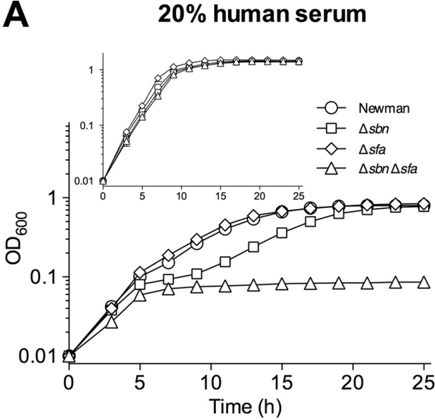
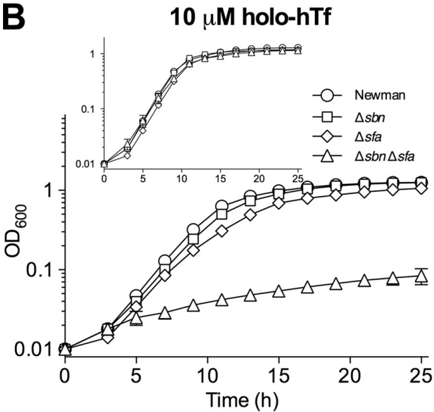
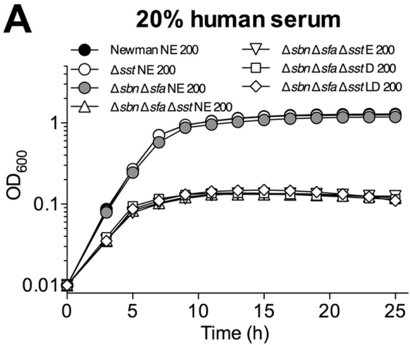
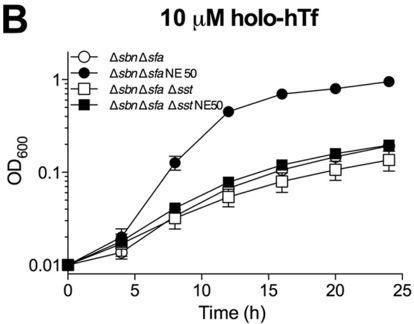
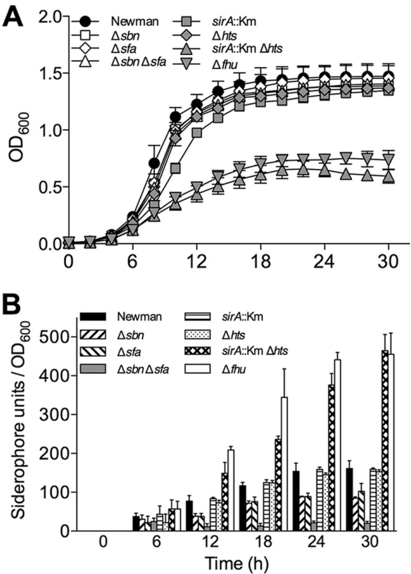
- Staphyloferrin-producing S. aureus grew in human serum or with human holotransferrin; a staphyloferrin-deficient sfa sbn mutant was severely restricted, and FeCl3 compensated for the defect.
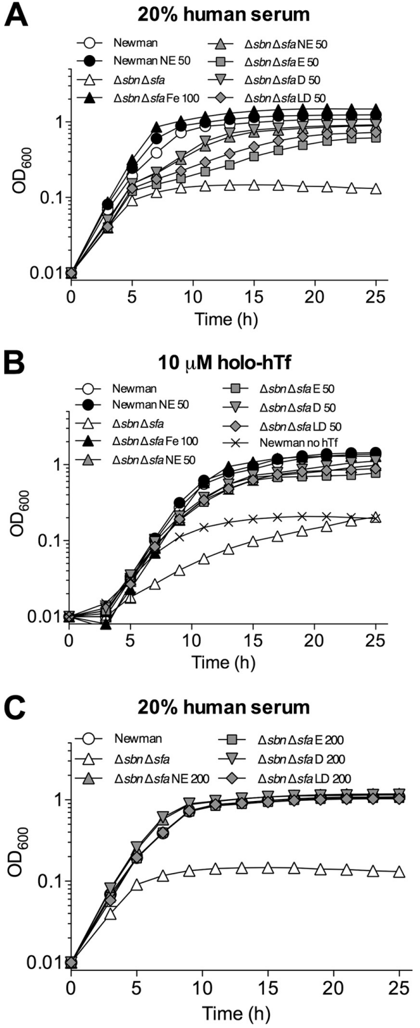
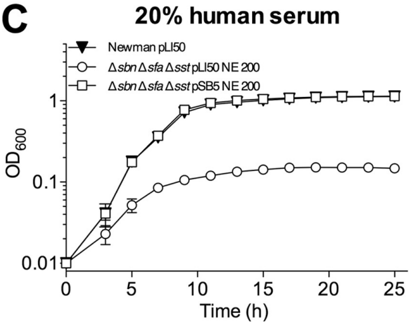
- Catecholamines (norepinephrine, epinephrine, dopamine, l-DOPA) at 50 μM did not enhance wild-type S. aureus growth but enhanced staphyloferrin-deficient S. aureus in human serum or holotransferrin; 200 μM catecholamine gave growth promotion equivalent to staphyloferrin production in serum. Sst was required, and the phenotype was complemented by wild-type sstABCD in trans.
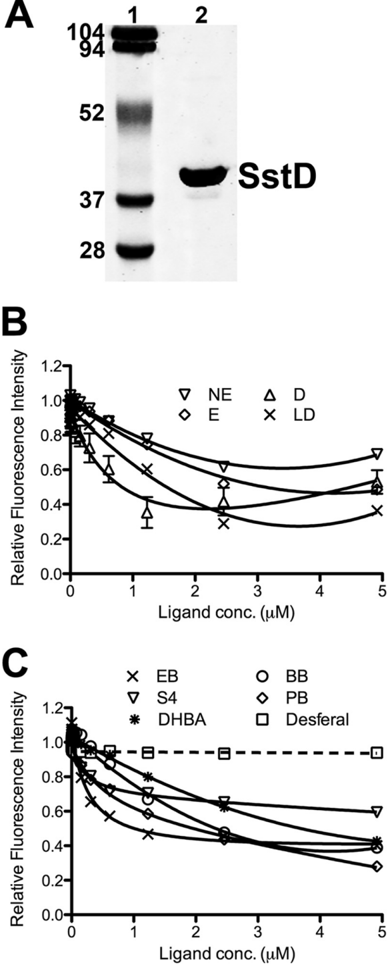
- Purified SstD bound ferrated catecholamines and catechol siderophores with Kd values of 1.07 μM (norepinephrine), 1.65 μM (epinephrine), 0.49 μM (dopamine), 1.44 μM (l-DOPA), 0.29 μM (enterobactin), 0.35 μM (salmochelin), 1.21 μM (bacillibactin), 1.62 μM (2,3-DHBA), and 1.62 μM (petrobactin); iron-free ligands and ferrated deferoxamine did not quench SstD fluorescence.
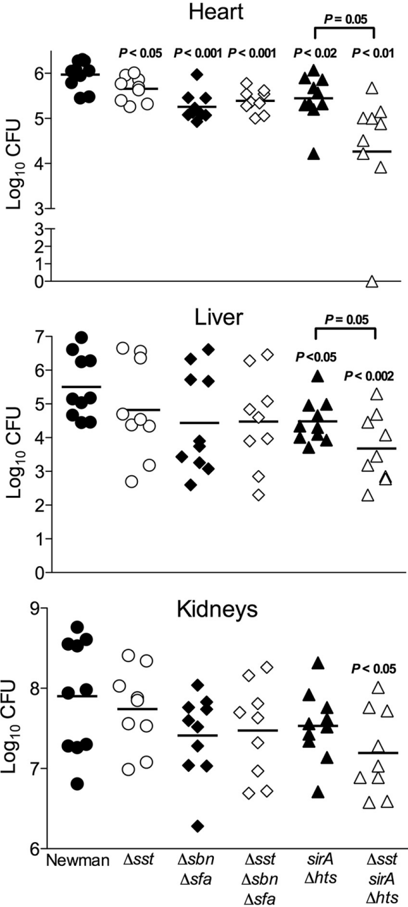
- In mice infected intravenously with 5 × 10^6 to 7 × 10^6 CFU, single sfa/sbn or hts/sir deletions did not significantly reduce organ counts, but sst alone, sfa-sbn, or hts-sir reduced heart colonization; sst plus sfa-sbn decreased heart and liver colonization, and sst plus sirA hts gave the largest drop in heart and liver and the lowest kidney burden among mutants tested.
Methods
- In vitro growth curves used S. aureus strains in TMS, chelated TMS, or 80:20 C-TMS–human serum, amended with human holotransferrin, catecholamines, or FeCl3; plate bioassays tested siderophore/catechol growth promotion, and CAS assays measured siderophore output.
- The sstABCD operon was deleted and replaced with an erythromycin cassette, combined with sfa/sbn or sirA/hts mutations, and complemented with pSB5; SstD was purified as a GST fusion, cleaved, and tested by intrinsic tryptophan fluorescence quenching.
- Murine systemic infection used 7-week-old female immunocompetent BALB/c mice, tail vein injection, and organ CFU enumeration at 96 h; a separate experiment used surgically implanted epinephrine pumps. Statistics used Student’s unpaired t test with P < 0.05.
Limitations
- The paper states that catecholamine concentrations tested (50 to 200 μM) are unlikely to occur in bulk plasma, even after gastric surgery, and that the epinephrine pump experiment did not identify any further difference between wild-type Newman and its sst mutant.
- The paper notes that single-locus staphyloferrin biosynthesis or uptake deletions did not significantly reduce bacterial counts in any organ, and that in vivo iron acquisition is complex and multifactorial.
- Evident from the text: most virulence data come from one murine intravenous model, some results are described as “data not shown,” and residual petrobactin/salmochelin S4 utilization in the sst mutant is attributed to other unknown transporters.
Model-written summary. Check it against the paper before relying on it.
Integrity signals
Registry
Cites
Statistics
Figures
Verification
Claims the paper makes
5 Valid · 2 Not valid · 30 Not checked · 68 Own results and interpretations
The cited sources support only part of this claim — read each source’s verdict below.
In the paper
“inactivating components of heme uptake reduces fitness only partially in virulence assays (37, 65)”
What the sources say
- Partly supportedcites [37] 37. Mason W. J., Skaar E. P. 2009. Assessing the contribution of heme-iron acquisition to Staphylococcus aureus pneumonia using computed tomography. PLoS One 4:e6668. [DOI] [PMC free article] [PubMed] [Google Scholar] sourceExperimental — accuracy not yet measured
The Results section supports the attenuated-virulence half of the paraphrase: retroorbital infection with the heme-transport-deficient ΔhtsAΔisdE gave 'a statistically significant decrease in the bacterial burden in the lung, heart and kidney ... as compared to wild type (Figure 2C)', and the Introduction states that 'both the Hts and Isd systems are individually required for full virulence in systemic models' — i.e. reduction, not abolition. What our copy does not support is the generalization to 'virulence assays': the paper's central finding is that in the intranasal pneumonia model ΔisdBH and ΔhtsAΔisdE showed no statistically significant difference in mortality or bacterial burden ('dispensable in a murine model of pneumonia'; Abstract Methodology/Principal Findings; Discussion: 'the heme-iron acquisition systems Isd and Hts had little influence on the development or pathogenesis of pneumonia'). Moreover, in the systemic assay the paper characterizes the defect as 'pronounced'/'severely decreased', not as merely partial, so the 'only partially' framing understates the source's own conclusion there while overextending it across assays. (LLM, conf=0.72)
- Supportedcites [65] 65. Torres V. J., Pishchany G., Humayun M., Schneewind O., Skaar E. P. 2006. Staphylococcus aureus IsdB is a hemoglobin receptor required for heme iron utilization. J. Bacteriol. 188:8421–8429 [DOI] [PMC free article] [PubMed] [Google Scholar] source
In RESULTS (mouse systemic abscess model), isdB inactivation caused only a 1-log reduction in splenic and renal bacterial load, explicitly contrasted with the 3-log virulence decrease of srtA mutants, and isdH inactivation gave a small, non-significant reduction — i.e., loss of these heme-uptake components attenuates, but does not abolish, fitness in vivo. The same RESULTS section states that, given residual hemoglobin binding and detectable growth of isdB mutants on hemoglobin, 'it is likely that S. aureus possesses additional mechanisms of access to hemoglobin-derived iron during infection,' and the DISCUSSION frames IsdB as required for 'full virulence' rather than virulence per se. Together these support the paraphrase that inactivating heme-uptake components reduces fitness only partially in virulence assays. (LLM, conf=0.85)
plainstates a cause- Asserted: passes — The authors put it forward as true.
- Checkable: passes — It can be checked against evidence.
- Load-bearing: passes — The paper’s conclusions depend on it.
- Based: passes — The paper gives a reason why it holds.
- Partly supported
Every source the paper cites for this claim was checked and supports it.
In the paper
“The S. aureus sst operon (NWMN_0702_0705) is iron regulated in vitro and in vivo and encodes a membrane-tethered lipoprotein, SstD (44).”
What the sources say
- Supportedcites [44] 44. Morrissey J. A., Cockayne A., Hill P. J., Williams P. 2000. Molecular cloning and analysis of a putative siderophore ABC transporter from Staphylococcus aureus. Infect. Immun. 68:6281–6288 [DOI] [PMC free article] [PubMed] [Google Scholar] source
The abstract states the cloned sst operon 'encodes four genes designated sstA, -B, -C, and D ... and a membrane-bound 38-kDa lipoprotein (sstD)', and the Results (p. on Fig. 2) add that SstD partitions in Triton X-114 and sits in the membrane fraction, i.e. a membrane-tethered lipoprotein. The same sections and the Discussion confirm iron regulation both in vitro (partial repression by ferric iron) and in vivo (expression detected in S. aureus recovered from the rat intraperitoneal chamber model). Only the locus-tag designation NWMN_0702_0705 is absent from our copy, but that is the citing authors' own genome annotation rather than content attributed to this source. (LLM, conf=0.90)
plain- Asserted: passes — The authors put it forward as true.
- Checkable: passes — It can be checked against evidence.
- Load-bearing: unclear — It is unclear whether the paper’s conclusions depend on it.
- Based: passes — The paper gives a reason why it holds.
- Supported
The cited sources support only part of this claim — read each source’s verdict below.
In the paper
“when strains were grown in unchelated TMS broth (i.e., no exogenous chelator added), growth defects were noted for mutants lacking both staphyloferrin transporters (sir hts) or the ATPase required to energize both transporters (fhuC) (3, 62).”
What the sources say
- Not checked — no full text of the sourcecites [3] 3. Beasley F. C., et al. 2009. Characterization of staphyloferrin A biosynthetic and transport mutants in Staphylococcus aureus. Mol. Microbiol. 72:947–963 [DOI] [PubMed] [Google Scholar] source
- Partly supportedcites [62] 62. Speziali C. D., Dale S. E., Henderson J. A., Vines E. D., Heinrichs D. E. 2006. Requirement of Staphylococcus aureus ATP-binding cassette-ATPase FhuC for iron-restricted growth and evidence that it functions with more than one iron transporter. J. Bacteriol. 188:2048–2055 [DOI] [PMC free article] [PubMed] [Google Scholar] sourceExperimental — accuracy not yet measured
Our copy supports the fhuC half of the claim: in iron-restricted (unchelated) TMS, the RN6390 ΔfhuCBG::ermC strain H1071 was 'significantly retarded compared to the growth of wild-type strain RN6390' (RESULTS, Fig. 1A), and the paper's own heading states 'The iron-restricted growth defect of S. aureus fhuCBG is more severe than that of S. aureus sirA or sirB mutants' (RESULTS), implying a lesser sirA/sirB defect under low-iron conditions — though in TMS + 50 μM 2,2′-dipyridyl H306 (sirA::Km) growth 'was not affected compared with the growth of parent strain RN6390'. What this source does not support is the 'both staphyloferrin transporters (sir hts)' framing: the hts/staphyloferrin B transporter is never mentioned, FhuC is established only as the ATPase for SirABC (staphyloferrin A/staphylobactin) and FhuBG (hydroxamates), and its involvement with a second siderophore uptake system is left as a hypothesis — 'In future studies we will examine the possibility that FhuC is required for transport of this additional siderophore' and 'fhuC may be involved in the transport of an additional iron chelate via another ABC transporter' (DISCUSSION). (LLM, conf=0.82)
plainstates a cause- Asserted: passes — The authors put it forward as true.
- Checkable: passes — It can be checked against evidence.
- Load-bearing: passes — The paper’s conclusions depend on it.
- Based: passes — The paper gives a reason why it holds.
The cited sources support only part of this claim — read each source’s verdict below.
In the paper
“The Kd values of SstD for its ligands, in the micromolar range, contrast with the Kd values in the nanomolar range that were determined for HtsA and SirA for their cognate ligands, staphyloferrin A and staphyloferrin B (24, 25).”
What the sources say
- Supportedcites [24] 24. Grigg J. C., Cheung J., Heinrichs D. E., Murphy M. E. 2010. Specificity of staphyloferrin B recognition by the SirA receptor from Staphylococcus aureus. J. Biol. Chem. 285:34579–34588 [DOI] [PMC free article] [PubMed] [Google Scholar] source
The RESULTS section ('FeSB-SirA Binding') states that titrations of HPLC-purified FeSB with recombinant SirA 'revealed a dissociation constant (Kd) that is in the low nanomolar range', and the DISCUSSION summary attributes SirA's 'low nanomolar dissociation constant' to loop enclosure of FeSB. The DISCUSSION also groups both receptors: 'The highly specific HtsA and SirA receptors bind ligands with low nanomolar affinities' (with the HtsA figure credited to its ref. 27 and the EXPERIMENTAL PROCEDURES confirming a fluorescence-titration Kd determination). One caveat the citing sentence drops: this paper could report only an upper limit for the SirA Kd ('we are unable to report an accurate Kd value other than an upper limit'), but the nanomolar magnitude it asserts is intact; the micromolar SstD comparison is the citing paper's own data, not attributed here. (LLM, conf=0.85)
- Not matchedcites [25] 25. Grigg J. C., Cooper J. D., Cheung J., Heinrichs D. E., Murphy M. E. 2010. The Staphylococcus aureus siderophore receptor HtsA undergoes localized conformational changes to enclose staphyloferrin A in an arginine-rich binding pocket. J. Biol. Chem. 285:11162–11171 [DOI] [PMC free article] [PubMed] [Google Scholar]
More than one paper fits this citation.
plainstates an association- Asserted: passes — The authors put it forward as true.
- Checkable: passes — It can be checked against evidence.
- Load-bearing: passes — The paper’s conclusions depend on it.
- Based: passes — The paper gives a reason why it holds.
- Supported
The cited sources support only part of this claim — read each source’s verdict below.
In the paper
“Catecholamine iron uptake was subsequently shown to be mediated by a distinct transporter, SstABCD, previously implicated in the S. aureus adaptive response to low-iron environments (44).”
What the sources say
- Partly supportedcites [44] 44. Morrissey J. A., Cockayne A., Hill P. J., Williams P. 2000. Molecular cloning and analysis of a putative siderophore ABC transporter from Staphylococcus aureus. Infect. Immun. 68:6281–6288 [DOI] [PMC free article] [PubMed] [Google Scholar] sourceExperimental — accuracy not yet measured
Our copy supports the 'previously implicated in the S. aureus adaptive response to low-iron environments' half: the DISCUSSION reports a Fur box consensus upstream of sstABCD, SstD expression partially repressed by ferric iron and induced in vivo in a highly iron-restricted environment, and the Introduction frames it as one of three iron-regulated staphylococcal ABC transporters. It does not support catecholamine iron uptake being mediated by SstABCD: the paper's own plate bioassays with the antisense SstD construct 'proved inconclusive', no consistent difference in utilization of a range of siderophores or siderophore precursors was observed, and the Introduction states that in each of these transporters 'the transported solute has not been identified'. The only catechol-related evidence is a homology inference in the RESULTS — SstD shows strong homology with the enterobactin transporters of C. jejuni and Neisseria gonorrhoeae — and the authors conclude only that sstABCD is 'likely to encode a third staphylococcal siderophore transporter', so the claim asserts as established mediation what this source presents as a sequence-based prediction. (LLM, conf=0.80)
plainstates a cause- Asserted: passes — The authors put it forward as true.
- Checkable: passes — It can be checked against evidence.
- Load-bearing: passes — The paper’s conclusions depend on it.
- Based: passes — The paper gives a reason why it holds.
- Partly supported
73 more claims
Create a free account to see all 105 claims and to verify the 44 references still open.
- It may state two separate claims as one. 12
- Probably not a substantial claim. 17
Claims other papers make about this one
Each is checked against this paper’s own text: does it say what the citing paper says it does?
The source backs part of the claim, not all of it — or backs it for a different population, condition or comparison.
In the citing paper
“previous studies have shown that catecholamines can promote the growth of various pathogenic bacteria, including Staphylococcus aureus, Listeria monocytogenes, Escherichia coli, Yersinia enterocolitica, and Salmonella enterica (21–23).”
From Dopamine Is a Siderophore-Like Iron Chelator That Promotes Salmonella enterica Serovar Typhimurium Virulence in Mice (2019) · cites this paper as [21]
Experimental — accuracy not yet measuredThe source backs part of the claim, not all of it — or backs it for a different population, condition or comparison.
In the citing paper
“Recent work has demonstrated heterogeneous production of specific siderophores during infection, suggesting that either bacteria experience distinct Fe levels within host tissue or additional, as yet unidentified, regulatory strategies for siderophore production or secretion exist 51-56 .”
From Nutritional immunity: the battle for nutrient metals at the host–pathogen interface (2022) · cites this paper as [52]
Experimental — accuracy not yet measuredThe cited source says what the claim attributes to it.
In the citing paper
“S. aureus also has the capability to utilize mammalian catecholamine hormones as an iron source.”
From Metal ion acquisition in Staphylococcus aureus: overcoming nutritional immunity (2012) · cites this paper as [60]
The cited source says what the claim attributes to it.
In the citing paper
“Inactivation of either the catecholamine transporter (Sst) alone, both siderophore operons (sfa and sbn), or both siderophore transporters (Hts and Sir) yields a reduction in colony recovery from the hearts of systemically infected mice.”
From Metal ion acquisition in Staphylococcus aureus: overcoming nutritional immunity (2012) · cites this paper as [60]
The cited source says what the claim attributes to it.
In the citing paper
“Staphylococcus aureus is an opportunistic pathogen that utilizes siderophores for Fe acquisition, and siderophore production is required for maximum virulence (5, 7).”
From Staphylococcus aureus exhibits heterogeneous siderophore production within the vertebrate host (2019) · cites this paper as [7]
8 more claims about this paper
Create a free account to see every claim other papers make about this one.
Citations
Cites
Molecular Cloning: A Laboratory Manual
Sambrook, J., Fritsch, E., & Maniatis, T. (1989) · UCLA - Biblioteca de Ciencias de la Salud · Cited by 133,589
Molecular cloning: A laboratory manual
Deininger, P. (1990) · Analytical Biochemistry · doi:10.1016/0003-2697(90)90595-z · Cited by 84,682
Universal chemical assay for the detection and determination of siderophores
Schwyn, B., & Neilands, J. B. (1987) · Analytical Biochemistry · doi:10.1016/0003-2697(87)90612-9 · Cited by 6,549 · cited 1×
“using a chrome azurol S (CAS) shuttle solution (55) as described previously (3);”
MethodGuzman, L. M., Belin, D., Carson, M. J., & Beckwith, J. (1995) · Journal of Bacteriology · doi:10.1128/jb.177.14.4121-4130.1995 · Cited by 4,935
Culture Medium for Enterobacteria
Neidhardt, F. C., Bloch, P. L., & Smith, D. F. (1974) · Journal of Bacteriology · doi:10.1128/jb.119.3.736-747.1974 · Cited by 2,958 · cited 1×
“was grown in enterobacterial minimal culture medium (47), with previously”
MethodIron Metabolism in Pathogenic Bacteria
Ratledge, C., & Dover, L. G. (2000) · Annual Review of Microbiology · doi:10.1146/annurev.micro.54.1.881 · Cited by 1,539 · cited 1×
“In aerobic environments, the metal exists predominantly as Fe(III), which at neutral pH has a solubility of approximately 1 10 9 M (52).”
BackgroundThe toxic shock syndrome exotoxin structural gene is not detectably transmitted by a prophage
Kreiswirth, B. N., Löfdahl, S., Betley, M. J., O'Reilly, M., Schlievert, P. M., Bergdoll, M. S., & Novick, R. P. (1983) · Nature · doi:10.1038/305709a0 · Cited by 1,326
Staphylococcus aureus Endocarditis: A Consequence of Medical Progress
Fowler, V. G., Miro, J. M., Hoen, B., Cabell, C. H., Abrutyn, E., Rubinstein, E., Corey, G. R., Spelman, D., Bradley, S. F., Barsic, B., et al. (2005) · JAMA · doi:10.1001/jama.293.24.3012 · Cited by 1,174 · cited 1×
“aureus is a leading cause of infective endocarditis (17).”
BackgroundStaphylococcal Coagulase: Mode of Action and Antigenicity
DUTHIE, E. S., & LORENZ, L. L. (1952) · Microbiology · doi:10.1099/00221287-6-1-2-95 · Cited by 622
Stoichiometric and site characteristics of the binding of iron to human transferrin
Aisen, P., Leibman, A., & Zweier, J. (1978) · Journal of Biological Chemistry · doi:10.1016/s0021-9258(19)62337-9 · Cited by 601 · cited 1×
“The primary iron sequestration factor in vertebrate serum is transferrin, a glycoprotein featuring two Fe(III) binding domains with high affinities for Fe(III) (Kd [dissociation constant], approximately 10 22 M) (1).”
BackgroundAntibiotic-resistance cassettes for Bacillus subtilis
Guérout-Fleury, A.-M., Shazand, K., Frandsen, N., & Stragier, P. (1995) · Gene · doi:10.1016/0378-1119(95)00652-4 · Cited by 595
Passage of Heme-Iron Across the Envelope of Staphylococcus aureus
Mazmanian, S. K., Skaar, E. P., Gaspar, A. H., Humayun, M., Gornicki, P., Jelenska, J., Joachmiak, A., Missiakas, D. M., & Schneewind, O. (2003) · Science · doi:10.1126/science.1081147 · Cited by 593 · cited 1×
“aureus proteins that function in an overall process which includes the extraction of heme from hemoglobin and the eventual internalization of heme, followed by the extraction of iron from the porphyrin ring (38, 45, 60, 64, 65).”
Background[27] Genetic systems in Staphylococci
Novick, R. P. (1991) · Methods in Enzymology · doi:10.1016/0076-6879(91)04029-n · Cited by 568 · cited 1×
“Newman recipients by use of phage 80 as described previously (48).”
MethodPeng, H. L., Novick, R. P., Kreiswirth, B., Kornblum, J., & Schlievert, P. (1988) · Journal of Bacteriology · doi:10.1128/jb.170.9.4365-4372.1988 · Cited by 566
Iron-Source Preference of Staphylococcus aureus Infections
Skaar, E. P., Humayun, M., Bae, T., DeBord, K. L., & Schneewind, O. (2004) · Science · doi:10.1126/science.1099930 · Cited by 440 · cited 1×
“aureus during infection is considered to be heme (61).”
BackgroundStaphylococcus aureus IsdB Is a Hemoglobin Receptor Required for Heme Iron Utilization
Torres, V. J., Pishchany, G., Humayun, M., Schneewind, O., & Skaar, E. P. (2006) · Journal of Bacteriology · doi:10.1128/jb.01335-06 · Cited by 302 · cited 2×
“In spite of this, inactivating components of heme uptake reduces fitness only partially in virulence assays (37, 65), suggesting either alternate mechanisms for heme uptake or a contribution of alternate host iron reservoirs to growth of invasive S.”
BackgroundMicrobial endocrinology: how stress influences susceptibility to infection
Freestone, P. P. E., Sandrini, S. M., Haigh, R. D., & Lyte, M. (2008) · Trends in Microbiology · doi:10.1016/j.tim.2007.11.005 · Cited by 299
IsdG and IsdI, Heme-degrading Enzymes in the Cytoplasm of Staphylococcus aureus
Skaar, E. P., Gaspar, A. H., & Schneewind, O. (2004) · Journal of Biological Chemistry · doi:10.1074/jbc.m307952200 · Cited by 282 · cited 1×
“aureus proteins that function in an overall process which includes the extraction of heme from hemoglobin and the eventual internalization of heme, followed by the extraction of iron from the porphyrin ring (38, 45, 60, 64, 65).”
BackgroundImpact of Siderophore Production on Pseudomonas aeruginosa Infections in Immunosuppressed Mice
Takase, H., Nitanai, H., Hoshino, K., & Otani, T. (2000) · Infection and Immunity · doi:10.1128/iai.68.4.1834-1839.2000 · Cited by 269 · cited 2×
“coli (12), Bordetella (4), Pseudomonas (63), and Rhizobium spp.”
BackgroundDale, S. E., Doherty-Kirby, A., Lajoie, G., & Heinrichs, D. E. (2004) · Infection and Immunity · doi:10.1128/iai.72.1.29-37.2004 · Cited by 232
Self-citationFreestone, P. P., Williams, P. H., Haigh, R. D., Maggs, A. F., Neal, C. P., & Lyte, M. (2002) · Shock · doi:10.1097/00024382-200211000-00014 · Cited by 227
Pathogenesis of streptococcal and staphylococcal endocarditis
Moreillon, P., Que, Y. A., & Bayer, A. S. (2002) · Infectious Disease Clinics of North America · doi:10.1016/s0891-5520(01)00009-5 · Cited by 223 · cited 1×
“Invasive infection by the opportunistic pathogen Staphylococcus aureus can result in syndromes including endocarditis and necrotizing pneumonia (42, 43).”
BackgroundFreestone, P. P. E., Lyte, M., Neal, C. P., Maggs, A. F., Haigh, R. D., & Williams, P. H. (2000) · Journal of Bacteriology · doi:10.1128/jb.182.21.6091-6098.2000 · Cited by 210 · cited 2×
“This second mechanism capitalizes on the recently characterized phenomenon of holotransferrin iron liberation through complex formation with mammalian catecholamine stress hormones (2, 5, 10, 19, 54).”
BackgroundRole of the Fur Regulon in Iron Transport in Bacillus subtilis
Ollinger, J., Song, K.-B., Antelmann, H., Hecker, M., & Helmann, J. D. (2006) · Journal of Bacteriology · doi:10.1128/jb.188.10.3664-3673.2006 · Cited by 209
Norepinephrine increases the pathogenic potential of Campylobacter jejuni
Cogan, T. A., Thomas, A. O., Rees, L. E. N., Taylor, A. H., Jepson, M. A., Williams, P. H., Ketley, J., & Humphrey, T. J. (2007) · Gut · doi:10.1136/gut.2006.114926 · Cited by 203
Lynch, D., O'Brien, J., Welch, T., Clarke, P., ÓCuı́v, P., Crosa, J. H., & O'Connell, M. (2001) · Journal of Bacteriology · doi:10.1128/jb.183.8.2576-2585.2001 · Cited by 193
Stimulation of Staphylococcus epidermidis growth and biofilm formation by catecholamine inotropes
Lyte, M., Freestone, P. P., Neal, C. P., Olson, B. A., Haigh, R. D., Bayston, R., & Williams, P. H. (2003) · The Lancet · doi:10.1016/s0140-6736(03)12231-3 · Cited by 177 · cited 1×
“epidermidis on transferrin (36, 46), although a similar effect was not noted for S.”
Lee, C. Y., & Iandolo, J. J. (1986) · Journal of Bacteriology · doi:10.1128/jb.166.2.385-391.1986 · Cited by 173
Torres, V. J., Attia, A. S., Mason, W. J., Hood, M. I., Corbin, B. D., Beasley, F. C., Anderson, K. L., Stauff, D. L., McDonald, W. H., Zimmerman, L. J., et al. (2010) · Infection and Immunity · doi:10.1128/iai.01423-09 · Cited by 169 · cited 1×
“aureus proteins that function in an overall process which includes the extraction of heme from hemoglobin and the eventual internalization of heme, followed by the extraction of iron from the porphyrin ring (38, 45, 60, 64, 65).”
BackgroundSelf-citationNeuroendocrine–Bacterial Interactions in a Neurotoxin-Induced Model of Trauma
Lyte, M., & Bailey, M. T. (1997) · Journal of Surgical Research · doi:10.1006/jsre.1997.5130 · Cited by 168 · cited 1×
“Other research has noted increases in indigenous bacterial gut flora following localized destruction of noradrenergic neurons (35).”
BackgroundDeaths: Preliminary Data for 2006
Heron, M. P., Hoyert, D. L., Xu, J., & Scott, C. (2008) · Cited by 168
Characterization of staphyloferrin A biosynthetic and transport mutants in Staphylococcus aureus
Beasley, F. C., Vinés, E. D., Grigg, J. C., Zheng, Q., Liu, S., Lajoie, G. A., Murphy, M. E. P., & Heinrichs, D. E. (2009) · Molecular Microbiology · doi:10.1111/j.1365-2958.2009.06698.x · Cited by 163 · cited 9×
“, no exogenous chelator added), growth defects were noted for mutants lacking both staphyloferrin transporters (sir hts) or the ATPase required to energize both transporters (fhuC) (3, 62).”
BackgroundMethodInfluentialSelf-citationSebulsky, M. T., Hohnstein, D., Hunter, M. D., & Heinrichs, D. E. (2000) · Journal of Bacteriology · doi:10.1128/jb.182.16.4394-4400.2000 · Cited by 145 · cited 2×
“aureus also carries the ironregulated FhuBGC2-D2/D1 transporter, with specificity for Fe(III)-hydroxamates (56, 57).”
BackgroundSelf-citationMolecular characterization of staphyloferrin B biosynthesis in Staphylococcus aureus
Cheung, J., Beasley, F. C., Liu, S., Lajoie, G. A., & Heinrichs, D. E. (2009) · Molecular Microbiology · doi:10.1111/j.1365-2958.2009.06880.x · Cited by 144 · cited 3×
“siderophore complex, is actively imported into the cytosol through permeases (3, 7, 24, 25).”
BackgroundSelf-citationMuryoi, N., Tiedemann, M. T., Pluym, M., Cheung, J., Heinrichs, D. E., & Stillman, M. J. (2008) · Journal of Biological Chemistry · doi:10.1074/jbc.m802171200 · Cited by 144 · cited 1×
“aureus proteins that function in an overall process which includes the extraction of heme from hemoglobin and the eventual internalization of heme, followed by the extraction of iron from the porphyrin ring (38, 45, 60, 64, 65).”
BackgroundSelf-citationSandrini, S. M., Shergill, R., Woodward, J., Muralikuttan, R., Haigh, R. D., Lyte, M., & Freestone, P. P. (2010) · Journal of Bacteriology · doi:10.1128/jb.01028-09 · Cited by 143 · cited 7×
“This second mechanism capitalizes on the recently characterized phenomenon of holotransferrin iron liberation through complex formation with mammalian catecholamine stress hormones (2, 5, 10, 19, 54).”
BackgroundInfluentialInvolvement of SirABC in Iron-Siderophore Import in Staphylococcus aureus
Dale, S. E., Sebulsky, M. T., & Heinrichs, D. E. (2004) · Journal of Bacteriology · doi:10.1128/jb.186.24.8356-8362.2004 · Cited by 132
Self-citationChen, L., James, L. P., & Helmann, J. D. (1993) · Journal of Bacteriology · doi:10.1128/jb.175.17.5428-5437.1993 · Cited by 127 · cited 1×
“described modifications (6), for 48 h.”
Sebulsky, M. T., & Heinrichs, D. E. (2001) · Journal of Bacteriology · doi:10.1128/jb.183.17.4994-5000.2001 · Cited by 127 · cited 2×
“aureus also carries the ironregulated FhuBGC2-D2/D1 transporter, with specificity for Fe(III)-hydroxamates (56, 57).”
BackgroundSelf-citationIron uptake and homeostasis in microorganisms
Cornélis, P., & Andrews, S. C. (2010) · CentAUR (University of Reading) · Cited by 121
Mutations Affecting Iron Transport in Escherichia coli
Cox, G. B., Gibson, F., Luke, R. K. J., Newton, N. A., O'Brien, I. G., & Rosenberg, H. (1970) · Journal of Bacteriology · doi:10.1128/jb.104.1.219-226.1970 · Cited by 117 · cited 1×
“coli (12), Bordetella (4), Pseudomonas (63), and Rhizobium spp.”
BackgroundFreestone, P. P. E., Haigh, R. D., Williams, P. H., & Lyte, M. (2003) · FEMS Microbiology Letters · doi:10.1016/s0378-1097(03)00243-x · Cited by 111
Burton, C. L., Chhabra, S. R., Swift, S., Baldwin, T. J., Withers, H., Hill, S. J., & Williams, P. (2002) · Infection and Immunity · doi:10.1128/iai.70.11.5913-5923.2002 · Cited by 102 · cited 3×
“coli on holotransferrin at concentrations comparable to those tested in this study (5, 40).”
BackgroundCotton, J. L., Tao, J., & Balibar, C. J. (2009) · Biochemistry · doi:10.1021/bi801844c · Cited by 95 · cited 2×
“aureus assembles and secretes two polycarboxylate-type siderophores, staphyloferrin A and staphyloferrin B (SA and SB, respectively) (7, 9).”
BackgroundSpeziali, C. D., Dale, S. E., Henderson, J. A., Vinés, E. D., & Heinrichs, D. E. (2006) · Journal of Bacteriology · doi:10.1128/jb.188.6.2048-2055.2006 · Cited by 95 · cited 1×
“, no exogenous chelator added), growth defects were noted for mutants lacking both staphyloferrin transporters (sir hts) or the ATPase required to energize both transporters (fhuC) (3, 62).”
BackgroundSelf-citationEisenhofer, G., Åneman, A., Hooper, D., Rundqvist, B., & Friberg, P. (1996) · Journal of Neurochemistry · doi:10.1046/j.1471-4159.1996.66041565.x · Cited by 93 · cited 2×
“While the catecholamine concentrations tested in this study (50 to 200 M) have been alluded to as physiologically or therapeutically relevant (54), it is unlikely that catecholamines approach micromolar concentrations in bulk plasma, even after gastric surgery (16).”
BackgroundThe Role of FhuD2 in Iron(III)-Hydroxamate Transport in Staphylococcus aureus
Sebulsky, M. T., Shilton, B. H., Speziali, C. D., & Heinrichs, D. E. (2003) · Journal of Biological Chemistry · doi:10.1074/jbc.m305073200 · Cited by 90 · cited 1×
“Kd values were calculated as previously described (58), and all curves were plotted using GraphPad Prism (GraphPad Software, La Jolla, CA).”
MethodSelf-citationHeme Coordination by Staphylococcus aureus IsdE
Grigg, J. C., Vermeiren, C. L., Heinrichs, D. E., & Murphy, M. E. P. (2007) · Journal of Biological Chemistry · doi:10.1074/jbc.m704602200 · Cited by 86 · cited 1×
“aureus Fe(III)-staphyloferrin receptors HtsA (25) and SirA (24) and the heme-binding IsdE protein (26).”
BackgroundSelf-citationMolecular Cloning and Analysis of a Putative Siderophore ABC Transporter from Staphylococcus aureus
Morrissey, J. A., Cockayne, A., Hill, P. J., & Williams, P. (2000) · Infection and Immunity · doi:10.1128/iai.68.11.6281-6288.2000 · Cited by 82 · cited 4×
“One additional iron-regulated transporter, SstABCD, was described as a putative siderophore transporter based on sequence similarities to catechol transport systems in Gram-negative and Gram-positive bacteria (44), but it has not yet been characterized for substrate specificity.”
BackgroundInfluentialNeal, C. P., Freestone, P. P. E., Maggs, A. F., Haigh, R. D., Williams, P. H., & Lyte, M. (2001) · FEMS Microbiology Letters · doi:10.1111/j.1574-6968.2001.tb09463.x · Cited by 77
Grigg, J. C., Cooper, J. D., Cheung, J., Heinrichs, D. E., & Murphy, M. E. P. (2010) · Journal of Biological Chemistry · doi:10.1074/jbc.m109.097865 · Cited by 75 · cited 5×
“Following capture of extracellular iron, the staphyloferrins are recognized by the highly specific receptors HtsA (SA) and SirA (SB), and at least iron, if not the iron* Corresponding author.”
BackgroundInfluentialSelf-citationSiderophore production by Staphylococcus aureus and identification of iron-regulated proteins
Courcol, R. J., Trivier, D., Bissinger, M. C., Martin, G. R., & Brown, M. R. (1997) · Infection and Immunity · doi:10.1128/iai.65.5.1944-1948.1997 · Cited by 74 · cited 1×
“aureus culture supernatants test negative for catechol siderophores (11), and the sbn sfa mutant tests negative for production of any siderophores (3).”
BackgroundMiethke, M., & Skerra, A. (2010) · Antimicrobial Agents and Chemotherapy · doi:10.1128/aac.01158-09 · Cited by 74 · cited 3×
“Bacteria equipped with catechol siderophore uptake systems could feasibly import Fe(III)-catecholamine3 complexes as “pseudosiderophores” for growth under iron-restricted conditions, as recently demonstrated for Bacillus subtilis and Escherichia coli (40).”
BackgroundFhuD1, a Ferric Hydroxamate-binding Lipoprotein in Staphylococcus aureus
Sebulsky, M. T., Speziali, C. D., Shilton, B. H., Edgell, D. R., & Heinrichs, D. E. (2004) · Journal of Biological Chemistry · doi:10.1074/jbc.m409793200 · Cited by 74 · cited 8×
“Prior to plate inoculation, strains were grown in glass tubes for 12 h in TMS broth and then subcultured and grown for 12 h in TMS broth chelated with 100 M 2,2 - dipyridyl (Sigma-Aldrich).”
MethodInfluentialSelf-citationSpecificity of Staphyloferrin B Recognition by the SirA Receptor from Staphylococcus aureus
Grigg, J. C., Cheung, J., Heinrichs, D. E., & Murphy, M. E. P. (2010) · Journal of Biological Chemistry · doi:10.1074/jbc.m110.172924 · Cited by 71 · cited 5×
“Following capture of extracellular iron, the staphyloferrins are recognized by the highly specific receptors HtsA (SA) and SirA (SB), and at least iron, if not the iron* Corresponding author.”
BackgroundInfluentialSelf-citationCoulanges, V., Andre, P., & Vidon, D. J.-M. (1998) · Biochemical and Biophysical Research Communications · doi:10.1006/bbrc.1998.9184 · Cited by 57 · cited 1×
“This second mechanism capitalizes on the recently characterized phenomenon of holotransferrin iron liberation through complex formation with mammalian catecholamine stress hormones (2, 5, 10, 19, 54).”
BackgroundNorepinephrine Mediates Acquisition of Transferrin-Iron in Bordetella bronchiseptica
Anderson, M. T., & Armstrong, S. K. (2008) · Journal of Bacteriology · doi:10.1128/jb.00086-08 · Cited by 52 · cited 2×
“This second mechanism capitalizes on the recently characterized phenomenon of holotransferrin iron liberation through complex formation with mammalian catecholamine stress hormones (2, 5, 10, 19, 54).”
BackgroundMethner, U., Rabsch, W., Reissbrodt, R., & Williams, P. H. (2008) · International Journal of Medical Microbiology · doi:10.1016/j.ijmm.2007.07.013 · Cited by 51 · cited 1×
“As a result, catecholamine hormones have been shown to enhance growth of pathogenic bacteria in serum (2, 19, 39, 54).”
BackgroundModun, B., Evans, R. W., Joannou, C. L., & Williams, P. (1998) · Infection and Immunity · doi:10.1128/iai.66.8.3591-3596.1998 · Cited by 49
von Montfort, C., Beier, J. I., Guo, L., Kaiser, J. P., & Arteel, G. E. (2008) · American Journal of Physiology-Gastrointestinal and Liver Physiology · doi:10.1152/ajpgi.00050.2008 · Cited by 46 · cited 1×
“selected based on a previous report (66).”
Methicillin-resistant Staphylococcus aureus Necrotizing Pneumonia
Monaco, M., Antonucci, R., Palange, P., Venditti, M., & Pantosti, A. (2005) · Emerging Infectious Diseases · doi:10.3201/eid1110.050776 · Cited by 44 · cited 1×
“Invasive infection by the opportunistic pathogen Staphylococcus aureus can result in syndromes including endocarditis and necrotizing pneumonia (42, 43).”
BackgroundGaballa, A., & Helmann, J. D. (2007) · Molecular Microbiology · doi:10.1111/j.1365-2958.2007.05905.x · Cited by 40 · cited 2×
“using the extinction coefficient (ε490 4,700 M 1 cm (1)) as described previously (22).”
MethodJewett, S. L., Eggling, S., & Geller, L. (1997) · Journal of Inorganic Biochemistry · doi:10.1016/s0162-0134(96)00198-5 · Cited by 32 · cited 1×
“Catecholamine hormones have previously been shown to form 2:1 and 3:1 complexes with iron(III) (30).”
BackgroundStaphylococcus aureus but not Staphylococcus epidermidis can acquire iron from transferrin
Lindsay, J. A., Riley, T. V., & Mee, B. J. (1995) · Microbiology · doi:10.1099/00221287-141-1-197 · Cited by 32
Rational engineering of a fluorescein-binding anticalin for improved ligand affinity
Vopel, S., Mohr, H., & Skerra, A. (2005) · Biological Chemistry · doi:10.1515/bc.2005.126 · Cited by 29 · cited 1×
“with 1 M N-acetyl-tryptophanamide, as described previously (67).”
MethodMason, W. J., & Skaar, E. P. (2009) · PLoS ONE · doi:10.1371/journal.pone.0006668 · Cited by 28
(2005) · PubMed
(2008) · PubMed
Neal, C. (2001) · FEMS Microbiology Letters · doi:10.1016/s0378-1097(00)00523-1 · cited 2×
“epidermidis on transferrin (36, 46), although a similar effect was not noted for S.”
Background
Research works printed but not linked: 1
- 23. Griffiths E., Williams P. 1999. The iron-uptake systems of pathogenic bacteria, fungi and protozoa, p. 87–212 In Bullen J. J., Griffiths E. (ed.), Iron and infection, 2nd ed. John Wiley and Sons, Ltd., New York, NY [Google Scholar]
Cited by
Microbial siderophores and their potential applications: a review
Saha, M., Sarkar, S., Sarkar, B., Sharma, B. K., Bhattacharjee, S., & Tribedi, P. (2016) · Environmental Science and Pollution Research · doi:10.1007/s11356-015-4294-0 · Cited by 819
“…meloti Drechsel et al. 1995 Staphyloferrin A Staphylococcus hyicus Meiwes et al. 1990 Staphyloferrin A, Staphyloferrin B Staphylococcus aureus Beasley et al. 2011 Unknown Halococcus saccharolyticus Dave et al. 2006 Unknown Halorubrum saccharovorum Dave et al. 2006 Unknown Haloterrigena…”
BackgroundNutritional immunity: the battle for nutrient metals at the host–pathogen interface
Murdoch, C. C., & Skaar, E. P. (2022) · Nature Reviews Microbiology · doi:10.1038/s41579-022-00745-6 · Cited by 701
Microbial siderophores: a mini review
Saha, R., Saha, N., Donofrio, R. S., & Bestervelt, L. L. (2013) · Journal of Basic Microbiology · doi:10.1002/jobm.201100552 · Cited by 440
“aureus utilize its siderophores staphyloferrin A and staphyloferrin B to remove iron from blood transferrin, to augment its proliferation in the host [102].”
BackgroundPortune, K. J., Beaumont, M., Davila, A.-M., Tomé, D., Blachier, F., & Sanz, Y. (2016) · Trends in Food Science & Technology · doi:10.1016/j.tifs.2016.08.011 · Cited by 356
The Role of Macrophages in Staphylococcus aureus Infection
Pidwill, G. R., Gibson, J. F., Cole, J., Renshaw, S. A., & Foster, S. J. (2021) · Frontiers in Immunology · doi:10.3389/fimmu.2020.620339 · Cited by 341
Metadata
- Authors
- Beasley, F. C., Marolda, C. L., Cheung, J., Buac, S., & Heinrichs, D. E.
- Affiliations
- Western University (CA)
- Corresponding author
- Heinrichs, David E.
- Venue
- Infection and Immunity
- Publisher
- American Society for Microbiology
- Published
- 2011-06
- Volume
- 79
- Issue
- 6
- Pages
- 2345-2355
- ISSN
- 0019-9567 (ISSN-L)
- 1098-5522
- PMC
- PMC3125851
- OpenAlex
- W2168593917
- Semantic Scholar
- 16f9f992a070ab6f26be1a6a3dab9982cc2d9c1c
- Cited by
- 151
- References
- 69
- Citations by year
- 2026: 12 · 2025: 10 · 2024: 7 · 2023: 5 · 2022: 11 · 2021: 16 · 2020: 13 · 2019: 12 · 2018: 4 · 2017: 7 · 2016: 7 · 2015: 13 · 2014: 9 · 2013: 7 · 2012: 12
- FWCI
- 6.78
- Type
- journal article
- Language
- en
- Open access
- green
- www.ncbi.nlm.nih.gov
- Licence
- journals.asm.org/non-commercial-tdm-license (tdm)
- Locations
- Infection and Immunity (publishedVersion)
- PubMed Central (publishedVersion)
- PubMed (publishedVersion)
- Funders
- Canadian Institutes of Health Research (MOP-38002)
- Topics
- Life Sciences › Biochemistry, Genetics and Molecular Biology › Genetics › Bacterial Genetics and Biotechnology
- Health Sciences › Medicine › Infectious Diseases › Antimicrobial Resistance in Staphylococcus
- Health Sciences › Medicine › Hematology › Iron Metabolism and Disorders
- Keywords
- Staphylococcus aureus, iron acquisition, transferrin, siderophore transporters, virulence, serum iron, bacterial iron metabolism
- MeSH terms
- Animals, Citrates, Epinephrine, Female, Genes, Bacterial, Humans, Iron, Mice, Inbred BALB C, Norepinephrine, Ornithine, Staphylococcal Infections, Staphylococcus aureus, Transferrin, Blotting, Western, Siderophores, Mice
About these checks
Registry, retraction, Cites and statistics results are computed, not judged, with one exception: a printed reference that no index lists is read once by a model before it counts as a citation error. Claims are extracted by a model and kept only when their quote appears verbatim in the text; each cited source is then checked, with a model’s help, for whether it says what the claim relies on. Those verdicts can be wrong — read the claim’s quote and the cited source before relying on one.
The claim verdicts this report counts are experimental: their accuracy is not yet measured.
A language model drew the claims from the paper on 2026-11-14, under version 3 of the claim definition (model deepseek-v4.1-flash, prompt extract-v3).
A second model labelled each claim on 2026-11-14 (model jev-1.13-20260917, definition revision gold-guideline-v0.2).
Cited sources are checked with a language model’s help (qwen3.8-omni-flash).
Statistics and arithmetic are recomputed, not judged.
Confidence bands are shown only for fields calibrated on our annotated test set. None is calibrated yet, so no band is shown.
What counts as a claim ›How we measure confidence ›How we check this ›
Are you an author, or do you see a problem with this page? Request a review
Data sources
Bibliographic data: Semantic Scholar, OpenAlex, Crossref.
Contains information from the Semantic Scholar Academic Graph Datasets, made available under the ODC Attribution License (ODC-BY 1.0).
Semantic Scholar’s data is described in: Kinney, R., et al. (2023). The Semantic Scholar Open Data Platform. arXiv:2301.10140.
