

Candida albicans-Induced Epithelial Damage Mediates Translocation through Intestinal Barriers
Open accessThe DOI matches its Crossref record; 83 of the 85 references it cites were found in a registry or an index.
Abstract
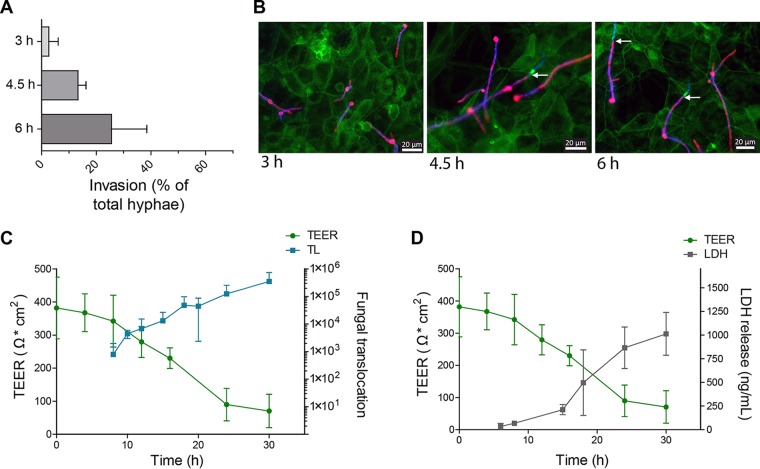
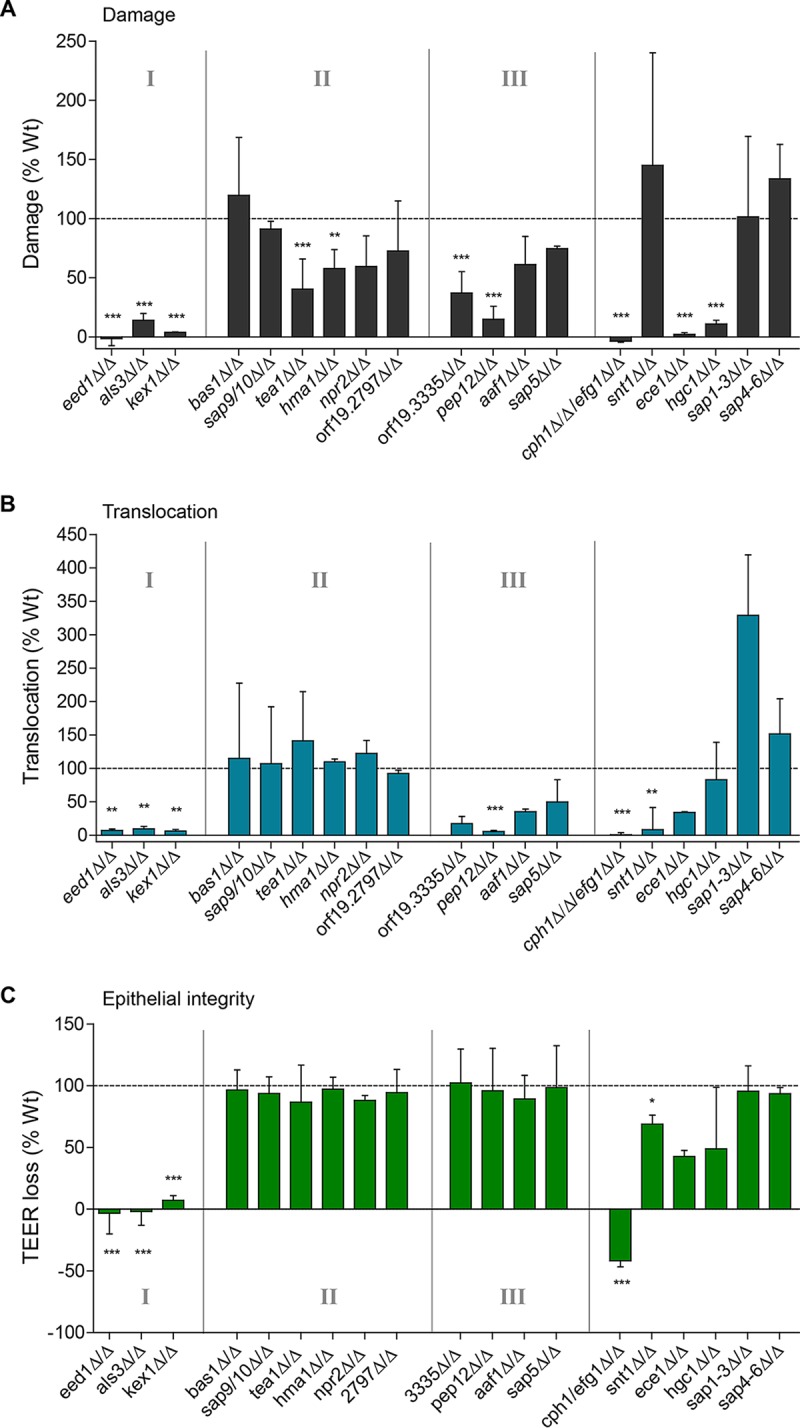
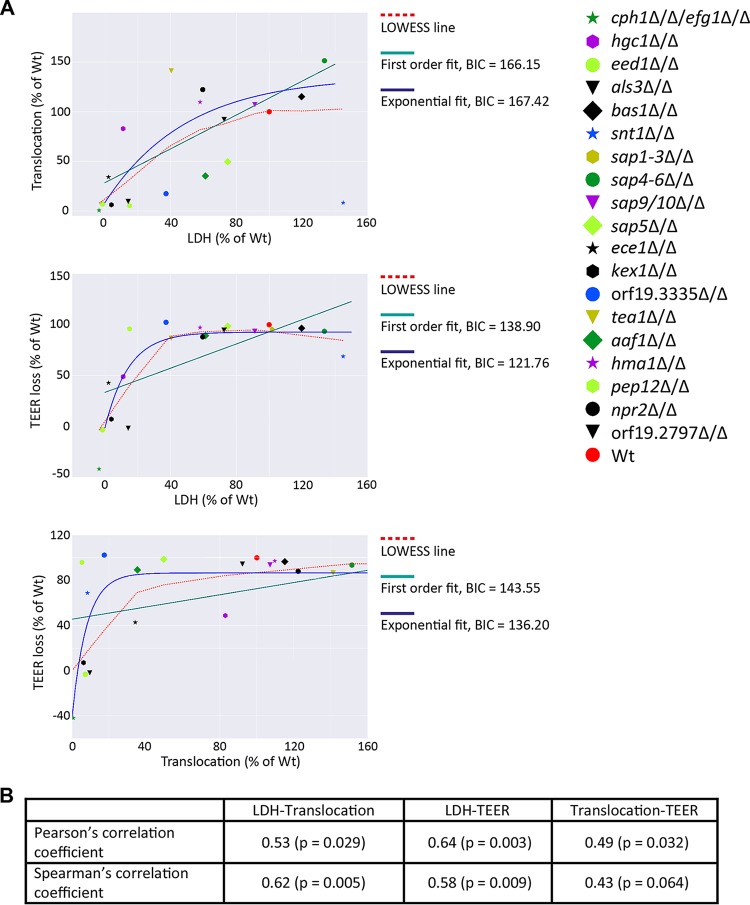
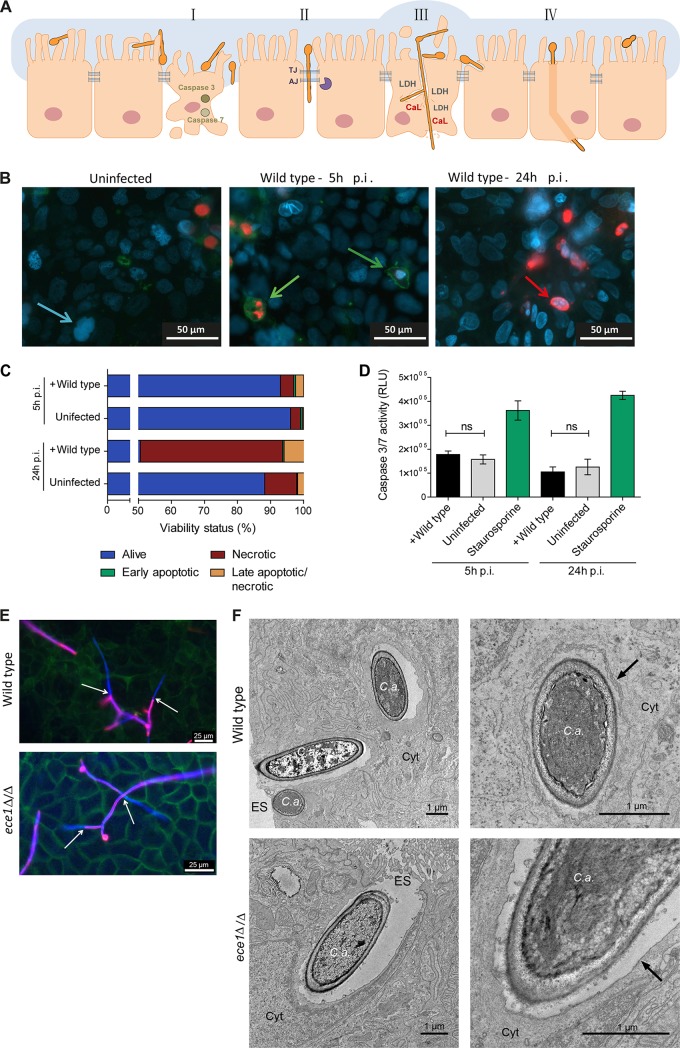
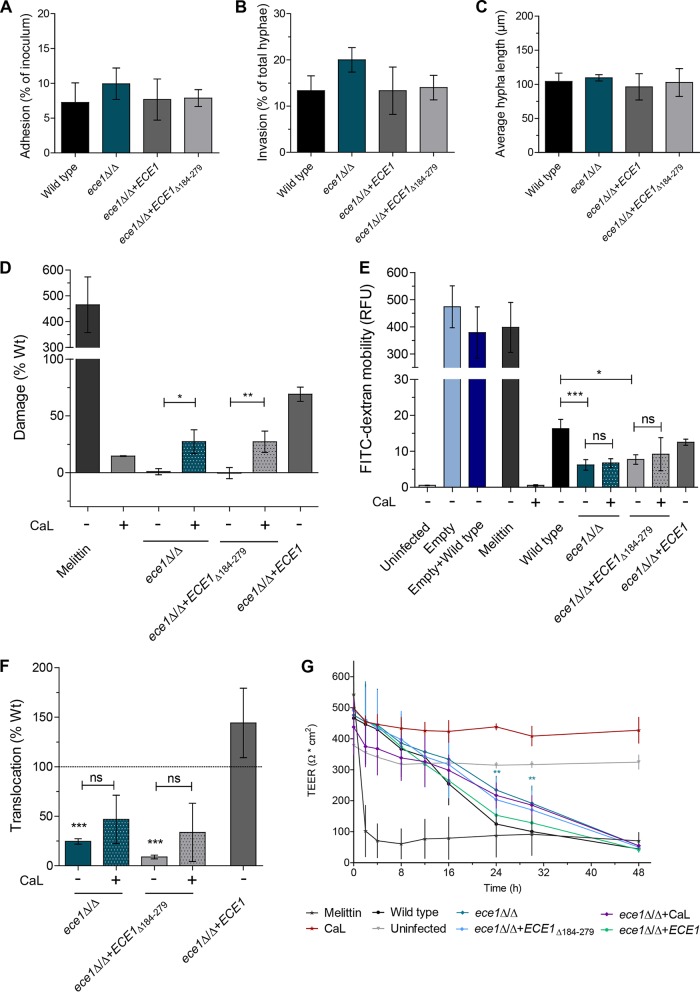
Life-threatening systemic infections often occur due to the translocation of pathogens across the gut barrier and into the bloodstream. While the microbial and host mechanisms permitting bacterial gut translocation are well characterized, these mechanisms are still unclear for fungal pathogens such as Candida albicans , a leading cause of nosocomial fungal bloodstream infections. In this study, we dissected the cellular mechanisms of translocation of C. albicans across intestinal epithelia in vitro and identified fungal genes associated with this process. We show that fungal translocation is a dynamic process initiated by invasion and followed by cellular damage and loss of epithelial integrity. A screen of >2,000 C. albicans deletion mutants identified genes required for cellular damage of and translocation across enterocytes. Correlation analysis suggests that hypha formation, barrier damage above a minimum threshold level, and a decreased epithelial integrity are required for efficient fungal translocation. Translocation occurs predominantly via a transcellular route, which is associated with fungus-induced necrotic epithelial damage, but not apoptotic cell death. The cytolytic peptide toxin of C. albicans , candidalysin, was found to be essential for damage of enterocytes and was a key factor in subsequent fungal translocation, suggesting that transcellular translocation of C. albicans through intestinal layers is mediated by candidalysin. However, fungal invasion and low-level translocation can also occur via non-transcellular routes in a candidalysin-independent manner. This is the first study showing translocation of a human-pathogenic fungus across the intestinal barrier being mediated by a peptide toxin. IMPORTANCE Candida albicans , usually a harmless fungus colonizing human mucosae, can cause lethal bloodstream infections when it manages to translocate across the intestinal epithelium. This can result from antibiotic treatment, immune dysfunction, or intestinal damage (e.g., during surgery). However, fungal processes may also contribute. In this study, we investigated the translocation process of C. albicans using in vitro cell culture models. Translocation occurs as a stepwise process starting with invasion, followed by epithelial damage and loss of epithelial integrity. The ability to secrete candidalysin, a peptide toxin deriving from the hyphal protein Ece1, is key: C. albicans hyphae, secreting candidalysin, take advantage of a necrotic weakened epithelium to translocate through the intestinal layer.
Overview
The claims and statistics of this paper haven’t been checked yet.
Free: it reads the open-access text and checks the first 5 claims that cite a source we can check. Create a free account to check every claim.
Integrity signals
Registry
Cites
Statistics
Figures
Verification
Claims the paper makes
The claims and statistics of this paper haven’t been checked yet.
Free: it reads the open-access text and checks the first 5 claims that cite a source we can check. Create a free account to check every claim.
Claims other papers make about this one
Each is checked against this paper’s own text: does it say what the citing paper says it does?
In the citing paper
“These organisms can cause lethal bloodstream infections (candidemia) and lead to invasive disease when they manage to cross the intestinal epithelium [193].”
From Mechanisms of fungal dissemination (2021) · cites this paper as [193]
In the citing paper
“While a considerable proportion of C. albicans infections arise from indwelling medical devices [192], studies have identified the intestinal population of C. albicans as the main source of endogenous infection, especially following immunosuppression [193].”
From Mechanisms of fungal dissemination (2021) · cites this paper as [193]
In the citing paper
“The cytolytic peptide toxin candidalysin, was also found to be essential for C. albicans to damage host enterocytes [193].”
From Mechanisms of fungal dissemination (2021) · cites this paper as [193]
Self-check
Percentages, sums and reported differences re-computed from the paper’s own numbers.
The self-check needs the paper’s full text.
Citations
Cites
Scikit-learn: Machine Learning in Python
Pedregosa, F., Varoquaux, G., Gramfort, A., Michel, V., Thirion, B., Grisel, O., Blondel, M., Müller, A., Nothman, J., Louppe, G., et al. (2012) · arXiv · doi:10.48550/arxiv.1201.0490 · Cited by 71,016 · cited 1×
“Clusters were identified in Python using the scikit-learn library (81) applying the densitybased spatial clustering of applications with noise (DBSCAN) algorithm (49).”
MethodThe Elements of Statistical Learning
Hastie, T., Tibshirani, R., & Friedman, J. (2009) · Springer Series in Statistics · doi:10.1007/978-0-387-84858-7 · Cited by 25,970
(1996) · Cited by 20,179
The Elements of Statistical Learning: Data Mining, Inference, and Prediction
John Lu, Z. Q. (2010) · Journal of the Royal Statistical Society Series A: Statistics in Society · doi:10.1111/j.1467-985x.2010.00646_6.x · Cited by 12,390
Robust Locally Weighted Regression and Smoothing Scatterplots
Cleveland, W. S. (1979) · Journal of the American Statistical Association · doi:10.1080/01621459.1979.10481038 · Cited by 11,594 · cited 2×
“We plotted the fitted polynomials and the LOWESS line (51) (i.”
MethodLocally Weighted Regression: An Approach to Regression Analysis by Local Fitting
Cleveland, W. S., & Devlin, S. J. (1988) · Journal of the American Statistical Association · doi:10.1080/01621459.1988.10478639 · Cited by 5,742 · cited 1×
“To visualize overall trends, the locally weighted scatterplot smoothing (LOWESS) line was used (51, 80).”
MethodHidden Killers: Human Fungal Infections
Brown, G. D., Denning, D. W., Gow, N. A. R., Levitz, S. M., Netea, M. G., & White, T. C. (2012) · Science Translational Medicine · doi:10.1126/scitranslmed.3004404 · Cited by 4,284
Epidemiology of Invasive Candidiasis: a Persistent Public Health Problem
Pfaller, M. A., & Diekema, D. J. (2007) · Clinical Microbiology Reviews · doi:10.1128/cmr.00029-06 · Cited by 4,174 · cited 1×
“, due to chemotherapy or immunosuppressive therapy), or damage of epithelial barrier functions by iatrogenic impairment, for instance due to cytostatic treatment, surgery, or trauma (17, 18).”
BackgroundIsogenic strain construction and gene mapping in Candida albicans.
Fonzi, W. A., & Irwin, M. Y. (1993) · Genetics · doi:10.1093/genetics/134.3.717 · Cited by 1,687
Characterization of the oral fungal microbiome (mycobiome) in healthy individuals
Ghannoum, M. A., Jurevic, R. J., Mukherjee, P. K., Cui, F., Sikaroodi, M., Naqvi, A., & Gillevet, P. M. (2010) · PLoS Pathogens · doi:10.1371/journal.ppat.1000713 · Cited by 1,150 · cited 1×
“Candida albicans is one of the predominant fungal species that colonizes the mucosal surfaces of most humans as a harmless member of the normal microbiota (1, 2).”
Background
Cited by
Items 201–218 of 218
Invasive growth in a human fungal pathogen : mechanical forces and cellular reorganization
Puerner, C. T. S. (2020) · theses.fr (ABES) · doi:10.70675/1186056bz53ebz48ecz9c29z9cdd6eb6dde1
Couttenier, E. (2020) · theses.fr (ABES) · doi:10.70675/402f3bf1zd527z43acz9758z57e168d6e67e · Cited by 1
Interactions hôte-candida au cours des péritonites fongiques graves de réanimation
Novy, E. (2024) · theses.fr (ABES) · doi:10.70675/bb875beazbffcz45cdz85b2z2ac1b68c7226
Investigating Candida albicans epithelial infection using a high-throughput microscopy-based assay
Pascault, A. (2023) · theses.fr (ABES) · doi:10.70675/ff2492b1za253z4230zb90eze50f1e817aff
Peng, X., Xie, Y., Wang, R., Chen, W., Yu, H., & Song, Z. (2026) · International Journal of Molecular Sciences · doi:10.3390/ijms27146437
Wang, J., Chen, H., & Tang, J. (2026) · Microbiological Research · doi:10.1016/j.micres.2026.128654
Dangerous liaisons: Candidalysin and myeloid cells in candidiasis
Gu, Z.-Q., Chen, Y.-Y., & Tsai, Y.-H. (2026) · PLoS Pathogens · doi:10.1371/journal.ppat.1014467
“Crucially, while in vitro studies demonstrate that candidalysin is essential for intestinal epithelial damage and subsequent fungal translocation [28], in vivo oral-gastric dissemination by even the high-virulent SC5314 strain necessitates an immunocompromised host [29].”
Fu, Y., Li, X., & Wan, X. (2026) · Frontiers in Cellular and Infection Microbiology · doi:10.3389/fcimb.2026.1918325
Rajak, S., Torabian, P., Mohamed, N. M. H., Asokan, N., Abdelaziz, R. H., & Chaturvedi, S. (2026) · Progress in molecular biology and translational science · doi:10.1016/bs.pmbts.2026.07.017
Phocaeicola vulgatus mpk colonization protects epithelial cells from Candida albicans infection
Hammer, M. L., Niemiec, M. J., Baumgarten, J., Auge, I., Gorki, F. S., Steimle, A., Frick, J.-S., Walker, A., & Jacobsen, I. D. (2026) · microLife · doi:10.1093/femsml/uqag030
“NF-κ B activation promotes maintenance of cell-cell junction, which limit intercellular translocation; however, transcellular invasion is the main route of infection of enterocytes by C. albicans (Allert et al. 2018 ).”
Self-citationFinkina, E. I., Fateeva, S. I., Shevchenko, О. V., Bogdanov, I. V., Tagaev, A. A., & Ovchinnikova, T. V. (2026) · Russian Journal of Bioorganic Chemistry · doi:10.1134/s1068162026602533
Antifungal Resistance and Development of Fungicidal Agents
Rahate, K., Dalvi, A., Chakraborty, S., & Idicula‐Thomas, S. (2026) · Springer eBooks · doi:10.1007/978-981-95-2300-9_32-1
Zhu, H., Wang, X., & Shao, J. (2026) · Biochimie · doi:10.1016/j.biochi.2026.09.004
Candida albicans’i Taf2 ja Taf14 valgu interaktsioon pagaripärmi mudelsüsteemis
Adson, M. R. (2026) · DSpace repository (University of Tartu)
Tight junction suppression by candidalysin promotes gut-to-blood dissemination of Candida albicans
Feng, Y., Fang, W., Zhang, N., Wen, Y., Li, D., & Shi, D. (2026) · Frontiers in Microbiology · doi:10.3389/fmicb.2026.1919478
Dyk, J. K. V. (2020) · Nelson Mandela University Research Repository
Complex Interrelationships Between Tumors, the Mycobiota, and Systemic Chemotherapy
Zolotukhin, O. S., Konechnyi, Y., Havryliak, V. V., Тимечко, І., & Oksenych, V. (2026) · Microorganisms · doi:10.3390/microorganisms14112430
Metadata
- Authors
- Allert, S., Förster, T. M., Svensson, C.-M., Richardson, J. P., Pawlik, T., Hebecker, B., Rudolphi, S., Juraschitz, M., Schaller, M., Blagojevic, M., Morschhäuser, J., Figge, M. T., Jacobsen, I. D., Naglik, J. R., Kasper, L., Mogavero, S., & Hube, B.
- Affiliations
- Leibniz-Institut für Naturstoff-Forschung und Infektionsbiologie e. V. - Hans-Knöll-Institut (HKI) (DE)
- King's College London (GB)
- University of Aberdeen (GB)
- Universitätsklinikum Tübingen (DE)
- University of Würzburg (DE)
- Corresponding author
- Hube, Bernhard
- ORCID
- Venue
- mBio
- Publisher
- American Society for Microbiology
- Published
- 2018-07-05
- Volume
- 9
- Issue
- 3
- ISSN
- 2150-7511 (ISSN-L)
- 2161-2129
- PMC
- PMC5989070
- OpenAlex
- W2806470471
- Cited by
- 208
- References
- 85
- Citations by year
- 2026: 23 · 2025: 29 · 2024: 23 · 2023: 25 · 2022: 29 · 2021: 23 · 2020: 31 · 2019: 20 · 2018: 5
- FWCI
- 14.94
- Type
- journal article
- Language
- en
- Open access
- gold
- doi.org
- Licence
- cc-by
- creativecommons.org/licenses/by/4.0/ (vor)
- journals.asm.org/non-commercial-tdm-license (tdm)
- Locations
- mBio (publishedVersion, cc-by)
- Europe PMC (PubMed Central) (publishedVersion, cc-by)
- PubMed Central (publishedVersion, cc-by)
- PubMed (publishedVersion)
- DOAJ (DOAJ: Directory of Open Access Journals) (submittedVersion)
- DOAJ (DOAJ: Directory of Open Access Journals) (submittedVersion, cc-by-sa)
- Research Portal (King's College London) (submittedVersion, cc-by)
- Online Publication Service of Würzburg University (Würzburg University) (submittedVersion, cc-by)
- Funders
- EU FP7-PEOPLE-2013 Initial Training Network (606786)
- NIH Research at Guys
- King's College London Biomedical Research Centre (IS-BRC-1215-20006)
- Deutsche Forschungsgemeinschaft Research Fellowship (GZ:HE7565/1-1)
- Biotechnology & Biological Sciences Research Council (BB/N014677/1)
- Deutsche Forschungsgemeinschaft Collaborative Research Center/Transregio 124 FungiNet (DFG CRC/TR 124)
- St. Thomas's NHS Foundation Trust
- HHS | National Institutes of Health (R37-DE022550)
- Rosetrees Trust (M680)
- RCUK | Medical Research Council (MR/M011372/1)
- King's Health Partners (R170501)
- Topics
- Health Sciences › Medicine › Infectious Diseases › Antifungal resistance and susceptibility
- Life Sciences › Biochemistry, Genetics and Molecular Biology › Molecular Biology › Fungal and yeast genetics research
- Health Sciences › Medicine › Infectious Diseases › Fungal Infections and Studies
- Keywords
- Candida albicans, fungal translocation, intestinal epithelial barrier, candidalysin, endothelin-converting enzyme-1, hyphal invasion, necrosis, epithelial damage, candidiasis, bloodstream infection, peptide toxins, enterocytes, fungal virulence genes
- MeSH terms
- Candida albicans, Candidiasis, Epithelial Cells, Humans, Intestinal Mucosa, Intestines, Apoptosis, Enterocytes, Host-Pathogen Interactions
About these checks
Registry, retraction, Cites and statistics results are computed, not judged, with one exception: a printed reference that no index lists is read once by a model before it counts as a citation error. Claims are extracted by a model and kept only when their quote appears verbatim in the text; each cited source is then checked, with a model’s help, for whether it says what the claim relies on. Those verdicts can be wrong — read the claim’s quote and the cited source before relying on one.
Statistics and arithmetic are recomputed, not judged.
Confidence bands are shown only for fields calibrated on our annotated test set. None is calibrated yet, so no band is shown.
What counts as a claim ›How we measure confidence ›How we check this ›
Are you an author, or do you see a problem with this page? Request a review
Data sources
Bibliographic data: Semantic Scholar, OpenAlex, Crossref.
Contains information from the Semantic Scholar Academic Graph Datasets, made available under the ODC Attribution License (ODC-BY 1.0).
Semantic Scholar’s data is described in: Kinney, R., et al. (2023). The Semantic Scholar Open Data Platform. arXiv:2301.10140.
