

The DOI matches its Crossref record; 88 of the 88 references it cites were found in a registry or an index.
Biotic Interactions Shape the Ecological Distributions of Staphylococcus Species
Open accessAbstract
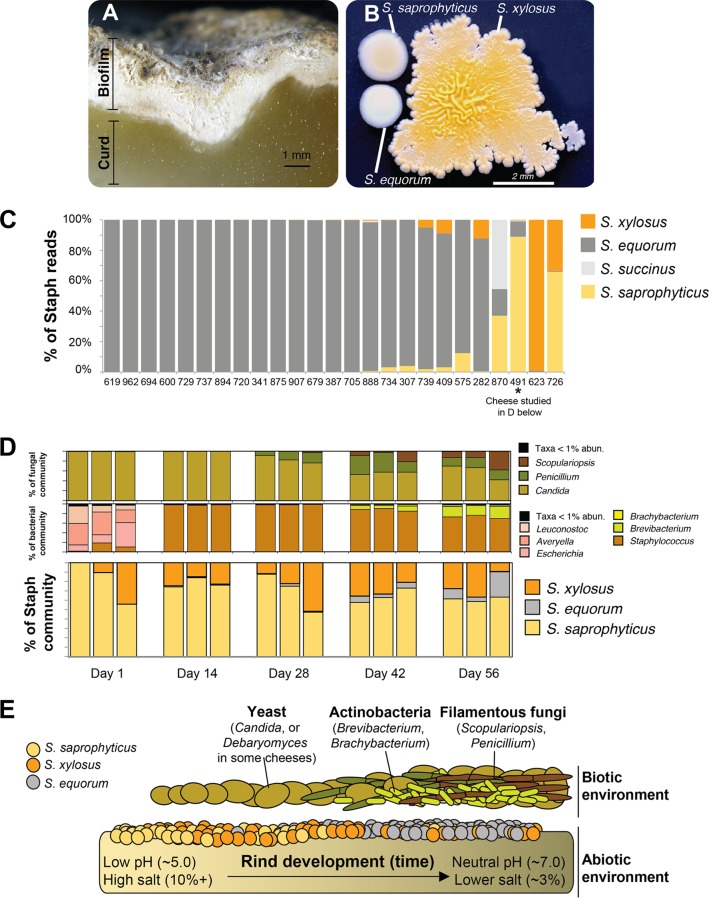
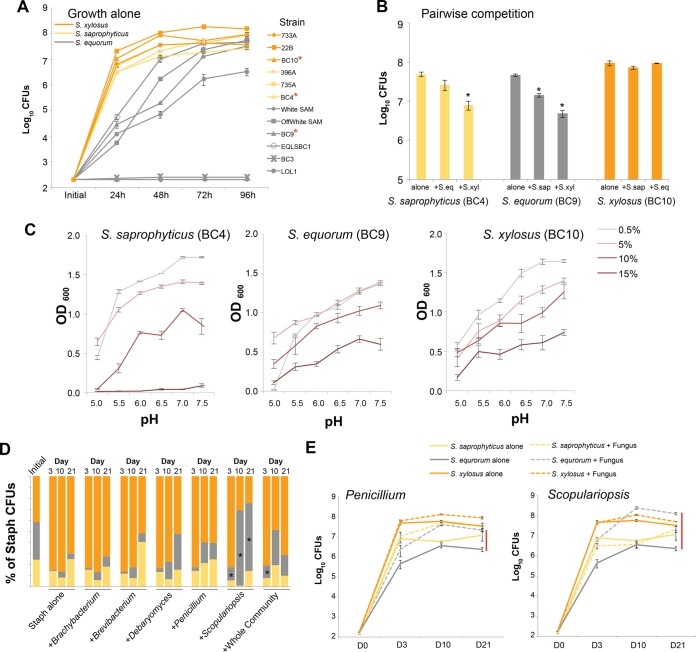
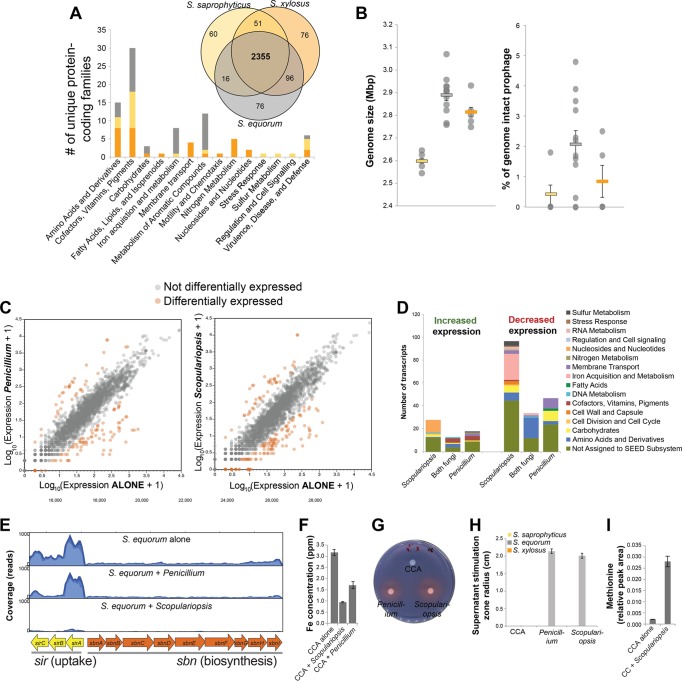
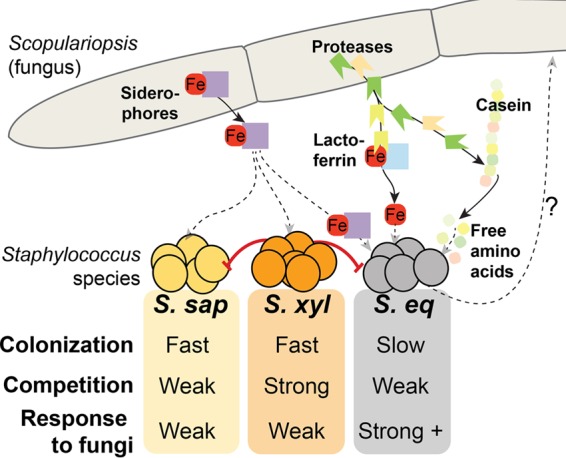
Many metagenomic sequencing studies have observed the presence of closely related bacterial species or genotypes in the same microbiome. Previous attempts to explain these patterns of microdiversity have focused on the abiotic environment, but few have considered how biotic interactions could drive patterns of microbiome diversity. We dissected the patterns, processes, and mechanisms shaping the ecological distributions of three closely related Staphylococcus species in cheese rind biofilms. Paradoxically, the most abundant species (S. equorum) is the slowest colonizer and weakest competitor based on growth and competition assays in the laboratory. Through in vitro community reconstructions, we determined that biotic interactions with neighboring fungi help resolve this paradox. Species-specific stimulation of the poor competitor by fungi of the genus Scopulariopsis allows S. equorum to dominate communities in vitro as it does in situ Results of comparative genomic and transcriptomic experiments indicate that iron utilization pathways, including a homolog of the S. aureus staphyloferrin B siderophore operon pathway, are potential molecular mechanisms underlying Staphylococcus-Scopulariopsis interactions. Our integrated approach demonstrates that fungi can structure the ecological distributions of closely related bacterial species, and the data highlight the importance of bacterium-fungus interactions in attempts to design and manipulate microbiomes. IMPORTANCE: Decades of culture-based studies and more recent metagenomic studies have demonstrated that bacterial species in agriculture, medicine, industry, and nature are unevenly distributed across time and space. The ecological processes and molecular mechanisms that shape these distributions are not well understood because it is challenging to connect in situ patterns of diversity with mechanistic in vitro studies in the laboratory. Using tractable cheese rind biofilms and a focus on coagulase-negative staphylococcus (CNS) species, we demonstrate that fungi can mediate the ecological distributions of closely related bacterial species. One of the Staphylococcus species studied, S. saprophyticus, is a common cause of urinary tract infections. By identifying processes that control the abundance of undesirable CNS species, cheese producers will have more precise control on the safety and quality of their products. More generally, Staphylococcus species frequently co-occur with fungi in mammalian microbiomes, and similar bacterium-fungus interactions may structure bacterial diversity in these systems.
Overview
The claims and statistics of this paper haven’t been checked yet.
Run the check — free, no account needed. It reads the open-access text and checks the sources it cites.
Integrity signals
Registry
Cites
Statistics
Figures
Verification
Claims the paper makes
The claims and statistics of this paper haven’t been checked yet.
Run the check — free, no account needed. It reads the open-access text and checks the sources it cites.
Claims other papers make about this one
Each is checked against this paper’s own text: does it say what the citing paper says it does?
The check wasn’t confident either way, so it gives no verdict — never disputed.
In the citing paper
“fermented meat, for instance, was characterized by L. sakei (typically present during ripening, aging, and fermentation), S. equorum , and Latilactobacillus curvatus .”
From Unexplored microbial diversity from 2,500 food metagenomes and links with the human microbiome. (2024) · cites this paper as [58]
Experimental — accuracy not yet measured
Self-check
Percentages, sums and reported differences re-computed from the paper’s own numbers.
The self-check needs the paper’s full text.
Citations
Cites
The RAST Server: Rapid Annotations using Subsystems Technology
Aziz, R. K., Bartels, D., Best, A. A., DeJongh, M., Disz, T. L., Edwards, R. A., Formsma, K., Gerdes, S., Glass, E. M., Kubal, M., et al. (2008) · BMC Genomics · doi:10.1186/1471-2164-9-75 · Cited by 11,893
Diet rapidly and reproducibly alters the human gut microbiome
David, L. A., Maurice, C. F., Carmody, R. N., Gootenberg, D. B., Button, J. E., Wolfe, B. E., Ling, A. V., Devlin, A. S., Varma, Y., Fischbach, M. A., et al. (2014) · Nature · doi:10.1038/nature12820 · Cited by 10,100
Self-citationChanges of Intestinal Functions in Liver Cirrhosis
Fukui, H., & Wiest, R. (2016) · Inflammatory Intestinal Diseases · doi:10.1159/000444436 · Cited by 6,820
Universal chemical assay for the detection and determination of siderophores
Schwyn, B., & Neilands, J. B. (1987) · Analytical Biochemistry · doi:10.1016/0003-2697(87)90612-9 · Cited by 6,581
Host-Bacterial Mutualism in the Human Intestine
Bäckhed, F., Ley, R. E., Sonnenburg, J. L., Peterson, D. A., & Gordon, J. I. (2005) · Science · doi:10.1126/science.1104816 · Cited by 5,277
Urinary tract infections: epidemiology, mechanisms of infection and treatment options
Flores‐Mireles, A. L., Walker, J. N., Caparon, M. G., & Hultgren, S. J. (2015) · Nature Reviews Microbiology · doi:10.1038/nrmicro3432 · Cited by 4,343
Microbial interactions: from networks to models
Faust, K., & Raes, J. (2012) · Nature Reviews Microbiology · doi:10.1038/nrmicro2832 · Cited by 4,268
Using network analysis to explore co-occurrence patterns in soil microbial communities
Barberán, A., Bates, S. T., Casamayor, E. O., & Fierer, N. (2012) · The ISME Journal · doi:10.1038/ismej.2011.119 · Cited by 3,044
Bacterial competition: surviving and thriving in the microbial jungle
Hibbing, M. E., Fuqua, C., Parsek, M. R., & Peterson, S. B. (2009) · Nature Reviews Microbiology · doi:10.1038/nrmicro2259 · Cited by 2,765
Competition and Biodiversity in Spatially Structured Habitats
Tilman, D. (1994) · Ecology · doi:10.2307/1939377 · Cited by 2,758
Cited by
Sorted by citations
Bacterial–fungal interactions: ecology, mechanisms and challenges
Deveau, A., Bonito, G. M., Uehling, J., Paoletti, M., Becker, M., Bindschedler, S., Hacquard, S., Hervé, V., Labbé, J., Lastovetsky, O. A., et al. (2018) · FEMS Microbiology Reviews · doi:10.1093/femsre/fuy008 · Cited by 823
Effect of Pichia on shaping the fermentation microbial community of sauce-flavor Baijiu
Zhang, H., Wang, L., Tan, Y., Wang, H., Yang, F., Chen, L., Hao, F., Lv, X., Du, H., & Xu, Y. (2020) · International Journal of Food Microbiology · doi:10.1016/j.ijfoodmicro.2020.108898 · Cited by 210
Zhang, Y., Kastman, E. K., Guasto, J., & Wolfe, B. E. (2018) · Nature Communications · doi:10.1038/s41467-017-02522-z · Cited by 149
Self-citationMayo, B., Rodríguez, J., Vázquez, L., & Flórez, A. B. (2021) · Foods · doi:10.3390/foods10030602 · Cited by 169
Unexplored microbial diversity from 2,500 food metagenomes and links with the human microbiome.
Carlino, N., Blanco-Míguez, A., Punčochář, M., Mengoni, C., Pinto, F., Tatti, A., Manghi, P., Armanini, F., Avagliano, M., Barcenilla, C., et al. (2024) · Cell · doi:10.1016/j.cell.2024.07.039 · Cited by 146
Metadata
- Authors
- Kastman, E. K., Kamelamela, N., Norville, J. W., Cosetta, C. M., Dutton, R. J., & Wolfe, B. E.
- Affiliations
- Tufts University (US)
- University of California San Diego (US)
- Corresponding author
- Wolfe, Benjamin E.
- Venue
- mBio
- Publisher
- American Society for Microbiology
- Published
- 2016-11-02
- Volume
- 7
- Issue
- 5
- ISSN
- 2150-7511 (ISSN-L)
- 2161-2129
- PMC
- PMC5082897
- OpenAlex
- W2538439703
- Cited by
- 127
- References
- 88
- Citations by year
- 2026: 7 · 2025: 14 · 2024: 14 · 2023: 18 · 2022: 4 · 2021: 15 · 2020: 13 · 2019: 14 · 2018: 18 · 2017: 9 · 2016: 1
- FWCI
- 12.24
- Type
- journal article
- Language
- en
- Update notices
- correction (2017-03-21)
- Open access
- gold
- doi.org
- Licence
- Locations
- mBio (publishedVersion, cc-by)
- PubMed Central (publishedVersion, cc-by)
- PubMed (publishedVersion)
- eScholarship (California Digital Library) (submittedVersion, cc-by)
- DOAJ (DOAJ: Directory of Open Access Journals) (submittedVersion, cc-by-sa)
- DOAJ (DOAJ: Directory of Open Access Journals) (submittedVersion)
- eScholarship (California Digital Library) (submittedVersion)
- Funders
- HHS | National Institutes of Health (P50 GM068763)
- Tufts University
- UC | University of California, San Diego
- Topics
- Physical Sciences › Environmental Science › Ecology › Microbial Community Ecology and Physiology
- Life Sciences › Biochemistry, Genetics and Molecular Biology › Molecular Biology › Bacterial biofilms and quorum sensing
- Health Sciences › Medicine › Infectious Diseases › Antimicrobial Resistance in Staphylococcus
- Keywords
- Staphylococcus, Staphylococcus equorum, Staphylococcus saprophyticus, Scopulariopsis, coagulase-negative staphylococci, ecological distribution, bacterial competition, colonization, iron utilization, siderophores, microbiota composition, urinary tract infection
- MeSH terms
- Food Microbiology, Iron, Staphylococcus, Gene Expression Profiling, Genomics, Microbial Interactions, Biota, Scopulariopsis
About these checks
Registry, retraction, Cites and statistics results are computed, not judged, with one exception: a printed reference that no index lists is read once by a model before it counts as a citation error. Claims are extracted by a model and kept only when their quote appears verbatim in the text; each cited source is then checked, with a model’s help, for whether it says what the claim relies on. Those verdicts can be wrong — read the claim’s quote and the cited source before relying on one.
Statistics and arithmetic are recomputed, not judged.
Confidence bands are shown only for fields calibrated on our annotated test set. None is calibrated yet, so no band is shown.
What counts as a claim ›How we measure confidence ›How we check this ›
Are you an author, or do you see a problem with this page? Request a review
