

Live Imaging of Host-Parasite Interactions in a Zebrafish Infection Model Reveals Cryptococcal Determinants of Virulence and Central Nervous System Invasion
Open accessThe DOI matches its Crossref record; 40 of the 40 references it cites were found in a registry or an index.
Abstract
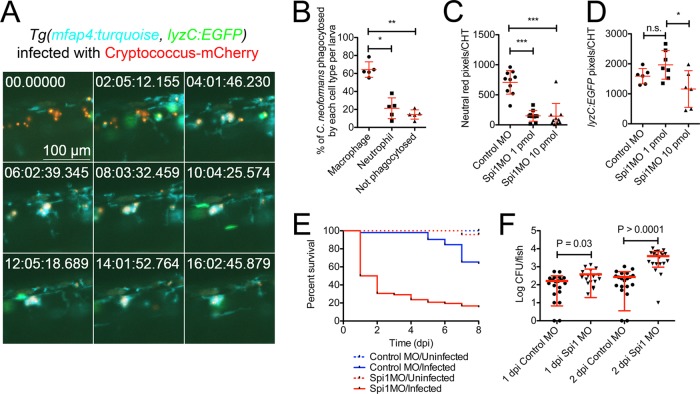
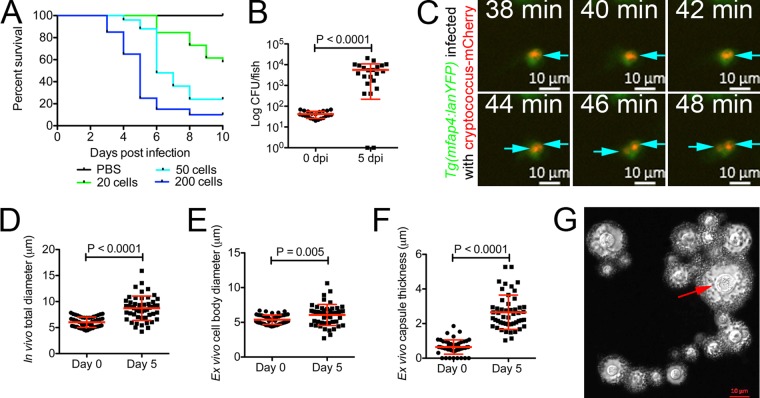
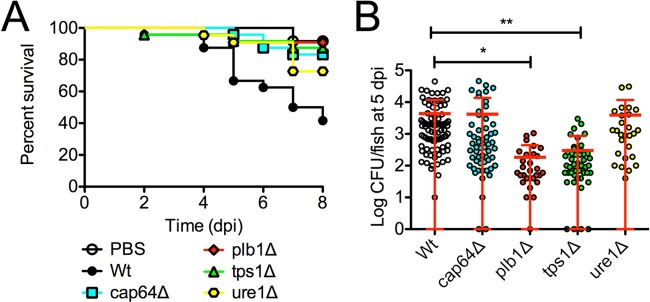
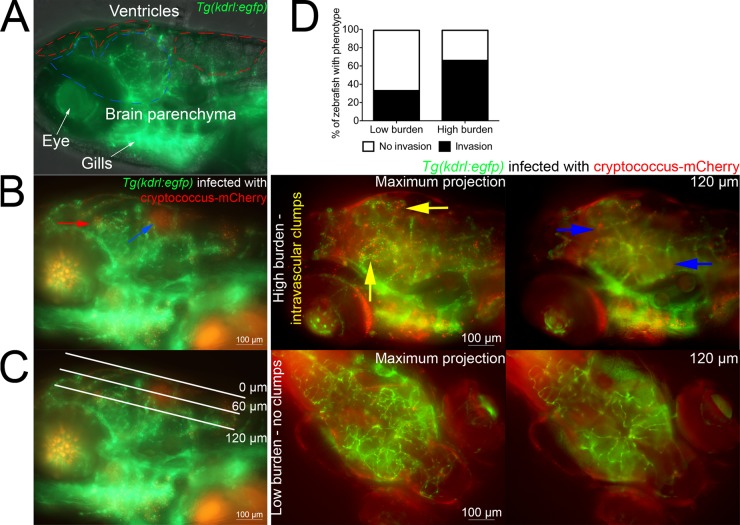
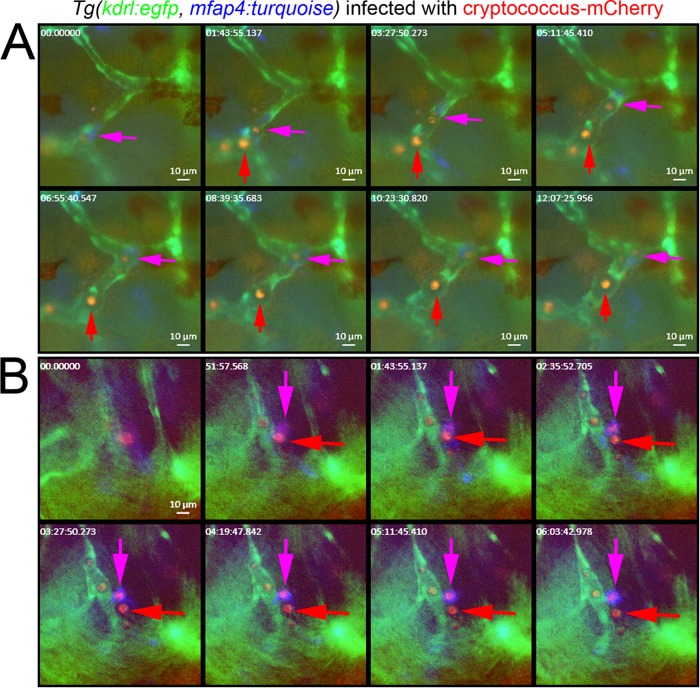
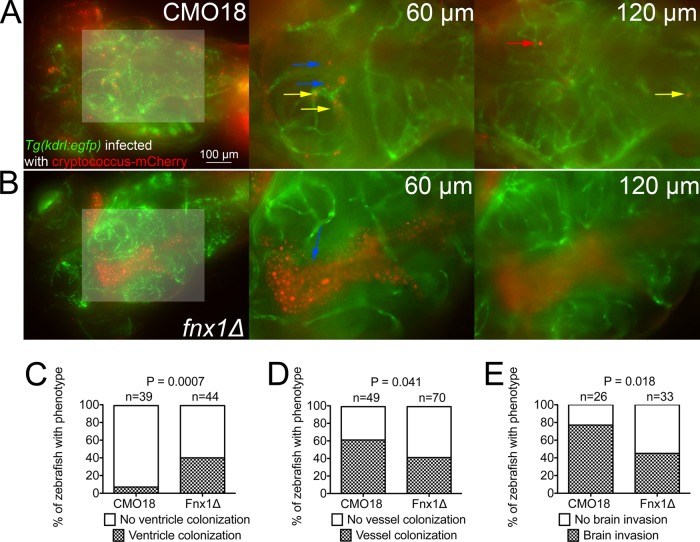
The human fungal pathogen Cryptococcus neoformans is capable of infecting a broad range of hosts, from invertebrates like amoebas and nematodes to standard vertebrate models such as mice and rabbits. Here we have taken advantage of a zebrafish model to investigate host-pathogen interactions of Cryptococcus with the zebrafish innate immune system, which shares a highly conserved framework with that of mammals. Through live-imaging observations and genetic knockdown, we establish that macrophages are the primary immune cells responsible for responding to and containing acute cryptococcal infections. By interrogating survival and cryptococcal burden following infection with a panel of Cryptococcus mutants, we find that virulence factors initially identified as important in causing disease in mice are also necessary for pathogenesis in zebrafish larvae. Live imaging of the cranial blood vessels of infected larvae reveals that C. neoformans is able to penetrate the zebrafish brain following intravenous infection. By studying a C. neoformans FNX1 gene mutant, we find that blood-brain barrier invasion is dependent on a known cryptococcal invasion-promoting pathway previously identified in a murine model of central nervous system invasion. The zebrafish- C. neoformans platform provides a visually and genetically accessible vertebrate model system for cryptococcal pathogenesis with many of the advantages of small invertebrates. This model is well suited for higher-throughput screening of mutants, mechanistic dissection of cryptococcal pathogenesis in live animals, and use in the evaluation of therapeutic agents. IMPORTANCE Cryptococcus neoformans is an important opportunistic pathogen that is estimated to be responsible for more than 600,000 deaths worldwide annually. Existing mammalian models of cryptococcal pathogenesis are costly, and the analysis of important pathogenic processes such as meningitis is laborious and remains a challenge to visualize. Conversely, although invertebrate models of cryptococcal infection allow high-throughput assays, they fail to replicate the anatomical complexity found in vertebrates and, specifically, cryptococcal stages of disease. Here we have utilized larval zebrafish as a platform that overcomes many of these limitations. We demonstrate that the pathogenesis of C. neoformans infection in zebrafish involves factors identical to those in mammalian and invertebrate infections. We then utilize the live-imaging capacity of zebrafish larvae to follow the progression of cryptococcal infection in real time and establish a relevant model of the critical central nervous system infection phase of disease in a nonmammalian model.
Overview
The claims and statistics of this paper haven’t been checked yet.
Free: it reads the open-access text and checks the first 5 claims that cite a source we can check. Create a free account to check every claim.
Integrity signals
Registry
Cites
Statistics
Figures
Verification
Claims the paper makes
The claims and statistics of this paper haven’t been checked yet.
Free: it reads the open-access text and checks the first 5 claims that cite a source we can check. Create a free account to check every claim.
Claims other papers make about this one
Each is checked against this paper’s own text: does it say what the citing paper says it does?
The cited source says what the claim attributes to it.
In the citing paper
“In this regard, intravital microscopy has been recently used to study fungal dissemination through the imaging of dynamic interactions between fungal cells and endothelial cells as well as phagocytes [17, 91–93, 116, 129, 229].”
From Mechanisms of fungal dissemination (2021) · cites this paper as [229]
Self-check
Percentages, sums and reported differences re-computed from the paper’s own numbers.
The self-check needs the paper’s full text.
Citations
Cites
Park, B. J., Wannemuehler, K. A., Marston, B. J., Govender, N., Pappas, P. G., & Chiller, T. M. (2009) · AIDS · doi:10.1097/qad.0b013e328322ffac · Cited by 2,014
mpeg1 promoter transgenes direct macrophage-lineage expression in zebrafish
Ellett, F., Pase, L., Hayman, J. W., Andrianopoulos, A., & Lieschke, G. J. (2011) · Blood · doi:10.1182/blood-2010-10-314120 · Cited by 1,077 · cited 1×
“Although this macrophage predominance is a fairly common response to microbial infection in zebrafish, differential roles have been observed for macrophages and neutrophils in containing fungal infections in zebrafish (34, 35).”
BackgroundThe zebrafish lysozyme C promoter drives myeloid-specific expression in transgenic fish
Hall, C., Flores, M. V., Storm, T., Crosier, K., & Crosier, P. (2007) · BMC Developmental Biology · doi:10.1186/1471-213x-7-42 · Cited by 591 · cited 1×
“To simultaneously image cryptococci, macrophages, and neutrophils, we made use of double transgenic Tg(lyzC:EGFPNZ117, mfap4:turquoisext27) animals, in which macrophages are marked by expression of turquoise from the mfap4 promoter and neutrophils are marked by the expression of enhanced green fluorescent protein (EGF…”
BackgroundThe lta4h Locus Modulates Susceptibility to Mycobacterial Infection in Zebrafish and Humans
Tobin, D. M., Vary, J. C., Ray, J. P., Walsh, G. S., Dunstan, S. J., Bang, N. D., Hagge, D. A., Khadge, S., King, M.-C., Hawn, T. R., et al. (2010) · Cell · doi:10.1016/j.cell.2010.02.013 · Cited by 528
Self-citationUrease as a Virulence Factor in Experimental Cryptococcosis
Cox, G. M., Mukherjee, J., Cole, G. T., Casadevall, A., & Perfect, J. R. (2000) · Infection and Immunity · doi:10.1128/iai.68.2.443-448.2000 · Cited by 522 · cited 12×
“However, the urel mutant survives normally when directly inoculated into the CNS of rabbits and mice (26, 28).”
BackgroundInfluentialSelf-citationChapter 4 The Capsule of the Fungal Pathogen Cryptococcus neoformans
Zaragoza, O., Rodrigues, M. L., De Jesus, M., Frases, S., Dadachova, E., & Casadevall, A. (2009) · Advances in Applied Microbiology · doi:10.1016/s0065-2164(09)01204-0 · Cited by 457 · cited 1×
“The capsule surrounds the cell wall and is a critical virulence factor with a multitude of effects in the host, including preventing phagocytosis by macrophages (16).”
BackgroundSystematic Genetic Analysis of Virulence in the Human Fungal Pathogen Cryptococcus neoformans
Liu, O. W., Chun, C. D., Chow, E. D., Chen, C., Madhani, H. D., & Noble, S. M. (2008) · Cell · doi:10.1016/j.cell.2008.07.046 · Cited by 443 · cited 1×
“cap64 (39), ure1 (28), plb1 (21), and fnx1 (33) mutants (33, 40).”
Galleria mellonella as a Model System To Study Cryptococcus neoformans Pathogenesis
Mylonakis, E., Moreno, R., El Khoury, J. B., Idnurm, A., Heitman, J., Calderwood, S. B., Ausubel, F. M., & Diener, A. (2005) · Infection and Immunity · doi:10.1128/iai.73.7.3842-3850.2005 · Cited by 433
Cryptococcus neoformans Is a Facultative Intracellular Pathogen in Murine Pulmonary Infection
Feldmesser, M., Kress, Y., Novikoff, P., & Casadevall, A. (2000) · Infection and Immunity · doi:10.1128/iai.68.7.4225-4237.2000 · Cited by 423 · cited 2×
“However, neither mammalian model allows real-time visualization of the dynamic interaction between innate immune cells and yeasts at distinct sites within the host, and neither model allows easy interrogation of large numbers of wild-type strains and mutants for screening and comparative purposes (3, 4).”
BackgroundExtracellular phospholipase activity is a virulence factor for Cryptococcus neoformans
Cox, G. M., McDade, H. C., Chen, S. C. A., Tucker, S. C., Gottfredsson, M., Wright, L. C., Sorrell, T. C., Leidich, S. D., Casadevall, A., Ghannoum, M. A., et al. (2001) · Molecular Microbiology · doi:10.1046/j.1365-2958.2001.02236.x · Cited by 362 · cited 2×
“(ii) PLB1 encodes a secreted phospholipase B that may function in multiple processes that contribute to disease within the host, including survival in macrophages and/or possible nutrient acquisition through breakdown of host phospholipids of the phagosome, and the plbl deletion mutant is avirulent in the murine syste…”
BackgroundSelf-citation
Cited by
Antifungal Therapy: New Advances in the Understanding and Treatment of Mycosis
Scorzoni, L., de Paula e Silva, A. C. A., Marcos, C. M., Assato, P. A., de Melo, W. C. M. A., de Oliveira, H. C., Costa-Orlandi, C. B., Mendes-Giannini, M. J. S., & Fusco-Almeida, A. M. (2017) · Frontiers in Microbiology · doi:10.3389/fmicb.2017.00036 · Cited by 418
Bojarczuk, A., Miller, K. A., Hotham, R., Lewis, A., Ogryzko, N. V., Kamuyango, A. A., Frost, H., Gibson, R. H., Stillman, E., May, R. C., et al. (2016) · Scientific Reports · doi:10.1038/srep21489 · Cited by 170
Wang, F., Han, R., & Chen, S. (2023) · Clinical Microbiology Reviews · doi:10.1128/cmr.00051-22 · Cited by 153
Fu, M. S., Coelho, C., De Leon-Rodriguez, C. M., Rossi, D. C. P., Camacho, E., Jung, E. H., Kulkarni, M., & Casadevall, A. (2018) · PLOS Pathogens · doi:10.1371/journal.ppat.1007144 · Cited by 138
Zebrafish as an alternative animal model in human and animal vaccination research
Bailone, R. L., Fukushima, H. C. S., Fernandes, B. H. V., de Aguiar, L. K., Corrêa, T., Janke, H., Setti, P. G., Roça, R. D. O., & Borra, R. C. (2020) · Laboratory Animal Research · doi:10.1186/s42826-020-00042-4 · Cited by 136
Metadata
- Authors
- Tenor, J. L., Oehlers, S. H., Yang, J. L., Tobin, D. M., & Perfect, J. R.
- Affiliations
- Duke Medical Center (US)
- Corresponding author
- Tobin, David M.
- Perfect, John R.
- Venue
- mBio
- Publisher
- American Society for Microbiology
- Published
- 2015-10-30
- Volume
- 6
- Issue
- 5
- Pages
- e01425-15
- ISSN
- 2150-7511 (ISSN-L)
- 2161-2129
- PMC
- PMC4611042
- OpenAlex
- W2131056555
- Cited by
- 78
- References
- 40
- Citations by year
- 2026: 3 · 2025: 5 · 2024: 6 · 2023: 8 · 2022: 5 · 2021: 8 · 2020: 10 · 2019: 5 · 2018: 6 · 2017: 9 · 2016: 13
- FWCI
- 7.32
- Type
- journal article
- Language
- en
- Open access
- gold
- doi.org
- Licence
- cc-by-nc-sa
- creativecommons.org/licenses/by-nc-sa/3.0/ (vor)
- journals.asm.org/non-commercial-tdm-license (tdm)
- Locations
- mBio (publishedVersion, cc-by-nc-sa)
- Europe PMC (PubMed Central) (publishedVersion, cc-by-nc-sa)
- PubMed Central (publishedVersion, cc-by-nc-sa)
- PubMed (publishedVersion)
- DOAJ (DOAJ: Directory of Open Access Journals) (submittedVersion, cc-by-sa)
- DukeSpace (Duke University) (submittedVersion)
- Funders
- Vallee Foundation
- National Institutes of Health (1dp2od008614-01, AI064518)
- Center for AIDS Research, Duke University (5P30-AI064518, AI 064518)
- Center for AIDS Research, University of Washington
- Medical Research Council
- National Health and Medical Research Council
- National Institute of Allergy and Infectious Diseases (R01AI073896, R01AI093257, P30AI064518)
- Topics
- Health Sciences › Medicine › Infectious Diseases › Fungal Infections and Studies
- Life Sciences › Biochemistry, Genetics and Molecular Biology › Cell Biology › Zebrafish Biomedical Research Applications
- Health Sciences › Medicine › Infectious Diseases › Antifungal resistance and susceptibility
- Keywords
- Cryptococcus neoformans, cryptococcosis, zebrafish infection model, host-pathogen interaction, virulence factors, macrophages, innate immunity, central nervous system infiltration, blood-brain barrier, meningitis, live imaging, cranial blood vessels, fungal pathogenesis, opportunistic fungal infection, zebrafish larvae
- MeSH terms
- Animals, Central Nervous System, Cryptococcosis, Cryptococcus neoformans, Disease Models, Animal, DNA Mutational Analysis, Host-Parasite Interactions, Larva, Macrophages, Virulence, Zebrafish, Survival Analysis, Virulence Factors, Gene Knockdown Techniques, Optical Imaging
About these checks
Registry, retraction, Cites and statistics results are computed, not judged, with one exception: a printed reference that no index lists is read once by a model before it counts as a citation error. Claims are extracted by a model and kept only when their quote appears verbatim in the text; each cited source is then checked, with a model’s help, for whether it says what the claim relies on. Those verdicts can be wrong — read the claim’s quote and the cited source before relying on one.
Statistics and arithmetic are recomputed, not judged.
Confidence bands are shown only for fields calibrated on our annotated test set. None is calibrated yet, so no band is shown.
What counts as a claim ›How we measure confidence ›How we check this ›
Are you an author, or do you see a problem with this page? Request a review
Data sources
Bibliographic data: Semantic Scholar, OpenAlex, Crossref.
Contains information from the Semantic Scholar Academic Graph Datasets, made available under the ODC Attribution License (ODC-BY 1.0).
Semantic Scholar’s data is described in: Kinney, R., et al. (2023). The Semantic Scholar Open Data Platform. arXiv:2301.10140.
