

The DOI matches its Crossref record; 31 of the 31 references it cites were found in a registry or an index; none of the 24 sources its claims cite is checked for support yet.
Timing of the decline in physical activity in childhood and adolescence: Gateshead Millennium Cohort Study
Open accessAbstract
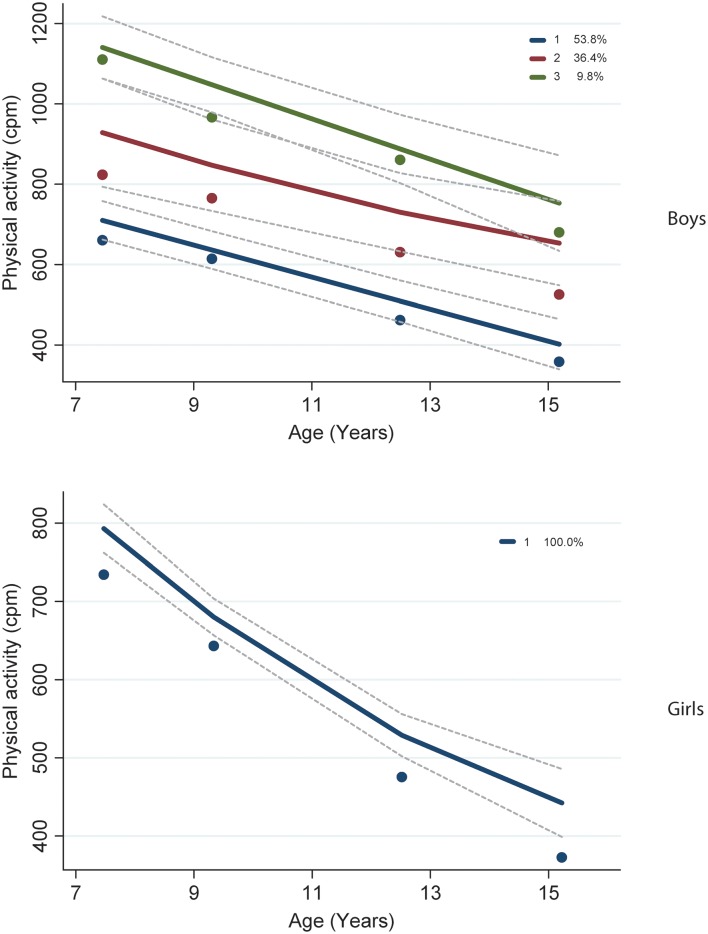
Background and aim: There is a widely held and influential view that physical activity begins to decline at adolescence. This study aimed to identify the timing of changes in physical activity during childhood and adolescence. Methods: Longitudinal cohort study (Gateshead Millennium Study) with 8 years of follow-up, from North-East England. Cohort members comprise a socioeconomically representative sample studied at ages 7, 9, 12 and 15 years; 545 individuals provided physical activity data at two or more time points. Habitual total volume of physical activity and moderate-to-vigorous intensity physical activity (MVPA) were quantified objectively using the Actigraph accelerometer over 5–7 days at the four time points. Linear mixed models identified the timing of changes in physical activity across the 8-year period, and trajectory analysis was used to identify subgroups with distinct patterns of age-related changes. Results: Four trajectories of change in total volume of physical activity were identified representing 100% of all participants: all trajectories declined from age 7 years. There was no evidence that physical activity decline began at adolescence, or that adolescent declines in physical activity were substantially greater than the declines during childhood, or greater in girls than boys. One group (19% of boys) had relatively high MVPA which remained stable between ages 7 and15 years. Conclusions: Future policy and research efforts to promote physical activity should begin well before adolescence, and should include both boys and girls.
Overview
AI snapshot
Written from the paper’s full text.
TL;DR
In the Gateshead Millennium Study, objectively measured physical activity was already declining by age 7 years in both boys and girls, with no evidence that the decline began or accelerated specifically at adolescence. The findings challenge the orthodox focus on adolescent girls as the main high-risk group for low physical activity.
Key findings
- Total physical activity declined from age 7 years in all identified trajectories: boys had three distinct trajectories and girls had one, together representing 100% of participants; no trajectory showed high childhood levels followed by a sharp adolescent decline.
- Mean total physical activity fell from 780 cpm at age 7 to 482 cpm at age 15 in boys, and from 746 cpm to 400 cpm in girls; MVPA fell from 75.5 to 51.4 min/day in boys and from 63.4 to 41.0 min/day in girls.
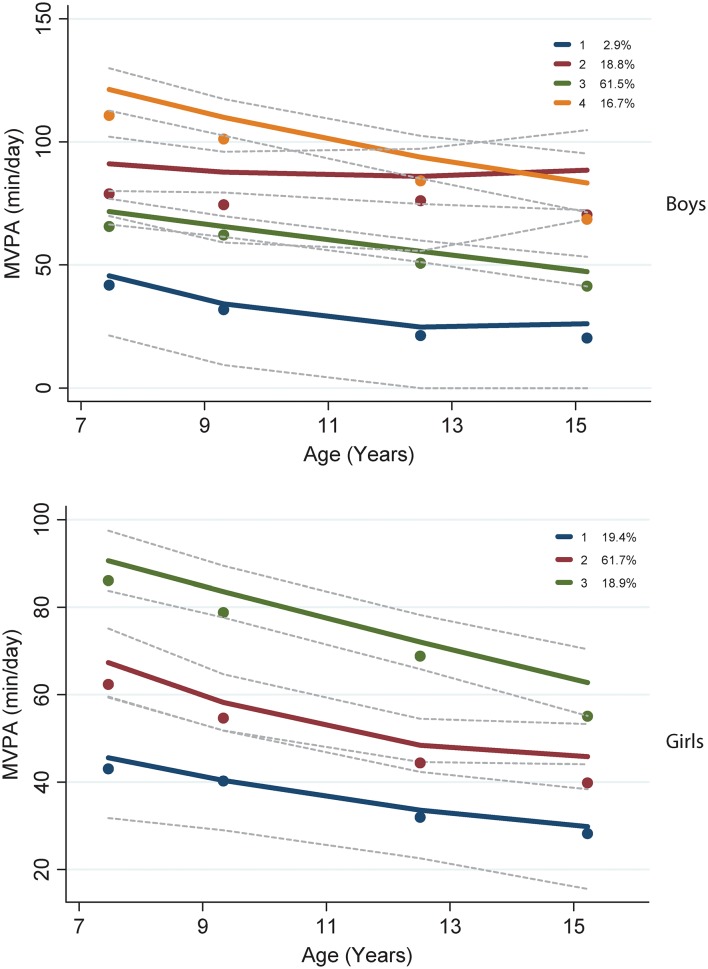
- MVPA trajectories were more complex: in boys, 3% had low and relatively stable/slowly declining MVPA, 17% had initially high but rapidly declining MVPA, 61% declined gradually, and 19% had relatively high and stable or increasing MVPA; in girls, 19% had low and relatively stable/modest declines, 62% declined gradually, and 19% had high initial MVPA with steeper declines.
- There was no evidence that physical activity decline began at adolescence, was substantially greater during adolescence than childhood, or was greater in girls than boys.
Methods
- Longitudinal cohort study (Gateshead Millennium Study) in North-East England, with follow-up at ages 7, 9, 12 and 15 years; 545 individuals provided physical activity data at two or more time points, and 217 at all four time points.
- Habitual total physical activity and MVPA were measured objectively with Actigraph GT1M accelerometers over 5–7 days at each time point; MVPA used a cut-point of 574 counts per 15 s, with a +9% correction applied to raw data, and age-15 data adjusted for season.
- Linear mixed models in SPSS described age-related changes; group-based trajectory modelling in STATA (Traj module) identified distinct trajectories, modelled separately for boys and girls using BIC and posterior probabilities.
Limitations
- The paper states that generalisability may be limited to populations with substantially different physical, social and/or policy environments; it also states that why changes occur was beyond scope, direct biological measures such as pubertal maturation were unavailable, the 3% boys subgroup needs confirmation in other populations, and measurement timing was largely determined by funding availability.
- Evident from the text: sample size declined across time points (431 at age 7 to 278 at age 15), and accelerometry excluded water-based activities, so some activity may be unmeasured.
Model-written summary. Check it against the paper before relying on it.
Integrity signals
Registry
Cites
Statistics
Figures
Verification
Claims the paper makes
14 Not checked yet · 12 Own result · 6 Own method · 5 Own interpretation · 1 No basis given
A result the paper reports from its own data — it cites no other source for it, so there is none to check. The quote shows it is in the paper.
In the paper
“There was no evidence that physical activity decline began at adolescence, or that adolescent declines in physical activity were substantially greater than the declines during childhood, or greater in girls than boys.”
§ Timing of the decline in physical activity in childhood and adolescence: Gateshead Millennium Cohort Study > Abstract > Results
plain- Asserted: passes — The authors put it forward as true.
- Checkable: passes — It can be checked against evidence.
- Load-bearing: passes — The paper’s conclusions depend on it.
- Based: passes — The paper gives a reason why it holds.
A result the paper reports from its own data — it cites no other source for it, so there is none to check. The quote shows it is in the paper.
In the paper
“None of the trajectories of MVPA in either boys or girls were characterised by high and stable childhood values followed by sharp adolescent declines.”
§ Timing of the decline in physical activity in childhood and adolescence: Gateshead Millennium Cohort Study > Results > Changes in physical activity analysed longitudinally using trajectory analysis
plain- Asserted: passes — The authors put it forward as true.
- Checkable: passes — It can be checked against evidence.
- Load-bearing: passes — The paper’s conclusions depend on it.
- Based: passes — The paper gives a reason why it holds.
A result the paper reports from its own data — it cites no other source for it, so there is none to check. The quote shows it is in the paper.
In the paper
“In boys, four distinct subgroups were identified: low and relatively stable/slowly declining MVPA from age 7 years across the 8 years (3% of the sample); initially high at age 7 years, but rapidly declining from age 7 years (17% of the sample); gradually declining from age 7 years (61% of the sample); relatively high and stable or increasing from age 7 years (19% of the sample).”
§ Timing of the decline in physical activity in childhood and adolescence: Gateshead Millennium Cohort Study > Results > Changes in physical activity analysed longitudinally using trajectory analysis
plain- Asserted: passes — The authors put it forward as true.
- Checkable: passes — It can be checked against evidence.
- Load-bearing: passes — The paper’s conclusions depend on it.
- Based: passes — The paper gives a reason why it holds.
A result the paper reports from its own data — it cites no other source for it, so there is none to check. The quote shows it is in the paper.
In the paper
“Four trajectories of change in total volume of physical activity were identified representing 100% of all participants: all trajectories declined from age 7 years.”
§ Timing of the decline in physical activity in childhood and adolescence: Gateshead Millennium Cohort Study > Abstract > Results
plain- Asserted: passes — The authors put it forward as true.
- Checkable: passes — It can be checked against evidence.
- Load-bearing: passes — The paper’s conclusions depend on it.
- Based: passes — The paper gives a reason why it holds.
A result the paper reports from its own data — it cites no other source for it, so there is none to check. The quote shows it is in the paper.
In the paper
“One group (19% of boys) had relatively high MVPA which remained stable between ages 7 and15 years.”
- Also stated in: § Main study findings and implications · hedged
“in around 19% of boys MVPA was relatively high and fairly stable across the 8-year period.”
§ Timing of the decline in physical activity in childhood and adolescence: Gateshead Millennium Cohort Study > Abstract > Results
plain- Asserted: passes — The authors put it forward as true.
- Checkable: passes — It can be checked against evidence.
- Load-bearing: unclear — It is unclear whether the paper’s conclusions depend on it.
- Based: passes — The paper gives a reason why it holds.
- Also stated in: § Main study findings and implications · hedged
A result the paper reports from its own data — it cites no other source for it, so there is none to check. The quote shows it is in the paper.
In the paper
“None of the trajectories of total volume of physical activity showed initial high levels followed by sharp adolescent declines.”
§ Timing of the decline in physical activity in childhood and adolescence: Gateshead Millennium Cohort Study > Results > Changes in physical activity analysed longitudinally using trajectory analysis
plain- Asserted: passes — The authors put it forward as true.
- Checkable: passes — It can be checked against evidence.
- Load-bearing: passes — The paper’s conclusions depend on it.
- Based: passes — The paper gives a reason why it holds.
A result the paper reports from its own data — it cites no other source for it, so there is none to check. The quote shows it is in the paper.
In the paper
“There was no evidence that physical activity decline began at adolescence, or that adolescent declines in physical activity were substantially greater than the declines during childhood, or greater in girls than boys.”
§ Timing of the decline in physical activity in childhood and adolescence: Gateshead Millennium Cohort Study > Abstract > Results
plain- Asserted: passes — The authors put it forward as true.
- Checkable: passes — It can be checked against evidence.
- Load-bearing: passes — The paper’s conclusions depend on it.
- Based: passes — The paper gives a reason why it holds.
A result the paper reports from its own data — it cites no other source for it, so there is none to check. The quote shows it is in the paper.
In the paper
“Four trajectories of change in total volume of physical activity were identified representing 100% of all participants: all trajectories declined from age 7 years.”
- Also stated in: § Changes in physical activity analysed longitudinally using trajectory analysis · plain
“in all three subgroups, representing 100% of the sample, the total volume of physical activity declined across the 8-year period from age 7 years; in the girls a single trajectory of declining total physical activity across the 8-year period from age 7 years characterised all study participants.”
§ Timing of the decline in physical activity in childhood and adolescence: Gateshead Millennium Cohort Study > Abstract > Results
plain- Asserted: passes — The authors put it forward as true.
- Checkable: passes — It can be checked against evidence.
- Load-bearing: passes — The paper’s conclusions depend on it.
- Based: passes — The paper gives a reason why it holds.
- Also stated in: § Changes in physical activity analysed longitudinally using trajectory analysis · plain
A result the paper reports from its own data — it cites no other source for it, so there is none to check. The quote shows it is in the paper.
In the paper
“in the girls a single trajectory of declining total physical activity across the 8-year period from age 7 years characterised all study participants.”
§ Timing of the decline in physical activity in childhood and adolescence: Gateshead Millennium Cohort Study > Results > Changes in physical activity analysed longitudinally using trajectory analysis
plain- Asserted: passes — The authors put it forward as true.
- Checkable: passes — It can be checked against evidence.
- Load-bearing: passes — The paper’s conclusions depend on it.
- Based: passes — The paper gives a reason why it holds.
A result the paper reports from its own data — it cites no other source for it, so there is none to check. The quote shows it is in the paper.
In the paper
“Three distinct trajectories were identified: low and relatively stable/with modest declines (19%); gradually declining from age 7 years (62%); high initial MVPA with steeper declines from age 7 years (19%).”
§ Timing of the decline in physical activity in childhood and adolescence: Gateshead Millennium Cohort Study > Results > Changes in physical activity analysed longitudinally using trajectory analysis
plain- Asserted: passes — The authors put it forward as true.
- Checkable: passes — It can be checked against evidence.
- Load-bearing: passes — The paper’s conclusions depend on it.
- Based: passes — The paper gives a reason why it holds.
- It may state two separate claims as one. 10
- Probably not a substantial claim. 11
A conclusion the paper draws from its own results — it cites no other source for it, so there is none to check. The quote shows it is in the paper.
In the paper
“The present study found that 100% of boys and girls fitted into longitudinal trajectories which were inconsistent with the orthodox view that physical activity begins to decline at adolescence, declines much more rapidly at adolescence and/or declines much more rapidly in adolescent girls than boys.”
§ Timing of the decline in physical activity in childhood and adolescence: Gateshead Millennium Cohort Study > Discussion > Main study findings and implications
plain- Asserted: passes — The authors put it forward as true.
- Checkable: passes — It can be checked against evidence.
- Load-bearing: passes — The paper’s conclusions depend on it.
- Based: passes — The paper gives a reason why it holds.
It may state two separate claims as one.
A conclusion the paper draws from its own results — it cites no other source for it, so there is none to check. The quote shows it is in the paper.
In the paper
“One weakness may be generalisability to populations with substantially different physical, social and/or policy environments.”
§ Timing of the decline in physical activity in childhood and adolescence: Gateshead Millennium Cohort Study > Discussion > Study strengths and weaknesses
hedged- Asserted: passes — The authors put it forward as true.
- Checkable: fails — It may be too vague to check against evidence.
- Load-bearing: fails — The paper’s conclusions may not depend on it.
- Based: passes — The paper gives a reason why it holds.
Probably not a substantial claim. It may be too vague to check against evidence. The paper’s conclusions may not depend on it.
What the paper did — it cites no source for this, so there is none to check. The quote shows it is in the paper.
In the paper
“The main strengths of the present study were the longitudinal design, the high quality objective measures of physical activity, the socioeconomically representative sample and the contemporary nature of the cohort.”
§ Timing of the decline in physical activity in childhood and adolescence: Gateshead Millennium Cohort Study > Discussion > Study strengths and weaknesses
plain- Asserted: passes — The authors put it forward as true.
- Checkable: passes — It can be checked against evidence.
- Load-bearing: fails — The paper’s conclusions may not depend on it.
- Based: passes — The paper gives a reason why it holds.
Probably not a substantial claim. The paper’s conclusions may not depend on it.
What the paper did — it cites no source for this, so there is none to check. The quote shows it is in the paper.
In the paper
“The main strengths of the present study were the longitudinal design, the high quality objective measures of physical activity, the socioeconomically representative sample and the contemporary nature of the cohort.”
§ Timing of the decline in physical activity in childhood and adolescence: Gateshead Millennium Cohort Study > Discussion > Study strengths and weaknesses
plain- Asserted: passes — The authors put it forward as true.
- Checkable: passes — It can be checked against evidence.
- Load-bearing: passes — The paper’s conclusions depend on it.
- Based: passes — The paper gives a reason why it holds.
Probably not a substantial claim.
A conclusion the paper draws from its own results — it cites no other source for it, so there is none to check. The quote shows it is in the paper.
In the paper
“The study questions the concept of the adolescent girl as a priority for research and policy effort in physical activity.”
§ Timing of the decline in physical activity in childhood and adolescence: Gateshead Millennium Cohort Study > Conclusions
plain- Asserted: passes — The authors put it forward as true.
- Checkable: passes — It can be checked against evidence.
- Load-bearing: passes — The paper’s conclusions depend on it.
- Based: passes — The paper gives a reason why it holds.
Probably not a substantial claim.
In the paper
“The Actigraph is a small, unobtrusive and lightweight monitor with high validity (relative to reference measures of physical activity, direct observation and energy expenditure), high reliability and low reactivity in children,16”
§ Timing of the decline in physical activity in childhood and adolescence: Gateshead Millennium Cohort Study > Methods > Objective measurement of total volume of physical activity and MVPA
What the sources say
- Not checked yetcites [16] source
plain- Asserted: passes — The authors put it forward as true.
- Checkable: passes — It can be checked against evidence.
- Load-bearing: unclear — It is unclear whether the paper’s conclusions depend on it.
- Based: passes — The paper gives a reason why it holds.
It may state two separate claims as one.
In the paper
“The International Children’s Accelerometry Database, though cross-sectional, suggests that objectively measured physical activity may be in decline in both sexes from around the age of school entry.13”
§ Timing of the decline in physical activity in childhood and adolescence: Gateshead Millennium Cohort Study > Introduction
What the sources say
- Not checked yetcites [13] Cooper, 2015, Objectively measured physical activity and sedentary time in youth: the International children’s accelerometry database (ICAD), Int J Behav Nutr Phys Act source
hedgedconditional- Asserted: passes — The authors put it forward as true.
- Checkable: passes — It can be checked against evidence.
- Load-bearing: passes — The paper’s conclusions depend on it.
- Based: passes — The paper gives a reason why it holds.
Probably not a substantial claim.
None of the sources cited for this claim have been checked yet.
In the paper
“since most studies completed data collection before 2000, they probably lack generalisability to contemporary populations given recent and dramatic societal changes: declines in active commuting,10 in the technology being used by children10 (eg, the ubiquitous nature of new screen-based media),11 and in overweight and obesity (which appear to reduce physical activity).12”
§ Timing of the decline in physical activity in childhood and adolescence: Gateshead Millennium Cohort Study > Introduction
What the sources say
hedgedconditional- Asserted: passes — The authors put it forward as true.
- Checkable: passes — It can be checked against evidence.
- Load-bearing: passes — The paper’s conclusions depend on it.
- Based: passes — The paper gives a reason why it holds.
It may state two separate claims as one.
In the paper
“in children born in Iowa in the early 1990s physical activity declined, in both sexes, from age 5 years in most study participants.14”
§ Timing of the decline in physical activity in childhood and adolescence: Gateshead Millennium Cohort Study > Introduction
What the sources say
- Not checked yetcites [14] Kwon, 2015, Developmental trajectories of physical activity, sports, and television viewing during childhood to young adulthood: Iowa bone development study, JAMA Pediatr source
plaindirect- Asserted: passes — The authors put it forward as true.
- Checkable: passes — It can be checked against evidence.
- Load-bearing: passes — The paper’s conclusions depend on it.
- Based: passes — The paper gives a reason why it holds.
Probably not a substantial claim.
None of the sources cited for this claim have been checked yet.
In the paper
“In summary, recent English longitudinal studies which used objective measures of physical activity are consistent with the present study in suggesting that physical activity does not decline especially markedly at adolescence, and does not decline more markedly in girls than boys during adolescence.”
§ Timing of the decline in physical activity in childhood and adolescence: Gateshead Millennium Cohort Study > Discussion > Consistency of evidence from the present study with other studies
What the sources say
hedged- Asserted: passes — The authors put it forward as true.
- Checkable: passes — It can be checked against evidence.
- Load-bearing: unclear — It is unclear whether the paper’s conclusions depend on it.
- Based: passes — The paper gives a reason why it holds.
It may state two separate claims as one.
What the paper did — it cites no source for this, so there is none to check. The quote shows it is in the paper.
In the paper
“Girls with more than two missing/invalid data points had slightly higher BMI z-scores at baseline than those with complete data, but similar physical activity.”
§ Timing of the decline in physical activity in childhood and adolescence: Gateshead Millennium Cohort Study > Results > Characteristics of study participants
plaincorrelational- Asserted: passes — The authors put it forward as true.
- Checkable: passes — It can be checked against evidence.
- Load-bearing: fails — The paper’s conclusions may not depend on it.
- Based: passes — The paper gives a reason why it holds.
Probably not a substantial claim. The paper’s conclusions may not depend on it. It may state two separate claims as one.
None of the sources cited for this claim have been checked yet.
In the paper
“In the Avon Longitudinal Study of Parents and Children cohort in England for example the incidence (appearance of new cases) of obesity across childhood and adolescence peaked around age 7 years,34 and among non-obese individuals the rate of excessive weight gain also peaked at the same time.35”
§ Timing of the decline in physical activity in childhood and adolescence: Gateshead Millennium Cohort Study > Discussion > Consistency of evidence from the present study with other studies
plain- Asserted: passes — The authors put it forward as true.
- Checkable: passes — It can be checked against evidence.
- Load-bearing: fails — The paper’s conclusions may not depend on it.
- Based: passes — The paper gives a reason why it holds.
Probably not a substantial claim. The paper’s conclusions may not depend on it. It may state two separate claims as one.
What the paper did — it cites no source for this, so there is none to check. The quote shows it is in the paper.
In the paper
“Participants who provided data at least twice had similar physical activity and similar BMI-z scores at baseline compared with those who had missing or invalid accelerometer data.”
§ Timing of the decline in physical activity in childhood and adolescence: Gateshead Millennium Cohort Study > Results > Characteristics of study participants
plainn = 545- Asserted: passes — The authors put it forward as true.
- Checkable: passes — It can be checked against evidence.
- Load-bearing: unclear — It is unclear whether the paper’s conclusions depend on it.
- Based: passes — The paper gives a reason why it holds.
It may state two separate claims as one.
What the paper did — it cites no source for this, so there is none to check. The quote shows it is in the paper.
In the paper
“The main strengths of the present study were the longitudinal design, the high quality objective measures of physical activity, the socioeconomically representative sample and the contemporary nature of the cohort.”
§ Timing of the decline in physical activity in childhood and adolescence: Gateshead Millennium Cohort Study > Discussion > Study strengths and weaknesses
plain- Asserted: passes — The authors put it forward as true.
- Checkable: passes — It can be checked against evidence.
- Load-bearing: fails — The paper’s conclusions may not depend on it.
- Based: passes — The paper gives a reason why it holds.
Probably not a substantial claim. The paper’s conclusions may not depend on it.
In the paper
“Dumith et al 9 published the most recent systematic review of changes in physical activity during adolescence, with 26 eligible longitudinal studies. Of these eligible studies only 2/26 included objective measures of the intensity of physical activity (accelerometry), most (16/26) were from the USA, and the representativeness of the samples in the eligible studies was usually unclear.9”
§ Timing of the decline in physical activity in childhood and adolescence: Gateshead Millennium Cohort Study > Introduction
What the sources say
- Not checked yetcites [9] source
plain- Asserted: passes — The authors put it forward as true.
- Checkable: passes — It can be checked against evidence.
- Load-bearing: passes — The paper’s conclusions depend on it.
- Based: passes — The paper gives a reason why it holds.
It may state two separate claims as one.
In the paper
“The recent systematic review by Tanaka et al also found that accelerometer-measured daily sedentary time increased from around the age of school entry, and as sedentary time increased with age physical activity was displaced.36”
§ Timing of the decline in physical activity in childhood and adolescence: Gateshead Millennium Cohort Study > Discussion > Consistency of evidence from the present study with other studies
What the sources say
- Not checked yetcites [36] Tanaka, 2014, Longitudinal changes in objectively measured sedentary behaviour and their relationship with adiposity in children and adolescents: systematic review and evidence appraisal, Obes Rev source
plaindirect- Asserted: passes — The authors put it forward as true.
- Checkable: passes — It can be checked against evidence.
- Load-bearing: fails — The paper’s conclusions may not depend on it.
- Based: passes — The paper gives a reason why it holds.
Probably not a substantial claim. The paper’s conclusions may not depend on it. It may state two separate claims as one.
None of the sources cited for this claim have been checked yet.
In the paper
“There is a widely held and influential view that physical activity begins to decline at adolescence.”
- Also stated in: § Introduction · boosted
“For many years the prevailing view among researchers, policy makers, and health and education practitioners, based largely on subjective measurement of physical activity, has been that levels of physical activity are adequate during childhood, but decline dramatically during adolescence, with the adolescent decline being much more marked in girls than boys.3–6”
§ Timing of the decline in physical activity in childhood and adolescence: Gateshead Millennium Cohort Study > Abstract > Background and aim
What the sources say
- Not checked yetcites [3] Physical Activity Review Group. Five year review of ’Let’s make Scotland more active: a strategy for physical activity': Update statement from the review group. Edinburgh: NHS Health Scotland, 2010.
- Not checked yetcites [4] Sportscotland. Increasing demand for sport and physical activity for adolescent girls in Scotland: Exploring issues and suggesting solutions. Edinburgh: sportscotland, 2006.
- Not checked yetcites [5] Activity P , Alliance H . Physical activity and adolescent girls – Knowledge Exchange Network. 2009. http://www.paha.org.uk/Feature/physical-activity-and-adolescent-girls-knowledge-exchange-network (accessed Jul 2016).
- Not checked yetcites [6] source
boosted- Asserted: fails — The authors may not put it forward as true.
- Checkable: passes — It can be checked against evidence.
- Load-bearing: passes — The paper’s conclusions depend on it.
- Based: passes — The paper gives a reason why it holds.
Probably not a substantial claim. The authors may not put it forward as true. It may state two separate claims as one.
- Also stated in: § Introduction · boosted
The paper relies on this without support.
The Gateshead Millennium Study cohort is representative of the UK population.
“the sample was socioeconomically representative of the north-east of England.15”
“The present study suggests that total volume of physical activity is already declining by age 7 years in the UK.”
Claims other papers make about this one
Each is checked against this paper’s own text: does it say what the citing paper says it does?
In the citing paper
“evidence suggests a decline in MVPA after early childhood,8, 9, 10”
From A mixed-studies systematic review and meta-analysis of school-based interventions to promote physical activity and/or reduce sedentary time in children (2020) · cites this paper as [8]
Self-check
Percentages, sums and reported differences re-computed from the paper’s own numbers.
Each contradiction between two passages listed here was confirmed by an independent check.
Rated minor: it would not touch a result — a value no result rests on, a p-value that stays on the same side of the significance level, or a conflict that is clerical, resolved elsewhere in the paper, or outside its own findings.
In the paper
§ Timing of the decline in physical activity in childhood and adolescence: Gateshead Millennium Cohort Study > Results > Summary data on physical activity at each of the four measurements
“BMI z-score | 0.4 (1.2) | 0.5 (1.2)† | 0.7 (1.2)†‡ | 0.5 (1.3)§”
§ Timing of the decline in physical activity in childhood and adolescence: Gateshead Millennium Cohort Study > Results > Summary data on physical activity at each of the four measurements
“§, significantly higher than age 12 years”
Rated minor: it would not touch a result — a value no result rests on, a p-value that stays on the same side of the significance level, or a conflict that is clerical, resolved elsewhere in the paper, or outside its own findings.
In the paper
§ Timing of the decline in physical activity in childhood and adolescence: Gateshead Millennium Cohort Study > Results > Summary data on physical activity at each of the four measurements
“469 (191)§*”
§ Timing of the decline in physical activity in childhood and adolescence: Gateshead Millennium Cohort Study > Results > Summary data on physical activity at each of the four measurements
“§, significantly higher than age 12 years”
Citations
Cites
Global physical activity levels: surveillance progress, pitfalls, and prospects
Hallal, P. C., Andersen, L. B., Bull, F. C., Guthold, R., Haskell, W., & Ekelund, U. (2012) · The Lancet · doi:10.1016/s0140-6736(12)60646-1 · Cited by 5,711 · cited 1×
“Many national and international physical activity surveillance programmes focus on adolescents, 8 also based on implicit or explicit assumptions that adolescence is the stage of the life course when physical activity declines dramatically.”
BackgroundJanssen, I., & LeBlanc, A. G. (2010) · International Journal of Behavioral Nutrition and Physical Activity · doi:10.1186/1479-5868-7-40 · Cited by 4,829 · cited 1×
“Systematic reviews have established that daily physical activity, particularly moderate-tovigorous intensity physical activity (MVPA), is important for both the current and future health of children and adolescents.(1,2) For many years the prevailing view among researchers, policymakers, and health and education pract…”
BackgroundGroup-Based Modeling of Development
NAGIN, D. (2005) · doi:10.4159/9780674041318 · Cited by 4,164 · cited 2×
“This method, initially developed by Nagin et al , 28 has recently been applied to longitudinal physical activity data.”
BackgroundMethodCorrelates of physical activity: why are some people physically active and others not?
Bauman, A. E., Reis, R. S., Sallis, J. F., Wells, J. C., Loos, R. J., & Martin, B. W. (2012) · The Lancet · doi:10.1016/s0140-6736(12)60735-1 · Cited by 4,151
Calibration of two objective measures of physical activity for children
Evenson, K. R., Catellier, D. J., Gill, K., Ondrak, K. S., & McMurray, R. G. (2008) · Journal of Sports Sciences · doi:10.1080/02640410802334196 · Cited by 2,677 · cited 1×
“Two evidence-based but distinct ‘cut-off points’ have been used widely in the literature, but in the present study the cut-point of 574 counts per 15 s was used 22 and it has acceptable classification accuracy.”
MethodBody mass index reference curves for the UK, 1990.
Cole, T. J., Freeman, J. V., & Preece, M. A. (1995) · Archives of Disease in Childhood · doi:10.1136/adc.73.1.25 · Cited by 2,050 · cited 1×
“26 Socioeconomic status was assessed using Townsend scores at birth, 27 an area-based measure derived from the UK census.”
MethodComparison of Accelerometer Cut Points for Predicting Activity Intensity in Youth
TROST, S. G., LOPRINZI, P. D., MOORE, R., & PFEIFFER, K. A. (2011) · Medicine & Science in Sports & Exercise · doi:10.1249/mss.0b013e318206476e · Cited by 1,360
Physical activity change during adolescence: a systematic review and a pooled analysis
Dumith, S. C., Gigante, D. P., Domingues, M. R., & Kohl, H. W. (2011) · International Journal of Epidemiology · doi:10.1093/ije/dyq272 · Cited by 1,275 · cited 4×
“Dumith et al 9 published the most recent systematic review of changes in physical activity during adolescence, with 26 eligible longitudinal studies.”
BackgroundMethodInfluentialCooper, A. R., Goodman, A., Page, A. S., Sherar, L. B., Esliger, D. W., van Sluijs, E. M., Andersen, L. B., Anderssen, S., Cardon, G., Davey, R., et al. (2015) · International Journal of Behavioral Nutrition and Physical Activity · doi:10.1186/s12966-015-0274-5 · Cited by 828 · cited 1×
“13 21 In brief, participants were asked to wear the accelerometer during waking hours for 7 days, removing only for bed and water-based activities such as showering, bathing and swimming.”
BackgroundSelf-citationSystematic review of physical activity and health in the early years (aged 0-4 years)
Timmons, B. W., LeBlanc, A. G., Carson, V., Connor Gorber, S., Dillman, C., Janssen, I., Kho, M. E., Spence, J. C., Stearns, J. A., & Tremblay, M. S. (2012) · Applied Physiology, Nutrition, and Metabolism · doi:10.1139/h2012-070 · Cited by 626 · cited 1×
“Systematic reviews have established that daily physical activity, particularly moderate-tovigorous intensity physical activity (MVPA), is important for both the current and future health of children and adolescents.(1,2) For many years the prevailing view among researchers, policymakers, and health and education pract…”
Background
Research works printed but not linked: 1
- Physical Activity Review Group. Five year review of ’Let’s make Scotland more active: a strategy for physical activity': Update statement from the review group. Edinburgh: NHS Health Scotland, 2010.
Cited by
Sorted by citations
Items 101–200 of 388
Damjanović, V. M., Salcin, L. O., Zenić, N., Foretić, N., & Lipošek, S. (2019) · International Journal of Environmental Research and Public Health · doi:10.3390/ijerph16142573 · Cited by 22
“On the other hand, our results suggesting a similar decline in PA in boys and girls are in certain disagreement with studies performed thus far, in which authors have mostly indicated girls to be a high-risk group for “low physical activity”, with an either implicit or explicit assumption that boys are at least partia…”
BackgroundResultCorder, K. L., Werneck, A. O., Jong, S. T., Hoare, E., Brown, H. E., Foubister, C., Wilkinson, P. O., & van Sluijs, E. M. F. (2020) · International Journal of Environmental Research and Public Health · doi:10.3390/ijerph17020390 · Cited by 19
“Preventing the decline of physical activity during adolescence is a major public health priority [8], as inactivity during adolescence is likely to last into adulthood, resulting in increasing health risks [9,10].”
BackgroundBourke, M., Hilland, T. A., & Craike, M. J. (2021) · Journal of Behavioral Medicine · doi:10.1007/s10865-020-00197-4 · Cited by 23
McCarthy, N., Hall, A. E., Shoesmith, A., Sutherland, R., Hodder, R. K., Campbell, E. M., & Nathan, N. (2021) · Preventive Medicine Reports · doi:10.1016/j.pmedr.2021.101418 · Cited by 22
A Scoping Review of Children and Adolescents’ Active Travel in Ireland
Costa, J., Adamakis, M., O’Brien, W., & Martins, J. (2020) · International Journal of Environmental Research and Public Health · doi:10.3390/ijerph17062016 · Cited by 23
“In combating the widely accepted age-related decline in PA participation [23,24], specifically during adolescence [25], it is concerning, however, that the most recent 40% figure of secondary school children actively commuting [21] to and from school in Ireland has not increased since 2010 [22].”
BackgroundVenetsanou, F., Emmanouılıdou, K., Soutos, K., Sotiriou, S. A., Bastida, L., Moya, A., & Kambas, A. (2020) · International Journal of Environmental Research and Public Health · doi:10.3390/ijerph17228503 · Cited by 23
“Additionally, there were no PA differences between students of 4th and 7th grade in any of the PA tools, confirming that nowadays, PA levels are already starting to decline in late childhood [10].”
BackgroundProspective Study of Physical Activity of Preterm Born Children from Age 5 to 14 Years
Spiegler, J., Mendonça, M., & Dieter Wolke, C. (2019) · The Journal of Pediatrics · doi:10.1016/j.jpeds.2018.12.013 · Cited by 22
Kharlova, I., Deng, W. H., Mamen, J., Mamen, A., Fredriksen, M. V., & Fredriksen, P. M. (2020) · Sports · doi:10.3390/sports8010009 · Cited by 19
Breau, B., Brandes, M., Veidebaum, T., Tornaritis, M. J., Moreno, L. A., Molnár, D., Lissner, L., Eiben, G., Lauria, F., Kaprio, J. A., et al. (2022) · International Journal of Behavioral Nutrition and Physical Activity · doi:10.1186/s12966-022-01383-0 · Cited by 19
“[35] suggest that PA does not start declining during adolescence, but rather propose that PA is already declining by the time children reach school-age.”
BackgroundLi, Z., Liu, Y., Han, X., & Zhou, Z. (2023) · Frontiers in Physiology · doi:10.3389/fphys.2023.1060216 · Cited by 27
“Furthermore, the global spread of COVID-19 has exacerbated the trend of declining activity levels among children and adolescents (Farooq et al., 2018; Sa et al., 2020).”
BackgroundLarouche, R., Gunnell, K. E., & Bélanger, M. F. (2018) · Journal of Transport & Health · doi:10.1016/j.jth.2018.08.012 · Cited by 19
Pearce, A., Hope, S., Griffiths, L. J., Cortina‐Borja, M., Chittleborough, C., & Law, C. (2018) · International Journal of Epidemiology · doi:10.1093/ije/dyy267 · Cited by 18
van de Kolk, I., Gerards, S. M. P. L., Harms, L. S. E., Kremers, S., & Gubbels, J. S. (2019) · International Journal of Environmental Research and Public Health · doi:10.3390/ijerph16245016 · Cited by 20
“This may be explained by the natural development of PA throughout childhood, with PA levels generally rising until the age of five and then starting to decline [59,60].”
BackgroundBaumgartner, L., Postler, T., Gräf, C., Ferrari, N., Haller, B., Oberhoffer, R., & Schulz, T. (2020) · Frontiers in Public Health · doi:10.3389/fpubh.2020.00352 · Cited by 19
Caldwell, H. A. T., Proudfoot, N. A., Cristofaro, N. A. D., Cairney, J., Bray, S. R., & Timmons, B. W. (2022) · Journal of Physical Activity and Health · doi:10.1123/jpah.2021-0635 · Cited by 16
Miežienė, B., Emeljanovas, A., Tilindienė, I., Tumynaitė, L., Trinkūnienė, L., & Kawachi, I. I. (2021) · International Journal of Environmental Research and Public Health · doi:10.3390/ijerph18030874 · Cited by 19
“Researchers propose that the decline in PA starts at age 7 [4], and by the age of 16 to 18 it becomes very low [5].”
BackgroundJong, S. T., Croxson, C. H. D., Foubister, C., Brown, H. E., Guell, C., Lawlor, E. R., Wells, E. K., Wilkinson, P. O., Wilson, E., van Sluijs, E. M. F., et al. (2020) · Children · doi:10.3390/children7110231 · Cited by 21
“UK cohort studies revealed that physical activity declines between the age of five and nine years [8,9].”
Adolescents’ Physical Activity and Depressive Symptoms: A Psychosocial Mechanism
Shen, L., Gu, X., Zhang, T., & Lee, J. (2022) · International Journal of Environmental Research and Public Health · doi:10.3390/ijerph19031276 · Cited by 21
Fröberg, A., Jönsson, L., Berg, C., Lindgren, E., Korp, P., Lindwall, M., Raustorp, A., & Larsson, C. L. (2018) · International Journal of Environmental Research and Public Health · doi:10.3390/ijerph15112542 · Cited by 23
“This is further supported by a recent longitudinal studies measuring PA by accelerometry, which show that PA gradually decreases with age [44].”
ResultMartins, J., Marques, A., Loureiro, N., da Costa, F. C., Diniz, J. A., & de Matos, M. G. (2019) · Journal of Physical Activity and Health · doi:10.1123/jpah.2018-0092 · Cited by 18
Pérez-Mármol, M., Cuberos, R. C., García-Mármol, E., & Sánchez, M. C. (2021) · Children · doi:10.3390/children8100901 · Cited by 25
González, S. A., Sarmiento, O. L., Katzmarzyk, P. T., Chaput, J., Camargo, D. M., & Tremblay, M. S. (2021) · Journal of Physical Activity and Health · doi:10.1123/jpah.2020-0568 · Cited by 18
Carver, A., Cerin, E., Akram, M., Sallis, J. F., Cain, K. L., Frank, L. D., Geremia, C. M., Conway, T. L., Glanz, K., & Saelens, B. E. (2023) · International Journal of Behavioral Nutrition and Physical Activity · doi:10.1186/s12966-023-01415-3 · Cited by 19
“On average children’s MVPA declined over two years, and this aligned with many studies demonstrating that children become less active as they grow older [4, 5, 56].”
BackgroundReimers, A. K., Boxberger, K., Schmidt, S., Niessner, C., Demetriou, Y., Marzi, I., & Wöll, A. (2019) · Children · doi:10.3390/children6100115 · Cited by 17
“Current longitudinal results indicate that the overall amount of physical activity, as well as MVPA in children already declines rapidly from age seven onwards [9].”
BackgroundMartin, R., Murphy, J., Molina-Soberanes, D., & Murtagh, E. (2022) · BMC Public Health · doi:10.1186/s12889-022-12944-0 · Cited by 15
“Recent studies have suggested that this declination in PA can be identified earlier [15], as soon as in 7-year-old children [16], with a decrease of 6 min per day of MVPA each year during childhood [17].”
BackgroundChildhood and adolescence physical activity and multimorbidity later in life: A systematic review
Souilla, L., Larsen, A. T. S., Juhl, C. B., Skou, S. T., & Bricca, A. (2024) · Journal of Multimorbidity and Comorbidity · doi:10.1177/26335565241231403 · Cited by 16
“6,7 Thus, the development of strategies to promote a physically active lifestyle in youth is more relevant than ever, and may provide bene fi ts even in adulthood.”
BackgroundRunning Footstrike Patterns and Footwear in Habitually Shod Preschool Children
Plesek, J., Silvernail, J. F., Hamill, J., et al. (2021) · Medicine & Science in Sports & Exercise · doi:10.1249/mss.0000000000002629 · Cited by 16
“When children begin to attend school, physical activity significantly declines (50).”
BackgroundWhen the world stops: The impact of COVID-19 on physical activity and physical literacy
Houser, N. E., Humbert, M. L., Kriellaars, D. J., & ERLANDSON, M. C. (2022) · Applied Physiology Nutrition and Metabolism · doi:10.1139/apnm-2022-0053 · Cited by 16
Farooq, A., Basterfield, L., Adamson, A., Pearce, M. S., Hughes, A. R., Janssen, X., Wilson, M. G., & Reilly, J. J. (2021) · International Journal of Environmental Research and Public Health · doi:10.3390/ijerph18147421 · Cited by 15
“The method of identifying latent groups in the field of physical activity in paediatric populations has always been univariate, that is, looking at only one exposure trajectory of physical activity [7], MVPA [8,9,11,28], questionnaire-based PA [28–30], or sports participation [9,10].”
BackgroundMethodSelf-citationShao, I. Y., Suglia, S. F., An, W., Méndez, D., Vaccarino, V., & Alonso, Á. (2023) · BMC Public Health · doi:10.1186/s12889-023-17365-1 · Cited by 12
“These findings are consistent with several earlier studies that also found 3 to 4 subgroups of trajectories for either PA or cigarette smoking behavior [29, 35, 40–42].”
ResultAre Young Athletes Strong Enough for Sport? DREAM On
Faigenbaum, A. D., MacDonald, J. P., & Haff, G. G. (2019) · Current Sports Medicine Reports · doi:10.1249/jsr.0000000000000554 · Cited by 17
“However, contemporary childhood is different, with global reports indicating that children and adolescents are not as active as they used to be, and this decline in daily physical activity appears to begin early in life (1,2).”
BackgroundResults from Lithuania’s 2018 Report Card on Physical Activity for Children and Youth
Šukys, S., Emeljanovas, A., Gruodytė-Račienė, R., Miežienė, B., Trinkūnienė, L., Rutkauskaitė, R., & Tremblay, M. S. (2019) · International Journal of Environmental Research and Public Health · doi:10.3390/ijerph16234710 · Cited by 12
“The decline in physical activity that occurs during adolescence may be occurring much earlier, in childhood, and no clear evidence that adolescent declines in physical activity were substantially greater than during childhood [9,10].”
BackgroundRapid Realist Review of School-Based Physical Activity Interventions in 7- to 11-Year-Old Children
Defever, E., & Jones, M. A. (2021) · Children · doi:10.3390/children8010052 · Cited by 16
Guimarães, R. D. F., Mathieu, M.-E., Reid, R. E. R., Henderson, M., & Barnett, T. A. (2021) · Journal of Physical Activity and Health · doi:10.1123/jpah.2020-0389 · Cited by 15
Chong, K. H., Dumuid, D., Cliff, D. P., Parrish, A., & Okely, A. D. (2022) · Journal of Physical Activity and Health · doi:10.1123/jpah.2021-0630 · Cited by 13
Motor competence, physical activity, and perceived motor competence: A relational systems approach
Feitoza, A. H. P., Santos, A. B. D., Barnett, L. M., & Cattuzzo, M. T. (2022) · Journal of Sports Sciences · doi:10.1080/02640414.2022.2158268 · Cited by 23
A qualitative approach – delineates changes on pubertal body image after menarche
Riboli, G., Borlimi, R., & Caselli, G. (2022) · International Journal of Adolescence and Youth · doi:10.1080/02673843.2022.2032219 · Cited by 17
Omer, M. S. (2019) · Journal of Architecture Planning and Construction Management · doi:10.31436/japcm.v9i1.338 · Cited by 14
“It is pertinent to note that construction projects are risky in nature and the existing theories and tools lack the ability to adequately capture the true picture of risk quantification (Farooq et al., 2018; Renn, 1998; Taroun, 2014).”
BackgroundProject SMART: A cooperative educational game to increase physical activity in elementary schools
Julien, C., Castelli, D. M., Bray, D., Lee, S., Burson, S. L., & Jung, Y. (2020) · Smart Health · doi:10.1016/j.smhl.2020.100163 · Cited by 16
“Recent studies debunk the myth that physical activity levels begin to decrease in adolescence; instead the decline begins in elementary school [24].”
BackgroundHabyarimana, J. D. D., Tugirumukiza, E., Sun, H., Pathirana, A., & Zhou, K. (2025) · Frontiers in Public Health · doi:10.3389/fpubh.2025.1636891 · Cited by 26
Bohn, C., Vogel, M., Poulain, T., Hiemisch, A., Kieß, W., & Körner, A. (2022) · PLoS ONE · doi:10.1371/journal.pone.0271676 · Cited by 13
“A general decrease in activity levels among children from age 7 onwards [42] may have additionally contributed to the steady increase in BMI among only children.”
Chen, S., Brown, D. M. Y., Parker, K. E., & Lee, E. (2024) · Scandinavian Journal of Medicine and Science in Sports · doi:10.1111/sms.14609 · Cited by 15
Predictors of Physical Activity in Middle Childhood. A Fixed-Effects Regression Approach
Zahl‐Thanem, T., Steinsbekk, S., & Wichstrøm, L. (2018) · Frontiers in Public Health · doi:10.3389/fpubh.2018.00305 · Cited by 15
“The contexts and types of PA varies with children’s age (18), and total PA levels are declining during early school years (19).”
BackgroundExpert’s Choice: 2018’s Most Exciting Research in the Field of Pediatric Exercise Science
Eliakim, A., Falk, B., Armstrong, N., Baptista, F., Behm, D. G., Dror, N., Faigenbaum, A. D., Janz, K. F., Jürimäe, J., McGowan, A. L., et al. (2019) · Pediatric Exercise Science · doi:10.1123/pes.2019-0010 · Cited by 15
Elmesmari, R., Reilly, J. J., & Paton, J. Y. (2022) · International Journal of Environmental Research and Public Health · doi:10.3390/ijerph19052912 · Cited by 13
“For example, longitudinal studies in healthy children and adolescents have shown that from around age 6–7 years (the mean age of participants in the present study), time spent sedentary increases and this displaces physical activity throughout childhood and adolescence, and by adolescence, it also displaces sleep [11,…”
BackgroundSelf-citationEverley, S., & Everley, K. (2018) · Early Child Development and Care · doi:10.1080/03004430.2018.1431231 · Cited by 12
“Indeed, recent associated evidence indicates that children are becoming obese at an earlier and earlier age with suggestions that physical activity (PA) may be declining from the age of 7 years (Farooq et al., 2017 Griffiths, Cortina-Borja, & Sera, 2013).”
BackgroundViskari, T., Koivumäki, T., Appelqvist‐Schmidlechner, K., Ståhl, T., Ruiz‐Ariza, A., & Fröjd, S. A. (2025) · Scandinavian Journal of Medicine and Science in Sports · doi:10.1111/sms.70150 · Cited by 18
“The volume of PA declines throughout childhood and adolescence, from the age of 7 years [35].”
Active Learning: A Review of European Studies of Active Lessons
Bailey, R. P., Ríes, F., Heck, S., & Scheuer, C. (2023) · Sustainability · doi:10.3390/su15043413 · Cited by 23
“Given the evidence that many children and young people are inactive to the extent that they are compromising their well-being, both today and in future life [4], and that a decline in physical activity (PA) occurs during schooling [5], this issue has great urgency.”
BackgroundEmke, H., Dijkstra, S. C., Kremers, S., Chinapaw, M. J. M., & Altenburg, T. M. (2023) · Public Health Nutrition · doi:10.1017/s1368980023000812 · Cited by 12
de Jesus, G. M., Dias, L. A., Barros, A. K. C., Araujo, L. D. M. D. S., & Schrann, M. M. F. (2024) · BMC Public Health · doi:10.1186/s12889-024-17672-1 · Cited by 11
“Previous studies have demonstrated a decrease in physical activity levels from childhood to adolescence [24, 25].”
BackgroundSon, H., & Kim, J. (2024) · Social Science & Medicine · doi:10.1016/j.socscimed.2024.117249 · Cited by 12
Oh, M., Zhang, D., Whitaker, K. M., Letuchy, E. M., Janz, K. F., & Levy, S. M. (2020) · Journal of Behavioral Medicine · doi:10.1007/s10865-020-00190-x · Cited by 12
Everley, S. (2021) · Education 3-13 · doi:10.1080/03004279.2021.1898433 · Cited by 11
“The problem is particularly acute in the UK as children are generally becoming less and less active at a younger age (Farooq et al., 2017).”
BackgroundMarić, D., Bianco, A., Kvesić, I., Sekulić, D., & Zenić, N. (2021) · Medicina · doi:10.3390/medicina57030214 · Cited by 12
“Although the authors are currently unable to offer clear evidence for such a statement, we may support it based on previous research that states that biological factors significantly contribute to gender differences in PAL [40,45,46].”
ResultLa prescription de l’activité physique adaptée chez le sujet âgé : de l’intention à la réalité
Barth, N., Hupin, D., Roche, F., Célarier, T., & Bongué, B. (2017) · NPG. Neurologie, psychiatrie, gériatrie/NPG · doi:10.1016/j.npg.2017.10.002 · Cited by 14
Stavnsbo, M., Aadland, E., Anderssen, S. A., Chinapaw, M. J. M., Steene‐Johannessen, J., Andersen, L. B., & Resaland, G. K. (2019) · Preventive Medicine · doi:10.1016/j.ypmed.2019.105868 · Cited by 14
“(Hallal et al., 2012; Dalene et al., 2018; Farooq et al., 2018), and some studies indicate that patterns of both PA and inactivity track into adulthood (Malina, 2001; Raitakari et al.”
BackgroundCamiletti‐Moirón, D., Timperio, A. F., Veitch, J., Fernández‐Santos, J. R., Abbott, G., Delgado-Alfonso, Á., Cabanas‐Sánchez, V., Veiga, Ó. L., Salmon, J., & Castro‐Piñero, J. (2020) · International Journal of Behavioral Nutrition and Physical Activity · doi:10.1186/s12966-020-00940-9 · Cited by 12
Fairclough, S. J., Weaver, R. G., Johnson, S., & Rawlinson, J. (2017) · Journal of science and medicine in sport · doi:10.1016/j.jsams.2017.09.186 · Cited by 12
McCormack, M., Pratt, M., Conway, T. L., Cain, K. L., Frank, L. D., Saelens, B. E., Glanz, K., Larsen, B. A., Bloss, C. S., Fox, E. H., et al. (2023) · Journal of Healthy Eating and Active Living · doi:10.51250/jheal.v3i1.59 · Cited by 11
“Higher age of youth is a well-documented correlate of less total physical activity (Farooq et al., 2018; Metcalf et al., 2015; Sallis et al., 2000).”
Beale, N., Eldridge, E., Delextrat, A. A., Esser, P., Bushnell, O., Curtis, E., Wassenaar, T. M., Wheatley, C., Johansen‐Berg, H., & Dawes, H. (2021) · BMJ Open Sport & Exercise Medicine · doi:10.1136/bmjsem-2020-000924 · Cited by 11
Agans, J. P., & Lerner, R. M. (2021) · Leisure Sciences · doi:10.1080/01490400.2021.1913266 · Cited by 11
Adank, A. M., van Kann, D., Remmers, T., Kremers, S., & Vos, S. B. (2021) · Journal of Physical Activity and Health · doi:10.1123/jpah.2020-0859 · Cited by 10
Pell, B., Hawkins, J. L., Cannings-John, R. L., Charles, J. M., Hallingberg, B., Moore, G. F., Roberts, J., van Sluijs, E. M. F., & Morgan, K. (2022) · Pilot and Feasibility Studies · doi:10.1186/s40814-021-00961-6 · Cited by 11
“There is a need for earlier intervention at primary school age, in the transition to adolescence, to prevent population level declines in girls’ physical activity through engaging less active girls in physical activity and maintaining activity levels among those who are already active [4].”
BackgroundChia, A., Descarpentrie, A., Cheong, R. N., Toh, J. Y., Padmapriya, N., Sugianto, R., Cai, S., Saldanha-Gomes, C., Dargent‐Molina, P., de Lauzon‐Guillain, B., et al. (2022) · International Journal of Behavioral Nutrition and Physical Activity · doi:10.1186/s12966-022-01266-4 · Cited by 10
“One possible explanation is that the lifestyle and movement behaviours of children become increasingly different as they grow older [45].”
BackgroundMaulida, R., Ikeda, E., Oni, T., & van Sluijs, E. M. F. (2022) · BMJ Open · doi:10.1136/bmjopen-2021-057082 · Cited by 12
Schmengler, H., Peeters, M., Stevens, G. W. J. M., Kunst, A. E., Delaruelle, K., Dierckens, M., Charrier, L., Weinberg, D., Oldehinkel, A. J., & Vollebergh, W. (2022) · Social Science & Medicine · doi:10.1016/j.socscimed.2022.115289 · Cited by 13
“For example, average levels of physical activity (Farooq et al., 2018), fruit and vegetable consumption (Albani et al., 2017), and the frequency of having breakfast (Alexy et al., 2010) tend to decrease, while the consumption of some unhealthy foods, such as soft drinks, tends to increase (Inchley…”
BackgroundKorcz, A., Krzysztoszek, J., Łopatka, M., Ludwiczak, M., Górska, P., & Bronikowski, M. (2020) · International Journal of Environmental Research and Public Health · doi:10.3390/ijerph17113970 · Cited by 10
Cowley, E. S., Foweather, L., Watson, P. M., Belton, S., Thompson, A., Thijssen, D. H. J., & Wagenmakers, A. J. M. (2022) · International Journal of Environmental Research and Public Health · doi:10.3390/ijerph19020966 · Cited by 11
Pullen, B. J., Oliver, J. L., Lloyd, R. S., & Knight, C. J. (2022) · Children · doi:10.3390/children9030375 · Cited by 16
“In addition, this study sampled children aged 11–13 years old, however the development of AMSC could be established earlier as a potential intervention to counteract the drop in physical activity levels, which begin as young as 7 years old [82].”
BackgroundAdank, A. M., van Kann, D., Hoeboer, J., et al. (2018) · Preprints.org · doi:10.20944/preprints201810.0244.v1 · Cited by 11
Sigmundová, D., Baďura, P., & Sigmund, E. (2020) · European Journal of Sport Science · doi:10.1080/17461391.2020.1833086 · Cited by 9
“Unlike other studies (Farooq et al., 2018; Jacobi et al., 2011), there is no decrease in objectively monitored PA with an increase in the age of the children and adolescents.”
BackgroundPawlowski, C. S., Andersen, H. B., & Schipperijn, J. (2020) · Journal of Physical Activity and Health · doi:10.1123/jpah.2019-0270 · Cited by 10
Kosti, R. I., Kanellopoulou, A., Morogianni, K., Notara, V., Αntonogeorgos, G., Kourtesa, T., Gil, A. P. R., Κornilaki, E. N., Lagiou, A., & Panagiotakos, D. B. (2022) · Nutrition and Health · doi:10.1177/02601060221102270 · Cited by 11
“This discrepancy could be justi fi ed by the particularly very small number of children with obesity (87 out of 1688) and the low percentage of children, just 14.5%, who engage in the recommended physical activity levels, in accordance with the international trends (Farooq et al., 2018).”
BackgroundResultInfluentialY Kids Academy Program Increases Knowledge of Healthy Living in Young Adolescents
Lee, J. S., Alpous, A., Yusuf, W., Cardarelli, S., Rhodenizer, T., Shaw-Swettenham, K., Adams, R., & Longmuir, P. E. (2018) · Exercise Medicine · doi:10.26644/em.2018.010 · Cited by 9
“Recent evidence has shown that PA levels begin to decline at 7 years of age [10], with the decline continuing throughout childhood and adolescence.”
BackgroundZwolinsky, S., Kime, N. H., Pringle, A., Widdop, P., & McKenna, J. (2018) · BMC Public Health · doi:10.1186/s12889-018-6049-6 · Cited by 10
Naito, T., Oka, K., & Ishii, K. (2024) · Scientific Reports · doi:10.1038/s41598-024-66598-6 · Cited by 14
Khudair, M., Marcuzzi, A., Tempest, G. D., Ng, K., Peric, R., Bartos̆, F., Maier, M., Brandes, M., Carlin, A., Ciaccioni, S., et al. (2024) · Sports Medicine · doi:10.1007/s40279-024-02136-8 · Cited by 10
Spring, F. D. H., Lærkholm, G., Jensen, R. B., & Kloppenborg, J. T. (2025) · Acta Paediatrica · doi:10.1111/apa.70048 · Cited by 9
“Additionally, physical activity levels tend to decline significantly with age, with some studies suggesting a decrease beginning as early as age 6 or 7 [31].”
Long-term Tennis Participation and Health Outcomes: An Investigation of “Lifetime” Activities
Spring, K. E., Holmes, M. E., & Smith, J. W. (2020) · International journal of exercise science · doi:10.70252/baht9366 · Cited by 9
“reports the decline of physical activity levels beginning early in childhood(9).”
BackgroundCorrelates of Active Videogame Use in Children
Schneider, K. L., Carter, J. S., Putnam, C., Keeney, J., DeCator, D. D., Kern, D., & Aylward, L. (2018) · Games for Health Journal · doi:10.1089/g4h.2017.0070 · Cited by 9
“40,41 Alter-natively, game designers should consider how AVGs might be tailored to older children to make them more acceptable.”
Kutac, P., Bunc, V., Sigmund, M., Bužga, M., & Krajcigr, M. (2022) · BMC Public Health · doi:10.1186/s12889-022-14605-8 · Cited by 8
“Moreover, adolescents engage in less PA as their age increases [6, 20].”
BackgroundResults from Scotland’s 2018 Report Card on Physical Activity for Children and Youth
Hughes, A. R., Johnstone, A., Bardid, F., et al. (2018) · Journal of Physical Activity and Health · doi:10.1123/jpah.2018-0516 · Cited by 9
“These problems begin well before adolescence, affect both sexes 8,9 and exist despite a favorable policy and physical environment, 1,2 suggesting that cultural barriers to physical activity and drivers of sedentary behavior may be important.”
BackgroundSelf-citationAffective experiences from exercise. Youth-adult differences and prediction of exercise behavior
Brand, R., Sudeck, G., & Panteleimon Ekkekakis, A. (2024) · Psychology of sport and exercise · doi:10.1016/j.psychsport.2024.102755 · Cited by 10
García, J. L., Aadland, E., Berger, N., Hansen, B. H., Benadjaoud, M. A., van Hees, V. T., Danilevicz, I. M., & Sabia, S. (2025) · Scientific Reports · doi:10.1038/s41598-025-03866-z · Cited by 8
Криволапчук, И. А., Chernova, M. B., & Gerasimova, A. A. (2020) · Human Sport Medicine · doi:10.14529/hsm200209 · Cited by 8
Monteagudo, P., Beltran‐Valls, M. R., Adelantado‐Renau, M., & Moliner‐Urdiales, D. (2023) · Journal of Sports Sciences · doi:10.1080/02640414.2023.2268359 · Cited by 9
“Likewise, levels of PA decline dramatically during adolescence, being more marked in girls than in boys (Farooq et al., 2018).”
BackgroundResultJohn, A., Wainwright, N., Goodway, J. D., et al. (2024) · Children · doi:10.3390/children11060629 · Cited by 8
Gallant, F., Giroux, M., Gunnell, K. E., Registe, P. P. W., Mekari, S., Doré, I., Sabiston, C. M., & Bélanger, M. F. (2024) · Scandinavian Journal of Medicine and Science in Sports · doi:10.1111/sms.14743 · Cited by 13
Wu, W., Chang, L., Luh, D., Wu, C.-C., Stanaway, F., Yen, L.-L., & Chang, H. (2020) · BMC Public Health · doi:10.1186/s12889-020-09745-8 · Cited by 10
“Addtionally, regarding the rates of change in vigorous activity, a longitudinal study monitoring adolescents from the age of 7 to 11 years found that physical activity among girls decreased more rapidly than among boys [25], while another study found no significant difference in rates of decline between sexes [17].”
BackgroundDuclos, M. (2021) · Revue du Rhumatisme Monographies · doi:10.1016/j.monrhu.2020.11.008 · Cited by 12
Farooq, A., Basterfield, L., Adamson, A., Pearce, M. S., Hughes, A. R., Janssen, X., Wilson, M. G., & Reilly, J. J. (2021) · International Journal of Environmental Research and Public Health · doi:10.3390/ijerph182413283 · Cited by 8
“While the majority of children and adolescents of both sexes in the UK have low MVPA and spend large parts of their day sedentary, and declines in MVPA and increases in time spent sedentary affect both sexes by early–mid childhood [6,7], this is not the same as the more nuanced issue of possible differences between bo…”
BackgroundInfluentialSelf-citationClinical Utility and Validity of Exercise Vital Sign in Children
Young, J. A., Hand, B. N., Oñate, J. A., & Valasek, A. E. (2022) · Current Sports Medicine Reports · doi:10.1249/jsr.0000000000000928 · Cited by 8
Understanding physical activity patterns among rural Aboriginal and non-Aboriginal young people
Macniven, R., Richards, J. A., Turner, N. A., et al. (2019) · Rural and Remote Health · doi:10.22605/rrh4876 · Cited by 8
Klizienė, I., Čižauskas, G., Augustinienė, A., Sipavičienė, S., & Aleksandravičienė, R. (2020) · Sustainability · doi:10.3390/su12124922 · Cited by 12
“It is seen that from early childhood to adolescence children’s physical activity levels decrease [33,34].”
BackgroundAars, N. A., Beldo, S. K., Jacobsen, B. K., Horsch, A., Morseth, B., Emaus, N., Furberg, A., & Grimsgaard, S. (2020) · BMJ Open · doi:10.1136/bmjopen-2020-036991 · Cited by 10
Khawaja, I., Woodfield, L., Collins, P., Benkwitz, A., & Nevill, A. M. (2020) · Children · doi:10.3390/children7100178 · Cited by 6
“The consistency in a middle school environment could explain the consistency in PA behaviours across all three school terms, which showed that on average, the older children were more active than the younger children, which is in contrast to previous research findings [29,33,34].”
ResultKharlova, I., Fredriksen, M. V., Mamen, A., & Fredriksen, P. M. (2020) · Sports · doi:10.3390/sports8110150 · Cited by 7
“Similar PA trends in children have been reported in Norwegian studies [7,8], in concert with world-wide studies [19,30,35,36].”
ResultSuh, J., Jeon, Y. W., Lee, J. H., Song, K., Choi, H. S., Kwon, A., Chae, H. W., Kim, H. C., Kim, H.-S., & Suh, I. (2021) · Annals of Epidemiology · doi:10.1016/j.annepidem.2021.05.002 · Cited by 7
Impact of Exercise and Detraining during Childhood on Brown Adipose Tissue Whitening in Obesity
Takaishi, K., Oshima, T., Eto, H., Nishihira, M., Nguyen, S. T., Ochi, R., Fujita, N., & Urakawa, S. (2021) · Metabolites · doi:10.3390/metabo11100677 · Cited by 9
“The decline in physical activity was often found by the age of 6–7 years in the case of obesity [33].”
BackgroundStracciolini, A., Berbert, L., Nohelty, E., Zwicker, R. L., Weller, E. A., Sugimoto, D., Myer, G. D., & Faigenbaum, A. D. (2022) · PM&R · doi:10.1002/pmrj.12794 · Cited by 9
“It is well established that physical activity for young children begins to decline at the age of 6–7 years when they become less immune to the competitive nature of youth sports.(29,30) Maintaining positive experiences with physical activity, building rather than reducing confidence and enjoyment in physical activity,…”
Background
Metadata
- Authors
- Farooq, M. A., Parkinson, K. N., Adamson, A. J., Pearce, M. S., Reilly, J. K., Hughes, A. R., Janssen, X., Basterfield, L., & Reilly, J. J.
- Affiliations
- University of Strathclyde (GB)
- Newcastle University (GB)
- Corresponding author
- Reilly, John J
- ORCID
- Venue
- British Journal of Sports Medicine
- Publisher
- BMJ
- Published
- 2017-03-13
- Volume
- 52
- Issue
- 15
- Pages
- 1002-1006
- ISSN
- 0306-3674 (ISSN-L)
- 1473-0480
- PMC
- PMC6204977
- OpenAlex
- W2592553955
- Semantic Scholar
- 0b9b14d09e18a737f5951e114f8ff2b470e1da98
- Cited by
- 418
- References
- 31
- Citations by year
- 2026: 23 · 2025: 33 · 2024: 41 · 2023: 43 · 2022: 67 · 2021: 66 · 2020: 63 · 2019: 44 · 2018: 27 · 2017: 11
- FWCI
- 29.10
- Type
- journal article
- Language
- en
- Open access
- hybrid
- doi.org
- Licence
- cc-by-nc
- Locations
- British Journal of Sports Medicine (publishedVersion, cc-by-nc)
- Europe PMC (PubMed Central) (publishedVersion, other-oa)
- PubMed Central (publishedVersion, cc-by-nc)
- PubMed (publishedVersion)
- Strathprints: The University of Strathclyde institutional repository (University of Strathclyde) (submittedVersion)
- HighWire Press Open Archive (submittedVersion)
- Newcastle University ePrints (Newcastle Univesity) (cc-by-nc)
- Funders
- UK Medical Research Council
- Chief Scientist Office
- Topics
- Health Sciences › Medicine › Public Health, Environmental and Occupational Health › Physical Activity and Health
- Health Sciences › Medicine › Public Health, Environmental and Occupational Health › Obesity, Physical Activity, Diet
- Social Sciences › Psychology › Developmental and Educational Psychology › Children's Physical and Motor Development
- Keywords
- physical activity decline, children's physical activity, adolescent physical activity, moderate-to-vigorous physical activity, physical activity trajectories, sex differences in physical activity, accelerometer-measured activity
- MeSH terms
- Adolescent, Child, England, Female, Humans, Longitudinal Studies, Male, Time Factors, Exercise, Actigraphy, Sedentary Behavior
About these checks
Registry, retraction, Cites and statistics results are computed, not judged, with one exception: a printed reference that no index lists is read once by a model before it counts as a citation error. Claims are extracted by a model and kept only when their quote appears verbatim in the text; each cited source is then checked, with a model’s help, for whether it says what the claim relies on. Those verdicts can be wrong — read the claim’s quote and the cited source before relying on one.
A language model drew the claims from the paper on 2026-10-08, under version 3 of the claim definition (model deepseek-v4.1-flash, prompt extract-v3).
A second model labelled each claim on 2026-10-08 (model jev-1.13-20260917, definition revision gold-guideline-v0.2).
Statistics and arithmetic are recomputed, not judged.
Confidence bands are shown only for fields calibrated on our annotated test set. None is calibrated yet, so no band is shown.
What counts as a claim ›How we measure confidence ›How we check this ›
Are you an author, or do you see a problem with this page? Request a review
