

The DOI matches its Crossref record; 31 of the 31 references it cites were found in a registry or an index; none of the 24 sources its claims cite is checked for support yet.
Timing of the decline in physical activity in childhood and adolescence: Gateshead Millennium Cohort Study
Open accessAbstract
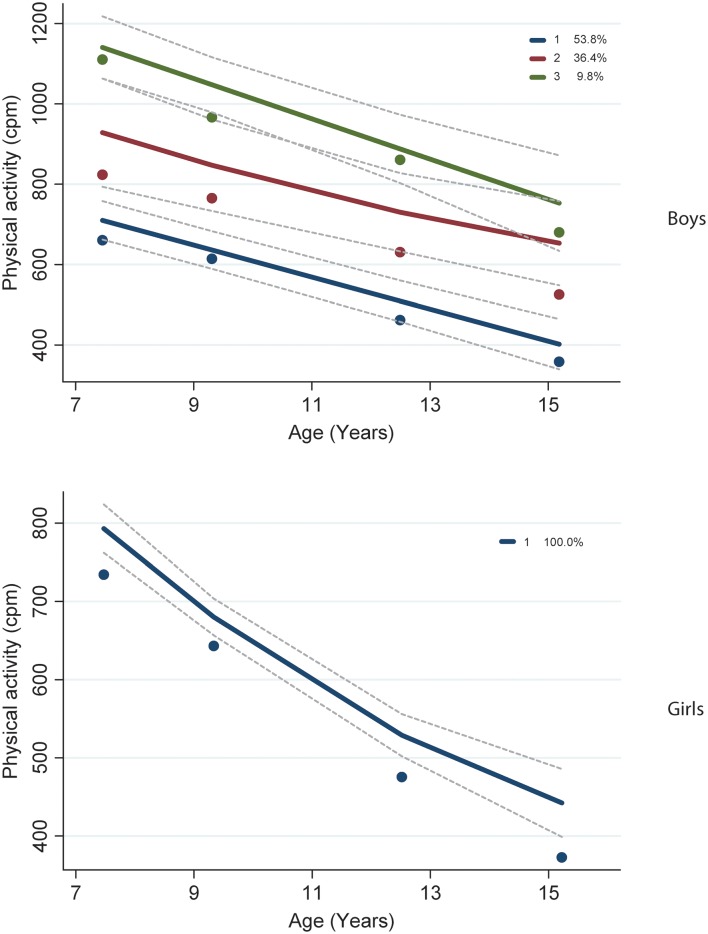
Background and aim: There is a widely held and influential view that physical activity begins to decline at adolescence. This study aimed to identify the timing of changes in physical activity during childhood and adolescence. Methods: Longitudinal cohort study (Gateshead Millennium Study) with 8 years of follow-up, from North-East England. Cohort members comprise a socioeconomically representative sample studied at ages 7, 9, 12 and 15 years; 545 individuals provided physical activity data at two or more time points. Habitual total volume of physical activity and moderate-to-vigorous intensity physical activity (MVPA) were quantified objectively using the Actigraph accelerometer over 5–7 days at the four time points. Linear mixed models identified the timing of changes in physical activity across the 8-year period, and trajectory analysis was used to identify subgroups with distinct patterns of age-related changes. Results: Four trajectories of change in total volume of physical activity were identified representing 100% of all participants: all trajectories declined from age 7 years. There was no evidence that physical activity decline began at adolescence, or that adolescent declines in physical activity were substantially greater than the declines during childhood, or greater in girls than boys. One group (19% of boys) had relatively high MVPA which remained stable between ages 7 and15 years. Conclusions: Future policy and research efforts to promote physical activity should begin well before adolescence, and should include both boys and girls.
Overview
AI snapshot
Written from the paper’s full text.
TL;DR
In the Gateshead Millennium Study, objectively measured physical activity was already declining by age 7 years in both boys and girls, with no evidence that the decline began or accelerated specifically at adolescence. The findings challenge the orthodox focus on adolescent girls as the main high-risk group for low physical activity.
Key findings
- Total physical activity declined from age 7 years in all identified trajectories: boys had three distinct trajectories and girls had one, together representing 100% of participants; no trajectory showed high childhood levels followed by a sharp adolescent decline.
- Mean total physical activity fell from 780 cpm at age 7 to 482 cpm at age 15 in boys, and from 746 cpm to 400 cpm in girls; MVPA fell from 75.5 to 51.4 min/day in boys and from 63.4 to 41.0 min/day in girls.
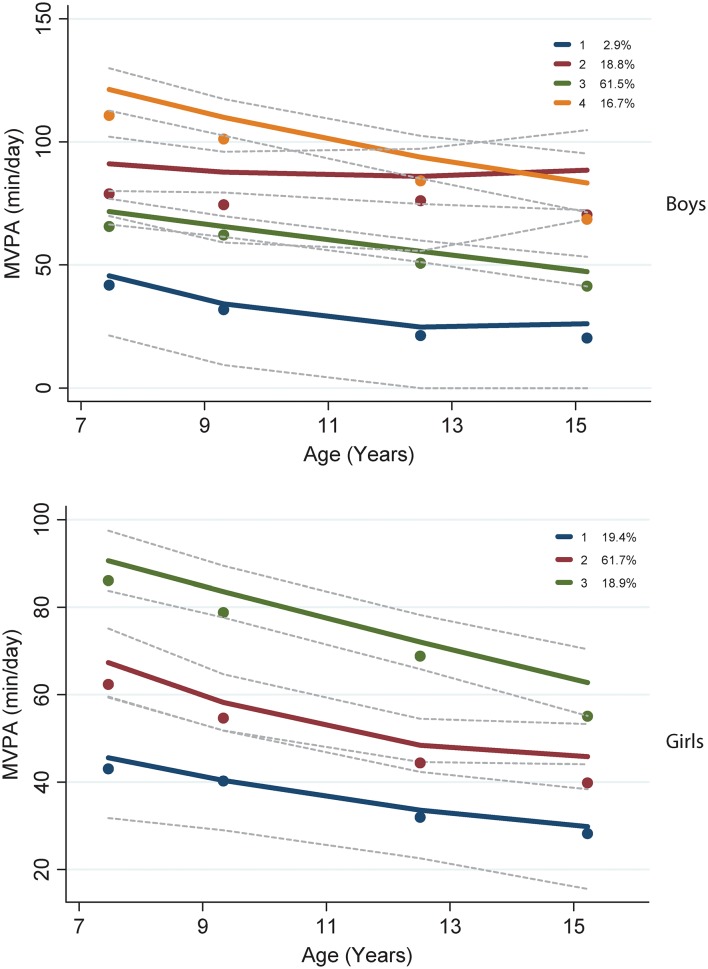
- MVPA trajectories were more complex: in boys, 3% had low and relatively stable/slowly declining MVPA, 17% had initially high but rapidly declining MVPA, 61% declined gradually, and 19% had relatively high and stable or increasing MVPA; in girls, 19% had low and relatively stable/modest declines, 62% declined gradually, and 19% had high initial MVPA with steeper declines.
- There was no evidence that physical activity decline began at adolescence, was substantially greater during adolescence than childhood, or was greater in girls than boys.
Methods
- Longitudinal cohort study (Gateshead Millennium Study) in North-East England, with follow-up at ages 7, 9, 12 and 15 years; 545 individuals provided physical activity data at two or more time points, and 217 at all four time points.
- Habitual total physical activity and MVPA were measured objectively with Actigraph GT1M accelerometers over 5–7 days at each time point; MVPA used a cut-point of 574 counts per 15 s, with a +9% correction applied to raw data, and age-15 data adjusted for season.
- Linear mixed models in SPSS described age-related changes; group-based trajectory modelling in STATA (Traj module) identified distinct trajectories, modelled separately for boys and girls using BIC and posterior probabilities.
Limitations
- The paper states that generalisability may be limited to populations with substantially different physical, social and/or policy environments; it also states that why changes occur was beyond scope, direct biological measures such as pubertal maturation were unavailable, the 3% boys subgroup needs confirmation in other populations, and measurement timing was largely determined by funding availability.
- Evident from the text: sample size declined across time points (431 at age 7 to 278 at age 15), and accelerometry excluded water-based activities, so some activity may be unmeasured.
Model-written summary. Check it against the paper before relying on it.
Integrity signals
Registry
Cites
Statistics
Figures
Verification
Claims the paper makes
14 Not checked yet · 12 Own result · 6 Own method · 5 Own interpretation · 1 No basis given
A result the paper reports from its own data — it cites no other source for it, so there is none to check. The quote shows it is in the paper.
In the paper
“There was no evidence that physical activity decline began at adolescence, or that adolescent declines in physical activity were substantially greater than the declines during childhood, or greater in girls than boys.”
§ Timing of the decline in physical activity in childhood and adolescence: Gateshead Millennium Cohort Study > Abstract > Results
plain- Asserted: passes — The authors put it forward as true.
- Checkable: passes — It can be checked against evidence.
- Load-bearing: passes — The paper’s conclusions depend on it.
- Based: passes — The paper gives a reason why it holds.
A result the paper reports from its own data — it cites no other source for it, so there is none to check. The quote shows it is in the paper.
In the paper
“None of the trajectories of MVPA in either boys or girls were characterised by high and stable childhood values followed by sharp adolescent declines.”
§ Timing of the decline in physical activity in childhood and adolescence: Gateshead Millennium Cohort Study > Results > Changes in physical activity analysed longitudinally using trajectory analysis
plain- Asserted: passes — The authors put it forward as true.
- Checkable: passes — It can be checked against evidence.
- Load-bearing: passes — The paper’s conclusions depend on it.
- Based: passes — The paper gives a reason why it holds.
A result the paper reports from its own data — it cites no other source for it, so there is none to check. The quote shows it is in the paper.
In the paper
“In boys, four distinct subgroups were identified: low and relatively stable/slowly declining MVPA from age 7 years across the 8 years (3% of the sample); initially high at age 7 years, but rapidly declining from age 7 years (17% of the sample); gradually declining from age 7 years (61% of the sample); relatively high and stable or increasing from age 7 years (19% of the sample).”
§ Timing of the decline in physical activity in childhood and adolescence: Gateshead Millennium Cohort Study > Results > Changes in physical activity analysed longitudinally using trajectory analysis
plain- Asserted: passes — The authors put it forward as true.
- Checkable: passes — It can be checked against evidence.
- Load-bearing: passes — The paper’s conclusions depend on it.
- Based: passes — The paper gives a reason why it holds.
A result the paper reports from its own data — it cites no other source for it, so there is none to check. The quote shows it is in the paper.
In the paper
“Four trajectories of change in total volume of physical activity were identified representing 100% of all participants: all trajectories declined from age 7 years.”
§ Timing of the decline in physical activity in childhood and adolescence: Gateshead Millennium Cohort Study > Abstract > Results
plain- Asserted: passes — The authors put it forward as true.
- Checkable: passes — It can be checked against evidence.
- Load-bearing: passes — The paper’s conclusions depend on it.
- Based: passes — The paper gives a reason why it holds.
A result the paper reports from its own data — it cites no other source for it, so there is none to check. The quote shows it is in the paper.
In the paper
“One group (19% of boys) had relatively high MVPA which remained stable between ages 7 and15 years.”
- Also stated in: § Main study findings and implications · hedged
“in around 19% of boys MVPA was relatively high and fairly stable across the 8-year period.”
§ Timing of the decline in physical activity in childhood and adolescence: Gateshead Millennium Cohort Study > Abstract > Results
plain- Asserted: passes — The authors put it forward as true.
- Checkable: passes — It can be checked against evidence.
- Load-bearing: unclear — It is unclear whether the paper’s conclusions depend on it.
- Based: passes — The paper gives a reason why it holds.
- Also stated in: § Main study findings and implications · hedged
A result the paper reports from its own data — it cites no other source for it, so there is none to check. The quote shows it is in the paper.
In the paper
“None of the trajectories of total volume of physical activity showed initial high levels followed by sharp adolescent declines.”
§ Timing of the decline in physical activity in childhood and adolescence: Gateshead Millennium Cohort Study > Results > Changes in physical activity analysed longitudinally using trajectory analysis
plain- Asserted: passes — The authors put it forward as true.
- Checkable: passes — It can be checked against evidence.
- Load-bearing: passes — The paper’s conclusions depend on it.
- Based: passes — The paper gives a reason why it holds.
A result the paper reports from its own data — it cites no other source for it, so there is none to check. The quote shows it is in the paper.
In the paper
“There was no evidence that physical activity decline began at adolescence, or that adolescent declines in physical activity were substantially greater than the declines during childhood, or greater in girls than boys.”
§ Timing of the decline in physical activity in childhood and adolescence: Gateshead Millennium Cohort Study > Abstract > Results
plain- Asserted: passes — The authors put it forward as true.
- Checkable: passes — It can be checked against evidence.
- Load-bearing: passes — The paper’s conclusions depend on it.
- Based: passes — The paper gives a reason why it holds.
A result the paper reports from its own data — it cites no other source for it, so there is none to check. The quote shows it is in the paper.
In the paper
“Four trajectories of change in total volume of physical activity were identified representing 100% of all participants: all trajectories declined from age 7 years.”
- Also stated in: § Changes in physical activity analysed longitudinally using trajectory analysis · plain
“in all three subgroups, representing 100% of the sample, the total volume of physical activity declined across the 8-year period from age 7 years; in the girls a single trajectory of declining total physical activity across the 8-year period from age 7 years characterised all study participants.”
§ Timing of the decline in physical activity in childhood and adolescence: Gateshead Millennium Cohort Study > Abstract > Results
plain- Asserted: passes — The authors put it forward as true.
- Checkable: passes — It can be checked against evidence.
- Load-bearing: passes — The paper’s conclusions depend on it.
- Based: passes — The paper gives a reason why it holds.
- Also stated in: § Changes in physical activity analysed longitudinally using trajectory analysis · plain
A result the paper reports from its own data — it cites no other source for it, so there is none to check. The quote shows it is in the paper.
In the paper
“in the girls a single trajectory of declining total physical activity across the 8-year period from age 7 years characterised all study participants.”
§ Timing of the decline in physical activity in childhood and adolescence: Gateshead Millennium Cohort Study > Results > Changes in physical activity analysed longitudinally using trajectory analysis
plain- Asserted: passes — The authors put it forward as true.
- Checkable: passes — It can be checked against evidence.
- Load-bearing: passes — The paper’s conclusions depend on it.
- Based: passes — The paper gives a reason why it holds.
A result the paper reports from its own data — it cites no other source for it, so there is none to check. The quote shows it is in the paper.
In the paper
“Three distinct trajectories were identified: low and relatively stable/with modest declines (19%); gradually declining from age 7 years (62%); high initial MVPA with steeper declines from age 7 years (19%).”
§ Timing of the decline in physical activity in childhood and adolescence: Gateshead Millennium Cohort Study > Results > Changes in physical activity analysed longitudinally using trajectory analysis
plain- Asserted: passes — The authors put it forward as true.
- Checkable: passes — It can be checked against evidence.
- Load-bearing: passes — The paper’s conclusions depend on it.
- Based: passes — The paper gives a reason why it holds.
- It may state two separate claims as one. 10
- Probably not a substantial claim. 11
A conclusion the paper draws from its own results — it cites no other source for it, so there is none to check. The quote shows it is in the paper.
In the paper
“The present study found that 100% of boys and girls fitted into longitudinal trajectories which were inconsistent with the orthodox view that physical activity begins to decline at adolescence, declines much more rapidly at adolescence and/or declines much more rapidly in adolescent girls than boys.”
§ Timing of the decline in physical activity in childhood and adolescence: Gateshead Millennium Cohort Study > Discussion > Main study findings and implications
plain- Asserted: passes — The authors put it forward as true.
- Checkable: passes — It can be checked against evidence.
- Load-bearing: passes — The paper’s conclusions depend on it.
- Based: passes — The paper gives a reason why it holds.
It may state two separate claims as one.
A conclusion the paper draws from its own results — it cites no other source for it, so there is none to check. The quote shows it is in the paper.
In the paper
“One weakness may be generalisability to populations with substantially different physical, social and/or policy environments.”
§ Timing of the decline in physical activity in childhood and adolescence: Gateshead Millennium Cohort Study > Discussion > Study strengths and weaknesses
hedged- Asserted: passes — The authors put it forward as true.
- Checkable: fails — It may be too vague to check against evidence.
- Load-bearing: fails — The paper’s conclusions may not depend on it.
- Based: passes — The paper gives a reason why it holds.
Probably not a substantial claim. It may be too vague to check against evidence. The paper’s conclusions may not depend on it.
What the paper did — it cites no source for this, so there is none to check. The quote shows it is in the paper.
In the paper
“The main strengths of the present study were the longitudinal design, the high quality objective measures of physical activity, the socioeconomically representative sample and the contemporary nature of the cohort.”
§ Timing of the decline in physical activity in childhood and adolescence: Gateshead Millennium Cohort Study > Discussion > Study strengths and weaknesses
plain- Asserted: passes — The authors put it forward as true.
- Checkable: passes — It can be checked against evidence.
- Load-bearing: fails — The paper’s conclusions may not depend on it.
- Based: passes — The paper gives a reason why it holds.
Probably not a substantial claim. The paper’s conclusions may not depend on it.
What the paper did — it cites no source for this, so there is none to check. The quote shows it is in the paper.
In the paper
“The main strengths of the present study were the longitudinal design, the high quality objective measures of physical activity, the socioeconomically representative sample and the contemporary nature of the cohort.”
§ Timing of the decline in physical activity in childhood and adolescence: Gateshead Millennium Cohort Study > Discussion > Study strengths and weaknesses
plain- Asserted: passes — The authors put it forward as true.
- Checkable: passes — It can be checked against evidence.
- Load-bearing: passes — The paper’s conclusions depend on it.
- Based: passes — The paper gives a reason why it holds.
Probably not a substantial claim.
A conclusion the paper draws from its own results — it cites no other source for it, so there is none to check. The quote shows it is in the paper.
In the paper
“The study questions the concept of the adolescent girl as a priority for research and policy effort in physical activity.”
§ Timing of the decline in physical activity in childhood and adolescence: Gateshead Millennium Cohort Study > Conclusions
plain- Asserted: passes — The authors put it forward as true.
- Checkable: passes — It can be checked against evidence.
- Load-bearing: passes — The paper’s conclusions depend on it.
- Based: passes — The paper gives a reason why it holds.
Probably not a substantial claim.
In the paper
“The Actigraph is a small, unobtrusive and lightweight monitor with high validity (relative to reference measures of physical activity, direct observation and energy expenditure), high reliability and low reactivity in children,16”
§ Timing of the decline in physical activity in childhood and adolescence: Gateshead Millennium Cohort Study > Methods > Objective measurement of total volume of physical activity and MVPA
What the sources say
- Not checked yetcites [16] source
plain- Asserted: passes — The authors put it forward as true.
- Checkable: passes — It can be checked against evidence.
- Load-bearing: unclear — It is unclear whether the paper’s conclusions depend on it.
- Based: passes — The paper gives a reason why it holds.
It may state two separate claims as one.
In the paper
“The International Children’s Accelerometry Database, though cross-sectional, suggests that objectively measured physical activity may be in decline in both sexes from around the age of school entry.13”
§ Timing of the decline in physical activity in childhood and adolescence: Gateshead Millennium Cohort Study > Introduction
What the sources say
- Not checked yetcites [13] Cooper, 2015, Objectively measured physical activity and sedentary time in youth: the International children’s accelerometry database (ICAD), Int J Behav Nutr Phys Act source
hedgedconditional- Asserted: passes — The authors put it forward as true.
- Checkable: passes — It can be checked against evidence.
- Load-bearing: passes — The paper’s conclusions depend on it.
- Based: passes — The paper gives a reason why it holds.
Probably not a substantial claim.
None of the sources cited for this claim have been checked yet.
In the paper
“since most studies completed data collection before 2000, they probably lack generalisability to contemporary populations given recent and dramatic societal changes: declines in active commuting,10 in the technology being used by children10 (eg, the ubiquitous nature of new screen-based media),11 and in overweight and obesity (which appear to reduce physical activity).12”
§ Timing of the decline in physical activity in childhood and adolescence: Gateshead Millennium Cohort Study > Introduction
What the sources say
hedgedconditional- Asserted: passes — The authors put it forward as true.
- Checkable: passes — It can be checked against evidence.
- Load-bearing: passes — The paper’s conclusions depend on it.
- Based: passes — The paper gives a reason why it holds.
It may state two separate claims as one.
In the paper
“in children born in Iowa in the early 1990s physical activity declined, in both sexes, from age 5 years in most study participants.14”
§ Timing of the decline in physical activity in childhood and adolescence: Gateshead Millennium Cohort Study > Introduction
What the sources say
- Not checked yetcites [14] Kwon, 2015, Developmental trajectories of physical activity, sports, and television viewing during childhood to young adulthood: Iowa bone development study, JAMA Pediatr source
plaindirect- Asserted: passes — The authors put it forward as true.
- Checkable: passes — It can be checked against evidence.
- Load-bearing: passes — The paper’s conclusions depend on it.
- Based: passes — The paper gives a reason why it holds.
Probably not a substantial claim.
None of the sources cited for this claim have been checked yet.
In the paper
“In summary, recent English longitudinal studies which used objective measures of physical activity are consistent with the present study in suggesting that physical activity does not decline especially markedly at adolescence, and does not decline more markedly in girls than boys during adolescence.”
§ Timing of the decline in physical activity in childhood and adolescence: Gateshead Millennium Cohort Study > Discussion > Consistency of evidence from the present study with other studies
What the sources say
hedged- Asserted: passes — The authors put it forward as true.
- Checkable: passes — It can be checked against evidence.
- Load-bearing: unclear — It is unclear whether the paper’s conclusions depend on it.
- Based: passes — The paper gives a reason why it holds.
It may state two separate claims as one.
What the paper did — it cites no source for this, so there is none to check. The quote shows it is in the paper.
In the paper
“Girls with more than two missing/invalid data points had slightly higher BMI z-scores at baseline than those with complete data, but similar physical activity.”
§ Timing of the decline in physical activity in childhood and adolescence: Gateshead Millennium Cohort Study > Results > Characteristics of study participants
plaincorrelational- Asserted: passes — The authors put it forward as true.
- Checkable: passes — It can be checked against evidence.
- Load-bearing: fails — The paper’s conclusions may not depend on it.
- Based: passes — The paper gives a reason why it holds.
Probably not a substantial claim. The paper’s conclusions may not depend on it. It may state two separate claims as one.
None of the sources cited for this claim have been checked yet.
In the paper
“In the Avon Longitudinal Study of Parents and Children cohort in England for example the incidence (appearance of new cases) of obesity across childhood and adolescence peaked around age 7 years,34 and among non-obese individuals the rate of excessive weight gain also peaked at the same time.35”
§ Timing of the decline in physical activity in childhood and adolescence: Gateshead Millennium Cohort Study > Discussion > Consistency of evidence from the present study with other studies
plain- Asserted: passes — The authors put it forward as true.
- Checkable: passes — It can be checked against evidence.
- Load-bearing: fails — The paper’s conclusions may not depend on it.
- Based: passes — The paper gives a reason why it holds.
Probably not a substantial claim. The paper’s conclusions may not depend on it. It may state two separate claims as one.
What the paper did — it cites no source for this, so there is none to check. The quote shows it is in the paper.
In the paper
“Participants who provided data at least twice had similar physical activity and similar BMI-z scores at baseline compared with those who had missing or invalid accelerometer data.”
§ Timing of the decline in physical activity in childhood and adolescence: Gateshead Millennium Cohort Study > Results > Characteristics of study participants
plainn = 545- Asserted: passes — The authors put it forward as true.
- Checkable: passes — It can be checked against evidence.
- Load-bearing: unclear — It is unclear whether the paper’s conclusions depend on it.
- Based: passes — The paper gives a reason why it holds.
It may state two separate claims as one.
What the paper did — it cites no source for this, so there is none to check. The quote shows it is in the paper.
In the paper
“The main strengths of the present study were the longitudinal design, the high quality objective measures of physical activity, the socioeconomically representative sample and the contemporary nature of the cohort.”
§ Timing of the decline in physical activity in childhood and adolescence: Gateshead Millennium Cohort Study > Discussion > Study strengths and weaknesses
plain- Asserted: passes — The authors put it forward as true.
- Checkable: passes — It can be checked against evidence.
- Load-bearing: fails — The paper’s conclusions may not depend on it.
- Based: passes — The paper gives a reason why it holds.
Probably not a substantial claim. The paper’s conclusions may not depend on it.
In the paper
“Dumith et al 9 published the most recent systematic review of changes in physical activity during adolescence, with 26 eligible longitudinal studies. Of these eligible studies only 2/26 included objective measures of the intensity of physical activity (accelerometry), most (16/26) were from the USA, and the representativeness of the samples in the eligible studies was usually unclear.9”
§ Timing of the decline in physical activity in childhood and adolescence: Gateshead Millennium Cohort Study > Introduction
What the sources say
- Not checked yetcites [9] source
plain- Asserted: passes — The authors put it forward as true.
- Checkable: passes — It can be checked against evidence.
- Load-bearing: passes — The paper’s conclusions depend on it.
- Based: passes — The paper gives a reason why it holds.
It may state two separate claims as one.
In the paper
“The recent systematic review by Tanaka et al also found that accelerometer-measured daily sedentary time increased from around the age of school entry, and as sedentary time increased with age physical activity was displaced.36”
§ Timing of the decline in physical activity in childhood and adolescence: Gateshead Millennium Cohort Study > Discussion > Consistency of evidence from the present study with other studies
What the sources say
- Not checked yetcites [36] Tanaka, 2014, Longitudinal changes in objectively measured sedentary behaviour and their relationship with adiposity in children and adolescents: systematic review and evidence appraisal, Obes Rev source
plaindirect- Asserted: passes — The authors put it forward as true.
- Checkable: passes — It can be checked against evidence.
- Load-bearing: fails — The paper’s conclusions may not depend on it.
- Based: passes — The paper gives a reason why it holds.
Probably not a substantial claim. The paper’s conclusions may not depend on it. It may state two separate claims as one.
None of the sources cited for this claim have been checked yet.
In the paper
“There is a widely held and influential view that physical activity begins to decline at adolescence.”
- Also stated in: § Introduction · boosted
“For many years the prevailing view among researchers, policy makers, and health and education practitioners, based largely on subjective measurement of physical activity, has been that levels of physical activity are adequate during childhood, but decline dramatically during adolescence, with the adolescent decline being much more marked in girls than boys.3–6”
§ Timing of the decline in physical activity in childhood and adolescence: Gateshead Millennium Cohort Study > Abstract > Background and aim
What the sources say
- Not checked yetcites [3] Physical Activity Review Group. Five year review of ’Let’s make Scotland more active: a strategy for physical activity': Update statement from the review group. Edinburgh: NHS Health Scotland, 2010.
- Not checked yetcites [4] Sportscotland. Increasing demand for sport and physical activity for adolescent girls in Scotland: Exploring issues and suggesting solutions. Edinburgh: sportscotland, 2006.
- Not checked yetcites [5] Activity P , Alliance H . Physical activity and adolescent girls – Knowledge Exchange Network. 2009. http://www.paha.org.uk/Feature/physical-activity-and-adolescent-girls-knowledge-exchange-network (accessed Jul 2016).
- Not checked yetcites [6] source
boosted- Asserted: fails — The authors may not put it forward as true.
- Checkable: passes — It can be checked against evidence.
- Load-bearing: passes — The paper’s conclusions depend on it.
- Based: passes — The paper gives a reason why it holds.
Probably not a substantial claim. The authors may not put it forward as true. It may state two separate claims as one.
- Also stated in: § Introduction · boosted
The paper relies on this without support.
The Gateshead Millennium Study cohort is representative of the UK population.
“the sample was socioeconomically representative of the north-east of England.15”
“The present study suggests that total volume of physical activity is already declining by age 7 years in the UK.”
Claims other papers make about this one
Each is checked against this paper’s own text: does it say what the citing paper says it does?
In the citing paper
“evidence suggests a decline in MVPA after early childhood,8, 9, 10”
From A mixed-studies systematic review and meta-analysis of school-based interventions to promote physical activity and/or reduce sedentary time in children (2020) · cites this paper as [8]
Self-check
Percentages, sums and reported differences re-computed from the paper’s own numbers.
Each contradiction between two passages listed here was confirmed by an independent check.
Rated minor: it would not touch a result — a value no result rests on, a p-value that stays on the same side of the significance level, or a conflict that is clerical, resolved elsewhere in the paper, or outside its own findings.
In the paper
§ Timing of the decline in physical activity in childhood and adolescence: Gateshead Millennium Cohort Study > Results > Summary data on physical activity at each of the four measurements
“BMI z-score | 0.4 (1.2) | 0.5 (1.2)† | 0.7 (1.2)†‡ | 0.5 (1.3)§”
§ Timing of the decline in physical activity in childhood and adolescence: Gateshead Millennium Cohort Study > Results > Summary data on physical activity at each of the four measurements
“§, significantly higher than age 12 years”
Rated minor: it would not touch a result — a value no result rests on, a p-value that stays on the same side of the significance level, or a conflict that is clerical, resolved elsewhere in the paper, or outside its own findings.
In the paper
§ Timing of the decline in physical activity in childhood and adolescence: Gateshead Millennium Cohort Study > Results > Summary data on physical activity at each of the four measurements
“469 (191)§*”
§ Timing of the decline in physical activity in childhood and adolescence: Gateshead Millennium Cohort Study > Results > Summary data on physical activity at each of the four measurements
“§, significantly higher than age 12 years”
Citations
Cites
Global physical activity levels: surveillance progress, pitfalls, and prospects
Hallal, P. C., Andersen, L. B., Bull, F. C., Guthold, R., Haskell, W., & Ekelund, U. (2012) · The Lancet · doi:10.1016/s0140-6736(12)60646-1 · Cited by 5,711 · cited 1×
“Many national and international physical activity surveillance programmes focus on adolescents, 8 also based on implicit or explicit assumptions that adolescence is the stage of the life course when physical activity declines dramatically.”
BackgroundJanssen, I., & LeBlanc, A. G. (2010) · International Journal of Behavioral Nutrition and Physical Activity · doi:10.1186/1479-5868-7-40 · Cited by 4,829 · cited 1×
“Systematic reviews have established that daily physical activity, particularly moderate-tovigorous intensity physical activity (MVPA), is important for both the current and future health of children and adolescents.(1,2) For many years the prevailing view among researchers, policymakers, and health and education pract…”
BackgroundGroup-Based Modeling of Development
NAGIN, D. (2005) · doi:10.4159/9780674041318 · Cited by 4,164 · cited 2×
“This method, initially developed by Nagin et al , 28 has recently been applied to longitudinal physical activity data.”
BackgroundMethodCorrelates of physical activity: why are some people physically active and others not?
Bauman, A. E., Reis, R. S., Sallis, J. F., Wells, J. C., Loos, R. J., & Martin, B. W. (2012) · The Lancet · doi:10.1016/s0140-6736(12)60735-1 · Cited by 4,151
Calibration of two objective measures of physical activity for children
Evenson, K. R., Catellier, D. J., Gill, K., Ondrak, K. S., & McMurray, R. G. (2008) · Journal of Sports Sciences · doi:10.1080/02640410802334196 · Cited by 2,677 · cited 1×
“Two evidence-based but distinct ‘cut-off points’ have been used widely in the literature, but in the present study the cut-point of 574 counts per 15 s was used 22 and it has acceptable classification accuracy.”
MethodBody mass index reference curves for the UK, 1990.
Cole, T. J., Freeman, J. V., & Preece, M. A. (1995) · Archives of Disease in Childhood · doi:10.1136/adc.73.1.25 · Cited by 2,050 · cited 1×
“26 Socioeconomic status was assessed using Townsend scores at birth, 27 an area-based measure derived from the UK census.”
MethodComparison of Accelerometer Cut Points for Predicting Activity Intensity in Youth
TROST, S. G., LOPRINZI, P. D., MOORE, R., & PFEIFFER, K. A. (2011) · Medicine & Science in Sports & Exercise · doi:10.1249/mss.0b013e318206476e · Cited by 1,360
Physical activity change during adolescence: a systematic review and a pooled analysis
Dumith, S. C., Gigante, D. P., Domingues, M. R., & Kohl, H. W. (2011) · International Journal of Epidemiology · doi:10.1093/ije/dyq272 · Cited by 1,275 · cited 4×
“Dumith et al 9 published the most recent systematic review of changes in physical activity during adolescence, with 26 eligible longitudinal studies.”
BackgroundMethodInfluentialCooper, A. R., Goodman, A., Page, A. S., Sherar, L. B., Esliger, D. W., van Sluijs, E. M., Andersen, L. B., Anderssen, S., Cardon, G., Davey, R., et al. (2015) · International Journal of Behavioral Nutrition and Physical Activity · doi:10.1186/s12966-015-0274-5 · Cited by 828 · cited 1×
“13 21 In brief, participants were asked to wear the accelerometer during waking hours for 7 days, removing only for bed and water-based activities such as showering, bathing and swimming.”
BackgroundSelf-citationSystematic review of physical activity and health in the early years (aged 0-4 years)
Timmons, B. W., LeBlanc, A. G., Carson, V., Connor Gorber, S., Dillman, C., Janssen, I., Kho, M. E., Spence, J. C., Stearns, J. A., & Tremblay, M. S. (2012) · Applied Physiology, Nutrition, and Metabolism · doi:10.1139/h2012-070 · Cited by 626 · cited 1×
“Systematic reviews have established that daily physical activity, particularly moderate-tovigorous intensity physical activity (MVPA), is important for both the current and future health of children and adolescents.(1,2) For many years the prevailing view among researchers, policymakers, and health and education pract…”
Background
Research works printed but not linked: 1
- Physical Activity Review Group. Five year review of ’Let’s make Scotland more active: a strategy for physical activity': Update statement from the review group. Edinburgh: NHS Health Scotland, 2010.
Cited by
Sorted by citations
Items 201–300 of 388
Emm-Collison, L., Salway, R., Matthews, J. A., Reid, T., & Jago, R. (2023) · Wellcome Open Research · doi:10.12688/wellcomeopenres.18262.1 · Cited by 6
Examining the factor structure and validity of the social motivational orientations in sport scale
Deng, A., Roberts, A. M., Zhang, G., Taylor, S. G., Fairchild, A. J., & Zarrett, N. R. (2023) · International Journal of Sport and Exercise Psychology · doi:10.1080/1612197x.2023.2224969 · Cited by 7
“…physical activity on development, declines in physical activity engagement are observed through adolescence, often beginning in early adolescence (Dumith et al., 2011; Farooq et al., 2018), and this is especially true for minoritised youth and those from low-income communities (Zhang et al., 2020).”
Contemporaneous trajectories of physical activity and screen time in adolescents
Riglea, T., Doré, I., O’Loughlin, J. L., Bélanger, M. F., & Sylvestre, M. (2021) · Applied Physiology, Nutrition, and Metabolism · doi:10.1139/apnm-2020-0631 · Cited by 7
Jones, M. A. (2017) · International Journal of Environmental Research and Public Health · doi:10.3390/ijerph14091052 · Cited by 6
“A decline in physical activity trajectories has been observed from children aged seven years rather than from adolescence, as commonly perceived [4].”
Backgroundvan Markus-Doornbosch, F., Peeters, E. A. J., Volker, G., van der Pas, S., Vlieland, T. P. M. V., & Meesters, J. J. L. (2019) · European Journal of Paediatric Neurology · doi:10.1016/j.ejpn.2019.08.003 · Cited by 7
Morgan, J., Bednarz, J., Semo, R., Clark, S. R., & Schubert, K. O. (2024) · PLoS ONE · doi:10.1371/journal.pone.0284660 · Cited by 6
Wu, H., Lin, Y., Yang, L., Lai, W., Li, Y., Xu, Y., Wang, W., Yang, L., Lu, C., & Yan, B. (2024) · Child and Adolescent Psychiatry and Mental Health · doi:10.1186/s13034-024-00836-7 · Cited by 6
Predictors and correlates of physical activity and sedentary behavior
Paoli, A. G. D. (2021) · Society for Transparency, Openness, and Replication in Kinesiology eBooks · doi:10.51224/b1005 · Cited by 7
“This relationship appears to be different for children where age is positively associated with physical activity then begins to decline around age seven (Farooq et al, 2018).”
Backgroundvan der Wurff, I. S. M., Kirschner, M., Golsteijn, R. H. J., de Jonge, M., Berendsen, B., Singh, A. S., Savelberg, H. H. C. M., & de Groot, R. H. M. (2024) · Preventive Medicine · doi:10.1016/j.ypmed.2024.107925 · Cited by 7
Tracking of MVPA across childhood and adolescence
Ramos-Munell, J., Pearce, M. S., Adamson, A., Janssen, X., Basterfield, L., & Reilly, J. J. (2024) · Journal of science and medicine in sport · doi:10.1016/j.jsams.2024.03.006 · Cited by 6
Self-citationBailey, R. P., Payne, R., Demidoff, A. R., Samsudin, N., & Scheuer, C. (2024) · Health Education Journal · doi:10.1177/00178969241254187 · Cited by 8
Frömel, K., Mitáš, J., & Tudor-Locke, C. E. (2022) · Journal of Physical Activity and Health · doi:10.1123/jpah.2022-0205 · Cited by 6
Meerits, P.-R., Tilga, H., & Koka, A. (2022) · Methods and Protocols · doi:10.3390/mps5050083 · Cited by 9
“Moreover, levels of PA in this age group tend to decline with age [8,9].”
BackgroundKawalec, A., Mozrzymas, R., Domżol, A., Zachurzok, A., Szczepańska, M., Noczyńska, A., & Zwołińska, D. (2024) · Healthcare · doi:10.3390/healthcare12020260 · Cited by 6
James, M., Christian, D. L., Scott, S. N., Todd, C., Stratton, G., Demmler, J. C., McCoubrey, S., Halcox, J., Audrey, S., Ellins, E. A., et al. (2019) · BMJ Open · doi:10.1136/bmjopen-2018-025618 · Cited by 11
Jolly, K. B., Griffin, T. L., Sidhu, M. S., Adab, P., Burgess, A., Collins, C. E., Daley, A., Entwistle, A., Frew, E. J., Hardy, P., et al. (2020) · Public Health Research · doi:10.3310/phr08020 · Cited by 5
McEvoy, O., Cronin, F. M., Brannigan, R., Stanistreet, D., & Layte, R. (2022) · SSM - Population Health · doi:10.1016/j.ssmph.2022.101216 · Cited by 5
“, 2016, 2020) and research has shown that there is a sharp decline in PA during adolescence between 11 and 15yrs (Dumith et al., 2011; Farooq et al., 2018; Rovio et al., 2018).”
BackgroundJoksimović, M., Németh, Z., Skrypchenko, I. T., et al. (2018) · International Journal of Anatolia Sport Sciences · doi:10.5505/jiasscience.2018.08208 · Cited by 6
Ng, J. L., & Button, C. (2023) · Frontiers in Bioengineering and Biotechnology · doi:10.3389/fbioe.2023.1094469 · Cited by 4
“Yet it is concerning that there are increasing levels of sedentary behaviour and physical inactivity in children (Hallal et al., 2012; Farooq et al., 2018).”
BackgroundHwang, J., Hillman, C. H., Lee, I.-M. M., Fernandez, A. M., & Lu, A. S. (2020) · Games for Health Journal · doi:10.1089/g4h.2020.0018 · Cited by 5
“The role of physical activity in protecting against childhood obesity is well documented; however, the rate of physical activity engagement begins to decline 6 and differs by weight status 7 around age 7.”
PERRY, A. C., Flanagan, E. W., Velasquez, C., Bolon, K. D., Zito, G., & Ahn, S. (2021) · Journal of Physical Activity and Health · doi:10.1123/jpah.2020-0622 · Cited by 5
Cheng, S., Vanluyten, K., Ward, P., Seghers, J., & Iserbyt, P. (2023) · Physical Education and Sport Pedagogy · doi:10.1080/17408989.2023.2194897 · Cited by 5
“A longitudinal cohort study on physical activity during childhood and adolescence including 545 participants with eight years of follow-up was conducted by Farooq et al. (2018).”
Estevan, I., Menescardi, C., Barnett, L. M., & Utesch, T. (2025) · Journal of Sport and Exercise Psychology · doi:10.1123/jsep.2023-0317 · Cited by 5
Dunton, G. F., Chu, D., Naya, C. H., Belcher, B. R., & Mason, T. B. (2021) · Journal of Physical Activity and Health · doi:10.1123/jpah.2020-0558 · Cited by 5
Association between perceived discrimination and physical activity among adolescents
Neto, C. M., Confortin, S. C., Lima, A. B. S., Mouzinho, L. S. N., & de Oliveira, B. L. C. A. (2022) · Ciência & Saúde Coletiva · doi:10.1590/1413-812320222710.05992022en · Cited by 4
Hall, J., Bingham, D. D., Seims, A., Dogra, S. A., Burkhardt, J., Nobles, J., McKenna, J., Bryant, M., Barber, S., & Daly-Smith, A. (2021) · medRxiv · doi:10.1101/2021.05.26.21257853 · Cited by 4
Kelly, H. T., Smith, J. J., Verdonschot, A., Kennedy, S. G., Scott, J. J., McKay, H. A., Nathan, N., Sutherland, R., Morgan, P. J., Salmon, J., et al. (2023) · BMJ Open · doi:10.1136/bmjopen-2023-075488 · Cited by 6
Li, J., Herold, F., Chen, Y., Zhang, Z., Werneck, A. O., Ji, T., Lowe, C. J., Tari, B., Hallgren, M. Å., Stubbs, B., et al. (2025) · Applied Psychology Health and Well-Being · doi:10.1111/aphw.70071 · Cited by 13
Atkin, A. J., Sherar, L. B., Ekelund, U., Hansen, B. H., Andersen, L. B., Anderssen, S. A., Kriemler, S., Kwon, S., Kristensen, P. L., Wedderkopp, N., et al. (2025) · PLoS ONE · doi:10.1371/journal.pone.0327394 · Cited by 10
“In addition, most of the existing evidence is derived from single-country studies, with participants recruited from a relatively small geographic region, potentially limiting their generalisability [16,18].”
Jurić, P., Karuc, J., Martinko, A., Mišigoj‐Duraković, M., & Sorić, M. (2022) · Sleep Medicine · doi:10.1016/j.sleep.2022.02.020 · Cited by 4
da Silva, J. I., Andrade, A. C. D. S., & Muraro, A. P. (2024) · Journal of Physical Activity and Health · doi:10.1123/jpah.2022-0645 · Cited by 10
“54 Older adolescents can acquire greater autonomy and tend to be involved in occupational activities, especially in the transition from adolescence to adulthood, which could contribute to their lower physical activity frequency.”
BackgroundActive Homework: an under-researched element of the active schools concept
Bailey, R. P., Heck, S., & Scheuer, C. (2022) · German Journal of Exercise and Sport Research · doi:10.1007/s12662-022-00802-5 · Cited by 4
Ringing the bell for quality P.E.: What are the realities of remote physical education?
Kovacs, V. A., Csányi, T., Blagus, R., Brandes, M., Starc, G., Rocha, P. M., Scheuer, C., & Okely, A. D. (2022) · European Journal of Public Health · doi:10.1093/eurpub/ckac082 · Cited by 5
Analysis of the Lifestyle and Psychological Well-being of Adolescents: Age-related Differences
Boraita, R. J., Torres, J. M. D., Ibort, E. G., & Alsina, D. A. (2022) · Child Indicators Research · doi:10.1007/s12187-022-09977-7 · Cited by 8
“Nevertheless, the exact time at which this decline begins is not clear and neither is it known whether the decline is influenced by gender (Metcalf et al., 2015; Farooq et al., 2018).”
BackgroundImran, A., Fazal, A., Tanvir, S., Zafar, S., Tariq, N., & Tariq, S. (2023) · Journal of University Medical & Dental College · doi:10.37723/jumdc.v14i2.765 · Cited by 4
“Most of the students do not participate in games, and this trend is continuously declining over time[11].”
BackgroundHamilton, C. N. B., Ylitalo, K. R., Wende, M. E., Sharkey, J. R., & Meyer, M. R. U. (2023) · Family & Community Health · doi:10.1097/fch.0000000000000388 · Cited by 4
“Younger populations show marked decreases in PA behavior and increases in sedentary behavior as they transition from childhood to adolescence, 71,72 so results from our study and similar studies may provide some explanation for this trend and offer guidance for developing PA interventions for youth.”
ResultTomaz, S. A., Reilly, J. J., Johnstone, A., Hughes, A. R., Robertson, J., Craig, L. C. A., & Bardid, F. (2024) · Journal of Public Health · doi:10.1093/pubmed/fdae022 · Cited by 6
“17,18 Future policy documents would benefit from giving specific attention to other vulnerable or underrepresented groups who are likely to benefit even more from robust PA and diet policies (e.g. children with chronic conditions, children with disabilities, children from different ethnic groups,…”
BackgroundSelf-citationLegarra‐Gorgoñon, G., García‐Alonso, Y., Ramírez‐Vélez, R., Alonso-Martínez, L., Izquierdo, M., & Alonso-Martínez, A. M. (2024) · JMIR Serious Games · doi:10.2196/60185 · Cited by 4
Jurado‐Castro, J. M., Pastor‐Villaescusa, B., Castro-Collado, C., Gil‐Campos, M., Leis, R., Babió, N., Moreno, L. A., Navas‐Carretero, S., Portolés, O., Echeverría, A. M., et al. (2025) · Sports Medicine - Open · doi:10.1186/s40798-025-00865-2 · Cited by 6
“Consistent with the findings of other researchers, who identify a decline in PA from the age of seven in both sexes [66], further research exploring socio-cultural and environmental factors shaping sex-specific PA trends during early childhood can provide valuable insights.”
Muñoz-Urtubia, N., Vega-Muñoz, A., Salazar-Sepúlveda, G., García-Gordillo, M. Á., & Carmelo-Adsuar, J. (2025) · Frontiers in Pediatrics · doi:10.3389/fped.2025.1449436 · Cited by 9
Yargıç, M. P., & Kürklü, G. B. (2019) · Perspectives in Public Health · doi:10.1177/1757913919868247 · Cited by 4
Preview investigators, Öhlin, A., Simunovic, N., Duong, A., & Ayeni, O. R. (2020) · BMC Musculoskeletal Disorders · doi:10.1186/s12891-020-03220-6 · Cited by 7
Verhees, A. H., Verjans-Janssen, S. R. B., van Kann, D., Kremers, S., Vos, S. B., & Gerards, S. M. P. L. (2020) · International Journal of Environmental Research and Public Health · doi:10.3390/ijerph17134838 · Cited by 3
“It is unknown whether such cultural differences in PA and performance of PA and sports as a family exist in The Netherlands [43].”
BackgroundChen, J., Wang, X., & Chen, W. (2021) · Children · doi:10.3390/children8060517 · Cited by 4
Kobayashi, M. A., George, S. M. S., Leite, R. O., Esquives, B. S. N., Wetstone, R. A., Pulgarón, E. R., Prado, G. J., & Czaja, S. J. (2021) · Journal of Aging and Physical Activity · doi:10.1123/japa.2020-0481 · Cited by 4
Les bénéfices de la pratique d’une activité physique pour la santé
Duclos, M. (2021) · La Revue de l Infirmière · doi:10.1016/j.revinf.2021.08.006 · Cited by 9
Bingham, D. D., Daly-Smith, A., Seims, A. L., et al. (2022) · JMIR Research Protocols · doi:10.2196/43619 · Cited by 4
“…the high childhood population in Bradford and given that there is an inverse association between physical activity levels and age during childhood [24], successfully increasing physical activity for the child population in Bradford could have far reaching public health positives for the city in…”
Wardhani, R. K., Kekalih, A., Wahyuni, L. K., et al. (2023) · Malaysian Family Physician · doi:10.51866/oa.179 · Cited by 3
The Effects of the LiiNK Intervention on Physical Activity and Obesity Rates among Children
Farbo, D. J., Zhang, Y., Braun-Trocchio, R., & Rhea, D. J. (2024) · International Journal of Environmental Research and Public Health · doi:10.3390/ijerph21101304 · Cited by 4
“PA among children is shown to peak at about the age of eight and then decrease, with males consistently achieving more MVPA minutes than females [13,53].”
BackgroundLong, B., Chen, S., Long, Y., Liu, Y., Li, Y., Wang, Y., Wang, P., Guo, M., & Yang, Y. (2025) · Scientific Reports · doi:10.1038/s41598-025-09369-1 · Cited by 4
Martínez, A. F., Dorado, L. A. D., Teva-Villén, M. R., et al. (2021) · International Journal of Environmental Research and Public Health · doi:10.3390/ijerph181910113 · Cited by 3
“High levels of sedentarism have been observed among children and adolescents, 80% of whom are inactive and fail to meet recommendations for physical activity [13,14].”
BackgroundThe Effects of a Yearlong Recess Intervention on Body Fat Shifts in Elementary-Aged Children
Farbo, D. J., & Rhea, D. J. (2022) · International Journal of Child Health and Nutrition · doi:10.6000/1929-4247.2022.11.02.1 · Cited by 3
The trajectory of patterns of light and sedentary physical activity among females, ages 14-23
Cohen, D. A., Han, B., Kraus, L. S., & Young, D. R. (2019) · PLoS ONE · doi:10.1371/journal.pone.0223737 · Cited by 5
Budzynski‐Seymour, E., Turvey, S., Paterson, J., Jones, M. A., & Steele, J. (2019) · PsyArXiv (OSF Preprints) · doi:10.31234/osf.io/kh37d · Cited by 3
Alayan, A., Salhab, A., Carmel, P., et al. (2025) · Frontiers in Sports and Active Living · doi:10.3389/fspor.2025.1625231 · Cited by 2
Maishman, R., Dobell, A., Pallan, M. J., Blair, P. S., White, J., Simpson, S. A., Martin, A., Kipping, R., Jago, R., & Hannam, K. J. (2025) · Journal of Physical Activity and Health · doi:10.1123/jpah.2025-0316 · Cited by 2
Ditzen-Janotta, C., Schwarz, S., Wendel, F., Kunzler, A. M., Schoenweger, P., Kirschneck, M., Merkel, L., Movsisyan, A., Weber, M., Rehfuess, E. A., et al. (2026) · European Archives of Psychiatry and Clinical Neuroscience · doi:10.1007/s00406-025-02187-6 · Cited by 4
“Many children and 81% of all adolescents fail to meet these targets - a shortfall that has been further intensified by the Covid-19 pandemic, likely contributing to the observed decline in youth mental health [11, 12, 14 ].”
Blouchou, P., & Nicolson, R. I. (2020) · Frontiers in Education · doi:10.3389/feduc.2020.00088 · Cited by 3
“Recent surveys indicate that physical activity declines in adolescence (Farooq et al., 2018), with a WHO survey of 1.”
BackgroundGitsels, L. A., Cortina‐Borja, M., Solebo, A. L., & Rahi, J. S. (2021) · British Journal of Ophthalmology · doi:10.1136/bjophthalmol-2021-320315 · Cited by 2
Çocukların Fiziksel Aktivite, Obezite Düzeylerinin İncelenmesi: Kayseri İli Örneği
YAZICI, M., Korkmaz, Z., Erten, Z. K., & Gürbüz, K. (2021) · Journal of General Health Sciences (JGEHES) Necmettin Erbakan University · doi:10.51123/jgehes.2021.32 · Cited by 2
Movement behaviours in paediatric cancer survivors during recovery and school weeks
Vyhlídal, T., Dygrýn, J., Pelclová, J., & Chmelík, F. (2022) · Frontiers in Oncology · doi:10.3389/fonc.2022.971805 · Cited by 1
Association between perceived discrimination and physical activity among adolescents
Neto, C. M., Confortin, S. C., Lima, A. B. S., Mouzinho, L. S. N., & de Oliveira, B. L. C. A. (2022) · Ciência & Saúde Coletiva · doi:10.1590/1413-812320222710.05992022 · Cited by 7
Faigenbaum, A. D. (2023) · Elsevier eBooks · doi:10.1016/b978-0-323-99992-2.00068-2 · Cited by 1
Fernández, I. L., Mayorga-Vega, D., Guijarro-Romero, S., & Viciana, J. (2024) · Retos · doi:10.47197/retos.v55.106263 · Cited by 7
Meriç, Ç. S., Yılmaz, H. Ö., Türkkan, T., & Bülbül, K. (2024) · Celal Bayar Üniversitesi Sağlık Bilimleri Enstitüsü Dergisi · doi:10.34087/cbusbed.1495145 · Cited by 2
Ziegeldorf, A., Niermann, C. Y. N., Speer, A., Streicher, H., Wagner, P., & Wulff, H. (2025) · Frontiers in Sports and Active Living · doi:10.3389/fspor.2025.1537854 · Cited by 2
La santé cardiovasculaire des femmes : agir ensemble pour une prévention efficace !
Mounier‐Véhier, C., Madika, A., & Letombe, B. (2017) · JMV-Journal de Médecine Vasculaire · doi:10.1016/j.jdmv.2017.04.004 · Cited by 2
“L’hygiène de vie est une mesure préventive capitale à initier dès le plus jeune âge avant 7 ans [5].”
BackgroundLahti, A., Rosengren, B. E., Dencker, M., Nilsson, J., & Karlsson, M. K. (2019) · BMJ Open Sport & Exercise Medicine · doi:10.1136/bmjsem-2019-000597 · Cited by 2
Physical Activity Behavior of Children and Adolescents in Luxembourg - An Accelerometer-based Study
Eckelt, M., Hutmacher, D., Steffgen, G., et al. (2020) · Open Repository and Bibliography (University of Luxembourg) · doi:10.12691/jpar-5-1-5 · Cited by 2
Howie, E. K., & Perryman, K. L. (2023) · American Journal of Health Education · doi:10.1080/19325037.2023.2253874 · Cited by 2
“As overall physical activity levels decrease with age, 42 it may be assumed that recess physical activity also decreases with age.”
BackgroundEarly and current physical activity: Cross-sectional associations with overweight among adults
Coledam, D. H. C. (2019) · Journal of preventive medicine and hygiene · doi:10.15167/2421-4248/jpmh2019.60.4.1265 · Cited by 2
“Although there is tracking of physical activity through childhood into adulthood, longer periods of monitoring result in lower stability of physical activity [29] and a decline can be evidenced over time [30].”
BackgroundWhen the world stops: The impact of COVID-19 on physical activity and physical literacyPreprint
Houser, N. E., Humbert, M. L., Kriellaars, D. J., et al. (2022) · Research Square · doi:10.21203/rs.3.rs-1448065/v1 · Cited by 2
Jee, H. (2023) · Journal of Exercise Rehabilitation · doi:10.12965/jer.2346352.176 · Cited by 2
Vanluyten, K., Cheng, S., Taherikazaj, H., & Iserbyt, P. (2024) · Journal of Physical Education and Sports Studies · doi:10.55929/besad.1388096 · Cited by 1
Khudair, M., Cheval, B., Ling, F. C. M., Hettinga, F., & Tempest, G. (2024) · Psychology of Sport And Exercise · doi:10.1016/j.psychsport.2024.102750 · Cited by 1
Study of physical activity in obese adolescents in Algeria
Yous, F., Zaabar, S., Aoun, O., et al. (2025) · Archives de Pédiatrie · doi:10.1016/j.arcped.2024.09.009 · Cited by 1
The Association Between Physical Activity and Markers of Obesity in Children Living With Obesity
dos Santos, E. S. B., de Medeiros, I. A. C. M., Oliveira, M. S. D. S., Cureau, F. V., Mortatti, A. L., & Oliveira, R. S. (2025) · Pediatric Exercise Science · doi:10.1123/pes.2024-0079 · Cited by 1
Paap, H., Koka, A., & Tilga, H. (2025) · Methods and Protocols · doi:10.3390/mps8020034 · Cited by 3
“However, PA levels among adolescents are low worldwide [2] and tend to decrease with age [3].”
Omojor-Oche, J. E. O., Tempest, G. D., Hettinga, F. J., & McCullogh, N. (2025) · PLoS ONE · doi:10.1371/journal.pone.0324781 · Cited by 2
“Similarly, the age of decline in PA is the same for children in the UK [22].”
Nevill, A. M., Duncan, M. J., Romero-Martínez, J., Menescardi, C., Montalt-García, S., & Estevan, I. (2025) · Journal of Sports Sciences · doi:10.1080/02640414.2025.2529031 · Cited by 1
Li, H.-W., Xu, H., Wang, J.-H., & Chen, Y. (2025) · Frontiers in Sports and Active Living · doi:10.3389/fspor.2025.1666033 · Cited by 1
Fairclough, S. J., Clifford, L., Banks, J., Edwards, P., Gilmour, A.-M., Tyler, R., Brown, D. M. Y., Rowlands, A. V., & MacDonald, M. J. (2025) · Journal of Activity Sedentary and Sleep Behaviors · doi:10.1186/s44167-025-00091-x · Cited by 1
“The longitudinal stability of physical activity for each cluster can subsequently be examined to provide deeper insights into children’s physical activity trajectories (e.g., whether less active children show increases over time relative to more active peers [15, 16].”
InfluentialTan, S. Y. X., Edney, S. M., Padmapriya, N., Tan, S. L., Chong, Y. S., Tan, K. H., Yap, F., Godfrey, K., Lee, Y. S., Eriksson, J. G., et al. (2026) · BMJ Open · doi:10.1136/bmjopen-2025-105140 · Cited by 1
“Our study is the first to examine trends across the 24-hour movement continuum from preschool to adolescence among multiethnic children in the less-studied Asian”
Physical activity, sedentary behavior, and BMI in schoolchildren: age and gender differences
Albisua, N., Angulo-Garay, G., Río, X., Sáez, I., Ubierna, I., Ruiz-Parra, B., & Larrínaga-Undabarrena, A. (2025) · South Florida Journal of Development · doi:10.46932/sfjdv6n7-003 · Cited by 1
Walker, R. A. J., Emm-Collison, L., House, D., Kent-Saisch, S., Salway, R., Porter, A., Howard, A., Reid, T., Beets, M., de Vocht, F., et al. (2026) · Frontiers in Public Health · doi:10.3389/fpubh.2026.1787666 · Cited by 1
“However, data suggest that over half of children and young people are not sufficiently active (6, 7) with longitudinal data showing a decline in physical activity levels with age (8, 9).”
Fredriksen, P. M., Kharlova, I., Hæhre, M. V., & Mamen, A. (2026) · PLoS ONE · doi:10.1371/journal.pone.0345363 · Cited by 1
“Evidence suggests that the decline starts well before adolescence, as shown in the present study as in others, PA trajectories declined from age 6 years, implying the adolescence is not the primary onset of decline [8].”
Shabila, N. P., Shabu, S. A., Boya, M. N., Saka, M. H., Saleh, A. M., Ahmed, H. M., Zaki, S. M., & Shakely, D. (2026) · Discover Public Health · doi:10.1186/s12982-026-02006-w · Cited by 1
Porrovecchio, A., & Racodon, M. (2019) · SALUTE E SOCIETÀ · doi:10.3280/ses2019-002011 · Cited by 1
Gonçalves, M. J. R. [., dos Santos, C. R., & da Silva, C. C. (2019) · Revista Brasileira de Atividade Física & Saúde · doi:10.12820/rbafs.24e0072 · Cited by 1
Guimarães, R. D. F., Josaphat, K., Reid, R. E. R., Henderson, M., Barnett, T. A., & Mathieu, M.-E. (2020) · Journal of Exercise Science & Fitness · doi:10.1016/j.jesf.2020.08.001 · Cited by 1
Environmental Physical Activity Cues and Children’s Active vs. Sedentary Recreation
Spitzer, A. N., Oselinsky, K. M., Lucas‐Thompson, R. G., & Graham, D. J. (2022) · International Journal of Environmental Research and Public Health · doi:10.3390/ijerph19031874 · Cited by 1
Evaluation of the response of maize to silicon additives under the influence of salt stress
AL-Anbagi, A. S. S., & Aswad, A. H. (2022) · International Journal of Health Sciences · doi:10.53730/ijhs.v6ns5.9797 · Cited by 1
“(Farooq et al., 2018) which increased potassium uptake (Soundararajan et al., 2017) and thus improved the biological processes in the plant, which was reflected in the biomass and thus increased potassium uptake salinity and improve interactions within the plant.”
BackgroundLopes, V. P., & Monteiro, D. (2022) · Kinesiology · doi:10.26582/k.54.2.4 · Cited by 1
“In addition, adolescence is known as a period when PA levels decline (Dumith, Gigante, Domingues, & Kohl, 2011; Farooq, et al., 2018).”
BackgroundKosti, R. I., Tsiampalis, T., Kouvari, M., Gketsios, I., Kanellopoulou, A., Notara, V., Αntonogeorgos, G., Gil, A. P. R., Κornilaki, E. N., Lagiou, A., et al. (2023) · Life · doi:10.3390/life13030622 · Cited by 1
“However, a mounting body of evidence underlines the declining trends in physical activity and increased sedentary behavior across childhood and adolescence [3,4].”
BackgroundIñigo, M. R., & Fernández-del-Valle, M. (2023) · Springer eBooks · doi:10.1007/978-3-031-15485-0_25 · Cited by 2
Topler, J. P., & Lukančić, M. K. (2024) · doi:10.18690/um.ft.1.2024 · Cited by 3
Khudair, M., Tempest, G. D., Condello, G., Capranica, L., Hettinga, F. J., & Ling, F. C. M. (2023) · Journal of Sports Sciences · doi:10.1080/02640414.2023.2300564 · Cited by 1
“However, only around half of children aged 7–8 years in England reach the recommended PA levels, and significant increases in inactivity are reported as children approach adolescence (Farooq et al., 2018; Griffiths et al., 2013; Guthold et al., 2020; Jago et al., 2017).”
BackgroundStatsenko, Y. A., Smetanina, D., Simiyu, G. L., Belghali, M., Ghenimi, N., Mannaerts, G. H. H., Almaramah, L., Alhashmi, M., Mohammad, N. C., Hamed, R. A., et al. (2024) · Healthcare · doi:10.3390/healthcare12181830 · Cited by 1
van Setten, L., de Moor, M. H. M., Oosterman, M., Schuengel, C., & Ledebt, A. (2025) · Journal of Motor Learning and Development · doi:10.1123/jmld.2023-0075 · Cited by 1
Kinuthia, S. K., Stratton, G., Wachira, L.-J. M., Okoth, V., Owino, G., Ochola, S., Kiplamai, F., Onywera, V. O., & Swindell, N. J. (2025) · PLoS ONE · doi:10.1371/journal.pone.0329173 · Cited by 1
“Child demographics such as sex [28], age [29], and obesity status [30] are consistently connected to PA. Generally, boys exhibit favourable PAV and intensity profiles than girls [25].”
Metadata
- Authors
- Farooq, M. A., Parkinson, K. N., Adamson, A. J., Pearce, M. S., Reilly, J. K., Hughes, A. R., Janssen, X., Basterfield, L., & Reilly, J. J.
- Affiliations
- University of Strathclyde (GB)
- Newcastle University (GB)
- Corresponding author
- Reilly, John J
- ORCID
- Venue
- British Journal of Sports Medicine
- Publisher
- BMJ
- Published
- 2017-03-13
- Volume
- 52
- Issue
- 15
- Pages
- 1002-1006
- ISSN
- 0306-3674 (ISSN-L)
- 1473-0480
- PMC
- PMC6204977
- OpenAlex
- W2592553955
- Semantic Scholar
- 0b9b14d09e18a737f5951e114f8ff2b470e1da98
- Cited by
- 418
- References
- 31
- Citations by year
- 2026: 23 · 2025: 33 · 2024: 41 · 2023: 43 · 2022: 67 · 2021: 66 · 2020: 63 · 2019: 44 · 2018: 27 · 2017: 11
- FWCI
- 29.10
- Type
- journal article
- Language
- en
- Open access
- hybrid
- doi.org
- Licence
- cc-by-nc
- Locations
- British Journal of Sports Medicine (publishedVersion, cc-by-nc)
- Europe PMC (PubMed Central) (publishedVersion, other-oa)
- PubMed Central (publishedVersion, cc-by-nc)
- PubMed (publishedVersion)
- Strathprints: The University of Strathclyde institutional repository (University of Strathclyde) (submittedVersion)
- HighWire Press Open Archive (submittedVersion)
- Newcastle University ePrints (Newcastle Univesity) (cc-by-nc)
- Funders
- UK Medical Research Council
- Chief Scientist Office
- Topics
- Health Sciences › Medicine › Public Health, Environmental and Occupational Health › Physical Activity and Health
- Health Sciences › Medicine › Public Health, Environmental and Occupational Health › Obesity, Physical Activity, Diet
- Social Sciences › Psychology › Developmental and Educational Psychology › Children's Physical and Motor Development
- Keywords
- physical activity decline, children's physical activity, adolescent physical activity, moderate-to-vigorous physical activity, physical activity trajectories, sex differences in physical activity, accelerometer-measured activity
- MeSH terms
- Adolescent, Child, England, Female, Humans, Longitudinal Studies, Male, Time Factors, Exercise, Actigraphy, Sedentary Behavior
About these checks
Registry, retraction, Cites and statistics results are computed, not judged, with one exception: a printed reference that no index lists is read once by a model before it counts as a citation error. Claims are extracted by a model and kept only when their quote appears verbatim in the text; each cited source is then checked, with a model’s help, for whether it says what the claim relies on. Those verdicts can be wrong — read the claim’s quote and the cited source before relying on one.
A language model drew the claims from the paper on 2026-10-08, under version 3 of the claim definition (model deepseek-v4.1-flash, prompt extract-v3).
A second model labelled each claim on 2026-10-08 (model jev-1.13-20260917, definition revision gold-guideline-v0.2).
Statistics and arithmetic are recomputed, not judged.
Confidence bands are shown only for fields calibrated on our annotated test set. None is calibrated yet, so no band is shown.
What counts as a claim ›How we measure confidence ›How we check this ›
Are you an author, or do you see a problem with this page? Request a review
