

Physical activity as a protective factor for dementia and Alzheimer's disease: systematic review, meta-analysis and quality assessment of cohort and case-control studies
Open accessThe DOI matches its Crossref record; 98 of the 98 references it cites were found in a registry or an index.
Abstract
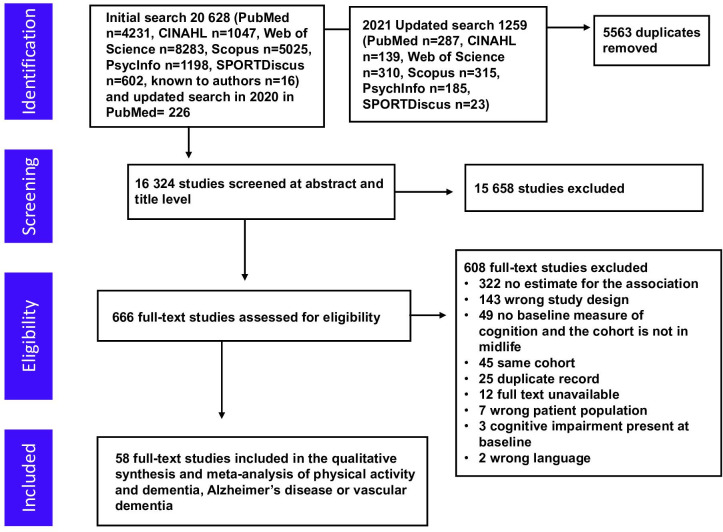
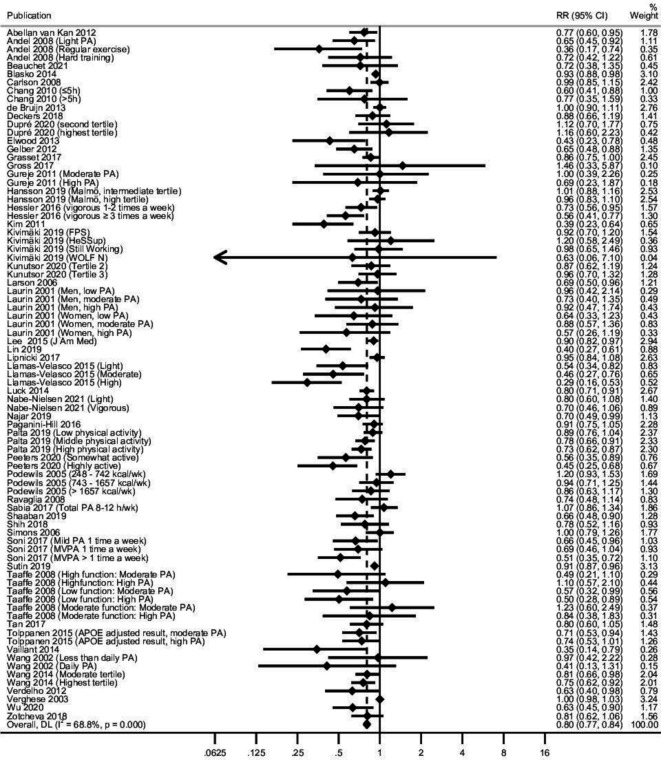
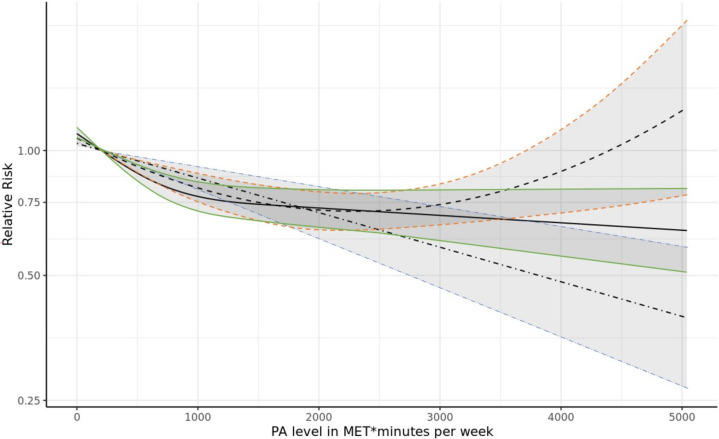
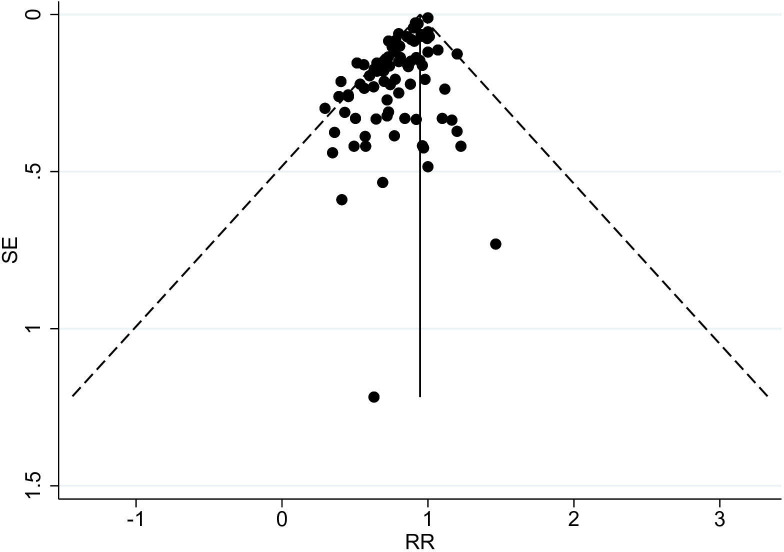
Objective: Physical activity (PA) is associated with a decreased incidence of dementia, but much of the evidence comes from short follow-ups prone to reverse causation. This meta-analysis investigates the effect of study length on the association. Design: A systematic review and meta-analysis. Pooled effect sizes, dose–response analysis and funnel plots were used to synthesise the results. Data sources: CINAHL (last search 19 October 2021), PsycInfo, Scopus, PubMed, Web of Science (21 October 2021) and SPORTDiscus (26 October 2021). Eligibility criteria: Studies of adults with a prospective follow-up of at least 1 year, a valid cognitive measure or cohort in mid-life at baseline and an estimate of the association between baseline PA and follow-up all-cause dementia, Alzheimer’s disease or vascular dementia were included (n=58). Results: PA was associated with a decreased risk of all-cause dementia (pooled relative risk 0.80, 95% CI 0.77 to 0.84, n=257 983), Alzheimer’s disease (0.86, 95% CI 0.80 to 0.93, n=128 261) and vascular dementia (0.79, 95% CI 0.66 to 0.95, n=33 870), even in longer follow-ups (≥20 years) for all-cause dementia and Alzheimer’s disease. Neither baseline age, follow-up length nor study quality significantly moderated the associations. Dose–response meta-analyses revealed significant linear, spline and quadratic trends within estimates for all-cause dementia incidence, but only a significant spline trend for Alzheimer’s disease. Funnel plots showed possible publication bias for all-cause dementia and Alzheimer’s disease. Conclusion: PA was associated with lower incidence of all-cause dementia and Alzheimer’s disease, even in longer follow-ups, supporting PA as a modifiable protective lifestyle factor, even after reducing the effects of reverse causation.
Overview
The claims and statistics of this paper haven’t been checked yet.
Free: it reads the open-access text and checks the first 5 claims that cite a source we can check. Create a free account to check every claim.
Integrity signals
Registry
Cites
Statistics
Figures
Verification
Claims the paper makes
The claims and statistics of this paper haven’t been checked yet.
Free: it reads the open-access text and checks the first 5 claims that cite a source we can check. Create a free account to check every claim.
Claims other papers make about this one
Each is checked against this paper’s own text: does it say what the citing paper says it does?
The source backs part of the claim, not all of it — or backs it for a different population, condition or comparison.
In the citing paper
“A systematic review and meta-analysis of 58 studies exploring the link between physical activity and dementia, found that physical activity was associated with a decreased risk of all-cause dementia (RR 0.80, 0.77 to 0.84, n=257,983) and dementia types in short and longer followups ≥20 years, and at all ages. (165)”
From Dementia prevention, intervention, and care: 2024 report of the Lancet standing Commission (2024) · cites this paper as [165]
Experimental — accuracy not yet measuredThe cited source says what the claim attributes to it.
In the citing paper
“Physical activity and exercise benefits apply to conditions characterized by very distinct pathophysiology, such as Alzheimer’s disease [629], cancer [628], heart disease [630], and pneumonia/other infections [631,632].”
From Global consensus on optimal exercise recommendations for enhancing healthy longevity in older adults (ICFSR) (2025) · cites this paper as [629]
The cited source says what the claim attributes to it.
In the citing paper
“Physical activity and exercise benefits apply to conditions characterized by very distinct pathophysiology, such as Alzheimer’s disease [629], cancer [628], heart disease [630], and pneumonia/other infections [631,632].”
From Global consensus on optimal exercise recommendations for enhancing healthy longevity in older adults (ICFSR) (2025) · cites this paper as [629]
Self-check
Percentages, sums and reported differences re-computed from the paper’s own numbers.
The self-check needs the paper’s full text.
Citations
Cites
1 retracted
Dementia prevention, intervention, and care: 2020 report of the Lancet Commission
Livingston, G., Huntley, J., Sommerlad, A., Ames, D., Ballard, C., Banerjee, S., Brayne, C., Burns, A., Cohen-Mansfield, J., Cooper, C., et al. (2020) · The Lancet · doi:10.1016/s0140-6736(20)30367-6 · Cited by 10,430
RetractedPreferred Reporting Items for Systematic Reviews and Meta-Analyses: the PRISMA statement
Moher, D., Liberati, A., Tetzlaff, J., Altman, D. G., & for the PRISMA Group (2009) · BMJ · doi:10.1136/bmj.b2535 · Cited by 83,823
Preferred Reporting Items for Systematic Reviews and Meta-Analyses: The PRISMA Statement
Moher, D., Liberati, A., Tetzlaff, J., Altman, D. G., & The PRISMA Group (2009) · PLoS Medicine · doi:10.1371/journal.pmed.1000097 · Cited by 64,042
Wang, G., Ma, R., Qiao, G., Wada, K., Aizawa, Y., & Satoh, T. (2015) · Integrative Medicine International · doi:10.1159/000368408 · Cited by 18,657
Borenstein, M., Hedges, L. V., Higgins, J. P. T., & Rothstein, H. R. (2009) · doi:10.1002/9780470743386 · Cited by 14,225
World Health Organization 2020 guidelines on physical activity and sedentary behaviour
Bull, F. C., Al-Ansari, S. S., Biddle, S., Borodulin, K., Buman, M. P., Cardon, G., Carty, C., Chaput, J.-P., Chastin, S., Chou, R., et al. (2020) · British Journal of Sports Medicine · doi:10.1136/bjsports-2020-102955 · Cited by 11,657
Jack, C. R., Knopman, D. S., Jagust, W. J., Petersen, R. C., Weiner, M. W., Aisen, P. S., Shaw, L. M., Vemuri, P., Wiste, H. J., Weigand, S. D., et al. (2013) · The Lancet Neurology · doi:10.1016/s1474-4422(12)70291-0 · Cited by 4,396
Zhang, J., & Yu, K. F. (1998) · JAMA · doi:10.1001/jama.280.19.1690 · Cited by 4,138
(2015) · HAL · Cited by 2,238
Leisure Activities and the Risk of Dementia in the Elderly
Verghese, J., Lipton, R. B., Katz, M. J., Hall, C. B., Derby, C. A., Kuslansky, G., Ambrose, A. F., Sliwinski, M., & Buschke, H. (2003) · New England Journal of Medicine · doi:10.1056/nejmoa022252 · Cited by 1,961
Cited by
Items 301–400 of 439
The challenges of consciousness research in light of the variations of conscious experience
(2024) · Frontiers research topics · doi:10.3389/978-2-8325-4362-7
PHYSICAL ACTIVITY IN DEMENTIA PREVENTION
Karp, P., Gabryszewski, M., & Karp, K. (2024) · Health Problems of Civilization · doi:10.5114/hpc.2024.139216
RELATIONSHIP OF PHYSICAL ACTIVITY AND VALUE-DEONTOLOGICAL COMPETENCE OF IT SPECIALIST
Pelekh, Y., Шліхта, Г., & Grygus, I. M. (2024) · Реабілітаційні та фізкультурно-рекреаційні аспекти розвитку людини (Rehabilitation & recreation) · doi:10.32782/2522-1795.2024.18.24
Bezerra, L. M. R., Júnior, E. S. G., de Freitas, J. P. L. F., Pereira, P. N. T., Ericeira, D. S., Júnior, V. L. R., Silva, G. D. S., Alves, C. M., Pires, L. G. C., & Paz, M. S. L. C. (2024) · RECIMA21 - Revista Científica Multidisciplinar · doi:10.47820/recima21.v5i5.5197 · Cited by 1
Health, lifestyle, and contextual factors in healthy and pathological neurocognitive aging
Anderson, N. D., Gatto, H., & Myftaraj, E. (2024) · Elsevier eBooks · doi:10.1016/b978-0-12-820480-1.00129-7
Walking time and genetic predisposition for Alzheimer’s disease: Results from the HELIAD study
Sampatakakis, S. N., Mourtzi, N., Charisis, S., Mamalaki, E., Ntanasi, E., Hatzimanolis, A., Ramírez, A., Lambert, J., Yannakoulia, M., Kosmidis, M. H., et al. (2024) · The Clinical Neuropsychologist · doi:10.1080/13854046.2024.2344869
“On the contrary, maintaining a good physical condition through physical activity has been recognized as a lifestyle factor that may maintain cognitive function and prevent cognitive decline and AD development (Iso-Markku et al., 2022).”
Singh, M., & Majumdar, V. (2024) · Journal of Aging Research and Lifestyle · doi:10.14283/jarlife.2024.5
Aktiv gegen das Vergessen – Demenz – ein Zukunftsthema für die Physiotherapie
Kemper, C., & Emicke, R. (2024) · physiopraxis · doi:10.1055/a-2273-1602
de Zorzi, R. S., & Lopes, E. P. (2024) · doi:10.22533/at.ed.3082412083
A ARGININA NO PROCESSO DE CICATRIZAÇÃO DE QUEIMADURAS
da Silva, J. B., da Silva, A. J., Júnior, F. C. A. D. A., & Maia, L. M. S. D. S. (2024) · doi:10.22533/at.ed.3082412081
Fonseca, R. L., Nakakogue, L. M., Losekann, A. D. S., Montrezol, A. V., da Silva, A. M., Storm, D., Kauka, H. D., Martini, E. G., Silva, P. H. A., Geha, Y. A. K., et al. (2024) · doi:10.22533/at.ed.3082412086
ACIDENTES DE TRÂNSITO: TRAÇOS EPIDEMIOLÓGICOS E SEUS PROBLEMAS NA SAÚDE PÚBLICA
Filho, F. M. A. B., de Lima, R. B., Carneiro, L. D. P., Alves, K. S. B., Silva, T. M. E., Alves, C. N. C., de Oliveira, A. C. A., Vasconcelos, S. S., Prado, M. Z. P., & Alves, A. G. C. (2024) · doi:10.22533/at.ed.3082412082
Brondani, A. M., & da Silva, L. M. C. (2024) · doi:10.22533/at.ed.3082412084
Promovendo a saúde para todos: práticas de desafios da saúde coletiva
Zarili, T. F. T. (2024) · doi:10.22533/at.ed.308241208 · Cited by 1
PANDEMIA DE COVID 19 – PRETEXTO, CAUSA OU CONCAUSA PARA O AGRAVAMENTO NAS RELAÇÕES DE TRABALHO?
Reis, F. L., Toniasso, S. D. C. C., Pereira, R. M., Baldin, C. P., Riedel, P. G., Bertoloto, J. C. F., Farias, G. S., & Brum, M. C. B. (2024) · doi:10.22533/at.ed.3082412085
Lifestyle Changes in Aging and their Potential Impact on POAG
Erb, C., Erb, C., Kazakov, A., Kapanova, G. Z., & Weisser, B. (2024) · Klinische Monatsblätter für Augenheilkunde · doi:10.1055/a-2372-3505
“Already known: Increased age is a risk factor for POAG Aging is a highly complex process.”
Feter, N., Cunha, L. L., de Paula, D., Feter, J. S., Caputo, E. L., & Rombaldi, A. J. (2024) · Science & Sports · doi:10.1016/j.scispo.2023.10.005
Midlife is good for more than a crisis: Exercise for dementia prevention
Fenton, L. E., & Pa, J. (2024) · Journal of the American Geriatrics Society · doi:10.1111/jgs.19207
“…control studies have consistently provided compelling evidence for an association between physical activity and brain health, with systematic reviews and meta-analyses concluding that physical activity is associated with lower risk of all-cause dementia and AD 7 and cognitive decline and dementia.”
Yu, F., Pituch, K. A., Maxfield, M., Joseph, R. P., Pruzin, J. J., Ashish, D., Coon, D. W., Shaibi, G. Q., & _, _. (2024) · Journal of Aging and Physical Activity · doi:10.1123/japa.2023-0353
Haynes, A. S., Wallbank, G., Gilchrist, H., Sherrington, C., West, C. A., Oliveira, J. S., O'Rourke, S. D., & Tiedemann, A. (2024) · BMC Public Health · doi:10.1186/s12889-024-20345-8 · Cited by 1
“Physical activity is associated with lower incidence of Alzheimer’s disease and all-cause dementia [6], and can improve symptoms of depression, anxiety and distress, including for people living with mental health disorders and chronic disease [7, 8].”
BackgroundFeter, N., de Paula, D., dos Reis, R. C. P., Raichlen, D. A., Barreto, S. M., Suemoto, C. K., Schmidt, M. I., & Duncan, B. B. (2024) · Public Health · doi:10.1016/j.puhe.2024.11.008 · Cited by 2
Healthy lifestyles, plasma proteomic profile and long-term risk of dementiaPreprint
Shen, J., Wu, M., Huang, Y., Yan, M., Yang, Y., Xu, X., Zong, G., Yang, J., Li, X., Chen, H., et al. (2024) · medRxiv · doi:10.1101/2024.12.01.24317800
Morikawa, M., Harada, K., Kurita, S., Nishijima, C., Fujii, K., Kakita, D., Yamashiro, Y., Takayanagi, N., Sudo, M., & Shimada, H. (2024) · Archives of Gerontology and Geriatrics · doi:10.1016/j.archger.2024.105736 · Cited by 1
Physical Activity and Dementia in Africa: The Missing Evidence and the Path Forward
Feter, N., & Feter, J. (2025) · Journal of Physical Activity and Health · doi:10.1123/jpah.2025-0078
Advances in Exercise and Nutrition as Therapy in Diabetes
Zaharieva, D. P., Shakeri, D., Turner, L. V., & Riddell, M. C. (2025) · Diabetes Technology & Therapeutics · doi:10.1089/dia.2025.8809.dpz
“This fi nding fi ts with a recent meta-analysis demonstrating that weekly PA levels have an inverse linear, quadratic, and/or cubic inverse association with all-cause dementia and vascular dementia in aging adults without diabetes (7).”
InfluentialGayatri, P. A., Soegiharto, A. P., Adisti, S. T., Pratiwi, D. A., & Paramita, P. P. (2025) · Jurnal Layanan Masyarakat (Journal of Public Services) · doi:10.20473/jlm.v9i1.2025.039-048
Nameni, F., & Dehkordi, M. R. A. K. (2025) · Journal of Neurorestoratology · doi:10.1016/j.jnrt.2025.100206
Xu, L., & Long, D. (2025) · Intensive and Critical Care Nursing · doi:10.1016/j.iccn.2025.104050
Modifiable risk factors for dementia
Veverová, K., Nováková, J. M., Sečník, J., Šteiner, J., Karamazovová, S., Chmátalová, Z., & Lerch, O. (2025) · Neurologie pro praxi · doi:10.36290/neu.2025.040
The Link Between Physical Function, β-Amyloid, and Cognitive Aging in Women
Pedrero‐Chamizo, R., & Szoeke, C. E. I. (2025) · Applied Sciences · doi:10.3390/app15095210
Physical Exercise as a Therapeutic Strategy in Alzheimer’s Disease: Mechanisms and Benefits
Bartoszek, A., Kopeć, K., Adamiuk, J., Marut, A., Biskup, M., Misiuk, J., Skuba, A., Załuska, K., Świdniak, A., & Nykiel, S. (2025) · Quality in Sport · doi:10.12775/qs.2025.41.58848
“Epidemiological studies have demonstrated that individuals engaging in moderate to vigorous exercise have a significantly lower risk of developing AD compared to those with sedentary lifestyles [11].”
Sergio, J. P., Gosselin, E., Arthur, E., Wu, W.-C., & Alber, J. (2025) · Therapeutic Advances in Ophthalmology · doi:10.1177/25158414251340541
Lifestyle Medicine: Perspective of health needs.Review
Adrianzén-Arrieta, G., Aguirre-Alegría, L., Arambulo-Hidalgo, R., Arévalo-Humbo, O., & Arroyo-Sánchez, A. S. (2025) · Revista Médica de Trujillo · doi:10.17268/rmt.2025.v20i1.6470
Importance of lifestyle on cognitive function
Peral‐Suárez, Á., Loria‐Kohen, V., Perea-Tajuelo, S., & López-Sobaler, A. M. (2025) · Nutrición Hospitalaria · doi:10.20960/nh.06091 · Cited by 1
Pau, M., Asoni, G., Viale, D., & Putzu, V. (2025) · Journal of Gerontology and Geriatrics · doi:10.36150/2499-6564-n872
Roccati, E., Collins, J. M., Callisaya, M. L., Alty, J., King, A. E., Brady, J. J. R., & Vickers, J. C. (2025) · Alzheimer s & Dementia Diagnosis Assessment & Disease Monitoring · doi:10.1002/dad2.70166 · Cited by 3
“Evidence from systematic reviews and meta-analyses supports the neuroprotective effect of physical activity for dementia, 10 yet we still do not understand how it interacts with the biological cascade that precedes or drives Alzheimer’s disease (AD) and other forms of dementia.”
Self-esteem and health indicators in Polish postmenopausal women
Krupa-Kotara, K. H., Gdańska, A., Grajek, M. K., Günay, T., & Rozmiarek, M. (2025) · Frontiers in Nutrition · doi:10.3389/fnut.2025.1599776
Abernethy, D. A. (2025) · Queensland University of Technology · doi:10.5204/thesis.eprints.259592
Gonçalves, N. G., Coelho, P. H. L., Feter, N., Lotufo, P. A., Benseñor, I. M., & Suemoto, C. K. (2025) · Alzheimer Disease & Associated Disorders · doi:10.1097/wad.0000000000000690
Hyodo, K., & Soya, H. (2025) · Advances in neurobiology · doi:10.1007/978-981-95-0066-6_21
Yook, V., Jung, J.-H., Han, K., Kim, H., & Jeon, H. J. (2025) · Psychiatry Investigation · doi:10.30773/pi.2025.0085
“20 Also, a previous cross-sectional study showed that regular PA is associated with better cognitive test performance in both depressed and non-depressed subjects compared to low level of PA, but the difference in the performance between regular PA and low PA groups were larger in the depressed…”
Feter, N., Raichlen, D. A., Feter, J. S., Caputo, E. L., Umpierre, D., & Rombaldi, A. J. (2025) · Brazilian Journal of Psychiatry · doi:10.47626/1516-4446-2025-4411
Moreno, M., Cuadrado, C. T., Palomo, M. S. M., Delgado‐Álvarez, A., Ortiz, M. E., Ribas, G. G., Luque, M. L., Dolado, A. M., Matías‐Guiu, J., Lopez, C. O., et al. (2025) · Neurología · doi:10.1016/j.nrl.2025.501918 · Cited by 1
“…un riesgo un 30% mayor de demencia 14 La evidencia proporcionada por los estudios apoya la AF como factor pro-tector de la demencia, disminuyendo el riesgo de demencia en, aproximadamente, un 20% en los estudios más rigu-rosos o un retraso de hasta 12 a˜nos en el desarrollo de demencia 12,13”
Management of patients with pre-dementia cognitive impairment
Koberskaya, N. N. (2025) · Russian Journal of Geriatric Medicine · doi:10.37586/2686-8636-3-2025-332-342
Oh, S.-E., Lee, S., & Kang, M. (2025) · Journal of Physical Activity and Health · doi:10.1123/jpah.2025-0326
Scerri, A., & Scerri, C. (2025) · Journal of Public Health Research · doi:10.1177/22799036251388563 · Cited by 1
Blue spaces and incident dementia: Differences by geospatial and historical contexts
Moored, K., Desjardins, M. R., Rosso, A. L., Lovasi, G. S., Shields, T. M., Curriero, F. C., López, O. L., & Carlson, M. C. (2025) · Alzheimer s & Dementia · doi:10.1002/alz.70850 · Cited by 1
Gauvrit, T., Benderradji, H., Pelletier, A., Carvalho, K., Aboulouard, S., Faivre, É., Chatelain, E., Cannafarina, H., Labous, L., Launay, A., et al. (2025) · Brain · doi:10.1093/brain/awaf417
Ko, M., Huang, C.-H. S., Brown, K. J., Vintch, K. M., Shutes‐David, A., Wilson, K. F., Seto, E., & Tsuang, D. W. (2025) · medRxiv · doi:10.64898/2025.12.08.25341850
Weiner‐Light, S., Tomasino, F., del Salto, M., VELA, A. M., Wolf, M. S., & Sideman, A. B. (2025) · Ethnicity and Health · doi:10.1080/13557858.2025.2600276
“Regular physical activity has consistently been identified as one directly-modifiable behavior with sufficient evidence demonstrating its role in ADRD prevention (Iso-Markku et al. 2022; Livingston et al. 2024).”
Sun, J., Ling, Y., Chen, J., & Zhao, M. (2025) · Investigación Clínica · doi:10.54817/ic.v66n4a01
Cubelo, F. (2025) · Working with Older People · doi:10.1108/wwop-07-2025-0035
Besal, S., Jurak, G., Pustivšek, S., & Samardžija, P. P. (2025) · Šport revija za teoretična in praktična vprašanja športa · doi:10.52165/sport.73.3-4.114-126
Lerfald, M., Lydersen, S., Zotcheva, E., Nilsen, T. I. L., Eldholm, R. S., Martinez-Velilla, N., Selbæk, G., & Ernstsen, L. (2024) · Figshare · doi:10.6084/m9.figshare.26621854
Zhao, J., Ke, Z., Huang, R., Wen, X., Liu, W., Wang, S., Zhang, X., Zhuang, X., Pan, L., & Liao, L. (2024) · Figshare · doi:10.6084/m9.figshare.27059060
Zhao, J., Ke, Z., Huang, R., Wen, X., Liu, W., Wang, S., Zhang, X., Zhuang, X., Pan, L., & Liao, L. (2024) · Figshare · doi:10.6084/m9.figshare.27059045
Zhao, J., Ke, Z., Huang, R., Wen, X., Liu, W., Wang, S., Zhang, X., Zhuang, X., Pan, L., & Liao, L. (2024) · Figshare · doi:10.6084/m9.figshare.27059057
Zhao, J., Ke, Z., Huang, R., Wen, X., Liu, W., Wang, S., Zhang, X., Zhuang, X., Pan, L., & Liao, L. (2024) · Figshare · doi:10.6084/m9.figshare.27059039
Zhao, J., Ke, Z., Huang, R., Wen, X., Liu, W., Wang, S., Zhang, X., Zhuang, X., Pan, L., & Liao, L. (2024) · Figshare · doi:10.6084/m9.figshare.27059042
Salsali, M., Sheikhhoseini, R., Sayyadi, P., Hides, J., Dadfar, M., & Piri, H. (2024) · Figshare · doi:10.6084/m9.figshare.26614027
Zhao, J., Ke, Z., Huang, R., Wen, X., Liu, W., Wang, S., Zhang, X., Zhuang, X., Pan, L., & Liao, L. (2024) · Figshare · doi:10.6084/m9.figshare.27059048
Zhao, J., Ke, Z., Huang, R., Wen, X., Liu, W., Wang, S., Zhang, X., Zhuang, X., Pan, L., & Liao, L. (2024) · Figshare · doi:10.6084/m9.figshare.27059054
Zhao, J., Ke, Z., Huang, R., Wen, X., Liu, W., Wang, S., Zhang, X., Zhuang, X., Pan, L., & Liao, L. (2024) · Figshare · doi:10.6084/m9.figshare.27059051
Zhao, J., Ke, Z., Huang, R., Wen, X., Liu, W., Wang, S., Zhang, X., Zhuang, X., Pan, L., & Liao, L. (2024) · Figshare · doi:10.6084/m9.figshare.27059036
Cheng, H. Y., Chair, S. Y., Choi, K. C., Wong, K. K., Tang, W. L., Ali, M. U., Sit, J. W. H., & Fung, E. (2026) · International Journal of Behavioral Nutrition and Physical Activity · doi:10.1186/s12966-026-01872-6
Kim, D. A., Choi, M., Chun, B., Sun, K., Moon, S. Y., Song, H.-S., & Lee, S. M. (2026) · Dementia and Neurocognitive Disorders · doi:10.12779/dnd.2026.25.1.54
“12 However, the effects of exercise cannot be fully explained by program participation alone and may vary depending on prior exercise experience and adherence among those exposed to the intervention.”
Siqueira, J. D. A., Neto, F. T. D. P., dos Santos, C. E. S., Alves, L. G., d’Orsi, E., & Rech, C. R. (2026) · Psychogeriatrics · doi:10.1111/psyg.70141
“Other findings highlight significant improvements in memory, learning, language, orientation, executive functions, processing speed, autonomy and functional independence [13, 14].”
How Can Individuals Promote Well-Being?
Hill, C. T., & Aydın, K. B. (2026) · Springer eBooks · doi:10.1007/978-3-032-06431-8_13
Levin, O., Just, I., Klepochová, R., Helsper, S., Vints, W. A. J., Silva, A. F., Langeard, A., Shalom, S. B., Karatzaferi, C., Ziaei, M., et al. (2026) · Experimental Gerontology · doi:10.1016/j.exger.2026.113082
Jha, S., Khatun, T., Azharuddin, M., Sehgal, C. A., Parveen, S., & Noohu, M. M. (2026) · Journal of Gerontology and Geriatrics · doi:10.3390/jgg74010003
“A meta-analysis of 58 studies with over 250,000 participants reported that higher physical activity significantly reduced the risk of all-cause dementia, Alzheimer’s disease, and vascular dementia, regardless of age, follow-up duration, or study quality [15].”
Gil‐Moreno, M. J., Cuadrado, C. T., Palomo, M. S. M., Alvarez, A. D., Ortiz, M. E., Ribas, G. G., Luque, M. L., Dolado, A. M., Matías‐Guiu, J., Lopez, C. O., et al. (2026) · Neurología (English Edition) · doi:10.1016/j.nrleng.2026.501918
Li, Z., Lei, Y., Wen, Z., Duan, L., & Xiao, Z. (2026) · Journal of Affective Disorders · doi:10.1016/j.jad.2026.121528
Chen, Y., Gašević, D., Owen, A., Shah, S., Ilić, D., Ryan, J. L., Woods, R. L., Talic, S., Wolfe, R., & Orchard, S. G. (2026) · GeroScience · doi:10.1007/s11357-026-02179-x
“Physical activity (PA) is a modifiable risk factor that may potentially delay or prevent the onset of dementia [3, 4].”
InfluentialOveisgharan, S., Yang, J., Wang, T., Bennett, D. A. A., & Buchman, A. S. (2026) · The Lancet Healthy Longevity · doi:10.1016/j.lanhl.2026.100824
“Findings from many observational studies 3 support recommendations to older adults to engage in physical activity to prevent or delay the risk of dementia.”
Joseph, R. P., Pituch, K. A., Yu, F., Salisbury, D. L., & Maxfield, M. (2026) · JMIR Formative Research · doi:10.2196/82494
“Maintaining high PA levels during this stage of life has consistently shown to lower ADRD risk, even among individuals who were previously sedentary [3, 10].”
Association between pet ownership and incident dementia: A systematic review
Minami, K., Fukuzawa, F., Kobayashi, T., Delmonaco, D., Marra, A. R., Ko, F. C., & Yamada, Y. (2026) · The American Journal of Medicine · doi:10.1016/j.amjmed.2026.03.008
ФОРМУВАННЯ СОЦІАЛЬНОГО СТАТУСУ ГОЛЬФУ ТА ЙОГОФУНКЦІОНАЛЬНА РОЛЬ ЯК ОЗДОРОВЧОГО ВИДУ СПОРТУ
Растворцев, Р., & Шевчун, В. (2026) · Physical Culture and Sport Scientific Perspective · doi:10.31891/pcs.2026.1.24
Lee, G. M., Lee, Y.-S., & Kim, J. H. (2026) · Medicina · doi:10.3390/medicina62040628
“In recent years, growing attention has been directed toward the role of physical activity in populations with dementia or cognitive impairment [13].”
Rong, H., & Wan, X. (2026) · Journal of the American Medical Directors Association · doi:10.1016/j.jamda.2026.106180
Manurung, K., Martina, S. E., & Nababan, D. (2026) · Contagion Scientific Periodical Journal of Public Health and Coastal Health · doi:10.30829/contagion.v8i1.26029
“This impact may be due to polyphenols in tea, notably catechins, which are antioxidants, anti-inflammatories, and protectors of neurons that can slow down damage to neurons that happens with age (Feng et al., 2021; Iso-Markku et al., 2022).”
Belviranlı, M., Okudan, N., & Sezer, T. (2026) · Metabolic Brain Disease · doi:10.1007/s11011-026-01857-1
“Physical exercise has emerged as a promising non-pharmacological intervention, with observational studies suggesting its role in both prevention and treatment (Sujkowski et al. 2022, Iso-Markku et al. 2022, Sá Leitão et al. 2025 , Dou et al. 2025).”
Lugosi, C. A., Dobos, P., & Pongrácz, P. (2026) · Frontiers in Veterinary Science · doi:10.3389/fvets.2026.1833531
“Overall, similar to the findings in the case of humans (27, 28), long-term and regular physical activity might reduce the risk of dementia-like canine cognitive decline.”
Hou, M., Luo, J., & Yang, L. (2026) · Research Square · doi:10.21203/rs.3.rs-9294197/v1
Chiba, I., Nakaya, N., Mugikura, S., Kogure, M., Hatanaka, R., Nakaya, K., Tokioka, S., Takase, M., Nakamura, T., Nagaie, S., et al. (2026) · Journal of Epidemiology · doi:10.2188/jea.je20250540
Dong, Y., Jin, H., Wang, S., & Xu, Y. (2026) · Frontiers in Behavioral Neuroscience · doi:10.3389/fnbeh.2026.1802923 · Cited by 5
Machado, L., Berryman, A., & Perry, C. (2026) · Journal of Cognitive Enhancement · doi:10.1007/s41465-026-00361-9
Hong, C., Zhao, J., Xue, J., Liu, S., Wang, S., Zhao, W., Zong, B., & Zhang, X. (2026) · Behavioral Sciences · doi:10.3390/bs16050722
“…that individuals who engage in regular exercise (RE) have a reduced risk of developing dementia and Parkinson’s disease, experiencing adverse psychological states, and suffering from cognitive decline (Fang et al., 2018; Hooker et al., 2022; Iso-Markku et al., 2022; Singh et al., 2025).”
Shen, C., Su, J., Liu, L., Li, J., Zhao, X., Wang, Z., Jiang, Y., & Zhao, D. (2026) · Archives of Public Health · doi:10.1186/s13690-026-01957-5
Tong, X., Yang, Y., 刘孜孜, Luo, R., Chen, F., Liu, Y., Wang, Z., Tao, X., & Liu, W. (2026) · Ageing Research Reviews · doi:10.1016/j.arr.2026.103179
Li, L., Xu, M., Wu, L., Hu, Z. L., Liu, L., Zhou, L., Zhao, M., Xiong, Y., Zhang, Z., Zheng, L., et al. (2026) · The Journal of Prevention of Alzheimer s Disease · doi:10.1016/j.tjpad.2026.100603
“…of PA are associated with a decreased risk of all-cause dementia (pooled relative risk [RR]: 0.80, 95 % confidence interval [CI] 0.77 – 0.84), Alzheimer ’ s disease (RR: 0.86, 95 % CI: 0.80 – 0.93), and vascular dementia (RR:0.79, 95 % CI: 0.66 – 0.95), even over extended follow-up periods [10].”
InfluentialMakino, K., Kato, T., Ito, K., Katayama, O., Yamaguchi, R., & Shimada, H. (2026) · GeroScience · doi:10.1007/s11357-026-02338-0
Sinaga, M. R. E., Intening, V. R., Puspitasari, R., & Khenda, N. A. (2026) · Nursing Current Jurnal Keperawatan · doi:10.19166/ncjk.v14i1.10471
Yang, H., Niu, Z., Li, M., Zhou, H., Xiao, Y., Zhou, S., Zhan, Z., Liu, Y., Liu, S., Tignanelli, C. J., et al. (2026) · Journal of the American Medical Informatics Association · doi:10.1093/jamia/ocag101
Soga, K., Takahashi, M., Oba, K., Uno, A., Kawamura, T., Kawashima, K., Shinada, T., & Taki, Y. (2026) · Frontiers in Sports and Active Living · doi:10.3389/fspor.2026.1851134
“Physical activity is one of the most promising interventions for preventing age-related cognitive decline and dementia (1 – 3).”
Karbownik, L., Kasterka, N., Kolasa, M., Figwer, A., Figwer, K., Dzitkowska, K., Czarny, N., Broniecka, A., Śmigielski, M., & Garbaciak, J. (2026) · Quality in Sport · doi:10.12775/qs.2026.59.72815
McLaren, J. E., Moo, L. R., Nguyen, A. H., Metcalf, E. E., Kraft, M. L., Frank, B. E., Randolph, J. J., Tripodis, Y., Scoglio, A. A. J., & O’Connor, M. K. (2026) · American Journal of Lifestyle Medicine · doi:10.1177/15598276261460835 · Cited by 2
Liu, C.-J., Ulloa, G., Leal, K., Fan, C.-W., Chang, P., & Wang, I. (2026) · Geriatrics · doi:10.3390/geriatrics11040081
Wiesner, T., van Gils, V., Kwon, M., Calvin, C. M., Smith, M. A., & Bauermeister, S. (2026) · medRxiv · doi:10.64898/2026.07.05.26357302
Metadata
- Authors
- Iso-Markku, P., Kujala, U. M., Knittle, K., Polet, J., Vuoksimaa, E., & Waller, K.
- Affiliations
- University of Jyväskylä (FI)
- University of Helsinki (FI)
- Venue
- British Journal of Sports Medicine
- Publisher
- BMJ
- Published
- 2022-03-17
- Volume
- 56
- Issue
- 12
- Pages
- 701-709
- ISSN
- 0306-3674 (ISSN-L)
- 1473-0480
- PMC
- PMC9163715
- OpenAlex
- W4221092313
- Semantic Scholar
- ce0eb19745b12fb042fa00aab1a6473a09e6f59b
- Cited by
- 423
- References
- 97
- Citations by year
- 2026: 94 · 2025: 121 · 2024: 141 · 2023: 57 · 2022: 10
- FWCI
- 14.11
- Type
- journal article
- Language
- en
- Open access
- hybrid
- doi.org
- Locations
- British Journal of Sports Medicine (publishedVersion, cc-by)
- PubMed Central (publishedVersion, cc-by)
- PubMed (publishedVersion)
- Jyväskylä University Digital Archive (University of Jyväskylä) (submittedVersion, cc-by)
- Työväentutkimus Vuosikirja (submittedVersion)
- Funders
- HUS Diagnostic Center
- Academy of Finland (314639, 320109)
- Juho Vainion Säätiö
- Topics
- Health Sciences › Medicine › Psychiatry and Mental health › Dementia and Cognitive Impairment Research
- Health Sciences › Medicine › Public Health, Environmental and Occupational Health › Physical Activity and Health
- Life Sciences › Neuroscience › Cellular and Molecular Neuroscience › Alzheimer's disease research and treatments
- Keywords
- physical activity, dementia, Alzheimer's disease, vascular dementia, all-cause dementia, follow-up duration, reverse causality, dose-response relationship, cognitive decline
- MeSH terms
- Alzheimer Disease, Humans, Prospective Studies, Dementia, Vascular, Exercise, Disease Progression, Protective Factors
About these checks
Registry, retraction, Cites and statistics results are computed, not judged, with one exception: a printed reference that no index lists is read once by a model before it counts as a citation error. Claims are extracted by a model and kept only when their quote appears verbatim in the text; each cited source is then checked, with a model’s help, for whether it says what the claim relies on. Those verdicts can be wrong — read the claim’s quote and the cited source before relying on one.
Statistics and arithmetic are recomputed, not judged.
Confidence bands are shown only for fields calibrated on our annotated test set. None is calibrated yet, so no band is shown.
What counts as a claim ›How we measure confidence ›How we check this ›
Are you an author, or do you see a problem with this page? Request a review
Data sources
Bibliographic data: Semantic Scholar, OpenAlex, Crossref.
Contains information from the Semantic Scholar Academic Graph Datasets, made available under the ODC Attribution License (ODC-BY 1.0).
Semantic Scholar’s data is described in: Kinney, R., et al. (2023). The Semantic Scholar Open Data Platform. arXiv:2301.10140.
