

Physical activity as a protective factor for dementia and Alzheimer's disease: systematic review, meta-analysis and quality assessment of cohort and case-control studies
Open accessThe DOI matches its Crossref record; 98 of the 98 references it cites were found in a registry or an index.
Abstract
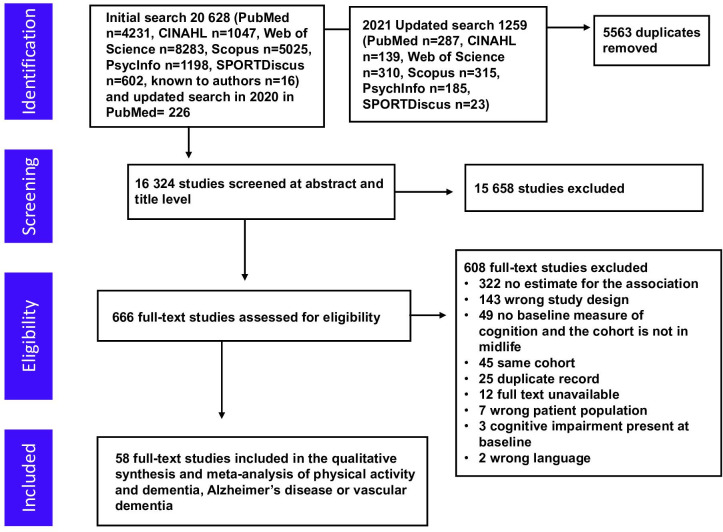
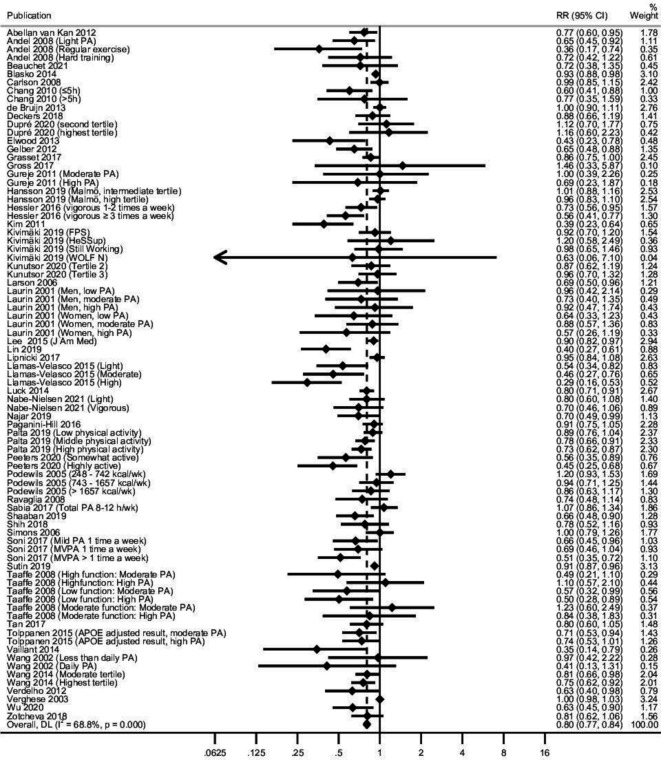
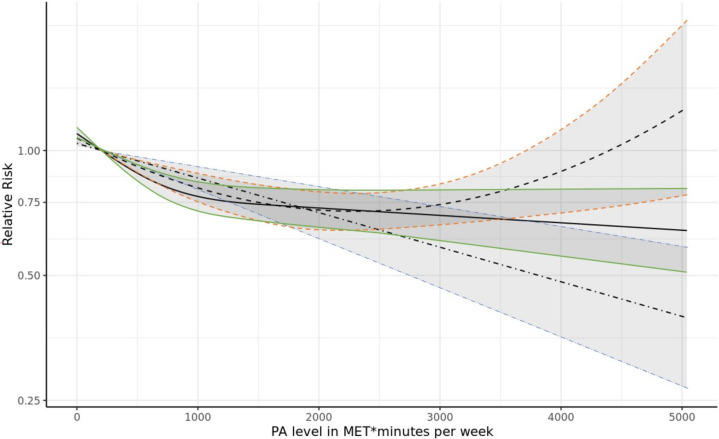
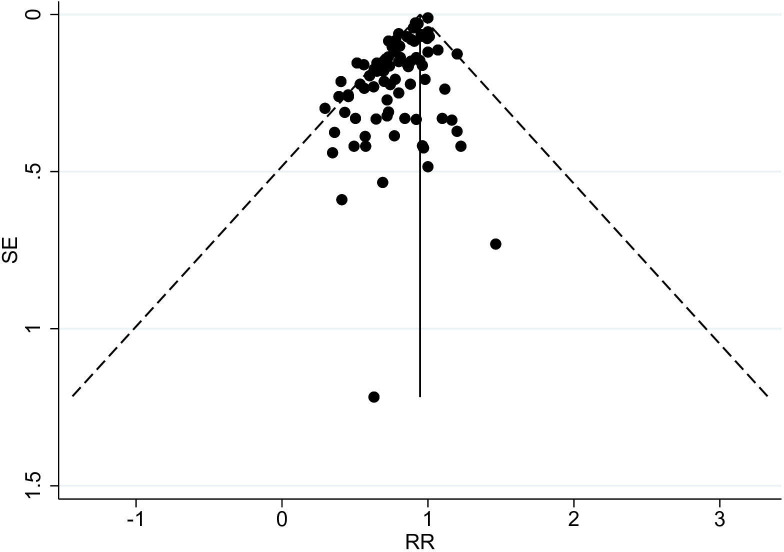
Objective: Physical activity (PA) is associated with a decreased incidence of dementia, but much of the evidence comes from short follow-ups prone to reverse causation. This meta-analysis investigates the effect of study length on the association. Design: A systematic review and meta-analysis. Pooled effect sizes, dose–response analysis and funnel plots were used to synthesise the results. Data sources: CINAHL (last search 19 October 2021), PsycInfo, Scopus, PubMed, Web of Science (21 October 2021) and SPORTDiscus (26 October 2021). Eligibility criteria: Studies of adults with a prospective follow-up of at least 1 year, a valid cognitive measure or cohort in mid-life at baseline and an estimate of the association between baseline PA and follow-up all-cause dementia, Alzheimer’s disease or vascular dementia were included (n=58). Results: PA was associated with a decreased risk of all-cause dementia (pooled relative risk 0.80, 95% CI 0.77 to 0.84, n=257 983), Alzheimer’s disease (0.86, 95% CI 0.80 to 0.93, n=128 261) and vascular dementia (0.79, 95% CI 0.66 to 0.95, n=33 870), even in longer follow-ups (≥20 years) for all-cause dementia and Alzheimer’s disease. Neither baseline age, follow-up length nor study quality significantly moderated the associations. Dose–response meta-analyses revealed significant linear, spline and quadratic trends within estimates for all-cause dementia incidence, but only a significant spline trend for Alzheimer’s disease. Funnel plots showed possible publication bias for all-cause dementia and Alzheimer’s disease. Conclusion: PA was associated with lower incidence of all-cause dementia and Alzheimer’s disease, even in longer follow-ups, supporting PA as a modifiable protective lifestyle factor, even after reducing the effects of reverse causation.
Overview
The claims and statistics of this paper haven’t been checked yet.
Free: it reads the open-access text and checks the first 5 claims that cite a source we can check. Create a free account to check every claim.
Integrity signals
Registry
Cites
Statistics
Figures
Verification
Claims the paper makes
The claims and statistics of this paper haven’t been checked yet.
Free: it reads the open-access text and checks the first 5 claims that cite a source we can check. Create a free account to check every claim.
Claims other papers make about this one
Each is checked against this paper’s own text: does it say what the citing paper says it does?
The source backs part of the claim, not all of it — or backs it for a different population, condition or comparison.
In the citing paper
“A systematic review and meta-analysis of 58 studies exploring the link between physical activity and dementia, found that physical activity was associated with a decreased risk of all-cause dementia (RR 0.80, 0.77 to 0.84, n=257,983) and dementia types in short and longer followups ≥20 years, and at all ages. (165)”
From Dementia prevention, intervention, and care: 2024 report of the Lancet standing Commission (2024) · cites this paper as [165]
Experimental — accuracy not yet measuredThe cited source says what the claim attributes to it.
In the citing paper
“Physical activity and exercise benefits apply to conditions characterized by very distinct pathophysiology, such as Alzheimer’s disease [629], cancer [628], heart disease [630], and pneumonia/other infections [631,632].”
From Global consensus on optimal exercise recommendations for enhancing healthy longevity in older adults (ICFSR) (2025) · cites this paper as [629]
The cited source says what the claim attributes to it.
In the citing paper
“Physical activity and exercise benefits apply to conditions characterized by very distinct pathophysiology, such as Alzheimer’s disease [629], cancer [628], heart disease [630], and pneumonia/other infections [631,632].”
From Global consensus on optimal exercise recommendations for enhancing healthy longevity in older adults (ICFSR) (2025) · cites this paper as [629]
Self-check
Percentages, sums and reported differences re-computed from the paper’s own numbers.
The self-check needs the paper’s full text.
Citations
Cites
1 retracted
Dementia prevention, intervention, and care: 2020 report of the Lancet Commission
Livingston, G., Huntley, J., Sommerlad, A., Ames, D., Ballard, C., Banerjee, S., Brayne, C., Burns, A., Cohen-Mansfield, J., Cooper, C., et al. (2020) · The Lancet · doi:10.1016/s0140-6736(20)30367-6 · Cited by 10,430
RetractedPreferred Reporting Items for Systematic Reviews and Meta-Analyses: the PRISMA statement
Moher, D., Liberati, A., Tetzlaff, J., Altman, D. G., & for the PRISMA Group (2009) · BMJ · doi:10.1136/bmj.b2535 · Cited by 83,823
Preferred Reporting Items for Systematic Reviews and Meta-Analyses: The PRISMA Statement
Moher, D., Liberati, A., Tetzlaff, J., Altman, D. G., & The PRISMA Group (2009) · PLoS Medicine · doi:10.1371/journal.pmed.1000097 · Cited by 64,042
Wang, G., Ma, R., Qiao, G., Wada, K., Aizawa, Y., & Satoh, T. (2015) · Integrative Medicine International · doi:10.1159/000368408 · Cited by 18,657
Borenstein, M., Hedges, L. V., Higgins, J. P. T., & Rothstein, H. R. (2009) · doi:10.1002/9780470743386 · Cited by 14,225
World Health Organization 2020 guidelines on physical activity and sedentary behaviour
Bull, F. C., Al-Ansari, S. S., Biddle, S., Borodulin, K., Buman, M. P., Cardon, G., Carty, C., Chaput, J.-P., Chastin, S., Chou, R., et al. (2020) · British Journal of Sports Medicine · doi:10.1136/bjsports-2020-102955 · Cited by 11,657
Jack, C. R., Knopman, D. S., Jagust, W. J., Petersen, R. C., Weiner, M. W., Aisen, P. S., Shaw, L. M., Vemuri, P., Wiste, H. J., Weigand, S. D., et al. (2013) · The Lancet Neurology · doi:10.1016/s1474-4422(12)70291-0 · Cited by 4,396
Zhang, J., & Yu, K. F. (1998) · JAMA · doi:10.1001/jama.280.19.1690 · Cited by 4,138
(2015) · HAL · Cited by 2,238
Leisure Activities and the Risk of Dementia in the Elderly
Verghese, J., Lipton, R. B., Katz, M. J., Hall, C. B., Derby, C. A., Kuslansky, G., Ambrose, A. F., Sliwinski, M., & Buschke, H. (2003) · New England Journal of Medicine · doi:10.1056/nejmoa022252 · Cited by 1,961
Cited by
Items 401–439 of 439
Li, Y., Li, Y., Liu, Y., Zhang, Y., Gu, X., Dong, D., Kang, J. H., Wang, M., Eliassen, A. H., Hu, F. B., et al. (2026) · The Lancet Public Health · doi:10.1016/s2468-2667(26)00123-4
Kröger, B., Ekblom, M. M., Wang, H., Thunborg, C., Kivipelto, M., & Wang, R. (2026) · Alzheimer s Research & Therapy · doi:10.1186/s13195-026-02140-2
“Moreover, occupational and leisure-time physical activity tend to be inversely related, with individuals in physically demanding occupations being less likely to engage in physical activity during leisure time [22].”
Dajani, I. A., Mahboob, A., Ibrahim, S. S., Ibrahim, R. S., Sedighi, M., Shirzadi, Z., Mahinrad, S., Sa, S., Khatoonabadi, A. R., Prina, M., et al. (2026) · Journal of Global Health · doi:10.7189/jogh.16.04181
Non-pharmacological strategies for the management of Alzheimer's disease
de Oliveira, G. L. D. S., & Bertollo, A. G. (2026) · Dementia & Neuropsychologia · doi:10.1590/1980-5764-dn-2025-0290
Sakal, C., Xu, W., Zhang, W., & Li, X. (2026) · Translational Psychiatry · doi:10.1038/s41398-026-04272-3
“While total volume-based measures of physical activity have been repeatedly associated with future dementia, depression, and anxiety [9 – 11], prolonged daily MVPA bouts and less fragmented activity patterns represent a promising new direction for future research and interventions.”
Merino-País, M., López‐Ortiz, S., Emanuele, E., Imbimbo, C., Imbimbo, B. P., Lista, S., & Santos‐Lozano, A. (2026) · Journal of Functional Morphology and Kinesiology · doi:10.3390/jfmk11030287
“Furthermore, its benefits extend to cognitive function, where PE is associated with improved cognitive outcomes across the lifespan and a reduced risk of AD [24–27].”
Moncion, K., Rodrigues, L., Bon, A., Sutoski, A., Sikorska, K., Allison, E. Y., Abreu, J., Golchi, S., Arbour, N., Gauthier, C. J., et al. (2026) · BMJ Open · doi:10.1136/bmjopen-2026-123336
Dog ownership and healthy brain aging: a pilot study
Potter, K., Martini, D. N., Sands, C. J., Falck, R. S., & Nagarajan, R. (2026) · PeerJ · doi:10.7717/peerj.21560 · Cited by 1
Atkinson, R. W., Blodgett, J. M., Hamer, M., Maddock, J., Winpenny, E. M., & Mitchell, J. J. (2026) · Journal of Epidemiology & Community Health · doi:10.1136/jech-2025-225100
Steiner, J. (2026) · Essentials · doi:10.1007/978-3-658-52146-2_1
He, J., Zhang, Y., Wang, X., Spartano, N. L., Rong, J., Benjamin, E. J., Ang, T. F. A., Au, R., Lin, H., Schramm, E., et al. (2026) · Journal of the American Heart Association · doi:10.1161/jaha.126.049284
“4,14,20,21 By incorporating both HR and step count, DHRPS may capture a vascular contribution to cognitive aging beyond what HR or step count reflects individually.”
Faieta, J. M., Devos, H., Philippou, E., Negm, A. M., Vaduvathiriyan, P., Erickson, K. I., Hirsch, M. A., van Wegen, E. E. H., Fakorede, S., Dagne, M. B., et al. (2026) · Archives of Physical Medicine and Rehabilitation · doi:10.1016/j.apmr.2026.08.001 · Cited by 1
Abernethy, D., Bennie, J. A., & Pavey, T. (2026) · Aging & Mental Health · doi:10.1080/13607863.2026.2714184
Yang, J., Li, G., Huang, J., Li, C., Li, P., Zhang, Y., & Hu, L. (2026) · Scientific Reports · doi:10.1038/s41598-026-67193-7
“While many population-based investigations have reported linear protective cognitive effects of increasing PA intensity 13 , this study revealed poorer cognitive performance associated with both low and high PA levels.”
Liu, C., Wang, J.-Y., Jia, X.-Y., Jia, C.-X., & Liu, B.-P. (2026) · International Journal of Behavioral Nutrition and Physical Activity · doi:10.1186/s12966-026-01966-1
“…an important correlate of brain health, and evidence from systematic reviews and meta-analyses suggests that higher levels of physical activity are associated with lower risks of several brain disorders, including anxiety [5], depression [6], dementia [7], Parkinson’s disease [8], and stroke [9].”
Prospective study on physical activity and Alzheimer's disease–related biomarkers
Iso‐Markku, P., Tu, X., Rissman, R. A., Gillespie, N. A., Elman, J. A., Fennema‐Notestine, C., Panizzon, M. S., Reynolds, C. A., Lyons, M. J., Kremen, W. S., et al. (2026) · Alzheimer s & Dementia · doi:10.1002/alz.71755
Self-citationSpires‐Jones, T. L. (2026) · Oxford University Press eBooks · doi:10.1093/9780198995296.003.0002
Lee, K. Y., Siew, S. K. H., Teo, T. L., Chua, K. C., Yu, J., Mahendran, R., & Rawtaer, I. (2026) · Frontiers in Sports and Active Living · doi:10.3389/fspor.2026.1768808
“Observational studies consistently demonstrate that higher levels of physical activity are associated with a reduced risk of cognitive decline and dementia (9 – 11).”
Lubkowski, S., & Pluta, B. (2026) · Studia Periegetica · doi:10.58683/sp.2205
“Higher levels of PA and less sedentary time are also associated with better global cognitive function in older adults, while regular PA may be associated with a lower risk of dementia and Alzheimer’s disease (Iso-Markku et al., 2022; Rojer et al., 2021).”
Current perspectives on non-pharmacological approaches to cognitive impairment
Gileva, E. A., Коваленко, Е. А., Makhnovich, E. V., Osinovskaya, N. A., & Bogolepova, A. N. (2026) · S S Korsakov Journal of Neurology and Psychiatry · doi:10.17116/jnevro202612608159
Ruiz‐Rizzo, A. L., Schrenk, S. J., Brodoehl, S., Frahm, C., Gaser, C., Herbsleb, M., Puta, C., Witte, O. W., & Finke, K. (2026) · medRxiv · doi:10.64898/2026.08.31.26361810
Chaowen, H., Gao, Y., & Wang, H. (2026) · Frontiers in Neuroscience · doi:10.3389/fnins.2026.1879617
Theobald, D., Williamson, P., Johnston, A., Tripp, L., Olabiyi, A. A., Silvers, X., Dickerson, A., Tran, T. D., Brás, L. E. D. C., Sriramula, S., et al. (2026) · GeroScience · doi:10.1007/s11357-026-02489-0
Bergman, F., Boraxbekk, C., Hettiarachchi, P., Svartengren, M., Wennberg, P., & Smidt, M. F.-D. (2026) · BMC Public Health · doi:10.1186/s12889-026-29397-4
“For example, midlife physical activity has been associated with a lower risk for all-cause dementia and Alzheimer’s disease in follow-ups longer than 20 years [5].”
Association between physical activity and incident dementia among individuals with hypertension
Yang, C., Zhao, Y., Li, J., Lei, L., Li, Y., Wang, W., Meng, X., Xia, C., Zhang, L., Wang, X., et al. (2026) · Frontiers in Aging Neuroscience · doi:10.3389/fnagi.2026.1833102
Knezović, A., Krsnik, A., Homolak, J., Perhoč, A. B., Deškin, A., Virag, D., Šalković‐Petrišić, M., & Barilar, J. O. (2026) · Neuroscience & Biobehavioral Reviews · doi:10.1016/j.neubiorev.2026.106982
A wearable accelerometry landscape of human health and disease
Liang, Y., Zhao, Y., Deng, Y., Li, Y., Xu, Y., Chen, Y., Cui, X., Li, Z., Wu, Y., Sahakian, B. J., et al. (2026) · 中国科学通报:英文版 · doi:10.1016/j.scib.2026.09.066
Gustafson, Y., Niklasson, J., Lövheim, H., Olofsson, B., & Corneliusson, L. (2026) · International Psychogeriatrics · doi:10.1016/j.inpsyc.2026.100280
Cardiorespiratory fitness is associated with cerebral oxygen extraction in Alzheimer’s disease
Kueck, P. J., Green, Z. D., Camones, R., John, C. S., Honea, R. A., Burns, J. M., Vidoni, E. D., & Morris, J. K. (2026) · Frontiers in Aging Neuroscience · doi:10.3389/fnagi.2026.1943472
Pakhomov, N. V., Kostyunina, D. S., & Artemenkov, A. A. (2026) · I P Pavlov Russian Medical Biological Herald · doi:10.17816/pavlovj635884
Zhang, Y., Merchant, A. T., Yang, C., Xu, H., Schulz, P. E., Crump, C., & Wei, J. (2026) · Alzheimer s & Dementia Translational Research & Clinical Interventions · doi:10.1002/trc2.70307
Longitudinal associations between physical activity and cognition post-stroke: the Nor-COAST study
Luzum, G., Aam, S., Allore, H. G., Saltvedt, I. T., Haberg, A. K., & Askim, T. (2026) · Brain Communications · doi:10.1093/braincomms/fcag367
“15,26,27 Additionally, there is considerable variability in the types and quality of instruments used to test both cognitive domains and physical activity.”
Madeira, R., Esteves, D., Neiva, H. P., Pinto, N., Nunes, C., Maia, A., Vercelli, A., & Pato, M. V. (2026) · Healthcare · doi:10.3390/healthcare14203539
van Baal, T. L., Köhler, S., Deckers, K., & Janssen, N. (2026) · Journal of Alzheimer s Disease · doi:10.1177/13872877261498431
Physical activity and brain aging in Sub-Saharan Africa: A scoping review of observational studies
Azage, M., Krell‐Roesch, J., Endalamaw, A., Kassie, G. G., Menber, Y., Nigatu, D., Mekonnen, A., Biyadgie, M., Enquobahrie, D. A., Baye, T. M., et al. (2026) · Journal of Alzheimer s Disease · doi:10.1177/13872877261499670
Meabon, J. S., McEvoy, C., Crabtree, A., Ditzel, R., Benedict, B. A., Ivory, R. A., Hebert, J. R., Flarity, K. M., Buckey, J. C., Geimer, S., et al. (2026) · Neuroscience & Biobehavioral Reviews · doi:10.1016/j.neubiorev.2026.107052
Li, H., Yang, S., Wu, Y., Wu, X., Kang, K., Liu, Z., Fan, L., & Diao, L. (2026) · Frontiers in Nutrition · doi:10.3389/fnut.2026.1947659
Wang, L., Lai, W., Wei, T., Zhang, Y., & Wen, Y. (2026) · Frontiers in Neurology · doi:10.3389/fneur.2026.1978500
Exercise is critical for brain health
Zhou, C., Wong, S., & Fabiano, N. (2026) · Brain Health · doi:10.61373/bh026v.0027
Metadata
- Authors
- Iso-Markku, P., Kujala, U. M., Knittle, K., Polet, J., Vuoksimaa, E., & Waller, K.
- Affiliations
- University of Jyväskylä (FI)
- University of Helsinki (FI)
- Venue
- British Journal of Sports Medicine
- Publisher
- BMJ
- Published
- 2022-03-17
- Volume
- 56
- Issue
- 12
- Pages
- 701-709
- ISSN
- 0306-3674 (ISSN-L)
- 1473-0480
- PMC
- PMC9163715
- OpenAlex
- W4221092313
- Semantic Scholar
- ce0eb19745b12fb042fa00aab1a6473a09e6f59b
- Cited by
- 423
- References
- 97
- Citations by year
- 2026: 94 · 2025: 121 · 2024: 141 · 2023: 57 · 2022: 10
- FWCI
- 14.11
- Type
- journal article
- Language
- en
- Open access
- hybrid
- doi.org
- Locations
- British Journal of Sports Medicine (publishedVersion, cc-by)
- PubMed Central (publishedVersion, cc-by)
- PubMed (publishedVersion)
- Jyväskylä University Digital Archive (University of Jyväskylä) (submittedVersion, cc-by)
- Työväentutkimus Vuosikirja (submittedVersion)
- Funders
- HUS Diagnostic Center
- Academy of Finland (314639, 320109)
- Juho Vainion Säätiö
- Topics
- Health Sciences › Medicine › Psychiatry and Mental health › Dementia and Cognitive Impairment Research
- Health Sciences › Medicine › Public Health, Environmental and Occupational Health › Physical Activity and Health
- Life Sciences › Neuroscience › Cellular and Molecular Neuroscience › Alzheimer's disease research and treatments
- Keywords
- physical activity, dementia, Alzheimer's disease, vascular dementia, all-cause dementia, follow-up duration, reverse causality, dose-response relationship, cognitive decline
- MeSH terms
- Alzheimer Disease, Humans, Prospective Studies, Dementia, Vascular, Exercise, Disease Progression, Protective Factors
About these checks
Registry, retraction, Cites and statistics results are computed, not judged, with one exception: a printed reference that no index lists is read once by a model before it counts as a citation error. Claims are extracted by a model and kept only when their quote appears verbatim in the text; each cited source is then checked, with a model’s help, for whether it says what the claim relies on. Those verdicts can be wrong — read the claim’s quote and the cited source before relying on one.
Statistics and arithmetic are recomputed, not judged.
Confidence bands are shown only for fields calibrated on our annotated test set. None is calibrated yet, so no band is shown.
What counts as a claim ›How we measure confidence ›How we check this ›
Are you an author, or do you see a problem with this page? Request a review
Data sources
Bibliographic data: Semantic Scholar, OpenAlex, Crossref.
Contains information from the Semantic Scholar Academic Graph Datasets, made available under the ODC Attribution License (ODC-BY 1.0).
Semantic Scholar’s data is described in: Kinney, R., et al. (2023). The Semantic Scholar Open Data Platform. arXiv:2301.10140.
