

The DOI matches its Crossref record; 30 of the 30 references it cites were found in a registry or an index.
Waning of vaccine effectiveness against moderate and severe covid-19 among adults in the US from the VISION network: test negative, case-control study
Open accessAbstract
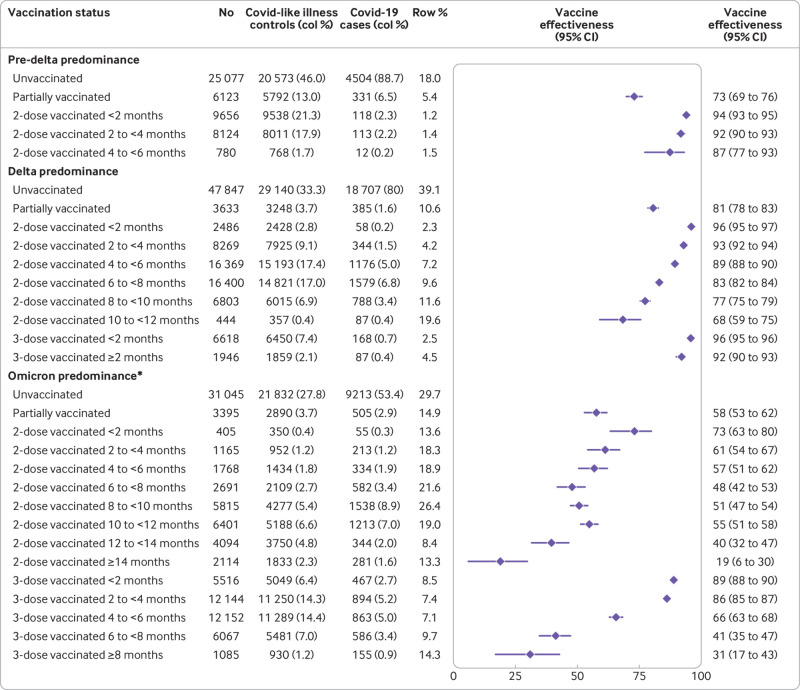
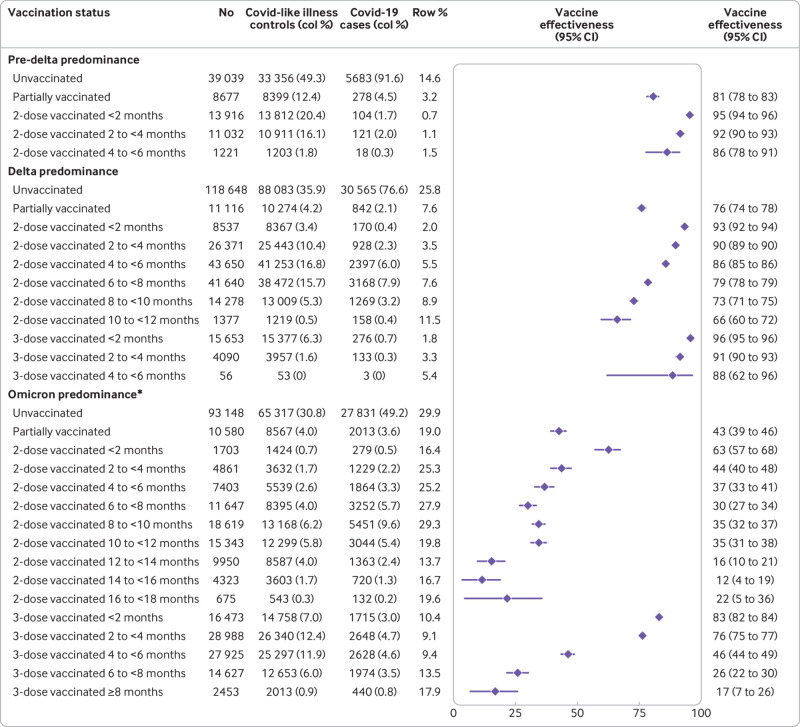
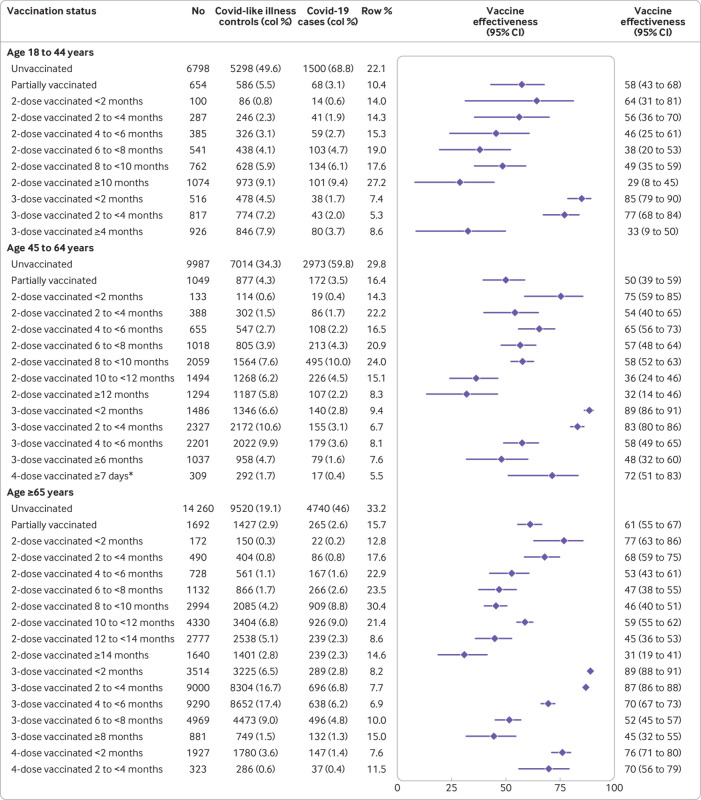
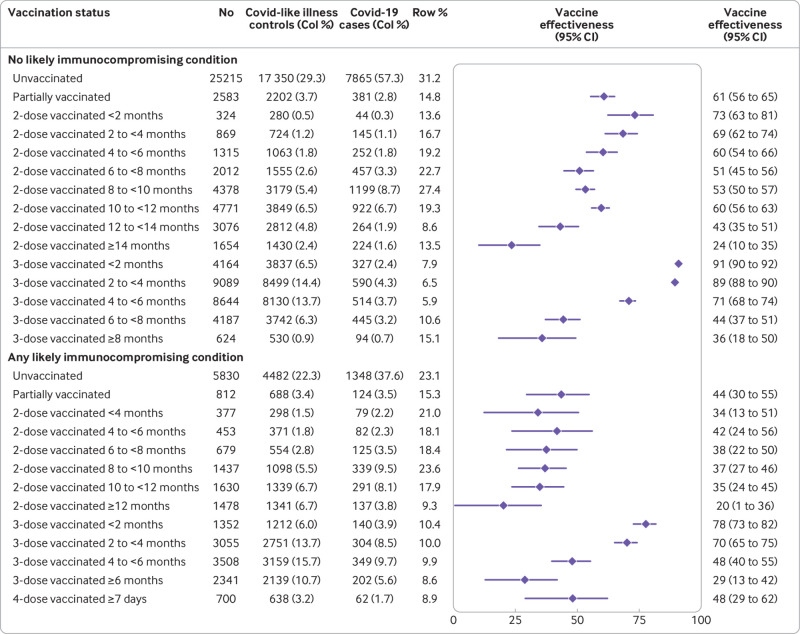
Objective: To estimate the effectiveness of mRNA vaccines against moderate and severe covid-19 in adults by time since second, third, or fourth doses, and by age and immunocompromised status. Design: Test negative case-control study. Setting: Hospitals, emergency departments, and urgent care clinics in 10 US states, 17 January 2021 to 12 July 2022. Participants: 893 461 adults (≥18 years) admitted to one of 261 hospitals or to one of 272 emergency department or 119 urgent care centers for covid-like illness tested for SARS-CoV-2. Main outcome measures: The main outcome was waning of vaccine effectiveness with BNT162b2 (Pfizer-BioNTech) or mRNA-1273 (Moderna) vaccine during the omicron and delta periods, and the period before delta was dominant using logistic regression conditioned on calendar week and geographic area while adjusting for age, race, ethnicity, local virus circulation, immunocompromised status, and likelihood of being vaccinated. Results: 45 903 people admitted to hospital with covid-19 (cases) were compared with 213 103 people with covid-like illness who tested negative for SARS-CoV-2 (controls), and 103 287 people admitted to emergency department or urgent care with covid-19 (cases) were compared with 531 168 people with covid-like illness who tested negative for SARS-CoV-2. In the omicron period, vaccine effectiveness against covid-19 requiring admission to hospital was 89% (95% confidence interval 88% to 90%) within two months after dose 3 but waned to 66% (63% to 68%) by four to five months. Vaccine effectiveness of three doses against emergency department or urgent care visits was 83% (82% to 84%) initially but waned to 46% (44% to 49%) by four to five months. Waning was evident in all subgroups, including young adults and individuals who were not immunocompromised; although waning was morein people who were immunocompromised. Vaccine effectiveness increased among most groups after a fourth dose in whom this booster was recommended. Conclusions: Effectiveness of mRNA vaccines against moderate and severe covid-19 waned with time after vaccination. The findings support recommendations for a booster dose after a primary series and consideration of additional booster doses.
Overview
The claims and statistics of this paper haven’t been checked yet.
Run the check — free, no account needed. It reads the open-access text and checks the sources it cites.
Integrity signals
Registry
Cites
Statistics
Figures
Verification
Claims the paper makes
The claims and statistics of this paper haven’t been checked yet.
Run the check — free, no account needed. It reads the open-access text and checks the sources it cites.
Claims other papers make about this one
Each is checked against this paper’s own text: does it say what the citing paper says it does?
The source backs part of the claim, not all of it — or backs it for a different population, condition or comparison.
In the citing paper
“Further, although boosting by BNT162b2 or CoronaVac restores strong protection against hospitalization and death33–35, the incremental effectiveness of BNT162b2 boosters against such outcomes waned over the course of 4–6 months34 for both adults and the elderly36.”
From Real-world COVID-19 vaccine effectiveness against the Omicron BA.2 variant in a SARS-CoV-2 infection-naive population (2023) · cites this paper as [36]
Experimental — accuracy not yet measuredThe cited source says what the claim attributes to it.
In the citing paper
“This led to a decline in vaccine effectiveness (VE) over time, as shown in several observational studies [2, 3].”
Self-check
Percentages, sums and reported differences re-computed from the paper’s own numbers.
The self-check needs the paper’s full text.
Citations
Cites
Safety and Efficacy of the BNT162b2 mRNA Covid-19 Vaccine
Polack, F. P., Thomas, S. J., Kitchin, N., Absalon, J., Gurtman, A., Lockhart, S., Perez, J. L., Pérez Marc, G., Moreira, E. D., Zerbini, C., et al. (2020) · New England Journal of Medicine · doi:10.1056/nejmoa2034577 · Cited by 14,592
Efficacy and Safety of the mRNA-1273 SARS-CoV-2 Vaccine
Baden, L. R., El Sahly, H. M., Essink, B., Kotloff, K., Frey, S., Novak, R., Diemert, D., Spector, S. A., Rouphael, N., Creech, C. B., et al. (2021) · New England Journal of Medicine · doi:10.1056/nejmoa2035389 · Cited by 10,119
Negative Controls: A Tool for Detecting Confounding and Bias in Observational Studies
Lipsitch, M., Tchetgen Tchetgen, E., & Cohen, T. (2010) · Epidemiology · doi:10.1097/ede.0b013e3181d61eeb · Cited by 1,583
Feikin, D. R., Higdon, M. M., Abu-Raddad, L. J., Andrews, N., Araos, R., Goldberg, Y., Groome, M. J., Huppert, A., O'Brien, K. L., Smith, P. G., et al. (2022) · The Lancet · doi:10.1016/s0140-6736(22)00152-0 · Cited by 1,237
Protection of BNT162b2 Vaccine Booster against Covid-19 in Israel
Bar-On, Y. M., Goldberg, Y., Mandel, M., Bodenheimer, O., Freedman, L., Kalkstein, N., Mizrahi, B., Alroy-Preis, S., Ash, N., Milo, R., et al. (2021) · New England Journal of Medicine · doi:10.1056/nejmoa2114255 · Cited by 1,169
Tartof, S. Y., Slezak, J. M., Fischer, H., Hong, V., Ackerson, B. K., Ranasinghe, O. N., Frankland, T. B., Ogun, O. A., Zamparo, J. M., Gray, S., et al. (2021) · The Lancet · doi:10.1016/s0140-6736(21)02183-8 · Cited by 1,167
Waning Immunity after the BNT162b2 Vaccine in Israel
Goldberg, Y., Mandel, M., Bar-On, Y. M., Bodenheimer, O., Freedman, L., Haas, E. J., Milo, R., Alroy-Preis, S., Ash, N., & Huppert, A. (2021) · New England Journal of Medicine · doi:10.1056/nejmoa2114228 · Cited by 1,034
Barda, N., Dagan, N., Cohen, C., Hernán, M. A., Lipsitch, M., Kohane, I. S., Reis, B. Y., & Balicer, R. D. (2021) · The Lancet · doi:10.1016/s0140-6736(21)02249-2 · Cited by 860
Waning of BNT162b2 Vaccine Protection against SARS-CoV-2 Infection in Qatar
Chemaitelly, H., Tang, P., Hasan, M. R., AlMukdad, S., Yassine, H. M., Benslimane, F. M., Al Khatib, H. A., Coyle, P., Ayoub, H. H., Al Kanaani, Z., et al. (2021) · New England Journal of Medicine · doi:10.1056/nejmoa2114114 · Cited by 831
Duration of Protection against Mild and Severe Disease by Covid-19 Vaccines
Andrews, N., Tessier, E., Stowe, J., Gower, C., Kirsebom, F., Simmons, R., Gallagher, E., Thelwall, S., Groves, N., Dabrera, G., et al. (2022) · New England Journal of Medicine · doi:10.1056/nejmoa2115481 · Cited by 807
Cited by
Sorted by citations
Items 101–185 of 185
Domen, J., Abrams, S., Digregorio, M., Ngoc, P. V., Duysburgh, E., Scholtes, B., & Coenen, S. (2024) · BMC Infectious Diseases · doi:10.1186/s12879-024-09969-8 · Cited by 3
Taus, E., Shino, M. Y., Ibarrondo, F. J., Hausner, M. A., Hofmann, C., & Yang, O. O. (2023) · Journal of Translational Medicine · doi:10.1186/s12967-023-04234-z · Cited by 3
Dugan, C., Simpson, A., Peeling, P., Lim, J., Davies, A., Buissink, P., MacLean, B., Jayasuriya, P. H., & Richards, T. (2023) · Patient Preference and Adherence · doi:10.2147/ppa.s397122 · Cited by 5
Samanta, S., Banerjee, J., Das, A., Das, S., Ahmed, R., Das, S., Pal, A., Ali, K. M., Mukhopadhyay, R., Giri, B., et al. (2024) · Current Microbiology · doi:10.1007/s00284-023-03597-2 · Cited by 3
Kumwichar, P., Poonsiri, C., Botwright, S., Sirichumroonwit, N., Loharjun, B., Thawillarp, S., Cheewaruangroj, N., Chokchaisiripakdee, A., Teerawattananon, Y., & Chongsuvivatwong, V. (2024) · JMIR Public Health and Surveillance · doi:10.2196/48255 · Cited by 4
Screening Strategies to Reduce COVID-19 Mortality in Nursing Homes
Dong, S., Jutkowitz, E., Giardina, J., & Bilinski, A. (2024) · JAMA Health Forum · doi:10.1001/jamahealthforum.2024.0688 · Cited by 5
Wang, Z., Röst, G., & Moghadas, S. M. (2024) · Royal Society Open Science · doi:10.1098/rsos.231971 · Cited by 3
Qi, Y., Zheng, H., Wang, J., Chen, Y., Guo, X., Li, Z., Zhang, W., Zhou, J., Wang, S., Lin, B., et al. (2024) · Vaccines · doi:10.3390/vaccines12070781 · Cited by 3
Lee, A., Davido, B., Beck, E. C., Demont, C., Joshi, K., Kohli, M. A., Maschio, M., Uhart, M., & Mouaddin, N. E. (2024) · Human Vaccines & Immunotherapeutics · doi:10.1080/21645515.2024.2423474 · Cited by 3
“In both the period of Delta and Omicron predominance, protection against hospitalization has been observed to be higher in the IC population compared to the general population [79].”
Lee, A. S., Jayasundara, K., Kohli, M. A., Maschio, M., Fust, K., Joshi, K., de Velde, N. V., & Beck, E. C. (2023) · medRxiv · doi:10.1101/2023.11.10.23298369 · Cited by 3
Uchida, S., Uno, S., Kondo, M., Uwamino, Y., Namkoong, H., Nishimura, T., Misawa, K., Kashimura, S., Yamato, K., Ishizaka, T., et al. (2024) · Scientific Reports · doi:10.1038/s41598-024-58603-9 · Cited by 2
“However, the waning of vaccine efficacy 2–5 and emergence of variant strains make it challenging to eradicate COVID-19 with vaccines alone; therefore, booster vaccinations are crucial 6 .”
BackgroundHou, J., Haslund-Gourley, B. S., Diray‐Arce, J., Hoch, A., Rouphael, N., Becker, P. M., Augustine, A. D., Ozonoff, A., Guan, L., Kleinstein, S. H., et al. (2025) · Frontiers in Medicine · doi:10.3389/fmed.2025.1604388 · Cited by 2
Association of public health and social measures with vaccine effectiveness
Tsang, T. K., Sullivan, S. G., Huang, X., Wang, C., Li-ping, P., Yang, B., & Cowling, B. J. (2026) · Nature Health · doi:10.1038/s44360-026-00127-9 · Cited by 2
Intapiboon, P., Pinpathomrat, N., Juthong, S., Uea‐Areewongsa, P., Ongarj, J., & Siripaitoon, B. (2023) · Vaccines · doi:10.3390/vaccines11030537 · Cited by 2
“However, this strategy is limited by the decline in vaccine immunity within a few months after vaccination in healthy and immunocompromised individuals, including those with autoimmune rheumatic diseases (ARDs) [2,3].”
BackgroundNew Trends and Challenges in Open Data
Kakulapati, V. (2023) · IntechOpen eBooks · doi:10.5772/intechopen.1000267 · Cited by 2
Ye, W., Li, K., Zhao, Z., Wu, S., Qu, H., Guo, Y., Abudunaibi, B., Chen, W., Cai, S., Chen, C., et al. (2023) · Frontiers in Public Health · doi:10.3389/fpubh.2023.1269194 · Cited by 2
SARS-CoV-2 and COVID-19: From Crisis to Solution
Šalamon, Š., Ewing, A. G., Fox, G., Bilodeau, S., Gershenson, C., Heino, M. T. J., & Bar-Yam, Y. (2024) · doi:10.59454/whn-2401-334 · Cited by 3
Matusali, G., Vergori, A., Cimini, E., Mariotti, D., Mazzotta, V., Cozzi‐Lepri, A., Colavita, F., Gagliardini, R., Notari, S., Meschi, S., et al. (2024) · Journal of Medical Virology · doi:10.1002/jmv.29598 · Cited by 2
Impacts of COVID-19 on mental health
Hayden, M. C. (2024) · Zeitschrift für Pneumologie · doi:10.1007/s10405-024-00562-z · Cited by 2
Lam, L. K., Tan, J. T., Ooi, P. H., Zhang, R., Chan, K. H., Mao, X., Hung, I. F., Seto, W., Yuen, M., & Cheung, K. S. (2024) · Journal of Gastroenterology and Hepatology · doi:10.1111/jgh.16716 · Cited by 1
“24 Subgroup analysis revealed that both the MASLD and non-MASLD groups had comparable immunogenicity within 4 months after the third dose of vaccination (vMN GMT: 46.87 vs 41.86; P = 0.240), but the difference in immunogenicity started to merge 4 months after the third dose (vMN GMT: 13.06 vs…”
InfluentialMaltezou, H. C., Gamaletsou, M. N., Chini, M., Petrakis, V., Rapti, V., Giannouchos, T. V., Karantoni, E., Kounouklas, K., Stamou, P., Karapanou, Α., et al. (2024) · Infectious Medicine · doi:10.1016/j.imj.2024.100144 · Cited by 2
Rowley, E. A. K., Mitchell, P. K., Yang, D., Lewis, N., Dixon, B. E., Vazquez‐Benitez, G., Fadel, W. F., Essien, I. J., Naleway, A. L., Stenehjem, E. A., et al. (2025) · JMIR Formative Research · doi:10.2196/58981 · Cited by 2
“Research studies required consideration of more nuanced exposure categories, based on a combination of the number of vaccine doses received and time since the most recent vaccine dose (to examine the waning of vaccine-induced protection against COVID-19) [24-26].”
Self-citationProtective Potential and Functional Role of Antibodies Against SARS-CoV-2 Nucleocapsid Protein
Rak, A. Y., Bazhenova, E. A., Игоревна, П. П., Matyushenko, V., Orshanskaya, Y. R., Сивак, К. В., Дмитриевна, К. А., Георгиевна, Р. Л., & Isakova-Sivak, I. (2025) · Antibodies · doi:10.3390/antib14020045 · Cited by 3
“…of the original SARS-CoV-2 strain and minimize the impact of the early phase of the COVID-19 pandemic [28,29], they predominantly targeted the coronavirus spike protein, which has led to the global spread of SARS-CoV-2 antigenic variants and a significant reduction in vaccine efficacy [30,31].”
Said, Z. N. A., Salama, I. I., Zaky, S., Shazly, S. H. E., Elzahaby, A. A., Elazhary, S. S., El‐Raey, F., Eid, K. A., Rushdi, A., Ghamry, A., et al. (2025) · BMC Infectious Diseases · doi:10.1186/s12879-025-11446-9 · Cited by 2
Pongutta, S., Tangcharoensathien, V., Leung, K. S. M., Larson, H. J., & Lin, L. K. (2024) · JMIR Public Health and Surveillance · doi:10.2196/54383 · Cited by 2
“Furthermore, resurgences are possible [6] due to waning immunity against COVID-19 and the evolution of new variants [7,8].”
Waning vaccine response to severe COVID-19 outcomes during omicron predominance in ThailandPreprint
Intawong, K., Chariyalertsak, S., Chalom, K., Wonghirundecha, T., Kowatcharakul, W., Thongprachum, A., Chotirosniramit, N., Noppakun, K., Khwanngern, K., Teacharak, W., et al. (2023) · Research Square · doi:10.21203/rs.3.rs-2449283/v1 · Cited by 2
Covid-19 Mortality: The Proportionality HypothesisPreprint
Cairns, A. J. G., Blake, D. P., Kessler, A. R., Kessler, M., & Mathur, R. (2023) · SSRN Electronic Journal · doi:10.2139/ssrn.4615371 · Cited by 2
Health Impacts of Federal Pandemic Aid to State and Local Governments
Clemens, J. P., & Mahajan, A. (2025) · National Bureau of Economic Research · doi:10.3386/w33699 · Cited by 2
Protection afforded by post-infection SARS-CoV-2 vaccine doses: A cohort study in ShanghaiPreprint
Zheng, B., Gonçalves, B. P., Deng, P., Wang, W., Tian, J., Liang, X., Yao, Y., & Xue, C. (2024) · eLife · doi:10.7554/elife.94990.3 · Cited by 2
Islam, M. T., Khanam, F., Ahmmed, F., Rajib, N. H., Hossen, M. I., Haque, S., Biswas, P. K., Ashrafi, S. A. A., Alam, A. N., Billah, M. M., et al. (2025) · Human Vaccines & Immunotherapeutics · doi:10.1080/21645515.2025.2518644 · Cited by 1
Sternberg, M., Johnson, A. G., King, J., Ali, A. R., Linde, L., Awofeso, A. O., Baker, J. S., Bayoumi, N. S., Broadway, S. E., Busen, K., et al. (2023) · PLoS ONE · doi:10.1371/journal.pone.0291678 · Cited by 2
Self-citationTurabián, J. L. (2024) · Archives of Community Medicine and Public Health · doi:10.17352/2455-5479.000207 · Cited by 1
Agamah, F. E., Ederveen, T. H. A., Skelton, M., Martin, D. P., Chimusa, E. R., & Hoen, P. A. C. ’. (2024) · Drug repurposing · doi:10.58647/drugrepo.24.1.0007 · Cited by 1
“111 Overall, the prioritized drug repurposing candidates ( Tables 3, 4, and 7 ) exhibit the potential to target a multitude of specific biological pathways and gene ontology processes that are associated with Covid-19 outcomes.”
BackgroundInfluentialMagid, A., Hussein, K., Dabaja‐Younis, H., Szwarcwort‐Cohen, M., Almog, R., Mekel, M., Weissman, A., Hyams, G., Gepstein, V., Horowitz, N. A., et al. (2024) · Antibodies · doi:10.3390/antib13030063 · Cited by 1
Yamaguchi, D., Saito, M. M., Hata, A., Shimizu, R., Miyazawa, S., Baba, T., Kubota, R., & Kitanishi, Y. (2024) · Infectious Diseases and Therapy · doi:10.1007/s40121-024-01046-6 · Cited by 1
On the Mark: Modeling and Forecasting for Public Health Impact
Panaggio, M. J., Wilson, S. N., Ratcliff, J. D., Mullany, L. C., Freeman, J. D., & Rainwater‐Lovett, K. (2023) · Health Security · doi:10.1089/hs.2023.0033 · Cited by 1
“3,5,6,15,21 Such an analysis would also enable identification of the aspects of existing health surveillance systems that contribute to uncertainty.”
Ngonghala, C. N., & Asare-Baah, M. (2022) · medRxiv · doi:10.1101/2022.07.06.22277303 · Cited by 1
Global COVID-19 Pandemic Outcomes: Dissecting a Failed StrategyPreprint
Thorp, J. A., Thorp, M. M., Thorp, E. M., Scott‐Emuakpor, A. B., & Thorp, K. E. (2022) · Preprints.org · doi:10.20944/preprints202211.0480.v1 · Cited by 1
Sakura, K. (2023) · doi:10.31219/osf.io/rczfu · Cited by 1
Covid-19 Vaccine Booster Cadence by Immunocompromised StatusPreprint
Yechezkel, M., Faust, J. S., Netzer, D., Razi, T., Shmueli, E., Arbel, R., & Yamin, D. (2023) · medRxiv · doi:10.1101/2023.04.18.23288615 · Cited by 1
Jones, R., & Ponomarenko, A. (2024) · Preprints.org · doi:10.20944/preprints202401.0333.v1
Agamah, F. E., Ederveen, T. H. A., Skelton, M., Martin, D. P., Chimusa, E. R., & Hoen, P. A. C. '. H. '. (2024) · doi:10.58647/drugarxiv.pr000010.v1 · Cited by 1
Chow, J. Y., Goh, Z. J., Li, R., Lim, D. Z. Y., Wee, L. E., Lye, D. C., Tan, K. B., & Lim, J. T. (2025) · medRxiv · doi:10.1101/2025.09.29.25336864 · Cited by 1
Derecho de las telecomunicaciones, nuevo derecho y nuevo mercado
Rodríguez, A. J. S. (2002) · Dialnet (Universidad de la Rioja)
Schildgen, V., Lüsebrink, J., & Schildgen, O. (2022) · Journal of Infection · doi:10.1016/j.jinf.2022.12.019
Nurses’ Intentions for COVID-19 Vaccination in South Korea in 2022
Song, B. Y., Choi, S. H., & Kim, D.-Y. (2023) · Journal of Korean Academy of Fundamentals of Nursing · doi:10.7739/jkafn.2023.30.1.125
Wilkinson, J., Demou, E., Cherrie, M. P. C., Edge, R., Gittins, M., Katikireddi, S. V., Kromydas, T., Mueller, W., Pearce, N. E., van Tongeren, M., et al. (2023) · medRxiv · doi:10.1101/2023.03.24.23287700
Wang, C. Y., Kuo, B.-S., Lee, Y., Ho, Y.-H., Pan, Y., Yang, Y.-T., Chang, H.-C., Lin-fang, F., & Peng, W. (2023) · medRxiv · doi:10.1101/2023.06.28.23291948
“13 DISCUSSION Conventionally, vaccine protection effectiveness or efficacy has been analyzed at 1-6 months post-vaccination [48-50].”
BackgroundLang, L., & Hou, C. M. (2023) · Elsevier eBooks · doi:10.1016/b978-0-323-91812-1.00004-4
Vaccination and Outcomes in Critically Ill Patients With COVID-19: A Nuanced But Encouraging Story*
Rhee, C. (2023) · Critical Care Medicine · doi:10.1097/ccm.0000000000005950
The Emerging Role of Photobiomodulation in COVID-19 Therapy – Part I
Williams, R. K. (2023) · Medical Research Archives · doi:10.18103/mra.v11i8.4029
Pandemic Open Data: Blessing or Curse?
Rinner, C. (2023) · doi:10.32920/24200505.v1
Pandemic Open Data: Blessing or Curse?
Rinner, C. (2023) · doi:10.32920/24200505
COVID-19 as an Ongoing Health Justice Issue in the United Kingdom and Globally
Bowen-Jones, E. (2023) · Studies in Gender and Sexuality · doi:10.1080/15240657.2023.2275527
“…initial phase), people who have been unable to be vaccinated remain at higher risk of severe disease or death, and vaccination may be less fully effective for some people who are clinically extremely vulnerable (CEV) to COVID-19 (Todd et al., 2021; Fendler et al., 2022; Ferdinands et al., 2022).”
BackgroundJain, V., Kerr, G. K., & Beaney, T. E. (2024) · PLOS Global Public Health · doi:10.1371/journal.pgph.0002046
Uemura, K., Ono, S., Michihata, N., Yamana, H., & Yasunaga, H. (2024) · Research Square · doi:10.21203/rs.3.rs-4023571/v1
Blecua, J., Fernández‐Recio, J., & Gutiérrez, J. M. (2024) · Open Journal of Modelling and Simulation · doi:10.4236/ojmsi.2024.122004
Protection afforded by post-infection SARS-CoV-2 vaccine doses: a cohort study in ShanghaiPreprint
Zheng, B., Gonçalves, B. P., Deng, P., Wang, W., Tian, J., Liang, X., Yao, Y., & Xue, C. (2024) · eLife · doi:10.7554/elife.94990.1
Folgen von COVID-19 für die psychische Gesundheit
Hayden, M. C. (2024) · Zeitschrift für Pneumologie · doi:10.1007/s10405-024-00561-0
Kramer, K. H., Zimmerman, R. K., Haggerty, C. L., Balasubramani, G. K., Nowalk, M. P., Martin, E. T., Gaglani, M., Phillips, C. H., Belongia, E. A., Chung, J., et al. (2024) · Human Vaccines & Immunotherapeutics · doi:10.1080/21645515.2024.2354013
Self-citationGlobal COVID-19 Pandemic Outcomes: A Cross-Country Comparison Study of Policy Strategies.
Thorp, J. A., Thorp, M. M., Thorp, E. M., Scott‐Emuakpor, A. B., & Thorp, K. E. (2024) · PubMed Central
Protection afforded by post-infection SARS-CoV-2 vaccine doses: a cohort study in ShanghaiPreprint
Zheng, B., Gonçalves, B. P., Deng, P., Wang, W., Tian, J., Liang, X., Yao, Y., & Xue, C. (2024) · eLife · doi:10.7554/elife.94990.2
Brambilla, R., Gili, R., Vigna‐Taglianti, F., Lenzi, J., Riccò, M., Burioni, R., Scarvaglieri, M., Rocco, R., Buttafuoco, V., Cristaudo, R. M. T. A., et al. (2024) · Vaccines · doi:10.3390/vaccines12111245
Makadzange, T., Gundidza, P., Konono, K. C. C., Gurumani, M., & Ndhlovu, C. E. (2024) · Vaccines · doi:10.3390/vaccines12121303
“This waning effectiveness aligns with observations from other studies and vaccine platforms [27,28].”
Wang, L., Swayze, S., Siddiqi, A., Baral, S., Sander, B., Sbihi, H., Kwong, J. C., & Mishra, S. (2025) · medRxiv · doi:10.1101/2025.01.30.25321209
Overview on Vaccine Efficacy, An
Bose, M., & Biswas, A. (2025) · International Encyclopedia of Statistical Science · doi:10.1007/978-3-662-69359-9_21
Wilton, J., García, H. A. V., Naveed, Z., Crabtree, A., Buxton, J. A., Wong, J., Krajden, M., Sbihi, H., & Janjua, N. Z. (2025) · Vaccine · doi:10.1016/j.vaccine.2025.127423
Holmes, A., Narayan, K. M., Yalcin, I., Hu, L., & Wingertzahn, M. A. (2025) · medRxiv · doi:10.1101/2025.07.23.25332095
Data science for pediatric infectious disease: utilizing COVID-19 as a model
Waxse, B. J., & Rao, S. (2025) · Current Opinion in Infectious Diseases · doi:10.1097/qco.0000000000001139
Self-citationKorves, C., Kulldorff, M., Balajee, A., Smith, J., Zwain, G., Graham, D. J., Whitaker, H., & Izurieta, H. S. (2025) · Vaccine · doi:10.1016/j.vaccine.2025.127658 · Cited by 1
Yükseköğretim Kurumlarında Dijital Doygunluğun SWOT ve Yapay Zekâ Destekli NLP Analizi
Kölemen, C. Ş., & Şahin, E. (2025) · Buca eğitim fakültesi dergisi (Online)/Buca Eğitim Fakültesi dergisi · doi:10.53444/deubefd.1732003
Risk factors of COVID-19 breakthrough infection: a case-control test-negative design study
Tejada, G., Pinós, L., Otero‐Romero, S., Borràs-Bermejo, B., Carbonés-Fargas, Í., Antón, A., Andrés, C., & Parés‐Badell, O. (2025) · BMC Infectious Diseases · doi:10.1186/s12879-025-11773-x
Dehnen, D., Botzenhardt, S., Giagkou, E., Enders, K., Hoeter, K., Simon, P. D., & Neuberger, E. W. I. (2025) · Virology Journal · doi:10.1186/s12985-025-03016-x
“Studies on vaccine effectiveness showed a lower effectiveness of mRNA vaccines against Omi-cron variants due to immune escape mechanisms [10– 12]; however, booster vaccinations improve protection against severe illness [13–15].”
Taus, E., Shino, M. Y., Ibarrondo, F. J., Hausner, M. A., Hofmann, C., & Yang, O. O. (2024) · Figshare · doi:10.6084/m9.figshare.26595695
Tsang, T. K., Sullivan, S. G., Meng, Y., Lai, F. T. T., Fan, M., Huang, X., Lin, Y., Peng, L., Zhang, C., Yang, B., et al. (2024) · Figshare · doi:10.6084/m9.figshare.27012277
Uemura, K., Ono, S., Michihata, N., Yamana, H., & Yasunaga, H. (2024) · Figshare · doi:10.6084/m9.figshare.26740445
Taus, E., Shino, M. Y., Ibarrondo, F. J., Hausner, M. A., Hofmann, C., & Yang, O. O. (2024) · Figshare · doi:10.6084/m9.figshare.26595698
Ess, G., Lew, A. S., Tippett, A., Salazar, L. W., Choi, C., Castro, K. D., Taylor, E. G., Reese, O., Momin, H., Ciric, C. R., et al. (2025) · Vaccines · doi:10.3390/vaccines14010045
“However, real-world VE decreased from the original estimates due to factors such as the emergence of SARS-CoV-2 variants, including Delta and Omicron with its subvariants [12–14].”
Wang, L., Swayze, S., Siddiqi, A., Baral, S., Sander, B., Sbihi, H., Kwong, J. C., & Mishra, S. (2026) · American Journal of Epidemiology · doi:10.1093/aje/kwag047 · Cited by 1
“…based on an individual’s vaccination status and prior COVID-19 diagnosis as of August 1, 2021, classified as either being immune (received ≥ 1 dose of the Johnson-Johnson vaccine or ≥ 2 doses of other vaccines or had a positive SARS-CoV-2 test, in the past 165 days 21 , 22 ) or non-immune.”
Holmes, A., Narayan, K. M., Yalcin, I., Hu, L., & Wingertzahn, M. A. (2026) · Open Forum Infectious Diseases · doi:10.1093/ofid/ofag168
Dadabhai, S. S., Samandari, T., Zhang, B., Hudson, A., Mkhize, N. N., Tapley, A., Andriesen, J. G., Moore, P., Chirenje, Z. M., Elyanu, P., et al. (2026) · Research Square · doi:10.21203/rs.3.rs-10935317/v1
“However, as with all COVID-19 vaccine platforms, waning immunity and escape from prior immunity by new SARS-CoV-2 variants – particularly omicron and its sub-lineages – reduced vaccine efficacy, especially in the elderly and the immunocompromised 3,4 .”
Ivo Rakovac, A., Triantafyllou, C., Psiakis, V., Galinovic, A., Domingues, A. M., Myrianthefs, P. M., & Breda, J. (2026) · Epidemiologia · doi:10.3390/epidemiologia7050129
“As vaccine effectiveness wanes over time, especially among elderly people and people with comorbidities, booster vaccine doses are key tools in protecting the most vulnerable [31,32].”
Feikin, D. R., Higdon, M. M., Abu-Raddad, L. J., Andrews, N., & Araos, R. (2023) · The Lancet Respiratory Medicine · doi:10.1016/s2213-2600(23)00015-6
“S, ChAdOx1, and mRNA-1273 Primary series Hospitalisations Delta El Adam (2022)51 Canada mRNA-1273 and BNT162b2 Primary series Infections Non-specific El Sahly (2021)52 USA mRNA-1273 Primary series Infections Non-specific Ferdinands (2022)53 USA mRNA-1273 and BNT162b2 Primary series Infections Omicron Florea (2021)54 U…”
BackgroundInfluential
Metadata
- Authors
- Ferdinands, J. M., Rao, S., Dixon, B. E., Mitchell, P. K., DeSilva, M. B., Irving, S. A., Lewis, N., Natarajan, K., Stenehjem, E., Grannis, S. J., Han, J., McEvoy, C., Ong, T. C., Naleway, A. L., Reese, S. E., Embi, P. J., Dascomb, K., Klein, N. P., Griggs, E. P., Liao, I.-C., Yang, D.-H., Fadel, W. F., Grisel, N., Goddard, K., Patel, P., Murthy, K., Birch, R., Valvi, N. R., Arndorfer, J., Zerbo, O., Dickerson, M., Raiyani, C., Williams, J., Bozio, C. H., Blanton, L., Link-Gelles, R., Barron, M. A., Gaglani, M., Thompson, M. G., & Fireman, B.
- Affiliations
- Centers for Disease Control and Prevention (US)
- University of Colorado Anschutz (US)
- Regenstrief Institute (US)
- Westat (United States) (US)
- HealthPartners (US)
- Kaiser Permanente (US)
- NewYork–Presbyterian Hospital (US)
- Intermountain Healthcare (US)
- Columbia University Irving Medical Center (US)
- Baylor Scott & White Medical Center - Temple (US)
- Corresponding author
- Ferdinands, Jill M
- ORCID
- Ferdinands, Jill M
- Rao, Suchitra
- Dixon, Brian E
- Mitchell, Patrick K
- DeSilva, Malini B
- Irving, Stephanie A
- Lewis, Ned
- Natarajan, Karthik
- Stenehjem, Edward
- Grannis, Shaun J
- McEvoy, Charlene
- Ong, Toan C
- Naleway, Allison L
- Reese, Sarah E
- Dascomb, Kristin
- Klein, Nicola P
- Griggs, Eric P
- Liao, I-Chia
- Yang, Duck-Hye
- Fadel, William F
- Goddard, Kristin
- Patel, Palak
- Murthy, Kempapura
- Valvi, Nimish R
- Zerbo, Ousseny
- Dickerson, Monica
- Raiyani, Chandni
- Bozio, Catherine H
- Blanton, Lenee
- Barron, Michelle A
- Gaglani, Manjusha
- Thompson, Mark G
- Fireman, Bruce
- Venue
- BMJ
- Publisher
- BMJ
- Published
- 2022-10-03
- Volume
- 379
- Pages
- e072141
- ISSN
- 1756-1833 (ISSN-L)
- PMC
- PMC9527398
- OpenAlex
- W4300863078
- Cited by
- 185
- References
- 30
- Citations by year
- 2026: 5 · 2025: 23 · 2024: 63 · 2023: 88 · 2022: 5
- FWCI
- 21.96
- Type
- journal article
- Language
- en
- Open access
- hybrid
- doi.org
- Licence
- Locations
- BMJ (publishedVersion, cc-by-nc)
- PubMed Central (publishedVersion, cc-by-nc)
- PubMed (publishedVersion)
- IUScholarWorks (Indiana University) (submittedVersion, cc-by-nc)
- Funders
- National Center for Immunization and Respiratory Diseases
- Topics
- Health Sciences › Medicine › Infectious Diseases › SARS-CoV-2 and COVID-19 Research
- Social Sciences › Health › Vaccine Coverage and Hesitancy
- Physical Sciences › Mathematics › Modeling and Simulation › COVID-19 epidemiological studies
- Keywords
- waning vaccine effectiveness, COVID-19 pandemic, SARS-CoV-2, mRNA vaccines, BNT162b2, mRNA-1273, booster vaccination, immunocompromised patients, hospitalization, emergency department visits, Omicron variant, Delta variant, adults, test-negative case-control, COVID-19 vaccination
- MeSH terms
- COVID-19, SARS-CoV-2, Vaccine Efficacy, BNT162 Vaccine, Humans, Case-Control Studies, Young Adult
About these checks
Registry, retraction, Cites and statistics results are computed, not judged, with one exception: a printed reference that no index lists is read once by a model before it counts as a citation error. Claims are extracted by a model and kept only when their quote appears verbatim in the text; each cited source is then checked, with a model’s help, for whether it says what the claim relies on. Those verdicts can be wrong — read the claim’s quote and the cited source before relying on one.
Statistics and arithmetic are recomputed, not judged.
Confidence bands are shown only for fields calibrated on our annotated test set. None is calibrated yet, so no band is shown.
What counts as a claim ›How we measure confidence ›How we check this ›
Are you an author, or do you see a problem with this page? Request a review
