

The DOI matches its Crossref record; 64 of the 64 references it cites were found in a registry or an index; 1 of the 45 sources its claims cite were checked for support.
Effect of exercise for depression: systematic review and network meta-analysis of randomised controlled trials
Open accessAbstract
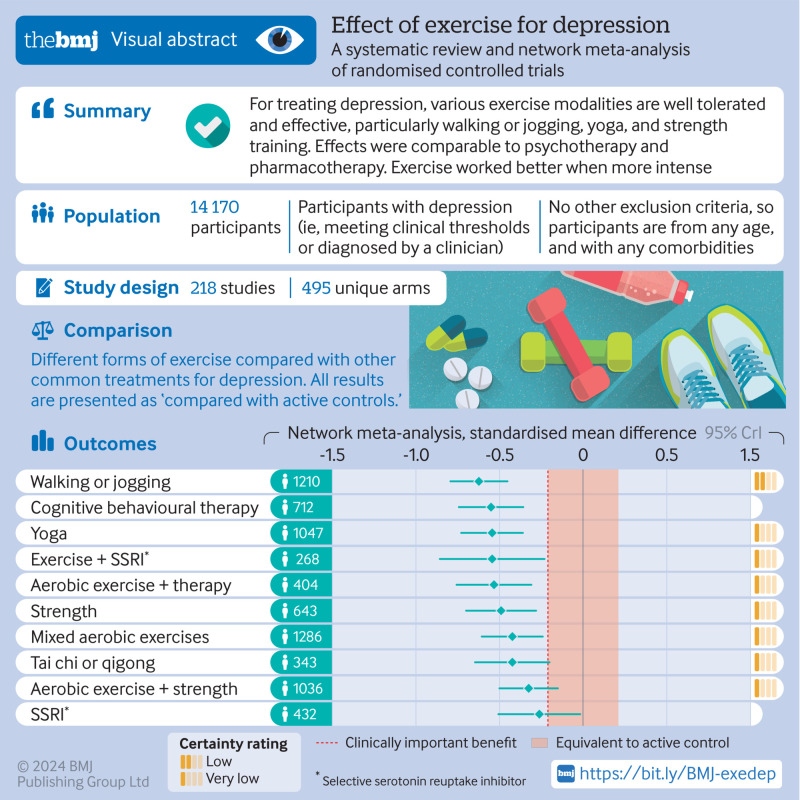
Objective: To identify the optimal dose and modality of exercise for treating major depressive disorder, compared with psychotherapy, antidepressants, and control conditions. Design: Systematic review and network meta-analysis. Methods: Screening, data extraction, coding, and risk of bias assessment were performed independently and in duplicate. Bayesian arm based, multilevel network meta-analyses were performed for the primary analyses. Quality of the evidence for each arm was graded using the confidence in network meta-analysis (CINeMA) online tool. Data sources: Cochrane Library, Medline, Embase, SPORTDiscus, and PsycINFO databases. Eligibility criteria for selecting studies: Any randomised trial with exercise arms for participants meeting clinical cut-offs for major depression. Results: 218 unique studies with a total of 495 arms and 14 170 participants were included. Compared with active controls (eg, usual care, placebo tablet), moderate reductions in depression were found for walking or jogging (n=1210, κ=51, Hedges’ g −0.62, 95% credible interval −0.80 to −0.45), yoga (n=1047, κ=33, g −0.55, −0.73 to −0.36), strength training (n=643, κ=22, g −0.49, −0.69 to −0.29), mixed aerobic exercises (n=1286, κ=51, g −0.43, −0.61 to −0.24), and tai chi or qigong (n=343, κ=12, g −0.42, −0.65 to −0.21). The effects of exercise were proportional to the intensity prescribed. Strength training and yoga appeared to be the most acceptable modalities. Results appeared robust to publication bias, but only one study met the Cochrane criteria for low risk of bias. As a result, confidence in accordance with CINeMA was low for walking or jogging and very low for other treatments. Conclusions: Exercise is an effective treatment for depression, with walking or jogging, yoga, and strength training more effective than other exercises, particularly when intense. Yoga and strength training were well tolerated compared with other treatments. Exercise appeared equally effective for people with and without comorbidities and with different baseline levels of depression. To mitigate expectancy effects, future studies could aim to blind participants and staff. These forms of exercise could be considered alongside psychotherapy and antidepressants as core treatments for depression. Systematic review registration: PROSPERO CRD42018118040.
Overview
AI snapshot
Written from the paper’s full text.
TL;DR
This systematic review and network meta-analysis of 218 randomised trials found that exercise produces moderate reductions in depression compared with active controls, with walking/jogging, yoga, strength training, and dance among the more effective modalities. Effects appeared proportional to prescribed intensity, but confidence in the evidence was low for walking/jogging and very low for other modalities.
Key findings
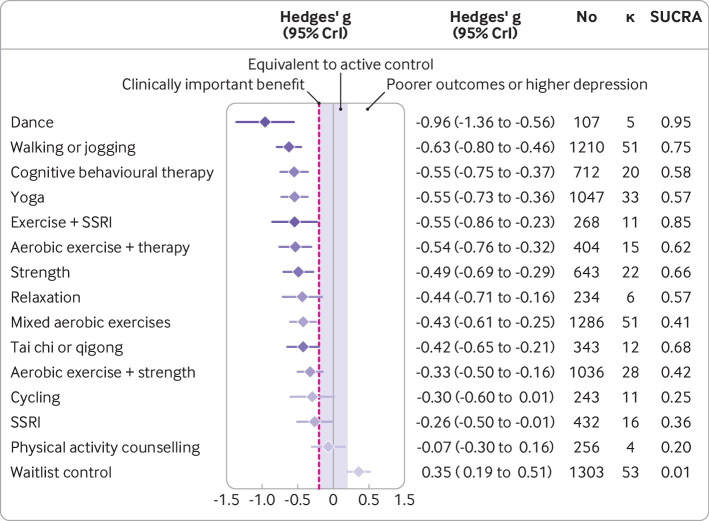
- Across 218 unique studies, 495 arms, and 14,170 participants, exercise reduced depression compared with active controls: dance (n=107, κ=5, Hedges’ g −0.96, 95% credible interval −1.36 to −0.56), walking or jogging (n=1210, κ=51, g −0.63, −0.80 to −0.46), yoga (n=1047, κ=33, g −0.55, −0.73 to −0.36), strength training (n=643, κ=22, g −0.49, −0.69 to −0.29), mixed aerobic exercises (n=1286, κ=51, g −0.43, −0.61 to −0.25), and tai chi or qigong (n=343, κ=12, g −0.42, −0.65 to −0.21).
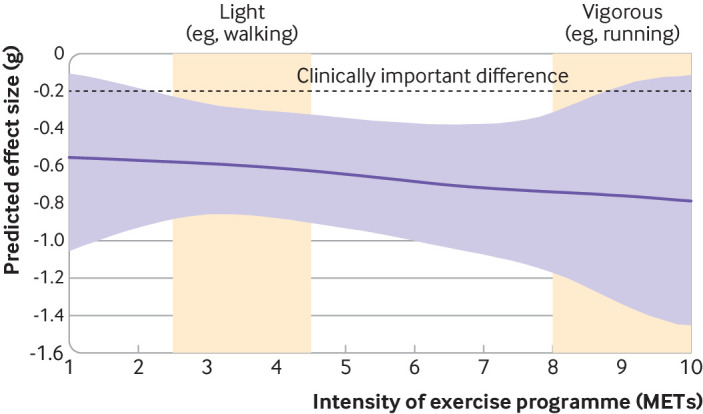
- Effects were proportional to prescribed intensity: light physical activity had g −0.58 (−0.82 to −0.33), while vigorous exercise had g −0.74 (−1.10 to −0.38).
- Strength training (odds ratio 0.55, 95% credible interval 0.31 to 0.99) and yoga (0.57, 0.35 to 0.94) had lower odds of dropout than active control.
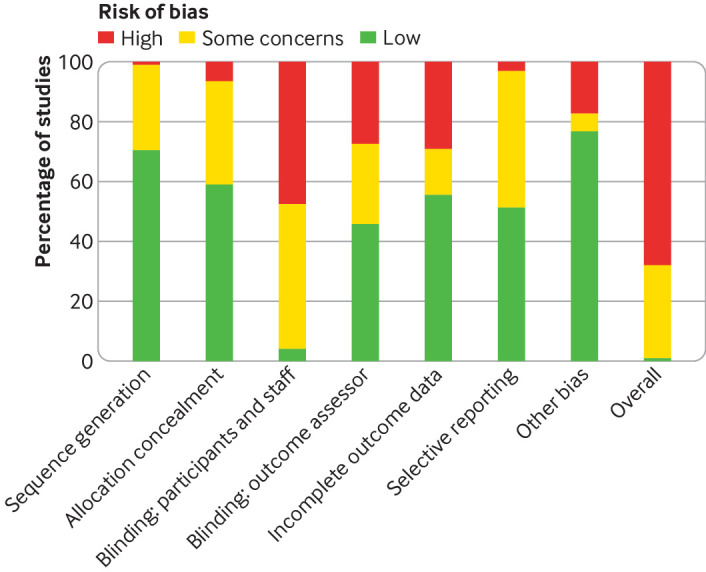
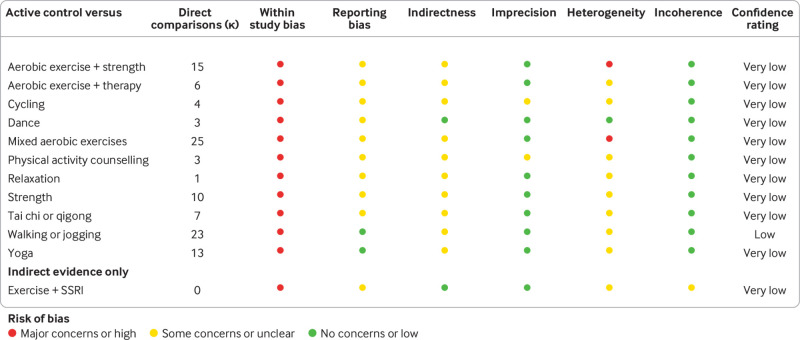
- Confidence in the evidence was low for walking or jogging and very low for other treatments; only one study met Cochrane criteria for low risk of bias.
Methods
- Systematic review and Bayesian arm-based multilevel network meta-analysis of randomised controlled trials, registered as PROSPERO CRD42018118040 and reported per PRISMA-NMA.
- Searches covered Cochrane Library, Medline, Embase, SPORTDiscus, and PsycINFO, with no language restrictions; eligible trials included exercise arms for participants meeting clinical cut-offs for major depression.
- Main analyses used Hedges’ g standardised mean change from baseline, with active controls grouped and waitlist control separated; credibility was assessed with CINeMA, and moderation analyses examined intensity, dose, age, sex, baseline depression, comorbidities, behaviour change techniques, autonomy, and funding.
Limitations
- The paper states that only one study met Cochrane criteria for low risk of bias, most studies did not blind participants or staff, and confidence was low for walking or jogging and very low for other treatments.
- The paper notes that publication bias was present, though not enough to nullify effects; risk-of-bias judgements may be too conservative because RoB 1 was used and many studies predated reporting checklists.
- The paper states that age and sex moderation was at the study level rather than individual level, dance evidence came from few studies with mostly young women, and searches were not designed to systematically capture grey literature or trial registries.
Model-written summary. Check it against the paper before relying on it.
Integrity signals
Registry
Cites
Statistics
Figures
Verification
Claims the paper makes
69 Own result · 29 Own interpretation · 28 Not checked yet · 20 Own method · 15 No basis given · 1 Supported so far
A result the paper reports from its own data — it cites no other source for it, so there is none to check. The quote shows it is in the paper.
In the paper
“mixed aerobic exercises (n=1286, κ=51, g −0.43, −0.61 to −0.24)”
- Also stated in: § Synthesis of results · plain
“mixed aerobic exercises (n=1286, κ=51, g=−0.43, −0.61 to −0.25)”
§ Effect of exercise for depression: systematic review and network meta-analysis of randomised controlled trials > Abstract > Results
plaindirectn = 1,286- Asserted: passes — The authors put it forward as true.
- Checkable: passes — It can be checked against evidence.
- Load-bearing: passes — The paper’s conclusions depend on it.
- Based: passes — The paper gives a reason why it holds.
- Rests on an assumption: Exercise interventions can be grouped into homogenous nodes for network meta-analysis.
- Also stated in: § Synthesis of results · plain
A result the paper reports from its own data — it cites no other source for it, so there is none to check. The quote shows it is in the paper.
In the paper
“or aerobic exercise was combined with psychotherapy (n=404, κ=15, g=−0.54, −0.76 to −0.32)”
§ Effect of exercise for depression: systematic review and network meta-analysis of randomised controlled trials > Results > Synthesis of results
plaindirectn = 404- Asserted: passes — The authors put it forward as true.
- Checkable: passes — It can be checked against evidence.
- Load-bearing: passes — The paper’s conclusions depend on it.
- Based: passes — The paper gives a reason why it holds.
- Rests on an assumption: Exercise interventions can be grouped into homogenous nodes for network meta-analysis.
A result the paper reports from its own data — it cites no other source for it, so there is none to check. The quote shows it is in the paper.
In the paper
“effects were moderate for cognitive behaviour therapy alone (n=712, κ=20, g=−0.55, −0.75 to −0.37)”
§ Effect of exercise for depression: systematic review and network meta-analysis of randomised controlled trials > Results > Synthesis of results
plaindirectn = 712- Asserted: passes — The authors put it forward as true.
- Checkable: passes — It can be checked against evidence.
- Load-bearing: unclear — It is unclear whether the paper’s conclusions depend on it.
- Based: passes — The paper gives a reason why it holds.
- Rests on an assumption: Exercise interventions can be grouped into homogenous nodes for network meta-analysis.
A result the paper reports from its own data — it cites no other source for it, so there is none to check. The quote shows it is in the paper.
In the paper
“Moderate, clinically meaningful effects were also present when exercise was combined with SSRIs (n=268, κ=11, g=−0.55, −0.86 to −0.23)”
§ Effect of exercise for depression: systematic review and network meta-analysis of randomised controlled trials > Results > Synthesis of results
plaindirectn = 268- Asserted: passes — The authors put it forward as true.
- Checkable: passes — It can be checked against evidence.
- Load-bearing: passes — The paper’s conclusions depend on it.
- Based: passes — The paper gives a reason why it holds.
- Rests on an assumption: Exercise interventions can be grouped into homogenous nodes for network meta-analysis.
A result the paper reports from its own data — it cites no other source for it, so there is none to check. The quote shows it is in the paper.
In the paper
“large reductions in depression were found for dance (n=107, κ=5, Hedges’ g −0.96, 95% credible interval −1.36 to −0.56)”
§ Effect of exercise for depression: systematic review and network meta-analysis of randomised controlled trials > Results > Synthesis of results
plaindirectn = 107- Asserted: passes — The authors put it forward as true.
- Checkable: passes — It can be checked against evidence.
- Load-bearing: passes — The paper’s conclusions depend on it.
- Based: passes — The paper gives a reason why it holds.
- Rests on an assumption: Exercise interventions can be grouped into homogenous nodes for network meta-analysis.
A result the paper reports from its own data — it cites no other source for it, so there is none to check. The quote shows it is in the paper.
In the paper
“strength training (n=643, κ=22, g −0.49, −0.69 to −0.29)”
- Also stated in: § Synthesis of results · plain
“strength training (n=643, κ=22, g=−0.49, −0.69 to −0.29)”
§ Effect of exercise for depression: systematic review and network meta-analysis of randomised controlled trials > Abstract > Results
plaindirectn = 643- Asserted: passes — The authors put it forward as true.
- Checkable: passes — It can be checked against evidence.
- Load-bearing: passes — The paper’s conclusions depend on it.
- Based: passes — The paper gives a reason why it holds.
- Rests on an assumption: Exercise interventions can be grouped into homogenous nodes for network meta-analysis.
- Also stated in: § Synthesis of results · plain
A result the paper reports from its own data — it cites no other source for it, so there is none to check. The quote shows it is in the paper.
In the paper
“All these treatments were significantly stronger than the standardised minimum clinically important difference compared with active control (g=−0.20), equating to an absolute g value of −1.16.”
§ Effect of exercise for depression: systematic review and network meta-analysis of randomised controlled trials > Results > Synthesis of results
plaindirect- Asserted: passes — The authors put it forward as true.
- Checkable: passes — It can be checked against evidence.
- Load-bearing: passes — The paper’s conclusions depend on it.
- Based: passes — The paper gives a reason why it holds.
A result the paper reports from its own data — it cites no other source for it, so there is none to check. The quote shows it is in the paper.
In the paper
“tai chi or qigong (n=343, κ=12, g −0.42, −0.65 to −0.21)”
- Also stated in: § Synthesis of results · plain
“tai chi or qigong (n=343, κ=12, g=−0.42, −0.65 to −0.21)”
§ Effect of exercise for depression: systematic review and network meta-analysis of randomised controlled trials > Abstract > Results
plaindirectn = 343- Asserted: passes — The authors put it forward as true.
- Checkable: passes — It can be checked against evidence.
- Load-bearing: passes — The paper’s conclusions depend on it.
- Based: passes — The paper gives a reason why it holds.
- Rests on an assumption: Exercise interventions can be grouped into homogenous nodes for network meta-analysis.
- Also stated in: § Synthesis of results · plain
A result the paper reports from its own data — it cites no other source for it, so there is none to check. The quote shows it is in the paper.
In the paper
“yoga (n=1047, κ=33, g −0.55, −0.73 to −0.36)”
- Also stated in: § Synthesis of results · plain
“yoga (n=1047, κ=33, g=−0.55, −0.73 to −0.36)”
§ Effect of exercise for depression: systematic review and network meta-analysis of randomised controlled trials > Abstract > Results
plaindirectn = 1,047- Asserted: passes — The authors put it forward as true.
- Checkable: passes — It can be checked against evidence.
- Load-bearing: passes — The paper’s conclusions depend on it.
- Based: passes — The paper gives a reason why it holds.
- Rests on an assumption: Exercise interventions can be grouped into homogenous nodes for network meta-analysis.
- Also stated in: § Synthesis of results · plain
A result the paper reports from its own data — it cites no other source for it, so there is none to check. The quote shows it is in the paper.
In the paper
“Compared with active controls (eg, usual care, placebo tablet), moderate reductions in depression were found for walking or jogging (n=1210, κ=51, Hedges’ g −0.62, 95% credible interval −0.80 to −0.45)”
- Also stated in: § Synthesis of results · plain
“moderate reductions for walking or jogging (n=1210, κ=51, g −0.63, −0.80 to −0.46)”
§ Effect of exercise for depression: systematic review and network meta-analysis of randomised controlled trials > Abstract > Results
plaindirectn = 1,210- Asserted: passes — The authors put it forward as true.
- Checkable: passes — It can be checked against evidence.
- Load-bearing: passes — The paper’s conclusions depend on it.
- Based: passes — The paper gives a reason why it holds.
- Rests on an assumption: Exercise interventions can be grouped into homogenous nodes for network meta-analysis.
- Also stated in: § Synthesis of results · plain
- Probably not a substantial claim. 48
- It may state two separate claims as one. 40
The sources with a verdict support this claim; the rest weren’t checked yet, have no full text we could read, or their verdicts aren’t rated yet.
In the paper
“Doing so can detect additional eligible studies72 and reveal the numbers of completed studies that remain unpublished.73”
§ Effect of exercise for depression: systematic review and network meta-analysis of randomised controlled trials > Discussion > Strengths, limitations, and future directions
What the sources say
- Not checked yetcites [72] Lefebvre C Glanville J Briscoe S . Searching for and selecting studies. In: Higgins JPT Thomas J Chandler J , eds. Cochrane Handbook for Systematic Reviews of Interventions. Cochrane, 2022, www.training.cochrane.org/handbook.
- Supportedcites [73] source
The Methods (MBT Trial Registrations; page unavailable) describe checking completed trial registrations for publications. The Results (Evaluation of MBT Trial Registrations; page unavailable) report that 8 of 21 eligible registered trials were published within 30 months of completion, allowing the number without a publication in that period to be identified. The finding is time-bounded; it does not establish that those trials remained unpublished indefinitely. (LLM, conf=0.91)
plaindirect- Asserted: passes — The authors put it forward as true.
- Checkable: passes — It can be checked against evidence.
- Load-bearing: fails — The paper’s conclusions may not depend on it.
- Based: passes — The paper gives a reason why it holds.
Probably not a substantial claim. The paper’s conclusions may not depend on it. It may state two separate claims as one.
A result the paper reports from its own data — it cites no other source for it, so there is none to check. The quote shows it is in the paper.
In the paper
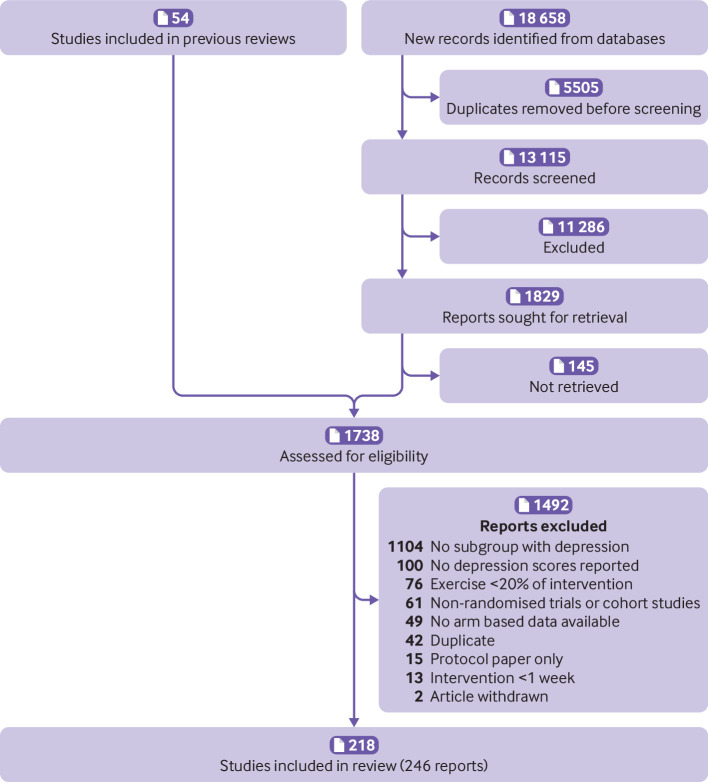
“218 unique studies with a total of 495 arms and 14 170 participants were included.”
- Also stated in: § Study selection · plain
“A total of 218 unique studies described in 246 reports were included, totalling 495 arms and 14 170 participants.”
§ Effect of exercise for depression: systematic review and network meta-analysis of randomised controlled trials > Abstract > Results
plainn = 14,170- Asserted: passes — The authors put it forward as true.
- Checkable: passes — It can be checked against evidence.
- Load-bearing: passes — The paper’s conclusions depend on it.
- Based: passes — The paper gives a reason why it holds.
It may state two separate claims as one.
- Also stated in: § Study selection · plain
A result the paper reports from its own data — it cites no other source for it, so there is none to check. The quote shows it is in the paper.
In the paper
“We found no indication that participants were likely to relapse within the measurement period (see supplementary file, section S12); effects remained steady when measured either directly after the intervention (g=−0.59, −0.80 to −0.39) or up to six months later (g=−0.63, −0.87 to −0.40).”
§ Effect of exercise for depression: systematic review and network meta-analysis of randomised controlled trials > Results > Moderation by intervention and design characteristics
hedged- Asserted: passes — The authors put it forward as true.
- Checkable: passes — It can be checked against evidence.
- Load-bearing: passes — The paper’s conclusions depend on it.
- Based: passes — The paper gives a reason why it holds.
It may state two separate claims as one.
A result the paper reports from its own data — it cites no other source for it, so there is none to check. The quote shows it is in the paper.
In the paper
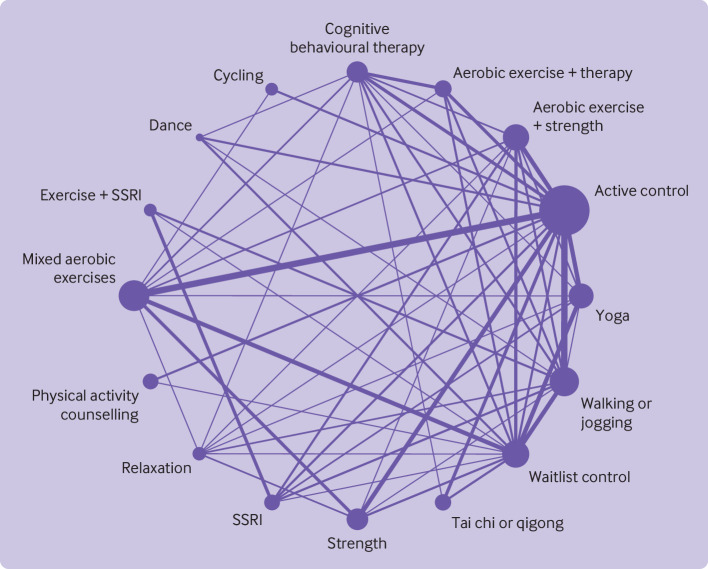
“The results of the global test design-by-treatment interaction model were not statistically significant, supporting the assumption of transitivity (χ2=94.92, df=75, P=0.06).”
§ Effect of exercise for depression: systematic review and network meta-analysis of randomised controlled trials > Results > Network geometry
plain- Asserted: passes — The authors put it forward as true.
- Checkable: passes — It can be checked against evidence.
- Load-bearing: passes — The paper’s conclusions depend on it.
- Based: passes — The paper gives a reason why it holds.
It may state two separate claims as one.
- The authors state this as an assumption: The network meta-analysis assumes transitivity: the only systematic difference between arms is the treatment, not other confounders.
A result the paper reports from its own data — it cites no other source for it, so there is none to check. The quote shows it is in the paper.
In the paper
“Evidence of publication bias was found for overall estimates of exercise on depression compared with active controls, although not enough to nullify effects.”
§ Effect of exercise for depression: systematic review and network meta-analysis of randomised controlled trials > Results > Sensitivity analyses
plain- Asserted: passes — The authors put it forward as true.
- Checkable: passes — It can be checked against evidence.
- Load-bearing: unclear — It is unclear whether the paper’s conclusions depend on it.
- Based: passes — The paper gives a reason why it holds.
It may state two separate claims as one.
A result the paper reports from its own data — it cites no other source for it, so there is none to check. The quote shows it is in the paper.
In the paper
“Funnel plots showed asymmetry, but the result of pooled effects remained statistically significant when only including non-significant studies”
§ Effect of exercise for depression: systematic review and network meta-analysis of randomised controlled trials > Results > Sensitivity analyses
plain- Asserted: passes — The authors put it forward as true.
- Checkable: passes — It can be checked against evidence.
- Load-bearing: unclear — It is unclear whether the paper’s conclusions depend on it.
- Based: passes — The paper gives a reason why it holds.
It may state two separate claims as one.
The paper states this without a source or data behind it here, so there is nothing to check it against. The quote shows it is in the paper.
In the paper
“As a result, overall risk of bias for most studies was unclear or high, and effect sizes could include expectancy effects, among other biases.”
§ Effect of exercise for depression: systematic review and network meta-analysis of randomised controlled trials > Results > Risk of bias within studies
hedged- Asserted: passes — The authors put it forward as true.
- Checkable: passes — It can be checked against evidence.
- Load-bearing: passes — The paper’s conclusions depend on it.
- Based: passes — The paper gives a reason why it holds.
It may state two separate claims as one.
The paper states this without a source or data behind it here, so there is nothing to check it against. The quote shows it is in the paper.
In the paper
“Overall, walking or jogging had low confidence, with other modalities being very low.”
- Also stated in: § Results · plain
“confidence in accordance with CINeMA was low for walking or jogging and very low for other treatments.”
§ Effect of exercise for depression: systematic review and network meta-analysis of randomised controlled trials > Results > Credibility assessment
plain- Asserted: passes — The authors put it forward as true.
- Checkable: passes — It can be checked against evidence.
- Load-bearing: passes — The paper’s conclusions depend on it.
- Based: passes — The paper gives a reason why it holds.
It may state two separate claims as one.
- Also stated in: § Results · plain
A result the paper reports from its own data — it cites no other source for it, so there is none to check. The quote shows it is in the paper.
In the paper
“Use of group exercise appeared to moderate the effects: although the overall effects were similar for individual (g=−1.10, −1.57 to −0.64) and group exercise (g=−1.16, −1.61 to −0.73), some interventions were better delivered in groups (yoga) and some were better delivered individually (strength training, mixed aerobic exercise”
§ Effect of exercise for depression: systematic review and network meta-analysis of randomised controlled trials > Results > Moderation by intervention and design characteristics
hedgedconditional- Asserted: passes — The authors put it forward as true.
- Checkable: passes — It can be checked against evidence.
- Load-bearing: passes — The paper’s conclusions depend on it.
- Based: passes — The paper gives a reason why it holds.
It may state two separate claims as one.
The paper states this without a source or data behind it here, so there is nothing to check it against. The quote shows it is in the paper.
In the paper
“In isolation, the most effective exercise modalities were walking or jogging, yoga, strength training, and dancing.”
§ Effect of exercise for depression: systematic review and network meta-analysis of randomised controlled trials > Discussion > Summary of evidence
plaindirect- Asserted: passes — The authors put it forward as true.
- Checkable: passes — It can be checked against evidence.
- Load-bearing: passes — The paper’s conclusions depend on it.
- Based: passes — The paper gives a reason why it holds.
It may state two separate claims as one.
A result the paper reports from its own data — it cites no other source for it, so there is none to check. The quote shows it is in the paper.
In the paper
“Our review did not uncover clear causal mechanisms, but the trends in the data are useful for generating hypotheses.”
§ Effect of exercise for depression: systematic review and network meta-analysis of randomised controlled trials > Discussion > Summary of evidence
plain- Asserted: passes — The authors put it forward as true.
- Checkable: passes — It can be checked against evidence.
- Load-bearing: passes — The paper’s conclusions depend on it.
- Based: passes — The paper gives a reason why it holds.
Probably not a substantial claim.
The paper states this without a source or data behind it here, so there is nothing to check it against. The quote shows it is in the paper.
In the paper
“The benefits from exercise tended to be proportional to the intensity prescribed, with vigorous activity being better.”
§ Effect of exercise for depression: systematic review and network meta-analysis of randomised controlled trials > Discussion > Summary of evidence
hedgedcorrelational- Asserted: passes — The authors put it forward as true.
- Checkable: passes — It can be checked against evidence.
- Load-bearing: passes — The paper’s conclusions depend on it.
- Based: passes — The paper gives a reason why it holds.
It may state two separate claims as one.
A result the paper reports from its own data — it cites no other source for it, so there is none to check. The quote shows it is in the paper.
In the paper
“In so doing, we found that these interventions do have different effects, with yoga being an intervention with strong effects and stretching being better described as an active control condition.”
§ Effect of exercise for depression: systematic review and network meta-analysis of randomised controlled trials > Discussion > Summary of evidence
boosteddirect- Asserted: passes — The authors put it forward as true.
- Checkable: passes — It can be checked against evidence.
- Load-bearing: passes — The paper’s conclusions depend on it.
- Based: passes — The paper gives a reason why it holds.
It may state two separate claims as one.
A result the paper reports from its own data — it cites no other source for it, so there is none to check. The quote shows it is in the paper.
In the paper
“We did find that autonomy, as provided in the methods of included studies, predicted effects, but in the opposite direction to our hypotheses: more autonomy was associated with weaker effects.”
§ Effect of exercise for depression: systematic review and network meta-analysis of randomised controlled trials > Discussion > Predictors of acceptability and outcomes
plaincorrelational- Asserted: passes — The authors put it forward as true.
- Checkable: passes — It can be checked against evidence.
- Load-bearing: passes — The paper’s conclusions depend on it.
- Based: passes — The paper gives a reason why it holds.
It may state two separate claims as one.
A result the paper reports from its own data — it cites no other source for it, so there is none to check. The quote shows it is in the paper.
In the paper
“Specifically, pooled effect sizes decreased when accounting for risk of publication bias, but no degree of publication bias could nullify effects.”
§ Effect of exercise for depression: systematic review and network meta-analysis of randomised controlled trials > Discussion > Strengths, limitations, and future directions
plaindirect- Asserted: passes — The authors put it forward as true.
- Checkable: passes — It can be checked against evidence.
- Load-bearing: passes — The paper’s conclusions depend on it.
- Based: passes — The paper gives a reason why it holds.
It may state two separate claims as one.
A result the paper reports from its own data — it cites no other source for it, so there is none to check. The quote shows it is in the paper.
In the paper
“Many exercise modalities appear to be effective treatments, particularly walking or jogging, strength training, and yoga, but confidence in many of the findings was low.”
§ Effect of exercise for depression: systematic review and network meta-analysis of randomised controlled trials > Discussion > Conclusions
hedgeddirect- Asserted: passes — The authors put it forward as true.
- Checkable: passes — It can be checked against evidence.
- Load-bearing: passes — The paper’s conclusions depend on it.
- Based: passes — The paper gives a reason why it holds.
It may state two separate claims as one.
The paper states this without a source or data behind it here, so there is nothing to check it against. The quote shows it is in the paper.
In the paper
“Effects appeared proportional to the intensity of exercise prescribed and were stronger for group exercise and interventions with clear prescriptions”
§ Effect of exercise for depression: systematic review and network meta-analysis of randomised controlled trials > Discussion > Conclusions
hedgedcorrelational- Asserted: passes — The authors put it forward as true.
- Checkable: passes — It can be checked against evidence.
- Load-bearing: passes — The paper’s conclusions depend on it.
- Based: passes — The paper gives a reason why it holds.
It may state two separate claims as one.
A result the paper reports from its own data — it cites no other source for it, so there is none to check. The quote shows it is in the paper.
In the paper
“Various exercise modalities are effective (walking, jogging, mixed aerobic exercise, strength training, yoga, tai chi, qigong) and well tolerated (especially strength training and yoga)”
§ Effect of exercise for depression: systematic review and network meta-analysis of randomised controlled trials > Discussion > Conclusions
plaindirect- Asserted: passes — The authors put it forward as true.
- Checkable: passes — It can be checked against evidence.
- Load-bearing: passes — The paper’s conclusions depend on it.
- Based: passes — The paper gives a reason why it holds.
It may state two separate claims as one.
What the paper did — it cites no source for this, so there is none to check. The quote shows it is in the paper.
In the paper
“Screening, data extraction, coding, and risk of bias assessment were performed independently and in duplicate.”
§ Effect of exercise for depression: systematic review and network meta-analysis of randomised controlled trials > Abstract > Methods
plain- Asserted: passes — The authors put it forward as true.
- Checkable: passes — It can be checked against evidence.
- Load-bearing: passes — The paper’s conclusions depend on it.
- Based: passes — The paper gives a reason why it holds.
Probably not a substantial claim. It may state two separate claims as one.
A conclusion the paper draws from its own results — it cites no other source for it, so there is none to check. The quote shows it is in the paper.
In the paper
“with walking or jogging, yoga, and strength training more effective than other exercises, particularly when intense.”
§ Effect of exercise for depression: systematic review and network meta-analysis of randomised controlled trials > Abstract > Conclusions
plaindirect- Asserted: passes — The authors put it forward as true.
- Checkable: passes — It can be checked against evidence.
- Load-bearing: passes — The paper’s conclusions depend on it.
- Based: passes — The paper gives a reason why it holds.
It may state two separate claims as one.
- The authors state this as an assumption: The network meta-analysis assumes transitivity: the only systematic difference between arms is the treatment, not other confounders.
- Rests on an assumption: Exercise interventions can be grouped into homogenous nodes for network meta-analysis.
What the paper did — it cites no source for this, so there is none to check. The quote shows it is in the paper.
In the paper
“We amended our analysis strategy after registering our review; these changes were to better align with new norms established by the Cochrane Comparing Multiple Interventions Methods Group.”
§ Effect of exercise for depression: systematic review and network meta-analysis of randomised controlled trials > Methods
plain- Asserted: passes — The authors put it forward as true.
- Checkable: passes — It can be checked against evidence.
- Load-bearing: fails — The paper’s conclusions may not depend on it.
- Based: passes — The paper gives a reason why it holds.
Probably not a substantial claim. The paper’s conclusions may not depend on it.
A conclusion the paper draws from its own results — it cites no other source for it, so there is none to check. The quote shows it is in the paper.
In the paper
“Yoga and strength training were well tolerated compared with other treatments.”
§ Effect of exercise for depression: systematic review and network meta-analysis of randomised controlled trials > Abstract > Conclusions
plaincorrelational- Asserted: passes — The authors put it forward as true.
- Checkable: passes — It can be checked against evidence.
- Load-bearing: passes — The paper’s conclusions depend on it.
- Based: passes — The paper gives a reason why it holds.
It may state two separate claims as one.
A conclusion the paper draws from its own results — it cites no other source for it, so there is none to check. The quote shows it is in the paper.
In the paper
“Exercise appeared equally effective for people with and without comorbidities and with different baseline levels of depression.”
§ Effect of exercise for depression: systematic review and network meta-analysis of randomised controlled trials > Abstract > Conclusions
hedged- Asserted: passes — The authors put it forward as true.
- Checkable: passes — It can be checked against evidence.
- Load-bearing: passes — The paper’s conclusions depend on it.
- Based: passes — The paper gives a reason why it holds.
It may state two separate claims as one.
What the paper did — it cites no source for this, so there is none to check. The quote shows it is in the paper.
In the paper
“We used Cochrane’s risk of bias tool for randomised controlled trials.”
§ Effect of exercise for depression: systematic review and network meta-analysis of randomised controlled trials > Methods > Risk of bias in individual studies
plain- Asserted: passes — The authors put it forward as true.
- Checkable: passes — It can be checked against evidence.
- Load-bearing: fails — The paper’s conclusions may not depend on it.
- Based: passes — The paper gives a reason why it holds.
Probably not a substantial claim. The paper’s conclusions may not depend on it.
What the paper did — it cites no source for this, so there is none to check. The quote shows it is in the paper.
In the paper
“Our findings are presented according to the Preferred Reporting Items for Systematic Reviews and Meta-Analyses-Network Meta-analyses (PRISMA-NMA) guidelines”
§ Effect of exercise for depression: systematic review and network meta-analysis of randomised controlled trials > Methods
plain- Asserted: passes — The authors put it forward as true.
- Checkable: passes — It can be checked against evidence.
- Load-bearing: fails — The paper’s conclusions may not depend on it.
- Based: passes — The paper gives a reason why it holds.
Probably not a substantial claim. The paper’s conclusions may not depend on it.
What the paper did — it cites no source for this, so there is none to check. The quote shows it is in the paper.
In the paper
“Quality of the evidence for each arm was graded using the confidence in network meta-analysis (CINeMA) online tool.”
§ Effect of exercise for depression: systematic review and network meta-analysis of randomised controlled trials > Abstract > Methods
plain- Asserted: passes — The authors put it forward as true.
- Checkable: passes — It can be checked against evidence.
- Load-bearing: fails — The paper’s conclusions may not depend on it.
- Based: passes — The paper gives a reason why it holds.
Probably not a substantial claim. The paper’s conclusions may not depend on it.
What the paper did — it cites no source for this, so there is none to check. The quote shows it is in the paper.
In the paper
“We preregistered informative priors based on the distributional parameters of our meta-analytical model.”
§ Effect of exercise for depression: systematic review and network meta-analysis of randomised controlled trials > Methods > Summary measures and synthesis
plain- Asserted: passes — The authors put it forward as true.
- Checkable: passes — It can be checked against evidence.
- Load-bearing: fails — The paper’s conclusions may not depend on it.
- Based: passes — The paper gives a reason why it holds.
Probably not a substantial claim. The paper’s conclusions may not depend on it.
What the paper did — it cites no source for this, so there is none to check. The quote shows it is in the paper.
In the paper
“All prespecified moderation and sensitivity analyses were performed.”
§ Effect of exercise for depression: systematic review and network meta-analysis of randomised controlled trials > Methods > Additional analyses
plain- Asserted: passes — The authors put it forward as true.
- Checkable: passes — It can be checked against evidence.
- Load-bearing: fails — The paper’s conclusions may not depend on it.
- Based: passes — The paper gives a reason why it holds.
Probably not a substantial claim. The paper’s conclusions may not depend on it.
A conclusion the paper draws from its own results — it cites no other source for it, so there is none to check. The quote shows it is in the paper.
In the paper
“For example, even taking conservative estimates (ie, the least favourable end of the credible interval), practitioners can expect patients to experience clinically significant effects from walking, running, yoga, qigong, strength training, and mixed aerobic exercise.”
§ Effect of exercise for depression: systematic review and network meta-analysis of randomised controlled trials > Discussion > Summary of evidence
plaindirect- Asserted: passes — The authors put it forward as true.
- Checkable: passes — It can be checked against evidence.
- Load-bearing: passes — The paper’s conclusions depend on it.
- Based: passes — The paper gives a reason why it holds.
It may state two separate claims as one.
- Rests on an assumption: The observed effect sizes correspond to clinically significant improvements for patients.
A conclusion the paper draws from its own results — it cites no other source for it, so there is none to check. The quote shows it is in the paper.
In the paper
“Exercise modalities such as running may satisfy many of the mechanisms, but they are unlikely to directly promote the mindful self-awareness provided by yoga and qigong.”
§ Effect of exercise for depression: systematic review and network meta-analysis of randomised controlled trials > Discussion > Summary of evidence
hedged- Asserted: passes — The authors put it forward as true.
- Checkable: fails — It may be too vague to check against evidence.
- Load-bearing: fails — The paper’s conclusions may not depend on it.
- Based: passes — The paper gives a reason why it holds.
Probably not a substantial claim. It may be too vague to check against evidence. The paper’s conclusions may not depend on it. It may state two separate claims as one.
In the paper
“Although confidence in many of the results was low, treatment guidelines may be overly conservative by conditionally recommending exercise as complementary or alternative treatment for patients in whom psychotherapy or pharmacotherapy is either ineffective or unacceptable.60”
§ Effect of exercise for depression: systematic review and network meta-analysis of randomised controlled trials > Discussion > Summary of evidence
What the sources say
- Not checked yetcites [60] American Psychological Association. Clinical practice guideline for the treatment of depression across three age cohorts. American Psychological Association; 2019. https://www.apa.org/depression-guideline/
hedgedconditional- Asserted: passes — The authors put it forward as true.
- Checkable: fails — It may be too vague to check against evidence.
- Load-bearing: passes — The paper’s conclusions depend on it.
- Based: passes — The paper gives a reason why it holds.
Probably not a substantial claim. It may be too vague to check against evidence.
None of the sources cited for this claim have been checked yet.
In the paper
“Meta-analyses have found each of these factors to be associated with decreases in depressive symptoms, but no single treatment covers all mechanisms.”
§ Effect of exercise for depression: systematic review and network meta-analysis of randomised controlled trials > Discussion > Summary of evidence
What the sources say
plaincorrelational- Asserted: passes — The authors put it forward as true.
- Checkable: passes — It can be checked against evidence.
- Load-bearing: unclear — It is unclear whether the paper’s conclusions depend on it.
- Based: passes — The paper gives a reason why it holds.
It may state two separate claims as one.
A conclusion the paper draws from its own results — it cites no other source for it, so there is none to check. The quote shows it is in the paper.
In the paper
“As a result, we were able to combine the strengths of various approaches to exercise and to make more nuanced and precise conclusions.”
§ Effect of exercise for depression: systematic review and network meta-analysis of randomised controlled trials > Discussion > Summary of evidence
plain- Asserted: passes — The authors put it forward as true.
- Checkable: fails — It may be too vague to check against evidence.
- Load-bearing: passes — The paper’s conclusions depend on it.
- Based: passes — The paper gives a reason why it holds.
Probably not a substantial claim. It may be too vague to check against evidence. It may state two separate claims as one.
What the paper did — it cites no source for this, so there is none to check. The quote shows it is in the paper.
In the paper
“We used methods that enabled us to separately analyse the effects of these treatment modalities.”
§ Effect of exercise for depression: systematic review and network meta-analysis of randomised controlled trials > Discussion > Summary of evidence
plain- Asserted: passes — The authors put it forward as true.
- Checkable: passes — It can be checked against evidence.
- Load-bearing: passes — The paper’s conclusions depend on it.
- Based: passes — The paper gives a reason why it holds.
Probably not a substantial claim.
None of the sources cited for this claim have been checked yet.
In the paper
“We attribute this to the study level data available in a network meta-analysis compared with an overview of reviews 24 and higher power compared with meta-analyses with smaller numbers of included studies.22 28”
§ Effect of exercise for depression: systematic review and network meta-analysis of randomised controlled trials > Discussion > Summary of evidence
What the sources say
- Not checked yetcites [24] Chaimani A, Caldwell DM, Li T, Higgins JPT, Salanti G. Undertaking network meta-analyses. In: Higgins JPT, Thomas J, Chandler J, Cumpston M, Li T, Page MJ, et al., editors. Cochrane Handbook for Systematic Reviews of Interventions. Cochrane; 2022. www.training.cochrane.org/handbook
- Not checked yetcites [22] source
- Not checked yetcites [28] source
plaindirect- Asserted: passes — The authors put it forward as true.
- Checkable: passes — It can be checked against evidence.
- Load-bearing: passes — The paper’s conclusions depend on it.
- Based: passes — The paper gives a reason why it holds.
It may state two separate claims as one.
In the paper
“They often include heterogeneous studies without having as much control over moderation analyses (eg, Singh et al included studies covering both prevention and treatment13).”
§ Effect of exercise for depression: systematic review and network meta-analysis of randomised controlled trials > Discussion > Summary of evidence
What the sources say
- Not checked yetcites [13] source
plaincorrelational- Asserted: passes — The authors put it forward as true.
- Checkable: passes — It can be checked against evidence.
- Load-bearing: passes — The paper’s conclusions depend on it.
- Based: passes — The paper gives a reason why it holds.
Probably not a substantial claim. It may state two separate claims as one.
None of the sources cited for this claim have been checked yet.
In the paper
“However, most existing reviews found various treatment modalities to be equally effective.13 27”
§ Effect of exercise for depression: systematic review and network meta-analysis of randomised controlled trials > Discussion > Summary of evidence
plain- Asserted: passes — The authors put it forward as true.
- Checkable: passes — It can be checked against evidence.
- Load-bearing: passes — The paper’s conclusions depend on it.
- Based: passes — The paper gives a reason why it holds.
Probably not a substantial claim.
The paper states this without a source or data behind it here, so there is nothing to check it against. The quote shows it is in the paper.
In the paper
“Overviews of reviews have the ability to more easily cover a wider range of participants, interventions, and outcomes, but also risk double counting randomised trials that are included in separate meta-analyses.”
§ Effect of exercise for depression: systematic review and network meta-analysis of randomised controlled trials > Discussion > Summary of evidence
plaincorrelational- Asserted: passes — The authors put it forward as true.
- Checkable: passes — It can be checked against evidence.
- Load-bearing: fails — The paper’s conclusions may not depend on it.
- Based: passes — The paper gives a reason why it holds.
Probably not a substantial claim. The paper’s conclusions may not depend on it. It may state two separate claims as one.
None of the sources cited for this claim have been checked yet.
In the paper
“Network meta-analyses revealed the same phenomenon with psychotherapy: researchers once concluded there was a dodo bird verdict, whereby “everybody has won, and all must have prizes,”67 until network meta-analyses showed some interventions were robustly more effective than others.6 26”
§ Effect of exercise for depression: systematic review and network meta-analysis of randomised controlled trials > Discussion > Summary of evidence
What the sources say
plaindirect- Asserted: passes — The authors put it forward as true.
- Checkable: passes — It can be checked against evidence.
- Load-bearing: fails — The paper’s conclusions may not depend on it.
- Based: passes — The paper gives a reason why it holds.
Probably not a substantial claim. The paper’s conclusions may not depend on it.
In the paper
“Our findings are likely related to the larger power in our review (n=14 170) compared with previous reviews (eg, n=2551),14 and our ability to better account for heterogeneity in exercise prescriptions.”
§ Effect of exercise for depression: systematic review and network meta-analysis of randomised controlled trials > Discussion > Predictors of acceptability and outcomes
What the sources say
- Not checked yetcites [14] source
hedgedconditionaln = 14- Asserted: passes — The authors put it forward as true.
- Checkable: passes — It can be checked against evidence.
- Load-bearing: passes — The paper’s conclusions depend on it.
- Based: passes — The paper gives a reason why it holds.
Probably not a substantial claim. It may state two separate claims as one.
A conclusion the paper draws from its own results — it cites no other source for it, so there is none to check. The quote shows it is in the paper.
In the paper
“One explanation for these data is that people with depression benefit from the clear direction and accountability of a standardised prescription.”
§ Effect of exercise for depression: systematic review and network meta-analysis of randomised controlled trials > Discussion > Predictors of acceptability and outcomes
hedgedconditional- Asserted: passes — The authors put it forward as true.
- Checkable: fails — It may be too vague to check against evidence.
- Load-bearing: fails — The paper’s conclusions may not depend on it.
- Based: passes — The paper gives a reason why it holds.
Probably not a substantial claim. It may be too vague to check against evidence. The paper’s conclusions may not depend on it.
A conclusion the paper draws from its own results — it cites no other source for it, so there is none to check. The quote shows it is in the paper.
In the paper
“Many forms of exercise potentially contain therapeutic benefits beyond just energy expenditure.”
§ Effect of exercise for depression: systematic review and network meta-analysis of randomised controlled trials > Discussion > Predictors of acceptability and outcomes
hedgedconditional- Asserted: passes — The authors put it forward as true.
- Checkable: fails — It may be too vague to check against evidence.
- Load-bearing: fails — The paper’s conclusions may not depend on it.
- Based: passes — The paper gives a reason why it holds.
Probably not a substantial claim. It may be too vague to check against evidence. The paper’s conclusions may not depend on it.
A conclusion the paper draws from its own results — it cites no other source for it, so there is none to check. The quote shows it is in the paper.
In the paper
“After choosing something value aligned, autonomy within the trial may not have helpful.”
§ Effect of exercise for depression: systematic review and network meta-analysis of randomised controlled trials > Discussion > Predictors of acceptability and outcomes
hedgedconditional- Asserted: passes — The authors put it forward as true.
- Checkable: passes — It can be checked against evidence.
- Load-bearing: fails — The paper’s conclusions may not depend on it.
- Based: passes — The paper gives a reason why it holds.
Probably not a substantial claim. The paper’s conclusions may not depend on it.
None of the sources cited for this claim have been checked yet.
In the paper
“Previous reviews on those with mild-moderate depression have found similar effects for exercise or SSRIs, or the two combined.13 14”
§ Effect of exercise for depression: systematic review and network meta-analysis of randomised controlled trials > Discussion > Predictors of acceptability and outcomes
plain- Asserted: passes — The authors put it forward as true.
- Checkable: passes — It can be checked against evidence.
- Load-bearing: fails — The paper’s conclusions may not depend on it.
- Based: passes — The paper gives a reason why it holds.
Probably not a substantial claim. The paper’s conclusions may not depend on it.
What the paper did — it cites no source for this, so there is none to check. The quote shows it is in the paper.
In the paper
“We found evidence to suggest good acceptability of yoga and strength training; although the measurement of study drop-out is an imperfect proxy of adherence.”
§ Effect of exercise for depression: systematic review and network meta-analysis of randomised controlled trials > Discussion > Predictors of acceptability and outcomes
plain- Asserted: passes — The authors put it forward as true.
- Checkable: passes — It can be checked against evidence.
- Load-bearing: fails — The paper’s conclusions may not depend on it.
- Based: passes — The paper gives a reason why it holds.
Probably not a substantial claim. The paper’s conclusions may not depend on it.
A conclusion the paper draws from its own results — it cites no other source for it, so there is none to check. The quote shows it is in the paper.
In the paper
“Alternatively, participants were likely autonomous when self-selecting into trials with exercise modalities they enjoyed, or those that fit their social circumstances.”
§ Effect of exercise for depression: systematic review and network meta-analysis of randomised controlled trials > Discussion > Predictors of acceptability and outcomes
hedged- Asserted: passes — The authors put it forward as true.
- Checkable: fails — It may be too vague to check against evidence.
- Load-bearing: fails — The paper’s conclusions may not depend on it.
- Based: passes — The paper gives a reason why it holds.
Probably not a substantial claim. It may be too vague to check against evidence. The paper’s conclusions may not depend on it.
What the paper did — it cites no source for this, so there is none to check. The quote shows it is in the paper.
In the paper
“Our judgement of the autonomy provided in the methods may not reflect how much autonomy support patients actually felt.”
§ Effect of exercise for depression: systematic review and network meta-analysis of randomised controlled trials > Discussion > Predictors of acceptability and outcomes
hedged- Asserted: passes — The authors put it forward as true.
- Checkable: fails — It may be too vague to check against evidence.
- Load-bearing: passes — The paper’s conclusions depend on it.
- Based: passes — The paper gives a reason why it holds.
Probably not a substantial claim. It may be too vague to check against evidence.
A conclusion the paper draws from its own results — it cites no other source for it, so there is none to check. The quote shows it is in the paper.
In the paper
“Alternatively, researchers may have used behaviour change techniques such as feedback or goal setting without explicitly reporting them in the study methods.”
§ Effect of exercise for depression: systematic review and network meta-analysis of randomised controlled trials > Discussion > Predictors of acceptability and outcomes
hedged- Asserted: passes — The authors put it forward as true.
- Checkable: fails — It may be too vague to check against evidence.
- Load-bearing: fails — The paper’s conclusions may not depend on it.
- Based: passes — The paper gives a reason why it holds.
Probably not a substantial claim. It may be too vague to check against evidence. The paper’s conclusions may not depend on it.
A conclusion the paper draws from its own results — it cites no other source for it, so there is none to check. The quote shows it is in the paper.
In the paper
“When provided with more freedom, the low self-efficacy that is symptomatic of depression may stop patients from setting an appropriate level of challenge (eg, they may be less likely to choose vigorous exercise).”
§ Effect of exercise for depression: systematic review and network meta-analysis of randomised controlled trials > Discussion > Predictors of acceptability and outcomes
hedgedconditional- Asserted: passes — The authors put it forward as true.
- Checkable: passes — It can be checked against evidence.
- Load-bearing: passes — The paper’s conclusions depend on it.
- Based: passes — The paper gives a reason why it holds.
Probably not a substantial claim.
A conclusion the paper draws from its own results — it cites no other source for it, so there is none to check. The quote shows it is in the paper.
In the paper
“These characteristics of a modality may be more influential than coexisting behaviour change techniques.”
§ Effect of exercise for depression: systematic review and network meta-analysis of randomised controlled trials > Discussion > Predictors of acceptability and outcomes
hedgedconditional- Asserted: passes — The authors put it forward as true.
- Checkable: passes — It can be checked against evidence.
- Load-bearing: fails — The paper’s conclusions may not depend on it.
- Based: passes — The paper gives a reason why it holds.
Probably not a substantial claim. The paper’s conclusions may not depend on it.
A conclusion the paper draws from its own results — it cites no other source for it, so there is none to check. The quote shows it is in the paper.
In the paper
“Exercise may therefore be considered a viable alternative to drug treatment.”
§ Effect of exercise for depression: systematic review and network meta-analysis of randomised controlled trials > Discussion > Predictors of acceptability and outcomes
hedgedconditional- Asserted: passes — The authors put it forward as true.
- Checkable: passes — It can be checked against evidence.
- Load-bearing: passes — The paper’s conclusions depend on it.
- Based: passes — The paper gives a reason why it holds.
Probably not a substantial claim.
A conclusion the paper draws from its own results — it cites no other source for it, so there is none to check. The quote shows it is in the paper.
In the paper
“It may be that the modality explains most of the variance between effects, such that behaviour change techniques (eg, presence or absence of feedback) did not provide a meaningful contribution.”
§ Effect of exercise for depression: systematic review and network meta-analysis of randomised controlled trials > Discussion > Predictors of acceptability and outcomes
hedgedconditional- Asserted: passes — The authors put it forward as true.
- Checkable: passes — It can be checked against evidence.
- Load-bearing: fails — The paper’s conclusions may not depend on it.
- Based: passes — The paper gives a reason why it holds.
Probably not a substantial claim. The paper’s conclusions may not depend on it.
A conclusion the paper draws from its own results — it cites no other source for it, so there is none to check. The quote shows it is in the paper.
In the paper
“Specifically, although the confidence in the evidence for exercise is less strong than for cognitive behavioural therapy, the effect sizes seem comparable, so it may be an alternative for patients who prefer not to engage in psychotherapy.”
§ Effect of exercise for depression: systematic review and network meta-analysis of randomised controlled trials > Discussion > Predictors of acceptability and outcomes
hedgedconditional- Asserted: passes — The authors put it forward as true.
- Checkable: passes — It can be checked against evidence.
- Load-bearing: passes — The paper’s conclusions depend on it.
- Based: passes — The paper gives a reason why it holds.
It may state two separate claims as one.
What the paper did — it cites no source for this, so there is none to check. The quote shows it is in the paper.
In the paper
“Therefore, our risk of bias judgements may be too conservative.”
§ Effect of exercise for depression: systematic review and network meta-analysis of randomised controlled trials > Discussion > Strengths, limitations, and future directions
hedged- Asserted: passes — The authors put it forward as true.
- Checkable: passes — It can be checked against evidence.
- Load-bearing: fails — The paper’s conclusions may not depend on it.
- Based: passes — The paper gives a reason why it holds.
Probably not a substantial claim. The paper’s conclusions may not depend on it.
In the paper
“Although assessments of bias between the two tools are generally comparable,71 the RoB 1 tool can be more conservative when assessing open label studies with subjective assessments (eg, unblinded studies with self-reported measures for depression).71”
§ Effect of exercise for depression: systematic review and network meta-analysis of randomised controlled trials > Discussion > Strengths, limitations, and future directions
What the sources say
- Not checked yetcites [71] Richter B, Hemmingsen B. Comparison of the Cochrane risk of bias tool 1 (RoB 1) with the updated Cochrane risk of bias tool 2 (RoB 2). Cochrane; 2021. Report No.: 1. https://community.cochrane.org/sites/default/files/uploads/inline-files/RoB1_2_project_220529_BR%20KK%20formatted.pdf
plaincorrelational- Asserted: passes — The authors put it forward as true.
- Checkable: passes — It can be checked against evidence.
- Load-bearing: unclear — It is unclear whether the paper’s conclusions depend on it.
- Based: passes — The paper gives a reason why it holds.
It may state two separate claims as one.
In the paper
“Blinding for exercise interventions may be harder than for drugs23; however, future studies could attempt to blind participants and staff to the study’s hypotheses to avoid expectancy effects.69”
§ Effect of exercise for depression: systematic review and network meta-analysis of randomised controlled trials > Discussion > Strengths, limitations, and future directions
What the sources say
- Not checked yetcites [23] source
hedgedconditional- Asserted: passes — The authors put it forward as true.
- Checkable: passes — It can be checked against evidence.
- Load-bearing: fails — The paper’s conclusions may not depend on it.
- Based: passes — The paper gives a reason why it holds.
Probably not a substantial claim. The paper’s conclusions may not depend on it.
What the paper did — it cites no source for this, so there is none to check. The quote shows it is in the paper.
In the paper
“The studies we found may be subject to a range of experimental biases.”
§ Effect of exercise for depression: systematic review and network meta-analysis of randomised controlled trials > Discussion > Strengths, limitations, and future directions
hedged- Asserted: passes — The authors put it forward as true.
- Checkable: passes — It can be checked against evidence.
- Load-bearing: fails — The paper’s conclusions may not depend on it.
- Based: passes — The paper gives a reason why it holds.
Probably not a substantial claim. The paper’s conclusions may not depend on it.
What the paper did — it cites no source for this, so there is none to check. The quote shows it is in the paper.
In the paper
“Similarly, our review was able to integrate evidence that directly compared exercise with other treatment modalities such as SSRIs or psychotherapy, while also informing estimates using indirect evidence (eg, comparing the relative effects of strength training and SSRIs when tested against a waitlist control).”
§ Effect of exercise for depression: systematic review and network meta-analysis of randomised controlled trials > Discussion > Strengths, limitations, and future directions
plain- Asserted: passes — The authors put it forward as true.
- Checkable: passes — It can be checked against evidence.
- Load-bearing: passes — The paper’s conclusions depend on it.
- Based: passes — The paper gives a reason why it holds.
It may state two separate claims as one.
What the paper did — it cites no source for this, so there is none to check. The quote shows it is in the paper.
In the paper
“But the small number of studies, low number of participants, and biases in the study designs prohibits us from recommending dance more strongly.”
§ Effect of exercise for depression: systematic review and network meta-analysis of randomised controlled trials > Discussion > Strengths, limitations, and future directions
plaindirect- Asserted: passes — The authors put it forward as true.
- Checkable: passes — It can be checked against evidence.
- Load-bearing: passes — The paper’s conclusions depend on it.
- Based: passes — The paper gives a reason why it holds.
It may state two separate claims as one.
In the paper
“For example, before CONSORT, few authors explicitly described how they generated a random sequence.23”
§ Effect of exercise for depression: systematic review and network meta-analysis of randomised controlled trials > Discussion > Strengths, limitations, and future directions
What the sources say
- Not checked yetcites [23] source
plain- Asserted: passes — The authors put it forward as true.
- Checkable: passes — It can be checked against evidence.
- Load-bearing: fails — The paper’s conclusions may not depend on it.
- Based: passes — The paper gives a reason why it holds.
Probably not a substantial claim. The paper’s conclusions may not depend on it.
In the paper
“Some of our ratings are for studies published before the proliferation of reporting checklists, so the ratings might be too critical.23”
§ Effect of exercise for depression: systematic review and network meta-analysis of randomised controlled trials > Discussion > Strengths, limitations, and future directions
What the sources say
- Not checked yetcites [23] source
hedgedconditional- Asserted: passes — The authors put it forward as true.
- Checkable: passes — It can be checked against evidence.
- Load-bearing: fails — The paper’s conclusions may not depend on it.
- Based: passes — The paper gives a reason why it holds.
Probably not a substantial claim. The paper’s conclusions may not depend on it.
None of the sources cited for this claim have been checked yet.
In the paper
“Similarly, we planned to use the Cochrane risk of bias (RoB) 1 tool40 so we could use the most recent Cochrane review of exercise and depression12 to calibrate our raters, and because RoB 2 had not yet been published.70”
§ Effect of exercise for depression: systematic review and network meta-analysis of randomised controlled trials > Discussion > Strengths, limitations, and future directions
What the sources say
plain- Asserted: passes — The authors put it forward as true.
- Checkable: passes — It can be checked against evidence.
- Load-bearing: fails — The paper’s conclusions may not depend on it.
- Based: passes — The paper gives a reason why it holds.
Probably not a substantial claim. The paper’s conclusions may not depend on it. It may state two separate claims as one.
What the paper did — it cites no source for this, so there is none to check. The quote shows it is in the paper.
In the paper
“We did not exclude grey literature, but our search strategy was not designed to systematically search grey literature or trial registries.”
§ Effect of exercise for depression: systematic review and network meta-analysis of randomised controlled trials > Discussion > Strengths, limitations, and future directions
plain- Asserted: passes — The authors put it forward as true.
- Checkable: passes — It can be checked against evidence.
- Load-bearing: fails — The paper’s conclusions may not depend on it.
- Based: passes — The paper gives a reason why it holds.
Probably not a substantial claim. The paper’s conclusions may not depend on it. It may state two separate claims as one.
A conclusion the paper draws from its own results — it cites no other source for it, so there is none to check. The quote shows it is in the paper.
In the paper
“In low resource or funding constrained settings, group exercise interventions may provide relatively low cost alternatives for patients with depression and for health systems.”
§ Effect of exercise for depression: systematic review and network meta-analysis of randomised controlled trials > Discussion > Clinical and policy implications
hedgedconditional- Asserted: passes — The authors put it forward as true.
- Checkable: fails — It may be too vague to check against evidence.
- Load-bearing: fails — The paper’s conclusions may not depend on it.
- Based: fails — The paper may give no reason why it holds.
Probably not a substantial claim. It may be too vague to check against evidence. The paper’s conclusions may not depend on it. The paper may give no reason why it holds.
What the paper did — it cites no source for this, so there is none to check. The quote shows it is in the paper.
In the paper
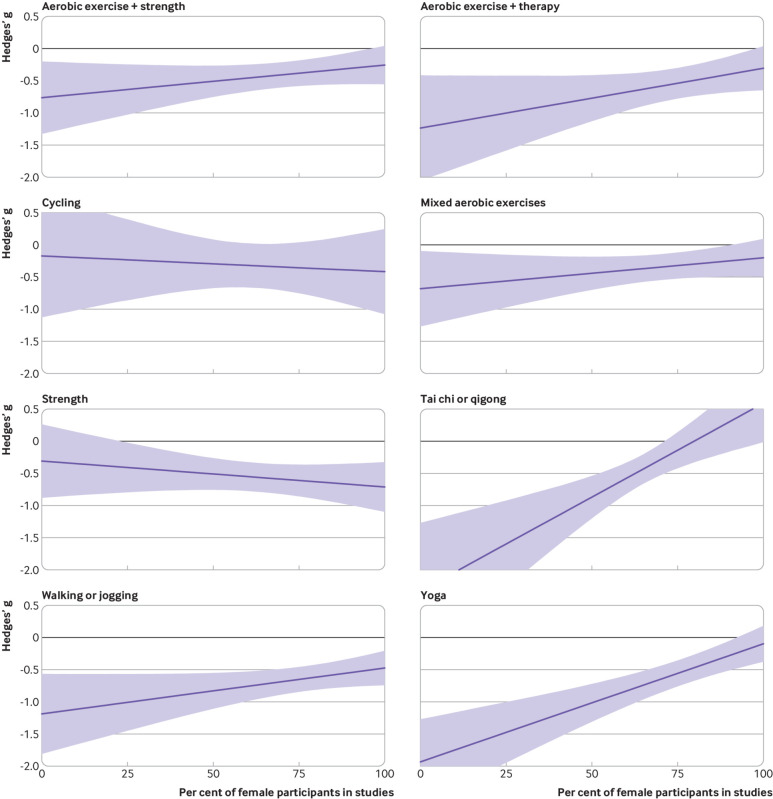
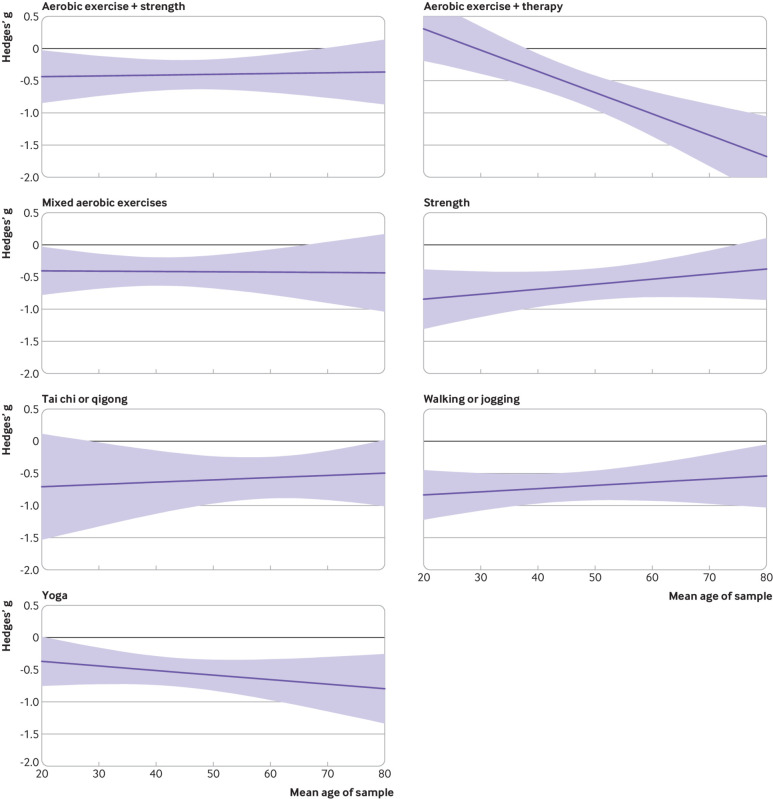
“Our review found some interesting moderators by age and sex, but these were at the study level rather than individual level—that is, rather than being able to determine whether women engaging in a strength intervention benefit more than men, we could only conclude that studies with more women showed larger effects than studies with fewer women.”
§ Effect of exercise for depression: systematic review and network meta-analysis of randomised controlled trials > Discussion > Strengths, limitations, and future directions
plaincorrelational- Asserted: passes — The authors put it forward as true.
- Checkable: passes — It can be checked against evidence.
- Load-bearing: passes — The paper’s conclusions depend on it.
- Based: passes — The paper gives a reason why it holds.
It may state two separate claims as one.
None of the sources cited for this claim have been checked yet.
In the paper
“Network meta-analyses exist that directly focus on psychotherapy7 and pharmacotherapy,25 and these combined for treating depression.6”
§ Effect of exercise for depression: systematic review and network meta-analysis of randomised controlled trials > Discussion > Strengths, limitations, and future directions
What the sources say
plain- Asserted: passes — The authors put it forward as true.
- Checkable: passes — It can be checked against evidence.
- Load-bearing: fails — The paper’s conclusions may not depend on it.
- Based: passes — The paper gives a reason why it holds.
Probably not a substantial claim. The paper’s conclusions may not depend on it. It may state two separate claims as one.
In the paper
“Globally there has been an attempt to reduce stigma associated with seeking treatment for depression.74”
§ Effect of exercise for depression: systematic review and network meta-analysis of randomised controlled trials > Discussion > Clinical and policy implications
What the sources say
- Not checked yetcites [74] source
plain- Asserted: passes — The authors put it forward as true.
- Checkable: passes — It can be checked against evidence.
- Load-bearing: fails — The paper’s conclusions may not depend on it.
- Based: passes — The paper gives a reason why it holds.
Probably not a substantial claim. The paper’s conclusions may not depend on it.
A conclusion the paper draws from its own results — it cites no other source for it, so there is none to check. The quote shows it is in the paper.
In the paper
“Exercise may support this effort by providing patients with treatment options that carry less stigma.”
§ Effect of exercise for depression: systematic review and network meta-analysis of randomised controlled trials > Discussion > Clinical and policy implications
hedgedconditional- Asserted: passes — The authors put it forward as true.
- Checkable: fails — It may be too vague to check against evidence.
- Load-bearing: fails — The paper’s conclusions may not depend on it.
- Based: fails — The paper may give no reason why it holds.
Probably not a substantial claim. It may be too vague to check against evidence. The paper’s conclusions may not depend on it. The paper may give no reason why it holds.
A conclusion the paper draws from its own results — it cites no other source for it, so there is none to check. The quote shows it is in the paper.
In the paper
“The same finding applied to age, where studies on older adults were likely adapted specifically to this age group.”
§ Effect of exercise for depression: systematic review and network meta-analysis of randomised controlled trials > Discussion > Strengths, limitations, and future directions
hedgedconditional- Asserted: passes — The authors put it forward as true.
- Checkable: fails — It may be too vague to check against evidence.
- Load-bearing: fails — The paper’s conclusions may not depend on it.
- Based: passes — The paper gives a reason why it holds.
Probably not a substantial claim. It may be too vague to check against evidence. The paper’s conclusions may not depend on it.
A conclusion the paper draws from its own results — it cites no other source for it, so there is none to check. The quote shows it is in the paper.
In the paper
“These between study differences may explain the heterogeneity in the effects of interventions, and confounding means our moderators for age and sex should be interpreted cautiously.”
§ Effect of exercise for depression: systematic review and network meta-analysis of randomised controlled trials > Discussion > Strengths, limitations, and future directions
hedgedconditional- Asserted: passes — The authors put it forward as true.
- Checkable: passes — It can be checked against evidence.
- Load-bearing: passes — The paper’s conclusions depend on it.
- Based: passes — The paper gives a reason why it holds.
It may state two separate claims as one.
The paper states this without a source or data behind it here, so there is nothing to check it against. The quote shows it is in the paper.
In the paper
“Those reviews include more than 500 studies comparing psychological or drug interventions with controls.”
§ Effect of exercise for depression: systematic review and network meta-analysis of randomised controlled trials > Discussion > Strengths, limitations, and future directions
plain- Asserted: passes — The authors put it forward as true.
- Checkable: passes — It can be checked against evidence.
- Load-bearing: fails — The paper’s conclusions may not depend on it.
- Based: passes — The paper gives a reason why it holds.
Probably not a substantial claim. The paper’s conclusions may not depend on it.
In the paper
“Doing so may help bridge the gap in treatment coverage by increasing the range of first line options for patients and health systems.9”
§ Effect of exercise for depression: systematic review and network meta-analysis of randomised controlled trials > Discussion > Clinical and policy implications
What the sources say
- Not checked yetcites [9] source
hedgedconditional- Asserted: passes — The authors put it forward as true.
- Checkable: fails — It may be too vague to check against evidence.
- Load-bearing: fails — The paper’s conclusions may not depend on it.
- Based: passes — The paper gives a reason why it holds.
Probably not a substantial claim. It may be too vague to check against evidence. The paper’s conclusions may not depend on it.
A conclusion the paper draws from its own results — it cites no other source for it, so there is none to check. The quote shows it is in the paper.
In the paper
“Our findings support the inclusion of exercise as part of clinical practice guidelines for depression, particularly vigorous intensity exercise.”
§ Effect of exercise for depression: systematic review and network meta-analysis of randomised controlled trials > Discussion > Clinical and policy implications
plainconditional- Asserted: passes — The authors put it forward as true.
- Checkable: passes — It can be checked against evidence.
- Load-bearing: passes — The paper’s conclusions depend on it.
- Based: passes — The paper gives a reason why it holds.
Probably not a substantial claim. It may state two separate claims as one.
A conclusion the paper draws from its own results — it cites no other source for it, so there is none to check. The quote shows it is in the paper.
In the paper
“These studies may have been tailored towards women, so effects may be subject to confounding, as both sex and intervention may have changed.”
§ Effect of exercise for depression: systematic review and network meta-analysis of randomised controlled trials > Discussion > Strengths, limitations, and future directions
hedgedconditional- Asserted: passes — The authors put it forward as true.
- Checkable: passes — It can be checked against evidence.
- Load-bearing: passes — The paper’s conclusions depend on it.
- Based: passes — The paper gives a reason why it holds.
It may state two separate claims as one.
A conclusion the paper draws from its own results — it cites no other source for it, so there is none to check. The quote shows it is in the paper.
In the paper
“Therefore, effective exercise modalities could be considered alongside those intervention as core treatments for depression.”
§ Effect of exercise for depression: systematic review and network meta-analysis of randomised controlled trials > Discussion > Conclusions
hedgedconditional- Asserted: passes — The authors put it forward as true.
- Checkable: passes — It can be checked against evidence.
- Load-bearing: passes — The paper’s conclusions depend on it.
- Based: passes — The paper gives a reason why it holds.
Probably not a substantial claim.
In the paper
“The World Health Organization recommends physical activity for everyone, including those with chronic conditions and disabilities,75 but not everyone can access treatment easily.”
§ Effect of exercise for depression: systematic review and network meta-analysis of randomised controlled trials > Discussion > Conclusions
What the sources say
- Not checked yetcites [75] source
plain- Asserted: passes — The authors put it forward as true.
- Checkable: passes — It can be checked against evidence.
- Load-bearing: fails — The paper’s conclusions may not depend on it.
- Based: passes — The paper gives a reason why it holds.
Probably not a substantial claim. The paper’s conclusions may not depend on it.
A conclusion the paper draws from its own results — it cites no other source for it, so there is none to check. The quote shows it is in the paper.
In the paper
“Many patients may have physical, psychological, or social barriers to participation.”
§ Effect of exercise for depression: systematic review and network meta-analysis of randomised controlled trials > Discussion > Conclusions
hedged- Asserted: passes — The authors put it forward as true.
- Checkable: fails — It may be too vague to check against evidence.
- Load-bearing: fails — The paper’s conclusions may not depend on it.
- Based: fails — The paper may give no reason why it holds.
Probably not a substantial claim. It may be too vague to check against evidence. The paper’s conclusions may not depend on it. The paper may give no reason why it holds.
The authors state this as an assumption.
The network meta-analysis assumes transitivity: the only systematic difference between arms is the treatment, not other confounders.
“Incoherence provides some evidence the network may violate the assumption of transitivity: that the only systematic difference between arms is the treatment, not other confounders.”
“The results of the global test design-by-treatment interaction model were not statistically significant, supporting the assumption of transitivity (χ2=94.92, df=75, P=0.06).”
The paper relies on this without support.
Exercise interventions can be grouped into homogenous nodes for network meta-analysis.
“These trials could be included because network meta-analysis methods allows for the grouping of those interventions into homogenous nodes.”
The paper relies on this without support.
The observed effect sizes correspond to clinically significant improvements for patients.
“practitioners can expect patients to experience clinically significant effects from walking, running, yoga, qigong, strength training, and mixed aerobic exercise.”
Claims other papers make about this one
Each is checked against this paper’s own text: does it say what the citing paper says it does?
The cited source says what the claim attributes to it.
In the citing paper
“These include physical activity/exercise, dietary modification, adequate sleep and social interaction, as well as mindfulness-based meditation, all of which have shown treatment efficacy in separate clinical trials of depression [4–16].”
From Personalized machine learning guided intervention for optimizing lifestyle behaviors in depression: a pilot study (2026) · cites this paper as [11]
The cited source says what the claim attributes to it.
In the citing paper
“Description of each 6-week iMAP in either sleep/ exercise/ diet/ social connection domain is provided in Supplementary Methods section S.5 and is grounded in evidence-based intervention protocols in these lifestyle domains in the context of depression [5, 6, 8, 11, 16, 68–70].”
From Personalized machine learning guided intervention for optimizing lifestyle behaviors in depression: a pilot study (2026) · cites this paper as [11]
The cited source says what the claim attributes to it.
In the citing paper
“Lifestyle targeted behavioral interventions in depression have typically shown small-to-medium effect sizes of ~0.3–0.5 [4–16], while the placebo effect of behavioral interventions are even smaller ~0.2 in RCTs [101, 102].”
From Personalized machine learning guided intervention for optimizing lifestyle behaviors in depression: a pilot study (2026) · cites this paper as [11]
In the citing paper
“And for depression, exercise is effective in proportion to the intensity prescribed.”
From A narrative review of anxiety regulation in PhD students based on Green model (2024) · cites this paper as Noetel et al., 2024
In the citing paper
“Strength training and yoga seem to be the most acceptable modalities (Noetel et al., 2024).”
From A narrative review of anxiety regulation in PhD students based on Green model (2024) · cites this paper as Noetel et al., 2024
Citations
Cites
RoB 2: a revised tool for assessing risk of bias in randomised trials
Sterne, J. A. C., Savović, J., Page, M. J., Elbers, R. G., Blencowe, N. S., Boutron, I., Cates, C. J., Cheng, H.-Y., Corbett, M. S., Eldridge, S. M., et al. (2019) · BMJ · doi:10.1136/bmj.l4898 · Cited by 34,787
The Cochrane Collaboration's tool for assessing risk of bias in randomised trials
Higgins, J. P. T., Altman, D. G., Gotzsche, P. C., Juni, P., Moher, D., Oxman, A. D., Savovic, J., Schulz, K. F., Weeks, L., Sterne, J. A. C., et al. (2011) · BMJ · doi:10.1136/bmj.d5928 · Cited by 33,817
Dermyshi, E., Wang, Y., Yan, C., Hong, W., Qiu, G., Gong, X., & Zhang, T. (2017) · Neonatology · doi:10.1159/000454668 · Cited by 24,586
World Health Organization 2020 guidelines on physical activity and sedentary behaviour
Bull, F. C., Al-Ansari, S. S., Biddle, S., Borodulin, K., Buman, M. P., Cardon, G., Carty, C., Chaput, J.-P., Chastin, S., Chou, R., et al. (2020) · British Journal of Sports Medicine · doi:10.1136/bjsports-2020-102955 · Cited by 11,657 · cited 1×
“The World Health Organization recommends physical activity for everyone, including those with chronic conditions and disabilities, 75 but not everyone can access treatment easily.”
BackgroundSelf-citationbrms : An R Package for Bayesian Multilevel Models Using Stan
Bürkner, P.-C. (2017) · Journal of Statistical Software · doi:10.18637/jss.v080.i01 · Cited by 9,476 · cited 1×
“45 We preregistered informative priors based on the distributional parameters of our meta-analytical model.”
Method(1985) · Europe PMC (PubMed Central) · Cited by 9,143
Hutton, B., Salanti, G., Caldwell, D. M., Chaimani, A., Schmid, C. H., Cameron, C., Ioannidis, J. P. A., Straus, S., Thorlund, K., Jansen, J. P., et al. (2015) · Annals of Internal Medicine · doi:10.7326/m14-2385 · Cited by 8,269
Sterne, J. A. C., Sutton, A. J., Ioannidis, J. P. A., Terrin, N., Jones, D. R., Lau, J., Carpenter, J., Rucker, G., Harbord, R. M., Schmid, C. H., et al. (2011) · BMJ · doi:10.1136/bmj.d4002 · Cited by 7,709
Michie, S., Richardson, M., Johnston, M., Abraham, C., Francis, J., Hardeman, W., Eccles, M. P., Cane, J., & Wood, C. E. (2013) · Annals of Behavioral Medicine · doi:10.1007/s12160-013-9486-6 · Cited by 7,629
Beck, A. T., Steer, R. A., & Brown, G. (2011) · PsycTESTS Dataset · doi:10.1037/t00742-000 · Cited by 7,535
Research works printed but not linked: 6
- National Collaborating Centre for Mental Health (UK). Depression: The Treatment and Management of Depression in Adults (Updated Edition). Leicester (UK): British Psychological Society; https://www.ncbi.nlm.nih.gov/pubmed/22132433
- American Psychiatric Association. Practice Guideline for the Treatment of Patients with Major Depressive Disorder. Third Edition. Washington, DC: American Psychiatric Association; 2010. 87 p. https://psychiatryonline.org/pb/assets/raw/sitewide/practice_guidelines/guidelines/mdd-1410197717630.pdf
- 10.2307/20056429 · DOI
- Veritas Health Innovation. Covidence systematic review software. Melbourne, Australia; 2023. www.covidence.org
- Chu IH . Effect of exercise intensity during aerobic training on depressive symptoms in initially sedentary depressed women. Dissertation Abstracts International B: Sciences and Engineering 2018;78(11-B(E)).
- Hunsley, 2002, Dodo bird, phoenix, or urban legend?, Sci Rev Ment Health Pract, 1, 11
Cited by
Sorted by citations
Varghese, S., Rao, S., Khattak, A., Zamir, F., & Chaari, A. (2024) · Nutrients · doi:10.3390/nu16213663 · Cited by 152
Immuno-metabolic depression: from concept to implementation
Penninx, B. W. J. H., Lamers, F., Jansen, R., Berk, M., Khandaker, G. M., Picker, L. D., & Milaneschi, Y. (2024) · The Lancet Regional Health - Europe · doi:10.1016/j.lanepe.2024.101166 · Cited by 131
Standardized mean differences in meta‐analysis: A tutorial
Gallardo‐Gómez, D., Richardson, R., & Dwan, K. M. (2024) · Cochrane Evidence Synthesis and Methods · doi:10.1002/cesm.12047 · Cited by 101
Self-citationThe interface of depression and diabetes: treatment considerations
Fanelli, G., Raschi, E., Hafez, G., Matura, S., Schiweck, C., Poluzzi, E., & Lunghi, C. (2025) · Translational Psychiatry · doi:10.1038/s41398-025-03234-5 · Cited by 112
Sedentarism and Chronic Health Problems
Goyal, J., & Rakhra, G. (2024) · Korean Journal of Family Medicine · doi:10.4082/kjfm.24.0099 · Cited by 94
Daily Step Count and Depression in Adults
Bizzozero‐Peroni, B., Goñi, V. D., Jiménez‐López, E., Rodríguez‐Gutiérrez, E., Sequí‐Domínguez, I., de Arenas‐Arroyo, S. N., López‐Gil, J. F., Martínez‐Vizcaíno, V., & Mesas, A. E. (2024) · JAMA Network Open · doi:10.1001/jamanetworkopen.2024.51208 · Cited by 62
Tian, H., Wang, Z., Meng, Y., Geng, L., Lian, H., Shi, Z., Zhuang, Z., Cai, W., & He, M. (2024) · Behavioural Brain Research · doi:10.1016/j.bbr.2024.115218 · Cited by 58
Nyberg, S. T., Frank, P., Pentti, J., Alfredsson, L. S., Ervasti, J. M., Goldberg, M., Knutsson, A., Koskinen, A., Lallukka, T. M., Nordin, M., et al. (2025) · The Lancet Public Health · doi:10.1016/s2468-2667(24)00300-1 · Cited by 51
Current landscape of fecal microbiota transplantation in treating depression
Zhang, Q., Bi, Y., Zhang, B., Jiang, Q., Mou, C. K., Lei, L., Deng, Y., Li, Y., Yu, J., Liu, W., et al. (2024) · Frontiers in Immunology · doi:10.3389/fimmu.2024.1416961 · Cited by 38
Mental health disorders and their impact on cardiovascular health disparities
Vaccarino, V., Prescott, E., Shah, A. J., Bremner, J. D., Raggi, P., Dobilienė, O., Gale, C. P., & Bugiardini, R. (2025) · The Lancet Regional Health - Europe · doi:10.1016/j.lanepe.2025.101373 · Cited by 44
Alberti, A., Coelho, D. R. A., Vieira, W. F., Iser, B. P. M., Lampert, R., Traebert, E., da Silva, B. B., de Oliveira, B. H., Leão, G. M., de Souza, G., et al. (2024) · Biomedicines · doi:10.3390/biomedicines12091994 · Cited by 44
Chen, Y.-E., Tsai, H.-L., Tu, Y., & Chen, L. (2024) · BMC Medicine · doi:10.1186/s12916-024-03716-1 · Cited by 40
Physical activity for public health in the 21st century
Salvo, D., Crochemore‐Silva, I., Wendt, A. T., Tarp, J., Shiroma, E. J., Simpson, R. J., Lee, I.-M. M., Ekelund, U., Cerin, E., Keïta, Y., et al. (2026) · Nature Medicine · doi:10.1038/s41591-026-04237-5 · Cited by 51
Mavranezouli, I., Megnin‐Viggars, O., Pedder, H., Welton, N. J., Dias, S., Watkins, E. R., Nixon, N. L., Daly, C., Keeney, E., Eadon, H., et al. (2024) · EClinicalMedicine · doi:10.1016/j.eclinm.2024.102780 · Cited by 38
Zhang, H., Hashim, S., Huang, D., & Zhang, B. (2024) · PeerJ · doi:10.7717/peerj.18111 · Cited by 31
Aerobic Physical Activity and Depression Among Patients With Cancer
Kulchycki, M., Halder, H. R., Askin, N., Rabbani, R., Schulte, F., Jeyaraman, M. M., Sung, L., Louis, D., Lix, L. M., Garland, A., et al. (2024) · JAMA Network Open · doi:10.1001/jamanetworkopen.2024.37964 · Cited by 28
Liu, Y., Zhao, G., Guo, J., Qu, H., Kong, L., & Yue, W. (2024) · Journal of Affective Disorders · doi:10.1016/j.jad.2024.09.074 · Cited by 29
Li, G., Xia, H., Teng, G., & Chen, A. (2025) · Neuroscience & Biobehavioral Reviews · doi:10.1016/j.neubiorev.2025.106008 · Cited by 24
Han, B., Duan, Y., Zhang, P., Zeng, L., Pi, P., Chen, J., & Du, G. (2024) · BMC Public Health · doi:10.1186/s12889-024-19348-2 · Cited by 28
Bedeutung von psychosozialen Faktoren in der Kardiologie – Update 2024
Kindermann, I., Köllner, V., Albus, C., Boer, J., Dannberg, G., Fritzsche, K., Gunold, H., Herrmann‐Lingen, C., Leithäuser, B., Meesmann, M., et al. (2024) · Die Kardiologie · doi:10.1007/s12181-024-00708-6 · Cited by 30
Evolution of resistance training in women: History and mechanisms for health and performance
Kraemer, W. J., Fragala, M. S., & Ratamess, N. A. (2025) · Sports Medicine and Health Science · doi:10.1016/j.smhs.2025.01.005 · Cited by 32
Gu, Q., Zhao, X., Lin, L., Teo, W., Liu, L., & Yuan, S. (2024) · International Journal of Clinical and Health Psychology · doi:10.1016/j.ijchp.2024.100512 · Cited by 24
Li, J., Zhou, Z., Hao, S., & Zang, L. (2024) · European Journal of Applied Physiology · doi:10.1007/s00421-024-05688-9 · Cited by 26
Budde, H., Dolz, N., Mueller‐Alcazar, A., Schacht, F., Velasques, B., Ribeiro, P. F. M., Machado, S. E. D. C., & Wegner, M. (2025) · PLoS ONE · doi:10.1371/journal.pone.0317610 · Cited by 23
Physical activity and quality of life in breast cancer survivors
Agussalim, N. Q., Ahmad, M., Prihantono, P., Usman, A. N., Rafiah, S., & Agustin, D. I. (2024) · Breast Disease · doi:10.3233/bd-249005 · Cited by 18
Zhou, S., Xu, Y., Yang, Y., Song, H., Wang, X., & Yu, Y. (2025) · BMC Public Health · doi:10.1186/s12889-025-25044-6 · Cited by 23
Vreijling, S. R., Penninx, B. W. J. H., Verhoeven, J. E., Teunissen, C. E., Blujdea, E. R., Beekman, A. T. F., Lamers, F., & Jansen, R. (2024) · Brain Behavior and Immunity · doi:10.1016/j.bbi.2024.10.033 · Cited by 19
Li, G., Teng, G., Zhang, W., Song, T., Li, Y., Wang, Z., & Chen, A. (2025) · Clinical Psychology Review · doi:10.1016/j.cpr.2025.102604 · Cited by 18
Bu, Z., Liu, F.-S., Shahjalal, M., Song, Y.-K., Li, M., Zhuo, R.-E., Zhong, Q., Du, Y.-W., Lu, C.-G., Yang, Z.-H., et al. (2025) · BMJ Evidence-Based Medicine · doi:10.1136/bmjebm-2024-113512 · Cited by 20
Yuping, Z., Tianbi, L., Wentao, S., Li, Y., & Zhang, G. (2024) · Depression and Anxiety · doi:10.1155/da/5716755 · Cited by 27
Clinical management of major depressive disorder with comorbid obesity
Opel, N., Hanßen, R., Steinmann, L. A., Roempler, J., Köhler‐Forsberg, O., Hahn, M., Ferretti, F., Palmer, C., Penninx, B. W. J. H., Gold, S. M., et al. (2025) · The Lancet Psychiatry · doi:10.1016/s2215-0366(25)00193-2 · Cited by 20
Niu, G., Zheng, X., Bigao, D. E. N. G., Yang, Q., & Du, Y. (2024) · Musculoskeletal Care · doi:10.1002/msc.1918 · Cited by 16
Yang, Y., Yuan, Y., Zhang, H., Fu, X., Wang, T., Wang, J., & Fang, C.-C. (2024) · Neuroscience & Biobehavioral Reviews · doi:10.1016/j.neubiorev.2024.105896 · Cited by 15
Exercise Interventions for Autistic People: An Integrative Review of Evidence from Clinical Trials
Rivera, R. A., Robertson, M. C., & McCleery, J. P. (2025) · Current Psychiatry Reports · doi:10.1007/s11920-025-01597-6 · Cited by 21
Malhi, G. S., Bell, E., Stavdal, A., Wu, C., Naylor, A., & Kumari, V. (2026) · The Lancet · doi:10.1016/s0140-6736(26)00201-1 · Cited by 19
Küçükosmanoğlu, H. S., Cramer, H., Tavakoly, R., Moosburner, A., & Bîlc, M. I. (2024) · Current Psychiatry Reports · doi:10.1007/s11920-024-01548-7 · Cited by 17
Chen, L., Guan, B., Anderson, D., Ferreira, P. H., Stanford, R., Beckenkamp, P. R., van Gelder, J. M., Bayartai, M.-E., Radojčić, M. R., Fairbank, J. C. T., et al. (2024) · BMC Medicine · doi:10.1186/s12916-024-03653-z · Cited by 14
Hou, Y., Liu, X., Li, Z., Huang, S., Chen, W., Jiang, Y., He, P., Sun, J., & Han, H. (2025) · Frontiers in Psychology · doi:10.3389/fpsyg.2025.1598936 · Cited by 14
van den Hoek, D., Mallard, A. R., Garrett, J. M., Beaumont, P. L., Howells, R. J., Spathis, J. G., Pearson, J., & Latella, C. (2024) · International Journal of Sports Science & Coaching · doi:10.1177/17479541241244481 · Cited by 18
Self-citationWeiner, L. S., Crowley, R. N., Sheeber, L., Koegler, F. H., Davis, J. F., Wells, M., Funkhouser, C. J., Auerbach, R. P., & Allen, N. B. (2024) · JMIR Mental Health · doi:10.2196/51366 · Cited by 20
Cao, J., Gorwood, P. A. P. M., Ramoz, N., & Viltart, O. (2024) · Nutrients · doi:10.3390/nu16162617 · Cited by 17
Zuo, W., & Yang, X. (2025) · BMC Geriatrics · doi:10.1186/s12877-025-05837-5 · Cited by 14
Xia, J., Zou, Y., Cui, Y., Zhang, S., Huo, K., Liu, W., Huang, Z., Zhang, Q., Qi, Z., & Liu, W. (2025) · Proceedings of the National Academy of Sciences · doi:10.1073/pnas.2503675122 · Cited by 19
Cui, Z., Li, Z., Wang, T., Li, K., Zheng, H., & Yang, C. (2025) · Frontiers in Psychology · doi:10.3389/fpsyg.2025.1621100 · Cited by 17
A narrative review of anxiety regulation in PhD students based on Green model
Ma, Y., Yu, A., Ma, H., Zhao, Y., Liu, X., Zhai, H., & Gao, Y. (2024) · Frontiers in Psychology · doi:10.3389/fpsyg.2024.1351386 · Cited by 13
Han, X., Zou, Y., & Zhang, S. (2024) · Sleep Medicine · doi:10.1016/j.sleep.2024.08.008 · Cited by 12
Yang, Z., Gao, C., Li, Z., Jiang, T., Liang, Y., Jiang, T., Chen, Y., Yan, S., Li, P., & Zhou, L. (2024) · Neuroscience · doi:10.1016/j.neuroscience.2024.09.005 · Cited by 14
Tian, S., Liang, Z., Tian, M., Qiu, F., Yu, Y., Mou, H., & Gao, Y. (2024) · Age and Ageing · doi:10.1093/ageing/afae211 · Cited by 14
Rangul, V., Sund, E. R., Ingul, J. M., Rimehaug, T., Pape, K., & Kvaløy, K. (2024) · International Journal of Environmental Research and Public Health · doi:10.3390/ijerph21111417 · Cited by 12
Mercier, L. J., McIntosh, S. J., Boucher, C., Joyce, J. M., Batycky, J. M., Galarneau, J.-M. F., Burma, J. S., Smirl, J. D., Esser, M. J., Schneider, K., et al. (2024) · Frontiers in Neurology · doi:10.3389/fneur.2024.1482266 · Cited by 13
Wang, Z.-Y., Deng, Y.-L., Zhou, T.-Y., Jiang, Z.-Y., Liu, Y., Liu, B., & Cao, Y. (2025) · Frontiers in Physiology · doi:10.3389/fphys.2025.1492221 · Cited by 13
Che, X., Lu, Z., & Jin, Y. (2025) · Scientific Reports · doi:10.1038/s41598-025-11225-1 · Cited by 16
A Primer on Fixed Effects and Fixed-Effects Panel Modeling Using R, Stata, and SPSS
Sommet, N., & Lipps, O. (2025) · Advances in Methods and Practices in Psychological Science · doi:10.1177/25152459251392843 · Cited by 19
Luttenberger, K., Baggenstos, B., Najem, C., Sifri, C., Lewczuk, P., Radegast, A., & Rosenbaum, S. (2024) · Conflict and Health · doi:10.1186/s13031-024-00615-3 · Cited by 17
Bottaccioli, A. G., Bologna, M., & Bottaccioli, F. (2025) · International Journal of Molecular Sciences · doi:10.3390/ijms26062759 · Cited by 15
Clegg, A. J., Hill, J. E., Mullin, D. S., Harris, C., Smith, C. J., Lightbody, C. E., Dwan, K., Cooney, G. M., Mead, G. E., & Watkins, C. L. (2026) · Cochrane Database of Systematic Reviews · doi:10.1002/14651858.cd004366.pub7 · Cited by 12
Current and Emerging Sleep Interventions for Older Adults with or without Mild Cognitive Impairment
Suraev, A. S., Kong, S. D., Schrire, Z. M., Tran, B. A., Cross, N. E., Matar, E., & Naismith, S. L. (2024) · Current Treatment Options in Neurology · doi:10.1007/s11940-024-00808-4 · Cited by 12
Importance of strength training for sustaining performance and health in military personnel
Taipale, R. S., Drain, J. R., Vaara, J. P., Nindl, B. C., & Kyröläinen, H. (2024) · BMJ Military Health · doi:10.1136/military-2024-002744 · Cited by 10
Guo, T., Zou, Q., Wang, Q., Zhang, Y., Zhong, X., Lin, H., Gong, W., Wang, Y., Xie, K., Wu, K., et al. (2024) · Nutrients · doi:10.3390/nu16244300 · Cited by 11
Rosenbaum, S., Farello, A., Latimer, K., Vancampfort, D., Ventevogel, P., Richards, J. A., Warria, A. R., Ager, A., Bray, M., Snider, L., et al. (2025) · Mental health and physical activity · doi:10.1016/j.mhpa.2025.100701 · Cited by 10
Schmill, P., Seaton, N., Greenwood, S. A., Hudson, J. L., McBride, E., Norton, S., & Chilcot, J. (2025) · Journal of Nephrology · doi:10.1007/s40620-025-02372-9 · Cited by 10
Deng, H., Li, W., Liu, P., Naharudin, M. N., & Fan, X. (2025) · Journal of the International Society of Sports Nutrition · doi:10.1080/15502783.2025.2566371 · Cited by 10
Research progress on the mechanism of exercise against depression
Zhao, Y., Sun, S., Qin, H., Zhu, Y., Luo, Z., Qian, Y., & Chen, S. (2024) · World Journal of Psychiatry · doi:10.5498/wjp.v14.i11.1611 · Cited by 11
Huang, K., Zhang, G., Gains, H., He, R., Jiao, Y., Jia, Y., & Chen, L. (2025) · Journal of the American Medical Directors Association · doi:10.1016/j.jamda.2025.105583 · Cited by 15
Xiao, Y., Shi, C., Zhang, X., & Liu, H. (2025) · BMC Public Health · doi:10.1186/s12889-025-22904-z · Cited by 11
Zeng, J., & Wang, H. (2025) · Frontiers in Public Health · doi:10.3389/fpubh.2025.1616925 · Cited by 9
RetractedNg, J. Y., Kochhar, J., & Cramer, H. (2024) · Frontiers in Psychiatry · doi:10.3389/fpsyt.2024.1416803 · Cited by 9
Exercise for the treatment of depression
Bellón, J. Á. (2024) · BMJ · doi:10.1136/bmj.q320 · Cited by 11
Liu, S., Xiao, Q., Tang, J., Li, Y., Zhu, P., Liang, X., Huang, D., Liu, L., Deng, Y., Jiang, L. H., et al. (2024) · Journal of Affective Disorders · doi:10.1016/j.jad.2024.09.124 · Cited by 8
Duan, T., Cao, Z., Wang, X., Min, J., Sun, T., Hong, L., & Xu, C. (2024) · The British Journal of Psychiatry · doi:10.1192/bjp.2024.227 · Cited by 8
Tavares, V. D. D. O., Cuthbert, C. A., Teychenne, M. J., Schuch, F. B., Cabral, D. A. R., de Sousa, G. M., Prado, C. M. M., Patten, S. B., Coelho, N. L. G., & Hallgren, M. Å. (2024) · Journal of Psychosocial Oncology · doi:10.1080/07347332.2024.2441693 · Cited by 8
Su, K. (2024) · Current Opinion in Psychiatry · doi:10.1097/yco.0000000000000986 · Cited by 9
Decoding depression: How DLPFC and SMA mediate stress perception's role in mental health?
Cao, X., Zhang, Y., Wu, H., Da, H., Xiao, Q., & Shi, H. (2025) · Journal of Affective Disorders · doi:10.1016/j.jad.2025.03.036 · Cited by 8
Quan, Y., Lo, C. Y., Wolff, L., Wang, J., Olsen, K. N., & Thompson, W. F. (2025) · Archives of Gerontology and Geriatrics · doi:10.1016/j.archger.2025.105848 · Cited by 8
The Role of Mitochondrial Energy Metabolism in the Mechanism of Exercise Improving Depression
Liu, Y., Zhong, C., Yang, Y., Hu, J., Yi, X., Huang, J., Li, H., Liu, X., Xue, K., & Chen, X. (2025) · Current Issues in Molecular Biology · doi:10.3390/cimb47050382 · Cited by 12
Microbiome: A Key Regulator of Body-Brain Interactions
O’Riordan, K. J., Aburto, M. R., Nagpal, J. K., Clarke, G. A., & Cryan, J. F. (2025) · Advances in experimental medicine and biology · doi:10.1007/978-3-031-89525-8_6 · Cited by 9
Beyond the Heart: The Significance of Depression in Cardiac Surgery
Stenman, M., Jackson, V., Särnholm, J., Falk, A. S., Nielsen, S. J., & Sartipy, U. (2025) · European Journal of Cardio-Thoracic Surgery · doi:10.1093/ejcts/ezaf277 · Cited by 8
Wollesen, B., Asuako, P. A. G., Herden, M., Giannaki, C. D., Langeard, A., Lamberti, N., Mack, M., Audiffren, M. F., Netz, Y., & Voelcker‐Rehage, C. (2025) · European Review of Aging and Physical Activity · doi:10.1186/s11556-025-00390-x · Cited by 8
Küppers, V., Bi, H., Nicolaisen‐Sobesky, E., Hoffstaedter, F., Yeo, B. T. T., Drzezga, A. E., Eickhoff, S. B., & Tahmasian, M. (2026) · Scientific Reports · doi:10.1038/s41598-025-34951-y · Cited by 9
Richards, L. G., Ifejika, N. L., Stein, J., Bahouth, M. N., Saylor, M. A., Barrett, A. M., Chen, P., Deutsch, A. F., Dusenbury, W., Ellis, C., et al. (2026) · Stroke · doi:10.1161/str.0000000000000536 · Cited by 12
Dong, J., Huang, J., Parisi, J. M., Zhou, Z. E., Li, M., Calderon, R., & Li, J. (2025) · Sleep Health · doi:10.1016/j.sleh.2024.12.004 · Cited by 8
Soini, E., Rosenström, T. H., Määttänen, I., & Jokela, M. M. (2024) · American Journal of Geriatric Psychiatry · doi:10.1016/j.jagp.2024.08.020 · Cited by 8
Opportunities to Improve Health Equity for Employees in Low-Wage Industries in the United States
Hannon, P. A., Harris, J. R., & Doody, D. R. (2024) · Annual Review of Public Health · doi:10.1146/annurev-publhealth-071723-120104 · Cited by 7
Wen, K., Nie, Y., Lai, Y., Li, P., Huang, Z., Liu, G., Zhong, Y., Li, H., & Liang, J. (2025) · BMC Public Health · doi:10.1186/s12889-025-21289-3 · Cited by 7
Peltonen, J., Benson, S., Kraushaar, J., Wunder, S., & Mang, C. S. (2025) · Disability and Rehabilitation · doi:10.1080/09638288.2025.2453639 · Cited by 7
Wang, Z., Ou, Y., Zhu, X., Zhou, Y. H., Zheng, X., Zhang, M., Li, S., Yang, S.-N., Juntti‐Berggren, L., Berggren, P., et al. (2025) · International Journal of Molecular Sciences · doi:10.3390/ijms26031383 · Cited by 7
Wu, Y., Wang, H., Hui, X., Qian, Z., Wang, M., Fenfen, E., Xu, M., Zhou, L., Deng, X., Li, X., et al. (2025) · Neuroscience & Biobehavioral Reviews · doi:10.1016/j.neubiorev.2025.106088 · Cited by 7
Ye, J., Fang, J., Yang, S., Xiang, Q., & Ahorsu, D. K. (2025) · Psychology Research and Behavior Management · doi:10.2147/prbm.s499936 · Cited by 8
Treating obesity in patients with depression: a narrative review and treatment recommendation
Kushner, P. R., Kahan, S. I., & McIntyre, R. S. (2025) · Postgraduate Medicine · doi:10.1080/00325481.2025.2478812 · Cited by 9
McKeon, G., Rosenbaum, S., Whitten, T., Tay, A. K., Moussa, B., Hassoun, F., & Rees, S. J. (2025) · Psychology of sport and exercise · doi:10.1016/j.psychsport.2025.102844 · Cited by 7
Yeh, G. Y., Ahn, A. C., Clark, J., Irwin, M. R., Kong, J., Lavretsky, H., Li, F., Manor, B. D., Mehling, W. E., Oh, B., et al. (2025) · Journal of Integrative and Complementary Medicine · doi:10.1089/jicm.2024.0958 · Cited by 8
Levihn‐Coon, A., Smits, J. A. J., & Beevers, C. G. (2025) · PLOS mental health. · doi:10.1371/journal.pmen.0000211 · Cited by 8
Zhao, C., Tao, X., Lei, B., Zhang, Y., Li, G., Lv, Y., & Yu, L. (2025) · Current Oncology · doi:10.3390/curroncol32060304 · Cited by 7
Yang, D., Hou, N., & Jia, M. (2025) · Journal of Alzheimer s Disease · doi:10.1177/13872877251346989 · Cited by 7
Public psychology and holistic approaches to prevention and treatment of depression
Patterson, E. H., Miller, C., & Hannapel, M. (2025) · Frontiers in Psychiatry · doi:10.3389/fpsyt.2025.1600094 · Cited by 11
Li, N., Yao, Y., Du, J., Wu, D., Qiao, X., Peng, F., Meng, F., Zhang, Y., Wang, L., Hao, A., et al. (2025) · Communications Biology · doi:10.1038/s42003-025-08347-7 · Cited by 7
Wang, C., Sun, J., Liang, Z., Cai, Y., Zhang, M., Tian, S., Yang, W., Cheng, S., Duan, R., & Wang, X. (2025) · European Journal of Pain · doi:10.1002/ejp.70109 · Cited by 8
Lederman, O., Chapman, J., Fibbins, H., Haywood, D., Hart, N. H., Furzer, B. J., Wright, K. E., McKeon, G., Brinsley, J., Mastrogiovanni, C., et al. (2026) · British Journal of Sports Medicine · doi:10.1136/bjsports-2025-110879 · Cited by 8
Wright, S. L., Chiocchia, V., Elugbadebo, O. O., Ouma, S., Furukawa, T. A., Friedrich, C., Austin, C., Dehdarirad, H., Gilbert, D., Kennett, J., et al. (2024) · Wellcome Open Research · doi:10.12688/wellcomeopenres.23033.1 · Cited by 6
Fi, B., Sumin, A. N., Garganeeva, N. P., Ларева, Н. В., Петрова, М. М., Петрунько, О. В., Попонина, Т. М., Repin, A. N., & Собенников, В. С. (2024) · Complex Issues of Cardiovascular Diseases · doi:10.17802/2306-1278-2024-13-3s-222-253 · Cited by 8
Metadata
- Authors
- Noetel, M., Sanders, T., Gallardo-Gómez, D., Taylor, P., del Pozo Cruz, B., van den Hoek, D., Smith, J. J., Mahoney, J., Spathis, J., Moresi, M., Pagano, R., Pagano, L., Vasconcellos, R., Arnott, H., Varley, B., Parker, P., Biddle, S., & Lonsdale, C.
- Affiliations
- The University of Queensland (AU)
- Australian Catholic University (AU)
- Department of Physical Education and Sport, University of Seville, Seville, Spain
- Department of Clinical Biomechanics and Sports Science, University of Southern Denmark, Odense, Denmark
- School of Health and Behavioural Sciences, University of the Sunshine Coast, Petrie, QLD, Australia
- University of Newcastle Australia (AU)
- Macquarie University (AU)
- The University of Sydney (AU)
- University of Southern Queensland (AU)
- Corresponding author
- Noetel, Michael
- ORCID
- Venue
- BMJ
- Publisher
- BMJ
- Published
- 2024-02-14
- Volume
- 384
- Pages
- e075847
- ISSN
- 1756-1833 (ISSN-L)
- PMC
- PMC10870815
- OpenAlex
- W4391847428
- Cited by
- 707
- References
- 64
- Citations by year
- 2026: 303 · 2025: 286 · 2024: 118
- FWCI
- 40.18
- Type
- journal article
- Language
- en
- Update notices
- correction (2024-05-28)
- Open access
- hybrid
- doi.org
- Licence
- Locations
- BMJ (publishedVersion, cc-by-nc)
- PubMed Central (publishedVersion, cc-by-nc)
- PubMed (publishedVersion)
- Jyväskylä University Digital Archive (University of Jyväskylä) (submittedVersion, cc-by-nc)
- RODIN (Universidad de Cádiz) (submittedVersion, cc-by-nc-nd)
- University of Southern Denmark Research Portal (University of Southern Denmark) (submittedVersion, cc-by-nc)
- HighWire Press Open Archive (submittedVersion)
- UNSWorks (University of New South Wales, Sydney, Australia) (submittedVersion, cc-by-nc)
- Topics
- Health Sciences › Medicine › Public Health, Environmental and Occupational Health › Physical Activity and Health
- Health Sciences › Medicine › Pharmacology (medical) › Treatment of Major Depression
- Social Sciences › Psychology › Experimental and Cognitive Psychology › Anxiety, Depression, Psychometrics, Treatment, Cognitive Processes
- Keywords
- exercise therapy, major depressive disorder, exercise dose-response, walking and jogging, yoga, resistance training, Tai Chi, qigong, aerobic exercise, antidepressants, psychotherapy, treatment acceptability, comorbidities, expectancy effects, publication bias, risk of bias assessment
- MeSH terms
- Antidepressive Agents, Major Depressive Disorder, Exercise Therapy, Humans, Psychotherapy, Yoga, Exercise, Randomized Controlled Trials as Topic, Treatment Outcome
About these checks
Registry, retraction, Cites and statistics results are computed, not judged, with one exception: a printed reference that no index lists is read once by a model before it counts as a citation error. Claims are extracted by a model and kept only when their quote appears verbatim in the text; each cited source is then checked, with a model’s help, for whether it says what the claim relies on. Those verdicts can be wrong — read the claim’s quote and the cited source before relying on one.
A language model drew the claims from the paper on 2026-10-09, under version 3 of the claim definition (model deepseek-v4.1-flash, prompt extract-v3).
A second model labelled each claim on 2026-10-09 (model jev-1.13-20260917, definition revision gold-guideline-v0.2).
Cited sources are checked with a language model’s help (gpt-6-sol).
Statistics and arithmetic are recomputed, not judged.
Confidence bands are shown only for fields calibrated on our annotated test set. None is calibrated yet, so no band is shown.
What counts as a claim ›How we measure confidence ›How we check this ›
Are you an author, or do you see a problem with this page? Request a review
