

FUTURE-AI: international consensus guideline for trustworthy and deployable artificial intelligence in healthcare
Open accessThe DOI matches its Crossref record, with a small difference in title or year; 191 of the 193 references it cites were found in a registry or an index; 11 of the 23 sources its claims cite were checked for support.
Abstract
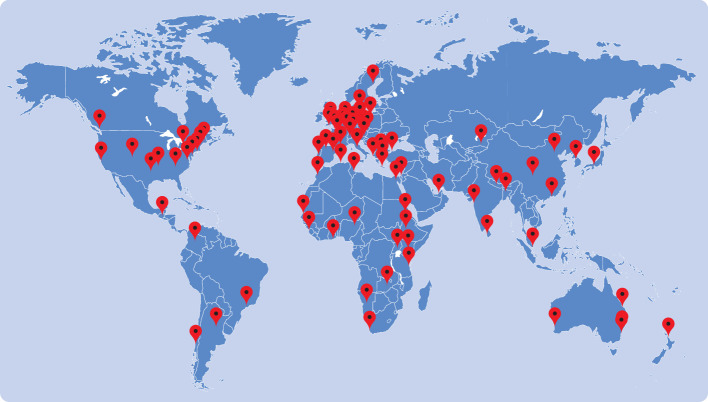
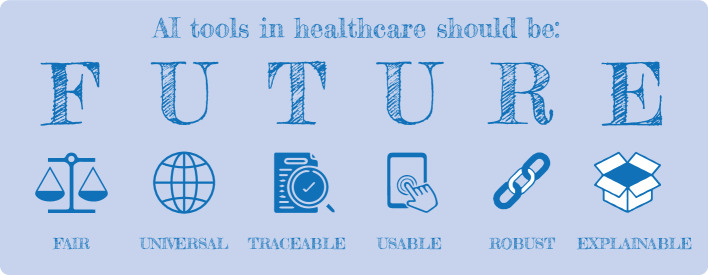
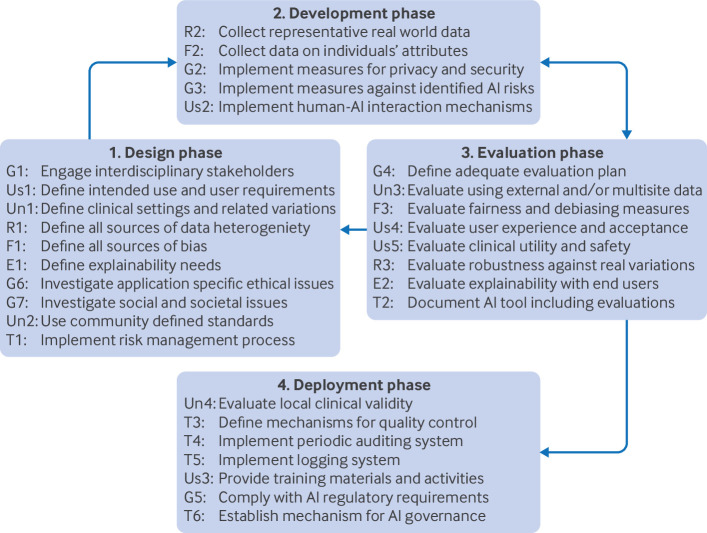
Despite major advances in artificial intelligence (AI) research for healthcare, the deployment and adoption of AI technologies remain limited in clinical practice. This paper describes the FUTURE-AI framework, which provides guidance for the development and deployment of trustworthy AI tools in healthcare. The FUTURE-AI Consortium was founded in 2021 and comprises 117 interdisciplinary experts from 50 countries representing all continents, including AI scientists, clinical researchers, biomedical ethicists, and social scientists. Over a two year period, the FUTURE-AI guideline was established through consensus based on six guiding principles—fairness, universality, traceability, usability, robustness, and explainability. To operationalise trustworthy AI in healthcare, a set of 30 best practices were defined, addressing technical, clinical, socioethical, and legal dimensions. The recommendations cover the entire lifecycle of healthcare AI, from design, development, and validation to regulation, deployment, and monitoring.
Overview
CoChat Summary
TL;DR
FUTURE-AI is an international consensus guideline for trustworthy and deployable healthcare AI, developed by 117 experts from 50 countries over 24 months. It defines six guiding principles—fairness, universality, traceability, usability, robustness, and explainability—and 30 best practices covering the full AI lifecycle.
Key findings
- The FUTURE-AI Consortium comprised 117 interdisciplinary experts from 50 countries representing all continents, including AI scientists, clinical researchers, biomedical ethicists, and social scientists.
- The guideline was established through a modified Delphi process over 24 months, with eight rounds of feedback and iterative discussion, resulting in 30 best practices across six guiding principles plus a “general” category.
- All final recommendations were approved with less than 5% disagreement among FUTURE-AI members; remaining disagreement mostly concerned whether recommendations should be “recommended” or “highly recommended” for research versus deployable tools.
- The framework distinguishes compliance levels for research/proof-of-concept AI tools versus deployable clinical AI tools, with higher expected compliance for deployable tools on many recommendations.
Methods
- International consensus guideline developed using a modified Delphi approach over 24 months, beginning with six core guiding principles and an initial set of recommendations.
- Eight rounds included working groups, an online survey, iterative written feedback, external feedback from 44 additional experts, online consensus meetings, and a final consensus vote.
- Results were aggregated quantitatively by analysing expert voting patterns and qualitatively by synthesising feedback and recurring themes; the final consortium consisted of 117 experts.
Limitations
- The paper states that implementation may involve substantial costs, potentially exacerbating disparities in AI adoption, especially for smaller developers and resource-limited health systems.
- The paper states that liability remains unaddressed, including who should perform audits and who should be accountable for errors, and that current regulations prevent post-release modifications because they would invalidate initial validation.
- The paper states that for some recommendations no clear standard yet exists, and that FUTURE-AI is proposed as a dynamic, living framework requiring future refinement and domain-specific operationalisation.
Model-written summary. Check it against the paper before relying on it.
Integrity signals
Registry
Cites
Statistics
Figures
Verification
Claims the paper makes
11 Valid · 0 Not valid · 10 Not checked · 42 Own results and interpretations
Every source the paper cites for this claim was checked and supports it.
In the paper
“Existing research has shown that even small, imperceptible variations in the input data might lead AI models into incorrect decisions.60”
§ FUTURE-AI: international consensus guideline for trustworthy and deployable artificial intelligence in healthcare > FUTURE-AI guideline > Robustness
What the sources say
- Supportedcites [60] Finlayson SG Bowers JD Ito J Zittrain JL Beam AL Kohane IS. Adversarial attacks on medical machine learning. Science 2019; 363: 1287- 9. 10.1126/science.aaw4399 30898923 PMC7657648 source
The opening passage says a small, carefully designed change to an input can cause a machine-learning system to reach a wrong conclusion. In “DEEP VULNERABILITIES,” the paper gives an example: a visually imperceptible image perturbation makes a classifier label a benign mole as malignant. The claim's tentative wording is consistent with this account of deliberately crafted changes. (LLM, conf=0.94)
hedgedstates a possible cause- Asserted: passes — The authors put it forward as true.
- Checkable: passes — It can be checked against evidence.
- Load-bearing: passes — The paper’s conclusions depend on it.
- Based: passes — The paper gives a reason why it holds.
- Supported
The cited sources support only part of this claim — read each source’s verdict below.
In the paper
“Bias in healthcare AI is application specific.32”
§ FUTURE-AI: international consensus guideline for trustworthy and deployable artificial intelligence in healthcare > FUTURE-AI guideline > Fairness
What the sources say
- Partly supportedcites [32] Ferryman K, Pitcan M. Fairness in Precision Medicine. Data & Society Research Institute. 2018. https://datasociety.net/library/fairness-in-precision-medicine/ sourceExperimental — accuracy not yet measured
The “Fairness in Precision Medicine” section says that bias can arise from human assumptions, automation, and different phases of data handling. That supports the idea that bias depends on how a system is developed and used, but the paper discusses precision medicine rather than establishing the claim for healthcare AI applications generally. No page number is available in our copy. (LLM, conf=0.75)
plain- Asserted: passes — The authors put it forward as true.
- Checkable: passes — It can be checked against evidence.
- Load-bearing: passes — The paper’s conclusions depend on it.
- Based: passes — The paper gives a reason why it holds.
- Partly supported
In the paper
“In particular, existing research has shown that AI tools in healthcare can be prone to errors and patient harm, biases and increased health inequalities, lack of transparency and accountability, as well as data privacy and security breaches.4 5 6 7 8”
§ FUTURE-AI: international consensus guideline for trustworthy and deployable artificial intelligence in healthcare > Introduction
What the sources say
- Not matchedcites 4 5 6 7 8
This doesn’t read as a citation we can look up.
plainstates a possible cause- Asserted: passes — The authors put it forward as true.
- Checkable: passes — It can be checked against evidence.
- Load-bearing: passes — The paper’s conclusions depend on it.
- Based: passes — The paper gives a reason why it holds.
- Not matched
In the paper
“However, there is an absence of clear, widely accepted guidelines on how healthcare AI tools should be designed, developed, evaluated, and deployed to be trustworthy—that is, technically robust, clinically safe, ethically sound, and legally compliant (see glossary in appendix table 1).9”
§ FUTURE-AI: international consensus guideline for trustworthy and deployable artificial intelligence in healthcare > Introduction
What the sources say
- Not matchedcites [9] High-Level Expert Group on AI, EU Commission. Ethics Guidelines For Trustworthy AI. 2019. https://www.europarl.europa.eu/cmsdata/196377/AI%20HLEG_Ethics%20Guidelines%20for%20Trustworthy%20AI.pdf
We searched by its title and found no matching paper.
plain- Asserted: passes — The authors put it forward as true.
- Checkable: passes — It can be checked against evidence.
- Load-bearing: passes — The paper’s conclusions depend on it.
- Based: passes — The paper gives a reason why it holds.
- Not matched
In the paper
“In particular, existing research has shown that AI tools in healthcare can be prone to errors and patient harm, biases and increased health inequalities, lack of transparency and accountability, as well as data privacy and security breaches.4 5 6 7 8”
§ FUTURE-AI: international consensus guideline for trustworthy and deployable artificial intelligence in healthcare > Introduction
What the sources say
- Not matchedcites 4 5 6 7 8
This doesn’t read as a citation we can look up.
plainstates a possible cause- Asserted: passes — The authors put it forward as true.
- Checkable: passes — It can be checked against evidence.
- Load-bearing: passes — The paper’s conclusions depend on it.
- Based: passes — The paper gives a reason why it holds.
- Not matched
3 more claims
Create a free account to see all 63 claims and to verify the 1 reference still open.
- Probably not a substantial claim. 48
- It may state two separate claims as one. 24
Claims other papers make about this one
Each is checked against this paper’s own text: does it say what the citing paper says it does?
The source backs part of the claim, not all of it — or backs it for a different population, condition or comparison.
In the citing paper
“First, many dimensions of trustworthiness-such as clinical appropriateness, fairness, and the usefulness of explanations-still rely heavily on human expert judgment (Lekadir et al., 2025).”
From Trustworthy Medical Question Answering: An Evaluation-Centric Survey (2025) · cites this paper as Lekadir et al., 2025
Experimental — accuracy not yet measuredThe check wasn’t confident either way, so it gives no verdict — never disputed.
In the citing paper
“Cancer-related mutations and chemical modifications can also alter these shapes.”
From Artificial Intelligence in Clinical Oncology: From Productivity Enhancement to Creative Discovery (2025) · cites this paper as [107]
Experimental — accuracy not yet measuredThe check wasn’t confident either way, so it gives no verdict — never disputed.
In the citing paper
“Drug binding often depends on motion, such as small shifts when a compound binds, long-range effects within the protein, hidden pockets that open and close, or changes when proteins form complexes.”
From Artificial Intelligence in Clinical Oncology: From Productivity Enhancement to Creative Discovery (2025) · cites this paper as [107]
Experimental — accuracy not yet measuredThe check wasn’t confident either way, so it gives no verdict — never disputed.
In the citing paper
“AlphaFold has been a breakthrough for drug discovery, including cancer therapeutics, but its limitations are well recognized [105,106,107,108].”
From Artificial Intelligence in Clinical Oncology: From Productivity Enhancement to Creative Discovery (2025) · cites this paper as [107]
Experimental — accuracy not yet measuredIn the citing paper
“It predicts a protein’s most stable shape; however, it does not model how the protein moves.”
From Artificial Intelligence in Clinical Oncology: From Productivity Enhancement to Creative Discovery (2025) · cites this paper as [107]
Citations
Cites
The FAIR Guiding Principles for scientific data management and stewardship
Wilkinson, M. D., Dumontier, M., Aalbersberg, I. J., Appleton, G., Axton, M., Baak, A., Blomberg, N., Boiten, J.-W., da Silva Santos, L. B., Bourne, P. E., et al. (2016) · Scientific Data · doi:10.1038/sdata.2016.18 · Cited by 18,423 · cited 1×
“AI in healthcare has unique properties compared with other domains, such as the special trust relation between doctors and patients, because patients themselves generally do not have the opportunity to objectively assess the diagnosis and treatment decisions of doctors.”
Sudlow, C., Gallacher, J., Allen, N., Beral, V., Burton, P., Danesh, J., Downey, P., Elliott, P., Green, J., Landray, M., et al. (2015) · PLOS Medicine · doi:10.1371/journal.pmed.1001779 · Cited by 12,728
High-performance medicine: the convergence of human and artificial intelligence
Topol, E. J. (2019) · Nature Medicine · doi:10.1038/s41591-018-0300-7 · Cited by 10,450
Heidenreich, P. A., Bozkurt, B., Aguilar, D., Allen, L. A., Byun, J. J., Colvin, M. M., Deswal, A., Drazner, M. H., Dunlay, S. M., Evers, L. R., et al. (2022) · Circulation · doi:10.1161/cir.0000000000001063 · Cited by 4,922
Collins, G. S., Moons, K. G. M., Dhiman, P., Riley, R. D., Beam, A. L., Van Calster, B., Ghassemi, M., Liu, X., Reitsma, J. B., van Smeden, M., et al. (2024) · BMJ · doi:10.1136/bmj-2023-078378 · Cited by 4,718
Self-citationThe Cancer Imaging Archive (TCIA): Maintaining and Operating a Public Information Repository
Clark, K., Vendt, B., Smith, K., Freymann, J., Kirby, J., Koppel, P., Moore, S., Phillips, S., Maffitt, D., Pringle, M., et al. (2013) · Journal of Digital Imaging · doi:10.1007/s10278-013-9622-7 · Cited by 4,599
Self-citationThe future of digital health with federated learning
Rieke, N., Hancox, J., Li, W., Milletarì, F., Roth, H. R., Albarqouni, S., Bakas, S., Galtier, M. N., Landman, B. A., Maier-Hein, K., et al. (2020) · npj Digital Medicine · doi:10.1038/s41746-020-00323-1 · Cited by 4,015
Self-citationThe Future of Digital Health with Federated Learning
Rieke, N., Hancox, J., Li, W., Milletari, F., Roth, H., Albarqouni, S., Bakas, S., Galtier, M. N., Landman, B., Maier-Hein, K., et al. (2020) · arXiv · doi:10.48550/arxiv.2003.08119 · Cited by 3,495
Self-citationKey challenges for delivering clinical impact with artificial intelligence
Kelly, C. J., Karthikesalingam, A., Suleyman, M., Corrado, G., & King, D. (2019) · BMC Medicine · doi:10.1186/s12916-019-1426-2 · Cited by 3,136
Explainable AI: a review of machine learning interpretability methods
Linardatos, P., Papastefanopoulos, V., & Kotsiantis, S. (2020) · Entropy · doi:10.3390/e23010018 · Cited by 2,922
Research works printed but not linked: 3
- IEEE Standards Association. IEEE Recommended Practice for the quality management of datasets for Medical Artificial Intelligence. https://standards.ieee.org/ieee/2801/7459/
- Cheatham B, Javanmardian K, Samandari H. Confronting the risks of artificial intelligence. 2019. https://www.semanticscholar.org/paper/Confronting-the-risks-of-artificial-intelligence-Cheatham-Javanmardian/2022830bf9f896d99c1d7ff228e3adca08efe352
- Quarta A, Bruno P, Calimeri F. Continual learning for medical image classification. 2022. http://ceur-ws.org
Cited by
Items 601–656 of 656
PREFER-IT: A transdisciplinary co-created framework to realise inclusive health AI
Ferreira, P. P., Longarón, S. S., Bouisaghouane, W., Goris, J., Hoekman, A. H., Markos, B., Maus, B., Pozzi, G., Hasan, H., Kalinauskaitė, I., et al. (2026) · PLOS Digital Health · doi:10.1371/journal.pdig.0001096 · Cited by 1
“While technical and governance-oriented guidelines exist [2], and ethical principles have been articulated in policy documents [1,11], systematic approaches to realise inclusivity remain dispersed and underdeveloped.”
InfluentialÇAYIRTEPE, Z., & Demir, B. (2026) · Hacettepe sağlık idaresi dergisi · doi:10.61859/hacettepesid.1922869
Generative Künstliche Intelligenz und Sprachmodelle in der Unfallchirurgie
Kuhn, S. (2026) · Die Unfallchirurgie · doi:10.1007/s00113-026-01762-3
Wang, Z.-Y., Liu, N., & Chen, M. (2026) · Frontiers in Molecular Biosciences · doi:10.3389/fmolb.2026.1875788
“Therefore, beyond summarizing reported model performance, it is necessary to critically evaluate cohort size, validation strategy, overfitting risk, potential bias, clinical utility, and translational readiness (Lekadir et al., 2025).”
From principles to practice: an actionable framework for AI governance in healthcare organisations
Freeman, S., Wang, A., Saraf, S., Potts, E., McKimm, A., Coiera, E. W., & Magrabi, F. (2026) · BMJ Digital Health & AI · doi:10.1136/bmjdh-2026-000018 · Cited by 2
When patients bring AI into the consultation: implications for clinical leadership
Mohsin, M. (2026) · BMJ Leader · doi:10.1136/leader-2026-001687
A Reproducible and Explainable Deep Learning Framework for Dermoscopic Image Analysis in Skin Cancer
Pınar, A., Yağın, F. H., Çolak, C., Yagin, B., Alzakari, S. A., Alkhalifa, A. K., & Tabnjh, A. K. (2026) · Journal of Clinical Medicine · doi:10.3390/jcm15197422
Boone, E., Loban, K., Daskalo, C., Rajasegaran, S., Guadagno, E., Haggerty, J. L., Lambert, S., & Poenaru, D. (2026) · JMIR Formative Research · doi:10.2196/96901
Chen, X., Liu, C., Lü, Q.-H., Shi, B., Qiu, J., Zhao, H., Xiang, X., Liu, K.-F., & Chu-hong, C. (2026) · Chemical Engineering Journal · doi:10.1016/j.cej.2026.182404
Rashidian, P., Smerat, A., Khan, M. A., Bansal, P., Sharma, C., Mansurov, D., Moghimnejadhosseini, S., Mojtahedzadeh, A., Talebzadeh, M., & Amini‐Salehi, E. (2026) · Medicine · doi:10.1097/md.0000000000050681
“[37] Beyond transparent reporting, clinical translation requires independent external validation, harmonized acquisition and preprocessing, explicit prevention of data leakage, reproducible code and model documentation, subgroup-specific performance, and calibration assessment.”
Yang, Y., Wu, Y., Wu, Z., Wu, Y., Zhang, Z., & Li, Y. (2026) · Journal of Medical Internet Research · doi:10.2196/95921
Sakthi, K., Sankeshwari, R. M., Ankola, A. V., Roychowdhury, B., Shankkari, S., Dutta, D., & Chavan, P. (2026) · Journal of Indian Association of Public Health Dentistry · doi:10.4103/jiaphd.jiaphd_24_26
Penedo, F. J., Fleszar‐Pavlović, S. E., Natori, A., Wang, A., Stathias, V., Bonnell, J. T., Esquives, B. S. N., Crane, T. E., MacIntyre, J., Calfa, C. J., et al. (2026) · Translational Behavioral Medicine · doi:10.1093/tbm/ibag063
Ma, Q., Zhang, S., Guan, C., Liu, Y., Yang, X., Chen, X., Jin, S., & Xiao, B. (2026) · Frontiers in Pharmacology · doi:10.3389/fphar.2026.1838338
Beyond Regulatory Approval: Lifecycle Assurance for Clinical Artificial Intelligence
Shujaat, S. (2026) · Journal of Medical Systems · doi:10.1007/s10916-026-02466-2 · Cited by 1
“…monitoring and lifecycle-oriented governance approaches have been discussed in the literature, current approaches remain fragmented and insufficiently operationalized, particularly across stages of validation, local verification, and ongoing longitudinal performance assurance [1– 3].”
InfluentialNgwu, D. C., & Omerenma, K. I. (2026) · Surgical Innovation · doi:10.1177/15533506261493244
Zaher, A., Prikshat, V., el aziz, J. A., & Vinot, D. (2026) · Journal of Health Organization and Management · doi:10.1108/jhom-03-2026-0364 · Cited by 1
“Attributes such as explainability, trustworthiness, and robustness are not inherent to AI systems but are realised through organisational processes and institutional support (Reddy et al. , 2020; Lekadir et al. , 2025).”
Waguih, H. (2026) · Future Business Journal · doi:10.1186/s43093-026-01017-y
“Consequently, explainability should be regarded as one component of trustworthy AI rather than a complete solution for establishing confidence in AI-enabled decision-support systems, particularly in high-stakes clinical settings [2, 3, 12, 17].”
InfluentialPrecision surgical oncology for hepatocellular carcinoma
Okabayashi, T., Tabuchi, M., Tokumaru, T., Uemura, S., & Tamura, S. (2026) · Frontiers in Oncology · doi:10.3389/fonc.2026.1957598
Luncă, S., Morărașu, Ș., & Dimofte, G. M. (2026) · Medicina · doi:10.3390/medicina62101875
Li, Q., Yang, Y.-H., Chu, J.-W., Wang, X.-Y., Du, S.-Y., Zhu, H.-G., & Yang, H.-Y. (2026) · Frontiers in Bioengineering and Biotechnology · doi:10.3389/fbioe.2026.1903071
Legal Frameworks for Governing Generalist and Agentic Artificial Intelligence in Medical Imaging
Sarangi, P. K., & Datta, S. (2026) · Cureus · doi:10.7759/cureus.117090
Fuchs, B., Studer, G., & Heesen, P. (2026) · BioMedInformatics · doi:10.3390/biomedinformatics6050082
Morfaki, C. (2026) · Hospitals · doi:10.3390/hospitals3040019 · Cited by 1
Oke, F. (2026) · Frontiers in Digital Health · doi:10.3389/fdgth.2026.1953969 · Cited by 1
Jiang, Y.-J., Gan, L., Lan, J., Liao, Y., & Deng, X. (2026) · Research Square · doi:10.21203/rs.3.rs-10755856/v1
Sulaiman, N., Muhammad, D., Ali, A., & Bendechache, M. (2026) · IBRO Neuroscience Reports · doi:10.1016/j.ibneur.2026.09.007
Artificial Intelligence in the Diagnosis of Atopic Dermatitis
Dermitzakis, I., Sotiriou, E., Vakirli, I., Kyriakoudi, S. A., Karakus, H., Gregoriou, S., Lallas, A., & Vakirlis, E. (2026) · Dermatology Practical & Conceptual · doi:10.5826/dpc.160s1a7537
Chen, Y., Liu, T., & Cheng, G. (2026) · Frontiers in Human Neuroscience · doi:10.3389/fnhum.2026.1958462
The lung as an autoimmune organ: From mucosal tolerance breach to AI-enabled interception
Ruggeri, P., Manti, S., Longhi, E., Danieli, M. G., & Gangemi, S. (2026) · Autoimmunity Reviews · doi:10.1016/j.autrev.2026.104190
Transforming cancer care in emerging economies: India’s AI innovation
Sharma, A. K., Behera, A., Qazi, S., Gupta, S., Dhamija, E., Pandey, R., Haresh, K. P., Panat, L., Yenishetti, S., Kataria, B., et al. (2026) · The BRICS Health Journal · doi:10.47093/3034-4700.2026.3.2.103
Schafer, F., & Righi, R. D. R. (2026) · Future Generation Computer Systems · doi:10.1016/j.future.2026.108850
Choi, Y. J., Kong, S. G., & Choi, S. Y. (2026) · Kosin Medical Journal · doi:10.7180/kmj.26.197
“TRIPOD+AI and PROBAST+AI emphasize appropriately designed external evaluation and assessment of applicability [8,9], while FUTURE-AI identifies universality and robustness as core requirements for trustworthy and deployable healthcare AI [13].”
Sağlık Hizmetlerinde Akıllı Kalite ve Akreditasyon: Karma Yöntemli Bir Çalışma
Kocaman, E., & Terlemez, B. (2026) · Mehmet Akif Ersoy Üniversitesi Uygulamalı Bilimler Dergisi · doi:10.31200/makuubd.2029510
Düffelmeyer, M. (2026) · Advances in computational intelligence and robotics book series · doi:10.4018/979-8-2600-0403-6.ch008
Virtual Staining for Nonlinear Imaging of Cancers
Deng, Z., Wu, Y., & Zhang, A. (2026) · Microscopy Research and Technique · doi:10.1002/jemt.70188
Stroke Burden in the Western Pacific
Gupta, R., & Guptha, S. (2026) · JACC Asia · doi:10.1016/j.jacasi.2026.08.027
Selecting the optimal study design!
Albabtain, M. A., AlRasheed, M. M., Arafat, A. A., Breitinger, H., Breitinger, U., Elsisi, G. H., Gaber, A., Gumaa, M., Hozien, M., Abdelghany, R. M., et al. (2026) · Elsevier eBooks · doi:10.1016/b978-0-443-45595-7.00015-7
Ji, C. (2026) · Neuroscience Informatics · doi:10.1016/j.neuri.2026.100296
Deng, Q., Shao, Z., & Yang, M. (2026) · Frontiers in Medicine · doi:10.3389/fmed.2026.1951037
Liu, Y., Peng, Y., Chen, F., Huang, J., Yang, J., & Zhong, J. (2026) · Frontiers in Medicine · doi:10.3389/fmed.2026.1955926
Koliou, N., Kourtidis, L., Lykoudis, P. M., Karavolias, I., Charalampous, S., Ayiomamitis, G. D., Kouki, P., & Iordanou, C. (2026) · Healthcare · doi:10.3390/healthcare14193331
Sun, Q., Meng, F., Shi, G., Tian, W., Wang, X., Yan, J., & Ma, Z. (2026) · Photodiagnosis and Photodynamic Therapy · doi:10.1016/j.pdpdt.2026.105674
Beyond early diagnosis: toward AI-enabled multi-omics prediction of necrotizing enterocolitis
Wu, Y., Lin, T., Meng, M.-J., et al. (2026) · World Journal of Pediatrics · doi:10.1007/s12519-026-01112-8
From big data to bedside intelligence: how machine learning is reshaping cardiovascular nursing care
Zeng, Y., Chen, F., & Shorey, S. (2026) · European Journal of Cardiovascular Nursing · doi:10.1093/eurjcn/zvag213
A Clinical Primer on Computer Vision
Parkinson, J., & Lindner, C. (2026) · Calcified Tissue International · doi:10.1007/s00223-026-01620-9
Muneer, A., Saad, M. B., Xu, H., & Wu, J. (2026) · Frontiers in Nuclear Medicine · doi:10.3389/fnume.2026.1956567
BAYDİLİ, I., Taşçı, B., Taşçı, G., Doğan, Ş., & Tuncer, T. (2026) · Bioengineering · doi:10.3390/bioengineering13101175 · Cited by 1
Yan, Y., Li, G., Chen, T., Yan, J., Wang, C., Yuan, A., Zhang, J., & Pu, J. (2026) · Frontiers in Artificial Intelligence · doi:10.3389/frai.2026.1962796
Shen, S., Cui, X., Yuan, Z., Li, L., Xiaotong, S., Wang, Y., He, G., Zheng, X., & Gou, X. (2026) · Journal of Medical Internet Research · doi:10.2196/97475
Integrating artificial intelligence into medical laboratories: A structured implementation framework
Peretz, A., Goldshmidt, H., Peretz, S., Kaplan, M., Schwartz, O., Marco, R., & Azrad, M. (2026) · Clinica Chimica Acta · doi:10.1016/j.cca.2026.122884
Liu, G., Yang, C., chen, W., Ding, N., Tian, W., Ye, X., Luo, M., Mao, X., Zhang, G., & Zheng, K. (2026) · JMIR Pediatrics and Parenting · doi:10.2196/95340
Multi-Omics and Liquid Biopsy Integration for Precision Stratification of Breast Cancer
Sharma, D., Srivastava, S., Sridhar, S. B., Shareef, J., Sahu, R., Budha, R. R., Tariq, M., & Kamal, M. A. (2026) · Cancers · doi:10.3390/cancers18193235
Clinical AI in Canadian Community Hospitals: A Framework for Implementation Readiness
Mohiyeddini, C. (2026) · Healthcare Management Forum · doi:10.1177/08404704261494446
Multimorbidity Measurement Strategies for Predicting Hospital Visits
Neves, B., Moreira, J. M., Gonçalves, S., Cerejo, J., Mota, I., Silva, N. A., Leite, F., & Silva, M. J. (2025) · doi:10.21203/rs.3.rs-6515465/v1
Metadata
- Authors
- Lekadir, K., Frangi, A. F., Porras, A. R., Glocker, B., Cintas, C., Langlotz, C. P., Weicken, E., Asselbergs, F. W., Prior, F., Collins, G. S., Kaissis, G., Tsakou, G., Buvat, I., Kalpathy-Cramer, J., Mongan, J., Schnabel, J. A., Kushibar, K., Riklund, K., Marias, K., Amugongo, L. M., Fromont, L. A., Maier-Hein, L., Cerdá-Alberich, L., Martí-Bonmatí, L., Cardoso, M. J., Bobowicz, M., Shabani, M., Tsiknakis, M., Zuluaga, M. A., Fritzsche, M.-C., Camacho, M., Linguraru, M. G., Wenzel, M., De Bruijne, M., Tolsgaard, M. G., Goisauf, M., Cano Abadía, M., Papanikolaou, N., Lazrak, N., Pujol, O., Osuala, R., Napel, S., Colantonio, S., Joshi, S., Klein, S., Aussó, S., Rogers, W. A., Salahuddin, Z., & Starmans, M. P. A.
- Affiliations
- Institució Catalana de Recerca i Estudis Avançats (ES)
- University of Leeds (GB)
- Colorado School of Public Health (US)
- Imperial College London (GB)
- IBM (United States) (US)
- Stanford Medicine (US)
- Fraunhofer Institute for Telecommunications, Heinrich Hertz Institute (DE)
- Health Data Research UK (GB)
- University of Arkansas for Medical Sciences (US)
- Centre for Statistics in Medicine, University of Oxford, Oxford, UK
- TUM Klinikum (DE)
- Gruppo Maggioli, Research and Development Lab, Athens, Greece
- Inserm (FR)
- Massachusetts General Hospital, Harvard Medical School, Boston, MA, USA
- University of California, San Francisco (US)
- Helmholtz Munich (DE)
- Universitat de Barcelona (ES)
- Umeå University (SE)
- Foundation for Research and Technology—Hellas (FORTH), Crete, Greece
- Namibia University of Science and Technology (NA)
- Barcelona Institute of Science and Technology (ES)
- German Cancer Research Center (DE)
- Instituto de Investigación Sanitaria La Fe (ES)
- Medical Imaging Department, Hospital Universitario y Politécnico La Fe, Valencia, Spain
- King's College London (GB)
- Gdańsk Medical University (PL)
- Ghent University (BE)
- Foundation for Research and Technology Hellas (GR)
- Data Science Department, EURECOM, Sophia Antipolis, France
- Technical University of Munich (DE)
- Children's National (US)
- Department of Radiology & Nuclear Medicine, Erasmus MC University Medical Centre, Rotterdam, Netherlands
- University of Copenhagen (DK)
- Biobanking and Biomolecular Resources Research Infrastructure Consortium (AT)
- BBMRI-ERIC, ELSI Services & Research, Graz, Austria
- Champalimaud Foundation (PT)
- Istituto di Scienza e Tecnologie dell'Informazione "Alessandro Faedo" (IT)
- Erasmus MC (NL)
- Artificial Intelligence in Healthcare Program, TIC Salut Social Foundation, Barcelona, Spain
- Macquarie University (AU)
- Maastricht University (NL)
- Corresponding author
- Lekadir, Karim
- ORCID
- Lekadir, Karim
- Frangi, Alejandro F
- Porras, Antonio R
- Glocker, Ben
- Cintas, Celia
- Langlotz, Curtis P
- Weicken, Eva
- Asselbergs, Folkert W
- Prior, Fred
- Kaissis, Georgios
- Tsakou, Gianna
- Buvat, Irène
- Mongan, John
- Schnabel, Julia A
- Kushibar, Kaisar
- Riklund, Katrine
- Amugongo, Lameck M
- Fromont, Lauren A
- Cerdá-Alberich, Leonor
- Cardoso, M Jorge
- Bobowicz, Maciej
- Shabani, Mahsa
- Tsiknakis, Manolis
- Fritzsche, Marie-Christine
- Camacho, Marina
- Linguraru, Marius George
- Wenzel, Markus
- Tolsgaard, Martin G
- Goisauf, Melanie
- Lazrak, Noussair
- Pujol, Oriol
- Osuala, Richard
- Napel, Sandy
- Colantonio, Sara
- Joshi, Smriti
- Klein, Stefan
- Aussó, Susanna
- Rogers, Wendy A
- Salahuddin, Zohaib
- Starmans, Martijn P A
- Venue
- BMJ
- Publisher
- BMJ
- Published
- 2025-02-05
- Volume
- 388
- Pages
- e081554
- ISSN
- 1756-1833 (ISSN-L)
- PMC
- PMC11795397
- OpenAlex
- W4407173730
- Cited by
- 957
- References
- 179
- Citations by year
- 2026: 732 · 2025: 207
- FWCI
- 192.91
- Type
- journal article
- Language
- en
- Update notices
- correction (2025-02-17)
- Open access
- hybrid
- doi.org
- Licence
- Locations
- BMJ (publishedVersion, cc-by-nc)
- PubMed Central (publishedVersion, cc-by-nc)
- PubMed (publishedVersion)
- Oxford University Research Archive (ORA) (University of Oxford) (publishedVersion)
- Pure Amsterdam UMC (publishedVersion, other-oa)
- University of Birmingham Research Portal (University of Birmingham) (publishedVersion, cc-by-nc)
- Research at the University of Copenhagen (University of Copenhagen) (publishedVersion, cc-by-nc)
- EUR Research Repository (Erasmus University Rotterdam) (publishedVersion, cc-by-nc)
- Repositori digital de la UPF (Universitat Pompeu Fabra) (publishedVersion, cc-by-nc)
- arXiv (Cornell University) (submittedVersion, other-oa)
- DiVA at Umeå University (Umeå University) (submittedVersion, other-oa)
- HAL (submittedVersion, cc-by)
- Ghent University Academic Bibliography (Ghent University) (submittedVersion, cc-by-nc)
- Lirias (submittedVersion, other-oa)
- City Research Online (City University London) (submittedVersion, other-oa)
- Research Explorer (The University of Manchester) (submittedVersion)
- Queen Mary Research Online (Queen Mary University of London) (submittedVersion, cc-by-nc)
- Research Publications (Maastricht University) (submittedVersion, cc-by-nc)
- Research Portal (King's College London) (submittedVersion, cc-by-nc)
- mediaTUM – the media and publications repository of the Technical University Munich (Technical University Munich) (submittedVersion)
- Fraunhofer-Publica (Fraunhofer-Gesellschaft) (submittedVersion)
- Research Explorer (The University of Manchester) (submittedVersion, cc-by-nc)
- EUR Research Repository (Erasmus University Rotterdam) (submittedVersion, other-oa)
- Griffith Research Online (submittedVersion, cc-by-nc)
- arXiv (Cornell University)
- Funders
- H2020 Health
- Topics
- Health Sciences › Medicine › Health Informatics › Artificial Intelligence in Healthcare and Education
- Physical Sciences › Computer Science › Artificial Intelligence › Ethics and Social Impacts of AI
- Physical Sciences › Computer Science › Artificial Intelligence › Explainable Artificial Intelligence (XAI)
- Keywords
- trustworthy AI, artificial intelligence in healthcare, consensus recommendations, AI ethics, fairness, explainability, robustness, traceability, usability, AI regulation, AI lifecycle
About these checks
Registry, retraction, Cites and statistics results are computed, not judged, with one exception: a printed reference that no index lists is read once by a model before it counts as a citation error. Claims are extracted by a model and kept only when their quote appears verbatim in the text; each cited source is then checked, with a model’s help, for whether it says what the claim relies on. Those verdicts can be wrong — read the claim’s quote and the cited source before relying on one.
The claim verdicts this report counts are experimental: their accuracy is not yet measured.
A language model drew the claims from the paper on 2026-10-05, under version 3 of the claim definition (model deepseek-v4.1-flash, prompt extract-v3).
A second model labelled each claim on 2026-10-05 (model jev-1.13-20260917, definition revision gold-guideline-v0.2).
Cited sources are checked with a language model’s help (gpt-6-sol).
Statistics and arithmetic are recomputed, not judged.
Confidence bands are shown only for fields calibrated on our annotated test set. None is calibrated yet, so no band is shown.
What counts as a claim ›How we measure confidence ›How we check this ›
Are you an author, or do you see a problem with this page? Request a review
Data sources
Bibliographic data: Semantic Scholar, OpenAlex, Crossref.
Contains information from the Semantic Scholar Academic Graph Datasets, made available under the ODC Attribution License (ODC-BY 1.0).
Semantic Scholar’s data is described in: Kinney, R., et al. (2023). The Semantic Scholar Open Data Platform. arXiv:2301.10140.
