

The DOI matches its Crossref record; 56 of the 61 references it cites were found in a registry or an index.
Effect of a multimodal high intensity exercise intervention in cancer patients undergoing chemotherapy: randomised controlled trial
Open accessAbstract
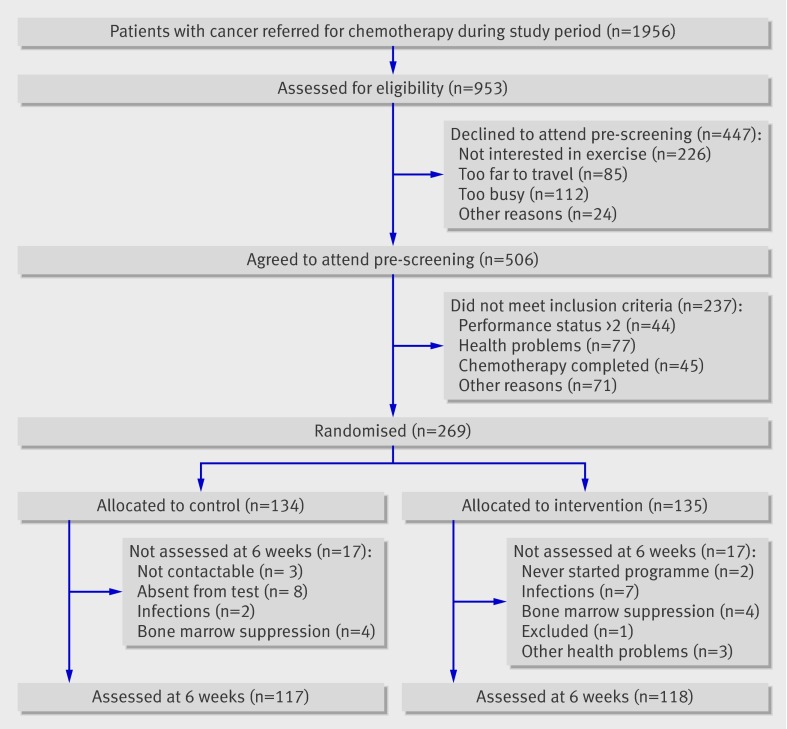
OBJECTIVE: To assess the effect of a multimodal group exercise intervention, as an adjunct to conventional care, on fatigue, physical capacity, general wellbeing, physical activity, and quality of life in patients with cancer who were undergoing adjuvant chemotherapy or treatment for advanced disease. DESIGN: Randomised controlled trial. SETTING: Two university hospitals in Copenhagen, Denmark. PARTICIPANTS: 269 patients with cancer; 73 men, 196 women, mean age 47 years (range 20-65) representing 21 diagnoses. Main exclusion criteria were brain or bone metastases. 235 patients completed follow-up. INTERVENTION: Supervised exercise comprising high intensity cardiovascular and resistance training, relaxation and body awareness training, massage, nine hours weekly for six weeks in addition to conventional care, compared with conventional care. MAIN OUTCOME MEASURES: European Organization for Research and Treatment of Cancer Quality of Life Questionnaire (EORTC QLQ-C30), Medical Outcomes Study Short Form (MOS SF-36), Leisure Time Physical Activity Questionnaire, muscular strength (one repetition maximum), maximum oxygen consumption (Vo(2)max). Statistical methods The general linear model was used for continuous outcome while analysis of associates between categorical outcomes was performed as analysis of marginal homogeneity in contingency tables. RESULTS: Adjusted for baseline score, disease, and demographic covariates, the intervention group showed an estimated improvement at six weeks for the primary outcome, fatigue, of -6.6 points (95% confidence interval -12.3 to -0.9, P=0.02; effect size=0.33, 0.04 to 0.61). Significant effects were seen on vitality (effect size 0.55, 95% CI 0.27 to 0.82), physical functioning (0.37, 0.09 to 0.65), role physical (0.37, 0.10 to 0.64), role emotional (0.32, 0.05 to 0.59), and mental health (0.28, 0.02 to 0.56) scores. Improvement was noted in physical capacity: estimated mean difference between groups for maximum oxygen consumption was 0.16 l/min (95% CI 0.1 to 0.2, P<0.0001) and for muscular strength (leg press) was 29.7 kg (23.4 to 34.9, P<0.0001). No significant effect was seen on global health status/quality of life. CONCLUSION: A supervised multimodal exercise intervention including high and low intensity components was feasible and could safely be used in patients with various cancers who were receiving adjuvant chemotherapy or treatment for advanced disease. The intervention reduced fatigue and improved vitality, aerobic capacity, muscular strength, and physical and functional activity, and emotional wellbeing, but not quality of life. TRIAL REGISTRATION: Current Controlled trials ISRCTN05322922.
Overview
The claims and statistics of this paper haven’t been checked yet.
Run the check — free, no account needed. It reads the open-access text and checks the sources it cites.
Integrity signals
Registry
Cites
Statistics
Figures
Verification
Claims the paper makes
The claims and statistics of this paper haven’t been checked yet.
Run the check — free, no account needed. It reads the open-access text and checks the sources it cites.
Claims other papers make about this one
Each is checked against this paper’s own text: does it say what the citing paper says it does?
The source backs part of the claim, not all of it — or backs it for a different population, condition or comparison.
In the citing paper
“Walking exercise [64, 65], HIIT and weight lifting [66, 67] is considered safe and does not cause undesirable events, such as lymphedema in patients who are undergoing treatment.”
From Empowerment in the treatment of fatigue in breast cancer patients (2021) · cites this paper as [66]
Experimental — accuracy not yet measuredIn the citing paper
“The methodological quality and risk of bias of the studies were assessed using the Physiotherapy Evidence Database (PEDro) scale [23].”
From Effects of Supervised Multimodal Exercise Interventions on Cancer-Related Fatigue: Systematic Review and Meta-Analysis of Randomized Controlled Trials (2015) · cites this paper as [23]
Self-check
Percentages, sums and reported differences re-computed from the paper’s own numbers.
The self-check needs the paper’s full text.
Citations
Cites
Statistical Power Analysis for the Behavioral Sciences
Muller, K. E., & Cohen, J. (1989) · Technometrics · doi:10.2307/1270020 · Cited by 99,603
Statistical power analysis for the behavioral sciences
Cohen, J. (1990) · Computers Environment and Urban Systems · doi:10.1016/0198-9715(90)90050-4 · Cited by 65,417
Statistical Power Analysis for the Behavioral Sciences (2nd ed.).
Lachenbruch, P. A., & Cohen, J. (1989) · Journal of the American Statistical Association · doi:10.2307/2290095 · Cited by 37,421
(1992) · PubMed · Cited by 33,716
Aaronson, N. K., Ahmedzai, S., Bergman, B., Bullinger, M., Cull, A., Duez, N. J., Filiberti, A., Flechtner, H., Fleishman, S. B., Haes, J. C. J. M. D., et al. (1993) · JNCI Journal of the National Cancer Institute · doi:10.1093/jnci/85.5.365 · Cited by 16,005
Compendium of physical activities: an update of activity codes and MET intensities
AINSWORTH, B. E., HASKELL, W. L., WHITT, M. C., IRWIN, M. L., SWARTZ, A. M., STRATH, S. J., O???BRIEN, W. L., BASSETT, D. R., SCHMITZ, K. H., EMPLAINCOURT, P. O., et al. (2000) · Medicine & Science in Sports & Exercise · doi:10.1097/00005768-200009001-00009 · Cited by 8,497
Effect size, confidence interval and statistical significance: a practical guide for biologists
Nakagawa, S., & Cuthill, I. C. (2007) · Biological Reviews · doi:10.1111/j.1469-185x.2007.00027.x · Cited by 3,835
Progression Models in Resistance Training for Healthy Adults
(2002) · Medicine and Science in Sports and Exercise · doi:10.1097/00005768-200202000-00027 · Cited by 2,979
Canadian Cancer Statistics 2012
Gaudette, L. A., Illing, E. M., & Hill, G. B. (2012) · PsycEXTRA Dataset · doi:10.1037/e611042012-001 · Cited by 1,485
Strength testing—predicting a one-rep max from reps-to-fatigue
Brzycki, M. (1993) · Journal of Physical Education, Recreation & Dance · doi:10.1080/07303084.1993.10606684 · Cited by 1,236
Research works printed but not linked: 2
- Anderson BD, Spector AH. Introduction to pilates-based rehabilitation. Orthop Phys Ther Clin N Am 2000;9:395-400.
- Lucía A, Earnest C, Pérez M. Cancer-related fatigue: can exercise physiology assist oncologists? Lancet Oncol 2003;4:616-25.
Cited by
Sorted by citations
Exercise as medicine - evidence for prescribing exercise as therapy in 26 different chronic diseases
Pedersen, B. K., & Saltin, B. (2015) · Scandinavian Journal of Medicine & Science in Sports · doi:10.1111/sms.12581 · Cited by 3,514
“One study (Adamsen et al., 2009) examined the effect of physical training in groups as a supplementary measure in addition to conventional therapy (adjuvant therapy or treatment for advanced cancer).”
BackgroundAmerican College of Sports Medicine Roundtable on Exercise Guidelines for Cancer Survivors
Schmitz, K. H., Courneya, K. S., Matthews, C., Demark-Wahnefried, W., GALVÃO, D. A., Pinto, B. M., IRWIN, M. L., WOLIN, K. Y., SEGAL, R. J., LUCIA, A., et al. (2010) · Medicine & Science in Sports & Exercise · doi:10.1249/mss.0b013e3181e0c112 · Cited by 2,781
“Four RCTs have shown that supervised exercise (aerobic, resistance, and stretching interventions) improves QOL in breast cancer survivors during chemotherapy or radiotherapy (1,18,64,98).”
BackgroundExercise for the management of cancer-related fatigue in adults
Cramp, F., & Byron-Daniel, J. (2012) · Cochrane Database of Systematic Reviews · doi:10.1002/14651858.cd006145.pub3 · Cited by 1,096
Greenlee, H., DuPont‐Reyes, M. J., Balneaves, L. G., Carlson, L. E., Cohen, M. R., Deng, G., Johnson, J. A., Mumber, M., Seely, D., Zick, S. M., et al. (2017) · CA A Cancer Journal for Clinicians · doi:10.3322/caac.21397 · Cited by 768
Stasi, R., Abriani, L., Beccaglia, P., Terzoli, E., & Amadori, S. (2003) · Cancer · doi:10.1002/cncr.11742 · Cited by 721
Mishra, S. I., Scherer, R. W., Snyder, C. F., Geigle, P. M., Berlanstein, D. R., & Topaloglu, Ö. (2012) · Cochrane Database of Systematic Reviews · doi:10.1002/14651858.cd008465.pub2 · Cited by 729
Impairment‐driven cancer rehabilitation: An essential component of quality care and survivorship
Silver, J. K., Baima, J. A., & Mayer, R. S. (2013) · CA A Cancer Journal for Clinicians · doi:10.3322/caac.21186 · Cited by 464
“After 6 weeks, patients in the intervention set demonstrated less fatigue, improved aerobic capacity, greater strength, improved vitality, and better emotional well-being.(118) The intervention resulted in a significant improvement in depression, but not in anxiety.”
BackgroundInterventions to enhance return-to-work for cancer patients
de Boer, A. G. E. M., Taskila, T. K., Tamminga, S. J., Feuerstein, M., Frings‐Dresen, M. H. W., & Verbeek, J. H. A. M. (2015) · Cochrane Database of Systematic Reviews · doi:10.1002/14651858.cd007569.pub3 · Cited by 430
Brown, J. C., Huedo-Medina, T. B., Pescatello, L. S., Pescatello, S. M., Ferrer, R. A., & Johnson, B. T. (2011) · Cancer Epidemiology, Biomarkers & Prevention · doi:10.1158/1055-9965.epi-10-0988 · Cited by 404
“included only resistance exercise (49, 55, 63, 68, 69, 71), 11 studies included a combination of aerobic and resistance exercise (40, 41, 48, 51, 60, 62, 64, 67, 72, 75, 76), and”
BackgroundSchmidt, M. E., Wiskemann, J., Armbrust, P., Schneeweiß, A., Ulrich, C. M., & Steindorf, K. (2014) · International Journal of Cancer · doi:10.1002/ijc.29383 · Cited by 324
“Additionally, four randomized exercise trials included breast cancer patients during any adjuvant treatment, and one trial included 269 patients during adjuvant chemotherapy with mixed cancer types.(19) Results of these trials on fatigue were heterogeneous.”
BackgroundSweegers, M. G., Altenburg, T. M., Chinapaw, M. J., Kalter, J., Verdonck-de Leeuw, I. M., Courneya, K. S., Newton, R. U., Aaronson, N. K., Jacobsen, P. B., Brug, J., et al. (2018) · British Journal of Sports Medicine · doi:10.1136/bjsports-2017-097891 · Cited by 288
Physical Exercise for Cancer Patients with Advanced Disease: A Randomized Controlled Trial
Oldervoll, L. M., Loge, J. H., Lydersen, S., Paltiel, H., May, B., Nygaard, U. V., Oredalen, E., Frantzen, T. L., Lesteberg, I., Amundsen, L., et al. (2011) · The Oncologist · doi:10.1634/theoncologist.2011-0133 · Cited by 287
“The patients in our cohort had higher levels of fatigue and poorer physical and social functioning at baseline than the patients included in a recently published RCT [8].”
BackgroundResultInfluentialEffect of Exercise Training on Peak Oxygen Consumption in Patients with Cancer: A Meta-Analysis
Jones, L. W., Liang, Y., Pituskin, E., Battaglini, C. L., Scott, J. M., Hornsby, W., & Haykowsky, M. J. (2011) · The Oncologist · doi:10.1634/theoncologist.2010-0197 · Cited by 295
Exercise for women receiving adjuvant therapy for breast cancer
Furmaniak, A. C., Menig, M., & Markes, M. H. (2016) · Cochrane Database of Systematic Reviews · doi:10.1002/14651858.cd005001.pub3 · Cited by 276
Exercise Interventions for Cancer Survivors: A Meta-Analysis of Quality of Life Outcomes
Ferrer, R. A., Huedo-Medina, T. B., Johnson, B. T., Ryan, S. M., & Pescatello, L. S. (2010) · Annals of Behavioral Medicine · doi:10.1007/s12160-010-9225-1 · Cited by 282
Updated evidence in support of diet and exercise interventions in cancer survivors
Pekmezi, D., & Demark‐Wahnefried, W. (2010) · Acta Oncologica · doi:10.3109/0284186x.2010.529822 · Cited by 279
“For example, in the current review, there were six (of 12) studies with samples of at least 100 participants [7,8,13,16,26,27,29,31], compared to the last review in which only one (of seven studies) had a sample size greater than 100.”
BackgroundMethodResultInfluentialGreenlee, H., Balneaves, L. G., Carlson, L. E., Cohen, M. R., Deng, G. E., Hershman, D. L., Mumber, M. P., Perlmutter, J., Seely, D., Sen, A., et al. (2014) · JNCI Monographs · doi:10.1093/jncimonographs/lgu041 · Cited by 279
“Exercise programs that include a relaxation/stress management component [Grade C (54,122)] can be considered as options for improving physical functioning, while programs oriented towards energy conservation [Grade D (88,123)] are not recommended.”
BackgroundBlaney, J. M., Lowe‐Strong, A., Rankin‐Watt, J., Campbell, A., & Gracey, J. H. (2013) · Psycho-Oncology · doi:10.1002/pon.2072 · Cited by 259
“Although findings mainly relate to breast cancer survivors, results to date are positive and include the following: decreased cancer-related fatigue (CRF) [1–8], improvements in cardiorespiratory/aerobic fitness [3,5,7], muscular strength [3,4,7], physical functioning [1,4,8–11] and Quality of Life (QoL) [3,6–8].”
BackgroundInfluentialGerritsen, J. K. W., & Vincent, A. J. P. E. (2016) · British Journal of Sports Medicine · doi:10.1136/bjsports-2015-094787 · Cited by 246
High-Intensity Interval Training for Cognitive and Mental Health in Adolescents
(2016) · doi:10.1249/mss.0000000000000993 · Cited by 236
“well-being (1) in a range of adult population groups (e.”
BackgroundCancer Cachexia: Its Mechanism and Clinical Significance
Nishikawa, H., Goto, M., Fukunishi, S., Asai, A., Nishiguchi, S., & Higuchi, K. (2021) · International Journal of Molecular Sciences · doi:10.3390/ijms22168491 · Cited by 253
Kessels, E., Husson, O., & Feltz-Cornelis, C. M. V. D. (2018) · Neuropsychiatric Disease and Treatment · doi:10.2147/ndt.s150464 · Cited by 230
Effect of Exercise on Cancer-Related Fatigue: A Meta-analysis
Tomlinson, D., Diorio, C., Beyene, J., & Sung, L. (2014) · American Journal of Physical Medicine & Rehabilitation · doi:10.1097/phm.0000000000000083 · Cited by 220
Stene, G. B., Helbostad, J. L., Balstad, T. R., Riphagen, I. I., Kaasa, S., & Oldervoll, L. M. (2013) · Critical Reviews in Oncology/Hematology · doi:10.1016/j.critrevonc.2013.07.001 · Cited by 210
“Overall, the tendency in these six trials was that the experimental groups (either AE, RE or CAE) maintained or modestly improved muscle mass from pre to post-test while the CG reduced muscle mass.”
BackgroundMethodResultInfluentialCancer-related fatigue: a practical review
Campos, M. P., Hassan, B. J., Riechelmann, R. P., & del Giglio, A. (2011) · Annals of Oncology · doi:10.1093/annonc/mdq458 · Cited by 222
“Studies of exercise during or just after treatment in patients undergoing a variety of cancer therapies have consistently demonstrated benefits in fatigue, quality of life, functional capacity, emotional distress, and other symptoms [52–66].”
BackgroundDifferential Effects of Exercise on Cancer-Related Fatigue During and Following Treatment
Puetz, T. W., & Herring, M. P. (2012) · American Journal of Preventive Medicine · doi:10.1016/j.amepre.2012.04.027 · Cited by 219
Lambert, J. E., Hayes, L. D., Keegan, T., Subar, D. A., & Gaffney, C. J. (2020) · Annals of Surgery · doi:10.1097/sla.0000000000004527 · Cited by 201
Berger, A. M., Mitchell, S. A., Jacobsen, P. B., & Pirl, W. F. (2015) · CA A Cancer Journal for Clinicians · doi:10.3322/caac.21268 · Cited by 207
Mijwel, S., Backman, M., Bolam, K. A., Jervaeus, A., Sundberg, C. J., Margolin, S., Browall, M., Rundqvist, H., & Wengström, Y. (2017) · Breast Cancer Research and Treatment · doi:10.1007/s10549-017-4571-3 · Cited by 192
“Only one previous trial [42] incorporating multimodal training, which included high-intensity exercise training, has shown positive effects on CRF from the unidimensional EORTC-QLQ-C30 scale, leading us to, again, speculate that the beneficial and clinically relevant effects of exercise on CRF are intensity-dependent.”
BackgroundDethlefsen, C., Hansen, L. S., Lillelund, C., Andersen, C., Gehl, J., Christensen, J. F., Pedersen, B. K., & Højman, P. (2017) · Cancer Research · doi:10.1158/0008-5472.can-16-3125 · Cited by 189
Self-citationExercise interventions for individuals with advanced cancer: A systematic review
Dittus, K. L., Gramling, R. E., & Ades, P. A. (2017) · Preventive Medicine · doi:10.1016/j.ypmed.2017.07.015 · Cited by 191
“Two studies, one a RCT and the other a pre/post program evaluation identified a significant improvement in all or nearly all tested measures of QOL (Adamsen et al., 2009; Gagnon et al., 2013).”
BackgroundMethodInfluentialFisher, E. B., Fitzgibbon, M., Glasgow, R. E., Haire-Joshu, D. L., Hayman, L. L., Kaplan, R. M., Nanney, M. S., & Ockene, J. K. (2011) · American Journal of Preventive Medicine · doi:10.1016/j.amepre.2010.12.031 · Cited by 197
Uster, A., Ruehlin, M., Mey, S., Gisi, D., Knols, R. H., Imoberdorf, R., Pless, M., & Ballmer, P. E. (2017) · Clinical Nutrition · doi:10.1016/j.clnu.2017.05.027 · Cited by 159
Naito, T., Mitsunaga, S., Miura, S., Tatematsu, N., Inano, T., Mouri, T., Tsuji, T., Higashiguchi, T., Inui, A., Okayama, T., et al. (2018) · Journal of Cachexia Sarcopenia and Muscle · doi:10.1002/jcsm.12351 · Cited by 163
“8%) of randomized controlled trial of multimodal high intensity exercise intervention for patients with advanced cancer receiving chemotherapy.(29) We set the threshold value as 45% according to the completion rate (44%) of feasibility study for structured exercise programme for adult patients with advanced NSCLC who…”
BackgroundSupervised exercise reduces cancer-related fatigue: a systematic review
Meneses-Echávez, J. F., González-Jiménez, E., & Ramírez-Vélez, R. (2015) · Journal of Physiotherapy · doi:10.1016/j.jphys.2014.08.019 · Cited by 146
“Two trials (18%) included diverse types of cancer.(28,32)”
BackgroundQuist, M., Rørth, M. R., Langer, S. W., Jones, L. W., Laursen, J. H., Pappot, H., Christensen, K. B., & Adamsen, L. (2011) · Lung Cancer · doi:10.1016/j.lungcan.2011.07.006 · Cited by 147
Self-citationEffects of Aerobic and Resistance Exercises on Physical Symptoms in Cancer Patients: A Meta-analysis
Nakano, J., Hashizume, K., Fukushima, T., Ueno, K., Matsuura, E., Ikio, Y., Ishii, S., Morishita, S., Tanaka, K., & Kusuba, Y. (2018) · Integrative Cancer Therapies · doi:10.1177/1534735418807555 · Cited by 137
Zhu, G., Zhang, X., Wang, Y., Xiong, H., Zhao, Y., & Sun, F. (2016) · OncoTargets and Therapy · doi:10.2147/ott.s97864 · Cited by 138
“In addition, previous studies demonstrated that it was feasible and safe for various cancer patients to exercise during treatment, 73 without increasing the risk or exacerbating the symptom of lymphedema.”
BackgroundMitchell, S. A., Hoffman, A. J., Clark, J. C., DeGennaro, R., Poirier, P., Robinson, C. B., & Weisbrod, B. L. (2014) · Clinical journal of oncology nursing · doi:10.1188/14.cjon.s3.38-58 · Cited by 135
“In addition, 11 RCTs examined these interventions in patients with a range of solid tumors, including those with advanced disease (Adamsen et al., 2006, 2009; Andersen et al., 2013; Cantarero-Villanueva et al., 2012; Cheville et al., 2010; Heim, Malsburg, & Niklas, 2007; Jensen et al., 2014;…”
Meneses-Echávez, J. F., González-Jiménez, E., & Ramírez-Vélez, R. (2015) · BioMed Research International · doi:10.1155/2015/328636 · Cited by 127
“Likewise, these results supported the implementation of personalized supervision in research, since it can optimize patient’s adherence to and compliance with interventions.”
ResultPerioperative exercise training in elderly subjects
Jack, S., West, M. A., & Grocott, M. P. W. (2011) · Best practice & research. Clinical anaesthesiology · doi:10.1016/j.bpa.2011.07.003 · Cited by 125
Fadiga relacionada ao câncer: uma revisão
Campos, M. P. D. O., Hassan, B. J., Riechelmann, R. P., & del Giglio, A. (2011) · Revista da Associação Médica Brasileira · doi:10.1590/s0104-42302011000200021 · Cited by 125
Quist, M., Adamsen, L., Rørth, M. R., Laursen, J. H., Christensen, K. B., & Langer, S. W. (2015) · Integrative Cancer Therapies · doi:10.1177/1534735415572887 · Cited by 131
“Our study employed the indirect Watt max test, which has been validated by comparison to a direct watt max test and a high correlation was found.(15) Independent qualitative research also shows that cancer patients receiving chemotherapy experience greater confidence when performing the Watt max test, the 1RM test, an…”
MethodResultSelf-citationImpact of Fatigue on Outcomes in the Hemodialysis (HEMO) Study
Jhamb, M., Pike, F., Ramer, S. J., Argyropoulos, C., Steel, J. L., Dew, M. A., Weisbord, S. D., Weissfeld, L. A., & Unruh, M. L. (2011) · American Journal of Nephrology · doi:10.1159/000328004 · Cited by 122
Dethlefsen, C., Lillelund, C., Midtgaard, J., Andersen, C., Pedersen, B. K., Christensen, J. F., & Højman, P. (2016) · Breast Cancer Research and Treatment · doi:10.1007/s10549-016-3970-1 · Cited by 120
Self-citationMuscaritoli, M., Arends, J., & Aapro, M. (2019) · Therapeutic Advances in Medical Oncology · doi:10.1177/1758835919880084 · Cited by 140
van Vugt, J. L. A., van den Braak, R. R. J. C., Lalmahomed, Z. S., Vrijland, W. W., Dekker, J. W. T., Zimmerman, D. D. E., Vles, W. J., Coene, P. L. O., & IJzermans, J. N. M. (2018) · European Journal of Surgical Oncology · doi:10.1016/j.ejso.2018.05.029 · Cited by 117
Interventions to enhance return-to-work for cancer patients
de Boer, A. G. E. M., Taskila, T. K., Tamminga, S. J., Frings‐Dresen, M. H. W., Feuerstein, M., & Verbeek, J. H. A. M. (2011) · Cochrane Database of Systematic Reviews · doi:10.1002/14651858.cd007569.pub2 · Cited by 116
Speyer, É., Herbinet, A., Vuillemin, A., Briançon, S., & Chastagner, P. B. (2010) · Pediatric Blood & Cancer · doi:10.1002/pbc.22698 · Cited by 113
“Our APOP results are consistent with studies investigating the effect of an exercise training program on HRQoL in adults with cancer, demonstrating that regular physical activity during treatment helped adult patients tolerate treatment-induced effects and contributed to better HRQoL [34–40].”
ResultChemotherapy-induced peripheral neuropathy and rehabilitation: A review
Zhang, S. (2021) · Seminars in Oncology · doi:10.1053/j.seminoncol.2021.09.004 · Cited by 113
“ome exercise program, outpatient and inpatient rehabilitation Based on the evidence from previous studies on the benefits of herapeutic exercise in patients with CIPN, [82-84 , 90 , 92-94 , 101] all ancer patients should be educated and counseled on the imporance of therapeutic exercise in addition to surgery, radiati…”
InfluentialI Diretriz Brasileira de Cardio-Oncologia da Sociedade Brasileira de Cardiologia
Filho, R. K., Hajjar, L., Bacal, F., Hoff, P. M., Estevez-Diz, M. D. P., & Galas, F. (2011) · Arquivos Brasileiros de Cardiologia · doi:10.1590/s0066-782x2011000700001 · Cited by 108
Jacobsen, P. B., & Andrykowski, M. A. (2015) · American Psychologist · doi:10.1037/a0036513 · Cited by 111
Loughney, L. A., West, M. A., Kemp, G. J., Grocott, M. P. W., & Jack, S. (2015) · European Journal of Surgical Oncology · doi:10.1016/j.ejso.2015.09.027 · Cited by 101
Schmitt, J., Lindner, N., Reuss-Borst, M., Holmberg, H.-C., & Sperlich, B. (2016) · Physiological Reports · doi:10.14814/phy2.12693 · Cited by 103
“Previous research has documented reduced cancerrelated fatigue following HIIT (Adamsen et al. 2009; Ferlay et al. 2013; Battaglini et al. 2014) and the present multimodal HIIT rehabilitation produced smallto-moderate effects on all scales of the MFI-20 and EORTC QLQ-C30 questionnaires.”
BackgroundMethodInfluentialWinters-Stone, K. M., Neil, S. E., & Campbell, K. L. (2014) · British Journal of Sports Medicine · doi:10.1136/bjsports-2012-091732 · Cited by 98
Andersen, C., Rørth, M. R., Ejlertsen, B., Stage, M., Møller, T., Midtgaard, J., Quist, M., Bloomquist, K., & Adamsen, L. (2012) · European Journal of Oncology Nursing · doi:10.1016/j.ejon.2012.09.003 · Cited by 103
Self-citationChemotherapy-induced muscle wasting: an update
Coletti, D. (2018) · European Journal of Translational Myology · doi:10.4081/ejtm.2018.7587 · Cited by 104
A systematic review and meta-analysis of exercise interventions for colorectal cancer patients
Cramer, H., Lauche, R., Klose, P., Dobos, G. J., & Langhorst, J. (2013) · European Journal of Cancer Care · doi:10.1111/ecc.12093 · Cited by 105
Gebruers, N., Camberlin, M., Theunissen, F., Tjalma, W. A. A., Verbelen, H., Soom, T. V., & van Breda, E. (2018) · Supportive Care in Cancer · doi:10.1007/s00520-018-4490-9 · Cited by 109
Brocki, B. C., Andreasen, J., Nielsen, L. R., Nekrasas, V., Gorst‐Rasmussen, A., & Westerdahl, E. (2013) · Lung Cancer · doi:10.1016/j.lungcan.2013.10.015 · Cited by 90
Control Group Design, Contamination and Drop-Out in Exercise Oncology Trials: A Systematic Review
Bisschop, C. N. S., Courneya, K. S., Velthuis, M. J., Monninkhof, E. M., Jones, L. W., Friedenreich, C. M., van der Wall, E., Peeters, P. H. M., & May, A. M. (2015) · PLoS ONE · doi:10.1371/journal.pone.0120996 · Cited by 89
“1 shows the flowchart of included studies [4, 8–42].”
Rush, S. E., & Sharma, M. (2017) · Journal of Evidence-Based Complementary & Alternative Medicine · doi:10.1177/2156587216661467 · Cited by 89
Chen, Y.-J., Li, X., Ma, H.-K., Zhang, X., Wang, B.-W., Guo, T.-T., Xiao, Y., Bing, Z., Ge, L., Yang, K., et al. (2019) · Journal of Pain and Symptom Management · doi:10.1016/j.jpainsymman.2019.09.010 · Cited by 89
Lin, K., Shun, S., Lai, Y., Liang, J., & Tsauo, J. (2013) · Cancer Nursing · doi:10.1097/ncc.0b013e3182791097 · Cited by 88
“Data used in the computation were from a randomized controlled study conducted with cancer patients undergoing chemotherapy.(11) The results of the study by Adamsen et al(12) showed a difference of 2.”
MethodPalma, S., Hasenoehrl, T., Jordakieva, G., Ramazanova, D., & Crevenna, R. (2020) · Supportive Care in Cancer · doi:10.1007/s00520-020-05834-x · Cited by 87
Cole, C. L., Kleckner, I. R., Jatoi, A., Schwarz, E. M., & Dunne, R. F. (2018) · JCSM Clinical Reports · doi:10.17987/jcsm-cr.v3i2.65 · Cited by 84
“Exercise preserves and increases muscle mass and function [27], while regulating both catabolic [28, 29] and anabolic [30] pathways in healthy individuals and those with disease [31].”
BackgroundToohey, K. L., Chapman, M., Rushby, A.-M., Urban, K., Ingham, G., & Singh, B. (2022) · Journal of Cancer Survivorship · doi:10.1007/s11764-021-01153-0 · Cited by 84
“1 3 an exercise intervention [71–74]; in this review, fatigue either did not get worse [34, 44, 48, 50] or improved across the studies [45, 49, 53].”
BackgroundMethodSystematic Review of Functional Outcomes in Cancer Rehabilitation
Sleight, A. G., Gerber, L. H., Marshall, T. F., Livinski, A. A., Alfano, C. M., Harrington, S., Flores, A. M., Virani, A., Hu, X., Mitchell, S. A., et al. (2022) · Archives of Physical Medicine and Rehabilitation · doi:10.1016/j.apmr.2022.01.142 · Cited by 93
Exercise for older adult inpatients with acute myelogenous leukemia: A pilot study
Klepin, H. D., Danhauer, S. C., Tooze, J. A., Stott, K., Daley, K., Vishnevsky, T., Powell, B. L., & Mihalko, S. L. (2010) · Journal of Geriatric Oncology · doi:10.1016/j.jgo.2010.10.004 · Cited by 81
A comprehensive review of head and neck cancer rehabilitation: Physical therapy perspectives
Guru, K., Supe, S., & Manoor, U. (2012) · Indian Journal of Palliative Care · doi:10.4103/0973-1075.100820 · Cited by 82
“[78] Dimeo et al. [78] found that all the patients experienced a clear reduction of fatigue and could carry out normal daily activities again without substantial limitations with an improvement in maximal physical performance (from 6.4 ± 0.4 km/h to 7.5 ± 0.9 km/h, P < 0.05) and maximal walked…”
InfluentialHunter, E. G., Gibson, R. W., Arbesman, M., & D’Amico, M. (2017) · American Journal of Occupational Therapy · doi:10.5014/ajot.2017.023564 · Cited by 83
Zyga, S., Alikari, V., Sachlas, A., Fradelos, Ε. C., Stathoulis, J. D., Panoutsopoulos, G. I., Georgopoulou, M., Theophilou, P., & Lavdaniti, M. (2015) · Medical Archives · doi:10.5455/medarh.2015.69.376-380 · Cited by 80
Physical activity level and quality of life in long term lung cancer survivors
Nes, L. S., Liu, H., Patten, C. A., Rausch, S. M., Sloan, J. A., Garces, Y. I., Cheville, A. L., Yang, P., & Clark, M. M. (2012) · Lung Cancer · doi:10.1016/j.lungcan.2012.05.096 · Cited by 78
Loughney, L. A., West, M. A., Kemp, G. J., Grocott, M. P. W., & Jack, S. (2015) · European Journal of Surgical Oncology · doi:10.1016/j.ejso.2015.08.153 · Cited by 76
Yee, J., Davis, G. M., Hackett, D. A., Beith, J. M., Wilcken, N. R. C., Currow, D. C., Emery, J. D., Phillips, J. L., Martin, A. J., Hui, R., et al. (2019) · Journal of Pain and Symptom Management · doi:10.1016/j.jpainsymman.2019.07.022 · Cited by 75
Multimodal exercise training during myeloablative chemotherapy: a prospective randomized pilot trial
Oechsle, K., Aslan, Z., Süsse, Y., Jensen, W., Bokemeyer, C., & de Wit, M. (2013) · Supportive Care in Cancer · doi:10.1007/s00520-013-1927-z · Cited by 74
Isanejad, A., Nazari, S., Gharib, B., & Motlagh, A. G. (2023) · Journal of sport and health science/Journal of Sport and Health Science · doi:10.1016/j.jshs.2023.07.001 · Cited by 72
Antoun, S., & Raynard, B. (2018) · Annals of Oncology · doi:10.1093/annonc/mdx809 · Cited by 74
Moderate Exercise Improves Experimental Cancer Cachexia by Modulating the Redox Homeostasis
Ballarò, R., Penna, F., Pin, F., Gómez‐Cabrera, M. C., Viña, J., & Costelli, P. (2019) · Cancers · doi:10.3390/cancers11030285 · Cited by 73
Nadler, M. B., Desnoyers, A., Langelier, D. M., & Amir, E. (2019) · Journal of Pain and Symptom Management · doi:10.1016/j.jpainsymman.2019.07.005 · Cited by 79
Cancer Rehabilitation and Palliative Care—Exploring the Synergies
Chowdhury, R. A., Brennan, F. P., & Gardiner, M. D. (2020) · Journal of Pain and Symptom Management · doi:10.1016/j.jpainsymman.2020.07.030 · Cited by 74
Physical activity and fitness in women with metastatic breast cancer
Yee, J., Davis, G. M., Beith, J. M., Wilcken, N. R. C., Currow, D. C., Emery, J. D., Phillips, J. L., Martin, A. J., Hui, R., Harrison, M., et al. (2014) · Journal of Cancer Survivorship · doi:10.1007/s11764-014-0378-y · Cited by 68
“Its effect on treatment-related side-effects and qualit y of life in women with early stage breast cancer has been extensively documented [10-12].”
BackgroundWenzel, J. A., Griffith, K. A., Shang, J., Thompson, C. B., Hedlin, H., Stewart, K. J., DeWeese, T., & Mock, V. (2013) · The Oncologist · doi:10.1634/theoncologist.2012-0278 · Cited by 70
Prehabilitation in Modern Colorectal Cancer Surgery: A Comprehensive Review
Baušys, A., Kryžauskas, M., Abeciūnas, V., Degutytė, A. E., Baušys, R., Strupas, K., & Poškus, T. (2022) · Cancers · doi:10.3390/cancers14205017 · Cited by 70
Saquib, N., Saquib, J., & Ioannidis, J. P. A. (2013) · BMJ · doi:10.1136/bmj.f4313 · Cited by 68
Goldberg, J. H., Magruder, K. M., Forsberg, C. W., Kazis, L. E., Üstün, T. B., Friedman, M. J., Litz, B. T., Vaccarino, V., Heagerty, P. J., Gleason, T., et al. (2013) · Quality of Life Research · doi:10.1007/s11136-013-0585-4 · Cited by 70
“Effect size is the standardized difference in scores and is widely used in studies of patient-reported outcomes and health functioning [16–18].”
Influence of physical activity on the immune system in breast cancer patients during chemotherapy
Schmidt, T., Jonat, W., Wesch, D., Oberg, H., Adam‐Klages, S., Keller, L., Röcken, C., & Mundhenke, C. (2018) · Journal of Cancer Research and Clinical Oncology · doi:10.1007/s00432-017-2573-5 · Cited by 68
McGettigan, M., Cardwell, C. R., Cantwell, M. M., & Tully, M. A. (2020) · Cochrane Database of Systematic Reviews · doi:10.1002/14651858.cd012864.pub2 · Cited by 69
Cave, J., Paschalis, A., Huang, C.-Y., West, M. A., Copson, E., Jack, S., & Grocott, M. P. W. (2018) · Supportive Care in Cancer · doi:10.1007/s00520-018-4295-x · Cited by 64
“One study adopted a more intense regime targeting 85–95% of calculated maximal heart rate [23].”
MethodPhysical activity and survival in breast cancer
Ammitzbøll, G., Søgaard, K., Karlsen, R. V., Tjønneland, A. M., Johansen, C., Frederiksen, K., & Bidstrup, P. E. (2016) · European Journal of Cancer · doi:10.1016/j.ejca.2016.07.010 · Cited by 63
Spinal Metastatic Disease: A Review of the Role of the Multidisciplinary Team
Curtin, M., Piggott, R. P., Murphy, E. P., Munigangaiah, S., Baker, J. F., McCabe, J. P., & Devitt, A. T. (2017) · Orthopaedic Surgery · doi:10.1111/os.12334 · Cited by 63
Muscoloskeletal aging, sarcopenia and cancer
Colloca, G. A., Capua, B. D., Bellieni, A., Cesari, M., Marzetti, E., Valentini, V., & Calvani, R. (2018) · Journal of Geriatric Oncology · doi:10.1016/j.jgo.2018.11.007 · Cited by 65
Cantarero‐Villanueva, I., Fernández‐Lao, C., del Moral-Ávila, R., Fernández‐de‐las‐Peñas, C., Feriche-Fernández-Castanys, M. B., & Arroyo‐Morales, M. (2011) · Evidence-based Complementary and Alternative Medicine · doi:10.1155/2012/620619 · Cited by 62
“Hindawi Publishing Corporation Evidence-Based Complementary and Alternative Medicine Volume 2012, Article ID 620619, 9 pages doi:10.1155/2012/620619”
BackgroundInfluentialPhysical activity among cancer survivors: a literature review.
Szymlek‐Gay, E. A., Richards, R., & Egan, R. (2011) · PubMed · Cited by 59
Arrieta, H., Astrugue, C., Regueme, S. C., Durrieu, J., Maillard, A., Rieger, A., Terrebonne, É., Laurent, C., Maget, B., Servent, V., et al. (2019) · Journal of Cachexia Sarcopenia and Muscle · doi:10.1002/jcsm.12382 · Cited by 61
“Telephone-based physical activity interventions have been proposed to allow for greater outreach to patients and minimize the high number of participants who refuse to attend supervised exercise sessions after cancer diagnosis due to the lack of interest in exercise, living too far away to travel, or because they are…”
BackgroundPre-radiotherapy daily exercise training in non-small cell lung cancer: A feasibility study
Egegaard, T., Rohold, J., Lillelund, C., Persson, G. F., & Quist, M. (2019) · Reports of Practical Oncology & Radiotherapy · doi:10.1016/j.rpor.2019.06.003 · Cited by 61
Self-citationPiil, K., Jakobsen, J., Christensen, K. B., Juhler, M., & Jarden, M. (2015) · Journal of Neuro-Oncology · doi:10.1007/s11060-015-1821-2 · Cited by 58
“(1) Leisure-time physical activity level [21–23].”
Lavin, K. M., Coen, P. M., Baptista, L. C. P., Bell, M. B., Drummer, D. J., Harper, S. A., Lixandrão, M. E., McAdam, J. S., O’Bryan, S. M., Ramos, S. V., et al. (2022) · Comprehensive physiology · doi:10.1002/cphy.c200033 · Cited by 78
Thomsen, S. N., Lahart, I. M., Thomsen, L. M., Fridh, M. K., Larsen, A. T. S., Mau‐Sørensen, M., Bolam, K. A., Fairman, C. M., Christensen, J. F., & Simonsen, C. (2023) · EClinicalMedicine · doi:10.1016/j.eclinm.2023.101937 · Cited by 62
Physical Functioning and Rehabilitation for the Cancer Survivor
Stubblefield, M. D., Schmitz, K. H., & Ness, K. K. (2013) · Seminars in Oncology · doi:10.1053/j.seminoncol.2013.09.008 · Cited by 58
Metadata
- Authors
- Adamsen, L., Quist, M., Andersen, C., Moller, T., Herrstedt, J., Kronborg, D., Baadsgaard, M. T., Vistisen, K., Midtgaard, J., Christiansen, B., Stage, M., Kronborg, M. T., & Rorth, M.
- Affiliations
- University of Copenhagen (DK)
- Copenhagen University Hospital (DK)
- Odense University Hospital (DK)
- Copenhagen Business School (DK)
- Herlev Hospital (DK)
- Corresponding author
- Adamsen, L.
- Venue
- BMJ
- Publisher
- BMJ
- Published
- 2009-10-13
- Volume
- 339
- Issue
- oct13 1
- Pages
- b3410-b3410
- ISSN
- 0007-1447 (ISSN-L)
- 0959-8138
- 1468-5833
- PMC
- PMC2762035
- OpenAlex
- W2041918383
- Cited by
- 492
- References
- 61
- Citations by year
- 2026: 17 · 2025: 21 · 2024: 13 · 2023: 26 · 2022: 30 · 2021: 33 · 2020: 32 · 2019: 30 · 2018: 36 · 2017: 42 · 2016: 29 · 2015: 34 · 2014: 26 · 2013: 31 · 2012: 34
- FWCI
- 15.00
- Type
- journal article
- Language
- en
- Open access
- hybrid
- doi.org
- Licence
- cc-by-nc
- Locations
- BMJ (publishedVersion, cc-by-nc)
- Europe PMC (PubMed Central) (publishedVersion, cc-by-nc)
- PubMed Central (publishedVersion, cc-by-nc)
- PubMed (publishedVersion)
- University of Southern Denmark Research Portal (University of Southern Denmark) (publishedVersion)
- Research at the University of Copenhagen (University of Copenhagen) (submittedVersion)
- CBS Research Portal (Copenhagen Business School) (submittedVersion, other-oa)
- Funders
- Kræftens Bekæmpelse
- Aase og Ejnar Danielsens Fond
- Lundbeckfonden
- Novo Nordisk Fonden
- Egmont Fonden
- H. Lundbeck A/S
- Topics
- Health Sciences › Medicine › Oncology › Cancer survivorship and care
- Health Sciences › Medicine › Physiology (medical) › Cardiovascular and exercise physiology
- Health Sciences › Medicine › Oncology › Cancer-related cognitive impairment studies
- Keywords
- high-intensity training, cancer patients, chemotherapy, cancer-related fatigue, quality of life, physical capacity, aerobic exercise, resistance training, relaxation training, massage, physical activity, muscle strength, oxygen consumption, well-being, advanced cancer, adjuvant chemotherapy, mental health, physical function, vitality, role physical, emotional role
- MeSH terms
- Adult, Aged, Antineoplastic Combined Chemotherapy Protocols, Exercise Therapy, Feasibility Studies, Female, Health Status, Humans, Leisure Activities, Male, Middle Aged, Neoplasms, Quality of Life, Exercise, Treatment Outcome, Muscle Strength, Young Adult
About these checks
Registry, retraction, Cites and statistics results are computed, not judged, with one exception: a printed reference that no index lists is read once by a model before it counts as a citation error. Claims are extracted by a model and kept only when their quote appears verbatim in the text; each cited source is then checked, with a model’s help, for whether it says what the claim relies on. Those verdicts can be wrong — read the claim’s quote and the cited source before relying on one.
Statistics and arithmetic are recomputed, not judged.
Confidence bands are shown only for fields calibrated on our annotated test set. None is calibrated yet, so no band is shown.
What counts as a claim ›How we measure confidence ›How we check this ›
Are you an author, or do you see a problem with this page? Request a review
