

The DOI matches its Crossref record; 41 of the 42 references it cites were found in a registry or an index; 1 of the 33 sources its claims cite were checked for support.
Accuracy of the Edinburgh Postnatal Depression Scale (EPDS) for screening to detect major depression among pregnant and postpartum women: systematic review and meta-analysis of individual participant data
Open accessAbstract
Objective: To evaluate the Edinburgh Postnatal Depression Scale (EPDS) for screening to detect major depression in pregnant and postpartum women. Design: Individual participant data meta-analysis. Data sources: Medline, Medline In-Process and Other Non-Indexed Citations, PsycINFO, and Web of Science (from inception to 3 October 2018). Eligibility criteria for selecting studies: Eligible datasets included EPDS scores and major depression classification based on validated diagnostic interviews. Bivariate random effects meta-analysis was used to estimate EPDS sensitivity and specificity compared with semi-structured, fully structured (Mini International Neuropsychiatric Interview (MINI) excluded), and MINI diagnostic interviews separately using individual participant data. One stage meta-regression was used to examine accuracy by reference standard categories and participant characteristics. Results: Individual participant data were obtained from 58 of 83 eligible studies (70%; 15 557 of 22 788 eligible participants (68%), 2069 with major depression). Combined sensitivity and specificity was maximised at a cut-off value of 11 or higher across reference standards. Among studies with a semi-structured interview (36 studies, 9066 participants, 1330 with major depression), sensitivity and specificity were 0.85 (95% confidence interval 0.79 to 0.90) and 0.84 (0.79 to 0.88) for a cut-off value of 10 or higher, 0.81 (0.75 to 0.87) and 0.88 (0.85 to 0.91) for a cut-off value of 11 or higher, and 0.66 (0.58 to 0.74) and 0.95 (0.92 to 0.96) for a cut-off value of 13 or higher, respectively. Accuracy was similar across reference standards and subgroups, including for pregnant and postpartum women. Conclusions: An EPDS cut-off value of 11 or higher maximised combined sensitivity and specificity; a cut-off value of 13 or higher was less sensitive but more specific. To identify pregnant and postpartum women with higher symptom levels, a cut-off of 13 or higher could be used. Lower cut-off values could be used if the intention is to avoid false negatives and identify most patients who meet diagnostic criteria. Registration: PROSPERO (CRD42015024785).
Overview
AI snapshot
Written from the paper’s full text.
TL;DR
In an individual participant data meta-analysis, the Edinburgh Postnatal Depression Scale (EPDS) maximised combined sensitivity and specificity at a cut-off of 11 or higher for detecting major depression in pregnant and postpartum women. Accuracy was similar across reference standards and subgroups, including pregnant versus postpartum status.
Key findings
- Among 58 included studies (15,557 participants; 2,069 with major depression), combined sensitivity and specificity was maximised at an EPDS cut-off of 11 or higher across reference standards (Youden’s J=0.70 for semi-structured, 0.73 for fully structured, 0.66 for MINI).
- For semi-structured interviews (36 studies, 9,066 participants, 1,330 with major depression), sensitivity and specificity were 0.85 (95% CI 0.79 to 0.90) and 0.84 (0.79 to 0.88) at ≥10; 0.81 (0.75 to 0.87) and 0.88 (0.85 to 0.91) at ≥11; and 0.66 (0.58 to 0.74) and 0.95 (0.92 to 0.96) at ≥13.
- Accuracy was similar across reference standards and subgroups, including pregnant and postpartum women; no other study or participant characteristics were consistently associated with differences in sensitivity or specificity across both semi-structured and MINI categories.
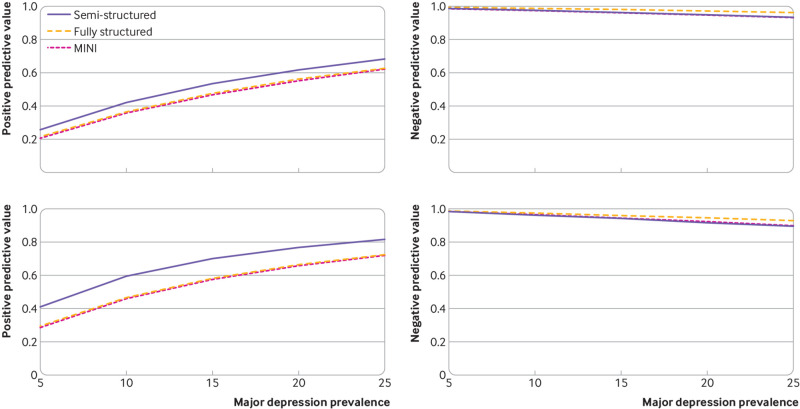
- For major depression prevalence of 5–25% and a cut-off of ≥11 compared with semi-structured interviews, positive predictive values ranged from 26% to 69% and negative predictive values from 93% to 99%.
Methods
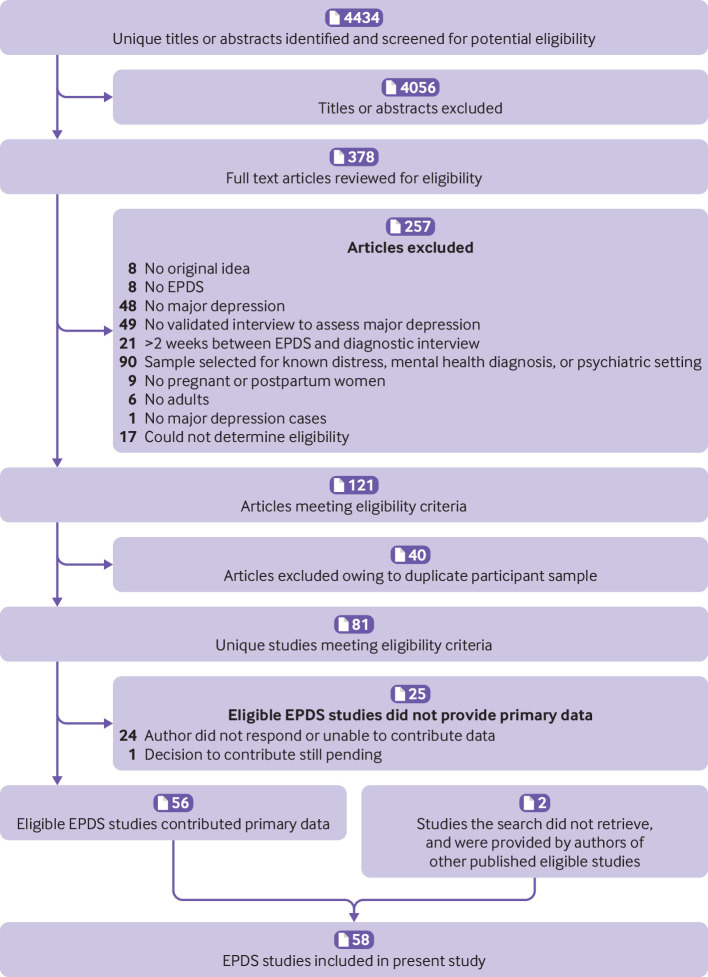
- Individual participant data meta-analysis (PROSPERO CRD42015024785) of studies administering the EPDS and classifying major depression via validated semi-structured or fully structured diagnostic interviews, with EPDS and interview no more than two weeks apart, in adult women during pregnancy or within 12 months postpartum.
- Searched Medline, Medline In-Process and Other Non-Indexed Citations, PsycINFO, and Web of Science from inception to 3 October 2018; obtained individual participant data from 58 of 83 eligible studies (70%; 15,557 of 22,788 eligible participants, 68%).
- Estimated sensitivity and specificity separately for semi-structured, fully structured (MINI excluded), and MINI reference standards using bivariate random effects models across cut-off values 7–15; used one-stage meta-regression to examine accuracy by reference standard categories and participant characteristics.
Limitations
- The paper states that data were not obtained from 25 of 83 published eligible datasets, moderate heterogeneity was found across studies, and subgroup analyses by cultural aspects, country or language, or specific pregnancy trimesters/postpartum periods could not be conducted because data were insufficient; few studies from low and middle income countries were included.
- The paper also states that while studies were categorised by interview administered, interviews might not always have been used as intended, and one third of studies were coded as unclear for interviewer qualification in risk of bias assessment.
- Evident from the text: the fully structured reference standard subgroup was very small (3 studies for sensitivity and 4 for specificity; 3,188 participants, 227 with major depression), and one study included only one participant with major depression; age <25 subgroup analyses excluded four semi-structured and four MINI studies with no participants with major depression.
Model-written summary. Check it against the paper before relying on it.
Integrity signals
Registry
Cites
Statistics
Figures
Verification
Claims the paper makes
30 Own result · 19 Not checked yet · 8 Own method · 5 Own interpretation · 2 No basis given · 1 Partly supported · accuracy not yet measured
A result the paper reports from its own data — it cites no other source for it, so there is none to check. The quote shows it is in the paper.
In the paper
“Among studies with a semi-structured interview (36 studies, 9066 participants, 1330 with major depression), sensitivity and specificity were 0.85 (95% confidence interval 0.79 to 0.90) and 0.84 (0.79 to 0.88) for a cut-off value of 10 or higher, 0.81 (0.75 to 0.87) and 0.88 (0.85 to 0.91) for a cut-off value of 11 or higher, and 0.66 (0.58 to 0.74) and 0.95 (0.92 to 0.96) for a cut-off value of 13”
§ Accuracy of the Edinburgh Postnatal Depression Scale (EPDS) for screening to detect major depression among pregnant and postpartum women: systematic review and meta-analysis of individual participant data > Abstract > Results
plaincorrelationaln = 9,066- Asserted: passes — The authors put it forward as true.
- Checkable: passes — It can be checked against evidence.
- Load-bearing: passes — The paper’s conclusions depend on it.
- Based: passes — The paper gives a reason why it holds.
A result the paper reports from its own data — it cites no other source for it, so there is none to check. The quote shows it is in the paper.
In the paper
“Accuracy was similar across reference standards and subgroups, including for pregnant and postpartum women.”
§ Accuracy of the Edinburgh Postnatal Depression Scale (EPDS) for screening to detect major depression among pregnant and postpartum women: systematic review and meta-analysis of individual participant data > Abstract > Results
plain- Asserted: passes — The authors put it forward as true.
- Checkable: passes — It can be checked against evidence.
- Load-bearing: passes — The paper’s conclusions depend on it.
- Based: passes — The paper gives a reason why it holds.
A result the paper reports from its own data — it cites no other source for it, so there is none to check. The quote shows it is in the paper.
In the paper
“Among studies with a semi-structured interview (36 studies, 9066 participants, 1330 with major depression), sensitivity and specificity were 0.85 (95% confidence interval 0.79 to 0.90) and 0.84 (0.79 to 0.88) for a cut-off value of 10 or higher, 0.81 (0.75 to 0.87) and 0.88 (0.85 to 0.91) for a cut-off value of 11 or higher, and 0.66 (0.58 to 0.74) and 0.95 (0.92 to 0.96) for a cut-off value of 13”
§ Accuracy of the Edinburgh Postnatal Depression Scale (EPDS) for screening to detect major depression among pregnant and postpartum women: systematic review and meta-analysis of individual participant data > Abstract > Results
plaincorrelationaln = 9,066- Asserted: passes — The authors put it forward as true.
- Checkable: passes — It can be checked against evidence.
- Load-bearing: passes — The paper’s conclusions depend on it.
- Based: passes — The paper gives a reason why it holds.
A result the paper reports from its own data — it cites no other source for it, so there is none to check. The quote shows it is in the paper.
In the paper
“Individual participant data were obtained from 58 of 83 eligible studies (70%; 15 557 of 22 788 eligible participants (68%), 2069 with major depression).”
- Also stated in: § Search results and dataset inclusion · plain
“Authors of included studies contributed data from two other studies that the search did not retrieve for a total of 58 datasets (15 557 participants, 2069 with major depression).”
§ Accuracy of the Edinburgh Postnatal Depression Scale (EPDS) for screening to detect major depression among pregnant and postpartum women: systematic review and meta-analysis of individual participant data > Abstract > Results
plainn = 557- Asserted: passes — The authors put it forward as true.
- Checkable: passes — It can be checked against evidence.
- Load-bearing: unclear — It is unclear whether the paper’s conclusions depend on it.
- Based: passes — The paper gives a reason why it holds.
- Also stated in: § Search results and dataset inclusion · plain
A result the paper reports from its own data — it cites no other source for it, so there is none to check. The quote shows it is in the paper.
In the paper
“Individual participant data were obtained from 58 of 83 eligible studies (70%; 15 557 of 22 788 eligible participants (68%), 2069 with major depression).”
- Also stated in: § Search results and dataset inclusion · plain
“Of 22 788 participants in 83 eligible published studies, 15 557 (68%) were included.”
§ Accuracy of the Edinburgh Postnatal Depression Scale (EPDS) for screening to detect major depression among pregnant and postpartum women: systematic review and meta-analysis of individual participant data > Abstract > Results
plainn = 788- Asserted: passes — The authors put it forward as true.
- Checkable: passes — It can be checked against evidence.
- Load-bearing: unclear — It is unclear whether the paper’s conclusions depend on it.
- Based: passes — The paper gives a reason why it holds.
- Also stated in: § Search results and dataset inclusion · plain
A result the paper reports from its own data — it cites no other source for it, so there is none to check. The quote shows it is in the paper.
In the paper
“Among studies with a semi-structured interview (36 studies, 9066 participants, 1330 with major depression), sensitivity and specificity were 0.85 (95% confidence interval 0.79 to 0.90) and 0.84 (0.79 to 0.88) for a cut-off value of 10 or higher, 0.81 (0.75 to 0.87) and 0.88 (0.85 to 0.91) for a cut-off value of 11 or higher, and 0.66 (0.58 to 0.74) and 0.95 (0.92 to 0.96) for a cut-off value of 13”
§ Accuracy of the Edinburgh Postnatal Depression Scale (EPDS) for screening to detect major depression among pregnant and postpartum women: systematic review and meta-analysis of individual participant data > Abstract > Results
plaincorrelational- Asserted: passes — The authors put it forward as true.
- Checkable: passes — It can be checked against evidence.
- Load-bearing: passes — The paper’s conclusions depend on it.
- Based: passes — The paper gives a reason why it holds.
A result the paper reports from its own data — it cites no other source for it, so there is none to check. The quote shows it is in the paper.
In the paper
“Among studies with a semi-structured interview (36 studies, 9066 participants, 1330 with major depression), sensitivity and specificity were 0.85 (95% confidence interval 0.79 to 0.90) and 0.84 (0.79 to 0.88) for a cut-off value of 10 or higher, 0.81 (0.75 to 0.87) and 0.88 (0.85 to 0.91) for a cut-off value of 11 or higher, and 0.66 (0.58 to 0.74) and 0.95 (0.92 to 0.96) for a cut-off value of 13”
§ Accuracy of the Edinburgh Postnatal Depression Scale (EPDS) for screening to detect major depression among pregnant and postpartum women: systematic review and meta-analysis of individual participant data > Abstract > Results
plaincorrelationaln = 9,066- Asserted: passes — The authors put it forward as true.
- Checkable: passes — It can be checked against evidence.
- Load-bearing: passes — The paper’s conclusions depend on it.
- Based: passes — The paper gives a reason why it holds.
A result the paper reports from its own data — it cites no other source for it, so there is none to check. The quote shows it is in the paper.
In the paper
“Individual participant data were obtained from 58 of 83 eligible studies (70%; 15 557 of 22 788 eligible participants (68%), 2069 with major depression).”
- Also stated in: § Search results and dataset inclusion · plain
“Authors of included studies contributed data from two other studies that the search did not retrieve for a total of 58 datasets (15 557 participants, 2069 with major depression).”
§ Accuracy of the Edinburgh Postnatal Depression Scale (EPDS) for screening to detect major depression among pregnant and postpartum women: systematic review and meta-analysis of individual participant data > Abstract > Results
plain- Asserted: passes — The authors put it forward as true.
- Checkable: passes — It can be checked against evidence.
- Load-bearing: unclear — It is unclear whether the paper’s conclusions depend on it.
- Based: passes — The paper gives a reason why it holds.
- Also stated in: § Search results and dataset inclusion · plain
A result the paper reports from its own data — it cites no other source for it, so there is none to check. The quote shows it is in the paper.
In the paper
“Among studies with a semi-structured interview (36 studies, 9066 participants, 1330 with major depression), sensitivity and specificity were 0.85 (95% confidence interval 0.79 to 0.90) and 0.84 (0.79 to 0.88) for a cut-off value of 10 or higher, 0.81 (0.75 to 0.87) and 0.88 (0.85 to 0.91) for a cut-off value of 11 or higher, and 0.66 (0.58 to 0.74) and 0.95 (0.92 to 0.96) for a cut-off value of 13”
§ Accuracy of the Edinburgh Postnatal Depression Scale (EPDS) for screening to detect major depression among pregnant and postpartum women: systematic review and meta-analysis of individual participant data > Abstract > Results
plaincorrelationaln = 9,066- Asserted: passes — The authors put it forward as true.
- Checkable: passes — It can be checked against evidence.
- Load-bearing: passes — The paper’s conclusions depend on it.
- Based: passes — The paper gives a reason why it holds.
- Probably not a substantial claim. 23
- It may state two separate claims as one. 27
The cited sources support only part of this claim — read each source’s verdict below.
In the paper
“An existing meta-analysis that has examined EPDS screening accuracy searched databases through February 2007 and found that combined sensitivity and specificity to detect major depression in postpartum women was greater for a cut-off value of 12 or higher (sensitivity 0.86, specificity 0.87, 15 studies) than for a cut-off value of 10 or higher (sensitivity 0.92, specificity 0.77, 14 studies) or 13”
§ Accuracy of the Edinburgh Postnatal Depression Scale (EPDS) for screening to detect major depression among pregnant and postpartum women: systematic review and meta-analysis of individual participant data > Introduction
What the sources say
- Partly supportedcites [13] sourceExperimental — accuracy not yet measured
In “Major depression (DSM or equivalent) only” (page unavailable), the paper identifies an EPDS cut-off of ≥12 as the best sensitivity–specificity trade-off for postnatal major depression, with pooled sensitivity 0.86 and specificity 0.87. The retrieved passages do not establish the cited study counts, the stated ≥10 figures, or the February 2007 search date, so those details remain unsupported by our copy. (LLM, conf=0.82)
plaincorrelational- Asserted: passes — The authors put it forward as true.
- Checkable: passes — It can be checked against evidence.
- Load-bearing: fails — The paper’s conclusions may not depend on it.
- Based: passes — The paper gives a reason why it holds.
Probably not a substantial claim. The paper’s conclusions may not depend on it.
- Partly supported
A result the paper reports from its own data — it cites no other source for it, so there is none to check. The quote shows it is in the paper.
In the paper
“Eligible studies that did and did not contribute data were generally similar in terms of sample size, proportion of participants with major depression (excluding non-contributing studies where number with major depression was not reported), and country human development index.”
§ Accuracy of the Edinburgh Postnatal Depression Scale (EPDS) for screening to detect major depression among pregnant and postpartum women: systematic review and meta-analysis of individual participant data > Results > Search results and dataset inclusion
plain- Asserted: passes — The authors put it forward as true.
- Checkable: passes — It can be checked against evidence.
- Load-bearing: unclear — It is unclear whether the paper’s conclusions depend on it.
- Based: passes — The paper gives a reason why it holds.
It may state two separate claims as one.
A result the paper reports from its own data — it cites no other source for it, so there is none to check. The quote shows it is in the paper.
In the paper
“Thirty six studies used semi-structured reference standards, including 34 that used the SCID; four used fully structured reference standards (MINI excluded), including three that used the CIDI; and 18 used the MINI (table 1).”
§ Accuracy of the Edinburgh Postnatal Depression Scale (EPDS) for screening to detect major depression among pregnant and postpartum women: systematic review and meta-analysis of individual participant data > Results > Search results and dataset inclusion
plain- Asserted: passes — The authors put it forward as true.
- Checkable: passes — It can be checked against evidence.
- Load-bearing: fails — The paper’s conclusions may not depend on it.
- Based: passes — The paper gives a reason why it holds.
Probably not a substantial claim. The paper’s conclusions may not depend on it. It may state two separate claims as one.
A result the paper reports from its own data — it cites no other source for it, so there is none to check. The quote shows it is in the paper.
In the paper
“Of 58 included studies, 25 included pregnant women, 30 postpartum women, and three both pregnant and postpartum women.”
§ Accuracy of the Edinburgh Postnatal Depression Scale (EPDS) for screening to detect major depression among pregnant and postpartum women: systematic review and meta-analysis of individual participant data > Results > Search results and dataset inclusion
plain- Asserted: passes — The authors put it forward as true.
- Checkable: passes — It can be checked against evidence.
- Load-bearing: fails — The paper’s conclusions may not depend on it.
- Based: passes — The paper gives a reason why it holds.
Probably not a substantial claim. The paper’s conclusions may not depend on it. It may state two separate claims as one.
A result the paper reports from its own data — it cites no other source for it, so there is none to check. The quote shows it is in the paper.
In the paper
“Among studies with a semi-structured interview (36 studies, 9066 participants, 1330 with major depression), sensitivity and specificity were 0.85 (95% confidence interval 0.79 to 0.90) and 0.84 (0.79 to 0.88) for a cut-off value of 10 or higher, 0.81 (0.75 to 0.87) and 0.88 (0.85 to 0.91) for a cut-off value of 11 or higher, and 0.66 (0.58 to 0.74) and 0.95 (0.92 to 0.96) for a cut-off value of 13”
§ Accuracy of the Edinburgh Postnatal Depression Scale (EPDS) for screening to detect major depression among pregnant and postpartum women: systematic review and meta-analysis of individual participant data > Abstract > Results
plainn = 1,330- Asserted: passes — The authors put it forward as true.
- Checkable: passes — It can be checked against evidence.
- Load-bearing: unclear — It is unclear whether the paper’s conclusions depend on it.
- Based: passes — The paper gives a reason why it holds.
It may state two separate claims as one.
A result the paper reports from its own data — it cites no other source for it, so there is none to check. The quote shows it is in the paper.
In the paper
“The proportion of studies with pregnant women only was also similar for contributing and non-contributing studies.”
§ Accuracy of the Edinburgh Postnatal Depression Scale (EPDS) for screening to detect major depression among pregnant and postpartum women: systematic review and meta-analysis of individual participant data > Results > Search results and dataset inclusion
plain- Asserted: passes — The authors put it forward as true.
- Checkable: passes — It can be checked against evidence.
- Load-bearing: fails — The paper’s conclusions may not depend on it.
- Based: passes — The paper gives a reason why it holds.
Probably not a substantial claim. The paper’s conclusions may not depend on it.
A result the paper reports from its own data — it cites no other source for it, so there is none to check. The quote shows it is in the paper.
In the paper
“Among both contributing and non-contributing studies, most studies used semi-structured interviews as the reference standard, followed by the MINI, and other fully structured interviews.”
§ Accuracy of the Edinburgh Postnatal Depression Scale (EPDS) for screening to detect major depression among pregnant and postpartum women: systematic review and meta-analysis of individual participant data > Results > Search results and dataset inclusion
plain- Asserted: passes — The authors put it forward as true.
- Checkable: passes — It can be checked against evidence.
- Load-bearing: fails — The paper’s conclusions may not depend on it.
- Based: passes — The paper gives a reason why it holds.
Probably not a substantial claim. The paper’s conclusions may not depend on it.
A result the paper reports from its own data — it cites no other source for it, so there is none to check. The quote shows it is in the paper.
In the paper
“0.66 (0.58 to 0.74) and 0.95 (0.92 to 0.96) for a cut-off value of 13 or higher”
- Also stated in: § Principal findings · plain
“At cut-off values of 10 or higher and 13 or higher, which are commonly used for depression screening,13 sensitivity and specificity were 85% and 84%, and 66% and 95%, respectively.”
§ Accuracy of the Edinburgh Postnatal Depression Scale (EPDS) for screening to detect major depression among pregnant and postpartum women: systematic review and meta-analysis of individual participant data > Results > EPDS sensitivity and specificity by reference standard category
plain- Asserted: passes — The authors put it forward as true.
- Checkable: passes — It can be checked against evidence.
- Load-bearing: passes — The paper’s conclusions depend on it.
- Based: passes — The paper gives a reason why it holds.
It may state two separate claims as one.
- Rests on an assumption: The EPDS is the most commonly used depression screening tool in perinatal care, with cut-off values of 10 or higher and 13 or higher typically used to identify women who might be depressed.
- Also stated in: § Principal findings · plain
A result the paper reports from its own data — it cites no other source for it, so there is none to check. The quote shows it is in the paper.
In the paper
“For major depression prevalence values of 5-25% and a cut-off value of 11 or higher compared with semi-structured interviews, positive predictive values ranged from 26% to 69% and negative predictive values ranged from 93% to 99%.”
§ Accuracy of the Edinburgh Postnatal Depression Scale (EPDS) for screening to detect major depression among pregnant and postpartum women: systematic review and meta-analysis of individual participant data > Results > EPDS sensitivity and specificity by reference standard category
plaincorrelational- Asserted: passes — The authors put it forward as true.
- Checkable: passes — It can be checked against evidence.
- Load-bearing: passes — The paper’s conclusions depend on it.
- Based: passes — The paper gives a reason why it holds.
It may state two separate claims as one.
A result the paper reports from its own data — it cites no other source for it, so there is none to check. The quote shows it is in the paper.
In the paper
“0.81 (0.75 to 0.87) and 0.88 (0.85 to 0.91) for a cut-off value of 11 or higher”
- Also stated in: § Principal findings · plain
“sensitivity and specificity were 81% and 88% for a cut-off value of 11 or higher.”
§ Accuracy of the Edinburgh Postnatal Depression Scale (EPDS) for screening to detect major depression among pregnant and postpartum women: systematic review and meta-analysis of individual participant data > Results > EPDS sensitivity and specificity by reference standard category
plain- Asserted: passes — The authors put it forward as true.
- Checkable: passes — It can be checked against evidence.
- Load-bearing: passes — The paper’s conclusions depend on it.
- Based: passes — The paper gives a reason why it holds.
It may state two separate claims as one.
- Also stated in: § Principal findings · plain
In the paper
“Based on studies with a semi-structured reference standard, across cut-off values of 10-13, sensitivity estimates in the present IPDMA were 6-13% lower than those in the previous meta-analysis, whereas specificity estimates were 4-7% higher.”
§ Accuracy of the Edinburgh Postnatal Depression Scale (EPDS) for screening to detect major depression among pregnant and postpartum women: systematic review and meta-analysis of individual participant data > Discussion > Comparison with other studies
What the sources say
- Not checked yetcites [13] source
plain- Asserted: passes — The authors put it forward as true.
- Checkable: passes — It can be checked against evidence.
- Load-bearing: unclear — It is unclear whether the paper’s conclusions depend on it.
- Based: passes — The paper gives a reason why it holds.
It may state two separate claims as one.
A result the paper reports from its own data — it cites no other source for it, so there is none to check. The quote shows it is in the paper.
In the paper
“We found no significant or substantive differences based on country human development index, but few studies from low and middle income countries were included.”
§ Accuracy of the Edinburgh Postnatal Depression Scale (EPDS) for screening to detect major depression among pregnant and postpartum women: systematic review and meta-analysis of individual participant data > Discussion > Strengths and limitations
plain- Asserted: passes — The authors put it forward as true.
- Checkable: passes — It can be checked against evidence.
- Load-bearing: unclear — It is unclear whether the paper’s conclusions depend on it.
- Based: passes — The paper gives a reason why it holds.
It may state two separate claims as one.
A result the paper reports from its own data — it cites no other source for it, so there is none to check. The quote shows it is in the paper.
In the paper
“For semi-structured interviews, sensitivity and specificity were 0.85 (95% confidence interval 0.79 to 0.90) and 0.84 (0.79 to 0.88) for a cut-off value of 10 or higher”
- Also stated in: § Principal findings · plain
“At cut-off values of 10 or higher and 13 or higher, which are commonly used for depression screening,13 sensitivity and specificity were 85% and 84%, and 66% and 95%, respectively.”
§ Accuracy of the Edinburgh Postnatal Depression Scale (EPDS) for screening to detect major depression among pregnant and postpartum women: systematic review and meta-analysis of individual participant data > Results > EPDS sensitivity and specificity by reference standard category
plain- Asserted: passes — The authors put it forward as true.
- Checkable: passes — It can be checked against evidence.
- Load-bearing: passes — The paper’s conclusions depend on it.
- Based: passes — The paper gives a reason why it holds.
It may state two separate claims as one.
- Rests on an assumption: The EPDS is the most commonly used depression screening tool in perinatal care, with cut-off values of 10 or higher and 13 or higher typically used to identify women who might be depressed.
- Also stated in: § Principal findings · plain
A result the paper reports from its own data — it cites no other source for it, so there is none to check. The quote shows it is in the paper.
In the paper
“Combined sensitivity and specificity was maximised at a cut-off value of 11 or higher for semi-structured interviews (Youden’s J=0.70), fully structured interviews (Youden’s J=0.73), and the MINI (Youden’s J=0.66).”
- Also stated in: § Principal findings · plain
“Our main finding was that combined sensitivity and specificity was maximised at a cut-off value of 11 or higher across reference standards.”
- Also stated in: § Conclusions · plain
“we found that combined sensitivity and specificity for the EPDS is maximised at a cut-off value of 11 or higher.”
§ Accuracy of the Edinburgh Postnatal Depression Scale (EPDS) for screening to detect major depression among pregnant and postpartum women: systematic review and meta-analysis of individual participant data > Results > EPDS sensitivity and specificity by reference standard category
plaincorrelational- Asserted: passes — The authors put it forward as true.
- Checkable: passes — It can be checked against evidence.
- Load-bearing: passes — The paper’s conclusions depend on it.
- Based: passes — The paper gives a reason why it holds.
It may state two separate claims as one.
- Also stated in: § Principal findings · plain
None of the sources cited for this claim have been checked yet.
In the paper
“The systematic review conducted to support the USPSTF guideline reported the range of accuracy estimates for EPDS cut-off values of 10 or higher (14 studies) and 13 or higher (17 studies) in 23 primary studies, but did not include a meta-analysis.14 15”
§ Accuracy of the Edinburgh Postnatal Depression Scale (EPDS) for screening to detect major depression among pregnant and postpartum women: systematic review and meta-analysis of individual participant data > Introduction
What the sources say
- Not checked yetcites [14] O’Connor E Rossom RC Henninger M . Screening for depression in adults: an updated systematic evidence review for the US Preventive Services Task Force: evidence synthesis No. 128. [AHRQ Publication No. 14-05208-EF-1] Agency for Healthcare Research and Quality, 2016.
- Not checked yetcites [15] source
plain- Asserted: passes — The authors put it forward as true.
- Checkable: passes — It can be checked against evidence.
- Load-bearing: passes — The paper’s conclusions depend on it.
- Based: passes — The paper gives a reason why it holds.
Probably not a substantial claim. It may state two separate claims as one.
None of the sources cited for this claim have been checked yet.
In the paper
“By design, fully structured interviews are intended to increase standardisation, but this could be at the cost of reduced validity.39 40 41 42”
§ Accuracy of the Edinburgh Postnatal Depression Scale (EPDS) for screening to detect major depression among pregnant and postpartum women: systematic review and meta-analysis of individual participant data > Methods > Statistical analyses
What the sources say
hedgedconditional- Asserted: passes — The authors put it forward as true.
- Checkable: passes — It can be checked against evidence.
- Load-bearing: fails — The paper’s conclusions may not depend on it.
- Based: passes — The paper gives a reason why it holds.
Probably not a substantial claim. The paper’s conclusions may not depend on it. It may state two separate claims as one.
What the paper did — it cites no source for this, so there is none to check. The quote shows it is in the paper.
In the paper
“Two reviewers independently reviewed titles and abstracts. For publications deemed potentially eligible by either reviewer, a full text review was done by two reviewers, also independently. Any conflicts were resolved by consensus and a third reviewer was consulted if necessary.”
§ Accuracy of the Edinburgh Postnatal Depression Scale (EPDS) for screening to detect major depression among pregnant and postpartum women: systematic review and meta-analysis of individual participant data > Methods > Database searches and study selection
plain- Asserted: passes — The authors put it forward as true.
- Checkable: passes — It can be checked against evidence.
- Load-bearing: fails — The paper’s conclusions may not depend on it.
- Based: passes — The paper gives a reason why it holds.
Probably not a substantial claim. The paper’s conclusions may not depend on it. It may state two separate claims as one.
None of the sources cited for this claim have been checked yet.
In the paper
“The 10 item EPDS is the most commonly used depression screening tool in perinatal care; cut-off values of 10 or higher and 13 or higher are most often used to identify women who might have depression.11 12 13 14 15”
§ Accuracy of the Edinburgh Postnatal Depression Scale (EPDS) for screening to detect major depression among pregnant and postpartum women: systematic review and meta-analysis of individual participant data > Introduction
What the sources say
plain- Asserted: passes — The authors put it forward as true.
- Checkable: passes — It can be checked against evidence.
- Load-bearing: fails — The paper’s conclusions may not depend on it.
- Based: passes — The paper gives a reason why it holds.
Probably not a substantial claim. The paper’s conclusions may not depend on it.
In the paper
“The USPSTF recommends screening pregnant and postpartum women with the EPDS, but does not specify a cut-off value.9”
§ Accuracy of the Edinburgh Postnatal Depression Scale (EPDS) for screening to detect major depression among pregnant and postpartum women: systematic review and meta-analysis of individual participant data > Introduction
What the sources say
- Not checked yetcites [9] source
plain- Asserted: passes — The authors put it forward as true.
- Checkable: passes — It can be checked against evidence.
- Load-bearing: passes — The paper’s conclusions depend on it.
- Based: passes — The paper gives a reason why it holds.
Probably not a substantial claim. It may state two separate claims as one.
None of the sources cited for this claim have been checked yet.
In the paper
“The 10 item EPDS is the most commonly used depression screening tool in perinatal care; cut-off values of 10 or higher and 13 or higher are most often used to identify women who might have depression.11 12 13 14 15”
§ Accuracy of the Edinburgh Postnatal Depression Scale (EPDS) for screening to detect major depression among pregnant and postpartum women: systematic review and meta-analysis of individual participant data > Introduction
What the sources say
plain- Asserted: passes — The authors put it forward as true.
- Checkable: passes — It can be checked against evidence.
- Load-bearing: passes — The paper’s conclusions depend on it.
- Based: passes — The paper gives a reason why it holds.
Probably not a substantial claim.
None of the sources cited for this claim have been checked yet.
In the paper
“This IPDMA was registered in PROSPERO (CRD42015024785), a protocol was published,20 and the results were reported following PRISMA-DTA (preferred reporting items for a systematic review and meta-analysis of diagnostic test accuracy studies)21 and PRISMA-IPD (preferred reporting items for systematic review and meta-analyses of individual participant data)22 guidelines.”
§ Accuracy of the Edinburgh Postnatal Depression Scale (EPDS) for screening to detect major depression among pregnant and postpartum women: systematic review and meta-analysis of individual participant data > Methods
What the sources say
plain- Asserted: passes — The authors put it forward as true.
- Checkable: passes — It can be checked against evidence.
- Load-bearing: fails — The paper’s conclusions may not depend on it.
- Based: passes — The paper gives a reason why it holds.
Probably not a substantial claim. The paper’s conclusions may not depend on it. It may state two separate claims as one.
What the paper did — it cites no source for this, so there is none to check. The quote shows it is in the paper.
In the paper
“We verified that participant characteristics and accuracy results from individual datasets matched those that had been published. If any discrepancies were found, we worked with the primary study investigators to understand and resolve differences.”
§ Accuracy of the Edinburgh Postnatal Depression Scale (EPDS) for screening to detect major depression among pregnant and postpartum women: systematic review and meta-analysis of individual participant data > Methods > Data contribution, extraction, and synthesis
plain- Asserted: passes — The authors put it forward as true.
- Checkable: passes — It can be checked against evidence.
- Load-bearing: fails — The paper’s conclusions may not depend on it.
- Based: passes — The paper gives a reason why it holds.
Probably not a substantial claim. The paper’s conclusions may not depend on it. It may state two separate claims as one.
The paper states this without a source or data behind it here, so there is nothing to check it against. The quote shows it is in the paper.
In the paper
“Therefore, the optimal cut-off value for screening remains unknown, and whether different cut-off values are needed for women with different characteristics needs to be determined.”
§ Accuracy of the Edinburgh Postnatal Depression Scale (EPDS) for screening to detect major depression among pregnant and postpartum women: systematic review and meta-analysis of individual participant data > Introduction
plain- Asserted: fails — The authors may not put it forward as true.
- Checkable: fails — It may be too vague to check against evidence.
- Load-bearing: passes — The paper’s conclusions depend on it.
- Based: passes — The paper gives a reason why it holds.
Probably not a substantial claim. The authors may not put it forward as true. It may be too vague to check against evidence.
What the paper did — it cites no source for this, so there is none to check. The quote shows it is in the paper.
In the paper
“For analyses in the age less than 25 subgroup, we excluded four semi-structured studies and four MINI studies that did not have any participants with major depression because the bivariate random effects model could not be applied. Therefore, 21 participants (1%) younger than 25 were excluded from semi-structured studies, and 77 (9%) from MINI studies.”
§ Accuracy of the Edinburgh Postnatal Depression Scale (EPDS) for screening to detect major depression among pregnant and postpartum women: systematic review and meta-analysis of individual participant data > Methods > Statistical analyses
plaindirectn = 21- Asserted: passes — The authors put it forward as true.
- Checkable: passes — It can be checked against evidence.
- Load-bearing: fails — The paper’s conclusions may not depend on it.
- Based: passes — The paper gives a reason why it holds.
Probably not a substantial claim. The paper’s conclusions may not depend on it. It may state two separate claims as one.
In the paper
“The MINI is a brief version of a fully structured interview that was designed for rapid administration and tends to be overinclusive.36”
§ Accuracy of the Edinburgh Postnatal Depression Scale (EPDS) for screening to detect major depression among pregnant and postpartum women: systematic review and meta-analysis of individual participant data > Methods > Statistical analyses
What the sources say
- Not checked yetcites [36] source
plain- Asserted: passes — The authors put it forward as true.
- Checkable: passes — It can be checked against evidence.
- Load-bearing: fails — The paper’s conclusions may not depend on it.
- Based: passes — The paper gives a reason why it holds.
Probably not a substantial claim. The paper’s conclusions may not depend on it. It may state two separate claims as one.
None of the sources cited for this claim have been checked yet.
In the paper
“We analysed studies that used different types of reference standards separately because we previously found that, controlling for depressive symptom levels, the MINI might classify depression more than other diagnostic interviews, and the CIDI might classify more participants with low level symptoms as having depression but fewer with high level symptoms.16 17 18”
§ Accuracy of the Edinburgh Postnatal Depression Scale (EPDS) for screening to detect major depression among pregnant and postpartum women: systematic review and meta-analysis of individual participant data > Methods > Statistical analyses
What the sources say
hedgedconditional- Asserted: passes — The authors put it forward as true.
- Checkable: passes — It can be checked against evidence.
- Load-bearing: passes — The paper’s conclusions depend on it.
- Based: passes — The paper gives a reason why it holds.
It may state two separate claims as one.
In the paper
“We used the Quality Assessment of Diagnostic Accuracy Studies-2 tool (QUADAS-2; eMethods2)31 to assess risk of bias of included studies. Two investigators independently performed this assessment and any differences were resolved through consensus or by involving a third investigator if necessary.”
§ Accuracy of the Edinburgh Postnatal Depression Scale (EPDS) for screening to detect major depression among pregnant and postpartum women: systematic review and meta-analysis of individual participant data > Methods > Risk of bias assessment
What the sources say
- Not checked yetcites [31] source
plain- Asserted: passes — The authors put it forward as true.
- Checkable: passes — It can be checked against evidence.
- Load-bearing: fails — The paper’s conclusions may not depend on it.
- Based: passes — The paper gives a reason why it holds.
Probably not a substantial claim. The paper’s conclusions may not depend on it. It may state two separate claims as one.
A conclusion the paper draws from its own results — it cites no other source for it, so there is none to check. The quote shows it is in the paper.
In the paper
“An EPDS cut-off value of 11 or higher maximised combined sensitivity and specificity; a cut-off value of 13 or higher was less sensitive but more specific.”
§ Accuracy of the Edinburgh Postnatal Depression Scale (EPDS) for screening to detect major depression among pregnant and postpartum women: systematic review and meta-analysis of individual participant data > Abstract > Conclusions
plaincorrelational- Asserted: passes — The authors put it forward as true.
- Checkable: passes — It can be checked against evidence.
- Load-bearing: passes — The paper’s conclusions depend on it.
- Based: passes — The paper gives a reason why it holds.
It may state two separate claims as one.
What the paper did — it cites no source for this, so there is none to check. The quote shows it is in the paper.
In the paper
“Two investigators independently extracted information on the diagnostic interview administered and the country of study from the published reports.”
§ Accuracy of the Edinburgh Postnatal Depression Scale (EPDS) for screening to detect major depression among pregnant and postpartum women: systematic review and meta-analysis of individual participant data > Methods > Data contribution, extraction, and synthesis
plain- Asserted: passes — The authors put it forward as true.
- Checkable: passes — It can be checked against evidence.
- Load-bearing: fails — The paper’s conclusions may not depend on it.
- Based: passes — The paper gives a reason why it holds.
Probably not a substantial claim. The paper’s conclusions may not depend on it.
In the paper
“A medical librarian designed a peer reviewed29 search strategy (eMethods1 in supplementary material) and searched Medline, Medline In-Process and Other Non-Indexed Citations, and PsycINFO through OvidSP, and Web of Science through ISI Web of Knowledge from inception to 3 October 2018.”
§ Accuracy of the Edinburgh Postnatal Depression Scale (EPDS) for screening to detect major depression among pregnant and postpartum women: systematic review and meta-analysis of individual participant data > Methods > Database searches and study selection
What the sources say
- Not checked yetcites [29] McGowan J, Sampson M, Salzwedel DM, et al. PRESS – Peer Review of Electronic Search Strategies: 2015 Guideline Explanation and Elaboration (PRESS E&E). CADTH. https://www.cadth.ca/sites/default/files/pdf/CP0015_PRESS_Update_Report_2016.pdf 2016 source
plain- Asserted: passes — The authors put it forward as true.
- Checkable: passes — It can be checked against evidence.
- Load-bearing: fails — The paper’s conclusions may not depend on it.
- Based: passes — The paper gives a reason why it holds.
Probably not a substantial claim. The paper’s conclusions may not depend on it.
In the paper
“The results were not pooled for pregnant women because there were too few studies, and no subgroup analyses were conducted among postpartum women because primary studies did not report the necessary data.”
§ Accuracy of the Edinburgh Postnatal Depression Scale (EPDS) for screening to detect major depression among pregnant and postpartum women: systematic review and meta-analysis of individual participant data > Introduction
What the sources say
- Not checked yetcites [13] source
plaindirect- Asserted: passes — The authors put it forward as true.
- Checkable: passes — It can be checked against evidence.
- Load-bearing: passes — The paper’s conclusions depend on it.
- Based: passes — The paper gives a reason why it holds.
It may state two separate claims as one.
What the paper did — it cites no source for this, so there is none to check. The quote shows it is in the paper.
In the paper
“No participants had missing data for any covariates in the meta-regressions.”
§ Accuracy of the Edinburgh Postnatal Depression Scale (EPDS) for screening to detect major depression among pregnant and postpartum women: systematic review and meta-analysis of individual participant data > Methods > Statistical analyses
plain- Asserted: passes — The authors put it forward as true.
- Checkable: passes — It can be checked against evidence.
- Load-bearing: fails — The paper’s conclusions may not depend on it.
- Based: passes — The paper gives a reason why it holds.
Probably not a substantial claim. The paper’s conclusions may not depend on it.
What the paper did — it cites no source for this, so there is none to check. The quote shows it is in the paper.
In the paper
“Firstly, we did not obtain data from 25 of 83 published eligible datasets, although the results did not change when we incorporated published results from studies that did not contribute data but published eligible accuracy results.”
§ Accuracy of the Edinburgh Postnatal Depression Scale (EPDS) for screening to detect major depression among pregnant and postpartum women: systematic review and meta-analysis of individual participant data > Discussion > Strengths and limitations
plain- Asserted: passes — The authors put it forward as true.
- Checkable: passes — It can be checked against evidence.
- Load-bearing: unclear — It is unclear whether the paper’s conclusions depend on it.
- Based: passes — The paper gives a reason why it holds.
It may state two separate claims as one.
In the paper
“Strengths include analysis of data from more than twice the number of studies compared with the previous conventional meta-analysis,13 and including results for all cut-off values from all studies.”
§ Accuracy of the Edinburgh Postnatal Depression Scale (EPDS) for screening to detect major depression among pregnant and postpartum women: systematic review and meta-analysis of individual participant data > Discussion > Strengths and limitations
What the sources say
- Not checked yetcites [13] source
plain- Asserted: passes — The authors put it forward as true.
- Checkable: passes — It can be checked against evidence.
- Load-bearing: passes — The paper’s conclusions depend on it.
- Based: passes — The paper gives a reason why it holds.
It may state two separate claims as one.
In the paper
“The cut-off value of 11 or higher that maximised combined sensitivity and specificity in the present study is lower than both the most commonly used cut-off value of 13 or higher13 and the cut-off value of 12 or higher that maximised combined sensitivity and specificity in a previous EPDS accuracy meta-analysis.13”
§ Accuracy of the Edinburgh Postnatal Depression Scale (EPDS) for screening to detect major depression among pregnant and postpartum women: systematic review and meta-analysis of individual participant data > Discussion > Comparison with other studies
What the sources say
- Not checked yetcites [13] source
plain- Asserted: passes — The authors put it forward as true.
- Checkable: passes — It can be checked against evidence.
- Load-bearing: passes — The paper’s conclusions depend on it.
- Based: passes — The paper gives a reason why it holds.
It may state two separate claims as one.
- Rests on an assumption: The EPDS is the most commonly used depression screening tool in perinatal care, with cut-off values of 10 or higher and 13 or higher typically used to identify women who might be depressed.
In the paper
“The previous meta-analysis did not pool results for pregnant women because too few studies were found, and no subgroup analyses were conducted among postpartum women because primary studies did not report the necessary data”
§ Accuracy of the Edinburgh Postnatal Depression Scale (EPDS) for screening to detect major depression among pregnant and postpartum women: systematic review and meta-analysis of individual participant data > Conclusions > What is already known on this topic
What the sources say
- Not checked yetcites [13] source
plaindirect- Asserted: passes — The authors put it forward as true.
- Checkable: passes — It can be checked against evidence.
- Load-bearing: passes — The paper’s conclusions depend on it.
- Based: passes — The paper gives a reason why it holds.
It may state two separate claims as one.
In the paper
“A previous meta-analysis of the screening accuracy of the EPDS, which was conducted more than 13 years ago, found that a cut-off value of 12 or higher maximised combined sensitivity and specificity in postpartum women (21 studies)”
§ Accuracy of the Edinburgh Postnatal Depression Scale (EPDS) for screening to detect major depression among pregnant and postpartum women: systematic review and meta-analysis of individual participant data > Conclusions > What is already known on this topic
What the sources say
- Not checked yetcites [13] source
plaincorrelational- Asserted: passes — The authors put it forward as true.
- Checkable: passes — It can be checked against evidence.
- Load-bearing: fails — The paper’s conclusions may not depend on it.
- Based: passes — The paper gives a reason why it holds.
Probably not a substantial claim. The paper’s conclusions may not depend on it.
What the paper did — it cites no source for this, so there is none to check. The quote shows it is in the paper.
In the paper
“one third of studies were coded as unclear for interviewer qualification in our risk of bias assessment.”
§ Accuracy of the Edinburgh Postnatal Depression Scale (EPDS) for screening to detect major depression among pregnant and postpartum women: systematic review and meta-analysis of individual participant data > Discussion > Strengths and limitations
plain- Asserted: passes — The authors put it forward as true.
- Checkable: passes — It can be checked against evidence.
- Load-bearing: fails — The paper’s conclusions may not depend on it.
- Based: passes — The paper gives a reason why it holds.
Probably not a substantial claim. The paper’s conclusions may not depend on it.
In the paper
“Differences in results between the current IPDMA and the previous meta-analysis might have occurred because the current IPDMA consisted of 58 primary studies, including 36 with a semi-structured reference standard, versus 21 primary studies with various types of reference standards in the previous meta-analysis.”
§ Accuracy of the Edinburgh Postnatal Depression Scale (EPDS) for screening to detect major depression among pregnant and postpartum women: systematic review and meta-analysis of individual participant data > Discussion > Comparison with other studies
What the sources say
- Not checked yetcites [13] source
hedgedconditional- Asserted: passes — The authors put it forward as true.
- Checkable: passes — It can be checked against evidence.
- Load-bearing: fails — The paper’s conclusions may not depend on it.
- Based: passes — The paper gives a reason why it holds.
Probably not a substantial claim. The paper’s conclusions may not depend on it.
The paper relies on this without support.
The EPDS is the most commonly used depression screening tool in perinatal care, with cut-off values of 10 or higher and 13 or higher typically used to identify women who might be depressed.
“The Edinburgh Postnatal Depression Scale (EPDS) is the most commonly used depression screening tool in perinatal care, with cut-off values of 10 or higher and 13 or higher typically used to identify women who might be depressed”
Claims other papers make about this one
Each is checked against this paper’s own text: does it say what the citing paper says it does?
The source backs part of the claim, not all of it — or backs it for a different population, condition or comparison.
In the citing paper
“Additionally, selection of this lower threshold score maximizes sensitivity of this screening tool to detect major depression [37].”
From Factors associated with postpartum depression symptoms following antepartum hospitalization (2026) · cites this paper as [37]
Experimental — accuracy not yet measuredThe cited source says what the claim attributes to it.
In the citing paper
“The most commonly used cut-off scores are ≥10 and ≥ 13 with sensitivity and specificity values of 85 % and 84 %, and 66 % and 95 %, respectively (Levis et al., 2020).”
From PandaMom – Feasibility and acceptability of an internet- and mobile-based intervention to enhance peripartum mental well-being and to prevent postpartum depression (2024) · cites this paper as Levis et al., 2020
Self-check
Percentages, sums and reported differences re-computed from the paper’s own numbers.
Each contradiction between two passages listed here was confirmed by an independent check.
Rated minor: it would not touch a result — a value no result rests on, a p-value that stays on the same side of the significance level, or a conflict that is clerical, resolved elsewhere in the paper, or outside its own findings.
In the paper
§ Accuracy of the Edinburgh Postnatal Depression Scale (EPDS) for screening to detect major depression among pregnant and postpartum women: systematic review and meta-analysis of individual participant data > Results > EPDS sensitivity and specificity by reference standard category
“eight of the 26 studies that did not contribute individual participant data”
§ Accuracy of the Edinburgh Postnatal Depression Scale (EPDS) for screening to detect major depression among pregnant and postpartum women: systematic review and meta-analysis of individual participant data > Discussion > Strengths and limitations
“we did not obtain data from 25 of 83 published eligible datasets”
Citations
Cites
Diagnostic and Statistical Manual of Mental Disorders
Williams, J. B. W., & First, M. B. (2013) · Oxford University Press eBooks · doi:10.1093/acrefore/9780199975839.013.104 · Cited by 109,845
Quantifying heterogeneity in a meta‐analysis
Higgins, J. P. T., & Thompson, S. G. (2002) · Statistics in Medicine · doi:10.1002/sim.1186 · Cited by 36,763
QUADAS-2: a revised tool for the quality assessment of diagnostic accuracy studies
Whiting, P. F., Rutjes, A. W. S., Westwood, M. E., Mallett, S., Deeks, J. J., Reitsma, J. B., Leeflang, M. M. G., Sterne, J. A. C., Bossuyt, P. M. M., & the QUADAS-2 Group* (2011) · Annals of Internal Medicine · doi:10.7326/0003-4819-155-8-201110180-00009 · Cited by 14,199
Detection of Postnatal Depression: Development of the 10-item Edinburgh Postnatal Depression Scale
Cox, J. L., Holden, J. M., & Sagovsky, R. (1987) · British Journal of Psychiatry · doi:10.1192/bjp.150.6.782 · Cited by 14,183
Diagnostic and Statistical Manual of Mental Disorders (DSM-IV)
Hu, R. J. (2003) · Elsevier eBooks · doi:10.1016/b0-12-226870-9/01070-4 · Cited by 9,168
PRESS Peer Review of Electronic Search Strategies: 2015 Guideline Statement
McGowan, J., Sampson, M., Salzwedel, D. M., Cogo, E., Foerster, V., & Lefebvre, C. (2016) · Journal of Clinical Epidemiology · doi:10.1016/j.jclinepi.2016.01.021 · Cited by 5,700
Lecrubier, Y., Sheehan, D., Weiller, E., Amorim, P., Bonora, I., Sheehan, K. H., Janavs, J., & Dunbar, G. (1997) · European Psychiatry · doi:10.1016/s0924-9338(97)83296-8 · Cited by 3,513
McInnes, M. D. F., Moher, D., Thombs, B. D., McGrath, T. A., Bossuyt, P. M., and the PRISMA-DTA Group, Clifford, T., Cohen, J. F., Deeks, J. J., Gatsonis, C., et al. (2018) · JAMA · doi:10.1001/jama.2017.19163 · Cited by 3,210
Self-citationRobins, L. N. (1988) · Archives of General Psychiatry · doi:10.1001/archpsyc.1988.01800360017003 · Cited by 2,909
Sheehan, D., Lecrubier, Y., Harnett Sheehan, K., Janavs, J., Weiller, E., Keskiner, A., Schinka, J., Knapp, E., Sheehan, M., & Dunbar, G. (1997) · European Psychiatry · doi:10.1016/s0924-9338(97)83297-x · Cited by 2,149
Research works printed but not linked: 1
- O’Connor E Rossom RC Henninger M . Screening for depression in adults: an updated systematic evidence review for the US Preventive Services Task Force: evidence synthesis No. 128. [AHRQ Publication No. 14-05208-EF-1] Agency for Healthcare Research and Quality, 2016.
Cited by
Sorted by citations
ACOG Committee on Clinical Practice Guidelines–Obstetrics (2023) · Obstetrics & Gynecology · doi:10.1097/aog.0000000000005200 · Cited by 294
Wu, Y., Levis, B., Sun, Y. B., He, C., Krishnan, A., Neupane, D., Bhandari, P. M., Negeri, Z., Benedetti, A., & Thombs, B. D. (2021) · BMJ · doi:10.1136/bmj.n972 · Cited by 292
Self-citationCeulemans, M., Foulon, V., Ngo, E., Panchaud, A., Winterfeld, U., Pomar, L., Lambelet, V., Cleary, B., O’Shaughnessy, F., Passier, A., et al. (2021) · Acta Obstetricia Et Gynecologica Scandinavica · doi:10.1111/aogs.14092 · Cited by 211
Wang, L., Kroenke, K., Stump, T. E., & Monahan, P. O. (2021) · General Hospital Psychiatry · doi:10.1016/j.genhosppsych.2020.12.007 · Cited by 153
Predicting women with depressive symptoms postpartum with machine learning methods
Andersson, S., Bathula, D. R., Iliadis, S. I., Walter, M., & Skalkidou, A. (2021) · Scientific Reports · doi:10.1038/s41598-021-86368-y · Cited by 147
Park, S., & Kim, J. (2022) · Archives of Gynecology and Obstetrics · doi:10.1007/s00404-022-06525-0 · Cited by 160
“However, none of the SRs compared the screening accuracy of the EPDS with other depression screening tools or contrasted the screening performance of the EPDS according to APD or PPD.”
MethodInfluentialDepression and Suicide Risk Screening
O’Connor, E., Perdue, L. A., Coppola, E. L., Henninger, M. L., Thomas, R. G., & Gaynes, B. N. (2023) · JAMA · doi:10.1001/jama.2023.7787 · Cited by 109
Parental Stress and Mental Health Symptoms in the NICU: Recognition and Interventions
Bernardo, J. P., Rent, S. M., Arias-Shah, A., Hoge, M. K., & Shaw, R. J. (2021) · NeoReviews · doi:10.1542/neo.22-8-e496 · Cited by 93
Postpartum Depression—Identifying Risk and Access to Intervention
Gopalan, P. R., Spada, M. L., Shenai, N., Brockman, I., Keil, M. A., Livingston, S., Moses‐Kolko, E. L., Nichols, N., O’Toole, K. S., Quinn, B., et al. (2022) · Current Psychiatry Reports · doi:10.1007/s11920-022-01392-7 · Cited by 86
Riseup-PPD-COVID-19 Group, Motrico, E., Bina, R., Domínguez‐Salas, S., Mateus, V., Contreras-García, Y., Carrasco‐Portiño, M., Ajaz, E., Apter, G., Christoforou, A., et al. (2021) · BMC Public Health · doi:10.1186/s12889-021-10330-w · Cited by 106
“A threshold of 13 or more will be used to identify clinically significant symptoms [37].”
BackgroundVigod, S. N., Frey, B. N., Clark, C. T., Grigoriadis, S., Barker, L. C., Brown, H. K., Charlebois, J., Dennis, C., Fairbrother, N., Green, S. M., et al. (2025) · The Canadian Journal of Psychiatry · doi:10.1177/07067437241303031 · Cited by 91
Mateus, V., Cruz, S., Costa, R. A., Mesquita, A. R., Christoforou, A., Wilson, C. A., Vousoura, E., Dikmen‐Yildiz, P., Bina, R., Domínguez‐Salas, S., et al. (2022) · Journal of Affective Disorders · doi:10.1016/j.jad.2022.08.017 · Cited by 86
“The cutoff score of ≥ 13 was used to identify women with clinically significant levels of depressive symptoms (Levis et al., 2020).”
MethodVan Lieshout, R. J., Layton, H., Savoy, C. D., Brown, J. S. L., Ferro, M. A., Streiner, D. L., Bieling, P. J., Feller, A., & Hanna, S. (2021) · JAMA Psychiatry · doi:10.1001/jamapsychiatry.2021.2488 · Cited by 73
Pregnancy during the pandemic: the impact of COVID-19-related stress on risk for prenatal depression
King, L. S., Feddoes, D. E., Kirshenbaum, J. S., Humphreys, K. L., & Gotlib, I. H. (2021) · Psychological Medicine · doi:10.1017/s003329172100132x · Cited by 75
“The EPDS has high sensitivity and specificity for detecting depression in pregnant women at a cut-off score of ⩾ 11 (Levis, Negeri, Sun, Benedetti, & Thombs, 2020).”
MethodCan the Edinburgh Postnatal Depression Scale-3A be used to screen for anxiety?
Smith‐Nielsen, J., Egmose, I., Wendelboe, K. I., Steinmejer, P., Lange, T., & Væver, M. S. (2021) · BMC Psychology · doi:10.1186/s40359-021-00623-5 · Cited by 73
Wang, S., Deng, C.-M., Zeng, Y., Chen, X., Li, A.-Y., Feng, S., Xu, L., Chen, L., Yuan, H., Hu, H., et al. (2024) · BMJ · doi:10.1136/bmj-2023-078218 · Cited by 75
Qi, W., Wang, Y., Wang, Y., Huang, S., Li, C., Jin, H., Zuo, J., Cui, X., Wei, Z., Guo, Q., et al. (2025) · Journal of Translational Medicine · doi:10.1186/s12967-025-06289-6 · Cited by 75
Mood instability, depression, and anxiety in pregnancy and adverse neonatal outcomes
Li, H., Bowen, A., Bowen, R., Muhajarine, N., & Balbuena, L. (2021) · BMC Pregnancy and Childbirth · doi:10.1186/s12884-021-04021-y · Cited by 76
“In this study, attaining a score ≥ 12 at either T1 or T2 was indicative of clinically significant depression [39].”
BackgroundThe association of unplanned pregnancy with perinatal depression: a longitudinal cohort study
Muskens, L., Boekhorst, M. G. B. M., Kop, W. J., van den Heuvel, M. I., Pop, V. J. M., & Beerthuizen, A. (2022) · Archives of Women s Mental Health · doi:10.1007/s00737-022-01225-9 · Cited by 73
“1 3 of ≥ 13 was used to categorize women with high levels of depressive symptoms indicating the presence of possible clinical depression, both during pregnancy and postpartum (Levis et al. 2020).”
MethodKhamidullina, Z., Marat, A., Muratbekova, S., Mustapayeva, N. M., Chingayeva, G. N., Shepetov, A. M., Ibatova, S. S., Terzic, M., & Aimagambetova, G. (2025) · Journal of Clinical Medicine · doi:10.3390/jcm14072418 · Cited by 63
“At present, the Edinburgh Postnatal Depression Scale is considered the gold standard in screening for PPD [25,85–88].”
Lean, R. E., Smyser, C. D., Brady, R. G., Triplett, R. L., Kaplan, S., Kenley, J. K., Shimony, J. S., Smyser, T. A., Miller, J. P., Barch, D. M., et al. (2022) · Proceedings of the National Academy of Sciences · doi:10.1073/pnas.2204135119 · Cited by 54
Sultan, P., Ando, K., Elkhateb, R., George, R. B., Lim, G., Carvalho, B., Chitneni, A., Kawai, R., Tulipan, T., Blake, L., et al. (2022) · JAMA Network Open · doi:10.1001/jamanetworkopen.2022.14885 · Cited by 60
Leng, L. L., Yin, M. X. C., & Ng, S. M. (2023) · Comprehensive Psychiatry · doi:10.1016/j.comppsych.2023.152375 · Cited by 65
Smith, M. S., Cairns, L., Pullen, L., Opondo, C., Fellmeth, G. L., & Alderdice, F. A. (2021) · Journal of Affective Disorders · doi:10.1016/j.jad.2021.11.011 · Cited by 54
Tsuno, K., Okawa, S., Matsushima, M., Nishi, D., Arakawa, Y., & Tabuchi, T. (2021) · Journal of Affective Disorders · doi:10.1016/j.jad.2022.03.056 · Cited by 50
El‐Den, S., Pham, L., Anderson, I., Yang, S., Moles, R. J., O’Reilly, C. L., Boyce, P. M., Raine, K. H., & Raynes‐Greenow, C. H. (2022) · Archives of Women s Mental Health · doi:10.1007/s00737-022-01249-1 · Cited by 50
“2014) as well as make decisions regarding optimal cut-off points based on the aim of screening, so as to maximise sensitivity, specificity or both (Levis et al. 2020).”
BackgroundLang, E., Colquhoun, H. L., LeBlanc, J. C., Riva, J. J., Moore, A. E., Traversy, G., Wilson, B. J., & Grad, R. M. (2022) · Canadian Medical Association Journal · doi:10.1503/cmaj.220290 · Cited by 56
“22 The impact on equity of a recommendation against screening is unknown.”
Duguay, G., Garon‐Bissonnette, J., Lemieux, R., Dubois‐Comtois, K., Mayrand, K., & Berthelot, N. (2022) · Child and Adolescent Psychiatry and Mental Health · doi:10.1186/s13034-022-00458-x · Cited by 56
Rondung, E., Massoudi, P., Nieminen, K., Wickberg, B., Peira, N., Silverstein, R. A., Moberg, K., Lundqvist, M., Grundberg, Å., & Hultcrantz, M. (2023) · Acta Obstetricia Et Gynecologica Scandinavica · doi:10.1111/aogs.14734 · Cited by 61
“In a recent systematic review that included studies of both pregnant and postpartum women from countries worldwide, 18 the authors concluded that an EPDS cutoff value of ≥11 would maximize sensitivity and specificity throughout the perinatal period (Youden's J = 0.66–0.73 to be compared with our…”
BackgroundMethodResultInfluentialChen, Z., Li, Y., Chen, J., & Guo, X. (2022) · BMC Pregnancy and Childbirth · doi:10.1186/s12884-022-04377-9 · Cited by 46
Singla, D. R., Silver, R. K., Vigod, S. N., Schoueri‐Mychasiw, N., Kim, J., Porte, L. M. L., Ravitz, P., Schiller, C. E., Lawson, A., Kiss, A., et al. (2025) · Nature Medicine · doi:10.1038/s41591-024-03482-w · Cited by 52
“This threshold has been used in antenatal, postnatal and community-based populations with high sensitivity 68 , particularly for specific cultural groups (for example, ref.”
Julian, M., Le, H., Coussons‐Read, M. E., Hobel, C. J., & Schetter, C. D. (2021) · Journal of Affective Disorders · doi:10.1016/j.jad.2021.05.082 · Cited by 47
Radoš, S. N. (2021) · Frontiers in Psychiatry · doi:10.3389/fpsyt.2021.723418 · Cited by 45
Oftedal, A., Bekkhus, M., Haugen, G. N., Czajkowski, N. O., & Kaasen, A. (2022) · Acta Obstetricia Et Gynecologica Scandinavica · doi:10.1111/aogs.14453 · Cited by 41
Froeliger, A., Deneux‐Tharaux, C., Loussert, L., Bouchghoul, H., Madar, H., & Sentilhes, L. (2023) · American Journal of Obstetrics and Gynecology · doi:10.1016/j.ajog.2023.08.026 · Cited by 50
Zhang, C. X. W., Okeke, J. C., Levitan, R. D., Murphy, K. E., Foshay, K., Lye, S. J., Knight, J. A., & Matthews, S. G. (2021) · American Journal of Obstetrics & Gynecology MFM · doi:10.1016/j.ajogmf.2022.100605 · Cited by 47
Larsen, A., Pintye, J. C., Odhiambo, B. O., Ngumbau, N. M., Marwa, M. M., Watoyi, S., Kinuthia, J., Abuna, F., Gómez, L., Dettinger, J. C., et al. (2022) · Journal of Affective Disorders · doi:10.1016/j.jad.2022.12.101 · Cited by 41
Harrison, S., QUIGLEY, M. A., Fellmeth, G. L., Stein, A. L., & Alderdice, F. A. (2023) · The Lancet Regional Health - Europe · doi:10.1016/j.lanepe.2023.100654 · Cited by 38
Myers, S., & Emmott, E. H. (2021) · Frontiers in Psychology · doi:10.3389/fpsyg.2021.648002 · Cited by 40
Miranda, A. R., Scotta, A. V., Cortez, M. V., & Soria, E. A. (2021) · Midwifery · doi:10.1016/j.midw.2021.103072 · Cited by 38
Ou, L., Shen, Q., Xiao, M., Wang, W., He, T., & Wang, B. (2025) · Psychological Medicine · doi:10.1017/s0033291725000601 · Cited by 36
Bilal, A.-M., Fransson, E., Bränn, E., Eriksson, A., Zhong, M., Gidén, K., Elofsson, U. O. E., Axfors, C., Skalkidou, A., & Papadopoulos, F. C. (2022) · BMJ Open · doi:10.1136/bmjopen-2021-059033 · Cited by 37
Berg, R. C., Solberg, B., Glavin, K., & Olsvold, N. (2022) · American Journal of Men s Health · doi:10.1177/15579883221114984 · Cited by 35
“EPDS is already one of the most extensively used instruments to evaluate postnatal depression in women (Levis et al., 2020), and with eight validation studies on men, it may already be the first choice for identifying probable depression in postnatal fathers.”
MethodSocial Needs Screening in Hospitalized Pediatric Patients: A Randomized Controlled Trial
Lopez, M. A., Yu, X., Hetrick, R. L., Raman, S., Lee, J., Hall, J., Tran, K., Vonasek, B. J., Garg, A., Raphael, J. L., et al. (2023) · Hospital Pediatrics · doi:10.1542/hpeds.2022-006815 · Cited by 34
Spadaro, B., Martin-Key, N. A., Funnell, E., & Bahn, S. (2022) · JMIR mhealth and uhealth · doi:10.2196/30724 · Cited by 34
Childbirth, trauma and family relationships
Reshef, S., Mouadeb, D., Sela, Y., Weiniger, F. C., & Freedman, S. (2023) · European Journal of Psychotraumatology · doi:10.1080/20008066.2022.2157481 · Cited by 34
Bai, Y., Li, Q., Cheng, K. K., Caine, E. D., Tong, Y., Wu, X., & Gong, W. (2023) · Depression and Anxiety · doi:10.1155/2023/8403222 · Cited by 34
Hurwitz, E. G., Butzin-Dozier, Z., Master, H., O’Neil, S. T., Walden, A., Holko, M., Patel, R. C., & Haendel, M. A. (2024) · JMIR mhealth and uhealth · doi:10.2196/54622 · Cited by 37
Hu, L., Mei, H., Feng, H., Huang, Y., Cai, X., Xiang, F., Chen, L., & Xiao, H. (2023) · Environmental Research · doi:10.1016/j.envres.2023.115248 · Cited by 36
Muñoz, M. D. L. F. R., Chrzan‐Dętkoś, M., Uka, A., García-López, H. S., Krupelnytska, L., Morozova-Larina, O., Vavilova, A., Molotokas, A. A., Murawska, N., & Le, H. (2023) · Frontiers in Psychology · doi:10.3389/fpsyg.2023.1152478 · Cited by 33
“The cut-off values of 10 or higher and 13 or higher are most often used to identify women who are at risk for depression (Levis et al., 2020).”
MethodJacobson, M. H., Stein, C. R., Liu, M., Ackerman, M. G., Blakemore, J. K., Long, S. E., Pinna, G., Romay-Tallón, R., Kannan, K., Zhu, H., et al. (2021) · The Journal of Clinical Endocrinology & Metabolism · doi:10.1210/clinem/dgab199 · Cited by 35
Анатольевна, Я. В., Suarez, A., & Kharchenko, A. (2021) · International Journal of Environmental Research and Public Health · doi:10.3390/ijerph19010335 · Cited by 32
“However, this cut-off point may be oversensitive and presents the risk of exaggerating the rate of PPD [43,44].”
BackgroundMaternal depressive symptoms, neonatal white matter, and toddler social-emotional development
Lautarescu, A., Bonthrone, A. F., Pietsch, M., Batalle, D., Cordero-Grande, L., Tournier, J.-D., Christiaens, D., Hajnal, J. V., Chew, A., Falconer, S., et al. (2022) · Translational Psychiatry · doi:10.1038/s41398-022-02073-y · Cited by 29
“A cut-off of 11 or more has been shown to maximise the sensitivity and specificity of screening for depressive symptoms [39], while a score of 13 or more can be used to indicate high-level symptoms.”
MethodPrenatal Exposure to Nonpersistent Environmental Chemicals and Postpartum Depression
Jacobson, M. H., Hamra, G. B., Monk, C. E., Crum, R. M., Upadhyaya, S. G., Avalos, L. A., Bastain, T. M., Barrett, E. S., Bush, N. R., Dunlop, A. L., et al. (2023) · JAMA Psychiatry · doi:10.1001/jamapsychiatry.2023.3542 · Cited by 32
Osborne, A. D., Barbeau, D. Y., Gladdis, T., Hansen, K., Branche, T. N., Miller, E. R., Pazandak, C. C., Hoge, M. K., Spencer, M., Montoya‐Williams, D., et al. (2024) · Journal of Perinatology · doi:10.1038/s41372-024-02187-9 · Cited by 35
Babineau, V., Fonge, Y. N., Miller, E. S., Grobman, W. A., Ferguson, P. L., Hunt, K. J., Vena, J. E., Newman, R., Guille, C., Tita, A., et al. (2022) · Journal of the American Academy of Child & Adolescent Psychiatry · doi:10.1016/j.jaac.2022.03.021 · Cited by 31
“To consider prenatal stress and depressive symptoms at a level more likely to be of clinical relevance, we created subgroups of women who reported high prenatal stress (ie, >85 percentile) or prenatal depressive symptoms at a clinical level (ie, above a clinical cutoff of 10).(46) Similar to our main findings, high pr…”
ResultInfluentialChen, Q., Zhuang, J., Zuo, R., Zheng, H., Dang, J., & Wang, Z. (2022) · Journal of Affective Disorders · doi:10.1016/j.jad.2022.07.052 · Cited by 31
Postpartum Mood Disorders: Insights into Diagnosis, Prevention, and Treatment
Jyotsna, G., Jajoo, S., Aradhya, D., Reddy, L. S., Dahiphale, S. M., & Patel, D. J. (2023) · Cureus · doi:10.7759/cureus.42107 · Cited by 44
“However, lower cut-off values could be employed if the goal is to minimize the occurrence of false negatives and capture a larger portion of patients who meet the diagnostic criteria [24].”
BackgroundPlace, J. M., Renbarger, K. M., Griend, K. M. V. D., Guinn, M., Wheatley, C., & Holmes, O. (2024) · Frontiers in Global Women s Health · doi:10.3389/fgwh.2024.1335437 · Cited by 30
“One such validated instrument for PPD and anxiety is the Edinburgh Postnatal Depression Scale (EPDS) and is the most frequently used in research and clinical practice settings (39).”
BackgroundMethodData-Driven Cutoff Selection for the Patient Health Questionnaire-9 Depression Screening Tool
Levis, B., Bhandari, P. M., Neupane, D., Fan, S., Sun, Y. B., He, C., Wu, Y., Krishnan, A., Negeri, Z., Imran, M., et al. (2024) · JAMA Network Open · doi:10.1001/jamanetworkopen.2024.29630 · Cited by 37
Self-citationCeulemans, M., Foulon, V., Panchaud, A., Winterfeld, U., Pomar, L., Lambelet, V., Cleary, B., O’Shaughnessy, F., Passier, A., Richardson, J. L., et al. (2022) · International Journal of Environmental Research and Public Health · doi:10.3390/ijerph19031389 · Cited by 30
“The Edinburgh Depression Scale (EDS) was used to assess the level of depressive symptoms, with a total score of 13 as cut-off for major depressive symptoms [28,29].”
MethodFranco-Antonio, C., Santano-Mogena, E., Chimento-Díaz, S., Sánchez-García, P., & Cordovilla-Guardia, S. (2022) · Scientific Reports · doi:10.1038/s41598-021-04338-w · Cited by 30
Lautarescu, A., Victor, S., Lau‐Zhu, A., Counsell, S. J., Edwards, A. D., & Craig, M. (2021) · Archives of Women s Mental Health · doi:10.1007/s00737-021-01153-0 · Cited by 31
Arakawa, Y., Haseda, M., Inoue, K., Nishioka, D., Kino, S., Nishi, D., Hashimoto, H., & Kondo, N. (2023) · BMC Medicine · doi:10.1186/s12916-023-02918-3 · Cited by 34
Nguyen, L. H., Nguyen, L. D., Ninh, L. T., Nguyen, H. T. T., Nguyen, A. D., Dam, V. A. T., Nguyen, T. T., Do, H. P., Vu, T. M. T., Tran, B. X., et al. (2021) · Journal of Affective Disorders · doi:10.1016/j.jad.2021.10.102 · Cited by 28
Danaher, B. G., Seeley, J. R., Silver, R. K., Tyler, M. S., Kim, J. J., Porte, L. M. L., Cleveland, E., Smith, D. R., Milgrom, J., & Gau, J. M. (2022) · American Journal of Obstetrics and Gynecology · doi:10.1016/j.ajog.2022.09.027 · Cited by 32
Pielage, M., Marroun, H. E., Odendaal, H. J., Willemsen, S. P., Hillegers, M. H. J., Steegers, E. A. P., & Rousian, M. (2023) · BMC Medicine · doi:10.1186/s12916-023-03020-4 · Cited by 33
“Maternal depression, collected at the enrollment visit, was scored using the Edinburgh postnatal depression scale (EPDS) [40].”
MethodChai, Y., Li, Q., Wang, Y., Tao, E., & Asakawa, T. (2022) · Frontiers in Endocrinology · doi:10.3389/fendo.2022.916611 · Cited by 28
Lin, R., Lu, Y., Luo, W., Zhang, B., Liu, Z., & Xu, Z. (2022) · Frontiers in Medicine · doi:10.3389/fmed.2022.1001855 · Cited by 36
Prenatal and Postnatal Anxiety and Depression in Mothers during the COVID-19 Pandemic
Baran, J., Leszczak, J., Baran, R., Biesiadecka, A., Weres, A., Czenczek‐Lewandowska, E., & Kalandyk-Osinko, K. (2021) · Journal of Clinical Medicine · doi:10.3390/jcm10143193 · Cited by 28
Paternity leave uptake and parental post-partum depression: findings from the ELFE cohort study
Barry, K., Gomajee, R., Benarous, X., Dufourg, M., Courtin, É., & Melchior, M. (2023) · The Lancet Public Health · doi:10.1016/s2468-2667(22)00288-2 · Cited by 28
Stress and mental health symptoms in early pregnancy are associated with the oral microbiome
Alex, A. M., Levendosky, A. A., Bogat, G. A., Muzik, M., Nuttall, A. K., Knickmeyer, R. C., & Lonstein, J. S. (2024) · BMJ Mental Health · doi:10.1136/bmjment-2024-301100 · Cited by 27
“…depression measures were self-reported, although our groups were created using cut-off scores that have high validity with diagnostic interviews 24 25 ; we targeted only one timepoint in pregnancy; and we did not analyse other sources of microbes, such as the lower gut, which might have a…”
Dachew, B. A., Scott, J. G., Heron, J., Ayano, G., & Alati, R. (2021) · JAMA Network Open · doi:10.1001/jamanetworkopen.2021.25854 · Cited by 27
Qiu, X., Wu, Y., Sun, Y., Levis, B., Tian, J., Boruff, J. T., Cuijpers, P. J., Ioannidis, J. P. A., Markham, S., Ziegelstein, R. C., et al. (2023) · Scientific Reports · doi:10.1038/s41598-023-29114-w · Cited by 35
Self-citationBabineau, V., McCormack, C. A., Feng, T., Lee, S., Berry, O. O., Knight, B. T., Newport, D. J., Stowe, Z. N., & Monk, C. E. (2022) · Bipolar Disorders · doi:10.1111/bdi.13207 · Cited by 26
Solorzano, C. S., Violani, C., & Grano, C. (2022) · Journal of Affective Disorders · doi:10.1016/j.jad.2022.09.056 · Cited by 26
Dosani, A., Yim, I. S., Shaikh, K., Lalani, S. B., Alcantara, J., Letourneau, N. L., & Premji, S. (2022) · Asian Journal of Psychiatry · doi:10.1016/j.ajp.2022.103066 · Cited by 29
Gupta, A., Lu, E., & Thayer, Z. M. (2024) · BMC Women s Health · doi:10.1186/s12905-024-03262-1 · Cited by 27
“The maximum EDS score is 30 and scores over 13 are interpreted as indicating probable clinical depression [30].”
BackgroundTauqeer, F., Ceulemans, M., Gerbier, E., Passier, A., Oliver, A. M., Foulon, V., Panchaud, A., Lupattelli, A., & Nordeng, H. (2023) · BMJ Open · doi:10.1136/bmjopen-2022-063391 · Cited by 25
Singla, D. R., Niño, A. P., Zibaman, M., Andrejek, N., Hossain, S., Cohen, M., Dalfen, A., Dennis, C., Kim, J. J., Porte, L. M. L., et al. (2023) · General Hospital Psychiatry · doi:10.1016/j.genhosppsych.2023.04.002 · Cited by 25
Screening for Perinatal Depression: Barriers, Guidelines, and Measurement Scales
Kendall-Tackett, K. A. (2024) · Journal of Clinical Medicine · doi:10.3390/jcm13216511 · Cited by 24
Alfayumi‐Zeadna, S., Bina, R., Levy, D., Merzbach, R., & Zeadna, A. (2022) · Journal of Clinical Medicine · doi:10.3390/jcm11020349 · Cited by 25
“As women who score ≥10 are considered at risk for PNDS [39,40], this cutoff score was chosen for use in the current study.”
MethodPerez, A., Göbel, A., Stuhrmann, L. Y., Schepanski, S. N., Singer, D., Bindt, C., & Mudra, S. (2022) · Frontiers in Psychology · doi:10.3389/fpsyg.2021.805543 · Cited by 26
Nicolson, S., Carron, S., & Paul, C. (2022) · Infant Mental Health Journal · doi:10.1002/imhj.21987 · Cited by 23
“A systematic review of the diagnostic accuracy of the EPDS confirmed the stringency of the cut-off score of 13, reporting specificity of .95 (.92–.96) and sensitivity of .66 (95% confidence interval .58– .74) for a cut-off of 13 and above, using data from 58 studies (Levis et al., 2020).”
BackgroundMethodSolo Fathers and Mothers: An Exploration of Well-Being, Social Support and Social Approval
Jones, C., Zadeh, S., Jadva, V., & Golombok, S. E. (2022) · International Journal of Environmental Research and Public Health · doi:10.3390/ijerph19159236 · Cited by 41
“Scores greater than 13 are considered to be above the cut-off for high levels of depressive symptoms [47].”
BackgroundFear and anxiety related to COVID-19 pandemic may predispose to perinatal depression in Italy
Orsolini, L., Pompili, S., Mauro, A., Salvi, V., & Volpe, U. (2022) · Frontiers in Psychiatry · doi:10.3389/fpsyt.2022.977681 · Cited by 24
Hübner, T., Wolfgang, T., Theis, A.-C., Steber, M., Wiedenmann, L., Wöckel, A., Diessner, J., Hein, G., Gründahl, M., Kämmerer, U., et al. (2022) · Reproductive Health · doi:10.1186/s12978-022-01493-9 · Cited by 30
Merza, D., Amani, B., Savoy, C. D., Babiy, Z., Bieling, P., Streiner, D. L., Ferro, M. A., & Lieshout, R. J. V. (2023) · Acta Psychiatrica Scandinavica · doi:10.1111/acps.13611 · Cited by 24
Suarez, A., Shraibman, L., & Анатольевна, Я. В. (2023) · Children · doi:10.3390/children10101718 · Cited by 23
“Nevertheless, it is worth noting that this particular threshold may be overly sensitive, potentially leading to an overestimation of the PPD rate [32,33], which, in turn, might have prevented us from detecting the consequences of more severe PPD symptoms on child development.”
BackgroundCîtu, C., Gorun, F. I., Motoc, A. G. M., Sas, I., Burlea, B., Citu, I. M., Biriş, M., Forga, M., Neagoe, O. C., & Gorun, O. M. (2022) · Journal of Clinical Medicine · doi:10.3390/jcm11061628 · Cited by 23
Melchior, M., Barry, K., Cohen, D., Plancoulaine, S., Bernard, J. Y., Milcent, K., Gassama, M., Gomajee, R., & Charles, M.-A. A. (2022) · BMC Public Health · doi:10.1186/s12889-022-13296-5 · Cited by 23
Digital screening for postnatal depression: mixed methods proof-of-concept study
Eisner, E., Lewis, S. W., Stockton-Powdrell, C., Agass, R., Whelan, P., & Tower, C. L. (2022) · BMC Pregnancy and Childbirth · doi:10.1186/s12884-022-04756-2 · Cited by 26
Brehaut, E., Neupane, D., Levis, B., Wu, Y., Sun, Y. B., Ioannidis, J. P. A., Markham, S., Cuijpers, P. J., Patten, S. B., Benedetti, A., et al. (2022) · International Journal of Methods in Psychiatric Research · doi:10.1002/mpr.1956 · Cited by 27
“…analyses (IPDMAs) of the screening accuracy of the 9‐item Patient Health Questionnaire‐9 (PHQ‐9) (Levis et al., 2019; Negeri et al., 2021), 10‐item Edinburgh Postnatal Depression Scale (EPDS) (Levis et al., 2020), and 7‐item depression subscale of the Hospital Anxiety and Depression Scale (HADS‐”
MethodSelf-citationFactors Associated with Postpartum Maternal Functioning in Black Women: A Secondary Analysis
James, K. F., Smith, K. E. R., Robinson, M. N., Tobin, C. S. T., Bulles, K. F., & Barkin, J. L. (2023) · Journal of Clinical Medicine · doi:10.3390/jcm12020647 · Cited by 27
“Using a cut-off score of 10, the sensitivity and specificity of the EPDS ranges from 85% to 84%, respectively [35], both of which are adequate.”
BackgroundKleine, I., Vamvakas, G., Lautarescu, A., Falconer, S., Chew, A. T. M., Counsell, S. J., Pickles, A. R., Edwards, A. D., & Nosarti, C. (2022) · BMJ Open · doi:10.1136/bmjopen-2021-058540 · Cited by 20
Validation of the intolerance of uncertainty scale as a screening tool for perinatal anxiety
Furtado, M., Frey, B. N., & Green, S. M. (2021) · BMC Pregnancy and Childbirth · doi:10.1186/s12884-021-04296-1 · Cited by 22
Psychological health of pregnant and postpartum women before and during the COVID-19 Pandemic
Kuipers, Y., Bleijenbergh, R., den Branden, L. V., van Gils, Y., Rimaux, S., Brosens, C., Claerbout, A., & Mestdagh, E. (2022) · PLoS ONE · doi:10.1371/journal.pone.0267042 · Cited by 22
Odd, D., Okano, S., Ingram, J. C., Blair, P. S., Billietop, A., Fleming, P., Thoresen, M., & Chakkarapani, E. (2021) · BMJ Paediatrics Open · doi:10.1136/bmjpo-2021-001280 · Cited by 22
Maternal self‐efficacy development from pregnancy to 3 months after birth
Samdan, G., Reinelt, T., Kiel, N., Mathes, B., & Pauen, S. (2022) · Infant Mental Health Journal · doi:10.1002/imhj.22018 · Cited by 22
Urinary incontinence increases risk of postpartum depression: systematic review and meta-analysis
Gallego‐Gómez, C., Rodríguez‐Gutiérrez, E., Torres-Costoso, A. I., Martínez‐Vizcaíno, V., Bustelo, S. M., Quezada-Bascuñán, C. A., & Ferri‐Morales, A. (2024) · American Journal of Obstetrics and Gynecology · doi:10.1016/j.ajog.2024.02.307 · Cited by 22
Metadata
- Authors
- Levis, B., Negeri, Z., Sun, Y., Benedetti, A., & Thombs, B. D.
- Affiliations
- Jewish General Hospital (CA)
- McGill University Health Centre (CA)
- Corresponding author
- Thombs, Brett D
- Venue
- BMJ
- Publisher
- BMJ
- Published
- 2020-11-11
- Volume
- 371
- Pages
- m4022
- ISSN
- 1756-1833 (ISSN-L)
- PMC
- PMC7656313
- OpenAlex
- W3093810429
- Semantic Scholar
- 78cf2d7bf5e2dc7094c88c17b4deb98714fadfab
- Cited by
- 922
- References
- 42
- Citations by year
- 2026: 174 · 2025: 216 · 2024: 190 · 2023: 167 · 2022: 123 · 2021: 50 · 2020: 1
- FWCI
- 14.25
- Type
- journal article
- Language
- en
- Open access
- hybrid
- doi.org
- Licence
- Locations
- BMJ (publishedVersion, cc-by-nc)
- PubMed Central (publishedVersion, cc-by-nc)
- PubMed (publishedVersion)
- Edinburgh Research Explorer (University of Edinburgh) (acceptedVersion, other-oa)
- IRIS Research product catalog (Sapienza University of Rome) (submittedVersion, cc-by-nc)
- Diva portal (Dalarna University Library) (submittedVersion, other-oa)
- eScholarship@McGill (McGill) (submittedVersion, cc-by-nc)
- HighWire Press Open Archive (submittedVersion)
- Funders
- National Science Foundation
- Patrick and Catherine Weldon Donaghue Medical Research Foundation
- Yale University
- Universidad de Santiago de Chile
- University of Connecticut
- McGill University
- Faculty of Medicine, McGill University
- Sveučilište u Zagrebu
- Wellcome Trust (211374/Z/18/Z, 082384/Z/07/Z/, 071571)
- McGill University Health Centre
- Australian Government
- National Institute for Health and Care Research (RP-PG-1210-12002, RP-DG-1108-10012)
- Department of Health and Social Care
- University of Southampton
- King's College London
- University of Oxford
- University of Bristol
- National Research Foundation
- Schweizerischer Nationalfonds zur Förderung der Wissenschaftlichen Forschung (0000000, 10002, 32003B, 125493)
- University of New South Wales
- Deakin University
- Monash University
- Fundação de Amparo à Pesquisa do Estado de São Paulo
- Chulalongkorn University (CU-56-457-HR)
- Conselho Nacional de Desenvolvimento Científico e Tecnológico (POCI 2010, 00000-00, 2014-5)
- Sapienza Università di Roma
- China Medical University Hospital
- Università degli Studi di Firenze
- Harry Crossley Foundation
- Fundação de Amparo à Pesquisa do Estado de Minas Gerais (0000000, POCI 2010)
- Department of Families, Housing, Community Services and Indigenous Affairs
- Université de Genève
- Ministério da Saúde
- Uppsala Universitet
- University of Cape Town
- China Medical University
- Universidade do Minho
- Ingham Institute for Applied Medical Research
- Szegedi Tudományegyetem
- Werner Otto Stiftung
- Duke Global Health Institute, Duke University (453-0751)
- Feinberg School of Medicine
- Institute of Psychiatry, Psychology and Neuroscience, King’s College London
- Canadian Institutes of Health Research (140994_1)
- Fonds de Recherche du Québec - Santé
- Medical Research Council (MR/S035818/1)
- National Health and Medical Research Council
- Faculty of Medicine, Chulalongkorn University
- Programme Grants for Applied Research (RP-PG-1210-12002)
- Universitätsklinikum Hamburg-Eppendorf
- National Institute of Mental Health (K23MH64476)
- Fondo Nacional de Desarrollo Científico y Tecnológico (1130230)
- Topics
- Health Sciences › Medicine › Public Health, Environmental and Occupational Health › Maternal Mental Health During Pregnancy and Postpartum
- Health Sciences › Medicine › Pediatrics, Perinatology and Child Health › Maternal and Neonatal Healthcare
- Social Sciences › Psychology › Experimental and Cognitive Psychology › Anxiety, Depression, Psychometrics, Treatment, Cognitive Processes
- Keywords
- Edinburgh Postnatal Depression Scale, postpartum depression, major depressive disorder, pregnancy, screening accuracy, sensitivity and specificity, cut-off values, diagnostic interview, MINI, semi-structured interviews, reference materials, subgroup analysis, maternal mental health
- MeSH terms
- Depressive Disorder, Major, Major Depressive Disorder, Female, Humans, Pregnancy, Pregnancy Complications, Prenatal Care, Psychometrics, Sensitivity and Specificity, Depression, Postpartum
About these checks
Registry, retraction, Cites and statistics results are computed, not judged, with one exception: a printed reference that no index lists is read once by a model before it counts as a citation error. Claims are extracted by a model and kept only when their quote appears verbatim in the text; each cited source is then checked, with a model’s help, for whether it says what the claim relies on. Those verdicts can be wrong — read the claim’s quote and the cited source before relying on one.
A language model drew the claims from the paper on 2026-10-08, under version 3 of the claim definition (model deepseek-v4.1-flash, prompt extract-v3).
A second model labelled each claim on 2026-10-08 (model jev-1.13-20260917, definition revision gold-guideline-v0.2).
Cited sources are checked with a language model’s help (gpt-6-sol).
Statistics and arithmetic are recomputed, not judged.
Confidence bands are shown only for fields calibrated on our annotated test set. None is calibrated yet, so no band is shown.
What counts as a claim ›How we measure confidence ›How we check this ›
Are you an author, or do you see a problem with this page? Request a review
