

The association between diabetes mellitus and incident infections: a systematic review and meta-analysis of observational studies
Open accessThe DOI matches its Crossref record; 55 of the 55 references it cites were found in a registry or an index.
Abstract
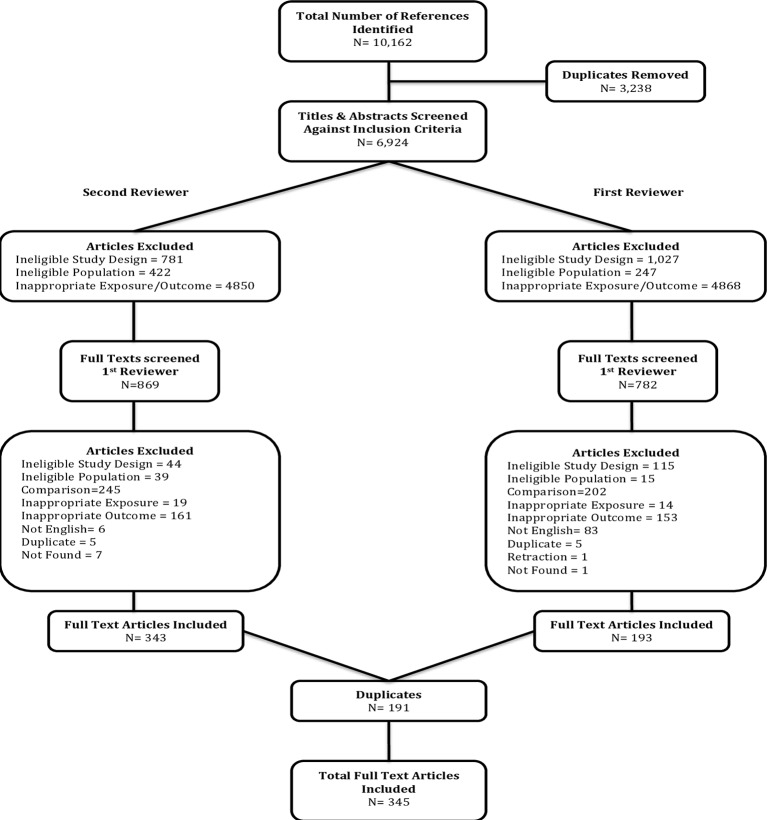
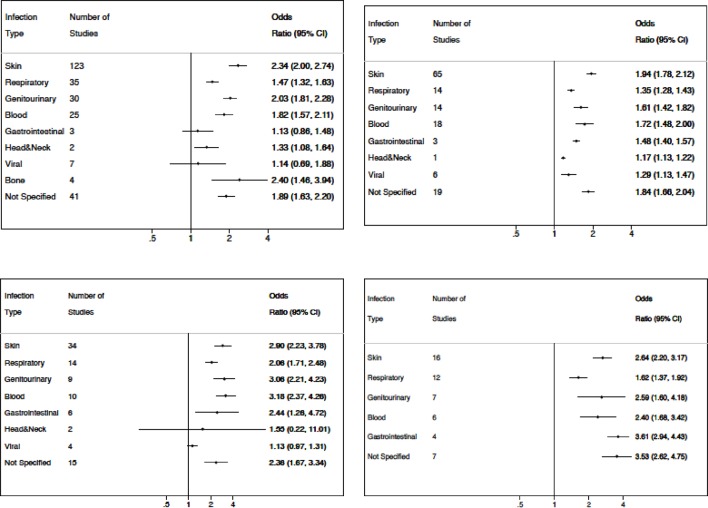
Objective: To quantify the association between diabetes and the risk of incident infections by conducting a systematic review and meta-analysis. Research design and methods: Two reviewers independently screened articles identified from PubMed, EMBASE, Cochrane Library, IPA, and Web of Science databases. Cohort studies (CS) or case–control studies (CCS) evaluating the incidence of infections in adults with diabetes were included. Infections were classified as: skin and soft tissue, respiratory, blood, genitourinary, head and neck, gastrointestinal, bone, viral, and non-specified infections. Study quality was assessed using the Newcastle-Ottawa Quality Assessment Scale. Summary crude and adjusted OR with 95% CIs were calculated using random effects models, stratified by study design. Heterogeneity was measured using the I 2 statistic and explored using subgroup analyses. Results: A total of 345 (243 CS and 102 CCS) studies were included. Combining adjusted results from all CS, diabetes was associated with an increased incidence of skin (OR 1.94, 95% CI 1.78 to 2.12), respiratory (OR 1.35, 95% CI 1.28 to 1.43), blood (OR 1.72, 95% CI 1.48 to 2.00), genitourinary (OR 1.61, 95% CI 1.42 to 1.82), head and neck (OR 1.17, 95% CI 1.13 to 1.22), gastrointestinal (OR 1.48, 95% CI 1.40 to 1.57), viral (OR 1.29, 95% CI 1.13 to 1.46), and non-specified (OR 1.84, 95% CI 1.66 to 2.04) infections. A stronger association was observed among CCS: skin (OR 2.64, 95% CI 2.20 to 3.17), respiratory (OR 1.62, 95% CI 1.37 to 1.92), blood (OR 2.40, 95% CI 1.68 to 3.42), genitourinary (OR 2.59, 95% CI 1.60 to 4.17), gastrointestinal (OR 3.61, 95% CI 2.94 to 4.43), and non-specified (OR 3.53, 95% CI 2.62 to 4.75). Conclusion: Diabetes is associated with an increased risk of multiple types of infections. A high degree of heterogeneity was observed; however, subgroup analysis decreased the amount of heterogeneity within most groups. Results were generally consistent across types of infections.
Overview
The claims and statistics of this paper haven’t been checked yet.
Free: it reads the open-access text and checks the first 5 claims that cite a source we can check. Create a free account to check every claim.
Integrity signals
Registry
Cites
Statistics
Figures
Verification
Claims the paper makes
The claims and statistics of this paper haven’t been checked yet.
Free: it reads the open-access text and checks the first 5 claims that cite a source we can check. Create a free account to check every claim.
Claims other papers make about this one
Each is checked against this paper’s own text: does it say what the citing paper says it does?
The check wasn’t confident either way, so it gives no verdict — never disputed.
In the citing paper
“Contrary to preliminary cohort-level evidence suggesting that exogenous insulin may be associated with an increased cancer risk,1820 particularly glargine”
From American Association of Clinical Endocrinology Clinical Practice Guideline: Developing a Diabetes Mellitus Comprehensive Care Plan-2022 Update. (2022) · cites this paper as [1820]
Experimental — accuracy not yet measured
Self-check
Percentages, sums and reported differences re-computed from the paper’s own numbers.
The self-check needs the paper’s full text.
Citations
Cites
Preferred Reporting Items for Systematic Reviews and Meta-Analyses: the PRISMA statement
Moher, D., Liberati, A., Tetzlaff, J., Altman, D. G., & for the PRISMA Group (2009) · BMJ · doi:10.1136/bmj.b2535 · Cited by 83,823
Preferred reporting items for systematic reviews and meta-analyses: the PRISMA Statement.
(2009) · PubMed Central · Cited by 44,859
Dermyshi, E., Wang, Y., Yan, C., Hong, W., Qiu, G., Gong, X., & Zhang, T. (2017) · Neonatology · doi:10.1159/000454668 · Cited by 24,451
Meta-analysis of Observational Studies in Epidemiology<SUBTITLE>A Proposal for Reporting</SUBTITLE>
Stroup, D. F. (2000) · JAMA · doi:10.1001/jama.283.15.2008 · Cited by 20,623
Preferred Reporting Items for Systematic Reviews and Meta-Analyses: The PRISMA Statement
Moher, D., Liberati, A., Tetzlaff, J., & Altman, D. G. (2009) · Journal of Clinical Epidemiology · doi:10.1016/j.jclinepi.2009.06.005 · Cited by 19,575
Sontrop, J. M., Dixon, S. N., Garg, A. X., Buendia-Jimenez, I., Dohein, O., Huang, S.-H. S., & Clark, W. F. (2013) · American Journal of Nephrology · doi:10.1159/000350377 · Cited by 5,871
Diabetes Mellitus, Fasting Glucose, and Risk of Cause-Specific Death
The Emerging Risk Factors Collaboration (2011) · New England Journal of Medicine · doi:10.1056/nejmoa1008862 · Cited by 2,726
Periodontal Disease: The sixth complication of diabetes mellitus
Löe, H. (1993) · Diabetes Care · doi:10.2337/diacare.16.1.329 · Cited by 1,580 · cited 1×
“45–47 The contributing factors involve higher salivary glucose, low salivary pH, microangiopathy, and abnormal collagen metabolism.”
BackgroundMortality and causes of death in the WHO Multinational Study of Vascular Disease in Diabetes
and the WHO Multinational Study Group, Morrish, N. J., Wang, S.-L., Stevens, L. K., Fuller, J. H., & Keen, H. (2001) · Diabetologia · doi:10.1007/pl00002934 · Cited by 1,288
Okura, Y., Urban, L. H., Mahoney, D. W., Jacobsen, S. J., & Rodeheffer, R. J. (2004) · Journal of Clinical Epidemiology · doi:10.1016/j.jclinepi.2004.04.005 · Cited by 1,234 · cited 1×
“50 In addition, misclassification of patients with diabetes who did not know that they had the disease to the referent group of participants without diabetes is highly likely given that 46% of the estimated prevalence of diabetes is in people with undiagnosed disease.”
Background
Research works printed but not linked: 2
- International Diabetes federation atlas sixth edition. http://www.idf.org/diabetesatlas/update-2014.
- Morrison A, Moulton K, Clark M, et al English language restriction when conducting systematic reviews-based meta-analyses: systematic review of published studies. Canadian Agency for Drugs and Technologies in Health 2009.
Cited by
Items 101–113 of 113
Djajakusumah, T. M., Hapsari, P., Yarman, I. P., Utomo, H. S. R., Lukman, K., Sulastri, D., & Ulurrosyad, M. F. (2024) · Majalah kedokteran Bandung/Majalah Kedokteran Bandung · doi:10.15395/mkb.v56.3042
Ahmed, H., Davies, A., Daniel, R., Noble, S., & Farewell, D. M. (2024) · Discover Public Health · doi:10.1186/s12982-024-00263-1
Chen, S.-X., Yang, Z.-K., Lin, L., Liao, H.-Z., Xiang, X.-T., Liu, D., & Huang, J.-S. (2025) · Journal of Global Health · doi:10.7189/jogh.15.04044
“Previous studies have indicated that patients with CAP and diabetes experience significant blood glucose fluctuations, creating a high-glycemic environment that facilitates bacterial growth and proliferation, which complicates the treatment of pneumonia [ 23 ].”
Gedefie, A., Ayele, F. Y., Getaneh, F. B., Ayres, A., Muche, A., Molla, A., & Wodajo, S. (2025) · Journal of Epidemiology and Global Health · doi:10.1007/s44197-025-00397-8 · Cited by 3
“Glycosuria also enhances bacterial growth and impair phagocytosis [69, 70 ].”
Alnahwi, H. H., AlGhawi, R. J., Alsahaf, H. A. A., & Ahmed, E. (2025) · Cureus · doi:10.7759/cureus.85116
“Diabetes patients are more prone to bacterial infections, including CDI, because they frequently have delayed immune responses and compromised neutrophil function [26].”
Giha, H. A., Sater, M. S., & Qarni, A. A. A. (2025) · Minerva Endocrinology · doi:10.23736/s2724-6507.25.04230-7 · Cited by 1
Gea–Izquierdo, E., Ruiz-Urbaez, R., Hernández‐Barrera, V., & de Miguel, Á. G. (2025) · Microorganisms · doi:10.3390/microorganisms13071642
“Therefore, patients with D tend to be hospitalized for infections more frequently than non-diabetics [4,7], and comorbidities play a crucial role in this scenario.”
Angriman, F., Lawler, P. R., Shah, B. R., Martin, C. M., & Scales, D. C. (2024) · Figshare · doi:10.6084/m9.figshare.26607763
Diabetes mellitus and the risk of vulvar and vaginal cancer: results from a large cohort study
Aune, D., Chang, W., Macfarlane, T. V., Sobiecki, J. G., Hsieh, T., Hsu, W., Chang, F.-L., & He, M.-S. (2026) · BMC Women s Health · doi:10.1186/s12905-026-04429-8
“…between diabetes mellitus and vulvar and vaginal cancer include reduced immune function and ability to clear infections (e.g. HPV infection) [31, 32], increased risk of vulvar lichen sclerosus [30], which is a strong risk factor for vulvar cancer [3], and increased risk of genital warts in…”
Marinescu, M., Botnariu, G. E., Mocanu, M., Vâță, D., Temelie-Olinici, D., Halip, I. A., Pătrașcu, A.-I., Popescu, I. A., Gheuca-Solovastru, D. F., & Solovăstru, L. G. (2026) · Life · doi:10.3390/life16060957 · Cited by 1
“Our results align with literature reports of lower limb ulcerations being a common complication in diabetes and partially related to bacterial superinfections [25].”
Aune, D., Chang, W., Macfarlane, T. V., Sobiecki, J. G., Hsieh, T., Hsu, W., Chang, F.-L., & He, M.-S. (2026) · Cancer Epidemiology · doi:10.1016/j.canep.2026.103155
Peng, K., Yang, D., Wang, J., Shen, C., Cheng, M. C., Chan, S. C. W., Tang, I. Y. K., Zhang, Q., Lai, E. C., Pratt, N. L., et al. (2026) · BMC Medical Informatics and Decision Making · doi:10.1186/s12911-026-03739-z
“These risk factors have all been documented in previous reviews [10, 40].”
Financing Health for all in the Era of Digitalization
Kucchal, T., Bannirchelvam, S., & Wang, M. (2026) · Health informatics · doi:10.1007/978-3-032-24537-3_6
Metadata
- Authors
- Abu-Ashour, W., Twells, L., Valcour, J., Randell, A., Donnan, J., Howse, P., & Gamble, J.-M.
- Affiliations
- Memorial University of Newfoundland (CA)
- Corresponding author
- Gamble, John-Michael
- ORCID
- Venue
- BMJ Open Diabetes Research & Care
- Publisher
- BMJ
- Published
- 2017-05
- Volume
- 5
- Issue
- 1
- Pages
- e000336
- ISSN
- 2052-4897 (ISSN-L)
- PMC
- PMC5530269
- OpenAlex
- W2616886176
- Cited by
- 113
- References
- 55
- Citations by year
- 2026: 7 · 2025: 11 · 2024: 19 · 2023: 20 · 2022: 12 · 2021: 16 · 2020: 17 · 2019: 5 · 2018: 3 · 2017: 3
- FWCI
- 1.12
- Type
- journal article
- Language
- en
- Open access
- gold
- doi.org
- Licence
- cc-by-nc
- Locations
- BMJ Open Diabetes Research & Care (publishedVersion, cc-by-nc)
- PubMed Central (publishedVersion, cc-by-nc)
- PubMed (publishedVersion)
- Funders
- Canadian Diabetes Association
- Canadian Institutes of Health Research
- Topics
- Health Sciences › Medicine › Endocrinology, Diabetes and Metabolism › Diabetic Foot Ulcer Assessment and Management
- Health Sciences › Medicine › Endocrinology, Diabetes and Metabolism › Diabetes Management and Research
- Health Sciences › Medicine › Endocrinology, Diabetes and Metabolism › Diabetes, Cardiovascular Risks, and Lipoproteins
- Keywords
- diabetes mellitus, infection risk, skin and soft tissue infections, respiratory infections, bloodstream infection, genitourinary infections, head and neck infections, gastrointestinal infections, viral infection, infection incidence
About these checks
Registry, retraction, Cites and statistics results are computed, not judged, with one exception: a printed reference that no index lists is read once by a model before it counts as a citation error. Claims are extracted by a model and kept only when their quote appears verbatim in the text; each cited source is then checked, with a model’s help, for whether it says what the claim relies on. Those verdicts can be wrong — read the claim’s quote and the cited source before relying on one.
Statistics and arithmetic are recomputed, not judged.
Confidence bands are shown only for fields calibrated on our annotated test set. None is calibrated yet, so no band is shown.
What counts as a claim ›How we measure confidence ›How we check this ›
Are you an author, or do you see a problem with this page? Request a review
Data sources
Bibliographic data: Semantic Scholar, OpenAlex, Crossref.
Contains information from the Semantic Scholar Academic Graph Datasets, made available under the ODC Attribution License (ODC-BY 1.0).
Semantic Scholar’s data is described in: Kinney, R., et al. (2023). The Semantic Scholar Open Data Platform. arXiv:2301.10140.
