

Systematic review and meta-analysis of dietary carbohydrate restriction in patients with type 2 diabetes
Open accessThe DOI matches its Crossref record; 30 of the 30 references it cites were found in a registry or an index.
Abstract
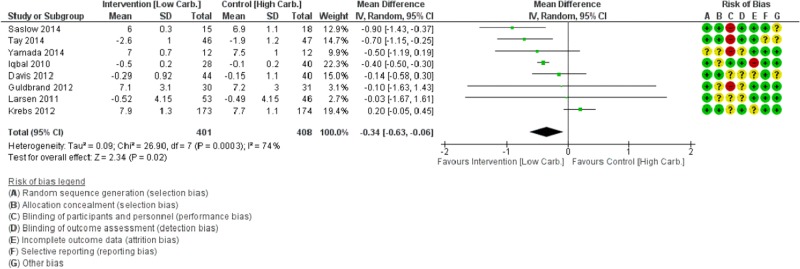
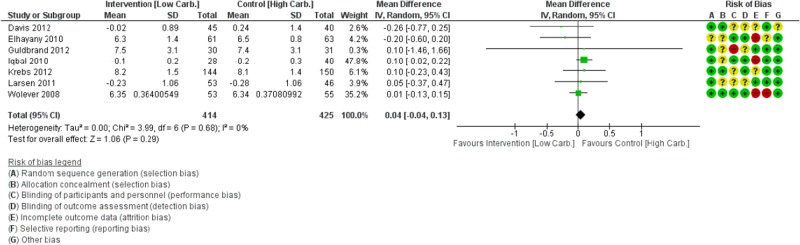
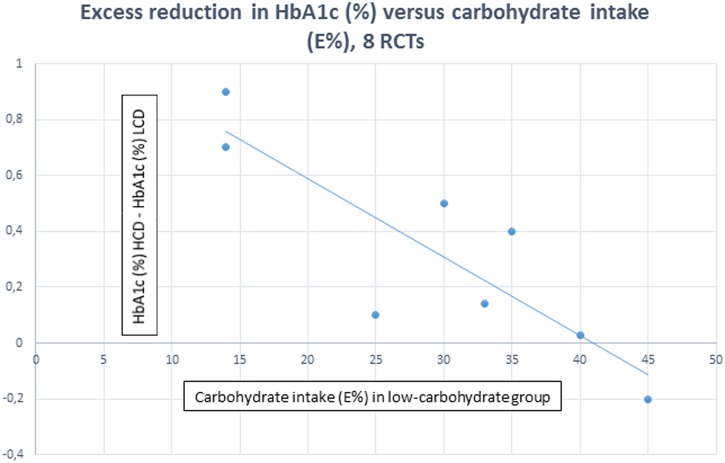
Objective: Nutrition therapy is an integral part of self-management education in patients with type 2 diabetes. Carbohydrates with a low glycemic index are recommended, but the ideal amount of carbohydrate in the diet is unclear. We performed a meta-analysis comparing diets containing low to moderate amounts of carbohydrate (LCD) (energy percentage below 45%) to diets containing high amounts of carbohydrate (HCD) in subjects with type 2 diabetes. Research design and methods: We systematically reviewed Cochrane library databases, EMBASE, and MEDLINE in the period 2004–2014 for guidelines, meta-analyses, and randomized trials assessing the outcomes HbA1c, BMI, weight, LDL cholesterol, quality of life (QoL), and attrition. Results: We identified 10 randomized trials comprising 1376 participants in total. In the first year of intervention, LCD was followed by a 0.34% lower HbA1c (3.7 mmol/mol) compared with HCD (95% CI 0.06 (0.7 mmol/mol), 0.63 (6.9 mmol/mol)). The greater the carbohydrate restriction, the greater the glucose-lowering effect (R=−0.85, p<0.01). At 1 year or later, however, HbA1c was similar in the 2 diet groups. The effect of the 2 types of diet on BMI/body weight, LDL cholesterol, QoL, and attrition rate was similar throughout interventions. Limitations: Glucose-lowering medication, the nutrition therapy, the amount of carbohydrate in the diet, glycemic index, fat and protein intake, baseline HbA1c, and adherence to the prescribed diets could all have affected the outcomes. Conclusions: Low to moderate carbohydrate diets have greater effect on glycemic control in type 2 diabetes compared with high-carbohydrate diets in the first year of intervention. The greater the carbohydrate restriction, the greater glucose lowering, a relationship that has not been demonstrated earlier. Apart from this lowering of HbA1c over the short term, there is no superiority of low-carbohydrate diets in terms of glycemic control, weight, or LDL cholesterol.
Overview
The claims and statistics of this paper haven’t been checked yet.
Free: it reads the open-access text and checks the first 5 claims that cite a source we can check. Create a free account to check every claim.
Integrity signals
Registry
Cites
Statistics
Figures
Verification
Claims the paper makes
The claims and statistics of this paper haven’t been checked yet.
Free: it reads the open-access text and checks the first 5 claims that cite a source we can check. Create a free account to check every claim.
Claims other papers make about this one
Each is checked against this paper’s own text: does it say what the citing paper says it does?
The source backs part of the claim, not all of it — or backs it for a different population, condition or comparison.
In the citing paper
“A net energy de fi cit that can be maintained is important for weight loss (5,6,22,72 -74).”
From Management of Hyperglycemia in Type 2 Diabetes, 2022. A Consensus Report by the American Diabetes Association (ADA) and the European Association for the Study of Diabetes (EASD) (2022) · cites this paper as [73]
Experimental — accuracy not yet measuredThe source backs part of the claim, not all of it — or backs it for a different population, condition or comparison.
In the citing paper
“For individuals with type 2 diabetes not meeting glycemic targets or for whom reducing glucose-lowering drugs is a priority, reducing overall carbohydrate intake with a low-or verylow-carbohydrate eating pattern is a viable option (137-139).”
From 5. Facilitating Positive Health Behaviors and Well-being to Improve Health Outcomes:Standards of Care in Diabetes—2023 (2023) · cites this paper as [139]
Experimental — accuracy not yet measuredThe source backs part of the claim, not all of it — or backs it for a different population, condition or comparison.
In the citing paper
“Low carbohydrate diets (LCD) have shown efficacy in managing clinical outcomes in type 2 diabetes (T2D).”
From mHealth low carbohydrate dietary intervention ameliorates glycaemic profile, blood pressure and weight status in people with type 2 diabetes (2025) · cites this paper as [5]
Experimental — accuracy not yet measuredThe source backs part of the claim, not all of it — or backs it for a different population, condition or comparison.
In the citing paper
“Research evidence shows that the prescription of a low carbohydrate diet (LCD) for management of T2D improves glycaemic control, reduces the need for medications, assists with weight loss, and may improve blood lipid concentrations5–9.”
From mHealth low carbohydrate dietary intervention ameliorates glycaemic profile, blood pressure and weight status in people with type 2 diabetes (2025) · cites this paper as [5]
Experimental — accuracy not yet measured
11 more claims about this paper
Create a free account to see every claim other papers make about this one.
Self-check
Percentages, sums and reported differences re-computed from the paper’s own numbers.
The self-check needs the paper’s full text.
Citations
Cites
Development of AMSTAR: A measurement tool to assess the methodological quality of systematic reviews
Shea, B. J., Grimshaw, J. M., Wells, G. A., Boers, M., Andersson, N., Hamel, C., Porter, A. C., Tugwell, P., Moher, D., & Bouter, L. M. (2007) · BMC Medical Research Methodology · doi:10.1186/1471-2288-7-10 · Cited by 4,374
AGREE II: advancing guideline development, reporting and evaluation in health care
Brouwers, M. C., Kho, M. E., Browman, G. P., Burgers, J. S., Cluzeau, F., Feder, G., Fervers, B., Graham, I. D., Grimshaw, J., Hanna, S. E., et al. (2010) · Canadian Medical Association Journal · doi:10.1503/cmaj.090449 · Cited by 3,790
Human gut microbes impact host serum metabolome and insulin sensitivity
Pedersen, H. K., Gudmundsdottir, V., Nielsen, H. B., Hyotylainen, T., Nielsen, T., Jensen, B. A. H., Forslund, K., Hildebrand, F., Prifti, E., Falony, G., et al. (2016) · Nature · doi:10.1038/nature18646 · Cited by 2,116 · cited 1×
“16 22 Apart from a lowering of the daily glycemic challenge, an initial hypoglycemic effect of LCD followed by an attenuation of the efficacy could also be due to changes in gut microbiota as a consequence of the altered carbohydrate intake followed by gradual adaptive mechanisms.(28) Our findings and recent trials su…”
BackgroundNutrition therapy recommendations for the management of adults with diabetes
Evert, A. B., Boucher, J. L., Cypress, M., Dunbar, S. A., Franz, M. J., Mayer-Davis, E. J., Neumiller, J. J., Nwankwo, R., Verdi, C. L., Urbanski, P., et al. (2013) · Diabetes Care · doi:10.2337/dc13-2042 · Cited by 1,129 · cited 1×
“▪ The greater the carbohydrate restriction, the greater glucose lowering.”
BackgroundFeinman, R. D., Pogozelski, W. K., Astrup, A., Bernstein, R. K., Fine, E. J., Westman, E. C., Accurso, A., Frassetto, L., Gower, B. A., McFarlane, S. I., et al. (2015) · Nutrition · doi:10.1016/j.nut.2014.06.011 · Cited by 912 · cited 2×
“▪ Apart from improvements in HbA1c over the short term, there is no superiority of low-carbohydrate diets in terms of glycemic control, weight, or LDL cholesterol.”
BackgroundSelf-citationAjala, O., English, P., & Pinkney, J. (2013) · The American Journal of Clinical Nutrition · doi:10.3945/ajcn.112.042457 · Cited by 821 · cited 2×
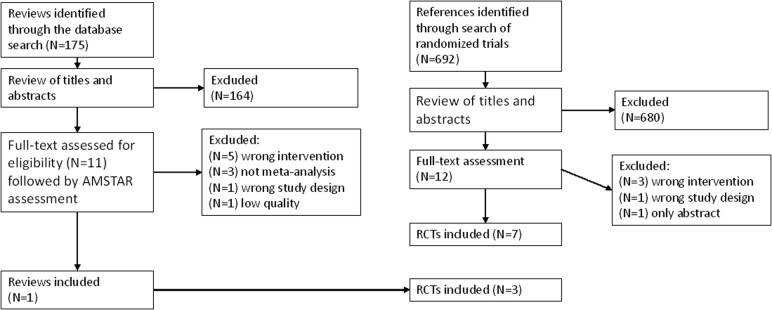
“The predefined criteria for entering the analysis and the issues we address were fulfilled in only one high-quality review.(6) Furthermore, only part of this review was relevant for the present analysis, so we entered data from individual studies rather than using estimates from the review.”
MethodBueno, N. B., de Melo, I. S. V., de Oliveira, S. L., & da Rocha Ataide, T. (2013) · British Journal of Nutrition · doi:10.1017/s0007114513000548 · Cited by 778
Nutrition therapy recommendations for the management of adults with diabetes
Evert, A. B., Boucher, J. L., Cypress, M., Dunbar, S. A., Franz, M. J., Mayer-Davis, E. J., Neumiller, J. J., Nwankwo, R., Verdi, C. L., Urbanski, P., et al. (2014) · Diabetes Care · doi:10.2337/dc14-s120 · Cited by 766
Westman, E. C., Yancy, W. S., Mavropoulos, J. C., Marquart, M., & McDuffie, J. R. (2008) · Nutrition & Metabolism · doi:10.1186/1743-7075-5-36 · Cited by 475 · cited 2×
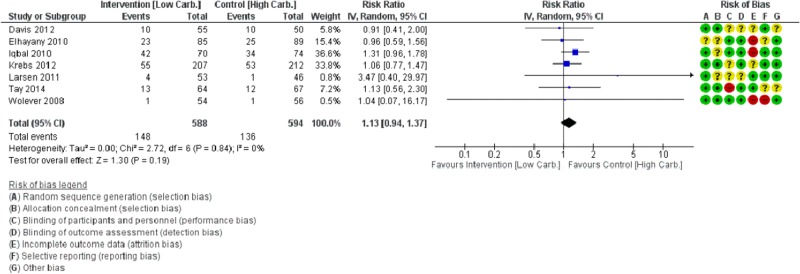
“Dropout rates at longest follow-up were similar in the two groups ( fi gure 5).”
BackgroundComparison of low- and high-carbohydrate diets for type 2 diabetes management: a randomized trial
Tay, J., Luscombe-Marsh, N. D., Thompson, C. H., Noakes, M., Buckley, J. D., Wittert, G. A., Yancy, W. S., & Brinkworth, G. D. (2015) · The American Journal of Clinical Nutrition · doi:10.3945/ajcn.115.112581 · Cited by 341 · cited 1×
“However, this problem cannot be solved.”
Research works printed but not linked: 1
- Covidence. Covidence systematic review software, Veritas Health Innovation. Melbourne, Australia http://www.covidence.org
Cited by
Items 301–391 of 391
Reynolds, A. N. (2017) · doi:10.2196/preprints.7672 · Cited by 1
Mason, A. E., Saslow, L. R., Moran, P. J., Kim, S., Wali, P. K., Abousleiman, H., Hartman, A. R., Richler, R., Schleicher, S., Hartogensis, W., et al. (2020) · JMIR Research Protocols · doi:10.2196/17226 · Cited by 1
Dietary management of obesity and type 2 diabetes: What advice should we be giving?
Dyson, J. (2017) · Oxford University Research Archive (ORA) (University of Oxford)
Zucker-Challenges und Low-Carb-Hype: Kohlenhydratverzicht auf dem Prüfstand
Kabisch, S. (2018) · Ernährung & Medizin · doi:10.1055/a-0612-6559
“Viele dieser Studien demonstrieren nämlich keine Beeinträchtigung von Körpergewicht und/ oder Stoffwechsel, was aber auf ihr Design zurückzuführen ist.”
BackgroundInfluentialErnährungstherapie bei Typ-2-Diabetes
Nussbaumer, H. (2018) · Springer eBooks · doi:10.1007/978-3-662-57808-7_4
Oldershaw, H. S. (2018) · Figshare
Lorkowski, S., & Dawczynski, C. (2018) · Der Diabetologe · doi:10.1007/s11428-018-0425-9
Use of low-carbohydrate diets in patients with type 2 diabetes
Oleszko, A., Szczepańska, E., & Jośko-Ochojska, J. (2018) · Annales Academiae Medicae Silesiensis · doi:10.18794/aams/91316
“significantly across studies, ranging from 2–60% in the LCD groups and from 2–46% in the HCD groups [21].”
BackgroundMethodInfluentialErnährungsempfehlungen bei Diabetes mellitus (Update 2019)
Schindler, K., Brix, J. M., Dämon, S., Hoppichler, F., Kautzky‐Willer, A., Kruschitz, R., Toplak, H., & Ludvik, B. H. (2019) · Wiener klinische Wochenschrift · doi:10.1007/s00508-019-1470-0
Harvey, C. (2019) · Tuwhera (Auckland University of Technology)
Ernährung bei Diabetes mellitus Typ 2
Fiederling, U. (2019) · Ernährung & Medizin · doi:10.1055/a-0970-3206
“Obwohl einer kohlenhydratarmen Kostform positive Effekte zugeschrieben werden, ließ sich eine Überlegenheit dieser Ernährungsweise in Studien nicht ausreichend belegen [5] [6].”
BackgroundInfluentialInsulin sensitivity is mediated by glucose in the hepatoportal region in the rat
Johnson, H. M. (2017) · The Sydney eScholarship Repository (The University of Sydney)
Recent Tendency of Nutritional Therapy for Diabetes Including Low Carbohydrate Diet (LCD)
Bando, H. (2019) · Biomedical Journal of Scientific & Technical Research · doi:10.26717/bjstr.2019.23.003833
“Its effects include A1C reduction, weight loss, lowered blood pressure, increased HDL-C and lowered triglycerides [18-20].”
BackgroundKetogenic Diet and Glucose Control
Lee, Y. H. (2019) · Journal of Korean Diabetes · doi:10.4093/jkd.2019.20.4.244
Clinical diversity of Low Carbohydrate Diet (LCD)
Bando, H. (2018) · doi:10.31038/jcrm.2018142
“Some reports showed beneficial effect of LCD and others revealed unremarkable difference between them [6, 10, 11].”
BackgroundDiet for the Treatment of Gestational Diabetes Mellitus
Mijatovic, J. (2019) · The Sydney eScholarship Repository (The University of Sydney)
新規疾病発症モデルから期待する糖質制限食のmulti‐morbidity への有効性
悟, 山. (2019) · The Japanese Journal of SURGICAL METABOLISM and NUTRITION · doi:10.11638/jssmn.53.5_191
Diabetology: A New Online Diabetes Journal. What Role Can It Play in a Crowded Field?
Clifton, P. M. (2020) · Diabetology · doi:10.3390/diabetology1010003
Novel Combination of Exercise and Carbohydrate Restriction for Metabolic Health
Gil-Sotomayor, A. (2020) · Tuwhera (Auckland University of Technology)
Hallberg, S. J., Dockter, N. E., Kushner, J. A., & Athinarayanan, S. J. (2019) · Preprints.org · doi:10.20944/preprints201812.0187.v2
“calories consumed as carbohydrate (as reported by research subjects), the greater the glycemic control achieved.(57)”
BackgroundReversing type 2 diabetes: journal review and a case study
Singh, R. (2020) · Advances in Obesity Weight Management & Control · doi:10.15406/aowmc.2020.10.00322
Carbohydrate Intake in Non-communicable Disease Prevention and Treatment
Venn, B. J. (2019) · MDPI eBooks · doi:10.3390/books978-3-03897-819-0
How does diet quality change after diagnosis with type 2 diabetes?
Burch, E. (2021) · Griffith Research Online · doi:10.25904/1912/4185
Developing a framework for carbohydrate awareness advice in type two diabetes
McArdle, P. (2019) · University of Birmingham Institutional Research Archive (University of Birmingham)
'Herz und Schwimmen sind eins': Anmerkungen zum Schwinmmen in Japan als militärische tradition
Niehaus, A. (2005) · Ghent University Academic Bibliography (Ghent University)
Avery, A. (2021) · Archives of Diabetes & Obesity · doi:10.32474/ado.2021.03.000172
“Despite a greater effect of carbohydraterestricted diets on weight and glycaemic control in the short-term in people with T2D compared with high carbohydrate diets, there is no evidence for their superiority in the long term (≥12 months) in diabetes management, and total energy intake remains the determining factor of…”
BackgroundMesures hygiéno-diététiques et états diabétiques
(2019) · Elsevier eBooks · doi:10.1016/b978-2-294-75889-8.00006-3
A Review of Type 1 Diabetes (T1D): To Assist Patients' and Carers' Understanding of This Condition
O’Donnell, E., & O’Donnell, L. (2019) · IGI Global eBooks · doi:10.4018/978-1-7998-1204-3.ch002
Meek, C. L. (2020) · Faculty Opinions – Post-Publication Peer Review of the Biomedical Literature · doi:10.3410/f.737501826.793577601
Hallberg, S. J., Dockter, N. E., Kushner, J. A., & Athinarayanan, S. J. (2018) · Preprints.org · doi:10.20944/preprints201812.0187.v1
(2019) · Journal of Holistic Performance · doi:10.26712/102019
An Appropriate Energy Intake Proportion of Three Major Nutrients for Treatment of Type 2 Diabetes
Yanai, H., & Katsuyama, H. (2020) · Journal of Endocrinology and Metabolism · doi:10.14740/jem693
“The meta-analysis of 10 RCTs showed that HbA1c was significantly lower for the first year in the low-carbohydrate diet group with carbohydrate content of less than 45% of total energy [8].”
Diètes cétogènes et diabète de type 2
Darmon, P., & Soghomonian, A. (2022) · Médecine des Maladies Métaboliques · doi:10.1016/j.mmm.2022.08.011
Effects of Carbohydrate and Fats in Turkish Patients with Type 2 Diabetes
Keser, M. G., Hacışahinoğulları, H., Karşıdağ, K., Vatansev, H., İpekçi, S. H., & Tan, H. (2022) · Journal of Contemporary Medicine · doi:10.16899/jcm.1033320
INNOVATIONS IN MODERN MEDICINE AND BIOLOGY
Vladlenov, D., Chepurna, A., Korz, A., Vydyborets, S., Melnyk, U., Perekhrestenko, T., Vydyborets, S., Popovych, M., Rishko, M. V., Vydyborets, S., et al. (2022) · Іnternational Science Group eBooks · doi:10.46299/isg.2022.mono.med.3
Reyes, M. S. R., & Prieto, C. (2022) · Revista Ciencia y Salud Integrando conocimientos · doi:10.34192/cienciaysalud.v6i6.539
Wasana, K. G. P., Attanayake, A. P., Weerarathna, T. P., Amarasekera, D. A. B. N., & Jayatilaka, K. A. P. W. (2023) · American Journal of Human Biology · doi:10.1002/ajhb.23870
“A meta-analysis revealed that carbohydrate restrictions corresponded to a significant reduction in HbA1C in patients with T2DM (Snorgaard et al., 2017).”
BackgroundCywes, R., Kajee, H., Wellington, N., Cucuzzella, M. T., Riley, K., Isaacs, D. M., Pataguana, N., Lake, I., Rauch, L., McKelvey, S., et al. (2023) · Elsevier eBooks · doi:10.1016/b978-0-12-821617-0.00010-3
Reynolds, A. N., Kahleová, H., Uusitupa, M. I. J., Hermansen, K., Aas, A., Schwab, U., Lean, M. E. J., Pfeiffer, A. F. H., Salas‐Salvadó, J., & Mann, J. I. (2023) · Diabetologia · doi:10.1007/s00125-023-05963-y
“The DNSG’s dietary recommendations [2] also took into account the consistent finding from observational data indicating increased mortality when carbohydrate intake was <40% or >70% of total energy [8, 9], as well as a recent Cochrane Review on low- vs balanced-carbohydrate diets for reducing weight and cardiovascular…”
BackgroundEffects of bioavailability of macronutrients on overall control of plasma glucose: a review
Mwakalu, S. M., Omwenga, V. O., & Ogao, P. J. (2023) · African Journal of Food Agriculture Nutrition and Development · doi:10.18697/ajfand.125.23245
다중 로지스틱 회귀 분석을 통한 고령자의 5대 질병 및 영양소 섭취와의 관계
김, 연., 김, 다., & Joo, N. (2023) · 한국식품조리과학회지 · doi:10.9724/kfcs.2023.39.6.492
Alimentazione e diabete: dietetica pratica
Rigalleau, V., Foussard, N., Larroumet, A., Monlun, M., Blanco, L., & Mohammedi, K. (2024) · EMC - AKOS - Trattato di Medicina · doi:10.1016/s1634-7358(24)49207-3
Non-Pharmacological Approach to Uncontrolled Type 2 Diabetes: A Case Report
Alexander, B., Hall, A., & Aucoin, M. (2024) · CAND Journal · doi:10.54434/candj.172
The Impact of Different Regions and Dietary Structures on Blood Glucose and Lipid Levels
Caiping, Z., & Xiaofei, Z. (2024) · World Journal of Public Health · doi:10.11648/j.wjph.20240903.13
METABOLISMO ÓSSEO NA OBESIDADE
Ramalho, A., Ribamar, A., Cordeiro, A., & Luna, M. (2024) · Seven Editora eBooks · doi:10.56238/livrosindi202436-008
Diabète de type 2 : régimes hypoglucidiques et cétogènes
Lecerf, J. (2024) · Pratiques en nutrition · doi:10.1016/j.pranut.2024.08.007
Martos-Barrachina, F. (2024) · Revista Electrónica de Comunicaciones y Trabajos de ASEPUMA · doi:10.24310/recta.25.1.2024.20358
Eating Patterns for the Management of Diabetes
Urbanski, P. (2017) · American Diabetes Association eBooks · doi:10.2337/9781580406482.ch03
The Management of Overweight and Obese Diabetic Patient
Vijayashree, N., Subramanian, D., & George, M. M. (2024) · Springer eBooks · doi:10.1007/978-981-97-6406-8_9
Effect of SGLT2 Inhibitors and Dietary Therapy
Omura, Y., & Fujimoto, K. (2024) · Nippon Eiyo Shokuryo Gakkaishi · doi:10.4327/jsnfs.77.339
Hussain, I., MacLeod, J., Dunn, F., Bickel, P. E., Abreu, M., McNulty, N., Lingvay, I., Kermani, A., & Abreu, M. (2020) · American Diabetes Association eBooks · doi:10.2337/9781580406314.ch03
Metabolische und psychische Folgen des PCO-Syndroms – Ansätze für Beratung und Therapie
Schoppe, T. (2025) · Diabetologie und Stoffwechsel · doi:10.1055/a-2519-1094
Relationship between Aging and Ketogenic Diet: A Bibliometric Analysis (1995-2025)
Elgün, T., Işık, A. A., Çıracı, E., Gündoğan, G. İ., Zıkşahna, K., & Arslan, H. I. (2025) · Endocrine Metabolic & Immune Disorders - Drug Targets · doi:10.2174/0118715303376457250617154223
The application of low-carb diet in diabetes treatment
Yuchen, H., & Yin, J. (2025) · Scientia Sinica Vitae · doi:10.1360/ssv-2025-0020
Lifestyle in the glycemic management of type 2 diabetes
Poulia, K. (2025) · Elsevier eBooks · doi:10.1016/b978-0-443-13825-6.00297-1
The Impact of Nutritional Education on Diabetes Outcomes in Inpatient Settings
Fadel, D. M., Aljomaie, H. A. H., Alhazmi, S. A., & Alkhyfi, H. A. (2024) · Journal of Posthumanism · doi:10.63332/joph.v4i1.3529
Pawar, A. D., Rohile, S. B., & D., S. S. (2025) · International Journal of Advanced Research in Science Communication and Technology · doi:10.48175/ijarsct-29628
Low-carbohydrate diets in diabetes mellitus: A clinical case report and a brief literature review
Hudiakova, N. V., Khudyakov, Y. S., Pchelin, I. Y., Stojanovich, S., Radoičić, D., Semigolovskii, N. Y., Мазуренко, С. О., & Смирнов, В. В. (2025) · Meditsinskiy sovet = Medical Council · doi:10.21518/ms2025-458
Faßhauer, S., Bund, D. R., Kolloquium, R., & Kolloquium, G. C. F. R. R. (. :. B. C. O. T. E. F. F. R. I. R. (. T. W. R.-W. (n.d.) · Informationszentrum Lebenswissenschaften (ZB MED) · doi:10.4126/frl01-006415305
Hawley, C. N., Huber, C. M., Best, L. G., Howard, B. V., Umans, J. G., Beresford, S. A. A., McKnight, B., Hager, A., O’Leary, M. A., Thorndike, A. N., et al. (2021) · Figshare · doi:10.6084/m9.figshare.14037415
Rein, M., Ben-Yacov, O., Godneva, A., Shilo, S., Zmora, N., Kolobkov, D. S., Cohen-Dolev, N., Wolf, B.-C., Kosower, N., Lotan‐Pompan, M., et al. (2022) · Figshare · doi:10.6084/m9.figshare.19144951
Zheng, X., Zhang, W., Wan, X., Lv, X., Lin, P., Si, S., Xue, F., Wang, A., & Cao, Y. (2024) · Figshare · doi:10.6084/m9.figshare.26708834
Rein, M., Ben-Yacov, O., Godneva, A., Shilo, S., Zmora, N., Kolobkov, D. S., Cohen-Dolev, N., Wolf, B.-C., Kosower, N., Lotan‐Pompan, M., et al. (2022) · Figshare · doi:10.6084/m9.figshare.19144957
Lago Sampedro, A. M. (2025) · Repositorio Institucional de la Universidad de Málaga (University of Málaga)
Föchterle, S. (2020) · University Library Linz repository (Johannes Kepler Universitat Linz)
Vega González, A., & Mateo‐Gállego, R. (2018) · Zaguan (Universidad de Zaragoza)
Souza, G. M. C., dos Santos, K. O., de Almeida, M. E. B., da Cruz, R. D. S., Alves, T. P., do Nascimento, J. M. L., Santos, A. R. S., & Rodrigues, K. B. R. (2025) · Revista fisio&terapia. · doi:10.69849/revistaft/pa10202511300942
Pedregoza, D. J. B., & Ganotise, R. O. O. (2025) · Research in Clinical Pharmacy · doi:10.59931/rcp.25.0013
Tian, Q., Jiang, Q., Ma, S., Yu, F., Tan, X., Liu, B., Zhu, J., & Wang, X. (2026) · Endocrinología Diabetes y Nutrición (English ed ) · doi:10.1016/j.endinu.2025.501742
Iyengar, S., Kaur, J., Singh, A., Sahay, I., Kumar, A., Kolke, S., Raut, M., & Singh, R. K. (2026) · Frontiers in Nutrition · doi:10.3389/fnut.2026.1718156
“T2D (T2D) is rising at epidemic rates in South Asia (1–6), with onset occurring at younger ages and lower body mass indices than in Western populations (7, 8).”
RetractedGoedeke, S. M. (2024) · Tuwhera (Auckland University of Technology)
Akar, E. A. (2022) · theses.fr (ABES) · doi:10.70675/a7b15e3fz84e7z4915z9447zc112181e06e4
Khraise, Y. (2026) · Cureus · doi:10.7759/cureus.108479
“The findings of this analysis are consistent with previous systematic reviews and meta-analyses that have reported beneficial effects of low-carbohydrate diets on glycemic outcomes [5,7], as well as more recent analyses reporting similar short-term HbA1c reductions [15].”
Ernährungsempfehlungen für Menschen mit Diabetes (Update 2026)
Klammer, C., Schindler, K., Bugl, R., Plazek, D., Vötter, M., Kirchner, T., Martino, C., Klammer-Martin, J., Huber, J., Krzizek, E.-C., et al. (2026) · Wiener klinische Wochenschrift · doi:10.1007/s00508-025-02676-7
“Langfristig ist sie einer Diät mit einem höheren Kohlenhydratanteil nicht überlegen [6, 150].”
Association between low-carbohydrate diets and continuous glucose monitoring-derived time in ranges
Osugi, K. (2023) · Institutional Repositories DataBase (IRDB)
Yokoyama, Y., Osari, N., Taworntawat, T., Sekimoto, S., Tsubota, K., Kitamura, N., & 渡辺, 光. (2026) · Foods · doi:10.3390/foods15183209
“Regarding the carbohydrate ratio, meta-analyses often use a cut-off of >45% of calories for high carbohydrates and ≤ 45% for low carbohydrates [48,49].”
Jawharji, M. T., Alshammari, G. M., Binobead, M. A., Saleh, A., Al‐Harbi, L. N., & Yahya, M. A. (2026) · Nutritional Neuroscience · doi:10.1080/1028415x.2026.2734187
Burdick, J., Ben‐Porat, T., Cohen, T. R., Acosta, P. F. C., Vakambi, M. D., Allaw, T., & Bacon, S. (2026) · Obesity Surgery · doi:10.1007/s11695-026-08950-5
“[ 12], while carbohydrate restriction has been linked to improvements in Hb-A1c [13].”
Hemoglobin HbA1c and Glucose Blood Levels in Diabetic Patients
Tahirović, I., Mahovac, E., Dizdar, M., Toromanovic, J., Mahmutović, O., Lepara, Z., & Ajanović, A. (2018) · Glasnik hemicara i tehnologa Bosne i Hercegovine
อาหารคาร์โบไฮเดรตต่ำสำหรับโรคอ้วน - ประโยชน์และความเสี่ยงต่อสุขภาพ
Churuangsuk, C. (2021) · Thai JPEN วารสารโภชนบำบัด
Heath, K. A., Pujol-Busquets, G., Marashula, L., Hill, P., Strachan, K., Dioka, L., Kudsk, J., & Retief, J. (2026) · Journal of Metabolic Health · doi:10.4102/jmh.v9i1.161
Aronica, L., Landry, M. J., Rigdon, J., & Gardner, C. D. (2023) · doi:10.3389/fnut.2023.1220020.s001
Thomsen, M. N., Skytte, M. J., Samkani, A., Astrup, A., Fenger, M., Frystyk, J., Hartmann, B., Holst, J. J., Larsen, T. M., Madsbad, S., et al. (2022) · doi:10.3389/fnut.2022.933118.s002
Self-citationHu, M., Shi, Q., Sun, S., Hong, H. I., Zhang, H., Qi, F., Zou, L., & Nie, J. (2022) · doi:10.3389/fnut.2022.894916.s001
Maneesing, T.-U., Dawangpa, A., Chaivanit, P., Songsakul, S., Prasertsri, P., Noronha, N. Y., Watanabe, L. M., Nonino, C. B., Pratumvinit, B., & Sae-Lee, C. (2023) · doi:10.3389/fnut.2023.1216753.s001
Metadata
- Authors
- Snorgaard, O., Poulsen, G. M., Andersen, H. K., & Astrup, A.
- Affiliations
- Hvidovre Hospital (DK)
- University of Copenhagen (DK)
- Bispebjerg Hospital (DK)
- Corresponding author
- Snorgaard, Ole
- ORCID
- Astrup, Arne
- Venue
- BMJ Open Diabetes Research & Care
- Publisher
- BMJ
- Published
- 2017-02
- Volume
- 5
- Issue
- 1
- Pages
- e000354
- ISSN
- 2052-4897 (ISSN-L)
- PMC
- PMC5337734
- OpenAlex
- W2589779601
- Semantic Scholar
- 9bb5ebd233cc8d34068bcecf8eed799f002961a8
- Cited by
- 351
- References
- 30
- Citations by year
- 2026: 17 · 2025: 26 · 2024: 28 · 2023: 32 · 2022: 46 · 2021: 45 · 2020: 46 · 2019: 55 · 2018: 41 · 2017: 14
- FWCI
- 5.24
- Type
- journal article
- Language
- en
- Open access
- gold
- doi.org
- Licence
- cc-by-nc
- Locations
- BMJ Open Diabetes Research & Care (publishedVersion, cc-by-nc)
- Europe PMC (PubMed Central) (publishedVersion, cc-by-nc)
- PubMed Central (publishedVersion, cc-by-nc)
- PubMed (publishedVersion)
- Research at the University of Copenhagen (University of Copenhagen) (publishedVersion, cc-by-nc)
- Topics
- Health Sciences › Medicine › Physiology (medical) › Diet and metabolism studies
- Health Sciences › Medicine › Physiology (medical) › Dietary Effects on Health
- Health Sciences › Medicine › Endocrinology, Diabetes and Metabolism › Diabetes Management and Research
- Keywords
- type 2 diabetes, carbohydrate restriction, low-carbohydrate diet, high-carbohydrate diet, glycemic control, HbA1c, weight, LDL cholesterol, quality of life, attrition, nutritional therapy
About these checks
Registry, retraction, Cites and statistics results are computed, not judged, with one exception: a printed reference that no index lists is read once by a model before it counts as a citation error. Claims are extracted by a model and kept only when their quote appears verbatim in the text; each cited source is then checked, with a model’s help, for whether it says what the claim relies on. Those verdicts can be wrong — read the claim’s quote and the cited source before relying on one.
Statistics and arithmetic are recomputed, not judged.
Confidence bands are shown only for fields calibrated on our annotated test set. None is calibrated yet, so no band is shown.
What counts as a claim ›How we measure confidence ›How we check this ›
Are you an author, or do you see a problem with this page? Request a review
Data sources
Bibliographic data: Semantic Scholar, OpenAlex, Crossref.
Contains information from the Semantic Scholar Academic Graph Datasets, made available under the ODC Attribution License (ODC-BY 1.0).
Semantic Scholar’s data is described in: Kinney, R., et al. (2023). The Semantic Scholar Open Data Platform. arXiv:2301.10140.
