

Systematic review and meta-analysis of dietary carbohydrate restriction in patients with type 2 diabetes
Open accessThe DOI matches its Crossref record; 30 of the 30 references it cites were found in a registry or an index.
Abstract
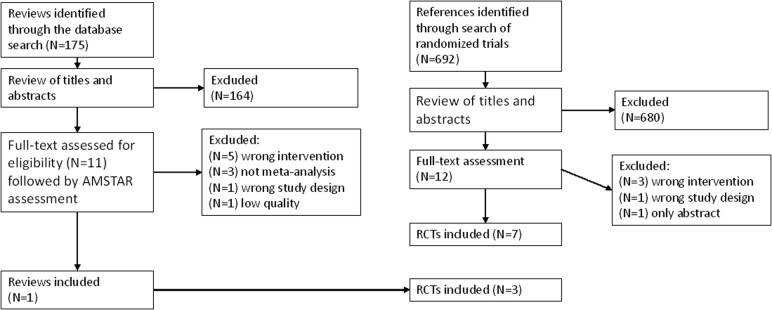
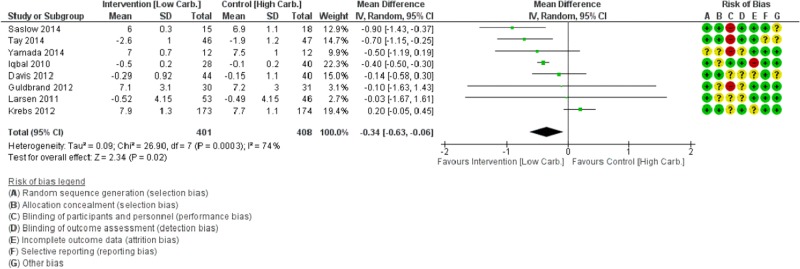
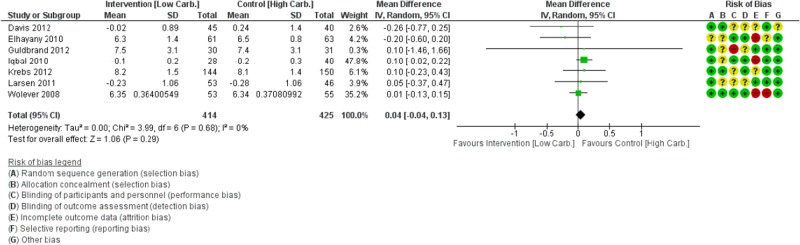
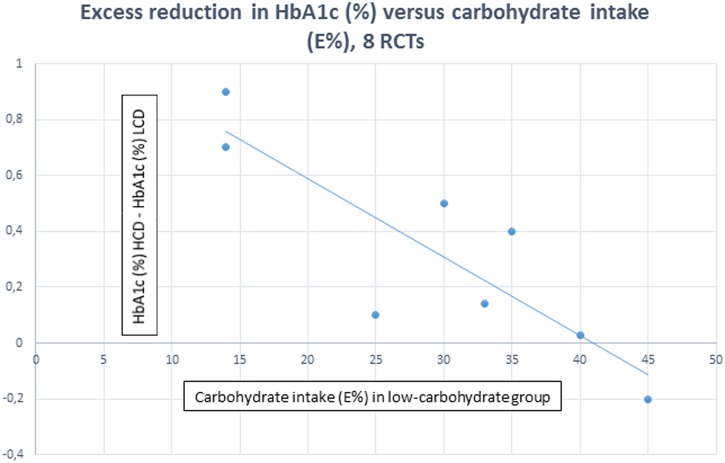
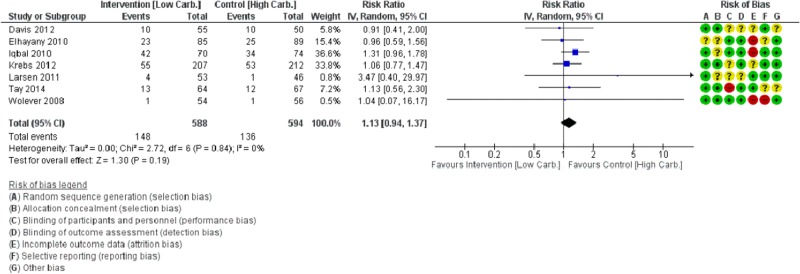
Objective: Nutrition therapy is an integral part of self-management education in patients with type 2 diabetes. Carbohydrates with a low glycemic index are recommended, but the ideal amount of carbohydrate in the diet is unclear. We performed a meta-analysis comparing diets containing low to moderate amounts of carbohydrate (LCD) (energy percentage below 45%) to diets containing high amounts of carbohydrate (HCD) in subjects with type 2 diabetes. Research design and methods: We systematically reviewed Cochrane library databases, EMBASE, and MEDLINE in the period 2004–2014 for guidelines, meta-analyses, and randomized trials assessing the outcomes HbA1c, BMI, weight, LDL cholesterol, quality of life (QoL), and attrition. Results: We identified 10 randomized trials comprising 1376 participants in total. In the first year of intervention, LCD was followed by a 0.34% lower HbA1c (3.7 mmol/mol) compared with HCD (95% CI 0.06 (0.7 mmol/mol), 0.63 (6.9 mmol/mol)). The greater the carbohydrate restriction, the greater the glucose-lowering effect (R=−0.85, p<0.01). At 1 year or later, however, HbA1c was similar in the 2 diet groups. The effect of the 2 types of diet on BMI/body weight, LDL cholesterol, QoL, and attrition rate was similar throughout interventions. Limitations: Glucose-lowering medication, the nutrition therapy, the amount of carbohydrate in the diet, glycemic index, fat and protein intake, baseline HbA1c, and adherence to the prescribed diets could all have affected the outcomes. Conclusions: Low to moderate carbohydrate diets have greater effect on glycemic control in type 2 diabetes compared with high-carbohydrate diets in the first year of intervention. The greater the carbohydrate restriction, the greater glucose lowering, a relationship that has not been demonstrated earlier. Apart from this lowering of HbA1c over the short term, there is no superiority of low-carbohydrate diets in terms of glycemic control, weight, or LDL cholesterol.
Overview
The claims and statistics of this paper haven’t been checked yet.
Free: it reads the open-access text and checks the first 5 claims that cite a source we can check. Create a free account to check every claim.
Integrity signals
Registry
Cites
Statistics
Figures
Verification
Claims the paper makes
The claims and statistics of this paper haven’t been checked yet.
Free: it reads the open-access text and checks the first 5 claims that cite a source we can check. Create a free account to check every claim.
Claims other papers make about this one
Each is checked against this paper’s own text: does it say what the citing paper says it does?
The source backs part of the claim, not all of it — or backs it for a different population, condition or comparison.
In the citing paper
“A net energy de fi cit that can be maintained is important for weight loss (5,6,22,72 -74).”
From Management of Hyperglycemia in Type 2 Diabetes, 2022. A Consensus Report by the American Diabetes Association (ADA) and the European Association for the Study of Diabetes (EASD) (2022) · cites this paper as [73]
Experimental — accuracy not yet measuredThe source backs part of the claim, not all of it — or backs it for a different population, condition or comparison.
In the citing paper
“For individuals with type 2 diabetes not meeting glycemic targets or for whom reducing glucose-lowering drugs is a priority, reducing overall carbohydrate intake with a low-or verylow-carbohydrate eating pattern is a viable option (137-139).”
From 5. Facilitating Positive Health Behaviors and Well-being to Improve Health Outcomes:Standards of Care in Diabetes—2023 (2023) · cites this paper as [139]
Experimental — accuracy not yet measuredThe source backs part of the claim, not all of it — or backs it for a different population, condition or comparison.
In the citing paper
“Low carbohydrate diets (LCD) have shown efficacy in managing clinical outcomes in type 2 diabetes (T2D).”
From mHealth low carbohydrate dietary intervention ameliorates glycaemic profile, blood pressure and weight status in people with type 2 diabetes (2025) · cites this paper as [5]
Experimental — accuracy not yet measuredThe source backs part of the claim, not all of it — or backs it for a different population, condition or comparison.
In the citing paper
“Research evidence shows that the prescription of a low carbohydrate diet (LCD) for management of T2D improves glycaemic control, reduces the need for medications, assists with weight loss, and may improve blood lipid concentrations5–9.”
From mHealth low carbohydrate dietary intervention ameliorates glycaemic profile, blood pressure and weight status in people with type 2 diabetes (2025) · cites this paper as [5]
Experimental — accuracy not yet measured
11 more claims about this paper
Create a free account to see every claim other papers make about this one.
Self-check
Percentages, sums and reported differences re-computed from the paper’s own numbers.
The self-check needs the paper’s full text.
Citations
Cites
Development of AMSTAR: A measurement tool to assess the methodological quality of systematic reviews
Shea, B. J., Grimshaw, J. M., Wells, G. A., Boers, M., Andersson, N., Hamel, C., Porter, A. C., Tugwell, P., Moher, D., & Bouter, L. M. (2007) · BMC Medical Research Methodology · doi:10.1186/1471-2288-7-10 · Cited by 4,374
AGREE II: advancing guideline development, reporting and evaluation in health care
Brouwers, M. C., Kho, M. E., Browman, G. P., Burgers, J. S., Cluzeau, F., Feder, G., Fervers, B., Graham, I. D., Grimshaw, J., Hanna, S. E., et al. (2010) · Canadian Medical Association Journal · doi:10.1503/cmaj.090449 · Cited by 3,790
Human gut microbes impact host serum metabolome and insulin sensitivity
Pedersen, H. K., Gudmundsdottir, V., Nielsen, H. B., Hyotylainen, T., Nielsen, T., Jensen, B. A. H., Forslund, K., Hildebrand, F., Prifti, E., Falony, G., et al. (2016) · Nature · doi:10.1038/nature18646 · Cited by 2,116 · cited 1×
“16 22 Apart from a lowering of the daily glycemic challenge, an initial hypoglycemic effect of LCD followed by an attenuation of the efficacy could also be due to changes in gut microbiota as a consequence of the altered carbohydrate intake followed by gradual adaptive mechanisms.(28) Our findings and recent trials su…”
BackgroundNutrition therapy recommendations for the management of adults with diabetes
Evert, A. B., Boucher, J. L., Cypress, M., Dunbar, S. A., Franz, M. J., Mayer-Davis, E. J., Neumiller, J. J., Nwankwo, R., Verdi, C. L., Urbanski, P., et al. (2013) · Diabetes Care · doi:10.2337/dc13-2042 · Cited by 1,129 · cited 1×
“▪ The greater the carbohydrate restriction, the greater glucose lowering.”
BackgroundFeinman, R. D., Pogozelski, W. K., Astrup, A., Bernstein, R. K., Fine, E. J., Westman, E. C., Accurso, A., Frassetto, L., Gower, B. A., McFarlane, S. I., et al. (2015) · Nutrition · doi:10.1016/j.nut.2014.06.011 · Cited by 912 · cited 2×
“▪ Apart from improvements in HbA1c over the short term, there is no superiority of low-carbohydrate diets in terms of glycemic control, weight, or LDL cholesterol.”
BackgroundSelf-citationAjala, O., English, P., & Pinkney, J. (2013) · The American Journal of Clinical Nutrition · doi:10.3945/ajcn.112.042457 · Cited by 821 · cited 2×
“The predefined criteria for entering the analysis and the issues we address were fulfilled in only one high-quality review.(6) Furthermore, only part of this review was relevant for the present analysis, so we entered data from individual studies rather than using estimates from the review.”
MethodBueno, N. B., de Melo, I. S. V., de Oliveira, S. L., & da Rocha Ataide, T. (2013) · British Journal of Nutrition · doi:10.1017/s0007114513000548 · Cited by 778
Nutrition therapy recommendations for the management of adults with diabetes
Evert, A. B., Boucher, J. L., Cypress, M., Dunbar, S. A., Franz, M. J., Mayer-Davis, E. J., Neumiller, J. J., Nwankwo, R., Verdi, C. L., Urbanski, P., et al. (2014) · Diabetes Care · doi:10.2337/dc14-s120 · Cited by 766
Westman, E. C., Yancy, W. S., Mavropoulos, J. C., Marquart, M., & McDuffie, J. R. (2008) · Nutrition & Metabolism · doi:10.1186/1743-7075-5-36 · Cited by 475 · cited 2×
“Dropout rates at longest follow-up were similar in the two groups ( fi gure 5).”
BackgroundComparison of low- and high-carbohydrate diets for type 2 diabetes management: a randomized trial
Tay, J., Luscombe-Marsh, N. D., Thompson, C. H., Noakes, M., Buckley, J. D., Wittert, G. A., Yancy, W. S., & Brinkworth, G. D. (2015) · The American Journal of Clinical Nutrition · doi:10.3945/ajcn.115.112581 · Cited by 341 · cited 1×
“However, this problem cannot be solved.”
Wolever, T. M., Gibbs, A. L., Mehling, C., Chiasson, J.-L., Connelly, P. W., Josse, R. G., Leiter, L. A., Maheux, P., Rabasa-Lhoret, R., Rodger, N. W., et al. (2008) · The American Journal of Clinical Nutrition · doi:10.1093/ajcn/87.1.114 · Cited by 333 · cited 1×
“The dropout rates differed considerably between studies, ranging from 2% to 60% in the LCD groups and from 2% to 46% in the HCD groups.”
BackgroundHall, K. D., Chen, K. Y., Guo, J., Lam, Y. Y., Leibel, R. L., Mayer, L. E., Reitman, M. L., Rosenbaum, M., Smith, S. R., Walsh, B. T., et al. (2016) · The American Journal of Clinical Nutrition · doi:10.3945/ajcn.116.133561 · Cited by 330 · cited 1×
“This is consistent with recent studies showing that LCD does not increase energy expenditure to a relevant extent.(30) Waist circumference was not included in the present analysis, but did not differ between groups in the individual studies where it was measured.”
ResultElhayany, A., Lustman, A., Abel, R., Attal‐Singer, J., & Vinker, S. (2010) · Diabetes, Obesity and Metabolism · doi:10.1111/j.1463-1326.2009.01151.x · Cited by 298
A Very Low-Carbohydrate, Low–Saturated Fat Diet for Type 2 Diabetes Management: A Randomized Trial
Tay, J., Luscombe-Marsh, N. D., Thompson, C. H., Noakes, M., Buckley, J. D., Wittert, G. A., Yancy, W. S., & Brinkworth, G. D. (2014) · Diabetes Care · doi:10.2337/dc14-0845 · Cited by 260 · cited 1×
“The dropout rates differed considerably between studies, ranging from 2% to 60% in the LCD groups and from 2% to 46% in the HCD groups.”
BackgroundDavis, N. J., Tomuta, N., Schechter, C., Isasi, C. R., Segal-Isaacson, C. J., Stein, D., Zonszein, J., & Wylie-Rosett, J. (2009) · Diabetes Care · doi:10.2337/dc08-2108 · Cited by 256
Naude, C. E., Schoonees, A., Senekal, M., Young, T., Garner, P., & Volmink, J. (2014) · PLoS ONE · doi:10.1371/journal.pone.0100652 · Cited by 252
Saslow, L. R., Kim, S., Daubenmier, J. J., Moskowitz, J. T., Phinney, S. D., Goldman, V., Murphy, E. J., Cox, R. M., Moran, P., & Hecht, F. M. (2014) · PLoS ONE · doi:10.1371/journal.pone.0091027 · Cited by 221 · cited 4×
“Scores were not significantly different between groups using the Diabetes-39 questionnaire(24) or other questionnaires.(18) 20 There were no differences between groups in reported adverse events, cardiovascular events, or mortality.”
BackgroundMethodInfluentialLarsen, R. N., Mann, N. J., Maclean, E., & Shaw, J. E. (2011) · Diabetologia · doi:10.1007/s00125-010-2027-y · Cited by 197 · cited 1×
“The dropout rates differed considerably between studies, ranging from 2% to 60% in the LCD groups and from 2% to 46% in the HCD groups.”
BackgroundGuldbrand, H., Dizdar, B., Bunjaku, B., Lindström, T., Bachrach-Lindström, M., Fredrikson, M., Östgren, C. J., & Nystrom, F. H. (2012) · Diabetologia · doi:10.1007/s00125-012-2567-4 · Cited by 189 · cited 3×
“Results from some of the trials included in the present analysis suggest that the lack of consistency of the effect of LCD could be related to a decline in dietary adherence over time.(15) 16 22 Apart from a lowering of the daily glycemic challenge, an initial hypoglycemic effect of LCD followed by an attenuation of t…”
BackgroundMethodResultInfluentialKodama, S., Saito, K., Tanaka, S., Maki, M., Yachi, Y., Sato, M., Sugawara, A., Totsuka, K., Shimano, H., Ohashi, Y., et al. (2009) · Diabetes Care · doi:10.2337/dc08-1716 · Cited by 160 · cited 1×
“18 20 There were no differences between groups in reported adverse events, cardiovascular events, or mortality.”
BackgroundIqbal, N., Vetter, M. L., Moore, R. H., Chittams, J. L., Dalton‐Bakes, C. V., Dowd, M., Williams‐Smith, C., Cardillo, S., & Wadden, T. A. (2010) · Obesity · doi:10.1038/oby.2009.460 · Cited by 144 · cited 1×
“However, this problem cannot be solved.”
Krebs, J. D., Elley, C. R., Parry-Strong, A., Lunt, H., Drury, P. L., Bell, D. A., Robinson, E., Moyes, S. A., & Mann, J. I. (2012) · Diabetologia · doi:10.1007/s00125-012-2461-0 · Cited by 137 · cited 2×
“Two trials measured QoL by means of SF-36 questionnaires.(16) 25 Physical component score tended to deteriorate during LCD compared with HCD (−1.”
BackgroundMethodYamada, Y., Uchida, J., Izumi, H., Tsukamoto, Y., Inoue, G., Watanabe, Y., Irie, J., & Yamada, S. (2014) · Internal Medicine · doi:10.2169/internalmedicine.53.0861 · Cited by 133 · cited 3×
“15 17 One study did not report changes in medication, but found symptomatic hypoglycemia in three subjects treated with LCD.(20) LCD and HCD had similar effects on LDL cholesterol throughout interventions (table 2).”
BackgroundMethodInfluentialA critical review of low‐carbohydrate diets in people with Type 2 diabetes
van Wyk, H. J., Davis, R. E., & Davies, J. S. (2016) · Diabetic Medicine · doi:10.1111/dme.12964 · Cited by 105 · cited 2×
“A recent review of the literature(26) did not perform meta-analysis of the available HbA1c data due to a large heterogeneity in the carbohydrate intake in the intervention groups, and other meta-analyses have either shown a numerically greater reduction in HbA1c,(6) 7 or no effect in type 2 diabetes.(9) A recent 52-we…”
BackgroundAtherogenicity of postprandial hyperglycemia and lipotoxicity
Ceriello, A., & Genovese, S. (2016) · Reviews in Endocrine and Metabolic Disorders · doi:10.1007/s11154-016-9341-8 · Cited by 86 · cited 1×
“However, the effect on glycemic control is limited and the importance of glucose excursions in the pathogenesis of cardiovascular complications in diabetes is still under debate.(29) Overall, and given the heterogeneity of the HbA1c estimate and other potential bias, the present evidence is insufficient to support LCD…”
BackgroundLow Carbohydrate Diets and Type 2 Diabetes: What is the Latest Evidence?
Dyson, P. (2015) · Diabetes Therapy · doi:10.1007/s13300-015-0136-9 · Cited by 79
Brinkworth, G. D., Luscombe‐Marsh, N. D., Thompson, C. H., Noakes, M., Buckley, J. D., Wittert, G., & Wilson, C. J. (2016) · Journal of Internal Medicine · doi:10.1111/joim.12501 · Cited by 54 · cited 1×
“A recent randomized trial with QoL as the primary outcome found equal improvement of Diabetes-39 questionnaire and problem areas in diabetes (PAID).(31) However, most of the elements, including energy and mobility, tended to improve more in the low-fat HCD group (SF-39).”
MethodGuldbrand, H., Lindström, T., Dizdar, B., Bunjaku, B., Östgren, C. J., Nystrom, F. H., & Bachrach-Lindström, M. (2014) · Diabetes Research and Clinical Practice · doi:10.1016/j.diabres.2014.08.032 · Cited by 53
A review of low and reduced carbohydrate diets and weight loss in type 2 diabetes
Dyson, P. A. (2008) · Journal of Human Nutrition and Dietetics · doi:10.1111/j.1365-277x.2008.00896.x · Cited by 49
Diabetes-specific Quality of Life After a Low-carbohydrate and Low-fat Dietary Intervention
Davis, N. J., Tomuta, N., Isasi, C. R., Leung, V., & Wylie‐Rosett, J. (2012) · The Science of Diabetes Self-Management and Care · doi:10.1177/0145721711436132 · Cited by 29 · cited 1×
“In two of the included RCTs, the QoL data were located in separate papers.(24) 25”
Background
Research works printed but not linked: 1
- Covidence. Covidence systematic review software, Veritas Health Innovation. Melbourne, Australia http://www.covidence.org
Cited by
Cosentino, F., Grant, P. J., Aboyans, V., Bailey, C. J., Ceriello, A., Delgado, V., Federici, M., Filippatos, G., Grobbee, D. E., Hansen, T. B., et al. (2020) · European Heart Journal · doi:10.1093/eurheartj/ehz486 · Cited by 4,763
Davies, M. J., D’Alessio, D. A., Fradkin, J., Kernan, W. N., Mathieu, C., Mingrone, G., Rossing, P., Tsapas, A., Wexler, D. J., & Buse, J. B. (2018) · Diabetes Care · doi:10.2337/dci18-0033 · Cited by 3,518
Davies, M. J., Aroda, V. R., Collins, B. S., Gabbay, R. A., Green, J., Maruthur, N. M., Rosas, S. E., Del Prato, S., Mathieu, C., Mingrone, G., et al. (2022) · Diabetes Care · doi:10.2337/dci22-0034 · Cited by 2,104
Nutrition Therapy for Adults With Diabetes or Prediabetes: A Consensus Report
Evert, A. B., Dennison, M., Gardner, C. D., Garvey, W. T., Lau, K. H. K., MacLeod, J., Mitri, J., Pereira, R. F., Rawlings, K., Robinson, S., et al. (2019) · Diabetes Care · doi:10.2337/dci19-0014 · Cited by 1,496
Davies, M. J., D’Alessio, D. A., Fradkin, J., Kernan, W. N., Mathieu, C., Mingrone, G., Rossing, P., Tsapas, A., Wexler, D. J., & Buse, J. B. (2018) · Diabetologia · doi:10.1007/s00125-018-4729-5 · Cited by 1,455
Metadata
- Authors
- Snorgaard, O., Poulsen, G. M., Andersen, H. K., & Astrup, A.
- Affiliations
- Hvidovre Hospital (DK)
- University of Copenhagen (DK)
- Bispebjerg Hospital (DK)
- Corresponding author
- Snorgaard, Ole
- ORCID
- Astrup, Arne
- Venue
- BMJ Open Diabetes Research & Care
- Publisher
- BMJ
- Published
- 2017-02
- Volume
- 5
- Issue
- 1
- Pages
- e000354
- ISSN
- 2052-4897 (ISSN-L)
- PMC
- PMC5337734
- OpenAlex
- W2589779601
- Semantic Scholar
- 9bb5ebd233cc8d34068bcecf8eed799f002961a8
- Cited by
- 351
- References
- 30
- Citations by year
- 2026: 17 · 2025: 26 · 2024: 28 · 2023: 32 · 2022: 46 · 2021: 45 · 2020: 46 · 2019: 55 · 2018: 41 · 2017: 14
- FWCI
- 5.24
- Type
- journal article
- Language
- en
- Open access
- gold
- doi.org
- Licence
- cc-by-nc
- Locations
- BMJ Open Diabetes Research & Care (publishedVersion, cc-by-nc)
- Europe PMC (PubMed Central) (publishedVersion, cc-by-nc)
- PubMed Central (publishedVersion, cc-by-nc)
- PubMed (publishedVersion)
- Research at the University of Copenhagen (University of Copenhagen) (publishedVersion, cc-by-nc)
- Topics
- Health Sciences › Medicine › Physiology (medical) › Diet and metabolism studies
- Health Sciences › Medicine › Physiology (medical) › Dietary Effects on Health
- Health Sciences › Medicine › Endocrinology, Diabetes and Metabolism › Diabetes Management and Research
- Keywords
- type 2 diabetes, carbohydrate restriction, low-carbohydrate diet, high-carbohydrate diet, glycemic control, HbA1c, weight, LDL cholesterol, quality of life, attrition, nutritional therapy
About these checks
Registry, retraction, Cites and statistics results are computed, not judged, with one exception: a printed reference that no index lists is read once by a model before it counts as a citation error. Claims are extracted by a model and kept only when their quote appears verbatim in the text; each cited source is then checked, with a model’s help, for whether it says what the claim relies on. Those verdicts can be wrong — read the claim’s quote and the cited source before relying on one.
Statistics and arithmetic are recomputed, not judged.
Confidence bands are shown only for fields calibrated on our annotated test set. None is calibrated yet, so no band is shown.
What counts as a claim ›How we measure confidence ›How we check this ›
Are you an author, or do you see a problem with this page? Request a review
Data sources
Bibliographic data: Semantic Scholar, OpenAlex, Crossref.
Contains information from the Semantic Scholar Academic Graph Datasets, made available under the ODC Attribution License (ODC-BY 1.0).
Semantic Scholar’s data is described in: Kinney, R., et al. (2023). The Semantic Scholar Open Data Platform. arXiv:2301.10140.
