

Determinants of adherence to antiretroviral therapy among HIV-positive adults in sub-Saharan Africa: a systematic review
Open accessThe DOI matches its Crossref record; 193 of the 204 references it cites were found in a registry or an index; 3 of the 7 sources its claims cite were checked for support.
Abstract
OBJECTIVE: The rapid scale up of antiretroviral treatment (ART) in sub-Saharan Africa (SSA) has resulted in an increased focus on patient adherence. Non-adherence can lead to drug-resistant HIV caused by failure to achieve maximal viral suppression. Optimal treatment requires the identification of patients at high risk of suboptimal adherence and targeted interventions. The aim of this review was to identify and summarise determinants of adherence to ART among HIV-positive adults. DESIGN: Systematic review of adherence to ART in SSA from January 2002 to October 2014. METHODS: A systematic search was performed in 6 databases (PubMed, Cochrane Library, EMBASE, Web of Science, Popline, Global Health Library) for qualitative and quantitative articles. Risk of bias was assessed. A meta-analysis was conducted for pooled estimates of effect size on adherence determinants. RESULTS: Of the 4052 articles screened, 146 were included for final analysis, reporting on determinants of 161 922 HIV patients with an average adherence score of 72.9%. Main determinants of non-adherence were use of alcohol, male gender, use of traditional/herbal medicine, dissatisfaction with healthcare facility and healthcare workers, depression, discrimination and stigmatisation, and poor social support. Promoters of adherence included counselling and education interventions, memory aids, and active disclosure among people living with HIV. Determinants of health status had conflicting influence on adherence. CONCLUSIONS: The sociodemographic, psychosocial, health status, treatment-related and intervention-related determinants are interlinked and contribute to optimal adherence. Clinics providing ART in SSA should therefore design targeted interventions addressing these determinants to optimise health outcomes.
Overview
CoChat Summary
## TL;DR
This systematic review of studies from sub-Saharan Africa found that ART adherence is shaped by interlinked sociodemographic, psychosocial, treatment-related, health-status, and intervention-related factors. Across 146 included articles on 161,922 patients, the most consistent barriers were alcohol use, male gender, traditional/herbal medicine use, poor patient–provider experiences, depression, discrimination/stigma, and poor social support.
## Key findings
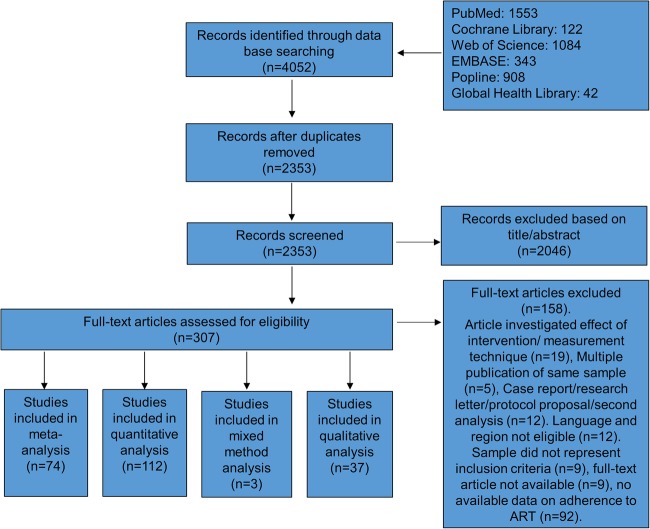
- Of 4,052 articles screened, 146 were included in the final analysis; these reported on 161,922 HIV patients and an average adherence score of 72.9% (using the paper’s 95% adherence definition). The average adherence rate was also reported as 52.5% when adherence was defined as 100%.
- Main determinants of non-adherence were alcohol use, male gender, use of traditional/herbal medicine, dissatisfaction with healthcare facilities and healthcare workers, depression, discrimination and stigmatisation, and poor social support.
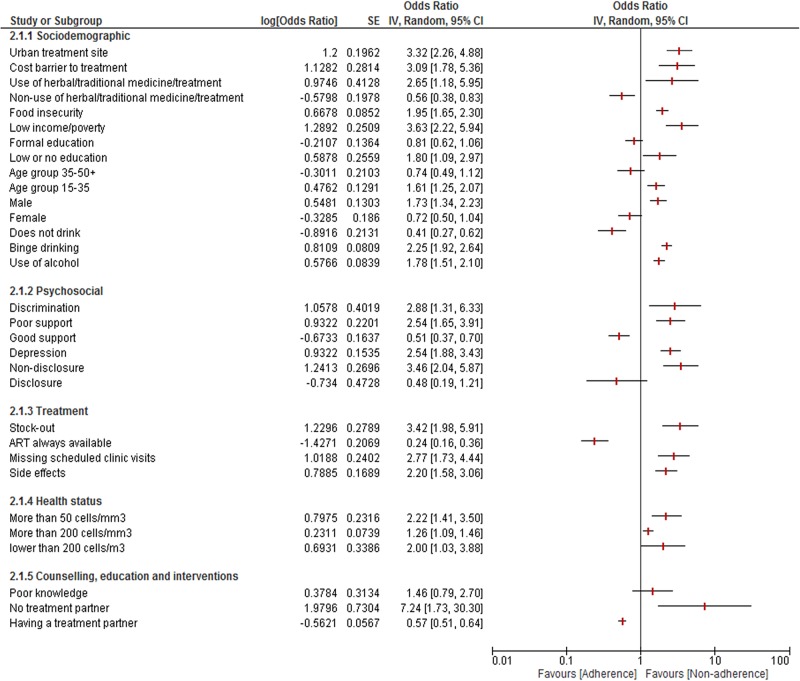
- Meta-analysis found non-adherence was associated with alcohol use (OR=1.78; 95% CI 1.51 to 2.09), binge drinking (OR=2.25; 95% CI 1.92 to 2.65), male gender (OR=1.73; 95% CI 1.34 to 2.23), younger age 15–35 years (OR=1.61; 95% CI 1.25 to 2.06), and use of herbal/traditional medicine/treatment (OR=2.65; 95% CI 1.18 to 5.95).
- Promoters of adherence included reliable ART availability (OR=0.24; 95% CI 0.16 to 0.37), good social support (OR=0.51; 95% CI 0.37 to 0.71), having a treatment partner (OR=0.57; 95% CI 0.51 to 0.64), and counselling/education, memory aids, and active disclosure.
## Methods
- Systematic review conducted per PRISMA and the Cochrane Handbook, with protocol registered in PROSPERO (CRD42014014476); search covered January 2002 to 27 October 2014.
- Searched 6 databases: PubMed/MEDLINE, Cochrane Library, EMBASE, Web of Science, POPLINE, and Global Health Library; included qualitative, quantitative, and mixed-methods studies of HIV-positive adults (≥15 years) receiving ART in sub-Saharan Africa.
- Risk of bias was assessed separately for quantitative and qualitative studies; meta-analysis pooled effect sizes (ORs/RRs) for determinants reported in at least two studies, with heterogeneity assessed using I².
## Limitations
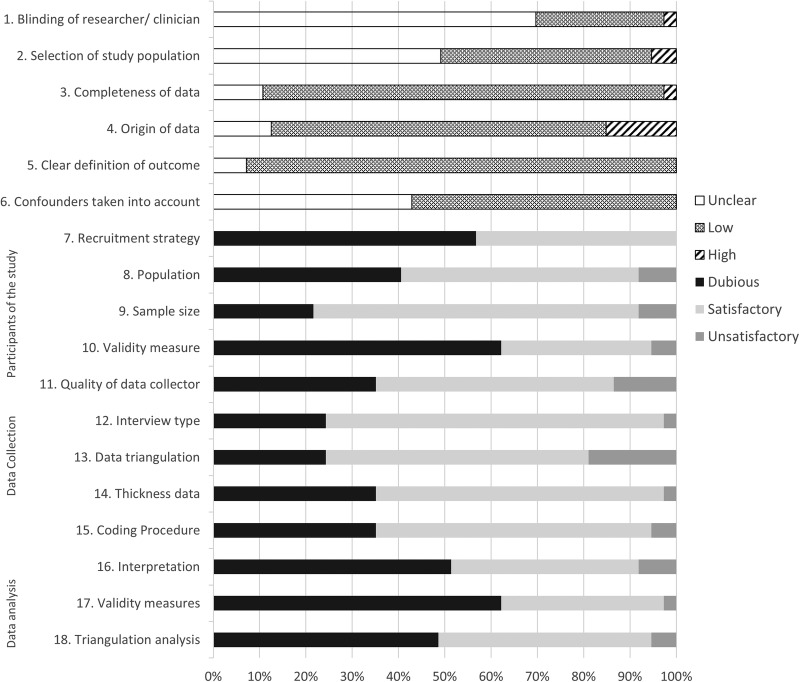
- The paper states that inference is limited by the quality of the underlying studies, including limited consideration of confounders; it also notes that data extraction was done mostly by one reviewer, which could have introduced bias.
- The paper states there was significant heterogeneity in adherence definitions, participant inclusion criteria, and adherence measurement methods across studies, and no gold standard measure was used.
- Evident from the text: not all included studies were suitable for meta-analysis because some lacked complete risk estimates, so several determinants were summarized narratively rather than quantitatively.
Model-written summary. Check it against the paper before relying on it.
Integrity signals
Registry
Cites
Statistics
Figures
Verification
Claims the paper makes
2 Valid · 1 Not valid · 29 Not checked · 40 Own results and interpretations
The cited sources support only part of this claim — read each source’s verdict below.
In the paper
“Studies on ART adherence showed that predictors and risk factors differ per region of the world, necessitating context-specific development of non-adherence profiles.9 10”
§ Determinants of adherence to antiretroviral therapy among HIV-positive adults in sub-Saharan Africa: a systematic review > Introduction
What the sources say
- Partly supportedcites [9] Ware NC, Idoko J, Kaaya S Explaining adherence success in sub-Saharan Africa: an ethnographic study. PLoS Med 2009; 6: e11 10.1371/journal.pmed.1000011 19175285 PMC2631046 sourceExperimental — accuracy not yet measured
The Discussion contrasts economic obstacles and social relationships in sub-Saharan Africa with an individual-level account of adherence in North America, and describes a theory of differences between resource-poor and resource-rich settings. This supports context-dependent influences on adherence, but the paper does not establish that predictors and risk factors differ across regions of the world generally. The call for context-specific non-adherence profiles is the citing authors’ inference, not a finding reported in this paper. (LLM, conf=0.83)
- Not checked — no full text of the sourcecites [10] Mills EJ, Nachega JB, Buchan I Adherence to antiretroviral therapy in sub-Saharan Africa and North America: a meta-analysis. JAMA 2006; 296: 679– 90. 10.1001/jama.296.6.679 16896111 source
plainstates an association- Asserted: passes — The authors put it forward as true.
- Checkable: passes — It can be checked against evidence.
- Load-bearing: passes — The paper’s conclusions depend on it.
- Based: passes — The paper gives a reason why it holds.
- Partly supported
Every source the paper cites for this claim was checked and supports it.
In the paper
“For a comprehensive overview, both qualitative and quantitative studies were included,12 as qualitative studies may identify key themes not found, described or discussed in larger quantitative studies.”
§ Determinants of adherence to antiretroviral therapy among HIV-positive adults in sub-Saharan Africa: a systematic review > Introduction
What the sources say
- Supportedcites [12] Mills E, Nachega J, Bangsberg D Adherence to HAART: a systematic review of developed and developing nation patient-reported barriers and facilitators. PLoS Med 2006; 3: 2039– 64. PMC1637123 17121449 source
The Discussion reports that the review identified key themes in qualitative studies that larger quantitative studies had not examined. The Results give examples of barriers and facilitators described in qualitative studies but absent from the quantitative studies. (LLM, conf=0.94)
hedgedstates a possible cause- Asserted: passes — The authors put it forward as true.
- Checkable: passes — It can be checked against evidence.
- Load-bearing: passes — The paper’s conclusions depend on it.
- Based: passes — The paper gives a reason why it holds.
- Supported
None of the sources cited for this claim have been checked yet.
In the paper
“Lower levels of education corresponded with non-adherence,42 45 52 53 56 57 and higher adherence was observed among patients with formal education.58–60”
§ Determinants of adherence to antiretroviral therapy among HIV-positive adults in sub-Saharan Africa: a systematic review > Results > Determinants of (non-)adherence
plainstates an association- Asserted: passes — The authors put it forward as true.
- Checkable: passes — It can be checked against evidence.
- Load-bearing: unclear — It is unclear whether the paper’s conclusions depend on it.
- Based: passes — The paper gives a reason why it holds.
None of the sources cited for this claim have been checked yet.
In the paper
“low or no education (OR=1.80; 95% CI 1.09 to 2.98; I2=81%),30 75 78 93 97 114 118”
§ Determinants of adherence to antiretroviral therapy among HIV-positive adults in sub-Saharan Africa: a systematic review > Results > Sociodemographic and socioeconomic factors
plainstates an association- Asserted: passes — The authors put it forward as true.
- Checkable: passes — It can be checked against evidence.
- Load-bearing: passes — The paper’s conclusions depend on it.
- Based: passes — The paper gives a reason why it holds.
51 more claims
Create a free account to see all 72 claims and every source verdict.
- Probably not a substantial claim. 11
- It may state two separate claims as one. 6
Claims other papers make about this one
Each is checked against this paper’s own text: does it say what the citing paper says it does?
The source backs part of the claim, not all of it — or backs it for a different population, condition or comparison.
In the citing paper
“We used the Center for Adherence Support Evaluation (CASE) adherence index [33, 34], a scale that has been widely used in sub-Saharan Africa to measure adherence to ART [34–36].”
From Associations Between Patterns of Alcohol Use and Viral Load Suppression Amongst Women Living with HIV in South Africa (2021) · cites this paper as [35]
Experimental — accuracy not yet measuredThe cited source says what the claim attributes to it.
In the citing paper
“However, failure to disclose one’s HIV status has been associated with poor adherence to ART [43].”
From Echoes of old HIV paradigms: reassessing the problem of engaging men in HIV testing and treatment through women’s perspectives (2017) · cites this paper as [43]
Citations
Cites
Preferred Reporting Items for Systematic Reviews and Meta-Analyses: the PRISMA statement
Moher, D., Liberati, A., Tetzlaff, J., Altman, D. G., & for the PRISMA Group (2009) · BMJ · doi:10.1136/bmj.b2535 · Cited by 83,823
Preferred Reporting Items for Systematic Reviews and Meta-Analyses: The PRISMA Statement
Moher, D., Liberati, A., Tetzlaff, J., Altman, D. G., & The PRISMA Group (2009) · PLoS Medicine · doi:10.1371/journal.pmed.1000097 · Cited by 64,042
Wang, G., Ma, R., Qiao, G., Wada, K., Aizawa, Y., & Satoh, T. (2015) · Integrative Medicine International · doi:10.1159/000368408 · Cited by 18,657
Suñé, P., Suñé, J. M., & Montoro, J. B. (2013) · PLoS ONE · doi:10.1371/journal.pone.0054583 · Cited by 1,687
A Selected Core Microbiome Drives the Early Stages of Three Popular Italian Cheese Manufactures
De Filippis, F., La Storia, A., Stellato, G., Gatti, M., & Ercolini, D. (2014) · PLoS ONE · doi:10.1371/journal.pone.0089680 · Cited by 1,398
Adherence to Antiretroviral Therapy in Sub-Saharan Africa and North America: A Meta-analysis
Mills, E. J., Nachega, J. B., Buchan, I., Orbinski, J., Attaran, A., Singh, S., Rachlis, B., Wu, P., Cooper, C., Thabane, L., et al. (2006) · JAMA · doi:10.1001/jama.296.6.679 · Cited by 899 · cited 1×
“9 10 This will enable healthcare providers to offer tailored care for patients at risk of non-adherence.”
BackgroundMills, E. J., Nachega, J. B., Bangsberg, D. R., Singh, S., Rachlis, B., Wu, P., Wilson, K., Buchan, I., Gill, C. J., & Cooper, C. (2006) · PLoS Medicine · doi:10.1371/journal.pmed.0030438 · Cited by 818 · cited 1×
“satisfaction with a healthcare provider may be more important in SSA countries with a low and medium Human Development Index,(11) as well as issues of access to healthcare, impact of financial constraints, and disruption of services and medication distribution.(12) A strength of this systematic review is our mixed-”
BackgroundPreferred Reporting Items for Systematic Reviews and Meta-Analyses
Vrabel, M. (2015) · Oncology Nursing Forum · doi:10.1188/15.onf.552-554 · Cited by 669
Humby, F., Bombardieri, M., Manzo, A., Kelly, S., Blades, M. C., Kirkham, B., Spencer, J., & Pitzalis, C. (2009) · PLoS Medicine · doi:10.1371/journal.pmed.0060001 · Cited by 537
Hunger, waiting time and transport costs: Time to confront challenges to ART adherence in Africa
Hardon, A. P., Akurut, D., Comoro, C., Ekezie, C., Irunde, H. F., Gerrits, T., Kglatwane, J., Kinsman, J., Kwasa, R., Maridadi, J., et al. (2007) · AIDS Care · doi:10.1080/09540120701244943 · Cited by 497
Research works printed but not linked: 5
- Deeks JJ Chapter 9: Analysing data and undertaking. Cochrane Handbook for Systematic Reviews of Interventions Version 510 (updated March 2011) 2011: 1– 43.
- Erah P, Arute J Adherence of HIV/AIDS patients to antiretroviral therapy in a tertiary health facility in Benin City. Afr J Pharm Pharmacol 2008; 2: 145– 52.
- Sow P, Toure K, Coume M Predictors of ART adherence among HIV infected individuals in Dakar, Senegal. J Med Med Sci 2012; 3: 212– 16.
- 10.1186/1742-6405-7-1 · DOI
- 10.1016/S0033-3182(10)70661-7 · doi:10.1016/s0033-3182(10)70661-7
Cited by
Items 301–358 of 358
Musayón-Oblitas, F. Y., Cárcamo, C., Gimbel, S., Echevarria, J. I., & Graña, A. (2023) · Revista Médica Herediana · doi:10.20453/rmh.v33i4.4405 · Cited by 1
“Diversos estudios han determinado que el consumo de alcohol en personas que viven con VIHSIDA (PVVS) se encuentra asociado a una pobre adherencia al TARV (3,4), por lo que la detección del consumo de riesgo de manera precisa y oportuna, para su consecuente abordaje, podría hacer la diferencia en el éxito de la terapia…”
BackgroundIdowu, S., Badru, O. A., Idowu, A. T., et al. (2024) · Families in Society The Journal of Contemporary Social Services · doi:10.1177/10443894231216306
“This finding aligns with the conclusion of an earlier systematic review that poor social support significantly influences non-adherence to ART and vice versa (Heestermans et al., 2016).”
Haeuser, E., Serfes, A. L., Cork, M. A., Yang, M., Abbastabar, H., Abhilash, E. S., Adabi, M., Adebayo, O., Adekanmbi, V., Adeyinka, D. A., et al. (2023) · Figshare · doi:10.6084/m9.figshare.22615336
Educational attainment and chronic HIV treatment adherence in southern and eastern Africa
Chamberlin, S. (2026) · PLoS ONE · doi:10.1371/journal.pone.0348947
“Inconsistent findings from prior research introduce important questions about potential differences in the association between education and HIV treatment adherence across sub-Saharan African countries [3,13].”
InfluentialThe impact of HIV on non-adherence for tamoxifen among women with breast cancer in South AfricaPreprint
Ayeni, O., Chiwambutsa, S., Chen, W. C., et al. (2022) · Research Square · doi:10.21203/rs.3.rs-2028498/v1
Barriers to HIV testing among Cameroonian men : the role of stigma and the impact of Covid-19
Iyok, H. (2021) · Scholars Archive - University at Albany (University at Albany, State University of New York) · doi:10.54014/ke3m-takh · Cited by 2
Madela, E. I. Y., Gregson, C. L., Paruk, F., Burton, A. J., Patel, R., Wilson, H., Habana, F., Manyara, A. M., Mbanjwa, B., Gates, L., et al. (2026) · BMC Infectious Diseases · doi:10.1186/s12879-026-13273-y · Cited by 1
“Women achieving better virological suppression than men has been postulated to be due to biological differences with men having higher levels of viraemia than women [43] and behavioural factors with men having 1.73 times odds of non-adherence than women [44].”
InfluentialBoakye, D. S., Kumah, E., Mubarick, H., Amoah, V. M. K., Adjorlolo, S., & Buabeng, K. O. (2026) · Discover Public Health · doi:10.1186/s12982-026-01729-0
Corley, A. G., Gibbs, S., Chakraborty, N. M., Fields, L., Ackermann, G. C., Coulson, J., Zhang, Y., & Bouanchaud, P. (2025) · Global Health Science and Practice · doi:10.9745/ghsp-d-23-00364
Tezera, T., Wolde, B., Endeshaw, M., et al. (2023) · Research Square · doi:10.21203/rs.3.rs-2561825/v1
Chamane, S. C., Mabaso, M., Reddy, T., Chambale, P., Skhosana, K., Sewpaul, R., Makola, L., Ngcobo, A. S., Mehlomakulu, V., Molopa, L., et al. (2026) · AIDS Research and Treatment · doi:10.1155/arat/7225073
“As observed in other studies, ART nonadherence was higher among the unemployed PLHIV compared to their counterparts [30, 31, 45].”
Ochieng, M., Kikuvi, G. M., & Mokaya, D. (2023) · Global Journal of Health Sciences · doi:10.47604/gjhs.1810
Nyukuri, D., Abongo, M., Mbithi, A., Kundu, C., Mutai, K. K., & Shah, R. (2026) · PLoS ONE · doi:10.1371/journal.pone.0320713
“In Kenya, for example, where 1.4 million people are living with HIV [4], persistent adherence challenges are common due to factors such as pill burden, treatment fatigue, and stigma [5].”
InfluentialFuge, T. G., Tsourtos, G., & Miller, E. R. (2021) · Research Square · doi:10.21203/rs.3.rs-627094/v1
Acceptabilité de l’utilisation de la téléphonie mobile dans la prise en charge du VIH au Togo
Gbeasor‐Komlanvi, F. A., Chokpon, A. C., Zida-Compaore, W. I. C., Sadio, A. J., Bali, L. G., Hounou-Adossi, A. F. E., Mensah, E., Patassi, A., Lepere, P., & Ekouévi, D. K. (2020) · Santé Publique · doi:10.3917/spub.202.0253 · Cited by 3
Enimil, A. K., Ayisi‐Boateng, N. K., Abutiate, S., et al. (2026) · BMC Infectious Diseases · doi:10.1186/s12879-025-12413-0
“One of the most reported determinants of adherence to ARTs is the influence of health-care workers on patients [1].”
InfluentialGoverning Oneself Through HIV Diagnosis to Antiretrovirals
Nkomo, N. (2023) · Qualitative Health Research · doi:10.1177/10497323231159804
“Health and policy discourses place more emphasis on physical survival, often underplaying the real fears and concerns behind delays to enrolment and inadequate adherence to ARVs (Becker et al., 2020; Heestermans et al., 2016; Kagee et al., 2011).”
BackgroundBonle, L. F.-O. T., Nguessan Aimé, B. R. O. U., Yeboue, M. K., Adingra, M. D. G., & Irie-N’guessan, G. (2026) · World Journal of AIDS · doi:10.4236/wja.2026.163009
Growing Up with HIV: (Non)adaptive Processes in Perinatally-Infected Adolescents and Young Adults
Oliveira, C., Teixeira, F., Gonçalves, M., & Maia, Â. (2025) · AIDS and Behavior · doi:10.1007/s10461-025-04979-2
“Barriers to therapeutic adherence extend beyond stigma and discrimination, sociodemographic factors, depressive symptoms, and risky behaviors [ 13].”
Perngmark, P., Sahawiriyasin, O., & Holroyd, E. A. (2025) · Journal of Transcultural Nursing · doi:10.1177/10436596251337069
Mwanza, T., Mapiki, C., & Mubanga, D. (2026) · Research Square · doi:10.21203/rs.3.rs-11084169/v1
Yirdaw, B. A. (2021) · Open University of Cape Town (University of Cape Town) · Cited by 1
Nakaluudhe, J., & Kazembe, L. N. (2025) · Emerging topics in statistics and biostatistics · doi:10.1007/978-3-031-97281-2_4
Luke, A., Owhonda, G. C., & Tobin-West, C. (2022) · International Journal of Community Medicine and Public Health · doi:10.18203/2394-6040.ijcmph20222584
Thahir, S., Morgan, C., Ngimbi, P., Mwandagalirwa, K., Ntambua, S., Matondo, J., Tabala, M., Mbendi, C., Kaba, D. K., Yotebieng, M., et al. (2022) · Research Square · doi:10.21203/rs.3.rs-1146875/v1
Zuo, H., Zhou, Y., Zhang, X., Gao, Y., Meng, J., Zou, X., He, J., Wang, W., Chen, X., & Wang, H. (2026) · BMC Public Health · doi:10.1186/s12889-026-26538-7
“This may be explained by the lack of family support among unmarried individuals, which can lead to social isolation, sadness, and poor medication adherence [30].”
Nutt, C. T., Muyindike, W. R., Nanfuka, V., Komukama, N., Barigye, I. T., Kansiime, L., Tumusiime, J., Omoding, D., Aung, T. N., Stuckwisch, A. M., et al. (2025) · JAIDS Journal of Acquired Immune Deficiency Syndromes · doi:10.1097/qai.0000000000003735
Philip, A. A. (2024) · Queensland University of Technology · doi:10.5204/thesis.eprints.246681 · Cited by 1
Hendricks, L., Young, T., Julies, R. F., Dollie, R., Reshaan, D., & Hannes, K. (2025) · Research Involvement and Engagement · doi:10.1186/s40900-025-00712-4 · Cited by 1
“Adherence to ART for YWLPHIV is strongly related to a range of social, cultural, political, economic, and environmental factors [16, 28, 31, 45].”
COMPLIANCE WITH ANTIRETROVIRAL THERAPY AMONG MSM AT CLINIC X, JAKARTA
Nafisah, L. (2020) · Jurnal Kesehatan Reproduksi · doi:10.22435/kespro.v11i2.3728.137-149 · Cited by 1
“which caused some of them to delay seeking treatment, undergoing traditional and/or spiritual medicine such as herbal medicine and fasting.(16,19)”
BackgroundKabongo, M. M., Philippe, L. N., Sekandi, J. N., Lutumba, P. T., Yabadile, L., Mukendi, C. K., Kasongo, B., Kalonji, A. N., & Haider, M. R. (2025) · Central African Journal of Public Health · doi:10.11648/j.cajph.20251104.17
Using social networks to understand and overcome implementation barriers in the global HIV responsePreprint
Harling, G., & Tsai, A. C. (2019) · doi:10.31235/osf.io/apwcy
Alho, L. M. O., Pires, A. B. D. S., de Lima, L. S., Farias, V. P. N., Prestes, P. B., Barbosa, C. G. D., dos Santos, B. T. S., Alecrim, M. E., Freire, M. C., & Cabral, L. N. (2025) · Oral Surgery · doi:10.1111/ors.12974
Bayesian analysis of the prevalence and determinants of viral load suppression in South Africa
Yilema, S. A., Belay, A. T., Rad, N. N., & Chen, D. (2026) · Discover Public Health · doi:10.1186/s12982-026-02252-y
“However, the differences may also be attributable to behavioral factors; a meta-analysis found that the odds of non-adherence in men were more likely than in women [65].”
Nkundabaza, C., Stamatakis, C. E., Mukamurigo, J., & Ndagijimana, A. (2024) · Research Square · doi:10.21203/rs.3.rs-4575128/v1
Ng’ambi, W. F., Kalaiwo, A., Estill, J. A. M., Orel, E., Adoration, C., Nwosu, K. D., & Keiser, O. (2026) · BMC Women s Health · doi:10.1186/s12905-026-04432-z · Cited by 1
Duut, F. Y., Nfoke, S. P., Ayamga, E., Kwayaja, N., Senoo, D. K. J., Salifu, R. S., Anyorigiya, T., Agongo, G., Abugri, J., & Dassah, S. (2026) · Research Square · doi:10.21203/rs.3.rs-8603324/v1
Altan, A. M. D., Ciccacci, F., Tounkara, M. R., et al. (2025) · Pan African Medical Journal · doi:10.11604/pamj.2025.52.180.46015
“Similarly, a systematic review identified stigma, discrimination, and insufficient social support as primary adherence barriers across sub-Saharan Africa [19].”
Formal educational attainment and HIV treatment adherence in southern and eastern AfricaPreprint
Chamberlin, S. (2025) · medRxiv · doi:10.1101/2025.08.06.25333107
Barros, C. R. D. S., Matsuda, E. M., da Rocha, A. B. M., Lopes, G. I. S. L., Campos, N. C., Brígido, L. F. D. M., Bassichetto, K. C., & Veras, M. A. D. S. M. (2024) · Epidemiologia e Serviços de Saúde · doi:10.1590/s2237-96222024v33e2024412.especial.pt
Tezera, T., Negash, A. Y., Amde, H. S., et al. (2025) · International Journal of Scientific Reports · doi:10.18203/issn.2454-2156.intjscirep20252191
Loss to Follow-Up and Visit Nonadherence in an HIV Incidence Cohort in Kisumu, Kenya
Serti, E., Bartolanzo, D., Frndak, S., Owuoth, J., Yates, A. M., Hamby, T., Nwoga, C., Otieno, J. D., Smith, H. J., Schluck, G., et al. (2025) · JAIDS Journal of Acquired Immune Deficiency Syndromes · doi:10.1097/qai.0000000000003825
Chen, H., Wang, W., Chen, R., et al. (2026) · International Journal of Infectious Diseases · doi:10.1016/j.ijid.2026.108729
Lamichhane, P., Koutentakis, M., Rathi, S., et al. (2023) · Annals of Medicine and Surgery · doi:10.1097/ms9.0000000000001411
“A systematic review from Africa reported that the level of adherence to ART ranged from 44.6 to 72.9% among the patients [5,6] .”
BackgroundInfluentialHaeuser, E., Serfes, A. L., Cork, M. A., Yang, M., Abbastabar, H., Abhilash, E. S., Adabi, M., Adebayo, O. M., Adekanmbi, V., Adeyinka, D. A., et al. (2023) · Figshare · doi:10.6084/m9.figshare.22615321
Gizamba, J. M., Davies, J., Africa, C., Choo-Kang, C., Goedecke, J. H., Madlala, H. P., Lambert, E. V., Rae, D. E., Myer, L., Luke, A., et al. (2024) · Figshare · doi:10.6084/m9.figshare.26651103
Saya, U. Y., MacCarthy, S., Mukasa, B., Wabukala, P., Lunkuse, L., Wagner, Z., & Linnemayr, S. (2022) · Figshare · doi:10.6084/m9.figshare.19905982
Haeuser, E., Serfes, A. L., Cork, M. A., Yang, M., Abbastabar, H., Abhilash, E. S., Adabi, M., Adebayo, O. M., Adekanmbi, V., Adeyinka, D. A., et al. (2023) · Figshare · doi:10.6084/m9.figshare.22615318
Olashore, A. A., Chiliza, B., & Paruk, S. (2023) · Figshare · doi:10.6084/m9.figshare.23740611
Haeuser, E., Serfes, A. L., Cork, M. A., Yang, M., Abbastabar, H., Abhilash, E. S., Adabi, M., Adebayo, O. M., Adekanmbi, V., Adeyinka, D. A., et al. (2023) · Figshare · doi:10.6084/m9.figshare.22615327
Gizamba, J. M., Davies, J., Africa, C., Choo-Kang, C., Goedecke, J. H., Madlala, H. P., Lambert, E. V., Rae, D. E., Myer, L., Luke, A., et al. (2024) · Figshare · doi:10.6084/m9.figshare.26651100
Johnson, L. F., Kubjane, M., de Voux, A., Ohrnberger, J., & Tlali, M. (2023) · Figshare · doi:10.6084/m9.figshare.23804924
Ndenkeh, J. J. N., Nji, A. M., Yumo, H. A., Rothe, C., & Kroidl, A. (2022) · Figshare · doi:10.6084/m9.figshare.21099144
Metadata
- Authors
- Heestermans, T., Browne, J. L., Aitken, S. C., Vervoort, S. C., & Klipstein-Grobusch, K.
- Affiliations
- University Medical Center Utrecht (NL)
- Julius Global Health, Julius Center for Health Sciences and Primary Care, University Medical Center Utrecht, Utrecht, The Netherlands
- Corresponding author
- Browne, Joyce L
- Venue
- BMJ Global Health
- Publisher
- BMJ
- Published
- 2016-12
- Volume
- 1
- Issue
- 4
- Pages
- e000125
- ISSN
- 2059-7908 (ISSN-L)
- PMC
- PMC5321378
- OpenAlex
- W2562073418
- Cited by
- 348
- References
- 204
- Citations by year
- 2026: 22 · 2025: 40 · 2024: 39 · 2023: 43 · 2022: 40 · 2021: 49 · 2020: 41 · 2019: 37 · 2018: 29 · 2017: 7 · 2016: 1
- FWCI
- 3.79
- Type
- journal article
- Language
- en
- Open access
- gold
- doi.org
- Locations
- BMJ Global Health (publishedVersion)
- Europe PMC (PubMed Central) (publishedVersion, other-oa)
- PubMed Central (publishedVersion, cc-by-nc)
- PubMed (publishedVersion)
- Utrecht University Repository (Utrecht University) (submittedVersion, other-oa)
- Topics
- Health Sciences › Medicine › Infectious Diseases › HIV/AIDS Research and Interventions
- Health Sciences › Medicine › Family Practice › Medication Adherence and Compliance
- Health Sciences › Medicine › Infectious Diseases › HIV/AIDS drug development and treatment
- Keywords
- antiretroviral therapy adherence, HIV, sub-Saharan Africa, predictors of adherence, alcohol consumption, depression, stigma and discrimination, social support, memory aids, HIV status disclosure, treatment satisfaction, drug resistance, viral suppression
About these checks
Registry, retraction, Cites and statistics results are computed, not judged, with one exception: a printed reference that no index lists is read once by a model before it counts as a citation error. Claims are extracted by a model and kept only when their quote appears verbatim in the text; each cited source is then checked, with a model’s help, for whether it says what the claim relies on. Those verdicts can be wrong — read the claim’s quote and the cited source before relying on one.
The claim verdicts this report counts are experimental: their accuracy is not yet measured.
A language model drew the claims from the paper on 2026-10-10, under version 3 of the claim definition (model deepseek-v4.1-flash, prompt extract-v3).
A second model labelled each claim on 2026-10-10 (model jev-1.13-20260917, definition revision gold-guideline-v0.2).
Cited sources are checked with a language model’s help (gpt-6-sol).
Statistics and arithmetic are recomputed, not judged.
Confidence bands are shown only for fields calibrated on our annotated test set. None is calibrated yet, so no band is shown.
What counts as a claim ›How we measure confidence ›How we check this ›
Are you an author, or do you see a problem with this page? Request a review
Data sources
Bibliographic data: Semantic Scholar, OpenAlex, Crossref.
Contains information from the Semantic Scholar Academic Graph Datasets, made available under the ODC Attribution License (ODC-BY 1.0).
Semantic Scholar’s data is described in: Kinney, R., et al. (2023). The Semantic Scholar Open Data Platform. arXiv:2301.10140.
