

Corticosteroids and risk of gastrointestinal bleeding: a systematic review and meta-analysis
Open accessThe DOI matches its Crossref record; 28 of the 28 references it cites were found in a registry or an index.
Abstract
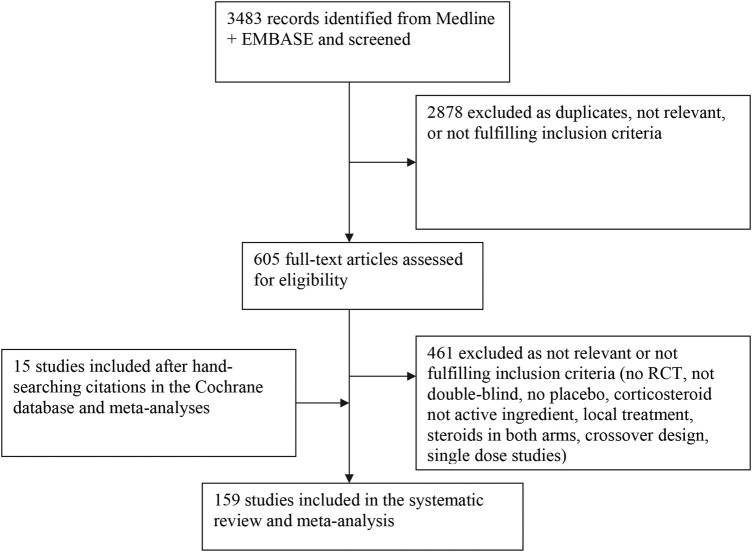
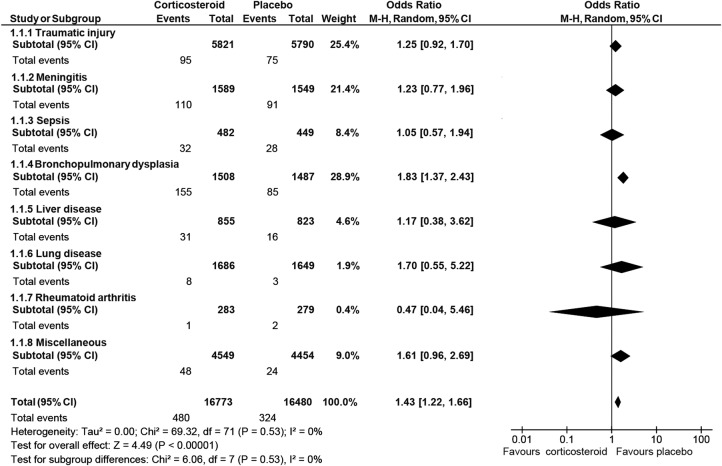
Objective: To assess whether corticosteroids are associated with increased risk of gastrointestinal bleeding or perforation. Design: Systematic review and meta-analysis of randomised, double-blind, controlled trials comparing a corticosteroid to placebo for any medical condition or in healthy participants. Studies with steroids given either locally, as a single dose, or in crossover studies were excluded. Data sources: Literature search using MEDLINE, EMBASE and Cochrane Database of Systematic Reviews between 1983 and 22 May 2013. Outcome measure: Outcome measures were the occurrence of gastrointestinal bleeding or perforation. Predefined subgroup analyses were carried out for disease severity, use of non-steroidal anti-inflammatory drugs (NSAIDs) or gastroprotective drugs, and history of peptic ulcer. Results: 159 studies (N=33 253) were included. In total, 804 (2.4%) patients had a gastrointestinal bleeding or perforation (2.9% and 2.0% for corticosteroids and placebo). Corticosteroids increased the risk of gastrointestinal bleeding or perforation by 40% (OR 1.43, 95% CI 1.22 to 1.66). The risk was increased for hospitalised patients (OR 1.42, 95% CI 1.22 to 1.66). For patients in ambulatory care, the increased risk was not statistically significant (OR 1.63, 95% CI 0.42 to 6.34). Only 11 gastrointestinal bleeds or perforations occurred among 8651 patients in ambulatory care (0.13%). Increased risk was still present in subgroup analyses (studies with NSAID use excluded; OR 1.44, 95% CI 1.20 to 1.71, peptic ulcer as an exclusion criterion excluded; OR 1.47, 95% CI 1.21 to 1.78, and use of gastroprotective drugs excluded; OR 1.42, 95% CI 1.21 to 1.67). Conclusions: Corticosteroid use was associated with increased risk of gastrointestinal bleeding and perforation. The increased risk was statistically significant for hospitalised patients only. For patients in ambulatory care, the total occurrence of bleeding or perforation was very low, and the increased risk was not statistically significant.
Overview
The claims and statistics of this paper haven’t been checked yet.
Free: it reads the open-access text and checks the first 5 claims that cite a source we can check. Create a free account to check every claim.
Integrity signals
Registry
Cites
Statistics
Figures
Verification
Claims the paper makes
The claims and statistics of this paper haven’t been checked yet.
Free: it reads the open-access text and checks the first 5 claims that cite a source we can check. Create a free account to check every claim.
Claims other papers make about this one
Each is checked against this paper’s own text: does it say what the citing paper says it does?
In the citing paper
“Despite the wide application, systemic immune suppression may cause Treg suppression and multiple adverse effects, including intestinal complications, muscle pain ,and headaches, which has brought other strategies to light [107, 226–228].”
From Immunogenicity of Recombinant Adeno-Associated Virus (AAV) Vectors for Gene Transfer (2023) · cites this paper as [226]
Self-check
Percentages, sums and reported differences re-computed from the paper’s own numbers.
The self-check needs the paper’s full text.
Citations
Cites
(1958) · Journal of the American Pharmaceutical Association (Scientific ed.) · doi:10.1002/jps.3030470133 · Cited by 2,489
The Hazards of Scoring the Quality of Clinical Trials for Meta-analysis
Jüni, P. (1999) · JAMA · doi:10.1001/jama.282.11.1054 · Cited by 1,981
Summary of product characteristics
(2013) · Pharmaceutical Medicine · doi:10.1093/med/9780199609147.003.0027 · Cited by 1,905
Risk Factors for Gastrointestinal Bleeding in Critically Ill Patients
Cook, D. J., Fuller, H. D., Guyatt, G. H., Marshall, J. C., Leasa, D., Hall, R., Winton, T. L., Rutledge, F., Todd, T., Roy, P., et al. (1994) · New England Journal of Medicine · doi:10.1056/nejm199402103300601 · Cited by 1,010
Corticosteroids for acute bacterial meningitis
Brouwer, M. C., McIntyre, P., Prasad, K., & van de Beek, D. (2015) · Cochrane Database of Systematic Reviews · doi:10.1002/14651858.cd004405.pub5 · Cited by 809
Corticosteroid Use and Peptic Ulcer Disease: Role of Nonsteroidal Anti-inflammatory Drugs
Piper, J. M., Ray, W. A., Daugherty, J. R., & Griffin, M. R. (1991) · Annals of Internal Medicine · doi:10.7326/0003-4819-114-9-735 · Cited by 608
Risk Factors for Gastrointestinal Bleeding in Critically Ill Patients
COOK, D. J., FULLER, H. D., MARSHALL, J. C., LEASA, D., HALL, R., WINTON, T., RUTLEDGE, F., TODD, T. J. R., ROY, P., LACROIX, J., et al. (1994) · Survey of Anesthesiology · doi:10.1097/00132586-199412000-00065 · Cited by 469
Association of Adrenocorticosteroid Therapy and Peptic-Ulcer Disease
Messer, J., Reitman, D., Sacks, H. S., Smith, H., & Chalmers, T. C. (1983) · New England Journal of Medicine · doi:10.1056/nejm198307073090105 · Cited by 422
Nonassociation of Adrenocorticosteroid Therapy and Peptic Ulcer
Conn, H. O., & Blitzer, B. L. (1976) · New England Journal of Medicine · doi:10.1056/nejm197602262940905 · Cited by 353
Corticosteroids and peptic ulcer: meta‐analysis of adverse events during steroid therapy
CONN, H. O., & POYNARD, T. (1994) · Journal of Internal Medicine · doi:10.1111/j.1365-2796.1994.tb00855.x · Cited by 312
Cited by
Items 301–327 of 327
Saeki, K., Nakagama, H., Tanaka, Y., Goto, Y., Kaneshiro, K., Kono, H., Yanai, K., Yamamoto, H., Yoneda, R., Shimakawa, T., et al. (2024) · Figshare · doi:10.6084/m9.figshare.27116128
Additional file 1 of Gastrointestinal bleeding in critically ill immunocompromised patients
Catano, J., Sacleux, S., Gornet, J., Camus, M., Bigé, N., Saliba, F., Azoulay, É., Dumas, G., & Zafrani, L. (2021) · Figshare · doi:10.6084/m9.figshare.16305375
Saeki, K., Nakagama, H., Tanaka, Y., Goto, Y., Kaneshiro, K., Kono, H., Yanai, K., Yamamoto, H., Yoneda, R., Shimakawa, T., et al. (2024) · Figshare · doi:10.6084/m9.figshare.27116122
Gastric Diseases in Rheumatology
Waseem, A., Pearlstein, E. F., Ayer, D., & Batool, A. (2025) · Clinical gastroenterology · doi:10.1007/978-3-032-07868-1_6
Wang, B., Wang, S., Yang, L., Jiang, J., Hua, R., Tang, J., & Wu, D. (2026) · Journal of Clinical Pharmacy and Therapeutics · doi:10.1155/jcpt/5576276
Stress Ulcer Prophylaxis in the Critically Ill Oncology Population
Collins, R. D., & Bruno, J. J. (2026) · Springer eBooks · doi:10.1007/978-3-319-74698-2_28-2
Kim, D. H., Porres, J. A., Ko, D., Costea, D., Narvaez, S. I., Nieto, L. M., Lukens, F. J., Argueta, P. P., Illigens, B. M. W., Cerqueira, T. L., et al. (2026) · European Geriatric Medicine · doi:10.1007/s41999-026-01472-4
“Corticosteroids increase risk of GIB and perforation by up to 40% [25].”
AI-Powered Diagnosis and Categorization of Gastrointestinal Diseases
Kaushal, S., Singh, L. K., Agnihotri, D., Garg, D., Kaur, B., & Gupta, V. K. (2025) · IEEE International Conference on Recent Trends in Computing and Smart Mobility (RCSM) · doi:10.1109/rcsm67767.2025.11507983
“The evidence supports prudent drug prescription to minimize adverse events [13].”
Prelog, P. R., Zupan, M., Kovačič, A., Frol, S., & Kramberger, M. G. (2026) · Frontiers in Neurology · doi:10.3389/fneur.2026.1814289 · Cited by 1
“A thorough medication review can help optimize treatment and minimize the risk of bleeding (41–48).”
Lewis, A. A., Huang, C.-Y., Cragun, J., Vuong, L., Irani, A., Anastasiou, C., Bozkurt, S., Donneyong, M. M., Garg, S., Groenewald, C. B., et al. (2026) · medRxiv · doi:10.64898/2026.05.19.26352957
BEYOND THERAPEUTIC BENEFITS: KAJIAN FARMAKOVIGILANS EFEK SAMPING KORTIKOSTEROID DI INDONESIA
Amalia, S. P., Istiqamah, F., Ainah, N., & Lestari, D. A. (2026) · Jurnal Insan Farmasi Indonesia · doi:10.36387/jifi.v9i1.3050 · Cited by 1
Use of corticosteroids in sepsis and infectious diseases: a narrative review
Kim, J. H. (2026) · The Korean Journal of Internal Medicine · doi:10.3904/kjim.2025.283
Scontre, V. A., Toyoshima, M. T. K., & Estevez-Diz, M. D. P. (2026) · Cancer Chemotherapy and Pharmacology · doi:10.1007/s00280-026-04920-x
“Experimental and clinical data suggest that glucocorticoids may shift from a protective to a deleterious gastrointestinal profile with prolonged use, particularly in vulnerable populations [18, 19].”
Lawal, R. A., Malaga, N. C., Asif, N., Bello, F., & Yang, J. (2026) · Cureus · doi:10.7759/cureus.112550
Postoperative Oral Dexamethasone and Pediatric Tonsillectomy Morbidity: A Randomized Clinical Trial
Shaffer, A. D., Omar, M., Maguire, R. C., Dohar, J. E., Stapleton, A. L., Kitsko, D. J., Tobey, A. B. J., Padia, R., Simons, J. P., Whelan, R. L., et al. (2026) · JAMA Otolaryngology–Head & Neck Surgery · doi:10.1001/jamaoto.2026.1910
Li, J., Ernst, P., & Suissa, S. (2026) · Drug Safety · doi:10.1007/s40264-026-01699-x
“…population, including only small fractions of patients with respiratory indications [9–12, For example, a systematic review and meta-analysis of randomized controlled trials reported an increased risk of GI bleeding or perforation with OCS use as compared to placebo (OR 1.43, 95% CI 1.22–1.66) [9].”
InfluentialMensah, E. O., Ghosh, A., Alem, A., Morgan, K., Fehlings, M. G., Chalif, J. I., & Lu, Y. (2026) · Spinal Cord · doi:10.1038/s41393-026-01247-5 · Cited by 1
Ulcerative colitis (UC) in the elderly: diagnostic and therapeutic considerations
Wróbel, Ł., & Małecka-Wojciesko, E. (2026) · Frontiers in Aging · doi:10.3389/fragi.2026.1815043
“Steroids also impair wound healing, cause hypothalamic-pituitary-adrenal (HPA) axis suppression, steroid myopathy, cataract, and glaucoma, all of which further increase the clinical risk of hospitalization and complications in elderly patients (Raine et al., 2021; Narum et al., 2014).”
Bañuelos-Huerta, R., Aguilar-Lazcano, E. Y., Ramírez-Barranco, M., Hernández-Hernández, J. L., Sandoval-Hernández, J. C., & Uriel, C.-V. (2026) · Archivos de Medicina de Urgencia de México · doi:10.35366/123748
Yotova, K., Balgaranov, N. K., Bozhanova, V., & Elkina, S. (2026) · Gastroenterology Insights · doi:10.3390/gastroent17030047
“High-dose systemic corticosteroids are a well-established risk factor for erosive gastropathy, particularly in the setting of critical illness [12].”
Antidepressants and bleeding risk: Putting the evidence into clinical practice
Gómez-Lumbreras, A., & Malone, D. C. (2026) · Journal of Psychosomatic Research · doi:10.1016/j.jpsychores.2026.112969
Nishida, K., Chrétien, B., Silva, A. D., Calabia, A., Matsui, S., Terada, T., & Ando, Y. (2026) · Frontiers in Pharmacology · doi:10.3389/fphar.2026.1858594
“…2008), systemic corticosteroids (H02 ATC codes) because of their association with capillary fragility (Ullian, 1999) and gastrointestinal bleeding (Narum et al., 2014), and SSRIs/SNRIs (N06AA and N06AB ATC codes), which may impair platelet aggregation via serotonin depletion (Grech et al., 2022).”
Zhang, R., Lina, C., Ding, D., Guo, G., Guo, C., Jia, G., Shang, Y., & Han, Y. (2026) · Frontiers in Immunology · doi:10.3389/fimmu.2026.1878948
“The analysis revealed that among hospitalized patients, GC users had a 40% increased odds ratio (OR 1.43, 95% CI 1.22 – 1.66) for gastrointestinal bleeding or perforation compared to placebo users (7).”
InfluentialKwon, S., Kwak, S. G., & Hong, H. (2026) · Journal of Critical Care · doi:10.1016/j.jcrc.2026.155750
Treatment and practical considerations of IgA nephropathy
Sawaf, H., Kim, J., Mehdi, A., Cavanaugh, C. J., & Taliercio, J. J. (2026) · Frontiers in Medicine · doi:10.3389/fmed.2026.1911077
“Mitigating the hyperkalemia risk while allowing maximal RAS blockade would include ensuring patients are not taking potassium supplements or NSAIDS (23, 24).”
Hai, N. T. T., Quý, P. T., Ha, T. H., Phú, N. V., Triet, N. T., Dương, P. N. Đ., Bảo, N. C., Onikanni, S. A., Dao, T. N. P., Phung, V. T., et al. (2026) · Results in Chemistry · doi:10.1016/j.rechem.2026.103990
Dudík, B., Mriňáková, B., Kimliková, K., Waczulı́ková, I., Krajčík, O., Kilianova, Z., Blažová, N., Kosírová, S., Usakova, V., Gočárová, K., et al. (2026) · Frontiers in Pharmacology · doi:10.3389/fphar.2026.1908515
“…IV acid suppression is also often driven by concern about corticosteroid associated gastrotoxicity, although available evidence does not support prophylaxis solely because of short course corticosteroid exposure in the absence of additional risk factors (Kumar et al., 2023; Narum et al., 2014).”
Metadata
- Authors
- Narum, S., Westergren, T., & Klemp, M.
- Affiliations
- Oslo University Hospital (NO)
- University of Oslo (NO)
- Corresponding author
- Narum, Sigrid
- Venue
- BMJ Open
- Publisher
- BMJ
- Published
- 2014-05
- Volume
- 4
- Issue
- 5
- Pages
- e004587
- ISSN
- 2044-6055 (ISSN-L)
- PMC
- PMC4025450
- OpenAlex
- W2110984144
- Cited by
- 327
- References
- 28
- Citations by year
- 2026: 26 · 2025: 36 · 2024: 38 · 2023: 33 · 2022: 36 · 2021: 28 · 2020: 22 · 2019: 30 · 2018: 27 · 2017: 22 · 2016: 17 · 2015: 11 · 2014: 1
- FWCI
- 2.78
- Type
- journal article
- Language
- en
- Open access
- gold
- doi.org
- Licence
- cc-by-nc
- Locations
- BMJ Open (publishedVersion, cc-by-nc)
- Europe PMC (PubMed Central) (publishedVersion, other-oa)
- PubMed Central (publishedVersion, cc-by-nc)
- PubMed (publishedVersion)
- HighWire Press Open Archive (submittedVersion)
- NORA - Norwegian Open Research Archives (submittedVersion, cc-by-nc)
- NORA - Norwegian Open Research Archives (submittedVersion, other-oa)
- Topics
- Health Sciences › Medicine › Gastroenterology › Gastrointestinal Bleeding Diagnosis and Treatment
- Health Sciences › Medicine › Pharmacology (medical) › Inflammatory mediators and NSAID effects
- Life Sciences › Pharmacology, Toxicology and Pharmaceutics › Toxicology › Pharmacovigilance and Adverse Drug Reactions
- Keywords
- corticosteroids, gastrointestinal bleeding, gastrointestinal perforation, adverse drug reactions, peptic ulcer, NSAID use, gastroprotective drugs, hospitalized patients, outpatient care, drug safety, placebo comparison, healthy volunteers
- MeSH terms
- Adrenal Cortex Hormones, Gastrointestinal Hemorrhage, Humans, Intestinal Perforation, Stomach Rupture, Randomized Controlled Trials as Topic, Risk Assessment
About these checks
Registry, retraction, Cites and statistics results are computed, not judged, with one exception: a printed reference that no index lists is read once by a model before it counts as a citation error. Claims are extracted by a model and kept only when their quote appears verbatim in the text; each cited source is then checked, with a model’s help, for whether it says what the claim relies on. Those verdicts can be wrong — read the claim’s quote and the cited source before relying on one.
Statistics and arithmetic are recomputed, not judged.
Confidence bands are shown only for fields calibrated on our annotated test set. None is calibrated yet, so no band is shown.
What counts as a claim ›How we measure confidence ›How we check this ›
Are you an author, or do you see a problem with this page? Request a review
Data sources
Bibliographic data: Semantic Scholar, OpenAlex, Crossref.
Contains information from the Semantic Scholar Academic Graph Datasets, made available under the ODC Attribution License (ODC-BY 1.0).
Semantic Scholar’s data is described in: Kinney, R., et al. (2023). The Semantic Scholar Open Data Platform. arXiv:2301.10140.
