

The DOI matches its Crossref record; 117 of the 118 references it cites were found in a registry or an index.
Use of probiotics to correct dysbiosis of normal microbiota following disease or disruptive events : a systematic review
Open accessAbstract
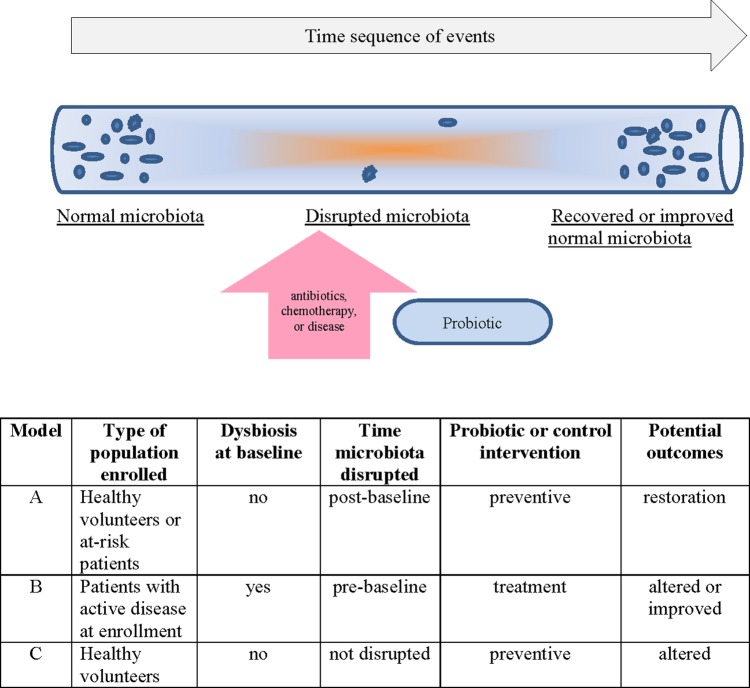
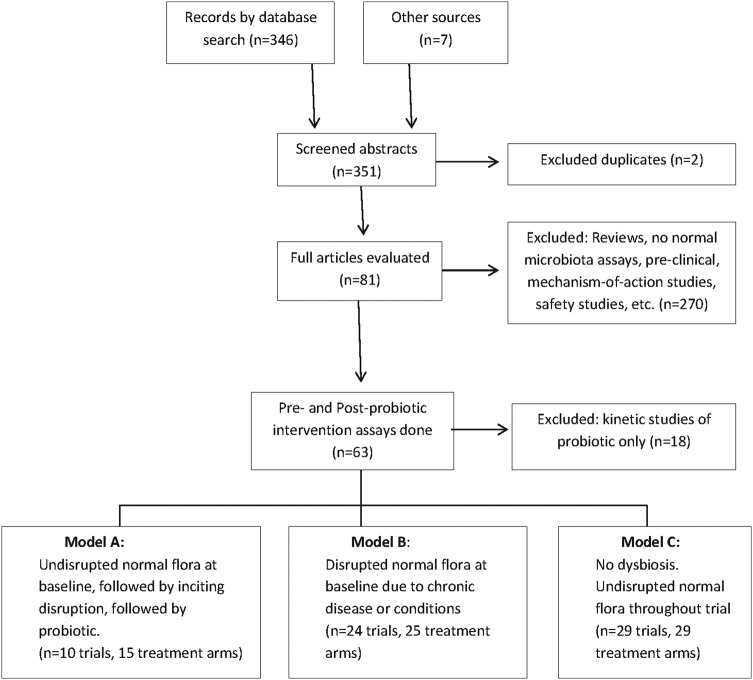
OBJECTIVE: To assess the evidence for the claim probiotics can correct dysbiosis of the normal microbiota resulting from disease or disruptive events. SETTING: Systematic review of published clinical trials of patients receiving a probiotic intervention for the prevention or treatment of various diseases. DATA SOURCES: Sources searched (1985-2013): PubMed, EMBASE, Cochrane Database of Systematic Reviews, CINAHL, AMED and ISI Web of Science. Three on-line clinical trial registries were searched: Cochrane Central Register of Controlled trials, MetaRegister of Controlled Trials and National Institutes of Health. REVIEW METHODS: Included studies were randomised clinical trials of probiotic interventions having microbiological assays. Studies were evaluated following Preferred Reporting Items for Systematic Reviews and Meta-Analyses guidelines for specific probiotic strains. A standard data extraction form was used to collect the raw data. OUTCOME MEASURES: The primary outcome is the degree of microbiota correction by specific probiotic strains. Secondary outcome was the association between the degree of dysbiosis correction and clinical efficacy. RESULTS: The review of the literature found three distinct study designs: model A (restoration) assayed patients enrolled with a healthy, undisturbed microbiota and then assayed postdisruptive event and probiotic therapy; model B (alteration) assayed patients with pre-existing disrupted microbiota and then postprobiotic therapy; model C (no dysbiosis) assayed volunteers with no disruptive event prebiotic and postprobiotic. From a total of 63 trials, 83% of the probiotic products using model A restored the microbiota, 56% using model B improved the microbiota and only 21% using model C had any effect on microbiota. Clinical efficacy was more commonly associated with strains capable of restoration of the normal microbiota. CONCLUSIONS: The ability to assess the degree of dysbiosis improvement is dependent on the enrolled population and the timing of microbiological assays. The functional claim for correcting dysbiosis is poorly supported for most probiotic strains and requires further research. TRIAL REGISTRATION NUMBER: PROSPERO (CRD42014007224).
Overview
The claims and statistics of this paper haven’t been checked yet.
Run the check — free, no account needed. It reads the open-access text and checks the sources it cites.
Integrity signals
Registry
Cites
Statistics
Figures
Verification
Claims the paper makes
The claims and statistics of this paper haven’t been checked yet.
Run the check — free, no account needed. It reads the open-access text and checks the sources it cites.
Claims other papers make about this one
Each is checked against this paper’s own text: does it say what the citing paper says it does?
In the citing paper
“and probiotics seem to offer some promising potential for re-establishing the microbiome following antimicrobial insult (Mcfarland, 2014).”
From Viral Infections, the Microbiome, and Probiotics (2021) · cites this paper as Mcfarland, 2014
Self-check
Percentages, sums and reported differences re-computed from the paper’s own numbers.
The self-check needs the paper’s full text.
Citations
Cites
Preferred Reporting Items for Systematic Reviews and Meta-Analyses: the PRISMA statement
Moher, D., Liberati, A., Tetzlaff, J., Altman, D. G., & for the PRISMA Group (2009) · BMJ · doi:10.1136/bmj.b2535 · Cited by 83,823
Preferred reporting items for systematic reviews and meta-analyses: the PRISMA Statement.
(2009) · PubMed Central · Cited by 44,859
Metagenomic Analysis of the Human Distal Gut Microbiome
Gill, S. R., Pop, M., DeBoy, R. T., Eckburg, P. B., Turnbaugh, P. J., Samuel, B. S., Gordon, J. I., Relman, D. A., Fraser-Liggett, C. M., & Nelson, K. E. (2006) · Science · doi:10.1126/science.1124234 · Cited by 4,699
Nugent, R. P., Krohn, M. A., & Hillier, S. L. (1991) · Journal of Clinical Microbiology · doi:10.1128/jcm.29.2.297-301.1991 · Cited by 3,332
The gut flora as a forgotten organ
O'Hara, A. M., & Shanahan, F. (2006) · The EMBO Reports · doi:10.1038/sj.embor.7400731 · Cited by 2,791
Metagenomics: Application of Genomics to Uncultured Microorganisms
Handelsman, J. (2004) · Microbiology and Molecular Biology Reviews · doi:10.1128/mmbr.68.4.669-685.2004 · Cited by 2,528
Dethlefsen, L., Huse, S., Sogin, M. L., & Relman, D. A. (2008) · PLoS Biology · doi:10.1371/journal.pbio.0060280 · Cited by 2,361
Franks, A. H., Harmsen, H. J. M., Raangs, G. C., Jansen, G. J., Schut, F., & Welling, G. W. (1998) · Applied and Environmental Microbiology · doi:10.1128/aem.64.9.3336-3345.1998 · Cited by 1,056
Glaser, E. (1972) · New England Journal of Medicine · doi:10.1056/nejm197210192871623 · Cited by 970
McFarland, L. V. (2006) · The American Journal of Gastroenterology · doi:10.1111/j.1572-0241.2006.00465.x · Cited by 872
Research works printed but not linked: 2
- Orrhage, 1994, Effects of supplements of Bifidobacterium longum and Lactobacillus acidophilus on the intestinal microbiota during administration of clindamycin, Microb Ecol Health Dis, 7, 17
- Girard-Pipau, 2002, Intestinal microflora, short chain and cellular fatty acids, influence of a probiotic S. boulardii, Microb Ecology Health Dis, 14, 220
Cited by
Sorted by citations
The pros, cons, and many unknowns of probiotics
Suez, J., Zmora, N., Segal, E., & Elinav, E. (2019) · Nature Medicine · doi:10.1038/s41591-019-0439-x · Cited by 1,398
Suez, J., Zmora, N., Zilberman-Schapira, G., Mor, U., Dori-Bachash, M., Bashiardes, S., Zur, M., Regev-Lehavi, D., Ben-Zeev Brik, R., Federici, S., et al. (2018) · Cell · doi:10.1016/j.cell.2018.08.047 · Cited by 1,184
Langdon, A. E., Crook, N., & Dantas, G. A. (2016) · Genome Medicine · doi:10.1186/s13073-016-0294-z · Cited by 968
Shaping the Future of Probiotics and Prebiotics
Cunningham, M., Azcarate-Peril, M. A., Barnard, A., Benoit, V., Grimaldi, R., Guyonnet, D., Holscher, H. D., Hunter, K., Manurung, S., Obis, D., et al. (2021) · Trends in Microbiology · doi:10.1016/j.tim.2021.01.003 · Cited by 637
Review article: dietary fibre-microbiota interactions
Simpson, H. L., & Campbell, B. J. (2015) · Alimentary Pharmacology & Therapeutics · doi:10.1111/apt.13248 · Cited by 602
Metadata
- Authors
- McFarland, L. V.
- Affiliations
- University of Washington (US)
- Corresponding author
- McFarland, Lynne V
- ORCID
- McFarland, Lynne V
- Venue
- BMJ Open
- Publisher
- BMJ
- Published
- 2014-08
- Volume
- 4
- Issue
- 8
- Pages
- e005047
- ISSN
- 2044-6055 (ISSN-L)
- PMC
- PMC4156804
- OpenAlex
- W1987378090
- Cited by
- 235
- References
- 118
- Citations by year
- 2026: 8 · 2025: 23 · 2024: 23 · 2023: 28 · 2022: 22 · 2021: 33 · 2020: 19 · 2019: 15 · 2018: 19 · 2017: 15 · 2016: 14 · 2015: 16
- FWCI
- 1.87
- Type
- journal article
- Language
- en
- Open access
- gold
- doi.org
- Licence
- cc-by-nc
- Locations
- BMJ Open (publishedVersion, cc-by-nc)
- Europe PMC (PubMed Central) (publishedVersion, cc-by-nc)
- PubMed Central (publishedVersion, cc-by-nc)
- PubMed (publishedVersion)
- HighWire Press Open Archive (submittedVersion)
- Topics
- Life Sciences › Agricultural and Biological Sciences › Food Science › Probiotics and Fermented Foods
- Life Sciences › Biochemistry, Genetics and Molecular Biology › Molecular Biology › Gut microbiota and health
- Life Sciences › Immunology and Microbiology › Microbiology › Reproductive tract infections research
- Keywords
- probiotics, dysbiosis, gut microbiota, microbiota restoration, probiotic strains, microbiological assay, disruptive events, clinical efficacy, prebiotics
- MeSH terms
- Disease, Humans, Severity of Illness Index, Treatment Outcome, Probiotics, Microbiota, Dysbiosis
About these checks
Registry, retraction, Cites and statistics results are computed, not judged, with one exception: a printed reference that no index lists is read once by a model before it counts as a citation error. Claims are extracted by a model and kept only when their quote appears verbatim in the text; each cited source is then checked, with a model’s help, for whether it says what the claim relies on. Those verdicts can be wrong — read the claim’s quote and the cited source before relying on one.
Statistics and arithmetic are recomputed, not judged.
Confidence bands are shown only for fields calibrated on our annotated test set. None is calibrated yet, so no band is shown.
What counts as a claim ›How we measure confidence ›How we check this ›
Are you an author, or do you see a problem with this page? Request a review
