

The DOI matches its Crossref record; 112 of the 112 references it cites were found in a registry or an index.
Efficacy of psychosocial interventions for psychological and pregnancy outcomes in infertile women and men: a systematic review and meta-analysis
Open accessAbstract
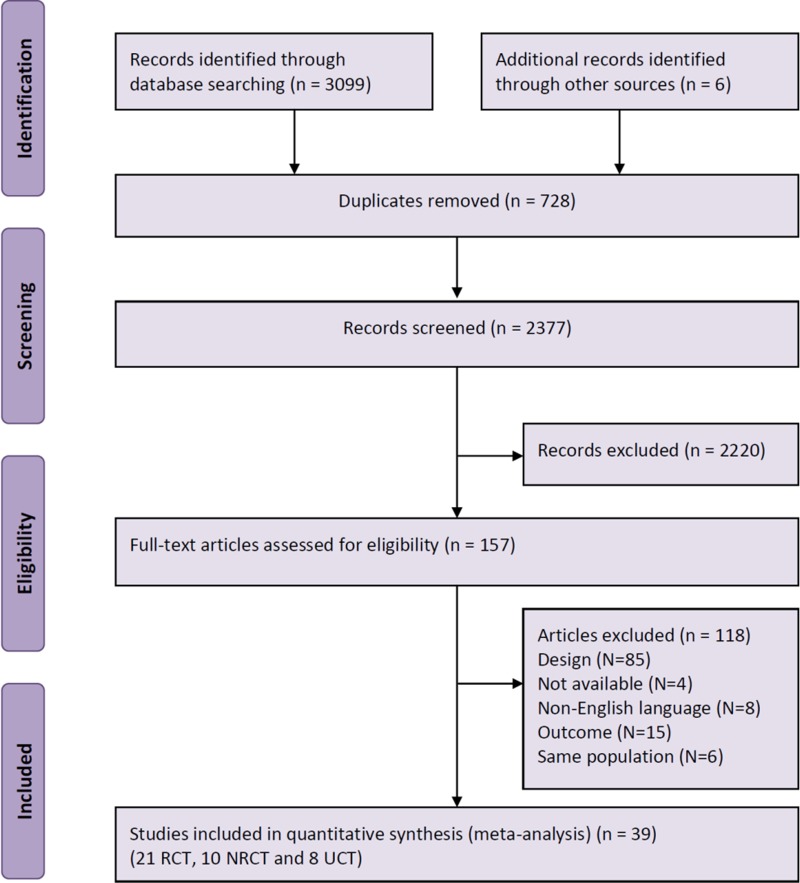
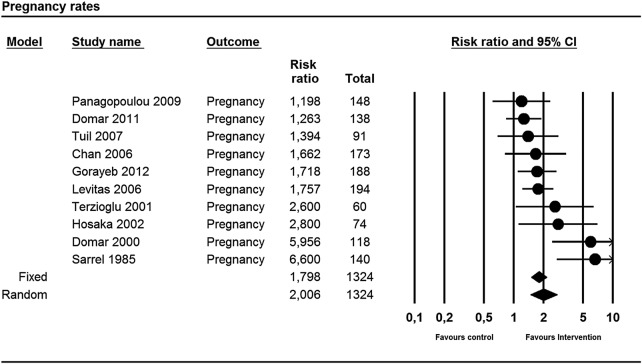
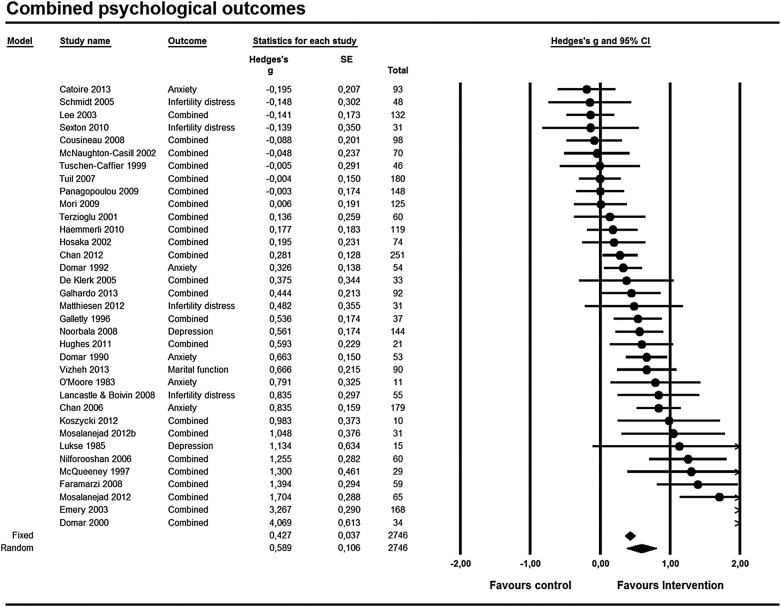
Objective: To evaluate the evidence on the efficacy of psychosocial interventions for improving pregnancy rates and reducing distress for couples in treatment with assisted reproductive technology (ART). Design: Systematic review and meta-analysis. Data sources: PsycINFO, PubMed, EMBASE, CINAHL, Web of Science and The Cochrane Library between 1978 and April 2014. Study selection: Studies were considered eligible if they evaluated the effect of any psychosocial intervention on clinical pregnancy and/or distress in infertile participants, used a quantitative approach and were published in English. Data extraction: Study characteristics and results were extracted and the methodological quality was assessed. Effect sizes (ES; Hedges g) were pooled using a random effects model. Heterogeneity was assessed using the Q statistic and I 2 , and publication bias was evaluated using Egger’s method. Possible moderators and mediators were explored with meta-analyses of variances (ANOVAs) and meta-regression. Results: We identified 39 eligible studies (total N=2746 men and women) assessing the effects of psychological treatment on pregnancy rates and/or adverse psychological outcomes, including depressive symptoms, anxiety, infertility stress and marital function. Statistically significant and robust overall effects of psychosocial intervention were found for both clinical pregnancy (risk ratio=2.01; CI 1.48 to 2.73; p<0.001) and combined psychological outcomes (Hedges g=0.59; CI 0.38 to 0.80; p=0.001). The pooled ES for psychological outcomes were generally larger for women (g: 0.51 to 0.73) than men (0.13 to 0.34), but the difference only reached statistical significance for depressive symptoms (p=0.004). Meta-regression indicated that larger reductions in anxiety were associated with greater improvement in pregnancy rates (Slope 0.19; p=0.004). No clear-cut differences were found between effects of cognitive–behavioural therapy (CBT; g=0.84), mind–body interventions (0.61) and other intervention types (0.50). Conclusions: The present meta-analysis suggests that psychosocial interventions for couples in treatment for infertility, in particular CBT, could be efficacious, both in reducing psychological distress and in improving clinical pregnancy rates.
Overview
The claims and statistics of this paper haven’t been checked yet.
Run the check — free, no account needed. It reads the open-access text and checks the sources it cites.
Integrity signals
Registry
Cites
Statistics
Figures
Verification
Claims the paper makes
The claims and statistics of this paper haven’t been checked yet.
Run the check — free, no account needed. It reads the open-access text and checks the sources it cites.
Claims other papers make about this one
Each is checked against this paper’s own text: does it say what the citing paper says it does?
The source backs part of the claim, not all of it — or backs it for a different population, condition or comparison.
In the citing paper
“Furthermore, the overall effect size associated with randomised controlled trials of psychological interventions on combined psychological outcomes was non-significant and efficacy was not found to differ according to intervention type.”
From Infertility-related distress and clinical targets for psychotherapy: A qualitative study (2021) · cites this paper as [15]
Experimental — accuracy not yet measuredThe source backs part of the claim, not all of it — or backs it for a different population, condition or comparison.
In the citing paper
“Although mindfulness approaches have proven to be of limited efficacy for infertility-related distress, one mindfulness-based approach that has yet to be applied to infertility is loving-kindness meditation (LKM),41 which seems to map on well to both shame/self-blame and severed relationships with others.”
From Infertility-related distress and clinical targets for psychotherapy: A qualitative study (2021) · cites this paper as [15]
Experimental — accuracy not yet measuredThe source backs part of the claim, not all of it — or backs it for a different population, condition or comparison.
In the citing paper
“Though CBT has been applied to infertility in a number of studies, with limited results, there are a number of CBT-based techniques that have yet to be used but that may address some of the specific infertility-related psychological challenges raised in this study.”
From Infertility-related distress and clinical targets for psychotherapy: A qualitative study (2021) · cites this paper as [15]
Experimental — accuracy not yet measuredThe source backs part of the claim, not all of it — or backs it for a different population, condition or comparison.
In the citing paper
“While cognitive restructuring, progressive muscle relaxation, and mindfulness meditation are the most-used and tested approaches to date for the treatment of infertility-related distress, their efficacy in this population is limited.15”
From Infertility-related distress and clinical targets for psychotherapy: A qualitative study (2021) · cites this paper as [15]
Experimental — accuracy not yet measuredThe cited source says what the claim attributes to it.
In the citing paper
“Though they were found to result in small reductions in anxiety, they were not found to improve depressive symptoms, infertility distress or marital functioning when adjusting for publication bias.”
From Infertility-related distress and clinical targets for psychotherapy: A qualitative study (2021) · cites this paper as [15]
In the citing paper
“Bai et al. [45] used the effect size d = 0.59 (medium effect [41]) for the calculation of the power analysis, which was determined in the meta-analysis by Frederiksen et al. [19].”
In the citing paper
“Furthermore, Frederiksen et al. [19] made some miscalculations in their meta-analysis [62].”
Self-check
Percentages, sums and reported differences re-computed from the paper’s own numbers.
The self-check needs the paper’s full text.
Citations
Cites
Preferred Reporting Items for Systematic Reviews and Meta-Analyses: the PRISMA statement
Moher, D., Liberati, A., Tetzlaff, J., Altman, D. G., & for the PRISMA Group (2009) · BMJ · doi:10.1136/bmj.b2535 · Cited by 83,823
The Measurement of Observer Agreement for Categorical Data
Landis, J. R., & Koch, G. G. (1977) · Biometrics · doi:10.2307/2529310 · Cited by 81,148
Statistical power analysis for the behavioral sciences
Cohen, J. (1990) · Computers Environment and Urban Systems · doi:10.1016/0198-9715(90)90050-4 · Cited by 65,417
Preferred Reporting Items for Systematic Reviews and Meta-Analyses: The PRISMA Statement
Moher, D., Liberati, A., Tetzlaff, J., Altman, D. G., & The PRISMA Group (2009) · PLoS Medicine · doi:10.1371/journal.pmed.1000097 · Cited by 64,042 · cited 1×
“Adjusted for publication bias (34)¶ – – – – – 0.”
Measuring inconsistency in meta-analyses
Higgins, J. P. T., Thompson, S. G., Deeks, J. J., & Altman, D. G. (2003) · BMJ · doi:10.1136/bmj.327.7414.557 · Cited by 63,139
Bias in meta-analysis detected by a simple, graphical test
Egger, M., Smith, G. D., Schneider, M., & Minder, C. (1997) · BMJ · doi:10.1136/bmj.315.7109.629 · Cited by 56,722 · cited 2×
“Catoire et al(77) France I: 50 (50) UCT Hypnosis MBI Individual 4 1 A: STAI − 4 (7) Galhardo et al(97) Portugal I: 55 (55)”
BackgroundPreferred reporting items for systematic reviews and meta-analyses: the PRISMA Statement.
(2009) · PubMed Central · Cited by 44,859
Liberati, A., Altman, D. G., Tetzlaff, J., Mulrow, C., Gøtzsche, P. C., Ioannidis, J. P. A., Clarke, M., Devereaux, P. J., Kleijnen, J., & Moher, D. (2009) · PLoS Medicine · doi:10.1371/journal.pmed.1000100 · Cited by 28,164
Cochrane Handbook for Systematic Reviews of Interventions: Cochrane Book Series
(2008) · doi:10.1002/9780470712184 · Cited by 25,048
Wang, G., Ma, R., Qiao, G., Wada, K., Aizawa, Y., & Satoh, T. (2015) · Integrative Medicine International · doi:10.1159/000368408 · Cited by 18,762
Research works printed but not linked: 6
- 10.1093/humrep/ · DOI
- 10.1037//0033-2909.86.3.638 · DOI · Paper page
- Gutierrez, 2008, Group psychological intervention in assisted human reproduction, Rev Iberoam Fertil Reprod Hum, 25, 47
- Bjornsen K . Opening the door to fertility. retreat to fertile ground: sometimes the secret to getting pregnant lies in just getting away from it all. Altern Med 2006 (88):80–1. http://search.ebscohost.com/login.aspx?direct=true&db=c8h&AN=2009216983&site=ehost-live
- 10.1037/0278-6133.19.6.568 · DOI
- Galhardo, 2013, Developing mindfulness and acceptance skills in infertility: the mindfulness based program for infertility, Aten Primaria, 45, 143
Cited by
Sorted by citations
The relationship between stress and infertility
Rooney, K. L., & Domar, A. D. (2018) · Dialogues in Clinical Neuroscience · doi:10.31887/dcns.2018.20.1/klrooney · Cited by 626
Recurrent implantation failure: A comprehensive summary from etiology to treatment
Ma, J., Gao, W., & Li, D. (2023) · Frontiers in Endocrinology · doi:10.3389/fendo.2022.1061766 · Cited by 212
Pasch, L. A., Holley, S. R., Bleil, M. E., Shehab, D., Katz, P., & Adler, N. E. (2016) · Fertility and Sterility · doi:10.1016/j.fertnstert.2016.03.006 · Cited by 180
Lifestyle and fertility: the influence of stress and quality of life on female fertility
Palomba, S., Daolio, J., Romeo, S., Battaglia, F. A., Marci, R., & Sala, G. B. L. (2018) · Reproductive Biology and Endocrinology · doi:10.1186/s12958-018-0434-y · Cited by 183
Aging and the environment affect gamete and embryo potential: can we intervene?
Meldrum, D. R., Casper, R. F., Diez-Juan, A., Simon, C., Domar, A. D., & Frydman, R. (2016) · Fertility and Sterility · doi:10.1016/j.fertnstert.2016.01.013 · Cited by 159
Metadata
- Authors
- Frederiksen, Y., Farver-Vestergaard, I., Skovgård, N. G., Ingerslev, H. J., & Zachariae, R.
- Affiliations
- Aarhus University (DK)
- Aarhus University Hospital (DK)
- Corresponding author
- Frederiksen, Yoon
- Venue
- BMJ Open
- Publisher
- BMJ
- Published
- 2015-01
- Volume
- 5
- Issue
- 1
- Pages
- e006592
- ISSN
- 2044-6055 (ISSN-L)
- PMC
- PMC4316425
- OpenAlex
- W2103859384
- Cited by
- 380
- References
- 112
- Citations by year
- 2026: 27 · 2025: 34 · 2024: 46 · 2023: 43 · 2022: 35 · 2021: 50 · 2020: 35 · 2019: 37 · 2018: 29 · 2017: 20 · 2016: 18 · 2015: 6
- FWCI
- 3.69
- Type
- journal article
- Language
- en
- Open access
- gold
- doi.org
- Licence
- cc-by-nc
- Locations
- BMJ Open (publishedVersion, cc-by-nc)
- Europe PMC (PubMed Central) (publishedVersion, cc-by-nc)
- PubMed Central (publishedVersion, cc-by-nc)
- PubMed (publishedVersion)
- Funders
- Aarhus Universitet
- Topics
- Health Sciences › Medicine › Reproductive Medicine › Reproductive Health and Technologies
- Health Sciences › Medicine › Public Health, Environmental and Occupational Health › Maternal Mental Health During Pregnancy and Postpartum
- Health Sciences › Medicine › Pediatrics, Perinatology and Child Health › Assisted Reproductive Technology and Twin Pregnancy
- Keywords
- psychosocial interventions, infertility, assisted reproduction, clinical pregnancy rate, psychological distress, depressive symptoms, anxiety, infertility stress, couples, cognitive behavioral therapy, mind-body interventions
- MeSH terms
- Mental Disorders, Female, Humans, Infertility, Male, Pregnancy, Pregnancy Outcome, Psychotherapy, Treatment Outcome, Pregnancy Rate, Reproductive Techniques, Assisted
About these checks
Registry, retraction, Cites and statistics results are computed, not judged, with one exception: a printed reference that no index lists is read once by a model before it counts as a citation error. Claims are extracted by a model and kept only when their quote appears verbatim in the text; each cited source is then checked, with a model’s help, for whether it says what the claim relies on. Those verdicts can be wrong — read the claim’s quote and the cited source before relying on one.
Statistics and arithmetic are recomputed, not judged.
Confidence bands are shown only for fields calibrated on our annotated test set. None is calibrated yet, so no band is shown.
What counts as a claim ›How we measure confidence ›How we check this ›
Are you an author, or do you see a problem with this page? Request a review
