

Menstrual hygiene management among adolescent girls in India: a systematic review and meta-analysis
Open accessThe DOI matches its Crossref record; 79 of the 82 references it cites were found in a registry or an index.
Abstract
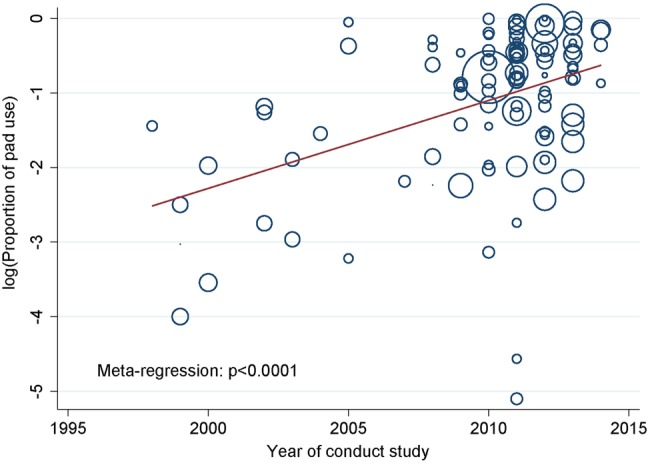
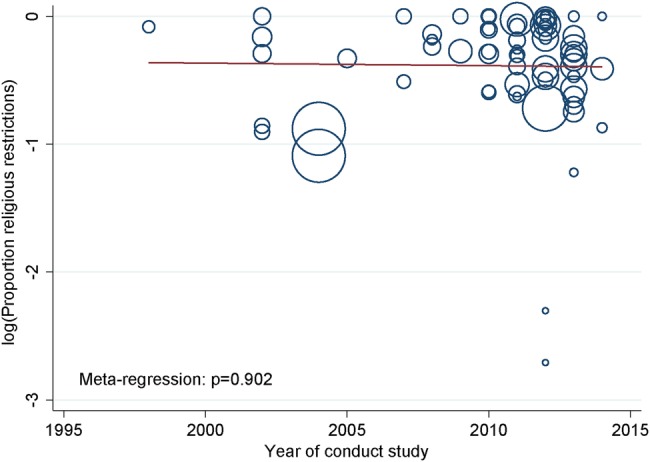
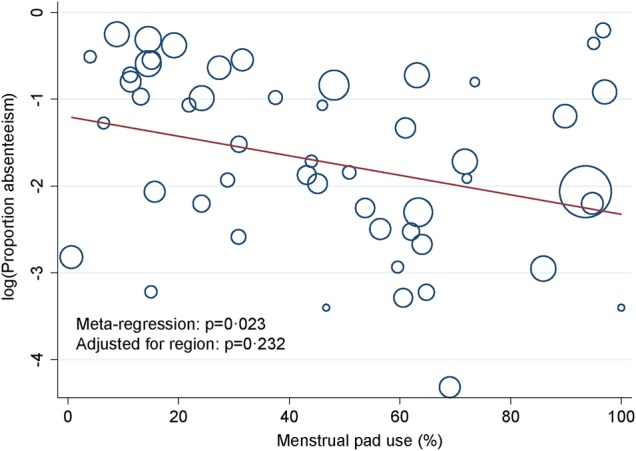
Objectives: To assess the status of menstrual hygiene management (MHM) among adolescent girls in India to determine unmet needs. Design: Systematic review and meta-analysis. We searched PubMed, The Global Health Database, Google Scholar and references for studies published from 2000 to September 2015 on girls’ MHM. Setting: India. Participants: Adolescent girls. Outcome measures: Information on menarche awareness, type of absorbent used, disposal, hygiene, restrictions and school absenteeism was extracted from eligible materials; a quality score was applied. Meta-analysis was used to estimate pooled prevalence (PP), and meta-regression to examine the effect of setting, region and time. Results: Data from 138 studies involving 193 subpopulations and 97 070 girls were extracted. In 88 studies, half of the girls reported being informed prior to menarche (PP 48%, 95% CI 43% to 53%, I 2 98.6%). Commercial pad use was more common among urban (PP 67%, 57% to 76%, I 2 99.3%, n=38) than rural girls (PP 32%, 25% to 38%, I 2 98.6%, n=56, p<0.0001), with use increasing over time (p<0.0001). Inappropriate disposal was common (PP 23%, 16% to 31%, I 2 99.0%, n=34). Menstruating girls experienced many restrictions, especially for religious activities (PP 0.77, 0.71 to 0.83, I 2 99.1%, n=67). A quarter (PP 24%, 19% to 30%, I 2 98.5%, n=64) reported missing school during periods. A lower prevalence of absenteeism was associated with higher commercial pad use in univariate (p=0.023) but not in multivariate analysis when adjusted for region (p=0.232, n=53). Approximately a third of girls changed their absorbents in school facilities (PP 37%, 29% to 46%, I 2 97.8%, n=17). Half of the girls’ homes had a toilet (PP 51%, 36% to 67%, I 2 99.4%, n=21). The quality of studies imposed limitations on analyses and the interpretation of results (mean score 3 on a scale of 0–7). Conclusions: Strengthening of MHM programmes in India is needed. Education on awareness, access to hygienic absorbents and disposal of MHM items need to be addressed. Trial registration number: CRD42015019197.
Overview
The claims and statistics of this paper haven’t been checked yet.
Free: it reads the open-access text and checks the first 5 claims that cite a source we can check. Create a free account to check every claim.
Integrity signals
Registry
Cites
Statistics
Figures
Verification
Claims the paper makes
The claims and statistics of this paper haven’t been checked yet.
Free: it reads the open-access text and checks the first 5 claims that cite a source we can check. Create a free account to check every claim.
Claims other papers make about this one
Each is checked against this paper’s own text: does it say what the citing paper says it does?
The source backs part of the claim, not all of it — or backs it for a different population, condition or comparison.
In the citing paper
“Ascertainment of intermediate outcomes such as school absence (i.e. which may contribute to dropout or failure to achieve) has been mixed (14, 31)”
From Menstrual hygiene management among adolescent schoolgirls in low- and middle-income countries: research priorities (2016) · cites this paper as [14]
Experimental — accuracy not yet measuredThe source backs part of the claim, not all of it — or backs it for a different population, condition or comparison.
In the citing paper
“inadequate social support, ongoing gender inequality, and social and hygiene taboos around menstruation in numerous countries leave girls experiencing shame, fear, and confusion when trying to cope with their menstrual flow (9–15, 20, 21).”
From Menstrual hygiene management among adolescent schoolgirls in low- and middle-income countries: research priorities (2016) · cites this paper as [14]
Experimental — accuracy not yet measuredThe source backs part of the claim, not all of it — or backs it for a different population, condition or comparison.
In the citing paper
“Studies to date, predominantly using school registers, have not shown a strong association between absence and menstrual intervention with varying duration of follow-up ranging between 1-month and 1-year.10 12–16”
From Menstrual cups and sanitary pads to reduce school attrition, and sexually transmitted and reproductive tract infections: a cluster randomised controlled feasibility study in rural Western Kenya (2016) · cites this paper as [12]
Experimental — accuracy not yet measuredThe source backs part of the claim, not all of it — or backs it for a different population, condition or comparison.
In the citing paper
“Women and girls in lower and middle-income countries (LMICs) face a multitude of barriers to safe and comfortable menstrual hygiene management (MHM).”
From ’It’s like a burden on the head’: Redefining adequate menstrual hygiene management throughout women’s varied life stages in Odisha, India. (2019) · cites this paper as [8]
Experimental — accuracy not yet measuredThe source backs part of the claim, not all of it — or backs it for a different population, condition or comparison.
In the citing paper
“In addition to these structural and resource barriers, women and girls face information and social support challenges: girls are often unprepared, uninformed, misinformed, and lack adequate support for understanding and managing menarche, menstruation, and puberty, resulting in fear, uncertainty, and potentially harmful behaviors, like risky sex, reduced bathing, and limited food and water intake”
From ’It’s like a burden on the head’: Redefining adequate menstrual hygiene management throughout women’s varied life stages in Odisha, India. (2019) · cites this paper as [8]
Experimental — accuracy not yet measured
21 more claims about this paper
Create a free account to see every claim other papers make about this one.
Self-check
Percentages, sums and reported differences re-computed from the paper’s own numbers.
The self-check needs the paper’s full text.
Citations
Cites
Measuring inconsistency in meta-analyses
Higgins, J. P. T., Thompson, S. G., Deeks, J. J., & Altman, D. G. (2003) · BMJ · doi:10.1136/bmj.327.7414.557 · Cited by 63,139 · cited 1×
“22 The extent of heterogeneity was measured using the I(2), a measure of the proportion of total variability explained by heterogeneity rather than chance expressed as a percentage.(23) To explore determinants of prevalence, we examined sources of heterogeneity across studies of the pooled”
MethodBarendregt, J. J., Doi, S. A., Lee, Y. Y., Norman, R. E., & Vos, T. (2013) · Journal of Epidemiology and Community Health · doi:10.1136/jech-2013-203104 · Cited by 2,169 · cited 1×
“21 22 The extent of heterogeneity was measured using the I 2 , a measure of the proportion of total variability explained by heterogeneity rather than chance expressed as a percentage.”
MethodMetaprop: a Stata command to perform meta-analysis of binomial data
Nyaga, V. N., Arbyn, M., & Aerts, M. (2014) · Archives of Public Health · doi:10.1186/2049-3258-72-39 · Cited by 2,139 · cited 1×
“21 22 The extent of heterogeneity was measured using the I 2 , a measure of the proportion of total variability explained by heterogeneity rather than chance expressed as a percentage.”
MethodImproved tests for a random effects meta‐regression with a single covariate
Knapp, G., & Hartung, J. (2003) · Statistics in Medicine · doi:10.1002/sim.1482 · Cited by 2,075 · cited 2×
“We estimated between-study variance ( τ 2 ) using the algorithm of residual (restricted) maximum likelihood and calculated p values, and 95% CI for coef fi cients using the modi fi cation by Knapp and Hartung.”
MethodAnalysing Data and Undertaking Meta‐Analyses
Deeks, J. J., Higgins, J. P., & Altman, D. G. (2008) · Cochrane Handbook for Systematic Reviews of Interventions · doi:10.1002/9780470712184.ch9 · Cited by 1,800
Harbord, R. M., & Higgins, J. P. T. (2008) · The Stata Journal: Promoting communications on statistics and Stata · doi:10.1177/1536867x0800800403 · Cited by 897 · cited 1×
“prevalence (PP) estimates using random-effects meta-regression.(24) Regression coefficients were presented as ORs with corresponding 95% CIs.”
MethodMenstrual hygiene: How hygienic is the adolescent girl?
Dasgupta, A., & Sarkar, M. (2008) · Indian Journal of Community Medicine · doi:10.4103/0970-0218.40872 · Cited by 592
A systematic review of the health and social effects of menstrual hygiene management
Sumpter, C., & Torondel, B. (2013) · PLoS ONE · doi:10.1371/journal.pone.0062004 · Cited by 518
Das, P., Baker, K. K., Dutta, A., Swain, T., Sahoo, S., Das, B. S., Panda, B., Nayak, A., Bara, M., Bilung, B., et al. (2015) · PLOS ONE · doi:10.1371/journal.pone.0130777 · Cited by 441
Mason, L., Nyothach, E., Alexander, K., Odhiambo, F. O., Eleveld, A., Vulule, J., Rheingans, R., Laserson, K. F., Mohammed, A., & Phillips-Howard, P. A. (2013) · PLoS ONE · doi:10.1371/journal.pone.0079132 · Cited by 375
Self-citation
Research works printed but not linked: 5
- Sommer M , Vasquez E , Worthington N , et al . WASH in schools empowers girls’ education. Proceedings of the Menstrual Hygiene Management in Schools Virtual Conference; 2012. New York, USA: UNICEF and Colombia University, 2013.
- Arunmozhi, 2013, A cross sectional study to assess the levels of knowledge practices of menstrual hygiene among adolescent girls of Chennai Higher Secondary Schools, Tamil Nadu, 2013, Med ej, 3, 211
- Reddy, 2005, Reproductive health constraints of adolescent school girls, Indian J Soc Work, 66, 431
- Venkatesh, 2011, Preceptions and practices during menstruation among adolescent girls in and around Bangalore city, Indian J Matern Child Health, 13, 1
- Gupta, 2001, Adolescents and menstruation, J Family Welf, 47, 1
Cited by
Items 201–300 of 509
Hadımlı, A. P., Akan, A., Kardeş, G., Akkurt, B., & Saydam, B. K. (2024) · Revista da Escola de Enfermagem da USP · doi:10.1590/1980-220x-reeusp-2024-0113en · Cited by 8
Adhikary, P. K., Motiyani, I., Öke, G., Joshi, M., Pathak, K., Singh, S. M., & Chakraborty, T. (2025) · Journal of Medical Internet Research · doi:10.2196/71977 · Cited by 13
Period Poverty in Brazil: A Public Health Emergency
de Moraes, M. F. R. C., Nunes, R., & Duarte, I. (2025) · Healthcare · doi:10.3390/healthcare13161944 · Cited by 8
“For example, adolescent girls in India began menstruating without understanding its cause, faced various restrictions, and often relied on cloth, especially in rural areas [9,10].”
Period product disposal in India: the tipping point
Biju, A. (2023) · The Lancet Regional Health - Southeast Asia · doi:10.1016/j.lansea.2023.100214 · Cited by 10
Kesavan, R., Palanichamy, N., & Thirumurugan, T. (2023) · JOIV International Journal on Informatics Visualization · doi:10.30630/joiv.7.4.2399 · Cited by 8
Dubey, P., Sivakami, M., Watkins, S. L., Baker, K. K., Story, W. T., & Afifi, R. (2024) · International Journal of Transgender Health · doi:10.1080/26895269.2024.2362915 · Cited by 10
Self-citationRamaiya, A., & Sood, S. (2019) · Waterlines · doi:10.3362/1756-3488.19-00005 · Cited by 7
Surendran, G., Gehlawat, M., Priyan, S., & Sarkar, S. (2021) · PubMed Central · doi:10.4103/ijcm.ijcm_243_20 · Cited by 11
“[2,3] However, menstruation continues to be a stigmatic subject associated with misconceptions.[4-7] According to National Family Health Survey 4, only 57.”
BackgroundSornapudi, S. D., Shrivastava, M., Soni, S., & Jha, S. (2018) · International Journal of Current Microbiology and Applied Sciences · doi:10.20546/ijcmas.2018.709.461 · Cited by 7
Solvig, N., Inbaraj, L. R., George, C. E., O’Connell, B., Gangadharan, P., & Norman, G. (2019) · Modern Health Science · doi:10.30560/mhs.v2n1p16 · Cited by 6
“Studies including both rural and urban populations across India show that close to half of girl’s lack knowledge regarding menstruation prior to menarche (Paria, Bhattacharyya & Das, 2014; Deo & Ghattargi, 2005; Van eijk et al., 2016).”
BackgroundSingh, A., Chakrabarty, M., Chandra, R. K., Chowdhury, S., & Singh, S. (2023) · PLOS Global Public Health · doi:10.1371/journal.pgph.0002047 · Cited by 10
“While some women and girls use tampons, sanitary pads, and menstrual cups, others use cloths, paper, ash, plant leaves, and many other materials to absorb menstrual blood and maintain personal cleanliness during menstruation [16, 17].”
BackgroundNeyazi, A., Faizi, G., Afzali, H., Ahmadi, M. K., Razaqi, N., Frough, Z., & Bhattacharya, S. (2021) · Research Square · doi:10.21203/rs.3.rs-847912/v1 · Cited by 7
Adolescent Reproductive Health in South Asia: Issues and Challenges
Biswas, U. N. (2020) · Encyclopedia of the UN sustainable development goals · doi:10.1007/978-3-319-70060-1_47-1 · Cited by 7
Measurement in the study of menstrual health and hygiene: A systematic review and auditPreprint
Hennegan, J. M., Brooks, D. J., Schwab, K. J., & Meléndez‐Torres, G. J. (2019) · SocArXiv (OSF Preprints) · doi:10.31235/osf.io/n8j5w · Cited by 6
Mirghafourvand, M., Ebadi, A., Jahanfar, S., Khorashadizadeh, F., & Shirzadi, S. (2024) · BMC Public Health · doi:10.1186/s12889-024-18600-z · Cited by 7
Elliason, E. K., Khajuria, A., Monday, S., & Kamanda, J. S. (2025) · Santosh University Journal of Health Sciences · doi:10.4103/sujhs.sujhs_6_25 · Cited by 5
Nayak, S., Nayak, M., Nayak, S. R., Parida, D., Mishra, B. K., Sinha, A., Pati, S., Delanerolle, G., Phiri, P., Shetty, A., et al. (2025) · Frontiers in Global Women s Health · doi:10.3389/fgwh.2025.1617970 · Cited by 6
Kasali, A. T., Ishaleku, D., Idoko, B., Aremu, S. O., Barkhadle, A. A., Idoko, D. O., & Akyala, A. I. (2026) · Health Science Reports · doi:10.1002/hsr2.72114 · Cited by 5
A "Quıet" need ın the dısaster of the century: a qualıtatıve study on menstrual hygıene management
Aydın, A., Gök, M. Ş., & Çiftçi, B. (2025) · BMC Public Health · doi:10.1186/s12889-025-21499-9 · Cited by 6
The Influence of Health Education Through Booklet on Knowledge and Practice of Menstrual Hygiene
Nisman, W. A., Mutiawati, D. F., Nugraheni, M., & Milasari, I. (2019) · Jurnal Keperawatan Soedirman · doi:10.20884/1.jks.2019.14.2.844 · Cited by 5
Bhatt, M. D., & Kadam, D. M. (2019) · International Journal of Community Medicine and Public Health · doi:10.18203/2394-6040.ijcmph20195860 · Cited by 5
Breaking the silence around menstruation: experiences from urban and rural India
Verma, A., Patyal, A., Meena, J. K., & Mathur, M. (2021) · International Journal of Community Medicine and Public Health · doi:10.18203/2394-6040.ijcmph20210859 · Cited by 7
“Around 25% of girls knew uterus a source of bleeding.(6) A study done in urban and rural Rajasthan, revealed that majority of the girls (49.”
BackgroundInfluentialGyasi-Gyamerah, A. A., Manukure, J. M., Andoh, L. N. A., Dey, N. E. Y., Ansah, K. O., & Agbadi, P. (2022) · Heliyon · doi:10.1016/j.heliyon.2022.e09463 · Cited by 6
Kumar, N., Kottu, D. S. S., Katta, P., Mangla, M., & Kartik, M. (2023) · Current Women s Health Reviews · doi:10.2174/1573404820666230504102045 · Cited by 5
Comprehensive FemTech Solution for Feminine Health
Jeswani, N., Jain, N., Sharma, A., & Roychowdhury, S. (2023) · 2023 International Conference on Signal Processing, Computation, Electronics, Power and Telecommunication (IConSCEPT) · doi:10.1109/iconscept57958.2023.10170571 · Cited by 5
Patavegar, B. N., Ahmad, S., Hassan, S. B., Ahmad, A., & Tiwari, P. K. (2024) · National Journal of Community Medicine · doi:10.55489/njcm.150920244178 · Cited by 5
“These results are consistent with the studies conducted by Vashisht A et al., 8 and Van Eijk et al 5 ; these studies found significant association between school absenteeism and non-use of sanitary napkins.”
ResultKokiwar, P. R., & Nikitha, P. (2020) · Indian Journal of Community Medicine · doi:10.4103/ijcm.ijcm_134_19 · Cited by 9
“, Not only this, the poor health as a result of this may lead to school absenteeism and future consequences like pregnancy complications.[2,3]”
BackgroundGarg, S., Singh, M. M., Marimuthu, Y., Borle, A. L., Bhatnagar, N., & Basu, S. (2021) · Indian Journal of Community Health · doi:10.47203/ijch.2021.v33i01.011 · Cited by 5
“(3) Cultural taboos and religious restriction during menstruation restrains the girls from leaving the houses during menstruation.(4,5) Studies have reported that menstrual hygiene practices affects the school absenteeism during menstruation.”
BackgroundPremkumar, J. P. J., Sedegah, D. D., McApreko, P. F., Dalaba, M. A., & Ane, J. (2023) · Journal of Environment and Sustainable Development · doi:10.55921/fosd3466 · Cited by 5
Goddard, M., & Sommer, M. (2020) · ScholarlyCommons (University of Pennsylvania) · Cited by 24
Benshaul-Tolonen, A., Zulaik, G., Nyothach, E., Oduor, C., Mason, L., Obor, D., Alexander, K., & Phillips‐Howard, P. A. (2026) · Journal of African Economies · doi:10.2139/ssrn.4302551 · Cited by 6
Self-citationAbraham, D. M., & Saliha, F. B. (2025) · Discover Public Health · doi:10.1186/s12982-025-00600-y · Cited by 4
Prabhu, D. A., Pandey, A. K., Kini, S. B., & Nair, S. (2024) · Clinical Epidemiology and Global Health · doi:10.1016/j.cegh.2024.101584 · Cited by 4
Das, T., Das, P., & Roy, T. B. (2025) · Discover Public Health · doi:10.1186/s12982-025-00461-5 · Cited by 5
Ganie, A. U. R., & Handa, S. (2025) · International Journal of Developmental Disabilities · doi:10.1080/20473869.2025.2597836 · Cited by 4
Menstrual Hygiene: A Salubrious Approach to Curb Gynecological Problems
Rawat, G. (2020) · Women s Health Science Journal · doi:10.23880/whsj-16000147 · Cited by 4
Jimin, S., Iwuala, F., Faith, L., Olufemi, O., Olugbenga, A., Kumolu, G., & Osinowo, O. (2023) · International Journal of Gender Studies · doi:10.47604/ijgs.1732 · Cited by 4
Sommer, M., & Schmitt, M. L. (2023) · Global Health Science and Practice · doi:10.9745/ghsp-d-22-00498 · Cited by 7
Menstrual health and hygiene (MHH): a bibliometric analysis
Pandey, N., Sudarsan, D., Patra, R. K., & Sethy, M. (2023) · Global Knowledge, Memory and Communication · doi:10.1108/gkmc-07-2023-0234 · Cited by 6
Ullah, S., Bibi, M., Parveen, A., Dinar, M., Manan, A., & Malik, S. (2025) · Eastern Mediterranean Health Journal · doi:10.26719/2025.31.6.393 · Cited by 5
“They factors shape menstrual hygiene behaviours, which significantly impact women’s physical and emotional health ( 5,15 ).”
“Can You Imagine?” Making the Case for a Bloody Crisis
Bobel, C. (2018) · Springer eBooks · doi:10.1007/978-3-319-89414-0_4 · Cited by 4
Breaking New Ground: Films on Menstruation Shatter an Old Silence
Bhandare, N. (2019) · Indian Journal of Gender Studies · doi:10.1177/0971521518808050 · Cited by 4
SELF-CARE PRACTICES REGARDING PREVENTION OF URINARY TRACT INFECTION AMONG SECONDARY NURSING STUDENTS
Mahmoud, H. F., Mohamed, G., Abd-Elsalam, N. A.-E., & Mossad, A. A. M. (2019) · Port Said Scientific Journal of Nursing · doi:10.21608/pssjn.2019.67995 · Cited by 4
Kalyan, G., Walia, A. K., Kaur, M., Kaler, A., Bajwa, A. K., Kaur, A., Sandhu, A. K., Chauhan, A., Franklin, A., & Sharma, A. (2021) · IP International Journal of Medical Paediatrics and Oncology · doi:10.18231/j.ijmpo.2021.029 · Cited by 4
Attitude of urban women towards sustainable sanitary products: A study in Bengaluru
Joseph, J., Elangovan, N., & Sundaravel, E. (2022) · Prayukti – Journal of Management Applications · doi:10.52814/pjma.2022.2101 · Cited by 4
“This, in turn, causes more harm to the environment as the absorbent gets soiled with water as well and reacts with ~ 3 ~ issues (Van Eijk et al., 2016).”
BackgroundPersistent economic inequalities in menstrual hygiene practices in India: a decomposition analysis
Pradhan, J., Patra, K. T., & Behera, S. (2023) · International Journal of Human Rights in Healthcare · doi:10.1108/ijhrh-10-2022-0109 · Cited by 4
Rahnejat, K. R., & Narice, B. F. (2023) · Sexual & Reproductive Healthcare · doi:10.1016/j.srhc.2023.100813 · Cited by 8
Sari, Y. M., & Novriyanti, N. (2023) · PubMed Central · doi:10.34763/jmotherandchild.20222601.d-22-00064 · Cited by 8
Patel, S. R., Patel, B., Pushpalatha, K. P., Halder, A., Modi, J., & Singh, B. (2023) · medRxiv · doi:10.1101/2023.08.01.23293531 · Cited by 5
Determinants of anaemia among adolescent girls in rural Varanasi, Uttar Pradesh
Yadav, P., Kumar, A., & Kansal, S. (2023) · International Journal of Research in Medical Sciences · doi:10.18203/2320-6012.ijrms20232159 · Cited by 5
Mohammed-Amin, S. R., & Faris, G. O. (2025) · UHD Journal of Science and Technology · doi:10.21928/uhdjst.v9n1y2025.pp106-113 · Cited by 4
Gbogbo, S., Axame, W. K., Wuresah, I., Gbogbo, E., Klutse, P., Hayibor, F., Kugbey, N., Imakando, M. M., Doku, V. C. K., Hennegan, J. M., et al. (2025) · BMJ Open · doi:10.1136/bmjopen-2024-094613 · Cited by 4
Yasmin, F., Hamide, M. S., & Touhiduzzaman, M. (2025) · Health Science Reports · doi:10.1002/hsr2.71541 · Cited by 4
Ganguly, M., Mondal, P., Dey, S., Jana, S., Chattaraj, M., Ganguly, A., & Midya, D. K. (2026) · Discover Public Health · doi:10.1186/s12982-026-01524-x · Cited by 6
A menstruációs szegénység mint láthatatlan depriváció – nemzetközi és hazai tapasztalatok
Erdey, L., & Várnagy, E. (2022) · Külgazdaság · doi:10.47630/kulg.2022.66.11-12.45 · Cited by 6
Danjin, R. M., Moda, H. M., Danjin, M., Doka, P. J. S., Kelechi-Ebisike, V. O., & Kelechi, J. E. (2023) · Asian Journal of Medicine and Health · doi:10.9734/ajmah/2023/v21i10890 · Cited by 3
Pednekar, S., Desouza, S., & Mukhopadhyay, P. (2024) · Journal of Water Sanitation and Hygiene for Development · doi:10.2166/washdev.2024.195 · Cited by 5
Mapping Menstrual and Pelvic Health Scenario in India: A Scoping Review of Biopsychosocial Factors
Mitra, S., Arora, A., & Shimpi, A. P. (2025) · Cureus · doi:10.7759/cureus.85541 · Cited by 4
“This gap underscores the need for culturally sensitive, inclusive education programs that address both genders [14-18, 22, 23 ].”
Hassan, M. M., Nohor, N., Hossen, I., Yasmin, S., Chowdhury, T. B. K., Juma, J. J., Trisha, M. K., Jahan, N., Momo, K. N., Mostofa, N. B., et al. (2025) · Health Science Reports · doi:10.1002/hsr2.71063 · Cited by 4
“A systematic review found that parental education often determines the extent of adolescent girls' access to menstrual resources and education [30].”
Caruso, B. A., Ellis, A. S., Sclar, G. D., Girod, C., Penakalapati, G., Sahin, M., & Cavill, S. (2018) · Pedagogy in Health Promotion · doi:10.1177/2373379918811983 · Cited by 3
Quantification of poor menstrual hygiene among women of reproductive age group in a slum of Kolkata
Dasgupta, A., Roy, K. R., Bandyopadhyay, L., & Paul, B. (2019) · International Journal of Community Medicine and Public Health · doi:10.18203/2394-6040.ijcmph20191811 · Cited by 5
“Numerous MHM studies have been conducted across the globe, examining prevalence of social, educational and health problems faced by adolescent girls with poor MHM.(2,5,7) This study was conducted to assess knowledge, attitude, and practices regarding menstrual hygiene among women of 15-49 years age residing in a urban…”
BackgroundInfluentialPhatak, A. G. (2020) · Indian Journal of Youth and Adolescent Health · doi:10.24321/2349.2880.201912 · Cited by 3
Knowledge and practice regarding menstrual hygiene among urban adolescents- A cross-sectional study
Sajjan, S. V., Pn, N., & Shingade, P. P. (2021) · Indian Journal of Forensic and Community Medicine · doi:10.18231/j.ijfcm.2021.024 · Cited by 5
Nalini, Y. C., Gaonkar, S., Anjusha, I. B., & Basavarajegowda, A. (2022) · BLDE University Journal of Health Sciences · doi:10.4103/bjhs.bjhs_2_22 · Cited by 5
“[2] Various studies have been done on the effectiveness of menstrual cups, vaginal tampons in comparison to sanitary pads.”
Sangha, N. K., Kaur, P., Sangha, F. S., Kaur, N., & Singh, S. (2022) · International Journal of Community Medicine and Public Health · doi:10.18203/2394-6040.ijcmph20222916 · Cited by 3
Dutta, D., Chakraborti, C., & Mishra, P. (2023) · Development Policy Review · doi:10.1111/dpr.12699 · Cited by 5
Mercy, M. (2023) · Indian Journal of Community and Family Medicine · doi:10.4103/ijcfm.ijcfm_30_22 · Cited by 3
Çavuşoğlu, F., & Eren, D. Ç. (2024) · Etkili Hemşirelik Dergisi · doi:10.46483/jnef.1468496 · Cited by 3
Niwemukiza, T., Mochama, M., & Andegiorgish, A. K. (2025) · BMC Research Notes · doi:10.1186/s13104-025-07429-3 · Cited by 3
“This finding is in line with other similar studies from Ethiopia and India [28, 29].”
A Study on Menstruation and Personal Hygiene among Adolescent Girls
Amgoth, D., & Reddy, R. G. (2019) · International Journal of Current Microbiology and Applied Sciences · doi:10.20546/ijcmas.2019.802.006 · Cited by 3
Asymmetric Information in Menstrual Health and Implications for Sustainability: Insights from India
Garikipati, S. (2021) · Springer eBooks · doi:10.1007/978-3-030-56371-4_19 · Cited by 3
Water, Sanitation, and Hygiene Condition in India: A State-Level Analysis
Trivedy, A., & Khatun, M. (2023) · Springer eBooks · doi:10.1007/978-3-031-40128-2_18 · Cited by 4
Menstrual Hygiene Practices among Adolescent School Girls in Pakistan
Mansoori, N., Tanweer, H., Ahmed, I., ., A., Noor, I., & Mubeen, S. M. (2020) · ANNALS of JINNAH SINDH MEDICAL UNIVERSITY · doi:10.46663/ajsmu.v6i2.44-49 · Cited by 4
Duru, C. O., Ikeanyi, E. M., & Merenu, I. A. (2021) · International Journal of Reproduction Contraception Obstetrics and Gynecology · doi:10.18203/2320-1770.ijrcog20210293 · Cited by 5
Garikipati, S., & Phillips‐Howard, P. A. (2021) · SSRN Electronic Journal · doi:10.2139/ssrn.3747091 · Cited by 9
Self-citationMenstLLaMA: A Specialized Large Language Model for Menstrual Health Education in IndiaPreprint
Adhikary, P. K., Motiyani, I., Öke, G., Joshi, M., Pathak, K., Singh, S. M., & Chakraborty, T. (2025) · medRxiv · doi:10.1101/2025.01.22.25320466 · Cited by 3
Prevalence of hygiene awareness during menstruation period among rural women of West Bengal, India
Bera, S., & Adhikari, A. (2024) · International Journal of Community Medicine and Public Health · doi:10.18203/2394-6040.ijcmph20240273 · Cited by 2
Menstrual wastes: a Sri Lankan perspective on quantities, characteristics, and issues
Kularatne, R. K. A. (2025) · Environmental Monitoring and Assessment · doi:10.1007/s10661-025-13663-w · Cited by 2
“…Dasgupta & Sarkar, 2008; Ali & Rizvi, 2010; Farage et al., 2011; Garg et al., 2012; Sommer et al., 2013; Das et al., 2015; Sommer et al., 2016; van Eijk et al., 2016; Kaluarachchi et al., 2017; Agampodi & Agampodi, 2018; Elledge et al., 2018; Dissanayake & Bandara, 2021; Peter & Abhitha,…”
InfluentialDutta, D., & Mishra, P. (2025) · International Journal of Community Well-Being · doi:10.1007/s42413-025-00254-3 · Cited by 3
“Inadequate menstrual management contributes to negative health outcomes and disrupts educational continuity, leading to increased school absenteeism, higher dropout rates, and lower academic achievement (Eijk et al., 2016; Mohammed et al., 2020; Sahiledengle et al., 2022).”
Prem, P., R, V. S., Meena, T. S., & Revathy, T. G. (2025) · Cureus · doi:10.7759/cureus.99192 · Cited by 5
Yasmin, F., Meem, J. J., Saha, S. K., & Khanam, D. (2026) · Health Science Reports · doi:10.1002/hsr2.71783 · Cited by 2
Zaman, M. N. U., Sai, A., & Yamauchi, T. (2026) · Scientific Reports · doi:10.1038/s41598-026-41531-1 · Cited by 4
Perspectives of Indian adolescent girls in promoting menstrual health: A qualitative analysis
D'silva, P., Lewis, M. S., Nayak, B. S., Prabhu, S. H., Kumari, P., & Kadke, S. A. (2026) · Women s Health · doi:10.1177/17455057251407846 · Cited by 2
STUDY OF MENSTRUAL PRACTICES IN INDIA – ACQUAINTANCE WITH MENSTRUAL CUPS
Agrawal, A., & Ruprai, R. K. (2020) · International Journal of Medical and Biomedical Studies · doi:10.32553/ijmbs.v4i9.1411 · Cited by 3
Huda, M. N., Hossain, S. Z., Mohsin, M., Azim, S., Rahman, M., Ferdous, A., & Hossain, M. A. (2022) · Women Midwives and Midwifery · doi:10.36749/wmm.2.1.84-97.2022 · Cited by 4
School Dropouts among Adolescent Girls and Violence against Women: Strategies for Their Containment
Inkane, S. M., & Petkar, P. B. (2023) · SBV Journal of Basic Clinical and Applied Health Science · doi:10.5005/jp-journals-10082-03197 · Cited by 2
Büyüksoy, G. D. B., & AHİ, S. (2023) · Ordu Üniversitesi Hemşirelik Çalışmaları Dergisi · doi:10.38108/ouhcd.1218288 · Cited by 2
Rabindran, P., Tamilarasi, S., Kanimozhi, K., & Lalthanthuami, H. T. (2023) · Indian Journal of Obstetrics and Gynecology Research · doi:10.18231/j.ijogr.2023.076 · Cited by 2
School-based intervention and its effect on menstrual awareness of rural and tribal adolescent girls
Nagar, S., Gupta, A., Mathur, A., & Chaudhary, S. (2024) · International Journal of Agriculture Extension and Social Development · doi:10.33545/26180723.2024.v7.i4sa.519 · Cited by 2
Shahida, S. (2024) · International Journal of Human Rights in Healthcare · doi:10.1108/ijhrh-06-2024-0034 · Cited by 3
Shrivastava, A., Saroshe, S., Khare, V., & Dixit, S. (2024) · Indian Journal of Public Health Research & Development · doi:10.37506/r805ty97 · Cited by 2
Jafrin, M. M., Pravinraj, S., & Ishwarya, R. (2025) · Indian Journal of Public Health Research & Development · doi:10.37506/tft9mr72 · Cited by 3
Siddiqui, S., & Nidhi, K. (2025) · Discover Public Health · doi:10.1186/s12982-025-00544-3 · Cited by 2
“Similarly, Van Eijk et al. (2016) found that a large proportion of women in low-and middle-income countries lack access to adequate menstrual hygiene products, often relying on traditional alternatives like cloth.”
Mbatia, Y. J., Bishoge, O. K., & Njee, R. M. (2024) · Tanzania journal of health research/Tanzania Journal of Health Research · doi:10.4314/thrb.v25i4.13 · Cited by 6
Ceylan, S. S. (2021) · Sakarya Medical Journal · doi:10.31832/smj.809611 · Cited by 3
Huda, M. N., Hossain, S. Z., Mohsin, M., Azim, S., Rahman, M., Ferdous, A., & Hossain, M. A. (2022) · Women Midwives and Midwifery · doi:10.36749/wmm.2.1.86-99.2022 · Cited by 3
“Our results also suggest that the majority of the Bihari women did daily baths, which is congruent with findings of a systematic review and meta-analysis on studies of adolescent girls in India (Eijk et al., 2016; Upashe et al., 2015) and with those of other studies in Ethiopia.”
ResultAcceptance of Sustainable Menstrual Choices among Youth: An Analysis Using UTAUT Perspective
Mehrotra, S., Mirza, A., Pandey, G. J., & Patel, K. (2023) · Universal Journal of Public Health · doi:10.13189/ujph.2023.110503 · Cited by 2
Aluko, O. O., Udechukwu, J. N., Arowosafe, P. O., Loto, O., Ojogba, G. O., & Orisawayi, O. (2023) · Women s Reproductive Health · doi:10.1080/23293691.2023.2287528 · Cited by 3
Menstrual Rights Programs and Policies for Childbearing-aged women and girls: A Systematic Review
Valipour, N. S., Farnam, F., Abbasi, M., Damghanian, M., & Azizi, M. (2023) · Crescent Journal of Medical and Biological Sciences · doi:10.34172/cjmb.2023.4010 · Cited by 2
“Such efforts have also turned menstruation into an intriguing area of research (54).”
BackgroundMenstrual Hygiene Awareness, Challenges and Management for Improving Quality of Life
Kaur, K., Kaur, A., Bhatia, R., & Mishra, R. (2024) · BIO Web of Conferences · doi:10.1051/bioconf/20248601024 · Cited by 4
Metadata
- Authors
- van Eijk, A. M., Sivakami, M., Thakkar, M. B., Bauman, A., Laserson, K. F., Coates, S., & Phillips-Howard, P. A.
- Affiliations
- Department of Clinical Sciences, Liverpool school of Tropical Medicine, Liverpool, UK
- Tata Institute of Social Sciences (IN)
- United Nations Children's Fund India (IN)
- Liverpool School of Tropical Medicine (GB)
- Centers for Disease Control and Prevention (US)
- ORCID
- Sivakami, M
- Venue
- BMJ Open
- Publisher
- BMJ
- Published
- 2016-03
- Volume
- 6
- Issue
- 3
- Pages
- e010290
- ISSN
- 2044-6055 (ISSN-L)
- PMC
- PMC4785312
- OpenAlex
- W2292933427
- Cited by
- 471
- References
- 82
- Citations by year
- 2026: 53 · 2025: 60 · 2024: 57 · 2023: 74 · 2022: 44 · 2021: 51 · 2020: 47 · 2019: 38 · 2018: 24 · 2017: 16 · 2016: 7
- FWCI
- 4.20
- Type
- journal article
- Language
- en
- Open access
- gold
- doi.org
- Licence
- cc-by-nc
- Locations
- BMJ Open (publishedVersion, cc-by-nc)
- PubMed Central (publishedVersion, cc-by-nc)
- PubMed (publishedVersion)
- LSTM Online Archive (Liverpool School of Tropical Medicine) (acceptedVersion)
- HighWire Press Open Archive (submittedVersion)
- Topics
- Health Sciences › Medicine › Public Health, Environmental and Occupational Health › Menstrual Health and Disorders
- Health Sciences › Medicine › Reproductive Medicine › Hypothalamic control of reproductive hormones
- Health Sciences › Medicine › Public Health, Environmental and Occupational Health › Adolescent Sexual and Reproductive Health
- Keywords
- menstrual hygiene management, adolescent girls, menstrual product disposal, school absenteeism, urban-rural disparities, India, unmet needs, menstrual health education, menstrual health policy, menstrual health advocacy
- MeSH terms
- Absenteeism, Adolescent, Female, Humans, Hygiene, India, Health Knowledge, Attitudes, Practice, Menarche, Menstruation, Rural Population, Schools, Urban Population
About these checks
Registry, retraction, Cites and statistics results are computed, not judged, with one exception: a printed reference that no index lists is read once by a model before it counts as a citation error. Claims are extracted by a model and kept only when their quote appears verbatim in the text; each cited source is then checked, with a model’s help, for whether it says what the claim relies on. Those verdicts can be wrong — read the claim’s quote and the cited source before relying on one.
Statistics and arithmetic are recomputed, not judged.
Confidence bands are shown only for fields calibrated on our annotated test set. None is calibrated yet, so no band is shown.
What counts as a claim ›How we measure confidence ›How we check this ›
Are you an author, or do you see a problem with this page? Request a review
Data sources
Bibliographic data: Semantic Scholar, OpenAlex, Crossref.
Contains information from the Semantic Scholar Academic Graph Datasets, made available under the ODC Attribution License (ODC-BY 1.0).
Semantic Scholar’s data is described in: Kinney, R., et al. (2023). The Semantic Scholar Open Data Platform. arXiv:2301.10140.
