

Menstrual hygiene management among adolescent girls in India: a systematic review and meta-analysis
Open accessThe DOI matches its Crossref record; 79 of the 82 references it cites were found in a registry or an index.
Abstract
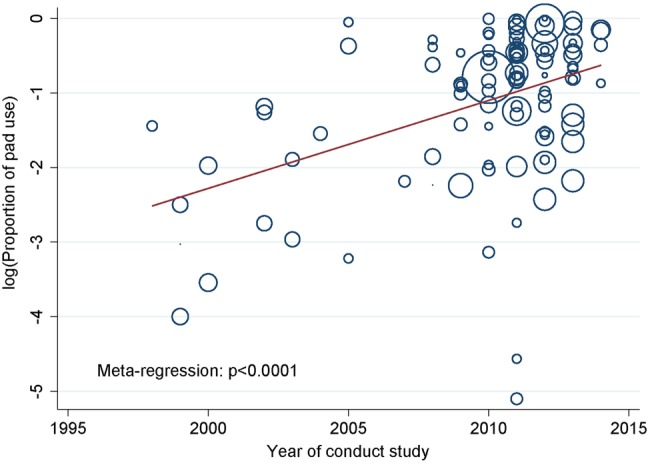
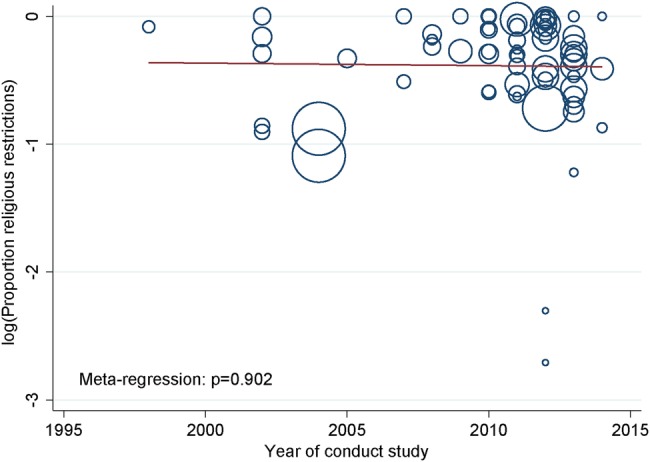
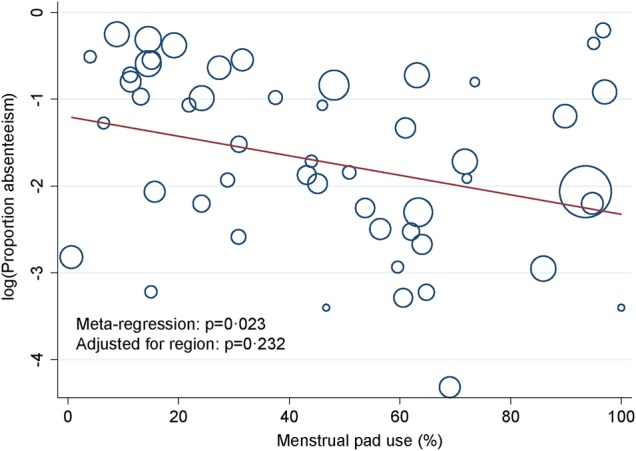
Objectives: To assess the status of menstrual hygiene management (MHM) among adolescent girls in India to determine unmet needs. Design: Systematic review and meta-analysis. We searched PubMed, The Global Health Database, Google Scholar and references for studies published from 2000 to September 2015 on girls’ MHM. Setting: India. Participants: Adolescent girls. Outcome measures: Information on menarche awareness, type of absorbent used, disposal, hygiene, restrictions and school absenteeism was extracted from eligible materials; a quality score was applied. Meta-analysis was used to estimate pooled prevalence (PP), and meta-regression to examine the effect of setting, region and time. Results: Data from 138 studies involving 193 subpopulations and 97 070 girls were extracted. In 88 studies, half of the girls reported being informed prior to menarche (PP 48%, 95% CI 43% to 53%, I 2 98.6%). Commercial pad use was more common among urban (PP 67%, 57% to 76%, I 2 99.3%, n=38) than rural girls (PP 32%, 25% to 38%, I 2 98.6%, n=56, p<0.0001), with use increasing over time (p<0.0001). Inappropriate disposal was common (PP 23%, 16% to 31%, I 2 99.0%, n=34). Menstruating girls experienced many restrictions, especially for religious activities (PP 0.77, 0.71 to 0.83, I 2 99.1%, n=67). A quarter (PP 24%, 19% to 30%, I 2 98.5%, n=64) reported missing school during periods. A lower prevalence of absenteeism was associated with higher commercial pad use in univariate (p=0.023) but not in multivariate analysis when adjusted for region (p=0.232, n=53). Approximately a third of girls changed their absorbents in school facilities (PP 37%, 29% to 46%, I 2 97.8%, n=17). Half of the girls’ homes had a toilet (PP 51%, 36% to 67%, I 2 99.4%, n=21). The quality of studies imposed limitations on analyses and the interpretation of results (mean score 3 on a scale of 0–7). Conclusions: Strengthening of MHM programmes in India is needed. Education on awareness, access to hygienic absorbents and disposal of MHM items need to be addressed. Trial registration number: CRD42015019197.
Overview
The claims and statistics of this paper haven’t been checked yet.
Free: it reads the open-access text and checks the first 5 claims that cite a source we can check. Create a free account to check every claim.
Integrity signals
Registry
Cites
Statistics
Figures
Verification
Claims the paper makes
The claims and statistics of this paper haven’t been checked yet.
Free: it reads the open-access text and checks the first 5 claims that cite a source we can check. Create a free account to check every claim.
Claims other papers make about this one
Each is checked against this paper’s own text: does it say what the citing paper says it does?
The source backs part of the claim, not all of it — or backs it for a different population, condition or comparison.
In the citing paper
“Ascertainment of intermediate outcomes such as school absence (i.e. which may contribute to dropout or failure to achieve) has been mixed (14, 31)”
From Menstrual hygiene management among adolescent schoolgirls in low- and middle-income countries: research priorities (2016) · cites this paper as [14]
Experimental — accuracy not yet measuredThe source backs part of the claim, not all of it — or backs it for a different population, condition or comparison.
In the citing paper
“inadequate social support, ongoing gender inequality, and social and hygiene taboos around menstruation in numerous countries leave girls experiencing shame, fear, and confusion when trying to cope with their menstrual flow (9–15, 20, 21).”
From Menstrual hygiene management among adolescent schoolgirls in low- and middle-income countries: research priorities (2016) · cites this paper as [14]
Experimental — accuracy not yet measuredThe source backs part of the claim, not all of it — or backs it for a different population, condition or comparison.
In the citing paper
“Studies to date, predominantly using school registers, have not shown a strong association between absence and menstrual intervention with varying duration of follow-up ranging between 1-month and 1-year.10 12–16”
From Menstrual cups and sanitary pads to reduce school attrition, and sexually transmitted and reproductive tract infections: a cluster randomised controlled feasibility study in rural Western Kenya (2016) · cites this paper as [12]
Experimental — accuracy not yet measuredThe source backs part of the claim, not all of it — or backs it for a different population, condition or comparison.
In the citing paper
“Women and girls in lower and middle-income countries (LMICs) face a multitude of barriers to safe and comfortable menstrual hygiene management (MHM).”
From ’It’s like a burden on the head’: Redefining adequate menstrual hygiene management throughout women’s varied life stages in Odisha, India. (2019) · cites this paper as [8]
Experimental — accuracy not yet measuredThe source backs part of the claim, not all of it — or backs it for a different population, condition or comparison.
In the citing paper
“In addition to these structural and resource barriers, women and girls face information and social support challenges: girls are often unprepared, uninformed, misinformed, and lack adequate support for understanding and managing menarche, menstruation, and puberty, resulting in fear, uncertainty, and potentially harmful behaviors, like risky sex, reduced bathing, and limited food and water intake”
From ’It’s like a burden on the head’: Redefining adequate menstrual hygiene management throughout women’s varied life stages in Odisha, India. (2019) · cites this paper as [8]
Experimental — accuracy not yet measured
21 more claims about this paper
Create a free account to see every claim other papers make about this one.
Self-check
Percentages, sums and reported differences re-computed from the paper’s own numbers.
The self-check needs the paper’s full text.
Citations
Cites
Measuring inconsistency in meta-analyses
Higgins, J. P. T., Thompson, S. G., Deeks, J. J., & Altman, D. G. (2003) · BMJ · doi:10.1136/bmj.327.7414.557 · Cited by 63,139 · cited 1×
“22 The extent of heterogeneity was measured using the I(2), a measure of the proportion of total variability explained by heterogeneity rather than chance expressed as a percentage.(23) To explore determinants of prevalence, we examined sources of heterogeneity across studies of the pooled”
MethodBarendregt, J. J., Doi, S. A., Lee, Y. Y., Norman, R. E., & Vos, T. (2013) · Journal of Epidemiology and Community Health · doi:10.1136/jech-2013-203104 · Cited by 2,169 · cited 1×
“21 22 The extent of heterogeneity was measured using the I 2 , a measure of the proportion of total variability explained by heterogeneity rather than chance expressed as a percentage.”
MethodMetaprop: a Stata command to perform meta-analysis of binomial data
Nyaga, V. N., Arbyn, M., & Aerts, M. (2014) · Archives of Public Health · doi:10.1186/2049-3258-72-39 · Cited by 2,139 · cited 1×
“21 22 The extent of heterogeneity was measured using the I 2 , a measure of the proportion of total variability explained by heterogeneity rather than chance expressed as a percentage.”
MethodImproved tests for a random effects meta‐regression with a single covariate
Knapp, G., & Hartung, J. (2003) · Statistics in Medicine · doi:10.1002/sim.1482 · Cited by 2,075 · cited 2×
“We estimated between-study variance ( τ 2 ) using the algorithm of residual (restricted) maximum likelihood and calculated p values, and 95% CI for coef fi cients using the modi fi cation by Knapp and Hartung.”
MethodAnalysing Data and Undertaking Meta‐Analyses
Deeks, J. J., Higgins, J. P., & Altman, D. G. (2008) · Cochrane Handbook for Systematic Reviews of Interventions · doi:10.1002/9780470712184.ch9 · Cited by 1,800
Harbord, R. M., & Higgins, J. P. T. (2008) · The Stata Journal: Promoting communications on statistics and Stata · doi:10.1177/1536867x0800800403 · Cited by 897 · cited 1×
“prevalence (PP) estimates using random-effects meta-regression.(24) Regression coefficients were presented as ORs with corresponding 95% CIs.”
MethodMenstrual hygiene: How hygienic is the adolescent girl?
Dasgupta, A., & Sarkar, M. (2008) · Indian Journal of Community Medicine · doi:10.4103/0970-0218.40872 · Cited by 592
A systematic review of the health and social effects of menstrual hygiene management
Sumpter, C., & Torondel, B. (2013) · PLoS ONE · doi:10.1371/journal.pone.0062004 · Cited by 518
Das, P., Baker, K. K., Dutta, A., Swain, T., Sahoo, S., Das, B. S., Panda, B., Nayak, A., Bara, M., Bilung, B., et al. (2015) · PLOS ONE · doi:10.1371/journal.pone.0130777 · Cited by 441
Mason, L., Nyothach, E., Alexander, K., Odhiambo, F. O., Eleveld, A., Vulule, J., Rheingans, R., Laserson, K. F., Mohammed, A., & Phillips-Howard, P. A. (2013) · PLoS ONE · doi:10.1371/journal.pone.0079132 · Cited by 375
Self-citation
Research works printed but not linked: 5
- Sommer M , Vasquez E , Worthington N , et al . WASH in schools empowers girls’ education. Proceedings of the Menstrual Hygiene Management in Schools Virtual Conference; 2012. New York, USA: UNICEF and Colombia University, 2013.
- Arunmozhi, 2013, A cross sectional study to assess the levels of knowledge practices of menstrual hygiene among adolescent girls of Chennai Higher Secondary Schools, Tamil Nadu, 2013, Med ej, 3, 211
- Reddy, 2005, Reproductive health constraints of adolescent school girls, Indian J Soc Work, 66, 431
- Venkatesh, 2011, Preceptions and practices during menstruation among adolescent girls in and around Bangalore city, Indian J Matern Child Health, 13, 1
- Gupta, 2001, Adolescents and menstruation, J Family Welf, 47, 1
Cited by
Items 401–500 of 509
Daniel, R. S., & Todalabagi, P. (2025) · International Journal of Community Medicine and Public Health · doi:10.18203/2394-6040.ijcmph20250319
Chakrabarty, M., & Singh, A. (2024) · Springer eBooks · doi:10.1007/978-981-97-8418-9_5
Menstrual health practices among Tibetan women: An ethnographic participant observation study
Dhadwal, Y., Kumar, A. S., & Pandey, S. (2025) · Journal of Family Medicine and Primary Care · doi:10.4103/jfmpc.jfmpc_1162_24
What can existing data on water and sanitation tell us about menstrual hygiene management?
Loughnan, L., Bain, R. B. R., Rop, R., Sommer, M., & Slaymaker, T. (2024) · Waterlines · doi:10.3362/1756-3488.24-00007
Impact of intervention on attitude towards hygiene management practices among college girls
Yashvee, Rani, E., Verma, V., & Verma, S. (2025) · International Journal of Agriculture and Food Science · doi:10.33545/2664844x.2025.v7.i4d.364
Dudhat, R., Saxena, L., Nainani, Y., Bhatnagar, V., Tiwari, V., & Sharma, A. (2025) · IEEE International Conference on Interdisciplinary Approaches in Technology and Management for Social Innovation (IATMSI) · doi:10.1109/iatmsi64286.2025.10985435
“Lack of access to clean water and sanitary products exacerbates these problems in rural and underprivileged areas, where approximately half of the homes are without adequate restrooms [1].”
Ubóstwo menstruacyjne w świetle badań i opracowań naukowych z lat 2013–2023
Buczak, A. (2024) · Nierówności społeczne a wzrost gospodarczy · doi:10.15584/nsawg.2024.4.6
'Whoever Invented This Thing Is God for Me": Experiences of Indian Women with the Menstrual CupPreprint
Chithrangathan, C., Salim, A. K., & Usman, S. (2025) · SSRN Electronic Journal · doi:10.2139/ssrn.5264786
Urgensi Edukasi Menstrual Hygiene sebagai Upaya Peningkatan Kesehatan Reproduksi Remaja Putri
Bakara, S. (2025) · Jurnal Pengabdian Masyarakat Bina Usada. · doi:10.36474/abdinusa.v3i1.509
Koshy, M., Khadir, F., Cheriyan, S., & Kumari, B. (2025) · International Journal of Community Medicine and Public Health · doi:10.18203/2394-6040.ijcmph20251697 · Cited by 1
Sustainable Periods-Motivations, Barriers AndEnvironmental Impact
Thukral, A., Jain, S., & Aggarwal, N. (2025) · International Journal of Environmental Sciences · doi:10.64252/5av74z86
Menstrual health practices in women with severe psychiatric disorders
Quadri, S. K., Rahman, M. A., Amjad, M., Zohra Fatima, S., Razvi, S. S. A. H., Amrullah, M., & Siddiqua, S. A. (2025) · International Journal of Research in Medical Sciences · doi:10.18203/2320-6012.ijrms20252388
(2024) · Cumulus Conference · doi:10.63442/tadx4016
Mejoramiento del conocimiento sobre salud menstrual en el deporte
McGawley, K., Sargent, D., Noordhof, D. A., Badenhorst, C. E., Julian, R., & Govus, A. D. (2025) · Pensar en Movimiento Revista de Ciencias del Ejercicio y la Salud · doi:10.15517/x43ajy28
Regional variation of menstruation hygiene among young scheduled caste women in India
Pakhadhara, T. R., & Raj, P. (2025) · Humanities & Social Sciences Reviews · doi:10.18510/hssr.2025.1327
Sharma, S., Phartyal, R., Biswas, C., Bhatia, J., Yadav, T., Roy, B., & Singh, J. (2024) · Health and population. Perspectives and issues · doi:10.5005/hppi-11041-47101
Paswan, A., & -, J. S. (2025) · International Journal For Multidisciplinary Research · doi:10.36948/ijfmr.2025.v07i04.53047
Mundodan, J. M., Madhusudanan, C., Subran, A. T., Krishnan, A., Ammanath, A., Suresh, A., Nair, A., Arjun, Reji, A., Thomas, A. A., et al. (2025) · International Journal of Community Medicine and Public Health · doi:10.18203/2394-6040.ijcmph20252837
Why Inter-sectoral Coordination is Imperative for Improved Menstrual Hygiene Management in India
Sherin Raj, T. P., & Kathuria, B. (2025) · Journal of Health Management · doi:10.1177/09720634251370523
“%) of adolescent girls in India were aware of menarche before their first menstruation, and had inadequate knowledge when attaining menarche (Van et al., 2016).”
Yaaqoob, B. Y. (2025) · .مجلة النسور للعلوم الطبية · doi:10.70492/2664-0554.1144
Yücel, E., Koç, S. D. G., Sungur, S., Metintaş, S., & Önsüz, M. F. (2025) · Global Health Promotion · doi:10.1177/17579759251382894 · Cited by 1
American Period Poverty: Highlighting Inequity at Home
Lever, J. E., & Grant, P. D. (2025) · The rural educator · doi:10.55533/2643-9662.1543
John, R. M., Ramaswamy, G., Kona, C., Das, S., Priyadarshini, R., Kulkarni, V., Panda, M., & Agarwal, N. (2025) · International Journal of Adolescent Medicine and Health · doi:10.1515/ijamh-2025-0044
Menon, R., Mathew, M., Gutjahr, G., Nedungadi, P., & Raman, R. (2025) · IEEE Global Humanitarian Technology Conference (GHTC) · doi:10.1109/ghtc66843.2025.11266599
Tanton, C., Nakuya, K., Kansiime, C., Hytti, L., Torondel, B., Francis, S. C., Namirembe, P., Nakalema, S., Nalugya, R., Musoke, S. N., et al. (2021) · Figshare · doi:10.6084/m9.figshare.17162909
Singh, A., Chakrabarty, M., Singh, S., Chandra, R. K., Chowdhury, S., & Singh, A. (2022) · Figshare · doi:10.6084/m9.figshare.21593817
Anbesu, E. W., & Asgedom, D. K. (2024) · Figshare · doi:10.6084/m9.figshare.26559410
Tanton, C., Nakuya, K., Kansiime, C., Hytti, L., Torondel, B., Francis, S. C., Namirembe, P., Nakalema, S., Nalugya, R., Musoke, S. N., et al. (2021) · Figshare · doi:10.6084/m9.figshare.17162906
Anbesu, E. W., & Asgedom, D. K. (2024) · Figshare · doi:10.6084/m9.figshare.26559404
Anbesu, E. W., & Asgedom, D. K. (2024) · Figshare · doi:10.6084/m9.figshare.26559416
Anbesu, E. W., & Asgedom, D. K. (2024) · Figshare · doi:10.6084/m9.figshare.26559407
Anbesu, E. W., & Asgedom, D. K. (2024) · Figshare · doi:10.6084/m9.figshare.26559413
Anbesu, E. W., & Asgedom, D. K. (2024) · Figshare · doi:10.6084/m9.figshare.26559401
Sahiledengle, B., Atlaw, D., Kumie, A., Beressa, G., Tekalegn, Y., Zenbaba, D., Woldeyohannes, D., Desta, F., Assefa, T., Odo, D. B., et al. (2022) · Figshare · doi:10.6084/m9.figshare.20227070
Sahiledengle, B., Atlaw, D., Kumie, A., Beressa, G., Tekalegn, Y., Zenbaba, D., Woldeyohannes, D., Desta, F., Assefa, T., Bogale, D., et al. (2022) · Figshare · doi:10.6084/m9.figshare.20227073
Sahiledengle, B., Atlaw, D., Kumie, A., Beressa, G., Tekalegn, Y., Zenbaba, D., Woldeyohannes, D., Desta, F., Assefa, T., Odo, D. B., et al. (2022) · Figshare · doi:10.6084/m9.figshare.20227067
Menstrual Health and Hygiene Awareness among Students of Selected University in NigeriaPreprint
Oyewusi, A. O., Fayomi, O. O., & Fondo, B. N. (2025) · SSRN Electronic Journal · doi:10.2139/ssrn.5403138
Tampubolon, M. M., Dewi, Y. I., Misrawati, M., & Utami, S. (2025) · Jurnal Ners · doi:10.31004/jn.v9i4.50259
“However, women in rural areas often prefer cloth pads (Kaur et al., 2018; Van Eijk et al., 2016).”
Period Relief: The Effects of Menstrual Hygiene Tax ExemptionsPreprint
Agarwal, S., Bhattacharya, J., Li, Z., & Shen, X. (2025) · SSRN Electronic Journal · doi:10.2139/ssrn.5858502
Kasbe, A. M., & Remold, R. (2025) · International Journal of Community Medicine and Public Health · doi:10.18203/2394-6040.ijcmph20254449
Mohan Kumar, M., Durairaj, T., Seetharaman, N., Shanmugam, J., Aparnavi, P., Kumar, A., Mahantshetti, S., & Dhandapani, S. (2026) · Social Sciences & Humanities Open · doi:10.1016/j.ssaho.2025.102359
Devassy, S. M., Baby, A., Scaria, L., & Eden, H. (2026) · Health Education · doi:10.1108/he-01-2025-0007
Menstrual Taboo and Women’s Agency
Dwivedi, A., & Moharana, K. C. (2025) · Indian Journal of Human Development · doi:10.1177/09737030251415015
“Young women complained that the toilets at school were very dirty, which made managing menstruation at school difficult (van Eijk et al., 2016).”
Shenoy, R., Kamath, M. G., & De, S. (2026) · IIUM Medical Journal Malaysia · doi:10.31436/imjm.v25i01.3214
“29 Changes were observed in self-reported practices three months post-workshop.”
Yadav, K., Kankaria, A., Chauhan, S., Pradhan, A., & Kakkar, R. (2026) · Indian Journal of Community Medicine · doi:10.4103/ijcm.ijcm_19_25 · Cited by 1
Menstrual Myths and Restrictive Practices among Adolescent Girls in Community SchoolsPreprint
Adhikari, S. U. (2026) · Research Square · doi:10.21203/rs.3.rs-8938844/v1
Male engagement in menstrual care: evidence from boys and young men in urban slums in Mumbai
Majumdar, P., Jejeebhoy, S. J., Chattopadhyay, A., & Sinha, D. (2026) · Culture Health & Sexuality · doi:10.1080/13691058.2026.2636219
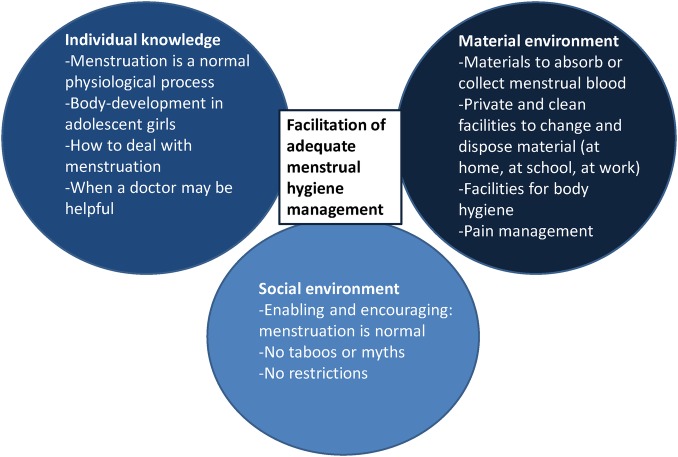
“The study draws on the conceptual framework proposed by van Eijk et al. (2016), in which menstrual hygiene management among girls is seen as shaped by knowledge, a supportive social environment and healthy WaSH conditions (van Eijk et al. 2016).”
Kumari, R., & Suvidha, S. (2026) · International Journal of Science and Research Archive · doi:10.30574/ijsra.2026.18.3.0464
Vijayakumar, G., Baskar, S., Raghupathy, S., & Rangarajulu, S. K. (2026) · Processes · doi:10.3390/pr14060918
Toward a Menstrual-friendly School Environment: A Convergent Parallel Mixed Method Study
Pawar, N., Seth, A. K., Goyal, A., Nath, B., Paul, S., Shukla, M., & Singh, A. (2026) · Indian Journal of Community Medicine · doi:10.4103/ijcm.ijcm_161_25
Chemical characterization of air and soil contaminants associated with menstrual hygiene products
Shankarappa, P., Shenoy, R. S., Amaravati, S., & Bhat, S. (2026) · Environmental Science and Pollution Research · doi:10.1007/s11356-026-37705-z
Concepire i corpi. Saperi e pratiche del corpo riproduttivo femminile nella città di Bhuj, India.
Gentile, L. (2020) · theses.fr (ABES) · doi:10.70675/67b6fd3eza646z4550zbb19z1213f6f23a9b · Cited by 3
Precilla Selvakumari, J. (2026) · International Journal of Drug Delivery Technology · doi:10.25258/ijddt.16.6s.57
Vyas, M. (2026) · International Journal of Science and Research (IJSR) · doi:10.21275/mr26408132055
Dadras, O., Stanikzai, M. H., Ezadi, Z., Jafari, M., Dadras, F., & Tawfiq, E. (2026) · BMC Women s Health · doi:10.1186/s12905-026-04535-7
Assessment of menstrual hygiene practices and menstrual disorders among adolescent girls
Likitha, P., & Padgul, S. S. (2026) · International Journal of Clinical Obstetrics and Gynaecology · doi:10.33545/gynae.2026.v10.i3d.2282
Raghute, L., Sharma, I., Nagvekar, M., Dandade, S., Ghadage, P., & Mohite, A. (2026) · Journal of Medical Sciences and Health · doi:10.46347/jmsh.v12.i1.25.383
van Eijk, A. M., Quinn-Savory, A., Zulaika, G., Skinner, A., Mason, L., Green, S. J., Phillips‐Howard, P. A., & Mehta, S. D. (2026) · EBioMedicine · doi:10.1016/j.ebiom.2026.106307
Self-citationSubhashini, N. G. M. D., & Thotawaththa, P. C. (2026) · Indonesian Journal of Sport Health and Physical Education Science · doi:10.58723/inasport.v4i2.637
“Similarly, Meignié et al. (2021) and Van Eijk et al., (2016) found that endurance, joint laxity, and metabolic efficiency could be negatively affected by hormonal fluctuations during menstruation.”
Pothangode, R., & Kumaran, J. A. (2026) · International Journal of Community Medicine and Public Health · doi:10.18203/2394-6040.ijcmph20261776
Brault, M. A., Singh, N., Kakkad, N. A., Peskin, M. F., Betori, A., Laynor, G., & Naiser, E. (2026) · PLoS ONE · doi:10.1371/journal.pone.0351147
Thapa, S. (2026) · International Journal of Social Science and Economic Research · doi:10.46609/ijsser.2026.v11i04.022
Nepal, N. (2026) · BMC research journal. · doi:10.3126/bmcrj.v5i1.95762
Kuponiyi, S. F., Akhagba, O. M., Nwafor, J. A., & Itodo, S. A. (2026) · Research Square · doi:10.21203/rs.3.rs-9997974/v1
Zahoor, H., & Ahmed, R. (2026) · Cureus · doi:10.7759/cureus.111289
“Prior studies in India have reported that hygienic menstrual practices are patterned by education, wealth, place of residence, mass media exposure, and geography [10-12].”
Marthadu, S., Thamineni, R., Maddirevula, M. K., Iguduru, M., Bogireddy, S., & Vemreddy, H. (2026) · Research Square · doi:10.21203/rs.3.rs-9833458/v1
Siregar, N., Sinaga, E. G., & Kurnia, N. U. (2026) · Napande Jurnal Bidan · doi:10.33860/njb.v5i1.4201
“This condition increases the risk of infection, discomfort, and school absenteeism during menstruation (van Eijk et al., 2016).”
Sarkar, P., & Shukla, D. (2026) · International Journal For Multidisciplinary Research · doi:10.36948/ijfmr.2026.v08i04.82805
Rafee, M., Kushwaha, S., Dolma, T., Tsomo, J., Banoo, J., Khenrab, S., & Lanzes, T. (2026) · Research Square · doi:10.21203/rs.3.rs-10175427/v1
Alam, M., & Al‐Mamun, M. (2026) · PLoS ONE · doi:10.1371/journal.pone.0354260
“A limited number of studies have comprehensively investigated the interplay of socio-economic, infrastructural, and cultural elements in influencing menstruation patterns, coping strategies, and access to hygiene supplies in informal urban environments [3,13,20].”
Singh, G., Gupta, A., & Gupta, P. (2026) · Indian Journal of Community Health · doi:10.47203/ijch.2026.v38i03.006
“[4] Factors such as misinformation, prevailing social stigma, lack of privacy, poor sanitation infrastructure, and restricted access to safe absorbent materials contribute to suboptimal menstrual practices.”
Velugu, S., Ruggiero, E. D., Kannuri, N. K., & Ataullahjan, A. (2026) · JMIR Research Protocols · doi:10.2196/94012
Hallad, J. S., Chokhandre, P. K., Pundappanavar, B. I., & Vatavati, S. R. (2026) · Global Social Welfare · doi:10.1007/s40609-026-00473-2
Sahu, M., & Joglekar, A. R. (2026) · International Journal of Home Science · doi:10.22271/23957476.2026.v12.i7b.2274
Edwards, J. K., Shakya, S., Subedi, M. S., Milton, R., Channon, S., Shrestha, B. K., Wenju, S. K., Sunar, K. K., Parajuli, S., Edwards, J., et al. (2026) · doi:10.12688/verixiv.3542.1
Mitra, S., Arora, A., Shimpi, A. P., & Patwardhan, S. (2026) · Research Square · doi:10.21203/rs.3.rs-10377763/v1
Niraula, B. L., Acharya, A., Phuyal, M., Marasini, B., & Acharya, P. (2026) · PLoS ONE · doi:10.1371/journal.pone.0336321
Bhattacharjee, D. (2026) · Journal of Policy Modeling · doi:10.1016/j.jpolmod.2026.107094
Physical Discomfort and Remedial Actions for Pain Management of Adolescent Girls
Adhikari, S. U., Adhikari, S. P., & Sharma, T. P. (2026) · Teacher Half-Yearly Journal · doi:10.3126/thj.v18i1.97910
Tamilmani, B., & Peninnah, J. (2026) · EPRA International Journal of Multidisciplinary Research (IJMR) · doi:10.36713/epra28930 · Cited by 1
Santra, S., Panwar, N., Dhama, S., Rajan, A. K., Singhal, P., & Verma, A. (2026) · International Journal of Community Medicine and Public Health · doi:10.18203/2394-6040.ijcmph20263176
Chouhan, P. (2026) · International Journal of Nursing Education and Research · doi:10.52711/2454-2660.2026.00051
Religious Affiliation and Reported Dual Menstrual Material Use Among Young Women in India
Seetharaman, N., Biradar, R. A., Sivasubramanian, Y. A. N., Sriram, S., Halli, S. S., & Prasad, J. B. (2026) · Healthcare · doi:10.3390/healthcare14182893
“While the adoption of modern menstrual hygiene products (like sanitary pads) is increasing, traditional materials such as cloth may continue to be used alongside modern products [5].”
InfluentialKumari, R., & Sharma, A. (2026) · Women s Reproductive Health · doi:10.1080/23293691.2026.2724071
Dhimara, M., Dewangan, D., & Dahariya, S. (2026) · International Journal of Clinical Obstetrics and Gynaecology · doi:10.33545/gynae.2026.v10.i5c.2866
Nakash, P., Debnath, S., Chaturvedi, B., Thakur, P., Jain, S., Sharma, A., Singh, M., Nathiya, D., & Tomar, B. S. (2026) · Discover Public Health · doi:10.1186/s12982-026-02956-1
Showkat, S. S., Arcot, P. P., & S, L. P. (2026) · IGI Global eBooks · doi:10.4018/979-8-3373-7370-6.ch011
Rafee, M. (2026) · BMC Women s Health · doi:10.1186/s12905-026-04888-z
Gender, sanitation and innovation: impacts and opportunities for gender equity and gender justice
Lawhon, M., Sutherland, C., Darmovzalova, J., Sánchez-López, S., Gqaleni, M. C., & Iyer, R. (2026) · Global Social Challenges Journal · doi:10.1332/27523349y2026d000000097
Goel, K., Dutt, R., Gupta, M., & Kiran, T. (2026) · JMIR Research Protocols · doi:10.2196/93628
Menstrual Health in South India: Knowledge, Stigma, and Barriers to ParticipationPreprint
Ravi, R., Amitrano, J., & Seshadri, D. (2026) · medRxiv · doi:10.64898/2026.09.16.26363278
Upadhyay, D., Acharya, B., Maharjan, K., Poudel, N., Neupane, B., & Dhakal, J. (2026) · Research Square · doi:10.21203/rs.3.rs-10722803/v1
Bi, F., & SAMANTARAY, P. (2026) · International Journal of Community Medicine and Public Health · doi:10.18203/2394-6040.ijcmph20263602
Perception and practices on menstrual hygiene among urban adolescent girls: a cross-sectional study
Panda, A., Panda, S. K., Panda, D., Patra, A., & Meher, T. (2026) · International Journal of Community Medicine and Public Health · doi:10.18203/2394-6040.ijcmph20263642
Yang, Y., & Myrick, J. G. (2026) · Journal of Health Communication · doi:10.1080/10810730.2026.2742315
Devi, J., Anand, M., Bagal, Y. S., & Jamwal, R. (2026) · International Journal of Drug Delivery Technology · doi:10.25258/ijddt.16.48s.64
Ansell, E., Saleh, I., Zulaika, G., Obor, D., van Eijk, A. M., Oruko, K., Oketch, S. Y., Phillips‐Howard, P. A., & Mason, L. (2026) · Frontiers in Reproductive Health · doi:10.3389/frph.2026.1931799
“Similarly, they report that girls feel embarrassed, ashamed, and stressed as a consequence (11, 16, 26, 29, 30).”
Self-citationMonima, M., Hassan, F., Rahman, A., Khaled, N., Mondal, P. P., Huda, F., & Afsana, K. (2026) · Discover Public Health · doi:10.1186/s12982-026-03031-5
Metadata
- Authors
- van Eijk, A. M., Sivakami, M., Thakkar, M. B., Bauman, A., Laserson, K. F., Coates, S., & Phillips-Howard, P. A.
- Affiliations
- Department of Clinical Sciences, Liverpool school of Tropical Medicine, Liverpool, UK
- Tata Institute of Social Sciences (IN)
- United Nations Children's Fund India (IN)
- Liverpool School of Tropical Medicine (GB)
- Centers for Disease Control and Prevention (US)
- ORCID
- Sivakami, M
- Venue
- BMJ Open
- Publisher
- BMJ
- Published
- 2016-03
- Volume
- 6
- Issue
- 3
- Pages
- e010290
- ISSN
- 2044-6055 (ISSN-L)
- PMC
- PMC4785312
- OpenAlex
- W2292933427
- Cited by
- 471
- References
- 82
- Citations by year
- 2026: 53 · 2025: 60 · 2024: 57 · 2023: 74 · 2022: 44 · 2021: 51 · 2020: 47 · 2019: 38 · 2018: 24 · 2017: 16 · 2016: 7
- FWCI
- 4.20
- Type
- journal article
- Language
- en
- Open access
- gold
- doi.org
- Licence
- cc-by-nc
- Locations
- BMJ Open (publishedVersion, cc-by-nc)
- PubMed Central (publishedVersion, cc-by-nc)
- PubMed (publishedVersion)
- LSTM Online Archive (Liverpool School of Tropical Medicine) (acceptedVersion)
- HighWire Press Open Archive (submittedVersion)
- Topics
- Health Sciences › Medicine › Public Health, Environmental and Occupational Health › Menstrual Health and Disorders
- Health Sciences › Medicine › Reproductive Medicine › Hypothalamic control of reproductive hormones
- Health Sciences › Medicine › Public Health, Environmental and Occupational Health › Adolescent Sexual and Reproductive Health
- Keywords
- menstrual hygiene management, adolescent girls, menstrual product disposal, school absenteeism, urban-rural disparities, India, unmet needs, menstrual health education, menstrual health policy, menstrual health advocacy
- MeSH terms
- Absenteeism, Adolescent, Female, Humans, Hygiene, India, Health Knowledge, Attitudes, Practice, Menarche, Menstruation, Rural Population, Schools, Urban Population
About these checks
Registry, retraction, Cites and statistics results are computed, not judged, with one exception: a printed reference that no index lists is read once by a model before it counts as a citation error. Claims are extracted by a model and kept only when their quote appears verbatim in the text; each cited source is then checked, with a model’s help, for whether it says what the claim relies on. Those verdicts can be wrong — read the claim’s quote and the cited source before relying on one.
Statistics and arithmetic are recomputed, not judged.
Confidence bands are shown only for fields calibrated on our annotated test set. None is calibrated yet, so no band is shown.
What counts as a claim ›How we measure confidence ›How we check this ›
Are you an author, or do you see a problem with this page? Request a review
Data sources
Bibliographic data: Semantic Scholar, OpenAlex, Crossref.
Contains information from the Semantic Scholar Academic Graph Datasets, made available under the ODC Attribution License (ODC-BY 1.0).
Semantic Scholar’s data is described in: Kinney, R., et al. (2023). The Semantic Scholar Open Data Platform. arXiv:2301.10140.
