

Implementing online consultations in primary care: a mixed-method evaluation extending normalisation process theory through service co-production
Open accessThe DOI matches its Crossref record; 42 of the 42 references it cites were found in a registry or an index.
Abstract
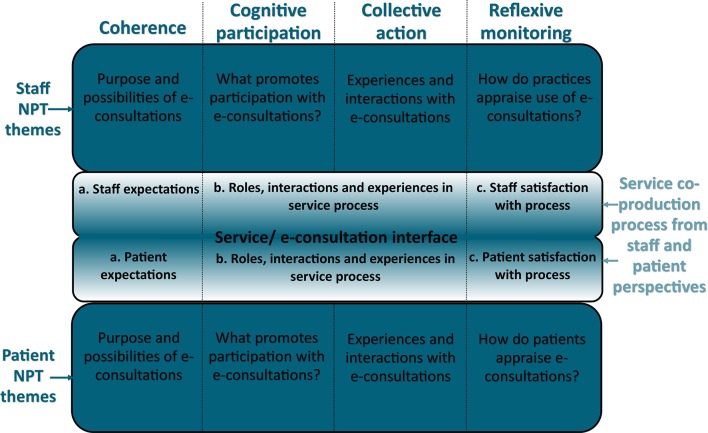
Objectives: To examine patient and staff views, experiences and acceptability of a UK primary care online consultation system and ask how the system and its implementation may be improved. Design: Mixed-method evaluation of a primary care e-consultation system. Setting: Primary care practices in South West England. Methods: Qualitative interviews with 23 practice staff in six practices. Patient survey data for 756 e-consultations from 36 practices, with free-text survey comments from 512 patients, were analysed thematically. Anonymised patients’ records were abstracted for 485 e-consultations from eight practices, including consultation types and outcomes. Descriptive statistics were used to analyse quantitative data. Analysis of implementation and the usage of the e-consultation system were informed by: (1) normalisation process theory, (2) a framework that illustrates how e-consultations were co-produced and (3) patients’ and staff touchpoints. Results: We found different expectations between patients and staff on how to use e-consultations ‘appropriately’. While some patients used the system to try and save time for themselves and their general practitioners (GPs), some used e-consultations when they could not get a timely face-to-face appointment. Most e-consultations resulted in either follow-on phone (32%) or face-to-face appointments (38%) and GPs felt that this duplicated their workload. Patient satisfaction of the system was high, but a minority were dissatisfied with practice communication about their e-consultation. Conclusions: Where both patients and staff interact with technology, it is in effect ‘co-implemented’. How patients used e-consultations impacted on practice staff’s experiences and appraisal of the system. Overall, the e-consultation system studied could improve access for some patients, but in its current form, it was not perceived by practices as creating sufficient efficiencies to warrant financial investment. We illustrate how this e-consultation system and its implementation can be improved, through mapping the co-production of e-consultations through touchpoints.
Overview
The claims and statistics of this paper haven’t been checked yet.
Free: it reads the open-access text and checks the first 5 claims that cite a source we can check. Create a free account to check every claim.
Integrity signals
Registry
Cites
Statistics
Figures


Verification
Claims the paper makes
The claims and statistics of this paper haven’t been checked yet.
Free: it reads the open-access text and checks the first 5 claims that cite a source we can check. Create a free account to check every claim.
Claims other papers make about this one
Each is checked against this paper’s own text: does it say what the citing paper says it does?
The source backs part of the claim, not all of it — or backs it for a different population, condition or comparison.
In the citing paper
“Studies reported low asynchronous telemedicine use before the pandemic; up to seven consultations per 1000 patients per month. 31–33,35”
From Effectiveness and safety of asynchronous telemedicine consultations in general practice: a systematic review (2024) · cites this paper as [33]
Experimental — accuracy not yet measuredThe cited source says what the claim attributes to it.
In the citing paper
“Many were telephone or face-to-face, (55.3–74%), which were more likely when patients had new or complex problems, 31–33 or required physical examination. 34,35”
From Effectiveness and safety of asynchronous telemedicine consultations in general practice: a systematic review (2024) · cites this paper as [33]
The cited source says what the claim attributes to it.
In the citing paper
“Concerns included digitally excluded patients and reinforcing health inequities. 31–33,43,48”
From Effectiveness and safety of asynchronous telemedicine consultations in general practice: a systematic review (2024) · cites this paper as [33]
The check wasn’t confident either way, so it gives no verdict — never disputed.
In the citing paper
“Three studies reported patient use of asynchronous telemedicine increased gradually before the pandemic 26,31–33,40 and in 2016 20% of UK general practices planned to introduce it. 49”
From Effectiveness and safety of asynchronous telemedicine consultations in general practice: a systematic review (2024) · cites this paper as [33]
Experimental — accuracy not yet measuredIn the citing paper
“One quantitative survey followed up 756 e-consultations in general practice and found that most generated either a telephone (32%) or face-to-face (38%) consultation (108)”
From Planning and Evaluating Remote Consultation Services: A New Conceptual Framework Incorporating Complexity and Practical Ethics (2021) · cites this paper as [108]
Self-check
Percentages, sums and reported differences re-computed from the paper’s own numbers.
The self-check needs the paper’s full text.
Citations
Cites
Using thematic analysis in psychology
Braun, V., & Clarke, V. (2006) · Qualitative Research in Psychology · doi:10.1191/1478088706qp063oa · Cited by 194,414
A conceptual model of service quality and its implications for future research
Parasuraman, A., Zeithaml, V. A., & Berry, L. L. (1985) · Journal of Marketing · doi:10.1177/002224298504900403 · Cited by 21,645
Greenhalgh, T., Wherton, J., Papoutsi, C., Lynch, J., Hughes, G., A'Court, C., Hinder, S., Fahy, N., Procter, R., & Shaw, S. (2017) · Journal of Medical Internet Research · doi:10.2196/jmir.8775 · Cited by 2,887
Implementing, Embedding, and Integrating Practices: An Outline of Normalization Process Theory
May, C., & Finch, T. (2009) · Sociology · doi:10.1177/0038038509103208 · Cited by 2,115
Murray, E., Treweek, S., Pope, C., MacFarlane, A., Ballini, L., Dowrick, C., Finch, T., Kennedy, A., Mair, F., O'Donnell, C., et al. (2010) · BMC Medicine · doi:10.1186/1741-7015-8-63 · Cited by 1,478
Service Blueprinting: A Practical Technique for Service Innovation
Bitner, M. J., Ostrom, A. L., & Morgan, F. N. (2008) · California Management Review · doi:10.2307/41166446 · Cited by 1,194
Co-Production and the Co-Creation of Value in Public Services: A suitable case for treatment?
Osborne, S. P., Radnor, Z., & Strokosch, K. (2016) · Public Management Review · doi:10.1080/14719037.2015.1111927 · Cited by 1,126
Coproduction of healthcare service
Batalden, M., Batalden, P., Margolis, P., Seid, M., Armstrong, G., Opipari-Arrigan, L., & Hartung, H. (2016) · BMJ Quality & Safety · doi:10.1136/bmjqs-2015-004315 · Cited by 1,078
Ross, J., Stevenson, F., Lau, R., & Murray, E. (2016) · Implementation Science · doi:10.1186/s13012-016-0510-7 · Cited by 1,011 · cited 3×
“Our results align with other studies that highlight potential barriers to technological implementation including that: the clinical data the system was designed to generate from patients were sometimes incomplete(46); the system was not fully interoperable with other IT systems, and costs prohibited long-term usage.(1…”
BackgroundResultInfluentialA New Theory for Public Service Management? Toward a (Public) Service-Dominant Approach
Osborne, S. P., Radnor, Z., & Nasi, G. (2013) · The American Review of Public Administration · doi:10.1177/0275074012466935 · Cited by 848
Cited by
Murphy, M., Scott, L. J., Salisbury, C., Turner, A., Scott, A., Denholm, R., Lewis, R., Iyer, G., Macleod, J., & Horwood, J. (2021) · British Journal of General Practice · doi:10.3399/bjgp.2020.0948 · Cited by 486
Self-citationErku, D., Khatri, R., Endalamaw, A., Wolka, E., Nigatu, F., Zewdie, A., & Assefa, Y. (2023) · International Journal of Environmental Research and Public Health · doi:10.3390/ijerph20196854 · Cited by 177
“Furthermore, e-consultations did not substitute for, but were, rather, an ‘add on’ to, face-to-face consultations, further duplicating their workload [59].”
Greenhalgh, T., Rosen, R., Shaw, S. E., Byng, R., Faulkner, S., Finlay, T., Grundy, E., Husain, L., Hughes, G., Leone, C., et al. (2021) · Frontiers in Digital Health · doi:10.3389/fdgth.2021.726095 · Cited by 173
“One quantitative survey followed up 756 e-consultations in general practice and found that most generated either a telephone (32%) or face-to-face (38%) consultation (108).”
BackgroundHuddlestone, L., Turner, J., Eborall, H., Hudson, N., Davies, M. J., & Martin, G. P. (2020) · BMC Family Practice · doi:10.1186/s12875-020-01107-y · Cited by 170
Smith, H. J. J., Budworth, L., Grindey, C., Hague, I., Hamer, N., Kislov, R., van der Graaf, P., & Langley, J. (2022) · Health Research Policy and Systems · doi:10.1186/s12961-022-00838-x · Cited by 169
GP retention in the UK: a worsening crisis. Findings from a cross-sectional survey
Owen, K., Hopkins, T., Shortland, T., & Dale, J. R. (2019) · BMJ Open · doi:10.1136/bmjopen-2018-026048 · Cited by 143
Ziébland, S., Hyde, E., & powell, J. A. (2021) · Social Science & Medicine · doi:10.1016/j.socscimed.2021.114419 · Cited by 143
The Impact of Digital-First Consultations on Workload in General Practice: Modeling Study
Salisbury, C., Murphy, M., & Duncan, P. (2020) · Journal of Medical Internet Research · doi:10.2196/18203 · Cited by 124
“Second, some clinicians suggest that the duration of a face-to-face consultation might be shorter after a prior online or telephone assessment than under conventional care [19] (although the evidence suggests this is not the case) [23,29].”
BackgroundSelf-citationThe Impact of Digital-First Consultations on Workload in General Practice: Modeling Study (Preprint)
Salisbury, C., Murphy, M., & Duncan, P. (2020) · doi:10.2196/preprints.18203 · Cited by 124
Self-citationMaking change last? Exploring the value of sustainability approaches in healthcare: a scoping review
Lennox, L., Linwood-Amor, A., Maher, L., & Reed, J. E. (2020) · Health Research Policy and Systems · doi:10.1186/s12961-020-00601-0 · Cited by 110
“[64] Normalisation Process Theory To analyse the implementation and acceptability of the eConsult system from patient and staff perspectives using the NPT as a framework to develop coding Australia Primary Care”
BackgroundMethodCo-creation in healthcare: framing the outcomes and their determinants
Fusco, F., Marsilio, M., & Guglielmetti, C. (2023) · Journal of service management · doi:10.1108/josm-06-2021-0212 · Cited by 103
Unintended consequences of online consultations: a qualitative study in UK primary care
Turner, A., Morris, R., Rakhra, D., Stevenson, F., McDonagh, L., Hamilton, F., Atherton, H., Farr, M., Blake, S., Banks, J., et al. (2022) · British Journal of General Practice · doi:10.3399/bjgp.2021.0426 · Cited by 92
Self-citationGabrielsson‐Järhult, F., Kjellström, S., & Josefsson, K. A. (2021) · Scandinavian Journal of Primary Health Care · doi:10.1080/02813432.2021.1913904 · Cited by 83
Silva, C. R. D. V., Lopes, R. H., Bay, O. D. G., Martiniano, C. S., Fuentealba-Torres, M., Arcêncio, R. A., Lapão, L. V., Dias, S., & Uchôa, S. A. D. C. (2022) · JMIR Human Factors · doi:10.2196/35380 · Cited by 75
“For greater benefits, the literature indicates that the use of technology should be simple, consistent with local workflows, convenient for users, offer advantages over face-to-face consultations [76,85,86], and complement other existing technologies.”
BackgroundStamenova, V., Agarwal, P., Kelley, L., Fujioka, J., Nguyen, M., Phung, M., Wong, I., Onabajo, N., Bhatia, R. S., & Bhattacharyya, O. (2020) · BMJ Open · doi:10.1136/bmjopen-2020-037064 · Cited by 70
Eldh, A. C., Sverker, A., Bendtsen, P., & Nilsson, E. (2020) · JMIR Human Factors · doi:10.2196/21698 · Cited by 70
“The notion that the inadequacies of digital communication are better settled by telephone [2,19] was addressed.”
BackgroundMold, F., Cooke, D. D., Ip, A., Roy, P., Denton, S., & Armes, J. (2021) · BMJ Health & Care Informatics · doi:10.1136/bmjhci-2020-100256 · Cited by 64
“…may offer alternative routes to care access for some service users, it may also inadvertently lead to subsequent or more frequent follow-up visits, either via telephone or face- to-face 18 25 47 or an even greater need for care delivery ‘down-stream’ between secondary and primary care providers.”
InfluentialMarsilio, M., Fusco, F., Gheduzzi, E., & Guglielmetti, C. (2021) · International Journal of Environmental Research and Public Health · doi:10.3390/ijerph18073336 · Cited by 59
Eccles, A., Hopper, M., Turk, A., & Atherton, H. (2019) · British Journal of General Practice · doi:10.3399/bjgp19x702197 · Cited by 55
Darley, S., Coulson, T., Peek, N., Moschogianis, S., van der Veer, S. N., Wong, D. C., & Brown, B. C. (2022) · Journal of Medical Internet Research · doi:10.2196/37436 · Cited by 53
“These queries also decreased health costs as they saved clinicians time, for example, when administrative staff were able to relay messages and there was no direct contact between physician and patient [23].”
InfluentialBarriers and Enablers in Implementing Electronic Consultations in Primary Care: Scoping Review
Baines, R., Tredinnick‐Rowe, J., Jones, R. B., & Chatterjee, A. (2020) · Journal of Medical Internet Research · doi:10.2196/19375 · Cited by 53
“Studies identified a low uptake as a further barrier to electronic consultation implementation [1,3,4,6,11,16,24].”
InfluentialHellzèn, O., Alm, A. K., & Holmström, M. R. (2022) · Nursing Reports · doi:10.3390/nursrep12040091 · Cited by 50
“Primary care is considered to be at the ‘saturation point’ [24], facing increasing demand, reduced accessibility, and heightened patient dissatisfaction [25].”
BackgroundNilsson, E., Sverker, A., Bendtsen, P., & Eldh, A. C. (2021) · Journal of Medical Internet Research · doi:10.2196/29868 · Cited by 48
“The results of these studies are consistent with the findings of this study regarding patients’ views on the appropriateness and availability of e-visits and the pros and cons of written communication [18-23].”
Protocol: Remote care as the ‘new normal’? Multi-site case study in UK general practice
Greenhalgh, T., Shaw, S. E., Nishio, A. A., Booth, A., Byng, R., Clarke, A., Dakin, F., Davies, R., Faulkner, S. D., Hemmings, N., et al. (2022) · NIHR Open Research · doi:10.3310/nihropenres.13289.1 · Cited by 42
“…efficiency—indeed, they often showed that remote modalities reduced efficiency as a result of double-handling or more service contacts 23,27–29, 32 , The strengths and limitations of large-scale quantitative studies for evaluating remote service models were illustrated by a study of ‘telephone…”
BackgroundSaigí-Rubió, F., Vidal‐Alaball, J., Torrent‐Sellens, J., Jiménez‐Zarco, A. I., Seguí, F. L., Hernández, M. C., Reig, X. A., Bonet, J. M., González, M. A., Piera-Jiménez, J., et al. (2021) · Journal of Medical Internet Research · doi:10.2196/28944 · Cited by 40
“Some studies have noted that these difficulties may be due to a lack of focus in the implementation of such interventions (ie, health care professionals do not see them as either necessary or effective [17]), or the paucity or inconclusive nature of the studies published thus far [18-20].”
Lewis, N. V., Dowrick, A., Sohal, A. H., Feder, G. S., & Griffiths, C. (2019) · Health & Social Care in the Community · doi:10.1111/hsc.12733 · Cited by 39
Leighton, C., Cooper, A., Porter, A., Edwards, A., & Joseph-Williams, N. (2024) · BJGP Open · doi:10.3399/bjgpo.2023.0177 · Cited by 34
“Six reported patients who used asynchronous telemedicine were younger on average than users of face- to-Table eConsult, UK 26,31–33, Responses next working day. eConsulta, Spain 28,46,47 Two-way online messaging between patient and clinician.”
BackgroundUse, cost, and digital divide in online public health care: lessons from Denmark
Andersen, K. N., Nielsen, J. A., & Kim, S. (2019) · Transforming Government People Process and Policy · doi:10.1108/tg-06-2018-0041 · Cited by 33
How to conduct written online consultations with patients in primary care
Bakhai, M., & Atherton, H. (2021) · BMJ · doi:10.1136/bmj.n264 · Cited by 30
Schutz, S., Walthall, H., Snowball, J., Vagner, R., Fernandez, N., Bartram, E., & Merriman, C. (2022) · Digital Health · doi:10.1177/20552076221115022 · Cited by 30
Farr, M., Pithara, C., Sullivan, S. A., Edwards, H. B., Hall, W., Gadd, C., Walker, J. S., Hebden, N., & Horwood, J. P. (2019) · Journal of Mental Health · doi:10.1080/09638237.2019.1608925 · Cited by 28
Self-citationMoschogianis, S. F., Darley, S., Coulson, T., Peek, N. B., Cheraghi‐Sohi, S., & Brown, B. C. (2023) · British Journal of General Practice · doi:10.3399/bjgp.2023.0076 · Cited by 27
“17,18,30–32 Exploration of patient views has been limited 33,34 with most studies employing survey-based methods, 24,28,35–38 rather than qualitative interview-based techniques.”
Pithara, C., Farr, M., Sullivan, S. A., Edwards, H. B., Hall, W., Gadd, C., Walker, J., Hebden, N., & Horwood, J. (2020) · Journal of Medical Internet Research · doi:10.2196/14868 · Cited by 24
“Importance attached by providers to the therapeutic relationship when adopting digital health technologies highlights the need to better understand interpersonal aspects of health technologies in clinical contexts [13,18,27,37].”
BackgroundSelf-citationAccess systems in general practice: a systematic scoping review
Eccles, A., Bryce, C., Driessen, A., Pope, C. J., MacLellan, J., Gronlund, T. A., Nicholson, B. D., Ziébland, S., & Atherton, H. (2024) · British Journal of General Practice · doi:10.3399/bjgp.2023.0149 · Cited by 23
Uses of Virtual Care in Primary Care: Scoping Review
Agarwal, P., Fletcher, G. G., Ramamoorthi, K., Yao, X., & Bhattacharyya, O. K. (2025) · Journal of Medical Internet Research · doi:10.2196/55007 · Cited by 22
Dahlgren, C., Spånberg, E., Sveréus, S., Dackehag, M., Wändell, P. E., & Rehnberg, C. (2023) · The European Journal of Health Economics · doi:10.1007/s10198-023-01572-z · Cited by 19
“[6] argued that the communication between patient and physician during a DTC telemedicine consultation may reduce the ability to discuss treatment decisions and to use shared”
BackgroundChantler, T., Pringle, E., Bell, S., Cooper, R., Edmundson, E., Nielsen, H., Roberts, S., Edelstein, M. L., & Mounier‐Jack, S. (2020) · BMJ Open · doi:10.1136/bmjopen-2020-038963 · Cited by 19
Lennox, L., Antonacci, G., Harris, M. J., & Reed, J. E. (2023) · Implementation Science Communications · doi:10.1186/s43058-023-00445-z · Cited by 19
Rodrigues, D., Kreif, N., Saravanakumar, K., Delaney, B. C., Barahona, M., & Mayer, E. K. (2022) · BMJ · doi:10.1136/bmj-2022-070757 · Cited by 17
Fernández, O. S., Seguí, F. L., Vidal-Alaball, J., Bonet Simo, J. M., Vian, O. H., Cabo, P. R., Hernandez, M. C., Dominguez, C. O., Reig, X. A., Rodríguez, Y. D., et al. (2020) · JMIR Medical Informatics · doi:10.2196/16484 · Cited by 12
“Some studies have pointed out that these difficulties may be due to a lack of focus in the implementation of these interventions [10] (ie, doctors do not see them as effective [11]), or it is due to the scarcity and inconclusive nature of the evidence published to date [12-14].”
BackgroundCost minimization analysis of digital-first healthcare pathways in primary care
Dahlberg, A., Jukarainen, S., Kaartinen, T., & Orre, P. (2025) · npj Digital Medicine · doi:10.1038/s41746-025-01937-z · Cited by 15
“…while our analysis focused on the provider ’ s perspective, other bene fi ts such as reduced transportation costs, lowerabsenteeism, patientpreference 36 – 39 andreduced emissions 40,41 further strengthen the case for digital-fi rst pathways, even though these were not quanti fi ed in this study.”
The impact of eHealth use on general practice workload in the pre-COVID-19 era: a systematic review
Keuper, J., van Tuyl, L. H. D., de Geit, E., Rijpkema, C., Vis, E., Batenburg, R. S., & Verheij, R. A. (2024) · BMC Health Services Research · doi:10.1186/s12913-024-11524-9 · Cited by 14
“Further, Farr et al. (2018) showed that the use of an eHealth service (i.e., e-consultations) resulted in a duplication of general practitioners’ (GPs) workload.”
BackgroundGe, X., Chappell, P., Ledger, J., Bakhai, M., & Clarke, G. M. (2024) · Journal of Medical Internet Research · doi:10.2196/51272 · Cited by 12
“The improved access may be of greater benefit to people from the most deprived communities who are more likely to find it difficult to take time away from work or caring commitments [38].”
My time, your time, our time. Older patients’ and GPs’ time sensibilities around email consultations
Grønning, A., Simonsen, L. M., Lüchau, E. C., Hvidt, E. A., & Klausen, M. (2024) · Health Sociology Review · doi:10.1080/14461242.2024.2316742 · Cited by 12
“However, some studies have shown that using email consultations has increased rather than decreased practice workloads, although some patients use email consultations to try to save their own and/or their GPs ’ time (Farr et al., 2018; Lichtner et al., 2013).”
BackgroundMcCarthy, S., Fitzgerald, C., Sahm, L. J., Bradley, C., & Walsh, E. K. (2020) · Health Systems · doi:10.1080/20476965.2020.1822146 · Cited by 12
“Scholars have highlighted the need for further studies to investigate the socio-technical implications of HIT adoption, with a focus on how these HIT become normalised through user-specific and network-specific factors (Farr et al., 2018; McCrorie et al., 2019; Scantlebury et al., 2017).”
BackgroundZucca, C., Long, E., Hilton, J., & McCann, M. (2021) · Frontiers in Public Health · doi:10.3389/fpubh.2021.653588 · Cited by 11
Remote consultations in primary care: Patient experiences and suggestions for improvement
de Visser, R. O., Nwamba, C., Brearley, E., Shafiei, V., & Hart, L. (2024) · Journal of Health Psychology · doi:10.1177/13591053241240383 · Cited by 11
“Furthermore, one UK study conducted prior to the Covid-19-inspired wide-spread application of RCs revealed that RCs were not perceived by practice staff to be creating sufficient efficiencies to warrant financial investment (Farr et al., 2018).”
BackgroundWhat patients want from access to UK general practice: systematic review
Atherton, H., Leach, H., Mortell, R., & Parsons, J. (2025) · British Journal of General Practice · doi:10.3399/bjgp.2024.0582 · Cited by 11
“29,36,44 Remote consulting was seen as offering convenience, 48,49,53,54 which patients wanted, allowing flexibility around working or caring commitments.”
Khong, M. L., Chan, E., Tanner, J. A., Lee, P. P. W., & Wong, G. T. C. (2020) · MedEdPublish · doi:10.15694/mep.2020.000212.1 · Cited by 11
“Within primary care, there is increasing evidence showing the benefits of telemedicine in providing ease of access for patients while reducing non-attendance rates (The Health Foundation, 2014; Farr et al. , 2018; Marshall, Shah and Stokes-Lampard, 2018).”
BackgroundBlease, C., Kharko, A., Bernstein, M., Bradley, C., Houston, M., Walsh, I., & D Mandl, K. (2023) · JMIR Medical Education · doi:10.2196/42639 · Cited by 10
Wetzlmair-Kephart, L.-C., O’Malley, A., & O’Carroll, V. (2025) · PLoS ONE · doi:10.1371/journal.pone.0302088 · Cited by 10
“Evaluations of teleconsultation platforms in the UK showed that healthcare professionals prefer to use tele-consultations only “for routine follow-up of chronic, stable conditions” over acute conditions [20,23].”
Kerr, G. K., Greenfield, G., Li, E., Beaney, T. E., Hayhoe, B. W. J., Car, J., Clavería, A., Collins, C., Gusso, G. D. F., Hoffman, R., et al. (2025) · Journal of Medical Internet Research · doi:10.2196/65147 · Cited by 10
“Previous UK research found that most online consultations required in-person or telephone follow-up [19,20].”
Gauhe, G., Cisneros, R. E. K., Ward, J., & Hohenschurz‐Schmidt, D. (2023) · Journal of Medical Internet Research · doi:10.2196/46355 · Cited by 10
Rozenberg, B., Petersiel, N., Korytny, A., Bishop, B., Mousa, A., Fried, C., Maister, A., & Neuberger, A. (2019) · Journal of Travel Medicine · doi:10.1093/jtm/taz025 · Cited by 10
Scoping review of user-level barriers to telemedicine adoption in healthcare
Maliasev, D., & Mohammed, J. (2025) · Discover Public Health · doi:10.1186/s12982-025-01085-5 · Cited by 8
Grønning, A. (2021) · Nordicom review/NORDICOM review · doi:10.2478/nor-2021-0038 · Cited by 8
Complexity and Simplicity in Doctor–Patient Email Consultations
Møller, J. E., Fage-Butler, A. M., & Brøgger, M. N. (2021) · Conjunctions Transdisciplinary Journal of Cultural Participation · doi:10.7146/tjcp.v8i1.123039 · Cited by 8
Leighton, C., Joseph-Williams, N., Porter, A., Edwards, A., & Cooper, A. (2025) · BMC Primary Care · doi:10.1186/s12875-025-02717-0 · Cited by 7
“GPs thought online platforms were good for straight-forward queries and for mental health problems and found they had a better starting point for follow-up consultations, as they had the patient’s presenting complaint and medical history from the e-consultation and existing record [8, 23, 24].”
InfluentialFonseca, M. B., MacKenna, B., Mehrkar, A., Collaborative, T. O., Walters, C. E., Hickman, G., Pearson, J., Fisher, L., Inglesby, P., Bacon, S., et al. (2023) · JMIR Public Health and Surveillance · doi:10.2196/46485 · Cited by 7
“By contrast, more targeted pilots and evaluation studies have been designed that do access richer quantitative or qualitative information [9,10,12,13], but these tend to be localized to a single supplier or set of general practices; therefore, they may not be nationally representative or provide a…”
BackgroundWillemsen, R. F., Aardoom, J. J., van der Galiën, O. P., van de Vijver, S. J. M., Chavannes, N. H., & Versluis, A. (2023) · International Journal of Medical Informatics · doi:10.1016/j.ijmedinf.2023.105296 · Cited by 7
Augmented video consultations in care homes during the COVID-19 pandemic: a qualitative study
Ochieng, L., Salehi, M., Ochieng, R., Nijhof, D., Wong, R., Gupta, V., Prasad, R., & Ochieng, B. M. N. (2022) · BJGP Open · doi:10.3399/bjgpo.2022.0073 · Cited by 7
Smart, C., Newman, C. G. J., Hartill, L., Bunce, S., & McCormick, J. (2022) · BJGP Open · doi:10.3399/bjgpo.2022.0024 · Cited by 7
Colombo, M. G., Joos, S., & Koch, R. (2023) · BMC Health Services Research · doi:10.1186/s12913-023-09592-4 · Cited by 6
“This became especially apparent when the quantitative results were assigned to the mechanisms and components of NPT.”
MethodResultInfluentialPatient-facing online triage tools and clinician decision-making: a systematic review
Paule, A., Abel, G., Parsons, J., & Atherton, H. (2025) · BMJ Open · doi:10.1136/bmjopen-2024-094068 · Cited by 6
Allen, J. (2022) · International Journal of Medical Students · doi:10.5195/ijms.2022.1363 · Cited by 6
Os benefícios e as dificuldades da telemedicina como alternativa no acesso à saúde
WANDERLEY, J. M. F., Bastos, C. S., da Silva, J. M. L., Freire, S. G. C., Morais, Y. P. D. P., & Silva, C. T. X. (2023) · Revista Eletrônica Acervo Médico · doi:10.25248/reamed.e13443.2023 · Cited by 6
Huang, Y., Chen, M., & Tang, K. (2021) · arXiv (Cornell University) · doi:10.48550/arxiv.2106.07502 · Cited by 6
“To assess the effects which electronic consultation system brings, many researches are conducted by using interviews and statistical analysis[20, 21, 22, 23, 24].”
BackgroundPandemic COVID‐19 as a challenge for telemedicine in the Czech Republic
Angelovská, O., Dobiášová, K., & Těšinová, J. K. (2024) · The International Journal of Health Planning and Management · doi:10.1002/hpm.3863 · Cited by 5
Kristiansen, E., Atherton, H., Austad, B., Bergmo, T. S., Norberg, B. L., Salisbury, C., & Zanaboni, P. (2025) · Journal of Medical Internet Research · doi:10.2196/55158 · Cited by 5
“At the same time, GPs have reported increased workload due to patients seeking help for minor issues [5,7] and a need for follow-ups after e-consultations [8].”
Self-citationTelemedicine and time management in primary care
Keshet, Y., Popper‐Giveon, A., & Adar, T. (2024) · Family Practice · doi:10.1093/fampra/cmae051 · Cited by 5
Stamenova, V., Agarwal, P., Kelley, L., Fujioka, J. K., Nguyen, M., Phung, M., Wong, I., Onabajo, N., Bhatia, R. S., & Bhattacharyya, O. K. (2023) · doi:10.32920/24191469.v1 · Cited by 5
Access to general practice appointments and sustainable change: a focused ethnographic case study
Atherton, H., Eccles, A., Bryce, C., Driessen, A., Gronlund, T. A., & Pope, C. J. (2025) · British Journal of General Practice · doi:10.3399/bjgp.2025.0140 · Cited by 4
Salute digitale e Cyber security: risultati della ricerca FIASO-MECOSAN
Borgonovi, E., Petralia, P., & Pinelli, N. (2023) · MECOSAN · doi:10.3280/mesa2022-123oa15594 · Cited by 4
Laursen, D., Simonsen, L. M., & Grønning, A. (2022) · Qualitative Research · doi:10.1177/14687941211061058 · Cited by 4
“Farr et al. (2018) accomplished qualitative interviews with 23 practice staff in six practices, a patient survey data for 756 email consultations from 36 practices and anonymised patients’ records.”
BackgroundScheepers, R. A., & Vollmann, M. (2024) · BMC Nursing · doi:10.1186/s12912-024-02481-z · Cited by 3
Tran, J. Y. S., Hao, Z., Xie, Z., Yiu, K. K. L., Li, A., & Tsoi, K. K. F. (2025) · BMJ Public Health · doi:10.1136/bmjph-2024-002296 · Cited by 3
Fonseca, M. B., MacKenna, B., Mehrkar, A., Collaborative, T. O., Walters, C. E., Hickman, G., Pearson, J., Fisher, L., Inglesby, P., Bacon, S., et al. (2023) · medRxiv · doi:10.1101/2023.01.25.23284428 · Cited by 3
Kristiansen, E., Atherton, H., Bergmo, T. S., & Zanaboni, P. (2024) · Frontiers in Digital Health · doi:10.3389/fdgth.2024.1459684 · Cited by 2
Innovations in primary health care
Платошкин, Э. Н., Platoshkina, Y. M., Шут, С. А., Ramanov, H. N., Kavalchuk, A. N., Тишков, С. П., Bartnouski, P. I., & Seifidinova, S. H. (2021) · Health and Ecology Issues · doi:10.51523/2708-6011.2021-18-4-2 · Cited by 2
“There were mixed responses to these changes from both patients and their GPs [24].”
BackgroundMarsilio, M., Gramegna, A., Fusco, F., Gheduzzi, E., Pizzamiglio, G., Blasi, F., & Guglielmetti, C. (2021) · International Journal of Integrated Care · doi:10.5334/ijic.5568 · Cited by 2
“So far, research reports positive impacts on providers, in terms of services’ effectiveness, efficiency, innovativeness, and personalisation [26, 33, 34]; on users, in terms of increasing wellbeing, quality of life, satisfaction, self-esteem, selfconfidence, and empowerment (e.”
BackgroundLeung, K. (2025) · BMJ Open Quality · doi:10.1136/bmjoq-2024-002741 · Cited by 1
Marks, T., Ge, X., Opie-Martin, S., Clarke, J., Xu, Y., Brine, R. J., Bakhai, M., & Clarke, G. M. (2026) · BMJ Open Quality · doi:10.1136/bmjoq-2025-003616 · Cited by 1
Practice workloads increase more than 10% in ten years, e-consultation finds
Drennan, V. M. (2018) · Primary Health Care · doi:10.7748/phc.28.4.13.s10 · Cited by 1
How to Strengthen EHR Usage in Paediatric Care: Designing a Competency-Based MOOC
Papakonstantinou, D. (2021) · SPOUDAI Journal of Economics and Business · Cited by 1
Montero-Alía, J. J., Casanova-Uclés, A., Jiménez-González, M. M., Leonarte, E. Z., López-Torrent, E., Gros-Garcia, T., Regué, M. B., Gombau, G. S., Costa-Garrido, A., Estrada-Bancells, G., et al. (2023) · Medical Research Archives · doi:10.18103/mra.v11i1.3326 · Cited by 1
Zanaboni, P., Bergmo, T. S., & Kristiansen, E. (2024) · BMJ Open · doi:10.1136/bmjopen-2023-075352 · Cited by 1
Tuiskula, R. (2023) · Theseus (Ammattikorkeakoulujen) · Cited by 1
Schellingerhout, J. M., & Mutsaerts, J. F. (2020) · Huisarts en Wetenschap · doi:10.1007/s12445-020-0919-8
IMPACT AND SATISFACTION WITH E-CONSULTATION: A PERCEPTION OF ALLIED HEALTH PROFESSIONALS
Siddiqui, M. (2021) · Pakistan Journal of Rehabilitation · doi:10.36283/pjr.zu.10.2/005
Greenhalgh, T., Shaw, S. E., Nishio, A. A., et al. (2022) · NIHR Open Research · doi:10.3310/nihropenres.14413.r28751
Greenhalgh, T., Shaw, S. E., Nishio, A. A., et al. (2023) · NIHR Open Research · doi:10.3310/nihropenres.14413.r29094
Greenhalgh, T., Shaw, S. E., Nishio, A. A., et al. (2023) · NIHR Open Research · doi:10.3310/nihropenres.14413.r29093
ONLINE HEALTH CONSULTATION PLATFORM DURING THE COVID-19 PANDEMIC
Santoso, B., Putri, S. S. F., Lestari, H. I., & Tanta, Y. (2021) · Conferences of Medical Sciences Dies Natalis Faculty of Medicine Universitas Sriwijaya · doi:10.32539/confmednatalisunsri.v3i1.64
Nazir, M. F., Wayenberg, E., & Qureshi, S. F. (2023) · Advances in logistics, operations, and management science book series · doi:10.4018/978-1-7998-9213-7.ch004
Colombo, M. G., Joos, S., & Koch, R. (2023) · Figshare · doi:10.6084/m9.figshare.23298900
Willemsen, R. F., Aardoom, J. J., Goedegebuure, D., Tanwir, A., Chavannes, N. H., & Versluis, A. (2025) · SSRN Electronic Journal · doi:10.2139/ssrn.5163863
Raudne, R., & Tillmann, T. (2025) · JMIR Formative Research · doi:10.2196/59620
Olumide, A. O., Uchendu, O. C., Balogun, F. M., Adebayo, E., Oyetunde, O., Adesoba, H., & Oluwagbayela, B. (2025) · Discover Health Systems · doi:10.1007/s44250-025-00247-1
“Digital consulting using various platforms including those customized by specific health facilities as well as free/ low-cost chat and video communication platforms have been used in many developed countries [3–6].”
Lennox, L., Linwood-Amor, A., Maher, L., & Reed, J. E. (2020) · Figshare · doi:10.6084/m9.figshare.13088038
Colombo, M. G., Joos, S., & Koch, R. (2023) · Figshare · doi:10.6084/m9.figshare.23298897
Metadata
- Authors
- Farr, M., Banks, J., Edwards, H. B., Northstone, K., Bernard, E., Salisbury, C., & Horwood, J.
- Affiliations
- University Hospitals Bristol NHS Foundation Trust (GB)
- Corresponding author
- Farr, Michelle
- Venue
- BMJ Open
- Publisher
- BMJ
- Published
- 2018-03
- Volume
- 8
- Issue
- 3
- Pages
- e019966
- ISSN
- 2044-6055 (ISSN-L)
- PMC
- PMC5875620
- OpenAlex
- W2792425939
- Cited by
- 106
- References
- 42
- Citations by year
- 2026: 4 · 2025: 13 · 2024: 12 · 2023: 23 · 2022: 13 · 2021: 18 · 2020: 15 · 2019: 7 · 2018: 1
- FWCI
- 9.76
- Type
- journal article
- Language
- en
- Open access
- gold
- doi.org
- Licence
- cc-by
- Locations
- BMJ Open (publishedVersion, cc-by)
- PubMed Central (publishedVersion, cc-by)
- PubMed (publishedVersion)
- Bristol Research (University of Bristol) (submittedVersion, cc-by)
- Funders
- National Institute for Health Research
- One Care Consortium Ltd
- Topics
- Health Sciences › Medicine › Public Health, Environmental and Occupational Health › Telemedicine and Telehealth Implementation
- Health Sciences › Health Professions › Health Information Management › Electronic Health Records Systems
- Health Sciences › Medicine › Public Health, Environmental and Occupational Health › Healthcare Systems and Technology
- Keywords
- teleconsultation, e-consultation, primary care, Normalisation Process Theory, service co-production, patient and staff experiences, acceptability, general practitioner workload, patient satisfaction, health care access, implementation evaluation, touchpoints
- MeSH terms
- Adult, Appointments and Schedules, Communication, England, Female, Humans, Interviews as Topic, Male, Online Systems, Primary Health Care, Surveys and Questionnaires, Referral and Consultation, Workload, Patient Satisfaction, Process Assessment, Health Care, Telemedicine, Qualitative Research, General Practitioners
About these checks
Registry, retraction, Cites and statistics results are computed, not judged, with one exception: a printed reference that no index lists is read once by a model before it counts as a citation error. Claims are extracted by a model and kept only when their quote appears verbatim in the text; each cited source is then checked, with a model’s help, for whether it says what the claim relies on. Those verdicts can be wrong — read the claim’s quote and the cited source before relying on one.
Statistics and arithmetic are recomputed, not judged.
Confidence bands are shown only for fields calibrated on our annotated test set. None is calibrated yet, so no band is shown.
What counts as a claim ›How we measure confidence ›How we check this ›
Are you an author, or do you see a problem with this page? Request a review
Data sources
Bibliographic data: Semantic Scholar, OpenAlex, Crossref.
Contains information from the Semantic Scholar Academic Graph Datasets, made available under the ODC Attribution License (ODC-BY 1.0).
Semantic Scholar’s data is described in: Kinney, R., et al. (2023). The Semantic Scholar Open Data Platform. arXiv:2301.10140.
