

The DOI matches its Crossref record; 44 of the 46 references it cites were found in a registry or an index; 16 of the 44 sources its claims cite were checked for support.
Protocol for a feasibility and acceptability study using a brief ACT-based intervention for people from Southwest Wales who live with persistent pain
Open accessAbstract
Introduction Persistent pain affects a large percentage of the UK population and its burden has wide ramifications that affect physical, psychological, socioeconomic and occupational status. Pain has a significant impact on people's well-being and quality of life. Some of the most common comorbidities found in this population are depression and anxiety and also maladaptive behaviours such as fear avoidance and catastrophising. Methods and analysis This is a protocol for a study assessing the feasibility and acceptability of a novel Acceptance and Commitment Therapy (ACT)-based intervention for people from Southwest Wales who live with persistent pain. A group of 12 participants will be recruited through the Health and Wellbeing Academy (Swansea University). After being referred by an Osteopath, and attending a brief meeting with the researcher, the participants will take part in six sessions over six consecutive weeks. 'A Mindful Act' is an ACT-based group programme aiming to teach people how to develop more acceptance and self-compassion, be more mindful and clarify personal values in order to live a more rich and meaningful life. The main outcomes will include the feasibility of the recruitment process and the measurement tools, the acceptability of the intervention for both the participants and the Osteopaths and the adherence to the programme. In order to measure acceptability of the intervention, qualitative interviews will be conducted to provide an insight into peoples' experiences of taking part. Data will be analysed using Thematic Analysis, with the use of NVIVO 10. In addition, quantitative data will be collected at baseline, on completion of the programme and at 1 month and 3 months follow-up to reveal any differences in psychological flexibility, depression, anxiety, fear avoidance and general health status. The findings will help enhance the intervention by making appropriate modifications to the processes and procedures involved, following the recommendations made by the Medical Research Council framework. A larger scale study is envisaged to follow, in order to investigate the full effectiveness and cost-effectiveness of 'A Mindful Act'. Ethics and dissemination This study was approved by the College of Human and Health Sciences Research Ethics Committee at Swansea University in December 2017. The findings will be disseminated through various means including: the first author's PhD thesis, peer-reviewed journals as well as well as national and international conferences and public events. © 2018 Author(s) (or their employer(s)).
Overview
CoChat Summary
TL;DR
This paper is a protocol for a mixed-methods feasibility and acceptability study of a brief ACT-based group intervention (“A Mindful Act”) for adults from Southwest Wales living with persistent pain and psychological comorbidities. It is not an efficacy trial; its goal is to test recruitment, measurement, adherence, and acceptability before a larger study.
Key findings
- Not stated in the paper.
- The planned sample is 12 participants in one group, delivered over six consecutive weekly sessions of 2 hours each.
- Primary outcomes are feasibility of recruitment and measurement, acceptability of the intervention to participants and osteopaths, and adherence; secondary outcomes are preliminary data on depression, anxiety, acceptance of pain, mindfulness, fear avoidance, and quality of life.
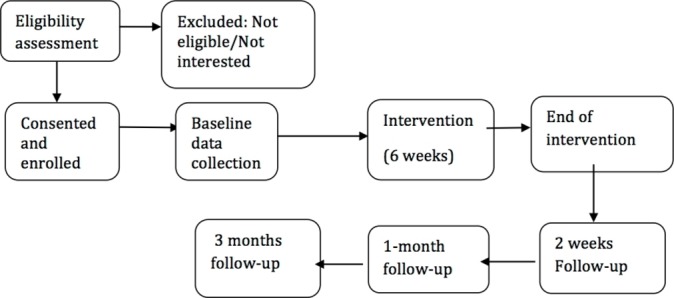
- The paper states that the study will use mixed methods, with quantitative assessments at baseline, post-programme, 1 month, and 3 months, plus qualitative interviews and a focus group.
Methods
- Protocol for a mixed-method feasibility and acceptability study, using quantitative measures and qualitative interviews/focus group.
- Participants are to be recruited through the Health and Wellbeing Academy at Swansea University in partnership with osteopaths; eligibility includes being over 18, living with persistent pain, having one or more of depression/anxiety/fear avoidance/catastrophizing in the medical record, and being able to attend six consecutive weekly sessions.
- Quantitative analysis is planned to be mostly descriptive, with means, SDs, and within-subjects effects reported; qualitative data will be analyzed using Thematic Analysis in NVivo 10, with two researchers validating the results.
Limitations
- The paper explicitly states that participants cannot be randomized, the study has a small number of participants, and there is no control group.
- It also states that running more than one group would have been a better test of feasibility, but this was not possible due to time and resource requirements.
- Evident from the protocol text: because the facilitators are also involved in the study, the authors note this could introduce bias in interviews, although they say an external person will collect qualitative data to address it.
Model-written summary. Check it against the paper before relying on it.
Integrity signals
Registry
Cites
Statistics
Figures
Verification
Claims the paper makes
16 Valid · 1 Not valid · 26 Not checked · 24 Own results and interpretations
The sources with a verdict support this claim; the rest weren’t checked yet, have no full text we could read, or their verdicts aren’t rated yet.
In the paper
“There is also increasing evidence to support the co-occurrence of persistent pain and anxiety disorders such as generalised anxiety disorder, panic attacks, social anxiety or post-traumatic stress disorder.6–8”
§ Protocol for a feasibility and acceptability study using a brief ACT-based intervention for people from Southwest Wales who live with persistent pain > Introduction
What the sources say
- Not checked — no full text of the sourcecites [6] source
- Supportedcites [7] source
The Introduction (page not indicated) states that chronic pain and anxiety disorders—particularly PTSD, panic disorder, generalized anxiety disorder, and social anxiety disorder—frequently co-occur. This supports the citing sentence's claim about persistent pain and those anxiety disorders. (LLM, conf=0.94)
- Not checked — no full text of the sourcecites [8] source
hedgedstates an association- Asserted: passes — The authors put it forward as true.
- Checkable: passes — It can be checked against evidence.
- Load-bearing: unclear — It is unclear whether the paper’s conclusions depend on it.
- Based: passes — The paper gives a reason why it holds.
Every source the paper cites for this claim was checked and supports it.
In the paper
“The development of this intervention has followed the recommendations of the updated Medical Research Council (MRC) guidance for developing complex interventions.25”
§ Protocol for a feasibility and acceptability study using a brief ACT-based intervention for people from Southwest Wales who live with persistent pain > Introduction
What the sources say
- Supportedcites [25] source
The introduction (p. 2) identifies this article as a summary of the MRC’s revised and updated guidance. The ‘Developing a complex intervention’ section (p. 3) gives recommendations for that development. The citation supports the identification of the guidance; it does not independently verify that the citing authors followed it. (LLM, conf=0.92)
plain- Asserted: passes — The authors put it forward as true.
- Checkable: passes — It can be checked against evidence.
- Load-bearing: unclear — It is unclear whether the paper’s conclusions depend on it.
- Based: passes — The paper gives a reason why it holds.
- Supported
Every source the paper cites for this claim was checked and supports it.
In the paper
“Some of the common barriers identified in the literature such as scheduling, travel distance, high cost of treatment and out-of-pocket costs have been considered when designing the intervention (the programme is offered for free, the location is considered easily reachable by public transport and travel expenses are expected to be low, the schedule will be designed in a way to facilitate attend”
§ Protocol for a feasibility and acceptability study using a brief ACT-based intervention for people from Southwest Wales who live with persistent pain > Discussion
What the sources say
- Supportedcites [41] Becker, 2017, Barriers and facilitators to use of non-pharmacological treatments in chronic pain, BMC Fam Pract source
The Results (Barriers) identify scheduling, distance to travel, high treatment cost, and out-of-pocket costs as access barriers to non-pharmacological chronic-pain treatments. The citing authors’ description of how they designed their own intervention is not a finding attributed to this source. (LLM, conf=0.94)
plain- Asserted: passes — The authors put it forward as true.
- Checkable: passes — It can be checked against evidence.
- Load-bearing: unclear — It is unclear whether the paper’s conclusions depend on it.
- Based: passes — The paper gives a reason why it holds.
- Supported
A result the paper reports from its own data — it cites no other source for it, so there is none to check. The quote shows it is in the paper.
In the paper
“The majority of the participants expressed curiosity and interest in trying something novel.”
§ Protocol for a feasibility and acceptability study using a brief ACT-based intervention for people from Southwest Wales who live with persistent pain > Methods and analysis > Patient involvement statement
plain- Asserted: passes — The authors put it forward as true.
- Checkable: passes — It can be checked against evidence.
- Load-bearing: unclear — It is unclear whether the paper’s conclusions depend on it.
- Based: passes — The paper gives a reason why it holds.
In the paper
“Although traditional Cognitive behavioural Therapy (CBT) has been a successful treatment for long- term pain, demonstrating reductions in pain and improvements in functioning, new methods like Acceptance and Commitment Therapy (ACT) can offer an important avenue for many patients living with pain.11”
§ Protocol for a feasibility and acceptability study using a brief ACT-based intervention for people from Southwest Wales who live with persistent pain > Introduction
What the sources say
- Not matchedcites [11] Hayes SC , Strosahl K , Wilson KG . Acceptance and commitment therapy: an experiential approach to behavior change. New York: Guilford Press, 1999.
Couldn’t be matched to a paper in Crossref, so it can’t be checked.
plainstates a possible cause- Asserted: passes — The authors put it forward as true.
- Checkable: passes — It can be checked against evidence.
- Load-bearing: passes — The paper’s conclusions depend on it.
- Based: passes — The paper gives a reason why it holds.
- Not matched
8 more claims
Create a free account to see all 67 claims and to verify the 1 reference still open.
- Probably not a substantial claim. 40
- It may state two separate claims as one. 30
Claims other papers make about this one
Each is checked against this paper’s own text: does it say what the citing paper says it does?
The source backs part of the claim, not all of it — or backs it for a different population, condition or comparison.
In the citing paper
“Furthermore, non-primary care health practitioners (such as osteopaths) may be ideally positioned to provide self-management and psychological support for people with persistent pain [23].”
From 'A Mindful ACT'- testing the feasibility and acceptability of a brief psychosocial intervention designed to accompany osteopathy treatment for people who live with persistent pain. (2021) · cites this paper as [23]
Experimental — accuracy not yet measuredThe source backs part of the claim, not all of it — or backs it for a different population, condition or comparison.
In the citing paper
“Other FOC and ACT feasibility and/or pilot studies have included participant samples ranging from 12 (Saracutu et al., Citation2018) to 28 (Nieminen et al., Citation2016).”
From The feasibility and acceptability of a single-session Acceptance and Commitment Therapy (ACT) intervention to support women self-reporting fear of childbirth in a first pregnancy. (2023) · cites this paper as Saracutu et al., 2018
Experimental — accuracy not yet measuredThe source backs part of the claim, not all of it — or backs it for a different population, condition or comparison.
In the citing paper
“The sample size is smaller than anticipated but it is similar to that of Saracutu et al. (Citation2018) feasibility study which used a brief ACT intervention for pain.”
From The feasibility and acceptability of a single-session Acceptance and Commitment Therapy (ACT) intervention to support women self-reporting fear of childbirth in a first pregnancy. (2023) · cites this paper as Saracutu et al., 2018
Experimental — accuracy not yet measuredThe cited source says what the claim attributes to it.
In the citing paper
“The questions to be asked of participants (see table 3) are based on another novel (non-internet-based) ACT-based protocol for chronic pain.89”
From Novel ACT-based eHealth psychoeducational intervention for students with mental distress: A study protocol for a mixed-methodology pilot trial (2019) · cites this paper as [89]
Citations
Cites
Using thematic analysis in psychology
Braun, V., & Clarke, V. (2006) · Qualitative Research in Psychology · doi:10.1191/1478088706qp063oa · Cited by 194,414
The Hospital Anxiety and Depression Scale
Zigmond, A. S., & Snaith, R. P. (1983) · Acta Psychiatrica Scandinavica · doi:10.1111/j.1600-0447.1983.tb09716.x · Cited by 47,139 · cited 1×
“hospital Anxiety and depression scale (hAds) The HADS is a self-assessment scale designed to detect states of depression, anxiety and emotional distress.(27) Patients are asked to reflect on how they have been feeling during the past week and respond to 14 items (seven for anxiety and seven for depression).”
Depression and quality of life in older persons: A review
Sivertsen, H., Bjørkløf, G. H., Engedal, K., Selbæk, G., & Helvik, A.-S. (2015) · Dementia and Geriatric Cognitive Disorders · doi:10.1159/000437299 · Cited by 14,152
The benefits of being present: Mindfulness and its role in psychological well-being
Brown, K. W., & Ryan, R. M. (2003) · Journal of Personality and Social Psychology · doi:10.1037/0022-3514.84.4.822 · Cited by 13,448 · cited 1×
“82) and convergent validity with related measures.(31) Increases in the practice of mindfulness have been related to positive outcomes such as: a better ability to handle long-term pain, fibromyalgia and physical stress.”
Developing and evaluating complex interventions: the new Medical Research Council guidance
Craig, P., Dieppe, P., Macintyre, S., Michie, S., Nazareth, I., & Petticrew, M. (2008) · BMJ · doi:10.1136/bmj.a1655 · Cited by 10,995
(1999) · Cited by 5,934
Survey of chronic pain in Europe: Prevalence, impact on daily life, and treatment
Breivik, H., Collett, B., Ventafridda, V., Cohen, R., & Gallacher, D. (2006) · European Journal of Pain · doi:10.1016/j.ejpain.2005.06.009 · Cited by 5,486 · cited 1×
“People living with pain are also less able or unable to sleep and report that pain has a significant effect on their social relationships.(9) Another significant issue that affects this population is pain-related fear of movement (kinesiophobia), which then leads to hypervigilance and avoidance behaviours.”
Sekhon, M., Cartwright, M., & Francis, J. J. (2017) · BMC Health Services Research · doi:10.1186/s12913-017-2031-8 · Cited by 3,938 · cited 1×
“Acceptability will be divided into three categories: prospective acceptability (how an individual feels about the intervention prior to participating), intervention coherence and adherence (the extent to which a participant understands the intervention and how it works and also the engagement with the programme) and e…”
Depression and Pain Comorbidity: A Literature Review
Bair, M. J., Robinson, R. L., Katon, W., & Kroenke, K. (2003) · Archives of Internal Medicine · doi:10.1001/archinte.163.20.2433 · Cited by 3,463
Waddell, G., Newton, M., Henderson, I., Somerville, D., & Main, C. J. (1993) · Pain · doi:10.1016/0304-3959(93)90127-b · Cited by 3,167
Research works printed but not linked: 1
- Hughes, 2017, Acceptance and Commitment Therapy (ACT) for chronic pain, The Clinical Journal of Pain, 33, 552, 10.1097/ajp.0000000000000425 · DOI · Paper page
Cited by
Ski, C. F., Taylor, R. S., McGuigan, K., Long, L., Lambert, J. D., Richards, S. H., & Thompson, D. R. (2024) · Cochrane Database of Systematic Reviews · doi:10.1002/14651858.cd013508.pub3 · Cited by 128
Interoception, mindfulness and touch: A meta-review of functional MRI studies
Casals-Gutiérrez, S., & Abbey, H. (2019) · International journal of osteopathic medicine · doi:10.1016/j.ijosm.2019.10.006 · Cited by 54
Kalolo, A., Kapologwe, N., Samky, H., & Kibusi, S. M. (2021) · The International Journal of Health Planning and Management · doi:10.1002/hpm.3402 · Cited by 20
Development of a digital intervention for psychedelic preparation (DIPP)
McAlpine, R. G., Sacchet, M. D., Simonsson, O., Khan, M. M., Krajnović, K., Morometescu, L., & Kamboj, S. K. (2024) · Scientific Reports · doi:10.1038/s41598-024-54642-4 · Cited by 18
“Within this study, we concentrated on the ‘Development’ stage, prioritising the early assessment of feasibility and acceptability through qualitative methods, as recommended by the MRC 65–67 .”
MethodPapachristou, N., Kartsidis, P. E., Anagnostopoulou, A., Marshall, R., Kotronoulas, G., Collantes, G., Valdivieso, B., Santaballa, A., Conde-Moreno, A. J., Domenech, J. R., et al. (2023) · Seminars in Oncology Nursing · doi:10.1016/j.soncn.2023.151437 · Cited by 19
Metadata
- Authors
- Saracutu, M., Edwards, D. J., Davies, H., & Rance, J.
- Affiliations
- Swansea University (GB)
- Corresponding author
- Saracutu, Madalina
- Venue
- BMJ Open
- Publisher
- BMJ
- Published
- 2018-11
- Volume
- 8
- Issue
- 11
- Pages
- e021866
- ISSN
- 2044-6055 (ISSN-L)
- PMC
- PMC6224746
- OpenAlex
- W2899419212
- Cited by
- 29
- References
- 46
- Citations by year
- 2026: 1 · 2025: 1 · 2024: 2 · 2023: 3 · 2022: 6 · 2021: 5 · 2020: 6 · 2019: 5
- FWCI
- 4.69
- Type
- journal article
- Language
- en
- Open access
- gold
- doi.org
- Licence
- cc-by-nc
- Locations
- BMJ Open (publishedVersion, cc-by-nc)
- Europe PMC (PubMed Central) (publishedVersion, cc-by-nc)
- PubMed Central (publishedVersion, cc-by-nc)
- PubMed (publishedVersion)
- DOAJ (DOAJ: Directory of Open Access Journals) (acceptedVersion)
- HighWire Press Open Archive (acceptedVersion)
- Cronfa (Swansea University) (submittedVersion, cc-by-nc)
- Topics
- Social Sciences › Psychology › Clinical Psychology › Mindfulness and Compassion Interventions
- Health Sciences › Health Professions › Physical Therapy, Sports Therapy and Rehabilitation › Musculoskeletal pain and rehabilitation
- Health Sciences › Medicine › Anesthesiology and Pain Medicine › Pain Management and Treatment
- Keywords
- chronic pain, acceptance and commitment therapy, feasibility and acceptability, psychological flexibility, depression, anxiety, fear avoidance, catastrophizing, self-compassion, mindfulness, values-based living, group intervention
- MeSH terms
- Interdisciplinary Research, Depression, Feasibility Studies, Humans, Osteopathic Medicine, Psychology, Quality of Life, Wales, Catastrophization, Chronic Pain, Mindfulness
About these checks
Registry, retraction, Cites and statistics results are computed, not judged, with one exception: a printed reference that no index lists is read once by a model before it counts as a citation error. Claims are extracted by a model and kept only when their quote appears verbatim in the text; each cited source is then checked, with a model’s help, for whether it says what the claim relies on. Those verdicts can be wrong — read the claim’s quote and the cited source before relying on one.
The claim verdicts this report counts are experimental: their accuracy is not yet measured.
A language model drew the claims from the paper on 2026-10-11, under version 3 of the claim definition (model deepseek-v4.1-flash, prompt extract-v3).
A second model labelled each claim on 2026-10-11 (model jev-1.13-20260917, definition revision gold-guideline-v0.2).
Cited sources are checked with a language model’s help (gpt-6-sol).
Statistics and arithmetic are recomputed, not judged.
Confidence bands are shown only for fields calibrated on our annotated test set. None is calibrated yet, so no band is shown.
What counts as a claim ›How we measure confidence ›How we check this ›
Are you an author, or do you see a problem with this page? Request a review
How to cite
Cite CoChat for the checks on this page, and the paper for its own findings.
- This page
- CoChat. (2026). Citation check: Protocol for a feasibility and acceptability study using a brief ACT-based intervention for people from Southwest Wales who live with persistent pain. https://app.cochat.ai/papers/10.1136/bmjopen-2018-021866
- The paper
- Saracutu, M., Edwards, D. J., Davies, H., & Rance, J. (2018). Protocol for a feasibility and acceptability study using a brief ACT-based intervention for people from Southwest Wales who live with persistent pain. BMJ Open. https://doi.org/10.1136/bmjopen-2018-021866
Data sources
Bibliographic data: Semantic Scholar, OpenAlex, Crossref.
Contains information from the Semantic Scholar Academic Graph Datasets, made available under the ODC Attribution License (ODC-BY 1.0).
Semantic Scholar’s data is described in: Kinney, R., et al. (2023). The Semantic Scholar Open Data Platform. arXiv:2301.10140.
