

Coached, Coordinated, Enhanced Neonatal Transition (CCENT): protocol for a multicentre pragmatic randomised controlled trial of transition-to-home support for parents of high-risk infants
Open accessThe DOI matches its Crossref record; 108 of the 112 references it cites were found in a registry or an index; 30 of the 97 sources its claims cite were checked for support.
Abstract
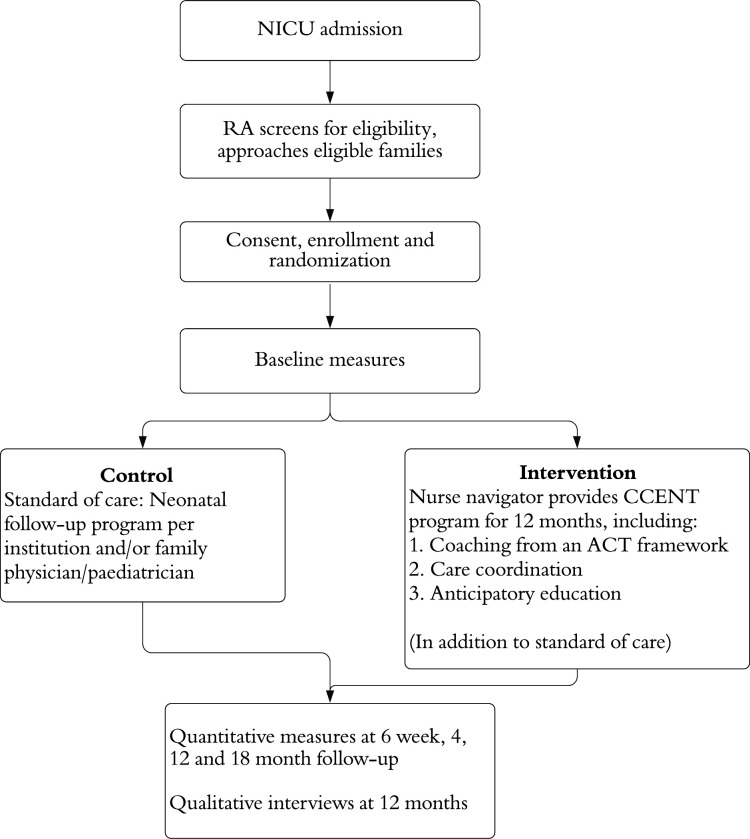
Introduction Having an infant admitted to the neonatal intensive care unit (NICU) is associated with increased parental stress, anxiety and depression. Enhanced support for parents may decrease parental stress and improve subsequent parent and child outcomes. The Coached, Coordinated, Enhanced Neonatal Transition (CCENT) programme is a novel bundled intervention of psychosocial support delivered by a nurse navigator that includes Acceptance and Commitment Therapy-based coaching, care coordination and anticipatory education for parents of high-risk infants in the NICU through the first year at home. The primary objective is to evaluate the impact of the intervention on parent stress at 12 months. Methods and analysis This is a multicentre pragmatic randomised controlled superiority trial with 1:1 allocation to the CCENT model versus control (standard neonatal follow-up). Parents of high-risk infants (n=236) will be recruited from seven NICUs across three Canadian provinces. Intervention participants are assigned a nurse navigator who will provide the intervention for 12 months. Outcomes are measured at baseline, 6 weeks, 4, 12 and 18 months. The primary outcome measure is the total score of the Parenting Stress Index Fourth Edition Short Form at 12 months. Secondary outcomes include parental mental health, empowerment and health-related quality of life for calculation of quality-adjusted life years (QALYs). A cost-effectiveness analysis will examine the incremental cost of CCENT versus usual care per QALY gained. Qualitative interviews will explore parent and healthcare provider experiences with the intervention. Ethics and dissemination Research ethics approval was obtained from Clinical Trials Ontario, Children's Hospital of Eastern Ontario Research Ethics Board (REB), The Hospital for Sick Children REB, UBC Children's and Women's REB and McGill University Health Centre REB. Results will be shared with Canadian level III NICUs, neonatal follow-up programmes and academic forums. Trial registration number ClinicalTrials.gov Registry (NCT03350243). © Author(s) (or their employer(s)) 2021. Re-use permitted under CC BY-NC. No commercial re-use. See rights and permissions. Published by BMJ.
Overview
CoChat Summary
TL;DR
CCENT is a multicentre pragmatic randomized controlled trial protocol testing whether a nurse-navigator-delivered bundled intervention can reduce parent stress for parents of high-risk infants from the NICU through the first year at home. The primary endpoint is the Parenting Stress Index Fourth Edition Short Form (PSI-4-SF) total score at 12 months.
Key findings
- Not stated in the paper.
- The trial will recruit 236 families from seven NICUs across three Canadian provinces and randomize them 1:1 to CCENT or standard follow-up care.
- The protocol states that with 200 families it has 80% power at alpha = 0.05 to detect a difference of at least 0.4 SD in PSI-4-SF mean total stress score at 12 months; allowing for up to 15% attrition, the recruitment target is 236 families.
- Trial status: 236 participants were enrolled as of January 2021.
Methods
- Multicentre pragmatic randomized controlled superiority trial with parallel groups and 1:1 allocation to CCENT versus standard neonatal follow-up care.
- Participants are parents of high-risk infants recruited from level III NICUs in Ontario, Quebec, and British Columbia; both parents may participate, but primary analyses use the self-identified primary caregiver.
- Primary analysis uses linear mixed models with site as a random effect and baseline PSI-4-SF as a covariate; secondary and cost-effectiveness analyses are also planned, along with qualitative interviews.
Limitations
- The paper states that measures of parental stress, mental health, family empowerment, and health service delivery are self-reported and cannot be independently verified.
- The paper states that blinding of participants and investigators is not feasible because of the interpersonal nature of the intervention; this may contribute to bias, although data analysts will be blinded.
- The paper notes a risk of refusal or attrition due to the time commitment required.
- Evident from the protocol (not explicitly framed as a limitation by the authors): results are from a study protocol, so the paper reports planned methods and anticipated effects, not trial outcomes.
Model-written summary. Check it against the paper before relying on it.
Integrity signals
Registry
Cites
Statistics
Figures
Verification
Claims the paper makes
25 Valid · 0 Not valid · 17 Not checked · 19 Own results and interpretations
The cited sources support only part of this claim — read each source’s verdict below.
In the paper
“These emotions increase during the transition to home from hospital,14–16 depending on the child’s condition and the parent’s readiness for discharge11 and their medical caregiving role.17 18”
§ Coached, Coordinated, Enhanced Neonatal Transition (CCENT): protocol for a multicentre pragmatic randomised controlled trial of transition-to-home support for parents of high-risk infants > Introduction
What the sources say
- Partly supportedcites [14] Benzies KM, Magill-Evans JE, Hayden K, et al. Key components of early intervention programs for preterm infants and their parents: a systematic review and meta-analysis. BMC Pregnancy Childbirth 2013; 13: S10. 10.1186/1471-2393-13-S1-S10 23445560 PMC3561170 sourceExperimental — accuracy not yet measured
The Discussion (page unavailable) says parental stress is reportedly very high at NICU discharge, supporting heightened distress around the move home. It does not establish that emotions increase during the transition. The child’s condition, discharge readiness and caregiving role are attached to other citations in the citing sentence, not this source. (LLM, conf=0.83)
- Not checked — no full text of the sourcecites [15] matched to “NICU infant health severity and family outcomes: A systematic review of assessments and findings in psychosocial research” (2019) source
- Not checked — no full text of the sourcecites [16] Ballantyne M, Orava T, Bernardo S, et al. Parents’ early healthcare transition experiences with preterm and acutely ill infants: a scoping review. Child Care Health Dev 2017; 43: 783– 96. 10.1111/cch.12458 28370174 source
- Not checked — no full text of the sourcecites [11] Alkozei A, McMahon E, Lahav A. Stress levels and depressive symptoms in NICU mothers in the early postpartum period. The Journal of Maternal-Fetal & Neonatal Medicine 2014; 27: 1738– 43. 10.3109/14767058.2014.942626 25005861 source
- Not matchedcites 17 18
This doesn’t read as a citation we can look up.
plainstates a cause- Asserted: passes — The authors put it forward as true.
- Checkable: passes — It can be checked against evidence.
- Load-bearing: passes — The paper’s conclusions depend on it.
- Based: passes — The paper gives a reason why it holds.
- Partly supported
The cited sources support only part of this claim — read each source’s verdict below.
In the paper
“Having an infant admitted to the neonatal intensive care unit (NICU) is associated with increased parental stress, anxiety and depression.”
- Also stated in: § Introduction · plain
“Having an infant admitted to the NICU is associated with increased parental stress due to the NICU environment, alterations in parental role and limitations to caregiving,6–8 as well as anxiety9 10 and depression.11–13”
§ Coached, Coordinated, Enhanced Neonatal Transition (CCENT): protocol for a multicentre pragmatic randomised controlled trial of transition-to-home support for parents of high-risk infants > Abstract > Introduction
What the sources say
- Not checked — no full text of the sourcecites [6] Al Maghaireh Dua'a Fayiz, Abdullah KL, Chan CM, et al. Systematic review of qualitative studies exploring parental experiences in the neonatal intensive care unit. J Clin Nurs 2016; 25: 2745– 56. 10.1111/jocn.13259 27256250 source
- Not checked — no full text of the sourcecites [7] Roque ATF, Lasiuk GC, Radünz V, et al. Scoping review of the mental health of parents of infants in the NICU. J Obstet Gynecol Neonatal Nurs 2017; 46: 576– 87. 10.1016/j.jogn.2017.02.005 28506679 source
- Not checked — no full text of the sourcecites [8] Caporali C, Pisoni C, Gasparini L, et al. A global perspective on parental stress in the neonatal intensive care unit: a meta-analytic study. J Perinatol 2020; 40: 1739– 52. 10.1038/s41372-020-00798-6 32901116 source
- Not matchedcites 9 10
This doesn’t read as a citation we can look up.
- Not checked — no full text of the sourcecites [11] Alkozei A, McMahon E, Lahav A. Stress levels and depressive symptoms in NICU mothers in the early postpartum period. The Journal of Maternal-Fetal & Neonatal Medicine 2014; 27: 1738– 43. 10.3109/14767058.2014.942626 25005861 source
- Not checked — no full text of the sourcecites [12] Treyvaud K. Parent and family outcomes following very preterm or very low birth weight birth: a review. Semin Fetal Neonatal Med 2014; 19: 131– 5. 10.1016/j.siny.2013.10.008 24252709 source
- Partly supportedcites [13] Treyvaud K, Lee KJ, Doyle LW, et al. Very preterm birth influences parental mental health and family outcomes seven years after birth. J Pediatr 2014; 164: 515– 21. 10.1016/j.jpeds.2013.11.001 24359937 PMC3950307 sourceExperimental — accuracy not yet measured
The Discussion and Results report higher parenting stress, anxiety and depression symptoms among parents of children born very preterm than among parents of term-born children, assessed seven years after birth. The paper does not establish this association for parents of all infants admitted to a NICU, so the citing sentence broadens the population studied. (LLM, conf=0.88)
plainstates an association- Asserted: passes — The authors put it forward as true.
- Checkable: passes — It can be checked against evidence.
- Load-bearing: passes — The paper’s conclusions depend on it.
- Based: passes — The paper gives a reason why it holds.
- Also stated in: § Introduction · plain
The cited sources support only part of this claim — read each source’s verdict below.
In the paper
“A lack of continuity of care post-discharge can negatively impact patient outcomes and parent well-being.20”
§ Coached, Coordinated, Enhanced Neonatal Transition (CCENT): protocol for a multicentre pragmatic randomised controlled trial of transition-to-home support for parents of high-risk infants > Introduction
What the sources say
- Partly supportedcites [20] Welch CD, Check J, O'Shea TM. Improving care collaboration for NICU patients to decrease length of stay and readmission rate. BMJ Open Qual 2017; 6: e000130. 10.1136/bmjoq-2017-000130 PMC5699126 29450288 sourceExperimental — accuracy not yet measured
The Discussion (page unavailable) reports that coordinated care was associated with fewer 30-day readmissions and says this outcome affects children’s and families’ well-being. However, the intervention coordinated care before discharge and the transition home; the paper did not test a lack of continuity after discharge, and it found no improvement in measured parent satisfaction. (LLM, conf=0.84)
plainstates a cause- Asserted: passes — The authors put it forward as true.
- Checkable: passes — It can be checked against evidence.
- Load-bearing: passes — The paper’s conclusions depend on it.
- Based: passes — The paper gives a reason why it holds.
- Partly supported
The cited sources support only part of this claim — read each source’s verdict below.
In the paper
“Complex interventions containing several interacting components may work best if tailored to individual circumstances,39”
§ Coached, Coordinated, Enhanced Neonatal Transition (CCENT): protocol for a multicentre pragmatic randomised controlled trial of transition-to-home support for parents of high-risk infants > Introduction
What the sources say
- Partly supportedcites [39] Craig P, Dieppe P, Macintyre S, et al. Developing and evaluating complex interventions: the new medical Research Council guidance. BMJ 2008; 337: a1655. 10.1136/bmj.a1655 18824488 PMC2769032 sourceExperimental — accuracy not yet measured
The paper describes complex interventions as having several interacting components (What are complex interventions?) and says they may work best when tailored to local circumstances (Conclusions; Box 2). It discusses adaptation to settings, not tailoring to an individual's circumstances, so that part of the claim is not supported. (LLM, conf=0.88)
hedgedstates a possible cause- Asserted: passes — The authors put it forward as true.
- Checkable: unclear — It is unclear whether it could be checked against evidence.
- Load-bearing: passes — The paper’s conclusions depend on it.
- Based: passes — The paper gives a reason why it holds.
- Partly supported
The cited sources support only part of this claim — read each source’s verdict below.
In the paper
“Discharge is accompanied by a sense of loss as families leave the familiarity of the NICU while severing supportive relationships with healthcare providers (HCPs).19”
§ Coached, Coordinated, Enhanced Neonatal Transition (CCENT): protocol for a multicentre pragmatic randomised controlled trial of transition-to-home support for parents of high-risk infants > Introduction
What the sources say
- Partly supportedcites [19] Ronan S, Brown M, Marsh L. Parents' experiences of transition from hospital to home of a child with complex health needs: a systematic literature review. J Clin Nurs 2020; 29: 3222– 35. 10.1111/jocn.15396 32621293 sourceExperimental — accuracy not yet measured
The review’s “Emotional experiences” section (p. 5) reports that some parents felt a sense of loss on discharge because they left a safe, familiar hospital environment and supportive relationships with health professionals. That passage concerns children with complex health needs leaving hospital; it does not establish that the loss occurred specifically when families left a NICU. (LLM, conf=0.88)
plainstates a cause- Asserted: passes — The authors put it forward as true.
- Checkable: passes — It can be checked against evidence.
- Load-bearing: passes — The paper’s conclusions depend on it.
- Based: passes — The paper gives a reason why it holds.
- Partly supported
11 more claims · 2 with their cited sources checked
Create a free account to see all 61 claims and to verify the 2 references still open.
- It may state two separate claims as one. 29
- Probably not a substantial claim. 29
Claims other papers make about this one
Each is checked against this paper’s own text: does it say what the citing paper says it does?
The cited source says what the claim attributes to it.
In the citing paper
“while position papers have advocated for the use of ACT with NICU parents [27], and one clinical trial is underway that uses an ' ACT framework ' as one part of a multi-modal intervention to support the transition from NICU to home [28], this study will be the first to test ACT as a stand-alone intervention with NICU parents.”
Citations
Cites
Harris, P. A., Taylor, R., Thielke, R., Payne, J., Gonzalez, N., & Conde, J. G. (2009) · Journal of Biomedical Informatics · doi:10.1016/j.jbi.2008.08.010 · Cited by 51,384
Three Approaches to Qualitative Content Analysis
Hsieh, H.-F., & Shannon, S. E. (2005) · Qualitative Health Research · doi:10.1177/1049732305276687 · Cited by 44,601
The REDCap consortium: building an international community of software platform partners
Harris, P. A., Taylor, R., Minor, B. L., Elliott, V., Fernandez, M., O'Neal, L., McLeod, L., Delacqua, G., Delacqua, F., Kirby, J., et al. (2019) · Journal of Biomedical Informatics · doi:10.1016/j.jbi.2019.103208 · Cited by 24,013
Developing and evaluating complex interventions: the new Medical Research Council guidance
Craig, P., Dieppe, P., Macintyre, S., Michie, S., Nazareth, I., & Petticrew, M. (2008) · BMJ · doi:10.1136/bmj.a1655 · Cited by 10,995
Acceptance and commitment therapy: model, processes and outcomes
Hayes, S. C., Luoma, J. B., Bond, F. W., Masuda, A., & Lillis, J. (2006) · Behaviour Research and Therapy · doi:10.1016/j.brat.2005.06.006 · Cited by 6,587
SPIRIT 2013 explanation and elaboration: guidance for protocols of clinical trials
Chan, A.-W., Tetzlaff, J. M., Gotzsche, P. C., Altman, D. G., Mann, H., Berlin, J. A., Dickersin, K., Hrobjartsson, A., Schulz, K. F., Parulekar, W. R., et al. (2013) · BMJ · doi:10.1136/bmj.e7586 · Cited by 6,251
Bond, F. W., Hayes, S. C., Baer, R. A., Carpenter, K. M., Guenole, N., Orcutt, H. K., Waltz, T., & Zettle, R. D. (2011) · Behavior Therapy · doi:10.1016/j.beth.2011.03.007 · Cited by 3,950
Marteau, T. M., & Bekker, H. (1992) · British Journal of Clinical Psychology · doi:10.1111/j.2044-8260.1992.tb00997.x · Cited by 3,238
Assessing social support: The Social Support Questionnaire.
Sarason, I. G., Levine, H. M., Basham, R. B., & Sarason, B. R. (1983) · Journal of Personality and Social Psychology · doi:10.1037//0022-3514.44.1.127 · Cited by 3,067
An overview of mortality and sequelae of preterm birth from infancy to adulthood
Saigal, S., & Doyle, L. W. (2008) · The Lancet · doi:10.1016/s0140-6736(08)60136-1 · Cited by 2,818
Stress and Health: Psychological, Behavioral, and Biological Determinants
Schneiderman, N., Ironson, G., & Siegel, S. D. (2005) · Annual Review of Clinical Psychology · doi:10.1146/annurev.clinpsy.1.102803.144141 · Cited by 2,252
A Brief Measure of Social Support: Practical and Theoretical Implications
Sarason, I. G., Sarason, B. R., Shearin, E. N., & Pierce, G. R. (1987) · Journal of Social and Personal Relationships · doi:10.1177/0265407587044007 · Cited by 1,977
Validation of the Edinburgh postnatal depression scale (EPDS) in non-postnatal women
Cox, J. (1996) · Journal of Affective Disorders · doi:10.1016/0165-0327(96)00008-0 · Cited by 810
Furlong, W. J., Feeny, D. H., Torrance, G. W., & Barr, R. D. (2001) · Annals of Medicine · doi:10.3109/07853890109002092 · Cited by 751
Integrated care: a position paper of the WHO European Office for Integrated Health Care Services.
Groene, O., & García-Barbero, M. (2001) · PubMed Central · Cited by 585
Briggs-Gowan, M. J. (2004) · Journal of Pediatric Psychology · doi:10.1093/jpepsy/jsh017 · Cited by 573
Grunau, R. E., Whitfield, M. F., Petrie-Thomas, J., Synnes, A. R., Cepeda, I. L., Keidar, A., Rogers, M., MacKay, M., Hubber-Richard, P., & Johannesen, D. (2009) · Pain · doi:10.1016/j.pain.2009.02.014 · Cited by 502
Self-citationThe Parental Experience of Having an Infant in the Newborn Intensive Care Unit
Obeidat, H. M., Bond, E. A., & Callister, L. C. (2009) · Journal of Perinatal Education · doi:10.1624/105812409x461199 · Cited by 427
Benzies, K. M., Magill-Evans, J. E., Hayden, K., & Ballantyne, M. (2013) · BMC Pregnancy and Childbirth · doi:10.1186/1471-2393-13-s1-s10 · Cited by 385
Self-citationScoping Review of the Mental Health of Parents of Infants in the NICU
Roque, A. T. F., Lasiuk, G. C., Radünz, V., & Hegadoren, K. (2017) · Journal of Obstetric, Gynecologic & Neonatal Nursing · doi:10.1016/j.jogn.2017.02.005 · Cited by 344
Al Maghaireh, D. F., Abdullah, K. L., Chan, C. M., Piaw, C. Y., & Al Kawafha, M. M. (2016) · Journal of Clinical Nursing · doi:10.1111/jocn.13259 · Cited by 328
Tluczek, A., Henriques, J. B., & Brown, R. L. (2009) · Journal of Nursing Measurement · doi:10.1891/1061-3749.17.1.19 · Cited by 308
Gröne (2001) · doi:10.5334/ijic.28 · Cited by 291
King, S., King, G., & Rosenbaum, P. (2004) · Children's Health Care · doi:10.1207/s15326888chc3301_3 · Cited by 289
Validity of the Ages and Stages Questionnaires in Term and Preterm Infants
Schonhaut, L., Armijo, I., Schönstedt, M., Alvarez, J., & Cordero, M. (2013) · Pediatrics · doi:10.1542/peds.2012-3313 · Cited by 284
Very Preterm Birth Influences Parental Mental Health and Family Outcomes Seven Years after Birth
Treyvaud, K., Lee, K. J., Doyle, L. W., & Anderson, P. J. (2014) · The Journal of Pediatrics · doi:10.1016/j.jpeds.2013.11.001 · Cited by 213
Stress levels and depressive symptoms in NICU mothers in the early postpartum period
Alkozei, A., McMahon, E., & Lahav, A. (2014) · The Journal of Maternal-Fetal & Neonatal Medicine · doi:10.3109/14767058.2014.942626 · Cited by 211
Parent and family outcomes following very preterm or very low birth weight birth: A review
Treyvaud, K. (2014) · Seminars in Fetal and Neonatal Medicine · doi:10.1016/j.siny.2013.10.008 · Cited by 211
An innovative approach to health care delivery for patients with chronic conditions
Clarke, J. L., Bourn, S., Skoufalos, A., Beck, E. H., & Castillo, D. J. (2017) · Population Health Management · doi:10.1089/pop.2016.0076 · Cited by 211
Barroso, N. E., Hungerford, G. M., Garcia, D., Graziano, P. A., & Bagner, D. M. (2016) · Psychological Assessment · doi:10.1037/pas0000257 · Cited by 203
A global perspective on parental stress in the neonatal intensive care unit: a meta-analytic study
Caporali, C., Pisoni, C., Gasparini, L., Ballante, E., Zecca, M., Orcesi, S., & Provenzi, L. (2020) · Journal of Perinatology · doi:10.1038/s41372-020-00798-6 · Cited by 200
Boyle, M. H., Furlong, W., Feeny, D., Torrance, G. W., & Hatcher, J. (1995) · Quality of Life Research · doi:10.1007/bf02260864 · Cited by 194
Family-Based Intervention to Enhance Infant–Parent Relationships in the Neonatal Intensive Care Unit
Browne, J. V., & Talmi, A. (2005) · Journal of Pediatric Psychology · doi:10.1093/jpepsy/jsi053 · Cited by 192
Newnham, C. A., Milgrom, J., & Skouteris, H. (2009) · Infant Behavior and Development · doi:10.1016/j.infbeh.2008.09.004 · Cited by 190
Nicu discharge planning and beyond: recommendations for parent psychosocial support
Purdy, I. B., Craig, J. W., & Zeanah, P. (2015) · Journal of Perinatology · doi:10.1038/jp.2015.146 · Cited by 186
Health Coaching: A Concept Analysis: Health Coaching Concept Analysis
Olsen, J. M. (2014) · Nursing Forum · doi:10.1111/nuf.12042 · Cited by 178
Squires, J., Potter, L., & Bricker, D. D. (2003) · Cited by 167
Psychometric analysis of the family empowerment scale
Singh, N. N., Curtis, W. J., Ellis, C. R., Nicholson, M. W., Villani, T. M., & Wechsler, H. A. (1995) · Journal of Emotional and Behavioral Disorders · doi:10.1177/106342669500300203 · Cited by 162
Going home: facilitating discharge of the preterm infant
Jefferies, A. L., Canadian Paediatric Society, & Fetus and Newborn Committee (2014) · Paediatrics & Child Health · doi:10.1093/pch/19.1.31 · Cited by 157
Preventive Care at Home for Very Preterm Infants Improves Infant and Caregiver Outcomes at 2 Years
Spittle, A. J., Anderson, P. J., Lee, K. J., Ferretti, C., Eeles, A., Orton, J., Boyd, R. N., Inder, T., & Doyle, L. W. (2010) · Pediatrics · doi:10.1542/peds.2009-3137 · Cited by 155
Risk and protective factors in maternal–fetal attachment development
Pisoni, C., Garofoli, F., Tzialla, C., Orcesi, S., Spinillo, A., Politi, P., Balottin, U., Manzoni, P., & Stronati, M. (2014) · Early Human Development · doi:10.1016/s0378-3782(14)50012-6 · Cited by 143
Parenting very preterm infants and stress in Neonatal Intensive Care Units
Baía, I., Amorim, M., Silva, S., Kelly-Irving, M., de Freitas, C., & Alves, E. (2016) · Early Human Development · doi:10.1016/j.earlhumdev.2016.04.001 · Cited by 142
(2006) · CiteSeer X (The Pennsylvania State University) · Cited by 142
Aydon, L., Hauck, Y., Murdoch, J., Siu, D., & Sharp, M. (2018) · Journal of Clinical Nursing · doi:10.1111/jocn.13883 · Cited by 139
Bode, M. M., D'Eugenio, D. B., Mettelman, B. B., & Gross, S. J. (2014) · Journal of Developmental & Behavioral Pediatrics · doi:10.1097/dbp.0000000000000110 · Cited by 138
Kaaresen, P. I., Rønning, J. A., Tunby, J., Nordhov, S. M., Ulvund, S. E., & Dahl, L. B. (2008) · Early Human Development · doi:10.1016/j.earlhumdev.2007.07.003 · Cited by 135
Parental Psychological Well-Being and Behavioral Outcome of Very Low Birth Weight Infants at 3 Years
Huhtala, M., Korja, R., Lehtonen, L., Haataja, L., Lapinleimu, H., Rautava, P., & on behalf of the PIPARI Study Group (2012) · Pediatrics · doi:10.1542/peds.2011-2411 · Cited by 133
NICU-based Interventions To Reduce Maternal Depressive and Anxiety Symptoms: A Meta-analysis
Mendelson, T., Cluxton-Keller, F., Vullo, G. C., Tandon, S. D., & Noazin, S. (2017) · Pediatrics · doi:10.1542/peds.2016-1870 · Cited by 130
Measure of Processes of Care: a review of 20 years of research
Cunningham, B. J., & Rosenbaum, P. L. (2014) · Developmental Medicine & Child Neurology · doi:10.1111/dmcn.12347 · Cited by 127
Briggs‐Gowan, M. J., & Carter, A. S. (2007) · Infant Mental Health Journal · doi:10.1002/imhj.20154 · Cited by 123
Carter, J. D., Mulder, R. T., & Darlow, B. A. (2007) · Personality and Mental Health · doi:10.1002/pmh.4 · Cited by 113
the Family Nurture Intervention (FNI) Trial Group, Welch, M. G., Hofer, M. A., Brunelli, S. A., Stark, R. I., Andrews, H. F., Austin, J., & Myers, M. M. (2012) · BMC Pediatrics · doi:10.1186/1471-2431-12-14 · Cited by 110
Watkins, R. E., Elliott, E. J., Mutch, R. C., Latimer, J., Wilkins, A., Payne, J. M., Jones, H. M., Miers, S., Peadon, E., McKenzie, A., et al. (2012) · BMC Pediatrics · doi:10.1186/1471-2431-12-69 · Cited by 109
Broyles, R. S., Tyson, J. E., Heyne, E. T., Heyne, R. J., Hickman, J. F., Swint, M., Adams, S. S., West, L. A., Pomeroy, N., Hicks, P. J., et al. (2000) · JAMA · doi:10.1001/jama.284.16.2070 · Cited by 109
Coaching Mothers of Children with Autism: A Qualitative Study for Occupational Therapy Practice
Foster, L. H., Dunn, W., & Lawson, L. M. (2012) · Physical & Occupational Therapy In Pediatrics · doi:10.3109/01942638.2012.747581 · Cited by 107
Karabekiroglu, K., Briggs-Gowan, M. J., Carter, A. S., Rodopman-Arman, A., & Akbas, S. (2010) · Infant Behavior and Development · doi:10.1016/j.infbeh.2010.07.001 · Cited by 103
Discharge Teaching in the NICU: Are Parents Prepared? An Integrative Review of Parents’ Perceptions
Sneath, N. (2009) · Neonatal Network · doi:10.1891/0730-0832.28.4.237 · Cited by 101
Postpartum Depression: How Childbirth Educators Can Help Break the Silence
Zauderer, C. (2009) · The Journal of Perinatal Education · doi:10.1624/105812409x426305 · Cited by 100
Halpern, L. F. (2001) · Journal of Pediatric Psychology · doi:10.1093/jpepsy/26.2.93 · Cited by 97
Lunsky, Y., Fung, K., Lake, J., Steel, L., & Bryce, K. (2018) · Mindfulness · doi:10.1007/s12671-017-0846-3 · Cited by 91
Integrated Care Models and Child Health: A Meta-analysis
Wolfe, I., Satherley, R.-M., Scotney, E., Newham, J., & Lingam, R. (2020) · Pediatrics · doi:10.1542/peds.2018-3747 · Cited by 90
Peebles‐Kleiger, M. J. (2000) · PubMed · Cited by 88
O'Neill, L., Latchford, G., McCracken, L. M., & Graham, C. D. (2019) · Journal of Contextual Behavioral Science · doi:10.1016/j.jcbs.2019.08.008 · Cited by 87
Parenting the Post-NICU Premature infant
Bakewell-Sachs, S., & Gennaro, S. (2004) · MCN, The American Journal of Maternal/Child Nursing · doi:10.1097/00005721-200411000-00011 · Cited by 87
Parenting and prematurity: understanding parent experience and preferences for support
Whittingham, K., Boyd, R. N., Sanders, M. R., & Colditz, P. (2014) · Journal of Child and Family Studies · doi:10.1007/s10826-013-9762-x · Cited by 84
Agweyu, A., Opiyo, N., & English, M. (2012) · BMC Pediatrics · doi:10.1186/1471-2431-12-1 · Cited by 84
Parker, S. M., & Fuller, J. D. (2015) · Health & Social Care in the Community · doi:10.1111/hsc.12194 · Cited by 82
Grunberg, V. A., Geller, P. A., Bonacquisti, A., & Patterson, C. A. (2019) · Journal of Perinatology · doi:10.1038/s41372-018-0282-9 · Cited by 79
Zelkowitz, P., Na, S., Wang, T., Bardin, C., & Papageorgiou, A. (2011) · Acta Paediatrica · doi:10.1111/j.1651-2227.2010.02128.x · Cited by 78
Forensic Uses of Clinical Assessment Instruments
(2013) · Routledge eBooks · doi:10.4324/9780203726587 · Cited by 75
Ballantyne, M., Orava, T., Bernardo, S., McPherson, A. C., Church, P., & Fehlings, D. (2017) · Child: Care, Health and Development · doi:10.1111/cch.12458 · Cited by 67
Self-citationTransition From Hospital to Home in Parents of Preterm Infants: A Literature Review
Boykova, M. (2016) · Journal of Perinatal & Neonatal Nursing · doi:10.1097/jpn.0000000000000211 · Cited by 65
School-Age outcomes of early intervention for preterm infants and their parents: a randomized trial
Spittle, A. J., Barton, S., Treyvaud, K., Molloy, C. S., Doyle, L. W., & Anderson, P. J. (2016) · Pediatrics · doi:10.1542/peds.2016-1363 · Cited by 62
Hospital-to-Home Interventions, Use, and Satisfaction: A Meta-analysis
Hamline, M. Y., Speier, R., Vu, P. D., Tancredi, D. J., Broman, A. R., Rasmussen, L. N., Tullius, B. P., Shaikh, U., & Li, S. T. (2018) · PEDIATRICS · doi:10.1542/peds.2018-0442 · Cited by 61
Acceptance and Commitment Therapy for Parental Management of Childhood Asthma: An RCT.
Chong, Y.-Y., Mak, Y.-W., Leung, S.-P., Lam, S.-Y., & Loke, A. Y. (2019) · Pediatrics · doi:10.1542/peds.2018-1723 · Cited by 60
Mothers' experiences of interacting with their premature infants
Nicolaou, M., Rosewell, R., Marlow, N., & Glazebrook, C. (2009) · Journal of Reproductive and Infant Psychology · doi:10.1080/02646830801922796 · Cited by 59
Care system redesign for preterm children after discharge from the NICU
Kuo, D. Z., Lyle, R. E., Casey, P. H., & Stille, C. J. (2017) · Pediatrics · doi:10.1542/peds.2016-2969 · Cited by 59
Ronan, S., Brown, M., & Marsh, L. (2020) · Journal of Clinical Nursing · doi:10.1111/jocn.15396 · Cited by 58
Muscara, F., McCarthy, M. C., Rayner, M., Nicholson, J. M., Dimovski, A., McMillan, L., Hearps, S. J. C., Yamada, J., Burke, K., Walser, R., et al. (2020) · JAMA Network Open · doi:10.1001/jamanetworkopen.2020.8507 · Cited by 57
Huhtala, M., Korja, R., Lehtonen, L., Haataja, L., Lapinleimu, H., Munck, P., Rautava, P., & the PIPARI Study Group (2011) · Acta Paediatrica · doi:10.1111/j.1651-2227.2011.02428.x · Cited by 54
Transforming NICU care to provide comprehensive family support
Hall, S. L., Phillips, R., & Hynan, M. T. (2016) · Newborn and Infant Nursing Reviews · doi:10.1053/j.nainr.2016.03.008 · Cited by 53
Ranjitkar, S., Kvestad, I., Strand, T. A., Ulak, M., Shrestha, M., Chandyo, R. K., Shrestha, L., & Hysing, M. (2018) · Frontiers in Psychology · doi:10.3389/fpsyg.2018.01265 · Cited by 53
The Generation of Integration: The Early Experience of Implementing Bundled Care in Ontario, Canada
Embuldeniya, G., Kirst, M. J., Walker, K., & Wodchis, W. P. (2018) · Milbank Quarterly · doi:10.1111/1468-0009.12357 · Cited by 53
The Edinburgh Postnatal Depression Scale (EPDS): A Review of the Reported Validity Evidence
McBride, H. L., Wiens, R. M., McDonald, M. J., Cox, D. W., & Chan, E. K. H. (2014) · Social Indicators Research Series · doi:10.1007/978-3-319-07794-9_9 · Cited by 43
Need to define patient engagement in research
Lough, S. (2015) · Canadian Medical Association Journal · doi:10.1503/cmaj.109-5109 · Cited by 39
Interaction between high-risk infants and their mothers: the NCAST as an assessment tool
Farel, A. M., Freeman, V. A., Keenan, N. L., & Huber, C. J. (1991) · Research in Nursing & Health · doi:10.1002/nur.4770140205 · Cited by 39
Psychological Sequelae in Parents of Extreme Low and Very Low Birth Weight Infants
Elklit, A., Hartvig, T., & Christiansen, M. (2007) · Journal of Clinical Psychology in Medical Settings · doi:10.1007/s10880-007-9077-4 · Cited by 39
Stotts, A. L., Villarreal, Y. R., Klawans, M. R., Suchting, R., Dindo, L., Dempsey, A., Spellman, M., Green, C., & Northrup, T. F. (2019) · Maternal and Child Health Journal · doi:10.1007/s10995-018-02699-9 · Cited by 36
Zerach, G., Elsayag, A., Shefer, S., & Gabis, L. (2015) · Stress and Health · doi:10.1002/smi.2547 · Cited by 35
Improving care collaboration for NICU patients to decrease length of stay and readmission rate
Welch, C. D., Check, J., & O’Shea, T. M. (2017) · BMJ Open Quality · doi:10.1136/bmjoq-2017-000130 · Cited by 34
Garfield, C. F., Simon, C. D., Rutsohn, J. P., & Lee, Y. S. (2017) · The Journal of Perinatal & Neonatal Nursing · doi:10.1097/jpn.0000000000000296 · Cited by 33
Ungar, W. J., Tsiplova, K., Millar, N., & Smith, I. M. (2018) · Clinical Practice in Pediatric Psychology · doi:10.1037/cpp0000226 · Cited by 33
Self-citationMothers' Stressor as the Day of Discharge From the NICU Approaches
Raines, D. A. (2013) · Advances in Neonatal Care · doi:10.1097/anc.0b013e318285fa2a · Cited by 32
Measuring empowerment in families whose children have emotional disabilities: A brief questionnaire.
Koren, P. E., DeChillo, N., & Friesen, B. J. (1992) · Rehabilitation Psychology · doi:10.1037//0090-5550.37.4.305 · Cited by 28
COLLABORATIVE CONSULTATION WITH PARENTS AND INFANTS IN THE PERINATAL PERIOD
Boukydis, Z. (2015) · Infant Mental Health Journal · doi:10.1002/imhj.21501 · Cited by 26 · cited 1×
“CCENT differs from previous interventions in the literature that focus primarily on mother–infant interactions 40 or collaborative family consultation 41 in the NICU, as the focus is a long-term intervention to reduce stress via a novel bundled programme including psychosocial support.”
MethodBaraldi, E., Allodi, M. W., Löwing, K., Smedler, A.-C., Westrup, B., & Ådén, U. (2020) · BMC Pediatrics · doi:10.1186/s12887-020-1934-4 · Cited by 25
Neonatal follow-up programs in Canada: A national survey
Albaghli, F., Church, P., Ballantyne, M., Girardi, A., & Synnes, A. (2021) · Paediatrics & Child Health · doi:10.1093/pch/pxz159 · Cited by 25
Self-citationNeonatal follow-up programs and follow-up studies: Historical and current perspectives
Sauve, R., & Lee, S. K. (2006) · Paediatrics & Child Health · doi:10.1093/pch/11.5.267 · Cited by 24
Outcomes of neonates with complex medical needs
Kieran, E., Sara, R., Claydon, J., Hait, V., de Salaberry, J., Osiovich, H., & Shivananda, S. (2019) · Advances in Neonatal Care · doi:10.1097/anc.0000000000000639 · Cited by 23
Self-citationJohnson, E. R., Davies, S. L., Aban, I., Mugavero, M. J., Shrestha, S., & Kempf, M.-C. (2015) · AIDS Patient Care and STDs · doi:10.1089/apc.2014.0187 · Cited by 22
Development of a Caregiver-Reported experience measure for pediatric Hospital-to-Home transitions
Desai, A. D., Jacob‐Files, E. A., Lowry, S. J., Opel, D. J., Mangione‐Smith, R., Britto, M. T., & Howard, W. J. (2018) · Health Services Research · doi:10.1111/1475-6773.12864 · Cited by 19
Discharge Planning: Hospital to Home Transitions for Infants
Bruder, M. B., & Walker, L. (1990) · Topics in Early Childhood Special Education · doi:10.1177/027112149000900404 · Cited by 17
Zakaria, R., Sutan, R., & Jaafar, R. (2020) · Journal of Education and Health Promotion · doi:10.4103/jehp.jehp_497_19 · Cited by 17
Nurse-led case management in the National Health Service: bridging clinical and social worlds
Manthorpe, J., Goodman, C. M., Drennan, V. M., Davies, S. L., Masey, H., Gage, H., Scott, C., Brearley, S. A., & Iliffe, S. (2011) · Primary Health Care Research & Development · doi:10.1017/s1463423611000533 · Cited by 15
Klassen, A. F., Lee, S. K., Raina, P. S., & Lisonkova, S. (2004) · BMC Pediatrics · doi:10.1186/1471-2431-4-24 · Cited by 13
Demonstrating the value of patient-oriented research in Ontario
Fergusson, D. A., & Monfaredi, Z. (2018) · Canadian Medical Association Journal · doi:10.1503/cmaj.180812 · Cited by 11
Validation of a Parent-Reported Hospital-to-Home Transition Experience Measure
Desai, A. D., Zhou, C., Simon, T. D., Mangione-Smith, R., & Britto, M. T. (2020) · Pediatrics · doi:10.1542/peds.2019-2150 · Cited by 10
Exploring Acceptance and Commitment Therapy for parents of preterm infants.
Esser, K., Barreira, L., Miller, D., Church, P., Major, N., Cohen, E., & Orkin, J. (2021) · Paediatrics & Child Health · doi:10.1093/pch/pxaa003 · Cited by 9
Self-citation
Research works printed but not linked: 4
- 10.1038/s41372–018–0282-9 · DOI · Paper page
- Resar R, Griffin FA, Haraden C. Using care bundles to improve health care quality. IHI innovation series white paper. Cambridge, Massachusetts: Institute for Healthcare Improvement, 2012.
- Steifel M, Nolan K. A guide to measuring the triple AIM: population health, experience of care, and per capita cost. Cambridge, Massachusetts: Institute for Healthcare Improvement, 2012.
- Abidin RR. Parenting stress index: manual, administration booklet and research update. Charlottesville, VA: Pediatric Psychology Press, 1983.
Cited by
Hintz, S. R., deRegnier, R.-A. O., & Vohr, B. R. (2023) · Clinics in Perinatology · doi:10.1016/j.clp.2022.10.001 · Cited by 12
Ginsberg, K. H., Alsweiler, J., Rogers, J., Cavadino, A., Douglas, M., & Serlachius, A. (2024) · Contemporary Clinical Trials · doi:10.1016/j.cct.2024.107519 · Cited by 7
O'Boyle-Finnegan, Ú., Graham, C. D., Doherty, N., & Adair, P. (2022) · Journal of Contextual Behavioral Science · doi:10.1016/j.jcbs.2022.05.002 · Cited by 5
Welke, N., Lagatta, J. M., Leuthner, S. R., & Acharya, K. (2023) · The Journal of Pediatrics · doi:10.1016/j.jpeds.2023.113779 · Cited by 5
Springer, C. M., Elleman, B., & Cooper, O. (2023) · Research Directs in Therapeutic Sciences · doi:10.53520/rdts2023.10578 · Cited by 12
Metadata
- Authors
- Orkin, J., Major, N., Esser, K., Parmar, A., Couture, E., Daboval, T., Kieran, E., Ly, L., O"Brien, K., Patel, H., Synnes, A., Robson, K., Barreira, L., Smith, W. L., Rizakos, S., Willan, A. R., Yaskina, M., Moretti, M. E., Ungar, W. J., Ballantyne, M., Church, P. T., & Cohen, E.
- Affiliations
- University of Toronto (CA)
- Children's Hospital of Eastern Ontario (CA)
- Hospital for Sick Children (CA)
- Division of Neonatology, Montreal Children"s Hospital, Montreal, Québec, Canada
- B.C. Women's Hospital & Health Centre (CA)
- Division of Neonatology, Mount Sinai Hospital, Toronto, Ontario, Canada
- Montreal Children's Hospital (CA)
- Sunnybrook Health Science Centre (CA)
- McMaster University (CA)
- SickKids Foundation (CA)
- University of Alberta (CA)
- Holland Bloorview Kids Rehabilitation Hospital (CA)
- Corresponding author
- Orkin, Julia
- Venue
- BMJ Open
- Publisher
- BMJ
- Published
- 2021-07
- Volume
- 11
- Issue
- 7
- Pages
- e046706
- ISSN
- 2044-6055 (ISSN-L)
- PMC
- PMC8264914
- OpenAlex
- W3179929506
- Cited by
- 11
- References
- 112
- Citations by year
- 2026: 1 · 2025: 1 · 2024: 4 · 2023: 4 · 2022: 1
- FWCI
- 2.88
- Type
- journal article
- Language
- en
- Open access
- gold
- doi.org
- Licence
- Locations
- BMJ Open (publishedVersion, cc-by-nc)
- PubMed (publishedVersion)
- PubMed Central (submittedVersion, cc-by-nc)
- DOAJ (DOAJ: Directory of Open Access Journals) (submittedVersion, cc-by-sa)
- Funders
- Canadian Institutes of Health Research (SCA-145104)
- Topics
- Health Sciences › Medicine › Pediatrics, Perinatology and Child Health › Infant Development and Preterm Care
- Health Sciences › Medicine › Pulmonary and Respiratory Medicine › Neonatal Respiratory Health Research
- Health Sciences › Medicine › Public Health, Environmental and Occupational Health › Maternal Mental Health During Pregnancy and Postpartum
- Keywords
- high-risk infants, neonatal intensive care, parental stress, nurse navigators, acceptance and commitment therapy, coaching, care coordination, psychosocial support
- MeSH terms
- Equivalence Trials as Topic, Child, Female, Humans, Infant, Infant, Newborn
About these checks
Registry, retraction, Cites and statistics results are computed, not judged, with one exception: a printed reference that no index lists is read once by a model before it counts as a citation error. Claims are extracted by a model and kept only when their quote appears verbatim in the text; each cited source is then checked, with a model’s help, for whether it says what the claim relies on. Those verdicts can be wrong — read the claim’s quote and the cited source before relying on one.
The claim verdicts this report counts are experimental: their accuracy is not yet measured.
A language model drew the claims from the paper on 2026-09-29, under version 3 of the claim definition (model deepseek-v4.1-flash, prompt extract-v3).
A second model labelled each claim on 2026-09-29 (model jev-1.13-20260917, definition revision gold-guideline-v0.2).
Cited sources are checked with a language model’s help (gpt-6-sol).
Statistics and arithmetic are recomputed, not judged.
Confidence bands are shown only for fields calibrated on our annotated test set. None is calibrated yet, so no band is shown.
What counts as a claim ›How we measure confidence ›How we check this ›
Are you an author, or do you see a problem with this page? Request a review
Data sources
Bibliographic data: Semantic Scholar, OpenAlex, Crossref.
Contains information from the Semantic Scholar Academic Graph Datasets, made available under the ODC Attribution License (ODC-BY 1.0).
Semantic Scholar’s data is described in: Kinney, R., et al. (2023). The Semantic Scholar Open Data Platform. arXiv:2301.10140.
