

Online computer or therapist-guided cognitive behavioral therapy in university students with anxiety and/or depression: study protocol of a randomised controlled trial
Open accessThe DOI matches its Crossref record; 69 of the 69 references it cites were found in a registry or an index.
Abstract
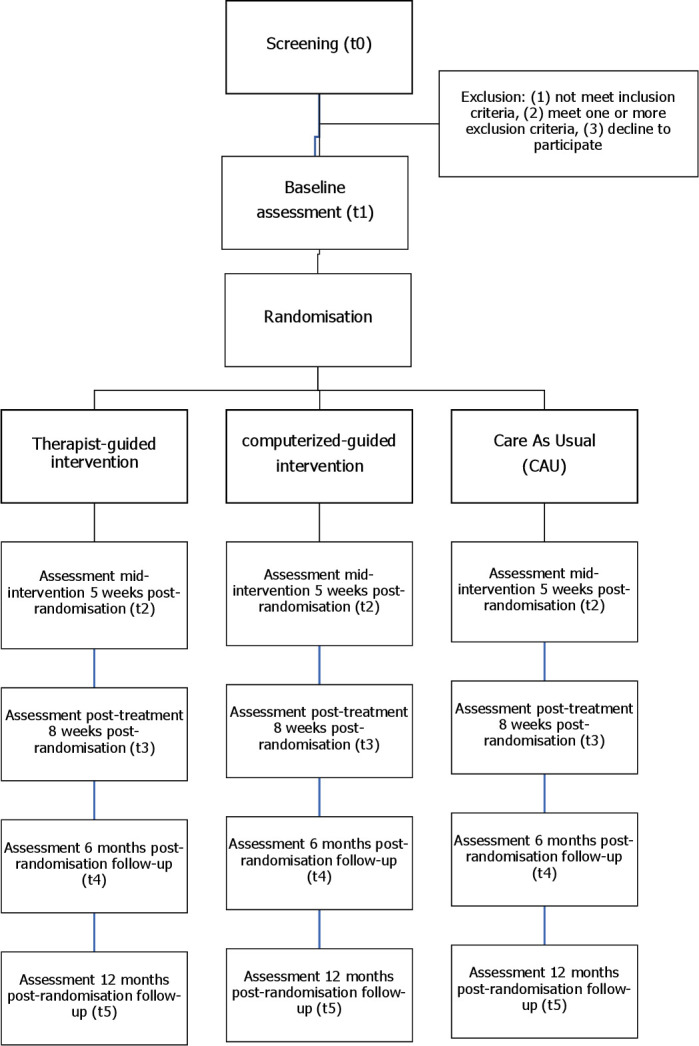
Introduction: Emerging adulthood is a phase in life that is associated with an increased risk to develop a variety of mental health disorders including anxiety and depression. However, less than 25% of university students receive professional help for their mental health reports. Internet-based cognitive behavioural therapy (iCBT) may entail useful interventions in a format that is attractive for university students. The aim of this study protocol is to test the effectiveness of a therapist-guided versus a computer-guided transdiagnostic iCBT programme with a main focus on anxiety and depression. Methods and analysis: University students with anxiety and/or depressive symptoms will be randomised to a (1) 7-week iCBT programme (excluding booster session) with therapist feedback, (2) the identical iCBT programme with computer feedback only or (3) care as usual. Participants in the care as usual condition are informed and referred to conventional care services and encouraged to seek the help they need. Primary outcome variables are self-reported levels of anxiety as measured with the General Anxiety Disorder-7 and self-reported levels of depression as measured with the Patient Health Questionnaire-9. Secondary outcomes include treatment adherence, client satisfaction, medical service use, substance use, quality of life and academic achievement. Assessments will take place at baseline (t1), midtreatment (t2), post-treatment (t3), at 6 months (t4) and 12 months (t5) postbaseline. Social anxiety and perfectionism are included as potentially important predictors of treatment outcome. Power calculations are based on a 3 (group) × 3 (measurement: pretreatment, midtreatment and post-treatment) interaction, resulting in an aimed sample of 276 participants. Data will be analysed based on intention-to-treat and per protocol samples using mixed linear models. Ethics and dissemination: The current study was approved by the Medical Ethics Review Committee (METC) of the Academic Medical Centre, Amsterdam, The Netherlands (number: NL64929.018.18). Results of this trial will be published in peer-reviewed journals. Trial registration number: NL7328.
Overview
The claims and statistics of this paper haven’t been checked yet.
Free: it reads the open-access text and checks the first 5 claims that cite a source we can check. Create a free account to check every claim.
Integrity signals
Registry
Cites
Statistics
Figures
Verification
Claims the paper makes
The claims and statistics of this paper haven’t been checked yet.
Free: it reads the open-access text and checks the first 5 claims that cite a source we can check. Create a free account to check every claim.
Claims other papers make about this one
Each is checked against this paper’s own text: does it say what the citing paper says it does?
The source backs part of the claim, not all of it — or backs it for a different population, condition or comparison.
In the citing paper
“Transdiagnostic interventions for mild to moderate depression and anxiety among university students have been developed and tested in Australia, Canada, Indonesia, the Netherlands, and the UK, [14–20]”
From Transdiagnostic and tailored internet intervention to improve mental health among university students: Research protocol for a randomized controlled trial (2024) · cites this paper as [15]
Experimental — accuracy not yet measuredThe source backs part of the claim, not all of it — or backs it for a different population, condition or comparison.
In the citing paper
“and results have so far shown minor effects.”
From Transdiagnostic and tailored internet intervention to improve mental health among university students: Research protocol for a randomized controlled trial (2024) · cites this paper as [15]
Experimental — accuracy not yet measured
Self-check
Percentages, sums and reported differences re-computed from the paper’s own numbers.
The self-check needs the paper’s full text.
Citations
Cites
A Brief Measure for Assessing Generalized Anxiety Disorder: The GAD-7
Spitzer, R. L., Kroenke, K., Williams, J. B. W., & Löwe, B. (2006) · Archives of Internal Medicine · doi:10.1001/archinte.166.10.1092 · Cited by 31,765
Emerging adulthood: A theory of development from the late teens through the twenties.
Arnett, J. J. (2000) · American Psychologist · doi:10.1037/0003-066x.55.5.469 · Cited by 16,843
EuroQol: a new facility for the measurement of health-related quality of life
(1990) · Health Policy · doi:10.1016/0168-8510(90)90421-9 · Cited by 15,736
SPIRIT 2013 explanation and elaboration: guidance for protocols of clinical trials
Chan, A.-W., Tetzlaff, J. M., Gotzsche, P. C., Altman, D. G., Mann, H., Berlin, J. A., Dickersin, K., Hrobjartsson, A., Schulz, K. F., Parulekar, W. R., et al. (2013) · BMJ · doi:10.1136/bmj.e7586 · Cited by 6,251
Bush, K. (1998) · Archives of Internal Medicine · doi:10.1001/archinte.158.16.1789 · Cited by 6,196
Comparison of Beck Depression Inventories -IA and -II in psychiatric outpatients
Beck, A. T., Steer, R. A., Ball, R., & Ranieri, W. F. (1996) · Journal of Personality Assessment · doi:10.1207/s15327752jpa6703_13 · Cited by 5,965
The PHQ-9: A New Depression Diagnostic and Severity Measure
Kroenke, K., & Spitzer, R. L. (2002) · Psychiatric Annals · doi:10.3928/0048-5713-20020901-06 · Cited by 5,898
An Ultra-Brief Screening Scale for Anxiety and Depression: The PHQ–4
Kroenke, K., Spitzer, R. L., Williams, J. B. W., & Löwe, B. (2009) · Psychosomatics · doi:10.1016/s0033-3182(09)70864-3 · Cited by 4,261
Lecrubier, Y., Sheehan, D., Weiller, E., Amorim, P., Bonora, I., Sheehan, K. H., Janavs, J., & Dunbar, G. (1997) · European Psychiatry · doi:10.1016/s0924-9338(97)83296-8 · Cited by 3,513
Skinner, H. A. (1982) · Addictive Behaviors · doi:10.1016/0306-4603(82)90005-3 · Cited by 3,134
Assessment of client/patient satisfaction: development of a general scale
Larsen, D. L., Attkisson, C. C., Hargreaves, W. A., & Nguyen, T. D. (1979) · Evaluation and Program Planning · doi:10.1016/0149-7189(79)90094-6 · Cited by 2,887 · cited 1×
“59 60 The CSQ-8 consists of 8 items scored on a 1 (‘quite dissatisfied’) to 4 (‘very satisfied’) scale, with total scores ranging between 8 and 32.”
BackgroundAuerbach, R. P., Collaborators, W. W.-I., Mortier, P., Bruffaerts, R., Alonso, J., Benjet, C., Cuijpers, P., Demyttenaere, K., Ebert, D. D., Green, J. G., et al. (2018) · Journal of Abnormal Psychology · doi:10.1037/abn0000362 · Cited by 2,522
Self-citationLevis, B., Benedetti, A., & Thombs, B. D. (2019) · BMJ · doi:10.1136/bmj.l1476 · Cited by 1,718
The Use of Psychological Testing for Treatment Planning and Outcome Assessment
Maruish, M. E., & Leahy, R. L. (2000) · Journal of Cognitive Psychotherapy · doi:10.1891/0889-8391.14.2.205 · Cited by 1,634
Mental disorders among college students in the World Health Organization World Mental Health Surveys
Auerbach, R. P., Alonso, J., Axinn, W. G., Cuijpers, P., Ebert, D. D., Green, J. G., Hwang, I., Kessler, R. C., Liu, H., Mortier, P., et al. (2016) · Psychological Medicine · doi:10.1017/s0033291716001665 · Cited by 1,587
Self-citationComputer-based psychological treatments for depression: A systematic review and meta-analysis
Richards, D., & Richardson, T. (2012) · Clinical Psychology Review · doi:10.1016/j.cpr.2012.02.004 · Cited by 1,442
Wang, P. S., Berglund, P., Olfson, M., Pincus, H. A., Wells, K. B., & Kessler, R. C. (2005) · Archives of General Psychiatry · doi:10.1001/archpsyc.62.6.603 · Cited by 1,325
Carlbring, P., Andersson, G., Cuijpers, P., Riper, H., & Hedman-Lagerlöf, E. (2018) · Cognitive Behaviour Therapy · doi:10.1080/16506073.2017.1401115 · Cited by 1,232
Self-citationAdherence in Internet Interventions for Anxiety and Depression
Christensen, H., Griffiths, K. M., & Farrer, L. (2009) · Journal of Medical Internet Research · doi:10.2196/jmir.1194 · Cited by 1,133 · cited 1×
“61 Finally, following previous studies (for a systematic review), 62 treatment adherence is measured by tracking the activities in Minddistrict.”
MethodExperiences of depression in normal young adults.
Blatt, S. J., D'Affitti, J. P., & Quinlan, D. M. (1976) · Journal of Abnormal Psychology · doi:10.1037//0021-843x.85.4.383 · Cited by 1,124
BEEKMAN, A. T. F., DEEG, D. J. H., VAN LIMBEEK, J., BRAAM, A. W., DE VRIES, M. Z., & VAN TILBURG, W. (1997) · Psychological Medicine · doi:10.1017/s0033291796003510 · Cited by 1,115
Andersson, G., Cuijpers, P., Carlbring, P., Riper, H., & Hedman, E. (2014) · World Psychiatry · doi:10.1002/wps.20151 · Cited by 1,077 · cited 2×
“24 Both approaches (with and without personal guidance) have shown to be efficacious, although programmes with (therapist) guidance generally report a higher effect size (for meta-analyses, see Cuijpers et al and Richards and Richardson 17 25 ), even though it should be noted that a recent…”
BackgroundSelf-citationPersistence of mental health problems and needs in a college student population
Zivin, K., Eisenberg, D., Gollust, S. E., & Golberstein, E. (2009) · Journal of Affective Disorders · doi:10.1016/j.jad.2009.01.001 · Cited by 784
The prevalence and correlates of untreated serious mental illness.
(2001) · PubMed Central · Cited by 780
Mental Health Service Utilization Among College Students in the United States
Eisenberg, D., Hunt, J., Speer, N., & Zivin, K. (2011) · Journal of Nervous & Mental Disease · doi:10.1097/nmd.0b013e3182175123 · Cited by 633
A Meta-Analytic Review of Adult Cognitive-Behavioral Treatment Outcome Across the Anxiety Disorders
Norton, P. J., & Price, E. C. (2007) · Journal of Nervous & Mental Disease · doi:10.1097/01.nmd.0000253843.70149.9a · Cited by 612
Newby, J. M., McKinnon, A., Kuyken, W., Gilbody, S., & Dalgleish, T. (2015) · Clinical Psychology Review · doi:10.1016/j.cpr.2015.06.002 · Cited by 545 · cited 1×
“2 As comorbidity is high, we will use a transdiagnostic iCBT intervention, which has the advantage to target both disorders at the same time and thereby might increase treatment effectiveness (for a systemic review and meta-analysis, see Newby et al 23 ).”
Methodde Girolamo, G., Dagani, J., Purcell, R., Cocchi, A., & McGorry, P. D. (2012) · Epidemiology and Psychiatric Sciences · doi:10.1017/s2045796011000746 · Cited by 544
Cuijpers, P., Noma, H., Karyotaki, E., Cipriani, A., & Furukawa, T. A. (2019) · JAMA Psychiatry · doi:10.1001/jamapsychiatry.2019.0268 · Cited by 539 · cited 5×
“Several studies demonstrated that the effectiveness of guided internet-based cognitive behavioural therapy (iCBT) programmes for anxiety and depression is comparable to conventional (face- to-face) CBT (for meta-analyses, see Carlbring et al and Cuijpers et al 16 17 ).”
BackgroundMethodInfluentialSelf-citationMini-SPIN: A brief screening assessment for generalized social anxiety disorder
Connor, K. M., Kobak, K. A., Churchill, L. E., Katzelnick, D., & Davidson, J. R. T. (2001) · Depression and Anxiety · doi:10.1002/da.1055 · Cited by 537
Ebert, D. D., Zarski, A.-C., Christensen, H., Stikkelbroek, Y., Cuijpers, P., Berking, M., & Riper, H. (2015) · PLOS ONE · doi:10.1371/journal.pone.0119895 · Cited by 533
Self-citationDavies, E. B., Morriss, R., & Glazebrook, C. (2014) · Journal of Medical Internet Research · doi:10.2196/jmir.3142 · Cited by 499 · cited 1×
“There is also some evidence for the effectiveness of internet interventions for young adults and university student populations with various mental health problems, including depression, anxiety, eating disorders, stress, alcohol and sleep problems 18–22 .”
BackgroundDiagnostic accuracy of the mood module of the patient health questionnaire: a systematic review
Wittkampf, K. A., Naeije, L., Schene, A. H., Huyser, J., & van Weert, H. C. (2007) · General Hospital Psychiatry · doi:10.1016/j.genhosppsych.2007.06.004 · Cited by 493
McGorry, P. D., Purcell, R., Goldstone, S., & Amminger, G. P. (2011) · Current Opinion in Psychiatry · doi:10.1097/yco.0b013e3283477a09 · Cited by 490
Harrer, M., Adam, S. H., Baumeister, H., Cuijpers, P., Karyotaki, E., Auerbach, R. P., Kessler, R. C., Bruffaerts, R., Berking, M., & Ebert, D. D. (2019) · International Journal of Methods in Psychiatric Research · doi:10.1002/mpr.1759 · Cited by 445
Self-citationBouwmans, C., De Jong, K., Timman, R., Zijlstra-Vlasveld, M., Van der Feltz-Cornelis, C., Tan, S. S., & Hakkaart-van Roijen, L. (2013) · BMC Health Services Research · doi:10.1186/1472-6963-13-217 · Cited by 401
Berger, T., Hämmerli, K., Gubser, N., Andersson, G., & Caspar, F. (2011) · Cognitive Behaviour Therapy · doi:10.1080/16506073.2011.616531 · Cited by 383 · cited 1×
“To date, little is known about the effectiveness for therapist-guided versus a computer-guided version of the same intervention tested within the same study when applied to a university student sample with mental health concerns 20 26 27 .”
BackgroundPeters, L., Sunderland, M., Andrews, G., Rapee, R. M., & Mattick, R. P. (2012) · Psychological Assessment · doi:10.1037/a0024544 · Cited by 379
Self-citationEtzelmueller, A., Vis, C., Karyotaki, E., Baumeister, H., Titov, N., Berking, M., Cuijpers, P., Riper, H., & Ebert, D. D. (2020) · Journal of Medical Internet Research · doi:10.2196/18100 · Cited by 356 · cited 1×
“The intervention was based on other effective protocols 40–43 and can be seen as a variant of an iCBT protocol for which several studies have proven its effectiveness.”
MethodSelf-citationMaisto, S. A., Carey, M. P., Carey, K. B., Gordon, C. M., & Gleason, J. R. (2000) · Psychological Assessment · doi:10.1037//1040-3590.12.2.186 · Cited by 302
Dear, B. F., Titov, N., Sunderland, M., McMillan, D., Anderson, T., Lorian, C., & Robinson, E. (2011) · Cognitive Behaviour Therapy · doi:10.1080/16506073.2011.582138 · Cited by 282
Using technology to deliver mental health services to children and youth: a scoping review.
Boydell, K., Hodgins, M., Pignatiello, A., Teshima, J., Edwards, H. E., & Willis, D. (2014) · Europe PMC (PubMed Central) · Cited by 273
Prevention of Depression in the College Student Population: A Review of the Literature
Buchanan, J. L. (2012) · Archives of Psychiatric Nursing · doi:10.1016/j.apnu.2011.03.003 · Cited by 238
Buntrock, C., Ebert, D. D., Lehr, D., Smit, F., Riper, H., Berking, M., & Cuijpers, P. (2016) · JAMA · doi:10.1001/jama.2016.4326 · Cited by 232
Self-citationAlonso, J., Mortier, P., Auerbach, R. P., Bruffaerts, R., Vilagut, G., Cuijpers, P., Demyttenaere, K., Ebert, D. D., Ennis, E., Gutiérrez-García, R. A., et al. (2018) · Depression and Anxiety · doi:10.1002/da.22778 · Cited by 205
Self-citationCurbing Problem Drinking with Personalized-Feedback Interventions
Riper, H., van Straten, A., Keuken, M., Smit, F., Schippers, G., & Cuijpers, P. (2009) · American Journal of Preventive Medicine · doi:10.1016/j.amepre.2008.10.016 · Cited by 203 · cited 1×
“There is also some evidence for the effectiveness of internet interventions for young adults and university student populations with various mental health problems, including depression, anxiety, eating disorders, stress, alcohol and sleep problems 18–22 .”
BackgroundSelf-citationUsing patient self-reports to study heterogeneity of treatment effects in major depressive disorder
Kessler, R. C., van Loo, H. M., Wardenaar, K. J., Bossarte, R. M., Brenner, L. A., Ebert, D. D., de Jonge, P., Nierenberg, A. A., Rosellini, A. J., Sampson, N. A., et al. (2017) · Epidemiology and Psychiatric Sciences · doi:10.1017/s2045796016000020 · Cited by 191
Hudson, J. L., Rapee, R. M., Lyneham, H. J., McLellan, L. F., Wuthrich, V. M., & Schniering, C. A. (2015) · Behaviour Research and Therapy · doi:10.1016/j.brat.2015.06.007 · Cited by 176
Self-citationAuerbach, R. P., Mortier, P., Bruffaerts, R., Alonso, J., Benjet, C., Cuijpers, P., Demyttenaere, K., Ebert, D. D., Green, J. G., Hasking, P., et al. (2019) · International Journal of Methods in Psychiatric Research · doi:10.1002/mpr.1752 · Cited by 158
Self-citationthe ESEMeD/MHEDEA 2000 investigators, König, H.-H., Heider, D., Lehnert, T., Riedel-Heller, S. G., Angermeyer, M. C., Matschinger, H., Vilagut, G., Bruffaerts, R., Haro, J. M., et al. (2010) · Health and Quality of Life Outcomes · doi:10.1186/1477-7525-8-143 · Cited by 143
The Use of Computerized Self-Help Packages to Treat Adolescent Depression and Anxiety
Sethi, S., Campbell, A. J., & Ellis, L. A. (2010) · Journal of Technology in Human Services · doi:10.1080/15228835.2010.508317 · Cited by 129
Perfectionism Impedes Social Relations and Response to Brief Treatment for Depression
Shahar, G., Blatt, S. J., Zuroff, D. C., Krupnick, J. L., & Sotsky, S. M. (2004) · Journal of Social and Clinical Psychology · doi:10.1521/jscp.23.2.140.31017 · Cited by 124
Self-criticism and psychotherapy outcome: A systematic review and meta-analysis
Löw, C. A., Schauenburg, H., & Dinger, U. (2020) · Clinical Psychology Review · doi:10.1016/j.cpr.2019.101808 · Cited by 111
A cross-national validation of the client satisfaction questionnaire: the Dutch experience
De Brey, H. (1983) · Evaluation and Program Planning · doi:10.1016/0149-7189(83)90018-6 · Cited by 109
Weeks, J. W., Spokas, M. E., & Heimberg, R. G. (2007) · Depression and Anxiety · doi:10.1002/da.20250 · Cited by 106
Ebert, D. D., Nobis, S., Lehr, D., Baumeister, H., Riper, H., Auerbach, R. P., Snoek, F., Cuijpers, P., & Berking, M. (2017) · Diabetic Medicine · doi:10.1111/dme.13173 · Cited by 101
Self-citation(1994) · Cited by 98
Bolinski, F., Boumparis, N., Kleiboer, A., Cuijpers, P., Ebert, D. D., & Riper, H. (2020) · Internet Interventions · doi:10.1016/j.invent.2020.100321 · Cited by 87
Self-citationVerhoog, S., Dopmeijer, J. M., de Jonge, J. M., van der Heijde, C. M., Vonk, P., Bovens, R. H. L. M., de Boer, M. R., Hoekstra, T., Kunst, A. E., Wiers, R. W., et al. (2020) · European Addiction Research · doi:10.1159/000503342 · Cited by 85
Self-citationEbert, D. D., Buntrock, C., Lehr, D., Smit, F., Riper, H., Baumeister, H., Cuijpers, P., & Berking, M. (2018) · Behavior Therapy · doi:10.1016/j.beth.2017.05.004 · Cited by 75
Self-citationThe Depressive Experiences Questionnaire
Desmet, M., Vanheule, S., Groenvynck, H., Verhaeghe, P., Vogel, J., & Bogaerts, S. (2007) · European Journal of Psychological Assessment · doi:10.1027/1015-5759.23.2.89 · Cited by 72
Psychometric Properties of the Mini-Social Phobia Inventory
Seeley-Wait, E., Abbott, M. J., & Rapee, R. M. (2009) · The Primary Care Companion to The Journal of Clinical Psychiatry · doi:10.4088/pcc.07m00576 · Cited by 69
Self-citationPresenteeism in college students: reliability and validity of the Presenteeism Scale for Students
Matsushita, M., Adachi, H., Arakida, M., Namura, I., Takahashi, Y., Miyata, M., Kumano-go, T., Yamamura, S., Shigedo, Y., Suganuma, N., et al. (2011) · Quality of Life Research · doi:10.1007/s11136-010-9763-9 · Cited by 40 · cited 3×
“Additionally, the work impairment subscale of the Presenteeism Scale for Students (PSS-WIS) 57 is administered to assess subjective academic achievement on a 5-point Likert scale ranging from ‘always’ (0) to ‘never’ (5).”
MethodInfluentialRenfrew, M. E., Morton, D. P., Morton, J. K., Hinze, J. S., Przybylko, G., & Craig, B. A. (2020) · Journal of Medical Internet Research · doi:10.2196/19945 · Cited by 35
Bolinski, F., Kleiboer, A., Karyotaki, E., Bosmans, J. E., Zarski, A.-C., Weisel, K. K., Ebert, D. D., Jacobi, C., Cuijpers, P., & Riper, H. (2018) · Trials · doi:10.1186/s13063-018-2477-y · Cited by 31 · cited 2×
“The online transdiagnostic intervention that is used in this study, ‘ICare Prevent’, was originally developed by Weisel et al 37 for the general German-speaking population and translated and adapted by Bolinski et al 38 and Karyotaki et al 39 for a Dutch undergraduate student population into Dutch and English.”
MethodSelf-citationKaryotaki, E., Klein, A. M., Riper, H., Wit, L. D., Krijnen, L., Bol, E., Bolinski, F., Burger, S., Ebert, D. D., Auerbach, R. P., et al. (2019) · BMJ Open · doi:10.1136/bmjopen-2018-028739 · Cited by 28 · cited 4×
“For a full description of the intervention, see Karyotaki et al .”
BackgroundMethodInfluentialSelf-citationHeslin, M., Chua, K., Trevillion, K., Nath, S., Howard, L. M., & Byford, S. (2019) · BJPsych Open · doi:10.1192/bjo.2019.71 · Cited by 23
Weisel, K. K., Zarski, A.-C., Berger, T., Schaub, M. P., Krieger, T., Moser, C. T., Berking, M., & Ebert, D. D. (2018) · Frontiers in Psychiatry · doi:10.3389/fpsyt.2018.00274 · Cited by 21
der Heijde, C. M. V., Vonk, P., & Meijman, F. J. (2015) · Health Psychology and Behavioral Medicine · doi:10.1080/21642850.2015.1049950 · Cited by 18
Self-citation
Cited by
Nottage, M., Oei, N. Y. L., Wolters, N. E., Klein, A. M., der Heijde, C. M. V., Vonk, P., Wiers, R. W. H. J., & Koelen, J. A. (2021) · Personality and Individual Differences · doi:10.1016/j.paid.2021.111233 · Cited by 56
Self-citationKoelen, J. A., Mansueto, A. C., Finnemann, A., de Koning, L., der Heijde, C. M. V., Vonk, P., Wolters, N. E., Klein, A. M., Epskamp, S., & Wiers, R. W. H. J. (2021) · International Journal of Methods in Psychiatric Research · doi:10.1002/mpr.1901 · Cited by 48
Self-citationBolinski, F., Kleiboer, A., Neijenhuijs, K., Karyotaki, E., Wiers, R., de Koning, L., Jacobi, C., Zarski, A.-C., Weisel, K. K., Cuijpers, P., et al. (2022) · Journal of Medical Internet Research · doi:10.2196/40892 · Cited by 24
“Ultimately, direct contact through students’ email addresses was the most effective recruitment channel, which was a unique opportunity in the UvAcare project [44].”
InfluentialSelf-citationKharroubi, S. A., Al-Akl, N., Chamate, S.-J., Abou Omar, T., & Ballout, R. (2024) · International Journal of Environmental Research and Public Health · doi:10.3390/ijerph21050597 · Cited by 20
“Poor mental health among college students is becoming an increasing concern for public health and policy [5,6].”
BackgroundKoelen, J. A., Klein, A. M., Wolters, N. E., Bol, E., de Koning, L., Roetink, S., Blom, J. V., boutin, B., Schaaf, J. V., Grasman, R. P. P. P., et al. (2024) · JMIR Mental Health · doi:10.2196/50503 · Cited by 20
Self-citation
Metadata
- Authors
- Klein, A., Wolters, N. E., Bol, E. J. M., Koelen, J., de Koning, L., Roetink, S. S. M., van Blom, J. J., Pronk, T., van der Heijde, C., Salemink, E., Bolinski, F., Riper, H., Karyotaki, E., Cuijpers, P., Schneider, S., Rapee, R. M., Vonk, P., & Wiers, R. W.
- Affiliations
- University of Amsterdam (NL)
- Addiction Development and Psychopathology (ADAPT)-lab, Developmental Psychology, Department of Psychology, University of Amsterdam, Amsterdam, The Netherlands
- Department of Research, Development and Prevention, Student Health Service, University of Amsterdam, Amsterdam, The Netherlands
- Utrecht University (NL)
- Amsterdam Public Health (NL)
- Ruhr University Bochum (DE)
- Macquarie University (AU)
- Corresponding author
- Klein, Anke
- ORCID
- Venue
- BMJ Open
- Publisher
- BMJ
- Published
- 2021-11
- Volume
- 11
- Issue
- 11
- Pages
- e049554
- ISSN
- 2044-6055 (ISSN-L)
- PMC
- PMC8628330
- OpenAlex
- W3217422225
- Cited by
- 10
- References
- 69
- Citations by year
- 2026: 1 · 2024: 5 · 2022: 2 · 2021: 2
- FWCI
- 2.00
- Type
- journal article
- Language
- en
- Open access
- gold
- doi.org
- Locations
- BMJ Open (publishedVersion, cc-by)
- PubMed Central (publishedVersion, cc-by)
- PubMed (publishedVersion)
- Pure Amsterdam UMC (publishedVersion, cc-by)
- Amsterdam UMC (VU Amsterdam) - Institutional Repository (publishedVersion, other-oa)
- VU Research Portal (publishedVersion, other-oa)
- Leiden Repository (Leiden University) (submittedVersion, cc-by)
- UvA-DARE (University of Amsterdam) (submittedVersion, cc-by)
- DOAJ (DOAJ: Directory of Open Access Journals) (submittedVersion, cc-by-sa)
- Utrecht University Repository (Utrecht University) (submittedVersion, other-oa)
- Data Archiving and Networked Services (DANS) (submittedVersion, other-oa)
- Funders
- Amsterdam, University of Amsterdam (N/A)
- Topics
- Social Sciences › Psychology › Applied Psychology › Digital Mental Health Interventions
- Social Sciences › Psychology › Experimental and Cognitive Psychology › Anxiety, Depression, Psychometrics, Treatment, Cognitive Processes
- Social Sciences › Psychology › Clinical Psychology › Psychological Treatments and Assessments
- Keywords
- internet-based cognitive behavioral therapy, transdiagnostic treatment, anxiety, depression, university students, emerging adulthood, medication adherence, client satisfaction, social anxiety, perfectionism, treatment outcome predictors, quality of life, academic performance
- MeSH terms
- Adult, Anxiety, Anxiety Disorders, Depression, Humans, Quality of Life, Students, Universities, Cognitive Behavioral Therapy, Randomized Controlled Trials as Topic, Treatment Outcome, Internet
About these checks
Registry, retraction, Cites and statistics results are computed, not judged, with one exception: a printed reference that no index lists is read once by a model before it counts as a citation error. Claims are extracted by a model and kept only when their quote appears verbatim in the text; each cited source is then checked, with a model’s help, for whether it says what the claim relies on. Those verdicts can be wrong — read the claim’s quote and the cited source before relying on one.
Statistics and arithmetic are recomputed, not judged.
Confidence bands are shown only for fields calibrated on our annotated test set. None is calibrated yet, so no band is shown.
What counts as a claim ›How we measure confidence ›How we check this ›
Are you an author, or do you see a problem with this page? Request a review
Data sources
Bibliographic data: Semantic Scholar, OpenAlex, Crossref.
Contains information from the Semantic Scholar Academic Graph Datasets, made available under the ODC Attribution License (ODC-BY 1.0).
Semantic Scholar’s data is described in: Kinney, R., et al. (2023). The Semantic Scholar Open Data Platform. arXiv:2301.10140.
