

Barriers to healthcare and self-reported adverse outcomes for autistic adults: a cross-sectional study
Open accessPublished version of a preprint
The DOI matches its Crossref record; 28 of the 28 references it cites were found in a registry or an index.
Abstract
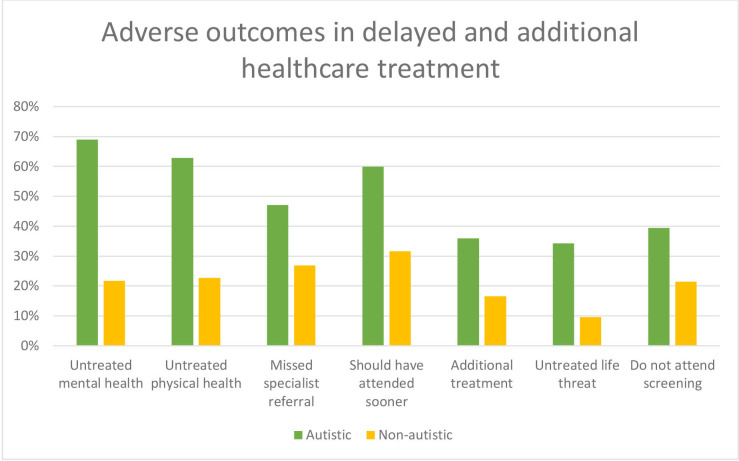
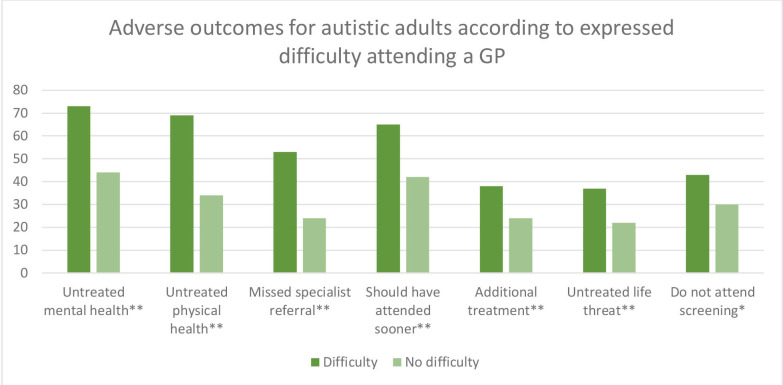
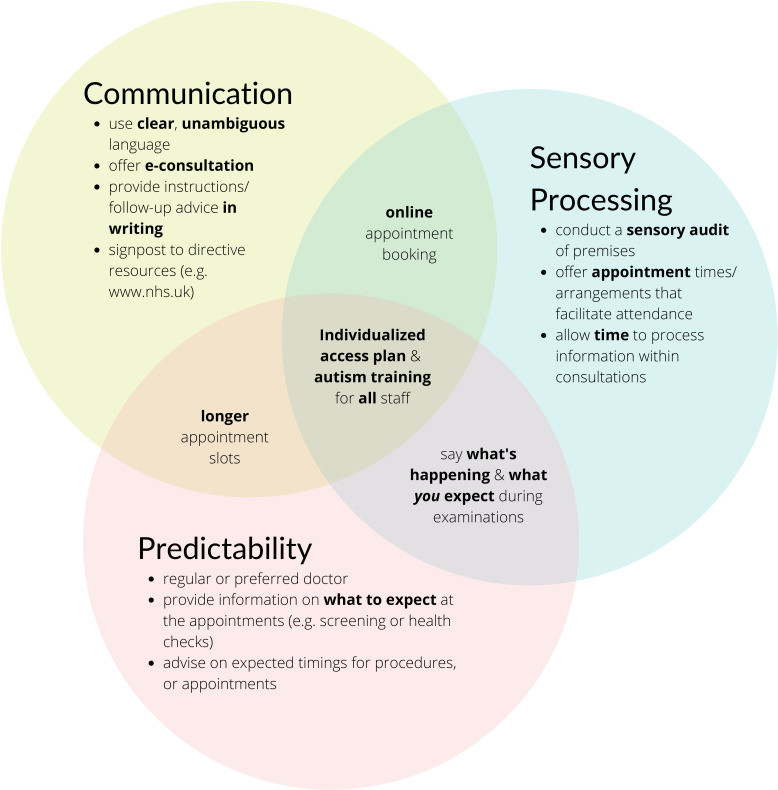
Objectives: Autistic people experience poor physical and mental health along with reduced life expectancy compared with non-autistic people. Our aim was to identify self-reported barriers to primary care access by autistic adults compared with non-autistic adults and to link these barriers to self-reported adverse health consequences. Design: Following consultation with the autistic community at an autistic conference, Autscape , we developed a self-report survey, which we administered online through social media platforms. Setting: A 52-item, international, online survey. Participants: 507 autistic adults and 157 non-autistic adults. Primary and secondary outcome measures: Self-reported barriers to accessing healthcare and associated adverse health outcomes. Results: Eighty per cent of autistic adults and 37% of non-autistic respondents reported difficulty visiting a general practitioner (GP). The highest-rated barriers by autistic adults were deciding if symptoms warrant a GP visit (72%), difficulty making appointments by telephone (62%), not feeling understood (56%), difficulty communicating with their doctor (53%) and the waiting room environment (51%). Autistic adults reported a preference for online or text-based appointment booking, facility to email in advance the reason for consultation, the first or last clinic appointment and a quiet place to wait. Self-reported adverse health outcomes experienced by autistic adults were associated with barriers to accessing healthcare. Adverse outcomes included untreated physical and mental health conditions, not attending specialist referral or screening programmes, requiring more extensive treatment or surgery due to late presentations and untreated potentially life-threatening conditions. There were no significant differences in difficulty attending, barriers experienced or adverse outcomes between formally diagnosed and self-identified autistic respondents. Conclusions: Reduction of healthcare inequalities for autistic people requires that healthcare providers understand autistic perspectives, communication needs and sensory sensitivities. Adjustments for autism-specific needs are as necessary as ramps for wheelchair users.
Overview
The claims and statistics of this paper haven’t been checked yet.
Free: it reads the open-access text and checks the first 5 claims that cite a source we can check. Create a free account to check every claim.
Integrity signals
Registry
Cites
Statistics
Figures
Verification
Claims the paper makes
The claims and statistics of this paper haven’t been checked yet.
Free: it reads the open-access text and checks the first 5 claims that cite a source we can check. Create a free account to check every claim.
Claims other papers make about this one
Each is checked against this paper’s own text: does it say what the citing paper says it does?
The source backs part of the claim, not all of it — or backs it for a different population, condition or comparison.
In the citing paper
“Waiting is difficult for autistic people, especially for an unknown duration in the sensory stress of a typical healthcare waiting-room, emergency department or inpatient ward (Doherty et al, 2022).”
From Autistic SPACE: a novel framework for meeting the needs of autistic people in healthcare settings (2023) · cites this paper as Doherty et al, 2022
Experimental — accuracy not yet measuredThe source backs part of the claim, not all of it — or backs it for a different population, condition or comparison.
In the citing paper
“Proximity to others, particularly within touching distance, is often difficult to tolerate (Doherty et al, 2022; Strömberg et al, 2022).”
From Autistic SPACE: a novel framework for meeting the needs of autistic people in healthcare settings (2023) · cites this paper as Doherty et al, 2022
Experimental — accuracy not yet measuredThe source backs part of the claim, not all of it — or backs it for a different population, condition or comparison.
In the citing paper
“Interacting with unknown people is also challenging (Doherty et al, 2022).”
From Autistic SPACE: a novel framework for meeting the needs of autistic people in healthcare settings (2023) · cites this paper as Doherty et al, 2022
Experimental — accuracy not yet measuredThe source backs part of the claim, not all of it — or backs it for a different population, condition or comparison.
In the citing paper
“Most autistic people have difficulty using telephones, so a flexible approach to appointment booking or services such as preoperative assessment facilitates access (Doherty et al, 2022).”
From Autistic SPACE: a novel framework for meeting the needs of autistic people in healthcare settings (2023) · cites this paper as Doherty et al, 2022
Experimental — accuracy not yet measuredThe cited source says what the claim attributes to it.
In the citing paper
“Barriers to accessing healthcare are associated with adverse health outcomes (Doherty et al, 2022).”
From Autistic SPACE: a novel framework for meeting the needs of autistic people in healthcare settings (2023) · cites this paper as Doherty et al, 2022
Self-check
Percentages, sums and reported differences re-computed from the paper’s own numbers.
The self-check needs the paper’s full text.
Citations
Cites
On the ontological status of autism: the ‘double empathy problem’
Milton, D. E. M. (2012) · Disability & Society · doi:10.1080/09687599.2012.710008 · Cited by 2,082
The health status of adults on the autism spectrum
Croen, L. A., Zerbo, O., Qian, Y., Massolo, M. L., Rich, S., Sidney, S., & Kripke, C. (2015) · Autism · doi:10.1177/1362361315577517 · Cited by 1,110
Premature mortality in autism spectrum disorder
Hirvikoski, T., Mittendorfer-Rutz, E., Boman, M., Larsson, H., Lichtenstein, P., & Bölte, S. (2016) · British Journal of Psychiatry · doi:10.1192/bjp.bp.114.160192 · Cited by 1,011
Epidemiology of Autism Spectrum Disorders in Adults in the Community in England
Brugha, T. S., McManus, S., Bankart, J., Scott, F., Purdon, S., Smith, J., Bebbington, P., Jenkins, R., & Meltzer, H. (2011) · Archives of General Psychiatry · doi:10.1001/archgenpsychiatry.2011.38 · Cited by 903
Corbett, B. A., Constantine, L. J., Hendren, R., Rocke, D., & Ozonoff, S. (2009) · Psychiatry Research · doi:10.1016/j.psychres.2008.02.005 · Cited by 584
Nicolaidis, C., Raymaker, D. M., Ashkenazy, E., McDonald, K. E., Dern, S., Baggs, A. E., Kapp, S. K., Weiner, M., & Boisclair, W. C. (2015) · Autism · doi:10.1177/1362361315576221 · Cited by 513
Nicolaidis, C., Raymaker, D., McDonald, K., Dern, S., Boisclair, W. C., Ashkenazy, E., & Baggs, A. (2013) · Journal of General Internal Medicine · doi:10.1007/s11606-012-2262-7 · Cited by 419
Mason, D., Ingham, B., Urbanowicz, A., Michael, C., Birtles, H., Woodbury-Smith, M., Brown, T., James, I., Scarlett, C., Nicolaidis, C., et al. (2019) · Journal of Autism and Developmental Disorders · doi:10.1007/s10803-019-04049-2 · Cited by 291
Autism spectrum disorders: Concurrent clinical disorders
Ming, X., Brimacombe, M., Chaaban, J., Zimmerman-Bier, B., & Wagner, G. C. (2008) · Journal of Child Neurology · doi:10.1177/0883073807307102 · Cited by 266
Zerbo, O., Massolo, M. L., Qian, Y., & Croen, L. A. (2015) · Journal of Autism and Developmental Disorders · doi:10.1007/s10803-015-2579-2 · Cited by 244
Cited by
Items 101–200 of 258
A mixed-methods study of autistic adults’ healthcare independence over time
Gilmore, D., Radford, D., Coyne, A. C., Hanks, C. D., Coury, D. L., Hess, A., Garvin, J. H., & Hand, B. N. (2023) · Health Care Transitions · doi:10.1016/j.hctj.2023.100029 · Cited by 3
Transtorno do espectro autista: Uma abordagem da medicina da família e comunidade
Paro, L. B., Barreto, L. B., Alves, N. F. D. C., & Moreira, S. L. D. A. (2024) · Research Society and Development · doi:10.33448/rsd-v13i3.45188 · Cited by 3
Savard, L., Prelock, P., Medeiros, S., & Lodestone, A. “. (2024) · Topics in Language Disorders · doi:10.1097/tld.0000000000000351 · Cited by 3
Rynkiewicz, A., Ferensztajn‐Rochowiak, E., Moseley, R. L., Turner‐Cobb, J. M., Hadjikhani, N. K., Lacroix, A., Curran, A. B., Sohl, K., & Darmochwał-Kolarz, D. (2025) · Psychiatria i Psychologia Kliniczna · doi:10.15557/pipk.2024.0045 · Cited by 3
Chown, N., Shaw, S., Doherty, M., Johnson, M., Krupa, J., Martin, N., & Brooker-Corcoran, M. (2023) · Canadian Journal of Educational and Social Studies · doi:10.53103/cjess.v3i1.99 · Cited by 7
“Whilst diabetes, epilepsy, or kidney disease will not affect a neurotypical adult patient’s likelihood of consulting their GP, there are various barriers that may cause an autistic adult patient to actively avoid seeking a medical opinion (Doherty et al., 2022).”
BackgroundInfluentialSelf-citationOrakani, S. N., Officer, T. N., Good, G. A., & McBride‐Henry, K. (2024) · Healthcare · doi:10.3390/healthcare12030387 · Cited by 6
“Other research suggests that these experiences may lead populations to access healthcare later when their care needs are greater [33,34].”
BackgroundTromans, S. J., Teece, L., Saunders, C. L., McManus, S., & Brugha, T. S. (2024) · BMJ Open · doi:10.1136/bmjopen-2023-081388 · Cited by 6
“…while attempts have previously been made to evaluate the healthcare experiences of autistic adults in different contexts, such as regarding their mental health, 40 to the author’s knowledge, this is the first analysis of a national survey of autistic adults experiences relating to primary care.”
How can autistic adults be supported in primary care?
O’Nions, E., McKechnie, D. G., Long, C., Mandy, W., & Stott, J. C. H. (2023) · British Journal of General Practice · doi:10.3399/bjgp23x735525 · Cited by 4
Newman, B., Cheek, C., Richardson, L., Gillies, D. M., Hutchinson, K., Austin, E. J., Murphy, M., Testa, L., Rojas, C., Raggett, L., et al. (2024) · Emergency Medicine Australasia · doi:10.1111/1742-6723.14500 · Cited by 2
Clark, S. (2025) · Journal of Patient Experience · doi:10.1177/23743735251333601 · Cited by 3
Fox, J., Carroll, J., & Death, J. (2025) · Autism · doi:10.1177/13623613251344425 · Cited by 3
“…include inflexibility and a lack of universal design with services (O’Connor et al., 2023), un-accom-modating service delivery environments and communication practices (Doherty et al., 2022), and providers having a limited knowledge around working with autistic adults (Maddox et al., 2020).”
Lampinen, L. A., Ederer, J. E., & Bal, V. H. (2025) · Journal of Autism and Developmental Disorders · doi:10.1007/s10803-025-06988-5 · Cited by 3
‘I feel trapped in my safe clothes’: The impact of tactile hyper-sensitivity on autistic adults
Knight, A. F., & Birtles, D. (2025) · Autism · doi:10.1177/13623613251366882 · Cited by 4
“…may be unexpected physical contact (MacLennan, Woolley, et al., 2022); maintaining personal hygiene such as oral care due to the physical sensations (Mirsky et al., 2021); and accessing healthcare and physical examinations which involve being touched (Doherty et al., 2022; Mirsky et al., 2021).”
Edwards, C., Love, A. M. A., Cai, R. Y., Constable, P. A., Love, D. C., Parmar, K. R., Gowen, E., & Gibbs, V. (2025) · Ophthalmic and Physiological Optics · doi:10.1111/opo.70029 · Cited by 4
“5,6 Providing care to autistic individuals is already a routine part of clinical practice for eye care professionals.”
Ellington, E. S., Parsons, S., & Kovshoff, H. (2026) · BMC Health Services Research · doi:10.1186/s12913-026-14025-z · Cited by 2
“Yet despite research suggesting that autistic people themselves frequently feel misunderstood within healthcare consultations [36–38], only recently have studies begun to explore how clinicians may be contributing to shared misunderstandings, or how they could adapt their practice to better meet…”
Quadt, L., Savage, G. K., Bond, R., Davies, K. A., Critchley, H., & Eccles, J. (2026) · Journal of Psychiatric Research · doi:10.1016/j.jpsychires.2026.02.036 · Cited by 9
Gray, L. J., McNeill, B. A., Woodman, J., Bernard, S., Kos, J., Hewitt, Y., Goldingay, S., Hayley, A., Hitch, D., Macfarlane, S., et al. (2026) · Teaching and Learning in Medicine · doi:10.1080/10401334.2026.2632753 · Cited by 5
Cooper, S., Doherty, M., & Shaw, S. C. K. (2026) · PLoS ONE · doi:10.1371/journal.pone.0345156 · Cited by 4
“Furthermore, such barriers lead to late presentations of serious conditions and have been statistically associated with adverse outcomes [20].”
Self-citationShifting the Vulnerability Economy: Autism and Unmasking
Dryden, J., & Catala, A. (2026) · Hypatia · doi:10.1017/hyp.2026.10080 · Cited by 2
Potts, B., & White, H. (2024) · Radiography · doi:10.1016/j.radi.2024.09.055 · Cited by 4
Disability and the dermatology patient—part 1: Improving access to dermatologic care
Muzumdar, S., Zemlok, S. K., Sloan, B., Krug, R., & Chang, M. W. (2024) · Journal of the American Academy of Dermatology · doi:10.1016/j.jaad.2024.10.122 · Cited by 2
From awareness to action: Facilitators and advocacy in healthcare by autistic adults
Best, M., Lindsay, R., Demissie, S. A., Burakov, I., Ramos‐Torres, S., & Burke, M. M. (2025) · Autism · doi:10.1177/13623613251343350 · Cited by 3
“While studies have increasingly centered the voices of autistic adults (e.g. Doherty et al., 2022; Mazurek et al., 2023; Nicolaidis et al., 2016), few studies have examined the role of self-advocacy in accessing healthcare services.”
Martini, M. I., Butwicka, A., & Taylor, M. J. (2023) · JAMA Psychiatry · doi:10.1001/jamapsychiatry.2022.5155 · Cited by 2
Hotez, E., & Hudson, S. (2023) · Journal of Autism and Developmental Disorders · doi:10.1007/s10803-023-06001-x · Cited by 4
Recognising and Responding to Physical and Mental Health Issues in Neurodivergent WomenPreprint
Kelly, C. A., Martin, R., & Taylor, R. (2023) · Qeios · doi:10.32388/nfb3fk.11 · Cited by 2
Translating Research into Change: Reporting the Lived Experience of hEDS and HSD in Scotland
Berg, K. M., Dockrell, D., & Matheson, R. (2024) · doi:10.2218/ed.9781912669837 · Cited by 2
Windarwati, H. D., Lestari, R., Hidayah, R., Hasan, H., Ati, N. A. L., Kusumawati, M. W., Selena, I. N., Dumar, B., & Rahayu, G. (2024) · Journal of Child and Adolescent Psychiatric Nursing · doi:10.1111/jcap.12450 · Cited by 5
Terroso, S. R., McKenney, E. E., Brunwasser, S. M., Richards, J. K., Day, T. C., Kofner, B., McDonald, R. G., Gillespie‐Lynch, K., Kang, E., Lerner, M. D., et al. (2024) · Autism in Adulthood · doi:10.1089/aut.2024.0090 · Cited by 2
“25 Untreated psychiatric disorders can have long-term negative consequences for autistic adults, including greater dif fi culties with social communication and adaptive behavior.”
Integrating Neurodiversity and Disability Rights into Primary Care Practices
Hotez, E., Rava, J. A., Williams, Z. J., Dwyer, P. S. R., Rosenau, K. A., & Onaiwu, M. G. (2024) · Springer eBooks · doi:10.1007/978-3-031-54281-7_13 · Cited by 3
Resnikoff, A. W., Colantuono, V., Wieckowski, A. T., Chernak, E. D., Plumb, J., Baynard, M. D., Sheridan, E., & Robins, D. L. (2024) · Journal of Autism and Developmental Disorders · doi:10.1007/s10803-024-06506-z · Cited by 1
“…in the waiting area and/or vaccination space prior to and during vaccine administration (e.g., noise from other patients, crowded area, uncomfortable fur-niture), feeling misunderstood by healthcare providers, as well as past negative experiences with healthcare providers (Doherty et al., 2022).”
Adamou, M., Jones, S. L., Fullen, T., Alty, B., Ward, J., & Mills, J. N. (2025) · Journal of Clinical Medicine · doi:10.3390/jcm14092933 · Cited by 2
“…report experiences of healthcare inequality [4,21], including expressing that their clinical journey is marred with ‘missed opportunities’ and ‘absent support’. inequality [4,21], including expressing that their clinical journey is marred with ‘missed opportunities’ and ‘absent support’.”
InfluentialCouture, M. M., Courteau, J., Brodeur, S., Chiu, Y. M., Courteau, M., Dubé, E., Thomas, N., LESAGE, A. D., Fombonne, E. J., & Dufour, I. (2025) · Autism Research · doi:10.1002/aur.70072 · Cited by 2
“Autistic adults also reported additional challenges (Doherty et al. 2022) such as not perceiving their symptoms as warrant‑ ing a medical visit, difficulties scheduling appointments, not feeling understood by healthcare providers, communication challenges, and sensory discomfort in waiting rooms…”
Øverland, E., Andersen, P. N., Skogli, E. W., Hauge, Å. L., & Pellicano, E. (2025) · Journal of Autism and Developmental Disorders · doi:10.1007/s10803-025-07070-w · Cited by 4
Baksh, R. A., Mueller, C., Strydom, A., & Sheehan, R. (2025) · Autism in Adulthood · doi:10.1177/25739581251394237 · Cited by 2
Girolamo, T. M., Escobedo, A. G., Butler, L. K., Larson, C., Campos, I., & Greene-Pendelton, K. (2025) · Autism · doi:10.1177/13623613251380448 · Cited by 1
Pregnancy and Childbirth in Neurodivergent Women: Shift Towards Personalized Maternity Care
Avdeeva, A. M., Parfenenko, M. A., Брызгалина, Е., Muminova, K., & Сагдуллаевна, Х. З. (2025) · Journal of Personalized Medicine · doi:10.3390/jpm15110557 · Cited by 1
“…recognition, coupled with a tendency for healthcare providers to misinterpret neurodivergent traits in women specifically, frequently leading to miscommu-nication with medical professionally, resulting in poorer care quality and a high prevalence of negative or traumatic medical encounters [10–12].”
Kennedy, B. S., Weir, E. M., Fysh, M. C., Tsompanidis, A., Payne, R., Allison, C. L., Matthews, F. E., & Baron‐Cohen, S. (2026) · Molecular Autism · doi:10.1186/s13229-025-00698-6 · Cited by 1
“Despite barriers to accessing health-care [20, 31], autistic people have higher rates of health-care utilization and healthcare spending, being more likely to have primary care, out-patient, and emergency department visits than others, including increased risk of emergency department visits for…”
Interoception in Autism, Pitfalls, and Promise: A Participatory Research Perspective
Palser, E. R., Lawson, W. B., Goodall, E., & Pellicano, E. (2026) · Autism in Adulthood · doi:10.1177/25739581251414545 · Cited by 2
Useful considerations for treating migraine in patients with autism
Nwaobi, S. E. (2026) · Headache The Journal of Head and Face Pain · doi:10.1111/head.70054 · Cited by 1
“8 Thus, starting with low doses and performing gradual up-titration with frequent monitoring are recommended.”
Bernhard, F. B., Skubik-Peplaski, C., & Dorich, J. M. (2026) · Occupational Therapy In Health Care · doi:10.1080/07380577.2026.2623230 · Cited by 1
Badgett, N. M., Taylor-Swanson, L. J., Quist, S., Price, J., & Villanueva, J. (2026) · Frontiers in Reproductive Health · doi:10.3389/frph.2026.1762773 · Cited by 1
“These challenges include increased barriers to accessing providers, higher unmet needs, and lower satisfaction with care than individuals without autism (23, 24).”
Priorities for change for autistic people across Europe
Ikhsan, S. N. B. M., Holt, R., Ruigrok, A. N. V., Man, J., Parsons, T. A., Gibbs, K., Bullock, E., Baranger, A., Allison, C. L., Doherty, M., et al. (2026) · Molecular Autism · doi:10.1186/s13229-026-00706-3 · Cited by 2
Self-citationCrompton, C. J., Efthimiou, T. N., Dockrell, D., & Berg, K. M. (2026) · BMC Medicine · doi:10.1186/s12916-026-04713-2 · Cited by 1
“Currently, autistic people face significant barriers to accessing healthcare [69] and poorer health outcomes [21] than non-autistic people, and focusing support in these areas may have significant benefits particularly for chronic, lifelong health conditions such as hEDS/HSD.”
Ball, R. C., Richdale, A. L., Lawson, L. P., & Morris, E. M. J. (2026) · Autism · doi:10.1177/13623613261433100 · Cited by 2
“This corroborates previous research about the experience of more barriers to general healthcare for autistic compared to non-autistic individuals (Arnold et al., 2023; A. J. Doherty et al., 2020; M. Doherty et al., 2022; Raymaker et al., 2017).”
Westgate, V., Thompson, C., Caramaschi, D., & O’Mahen, H. (2026) · BJPsych Open · doi:10.1192/bjo.2026.12045 · Cited by 2
“And I went, no ’ (Participant 14).”
Autistic Shame: Reflections on an Underrecognized Determinant of Autistic Mental Health
Doherty, M. (2026) · Autism in Adulthood · doi:10.1177/25739581261479601 · Cited by 6
Self-citationBrilhante, A. V. M., Brasil, C. C. P., da Silva, R. M., Askari, M., Sampaio, L. A. D. M., Gonçalves, J. L., Sabóia, L., Cruz, L. A. M., DIAS, H. R., Cavalcanti, L. A., et al. (2026) · PLoS ONE · doi:10.1371/journal.pone.0358429 · Cited by 1
Suicide attempt risk in autism: a national EHR study of 2.3 million individuals
Baker, M., Lam, W. Y., Virtosu, M., & de Lacy, N. (2026) · Frontiers in Psychiatry · doi:10.3389/fpsyt.2026.1940193 · Cited by 1
“…fi culties are among the most consistently identi fi ed barriers to healthcare access and engagement for individuals with intellectual disability and/or ASD, which may result in less frequent or less complete clinical documentation for this subgroup relative to more verbal individuals with ASD (88).”
Ukaji, N. F., Malamateniou, C., Potts, B., Meertens, R. M., & Skelton, E. (2026) · Radiography · doi:10.1016/j.radi.2026.103574
Cakıl, Z., & Piyal, B. (2023) · Turkish Journal of Family Medicine & Primary Care · doi:10.21763/tjfmpc.1294603 · Cited by 1
Intelligent Emotion Prediction System for Help in Telemedicine Therapies of Children with ASD
Herrera, D., Alanís, A., Baltazar, R., & Velázquez, D. (2023) · Communications in computer and information science · doi:10.1007/978-3-031-48930-3_20 · Cited by 1
Magowe, M. K. M., & Tsima, O. (2024) · Springer eBooks · doi:10.1007/978-3-031-61160-5_9 · Cited by 1
Neurodiversity: Increasing accessibility in community sentence treatment requirements
Morris, L., French, M., Pinder-Gott, L., Ahmed, S., Hook, S., Swindell, M., & Tilley, C. (2025) · Probation Journal · doi:10.1177/02645505241307647 · Cited by 1
“One example of inaccessible systems is highlighted by research by Doherty et al. (2022) who demonstrated barriers for autistic people when trying to access primary care services like overstimulating waiting rooms and the need to use telephones to book appointments.”
Bhattarai, N., Goodwin, J., Pelton, M., Gordon, I., Rodgers, J., Cassidy, S., Wagnild, J. M., Wilson, C., Heslop, P., Ogundimu, E. O., et al. (2025) · BMC Health Services Research · doi:10.1186/s12913-025-12642-8 · Cited by 2
“However, they can face difficulty in accessing healthcare services [7] and their needs are often unmet [8].”
The Experience of Itch in Autistic Adults: An Online Survey
Tackley, G., Unwin, K. L., Underwood, J. F. G., & Jones, C. R. G. (2025) · Autism in Adulthood · doi:10.1089/aut.2024.0143 · Cited by 1
“50 It is therefore essential that heightened, medically caused itch is researched alongside other itch types in autism, and that relevant fi ndings are made accessible to patients and health care professionals to guide their management.”
Sidhu, H. K., & Greene, M. C. (2022) · Advances in Autism · doi:10.1108/aia-03-2022-0015 · Cited by 2
Mind the Gap! Developing Patient Responsive Information for EpilepsyPreprint
Jones, S. E., & Angus‐Leppan, H. (2022) · medRxiv · doi:10.1101/2022.08.23.22279110 · Cited by 1
“Lived experience accounts detail the difficulties with asking questions at appointments: embarrassment (11), focus on clinical issues (12), not wanting to “waste clinicians time” (13), not having a relationship with the clinician (14), and forgetting to ask/lack of understanding (15).”
BackgroundRecognising and Responding to Physical and Mental Health Issues in Neurodivergent WomenPreprint
Kelly, C. A., Martin, R., Taylor, R., & Doherty, M. (2023) · Qeios · doi:10.32388/nfb3fk.9
Self-citationHarada, N., Pellicano, E., Kumagaya, S., Ayaya, S., Asada, K., & Senju, A. (2024) · doi:10.31234/osf.io/my3r9 · Cited by 1
Increased risk of major ischaemic events among autistic peoplePreprint
Al-Rubaie, O., Weir, E. M., Tsompanidis, A., Allison, C. L., Fysh, M. C., Angelantonio, E. D., Payne, R., Matthews, F. E., & Baron‐Cohen, S. (2026) · medRxiv · doi:10.64898/2026.07.01.26357011 · Cited by 1
Quadt, L., Csecs, J., Savage, G., Davies, G., Ramanuj, P., Hakim, A. J., Grey, N., Critchley, H. D., & Eccles, J. A. (2026) · npj Mental Health Research · doi:10.1038/s44184-026-00214-5
“Neurodivergent individuals have a decreased life expectancy of up to 30 years 3 , and experience substantial barriers to effective healthcare 4 .”
Health-care barriers prevent many autistic people from seeking medical treatment
McCarty, N. (2022) · The Transmitter · doi:10.53053/rrju5549
Clinicians must put more effort into autism-specific medical care
Rosa, S. D. R. (2022) · The Transmitter · doi:10.53053/tqqe6304
Chown, N., Shaw, S. C. K., Doherty, M., Johnson, M., Krupa, J., Martin, N., & Brooker-Corcoran, M. (2022) · Canadian Journal of Educational and Social Studies · doi:10.53103/cjess.v2i4.57 · Cited by 1
“…location of visits and flexibility of appointment times), patient anxiety prior to a consultation, and communication between doctor and patient during a consultation as the most difficult issues prior to and during a consultation with their GP. Doherty et al. (2022) also identified these issues.”
BackgroundInfluentialSelf-citationBennett, G. (2023) · New Perspectives in Behavioral & Health Sciences · doi:10.1007/978-981-99-2359-5_2
Bennett, G. (2023) · New Perspectives in Behavioral & Health Sciences · doi:10.1007/978-981-99-2359-5_1 · Cited by 1
How do autistic adults experience ageing? A qualitative interview studyPreprint
Aitken, R., Berry, K., Gowen, E., & BROWN, L. J. E. (2024) · doi:10.31234/osf.io/zw92a
Clifford, A., & Camps, D. (2024) · Advances in Autism · doi:10.1108/aia-05-2023-0024
Mostafavi, M., & Sayej, W. N. (2024) · Journal of Autism and Developmental Disorders · doi:10.1007/s10803-024-06318-1
“It is easily comprehensible that the rigidity, sensory sensitivities, and language/communication barriers make what is an inherently ableist health system that much more inaccessible, as often described by those with lived experience (Doherty et al., 2022).”
Advanced nursing practice assessment: a case study from paediatric neurodisability
John, A. S., & McBrien, B. (2024) · International Journal for Advancing Practice · doi:10.12968/ijap.2024.2.2.75
Understanding and Improving the Experiences of Autistic Girls and Women in Healthcare
Hotez, E., Rosenau, K. A., Chiang, L., Brown, K. M., Lejbman, J. M., Ricketts, W. D., & VanderVeen, N. T. (2024) · Advances in psychology, mental health, and behavioral studies (APMHBS) book series · doi:10.4018/979-8-3693-1285-8.ch009
Hricak, K., Helt, M. S., Maddox, B. B., & de Marchena, A. B. (2024) · Autism in Adulthood · doi:10.1089/aut.2023.0115
Okewole, A., Bourque, V.-R., Koko, M., Huguet, G., Børglum, A. D., Grove, J., Jacquemont, S., Baron‐Cohen, S., & Warrier, V. (2024) · medRxiv · doi:10.1101/2024.11.11.24317097
Resilience and Virtues for Health Promotion with Neurodiversity
Ntinda, K. (2025) · Springer eBooks · doi:10.1007/978-981-92-1290-3_102
Grant, S., Norton, S., & Hoekstra, R. A. (2025) · Autism in Adulthood · doi:10.1089/aut.2024.0186
“65,70 A psychosocial factor that may contribute to poor physical health in autism is a phenomenon referred to as camou fl aging, or masking, a coping strategy adopted by many autistic people through which they hide autistic traits and/or use techniques that help them appear more similar to other…”
Spanyol, S., Leung, C., Bennett‐Weston, A., & Silva, A. C. S. E. (2025) · Research in Autism · doi:10.1016/j.reia.2025.202534 · Cited by 2
Advancing Dermatologic Equity for Individuals With Autism Through Awareness and Structural Reform
Misra, R., Chang, R., Adebiyi, O., Orbe, M., Pham, D., Miner, K., & Frasier, K. M. (2025) · Cureus · doi:10.7759/cureus.83829 · Cited by 4
“…adults in 2022, researchers demonstrated that 72% of autistic adults experience difficulty getting an appointment with a general practitioner, including 53% reporting challenges in effectively communicating with their general practitioner regarding the availability of an appointment [41].”
Anesthetic Management of Extreme Obesity: A Case Study
Alessandro, N., Landsbergen, E., & Dhumak, V. (2025) · International journal of anesthesia and clinical medicine. · doi:10.11648/j.ijacm.20251301.17
Melvin, H., Cano, I. E., & Millar, C. (2025) · Research Square · doi:10.21203/rs.3.rs-6602818/v1 · Cited by 1
RetractedStepping into Who I Fully Am: A Creative Exploration of Autistic Menopause
Matthews, R. J., Jenkins, C. A., van Rensburg, M. J., Brady, M. J., Moseley, R. L., & Turner‐Cobb, J. M. (2025) · International Journal of Disability and Social Justice · doi:10.13169/intljofdissocjus.5.1.0004
Acute Medical Events in Adults with Profound Autism: A Review and Illustrative Case Series
Patel, H., Shrimali, A. L., McDougle, C. J., & Carroll, H. M. (2025) · Brain Sciences · doi:10.3390/brainsci15070740 · Cited by 3
“Providers unfamiliar with the expressive limitations of profound ASD may lead to clinical oversight that manifests as mislabeling nonverbal signs of distress as baseline behaviors or psychiatric symptoms [22–24].”
Csecs, J. L. L., Quadt, L., Savage, G. K., Davies, G., Ramanuj, P., Hakim, A. J., Critchley, H., & Eccles, J. (2025) · Research Square · doi:10.21203/rs.3.rs-5563877/v1
Innovative care: Developing an autism pathway within psychiatric liaison
Pratt, E. (2025) · FPOP Bulletin Psychology of Older People · doi:10.53841/bpsfpop.2025.1.171.89
Quadt, L., Savage, G. K., Bond, R., Davies, K. A., Critchley, H., & Eccles, J. (2025) · SSRN Electronic Journal · doi:10.2139/ssrn.5381277
No evidence to show whether autism health passports are effective – new review
Ellis, R., & Grant, A. (2023) · The Conversation · doi:10.64628/ab.3cqcy6kps
School Anxiety Experienced by Autistic Children: A Systematic Review of Contributing FactorsPreprint
Fisher, E., Rob, P., MacLennan, K., Mullally, S. L., Rodgers, J., & Tzemou, E. (2025) · Research Square · doi:10.21203/rs.3.rs-7711229/v1
Mengesha, A. K., Beyna, A. T., Kidanu, G. E., Misker, M. F., & Ayele, H. S. (2025) · Scientific Reports · doi:10.1038/s41598-025-97654-4 · Cited by 3
McFarlane, Z., & Wilson, A. C. (2025) · Autism in Adulthood · doi:10.1177/25739581251388228 · Cited by 1
(ID: 228) Building neurodiversity competence in community pharmacy: a pilot study from Swansea Bay
Healy, M. A., Ali, A., & Wail, S. (2025) · International Journal of Pharmacy Practice · doi:10.1093/ijpp/riaf093.076
Gallagher, A., Meehan, E., Kerr, C., Manikandan, M., O’Sullivan, R., Whiston, A., Galvin, R., & Robinson, K. (2025) · Disability and Rehabilitation · doi:10.1080/09638288.2025.2587014 · Cited by 2
“…agreement in scores across 16 papers with a discrepancy in relation to one criterion (whether or not appropriate statistical techniques were used) in Doherty et al. [48] A random sample of appraised papers ( n = 5) were independently verified by a third researcher (author 6) with 100% consistency.”
InfluentialThe Experience of Autistic Professionals Working in Health and Education: A Systematic Review
Curnow, E., Maciver, D., Meff, T., Muggleton, J., Johnston, L., Gray, A. H., Day, H., Kourti, M., Utley, I., & Rutherford, M. (2026) · Autism in Adulthood · doi:10.1177/25739581251392464 · Cited by 3
Nouju, D., Daff, D., & Everingham, P. (2025) · Australian Journal of Primary Health · doi:10.1071/py25057
Participatory systems mapping: Can this approach improve how services work for autistic people?
Freeth, M., Poole, D., Newell, V., & Scargill, K. (2025) · Autism · doi:10.1177/13623613251399656
“Autistic people tend to rely on these systems more than non-autistic people do (Zerbo et al., 2019), so when they work poorly or are inaccessible, the consequences for this community are particularly severe (Brede et al., 2022; Doherty et al., 2022; Shattuck et al., 2012).”
Patterns of emergency department utilization by autistic patients in a large NY health system
Romanos‐Sirakis, E., & Javor, J. (2025) · The American Journal of Emergency Medicine · doi:10.1016/j.ajem.2025.12.014
Tejada, M. P. G., Klomhaus, A. M., Ortiz, R., Tibbe, T. D., & Nwaobi, S. E. (2025) · Headache The Journal of Head and Face Pain · doi:10.1111/head.70035 · Cited by 2
“35,36 In the face of these challenges, this study and others underscore the importance of not overlooking migraine symptoms in individuals with autism for both the general provider/pediatrician and neurologist/sub-specialist.”
Understanding phenomenological experiences of autistic inertia using online community discourse
Ward, T., Popazov, S., Adams, J., Clapham, H., Lawson, W. B., Karaminis, T. N., & Pellicano, E. (2026) · Communications Psychology · doi:10.1038/s44271-025-00386-4
“It is well established that healthcare professionals ’ outdated and sometimes prejudicial perspectives can hinder their ability to engage with Autistic people and provide appropriate care 38 – 42 , and canevencauseAutisticpeople toavoid seeking formal healthcare support 39 .”
Green, C. F., & Cominotti, A. (2026) · Journal of Substance Use · doi:10.1080/14659891.2026.2627192
“Waiting rooms frequently present unpredictable sensory challenges for neurodivergent clients (Tola et al., 2021), with research indicating that 51% of autistic adults view these spaces as significant barriers to care access (Doherty et al., 2022).”
Teague, V., & Naughton, S. (2026) · Irish Journal of Psychological Medicine · doi:10.1017/ipm.2026.10182
Metadata
- Authors
- Doherty, M., Neilson, S., O'Sullivan, J., Carravallah, L., Johnson, M., Cullen, W., & Shaw, S. C. K.
- Affiliations
- Our Lady's Hospital (IE)
- Independent Researcher, Cork, Ireland
- Department of Anaesthesia, Mater Private Hospital, Dublin, Leinster, Ireland
- Michigan State University (US)
- NHS Digital (GB)
- University College Dublin (IE)
- Department of Medical Education, Brighton and Sussex Medical School, Brighton, Brighton and Hove, UK
- Corresponding author
- Doherty, Mary
- Venue
- BMJ Open
- Publisher
- BMJ
- Published
- 2022-02
- Volume
- 12
- Issue
- 2
- Pages
- e056904
- ISSN
- 2044-6055 (ISSN-L)
- PMC
- PMC8883251
- OpenAlex
- W4213379370
- Cited by
- 257
- References
- 25
- Citations by year
- 2026: 82 · 2025: 61 · 2024: 61 · 2023: 34 · 2022: 15
- FWCI
- 22.05
- Type
- journal article
- Language
- en
- Open access
- gold
- doi.org
- Licence
- Locations
- BMJ Open (publishedVersion, cc-by-nc)
- medRxiv (acceptedVersion, cc-by-nc-nd)
- PubMed Central (publishedVersion, cc-by-nc)
- PubMed (publishedVersion)
- Research Open (London South Bank University) (acceptedVersion, cc-by-nc)
- Sussex Research Online (University of Sussex) (submittedVersion, cc-by-nc)
- DOAJ (DOAJ: Directory of Open Access Journals) (submittedVersion, cc-by-sa)
- Figshare (submittedVersion, cc-by-nc)
- Funders
- AsIAm, Ireland National Autism Charity and Scally's Supervalu, Clonakilty, Cork, Ireland (N/A)
- Topics
- Life Sciences › Neuroscience › Cognitive Neuroscience › Autism Spectrum Disorder Research
- Health Sciences › Health Professions › General Health Professions › Patient-Provider Communication in Healthcare
- Health Sciences › Medicine › Public Health, Environmental and Occupational Health › Down syndrome and intellectual disability research
- Keywords
- autism spectrum disorder, autistic adults, barriers to health care access, primary care, general practitioner visits, adverse health effects, delayed presentation, health care disparities, physician-patient communication, sensory sensitivity, waiting room environment
- MeSH terms
- Adult, Autistic Disorder, Cross-Sectional Studies, Health Services Accessibility, Humans, Healthcare Disparities, Self Report
About these checks
Registry, retraction, Cites and statistics results are computed, not judged, with one exception: a printed reference that no index lists is read once by a model before it counts as a citation error. Claims are extracted by a model and kept only when their quote appears verbatim in the text; each cited source is then checked, with a model’s help, for whether it says what the claim relies on. Those verdicts can be wrong — read the claim’s quote and the cited source before relying on one.
Statistics and arithmetic are recomputed, not judged.
Confidence bands are shown only for fields calibrated on our annotated test set. None is calibrated yet, so no band is shown.
What counts as a claim ›How we measure confidence ›How we check this ›
Are you an author, or do you see a problem with this page? Request a review
Data sources
Bibliographic data: Semantic Scholar, OpenAlex, Crossref.
Contains information from the Semantic Scholar Academic Graph Datasets, made available under the ODC Attribution License (ODC-BY 1.0).
Semantic Scholar’s data is described in: Kinney, R., et al. (2023). The Semantic Scholar Open Data Platform. arXiv:2301.10140.
