

Environmental and behavioural exposure pathways associated with diarrhoea and enteric pathogen detection in 5-month-old, periurban Kenyan infants: a cross-sectional study
Open accessThe DOI matches its Crossref record; 42 of the 44 references it cites were found in a registry or an index; 30 of the 40 sources its claims cite were checked for support.
Abstract
Cross-sectional study utilising enrolment survey data of households participating in the Safe Start cluster-randomised controlled trial.
Overview
CoChat Summary
TL;DR
In a cross-sectional analysis of 5-month-old infants in periurban Kisumu, Kenya, caregiver handwashing after animal handling and before eating was associated with lower reported diarrhoea, while animal cohabitation and milk feeding were linked to greater enteric pathogen detection. Shared sanitation’s pathogen risk depended on post-defecation handwashing, with private latrines protective only when caregivers washed hands after defecation.
Key findings
- Caregiver-reported 7-day diarrhoea prevalence was 14.9% (134 infants). Handwashing after handling animals (adjusted odds ratio [aOR]=0.20; 95% CI=0.06 to 0.50) and before eating (aOR=0.44; 95% CI=0.26 to 0.73) were strongly associated with lower odds of reported diarrhoea.
- Enteric pathogens were highly prevalent: 88.9% (707/773) of infants had at least one of 23 assessed pathogens detected, 66.9% (532) had two or more, and median pathogen types detected was 2 (IQR 1–3).
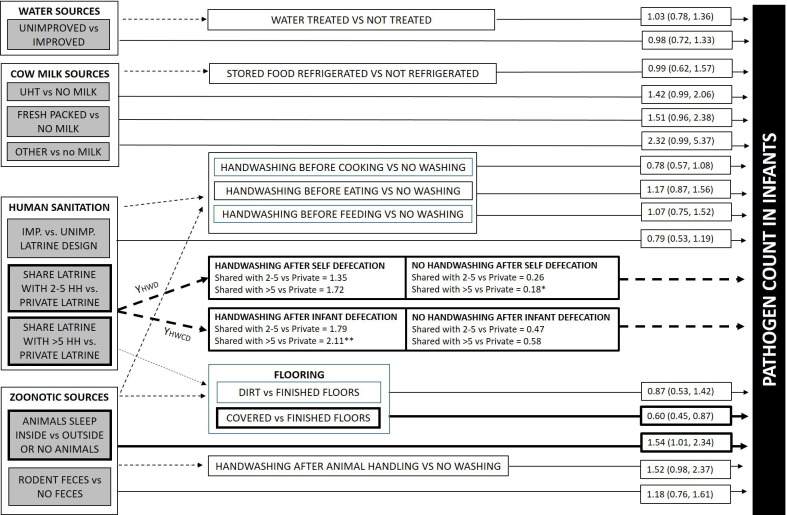
- Cohabitation with animals (aOR=1.54; 95% CI=1.01 to 2.34) was associated with pathogen codetection, while living in a household with vinyl-covered dirt floors (aOR=0.60; 95% CI=0.45 to 0.87) was associated with lower pathogen codetection.
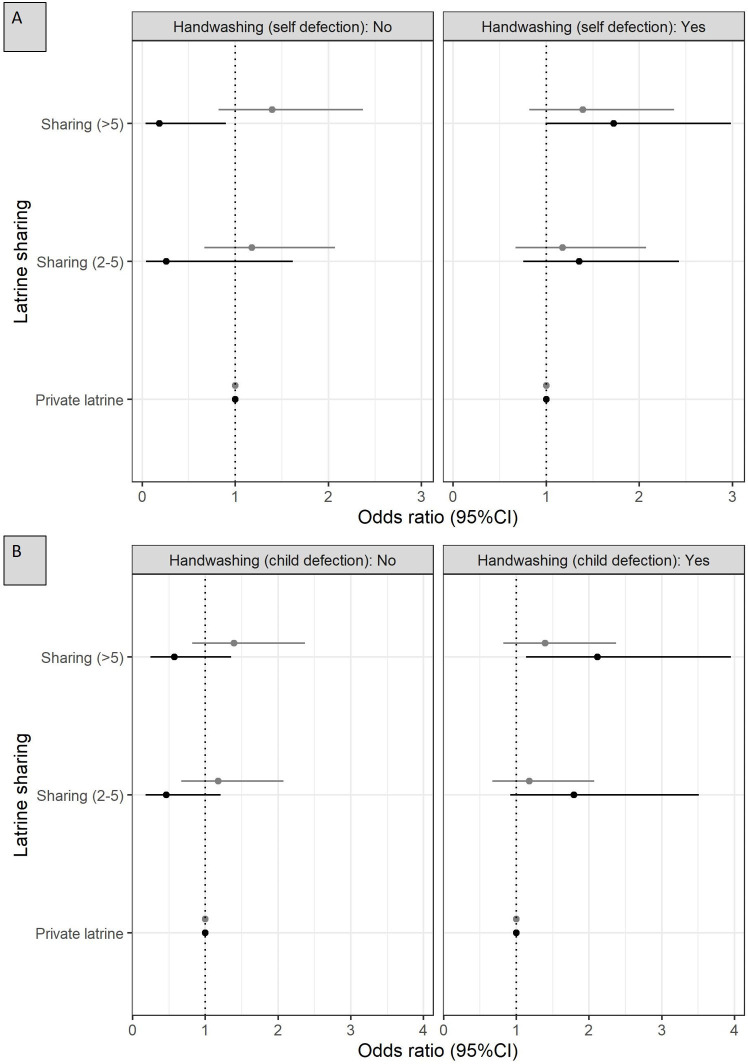
- Handwashing after child defecation (p=0.02) or self-defecation (p=0.03) moderated the relationship between shared sanitation and infant pathogen exposure; private latrine access was protective among caregivers who washed hands after defecation, but without handwashing private sanitation posed no benefit over shared latrines.
Methods
- Cross-sectional study using enrolment survey data from households in the Safe Start cluster-randomised controlled trial in Kisumu, Kenya; 898 caregivers with 5-month-old (22 weeks ±1 week) infants were enrolled, with 862 having complete exposure and diarrhoea data and 773 having exposure and pathogen data.
- Outcomes were caregiver-reported 7-day diarrhoea (three or more loose, watery stools in previous 24 hours) and count of enteric pathogen types in infant stool, assessed by TaqMan Array Card for 23 gene targets with a Cq35 positivity threshold.
- Logistic regression estimated diarrhoea associations; ordinal logistic regression estimated pathogen-count associations; moderation hypotheses were tested one at a time by adding interaction terms and using likelihood ratio tests.
Limitations
- The paper states the cross-sectional design limits causal inference, and the 7-day self-reported diarrhoea and pathogen detection outcomes occurred before observation of household living conditions.
- The paper notes reliance on self-reported breastfeeding, handwashing, and feeding behaviours vulnerable to reporting bias; self-reported handwashing exceeded observed functional handwashing stations, and statistical power for effect modification was limited where conditions varied little, such as primary water sources.
- The paper states results may not be generalisable to rural Kenyan households, higher-income households, or low-income households in other countries; MS2 spiking of about half of stool specimens limited detection of poor extraction efficiency among individual specimens.
Model-written summary. Check it against the paper before relying on it.
Integrity signals
Registry
Cites
Statistics
Figures
Verification
Claims the paper makes
18 Valid · 2 Not valid · 2 Not checked · 64 Own results and interpretations
The cited sources support only part of this claim — read each source’s verdict below.
In the paper
“Most handwashing interventions focus on infant caregivers, not on <5 year siblings and playmates.8”
§ Environmental and behavioural exposure pathways associated with diarrhoea and enteric pathogen detection in 5-month-old, periurban Kenyan infants: a cross-sectional study > Introduction
What the sources say
- Partly supportedcites [8] Watson JA, Ensink JHJ, Ramos M, et al. Does targeting children with hygiene promotion messages work? the effect of handwashing promotion targeted at children, on diarrhoea, soil-transmitted helminth infections and behaviour change, in low- and middle-income countries. Trop Med Int Health 2017; 22: 526– 38. 10.1111/tmi.12861 28244191 sourceExperimental — accuracy not yet measured
The Discussion (page unavailable) says all interventions identified by this review targeted primary-school children aged five to twelve, and identifies children outside school as an overlooked group. That supports the concern about younger children being missed, but the paper does not establish that most handwashing interventions focus on infant caregivers. (LLM, conf=0.83)
plain- Asserted: passes — The authors put it forward as true.
- Checkable: passes — It can be checked against evidence.
- Load-bearing: passes — The paper’s conclusions depend on it.
- Based: passes — The paper gives a reason why it holds.
- Partly supported
The cited sources support only part of this claim — read each source’s verdict below.
In the paper
“The presence of rodents, flies and domestic animals in the immediate household or compound can contaminate soil and surfaces in areas where infants dwell with faeces containing pathogens,11 12”
§ Environmental and behavioural exposure pathways associated with diarrhoea and enteric pathogen detection in 5-month-old, periurban Kenyan infants: a cross-sectional study > Introduction
What the sources say
- Not checked — no full text of the sourcecites [11] Emerson PM, Lindsay SW, Alexander N, et al. Role of flies and provision of latrines in trachoma control: cluster-randomised controlled trial. Lancet 2004; 363: 1093– 8. 10.1016/S0140-6736(04)15891-1 15064026 source
- Partly supportedcites [12] Zambrano LD, Levy K, Menezes NP, et al. Human diarrhea infections associated with domestic animal husbandry: a systematic review and meta-analysis. Trans R Soc Trop Med Hyg 2014; 108: 313– 25. 10.1093/trstmh/tru056 24812065 PMC4023907 sourceExperimental — accuracy not yet measured
The Introduction (page unavailable) says livestock and poultry near homes can contaminate the household environment and soil with feces, posing a particular risk to young children during play. It does not address rodents or flies as sources of contamination, or specifically identify contaminated surfaces or infants. (LLM, conf=0.88)
plainstates a cause- Asserted: passes — The authors put it forward as true.
- Checkable: passes — It can be checked against evidence.
- Load-bearing: passes — The paper’s conclusions depend on it.
- Based: passes — The paper gives a reason why it holds.
The cited sources support only part of this claim — read each source’s verdict below.
In the paper
“The benefits of maintaining hygiene conditions in one’s own household can be derailed if hygiene conditions of communal compound living spaces and infrastructure (eg, shared latrines) are poor.15–17”
§ Environmental and behavioural exposure pathways associated with diarrhoea and enteric pathogen detection in 5-month-old, periurban Kenyan infants: a cross-sectional study > Introduction
What the sources say
- Partly supportedcites [15] Baker KK, O'Reilly CE, Levine MM, et al. Sanitation and Hygiene-Specific risk factors for moderate-to-severe diarrhea in young children in the global enteric multicenter study, 2007-2011: case-control study. PLoS Med 2016; 13: e1002010. 10.1371/journal.pmed.1002010 27138888 PMC4854459 sourceExperimental — accuracy not yet measured
The Discussion (page not provided) links shared and unhygienic sanitation to diarrhea risk in young children and says that risks can arise through exposure outside the household, supporting the concern about shared latrines. It does not establish that poor hygiene across communal compound living spaces derails the benefits of hygiene maintained within a household. (LLM, conf=0.82)
- Partly supportedcites [16] Simiyu S, Swilling M, Cairncross S, et al. Determinants of quality of shared sanitation facilities in informal settlements: case study of Kisumu, Kenya. BMC Public Health 2017; 17: 68. 10.1186/s12889-016-4009-6 28077103 PMC5225536 sourceExperimental — accuracy not yet measured
The Discussion describes poor hygiene in shared latrines as a public-health risk, and the qualitative results describe women cleaning compound toilets to protect their children. The paper does not examine hygiene maintained inside individual households or show that poor communal conditions negate its benefits. (LLM, conf=0.84)
- Supportedcites [17] Ritter RL, Peprah D, Null C, et al. Within-Compound versus public Latrine access and child feces disposal practices in low-income neighborhoods of Accra, Ghana. Am J Trop Med Hyg 2018; 98: 1250– 9. 10.4269/ajtmh.17-0654 29557327 PMC5953368 source
The Discussion states that neighbors’ sanitary practices could affect shared spaces where children eat and play, regardless of how safely a household manages its own sanitation. It also explains that unsafe child-feces disposal by neighbors could contaminate those spaces. (LLM, conf=0.91)
plainstates a cause- Asserted: passes — The authors put it forward as true.
- Checkable: passes — It can be checked against evidence.
- Load-bearing: passes — The paper’s conclusions depend on it.
- Based: passes — The paper gives a reason why it holds.
- Partly supported
The cited sources support only part of this claim — read each source’s verdict below.
In the paper
“Access to a latrine within a compound is not a guarantee that all compound residents will consistently use it for personal defecation or child faeces disposal.17”
§ Environmental and behavioural exposure pathways associated with diarrhoea and enteric pathogen detection in 5-month-old, periurban Kenyan infants: a cross-sectional study > Introduction
What the sources say
- Partly supportedcites [17] Ritter RL, Peprah D, Null C, et al. Within-Compound versus public Latrine access and child feces disposal practices in low-income neighborhoods of Accra, Ghana. Am J Trop Med Hyg 2018; 98: 1250– 9. 10.4269/ajtmh.17-0654 29557327 PMC5953368 sourceExperimental — accuracy not yet measured
The Results (Relationship between latrine access and usage indicators; page unavailable) found that within-compound latrine access was not associated with improved perceived child-feces disposal practices among neighboring caregivers after adjustment. The Methods (Sanitation access and usage variables; page unavailable) also report that latrine use by children under five was uncommon. These findings support the point that access does not guarantee child-feces disposal, but the paper does not establish whether all compound residents consistently use the latrine for their own defecation. (LLM, conf=0.85)
plain- Asserted: passes — The authors put it forward as true.
- Checkable: passes — It can be checked against evidence.
- Load-bearing: passes — The paper’s conclusions depend on it.
- Based: passes — The paper gives a reason why it holds.
- Partly supported
Every source the paper cites for this claim was checked and supports it.
In the paper
“We did not assess caregiver washing of infant hands, but infants place their own hands into their mouth frequently.19 36”
§ Environmental and behavioural exposure pathways associated with diarrhoea and enteric pathogen detection in 5-month-old, periurban Kenyan infants: a cross-sectional study > Discussion
What the sources say
- Supportedcites [19] Medgyesi D, Brogan J, Sewell D, et al. Where children play: young child exposure to environmental hazards during play in public areas in a transitioning internally displaced persons community in Haiti. Int J Environ Res Public Health 2018; 15: 1682. 10.3390/ijerph15081646 PMC6122025 30081490 source
The Results (§3.5, Object-to-Mouth Contacts) state that children of all developmental stages frequently placed their hands in their mouths and report a hand-to-mouth contact rate of 18 per hour for infants. This directly supports the attributed claim. (LLM, conf=0.94)
- Supportedcites [36] Kwong LH, Ercumen A, Pickering AJ, et al. Hand- and Object-Mouthing of rural Bangladeshi children 3-18 months old. Int J Environ Res Public Health 2016; 13. 10.3390/ijerph13060563. [Epub ahead of print: 04 06 2016]. PMC4924020 27271651 source
The Observational Results report median hand-mouthing frequencies of 30–37 times per hour among rural Bangladeshi children aged 3–18 months. The Discussion explicitly includes children mouthing their own hands in the behaviors measured, supporting the claim that infants do this frequently. Page numbers are unavailable in our copy. (LLM, conf=0.90)
plain- Asserted: passes — The authors put it forward as true.
- Checkable: passes — It can be checked against evidence.
- Load-bearing: passes — The paper’s conclusions depend on it.
- Based: passes — The paper gives a reason why it holds.
- Supported
54 more claims
Create a free account to see all 86 claims and to verify the 3 references still open.
- Probably not a substantial claim. 12
- It may state two separate claims as one. 19
Citations
Cites
Kirk, M. D., Pires, S. M., Black, R. E., Caipo, M., Crump, J. A., Devleesschauwer, B., Döpfer, D., Fazil, A., Fischer-Walker, C. L., Hald, T., et al. (2015) · PLoS Medicine · doi:10.1371/journal.pmed.1001921 · Cited by 1,625
Platts-Mills, J. A., Babji, S., Bodhidatta, L., Gratz, J., Haque, R., Havt, A., McCormick, B. J., McGrath, M., Olortegui, M. P., Samie, A., et al. (2015) · The Lancet Global Health · doi:10.1016/s2214-109x(15)00151-5 · Cited by 894
Luby, S. P., Rahman, M., Arnold, B. F., Unicomb, L., Ashraf, S., Winch, P. J., Stewart, C. P., Begum, F., Hussain, F., Benjamin-Chung, J., et al. (2018) · The Lancet Global Health · doi:10.1016/s2214-109x(17)30490-4 · Cited by 759
Null, C., Stewart, C. P., Pickering, A. J., Dentz, H. N., Arnold, B. F., Arnold, C. D., Benjamin-Chung, J., Clasen, T., Dewey, K. G., Fernald, L. C. H., et al. (2018) · The Lancet Global Health · doi:10.1016/s2214-109x(18)30005-6 · Cited by 602
A Laboratory-Developed TaqMan Array Card for Simultaneous Detection of 19 Enteropathogens
Liu, J., Gratz, J., Amour, C., Kibiki, G., Becker, S., Janaki, L., Verweij, J. J., Taniuchi, M., Sobuz, S. U., Haque, R., et al. (2013) · Journal of Clinical Microbiology · doi:10.1128/jcm.02658-12 · Cited by 393
Rogawski, E. T., Liu, J., Platts-Mills, J. A., Kabir, F., Lertsethtakarn, P., Siguas, M., Khan, S. S., Praharaj, I., Murei, A., Nshama, R., et al. (2018) · The Lancet Global Health · doi:10.1016/s2214-109x(18)30351-6 · Cited by 387
Liu, J., Kabir, F., Manneh, J., Lertsethtakarn, P., Begum, S., Gratz, J., Becker, S. M., Operario, D. J., Taniuchi, M., Janaki, L., et al. (2014) · The Lancet Infectious Diseases · doi:10.1016/s1473-3099(14)70808-4 · Cited by 307
The impact of malnutrition on childhood infections
Walson, J. L., & Berkley, J. A. (2018) · Current Opinion in Infectious Diseases · doi:10.1097/qco.0000000000000448 · Cited by 273
Role of flies and provision of latrines in trachoma control: cluster-randomised controlled trial
Emerson, P. M., Lindsay, S. W., Alexander, N., Bah, M., Dibba, S.-M., Faal, H. B., Lowe, K., McAdam, K. P., Ratcliffe, A. A., Walraven, G. E., et al. (2004) · The Lancet · doi:10.1016/s0140-6736(04)15891-1 · Cited by 240
Zambrano, L. D., Levy, K., Menezes, N. P., & Freeman, M. C. (2014) · Transactions of The Royal Society of Tropical Medicine and Hygiene · doi:10.1093/trstmh/tru056 · Cited by 210
Shared Sanitation versus Individual Household Latrines: A Systematic Review of Health Outcomes
Heijnen, M., Cumming, O., Peletz, R., Chan, G. K.-S., Brown, J., Baker, K., & Clasen, T. (2014) · PLoS ONE · doi:10.1371/journal.pone.0093300 · Cited by 168
Self-citationBaker, K. K., O’Reilly, C. E., Levine, M. M., Kotloff, K. L., Nataro, J. P., Ayers, T. L., Farag, T. H., Nasrin, D., Blackwelder, W. C., Wu, Y., et al. (2016) · PLOS Medicine · doi:10.1371/journal.pmed.1002010 · Cited by 137
Self-citationDiarrhoeal disease in children due to contaminated food
Kirk, M. D., Angulo, F. J., Havelaar, A. H., & Black, R. E. (2017) · Bulletin of the World Health Organization · doi:10.2471/blt.16.173229 · Cited by 117
Aseyo, R. E., Mumma, J. A. O., Scott, K., Nelima, D., Davis, E., Baker, K. K., Cumming, O., & Dreibelbis, R. (2018) · Human Resources for Health · doi:10.1186/s12960-018-0318-4 · Cited by 109
Self-citationRogawski McQuade, E. T., Platts-Mills, J. A., Gratz, J., Zhang, J., Moulton, L. H., Mutasa, K., Majo, F. D., Tavengwa, N., Ntozini, R., Prendergast, A. J., et al. (2020) · The Journal of Infectious Diseases · doi:10.1093/infdis/jiz179 · Cited by 103
Simiyu, S., Swilling, M., Cairncross, S., & Rheingans, R. (2017) · BMC Public Health · doi:10.1186/s12889-016-4009-6 · Cited by 97
Self-citationFuller, J. A., Clasen, T., Heijnen, M., & Eisenberg, J. N. S. (2014) · The American Society of Tropical Medicine and Hygiene · doi:10.4269/ajtmh.13-0503 · Cited by 84
Harris, M., Alzua, M. L., Osbert, N., & Pickering, A. (2017) · Environmental Science & Technology · doi:10.1021/acs.est.7b00178 · Cited by 78
Hand- and Object-Mouthing of Rural Bangladeshi Children 3–18 Months Old
Kwong, L., Ercumen, A., Pickering, A., Unicomb, L., Davis, J., & Luby, S. (2016) · International Journal of Environmental Research and Public Health · doi:10.3390/ijerph13060563 · Cited by 70
Hygiene intervention reduces contamination of weaning food in Bangladesh
Islam, M. S., Mahmud, Z. H., Gope, P. S., Zaman, R. U., Hossain, Z., Islam, M. S., Mondal, D., Sharker, M. A. Y., Islam, K., Jahan, H., et al. (2013) · Tropical Medicine & International Health · doi:10.1111/tmi.12051 · Cited by 66
Infection against infection: parasite antagonism against parasites, viruses and bacteria
Shen, S.-S., Qu, X.-Y., Zhang, W.-Z., Li, J., & Lv, Z.-Y. (2019) · Infectious Diseases of Poverty · doi:10.1186/s40249-019-0560-6 · Cited by 65
Watson, J. A., Ensink, J. H. J., Ramos, M., Benelli, P., Holdsworth, E., Dreibelbis, R., & Cumming, O. (2017) · Tropical Medicine & International Health · doi:10.1111/tmi.12861 · Cited by 58
Self-citationBarnes, A. N., Anderson, J. D., Mumma, J. A. O., Mahmud, Z. H., & Cumming, O. (2018) · PLoS ONE · doi:10.1371/journal.pone.0197587 · Cited by 57
Self-citationHirani, S. A. A., & Karmaliani, R. (2013) · Women and Birth · doi:10.1016/j.wombi.2012.10.007 · Cited by 56
Johnson, H. L., Liu, L., Fischer-Walker, C., & Black, R. E. (2010) · International Journal of Epidemiology · doi:10.1093/ije/dyq074 · Cited by 47
Enteric Pathogen Diversity in Infant Foods in Low-Income Neighborhoods of Kisumu, Kenya
Tsai, K., Simiyu, S., Mumma, J., Aseyo, R. E., Cumming, O., Dreibelbis, R., & Baker, K. K. (2019) · International Journal of Environmental Research and Public Health · doi:10.3390/ijerph16030506 · Cited by 40
Self-citationBenjamin-Chung, J., Crider, Y. S., Mertens, A., Ercumen, A., Pickering, A. J., Lin, A., Steinbaum, L., Swarthout, J., Rahman, M., Parvez, S. M., et al. (2021) · The Lancet Global Health · doi:10.1016/s2214-109x(20)30523-4 · Cited by 39
Medgyesi, D. N., Brogan, J. M., Sewell, D. K., Creve-Coeur, J. P., Kwong, L. H., & Baker, K. K. (2018) · International Journal of Environmental Research and Public Health · doi:10.3390/ijerph15081646 · Cited by 39
Self-citationMedgyesi, D., Sewell, D., Senesac, R., Cumming, O., Mumma, J., & Baker, K. K. (2019) · PLOS Neglected Tropical Diseases · doi:10.1371/journal.pntd.0007292 · Cited by 37
Self-citationDavis, E., Cumming, O., Aseyo, R. E., Nelima, D., Baker, K. K., Mumma, J. A. O., & Dreibelbis, R. (2018) · International Journal of Environmental Research and Public Health · doi:10.3390/ijerph15020192 · Cited by 35
Self-citationDeterminants of the Breastfeeding Pattern Among Working Women in Sdo Paulo
Rea, M. F., Venancio, S. I., Batista, L. E., & Greiner, T. (1999) · Journal of Human Lactation · doi:10.1177/089033449901500314 · Cited by 33
Hoffmann, V., Simiyu, S., Sewell, D., Tsai, K., Cumming, O., Mumma, J., & Baker, K. K. (2020) · doi:10.1101/2020.08.24.20181222 · Cited by 30
Self-citation(2022) · doi:10.3389/fpubh.2021.772892 · Cited by 30
Self-citationSimiyu, S. N., Czerniewska, A., Aseyo, E., Baker, K. K., Cumming, O., Mumma, J. A. O., & Dreibelbis, R. (2020) · American Journal of Tropical Medicine and Hygiene · doi:10.4269/ajtmh.19-0629 · Cited by 28
Self-citationChard, A. N., Baker, K. K., Tsai, K., Levy, K., Sistrunk, J. R., Chang, H. H., & Freeman, M. C. (2019) · Parasites & Vectors · doi:10.1186/s13071-019-3471-2 · Cited by 28
Self-citationWorking Women, Maternity Entitlements, and Breastfeeding: A Report from Bangladesh
Haider, R., & Begum, S. (1995) · Journal of Human Lactation · doi:10.1177/089033449501100413 · Cited by 26
Role, ownership and presence of domestic animals in peri‐urban households of Kisumu, Kenya
Barnes, A. N., Mumma, J., & Cumming, O. (2018) · Zoonoses and Public Health · doi:10.1111/zph.12429 · Cited by 25
Self-citationMumma, J. A. O., Simiyu, S. N., Aseyo, E., Anderson, J., Czerniewska, A., Allen, E., Dreibelbis, R., Baker, K. K., & Cumming, O. (2019) · BMC Infectious Diseases · doi:10.1186/s12879-019-4657-0 · Cited by 22
Self-citationThe role of home environment in infant diarrhea in rural Egypt
Wright, C. E., Alamy, M. E., DuPont, H. L., Holguin, A. H., Hsi, B. P., Thacker, S. B., Zaki, A. M., & Habib, M. (1991) · American Journal of Epidemiology · doi:10.1093/oxfordjournals.aje.a116163 · Cited by 22
Mumma, J. A. O., Cumming, O., Simiyu, S., Czerniewska, A., Aseyo, R. E., Muganda, D. N., Davis, E., Baker, K. K., & Dreibelbis, R. (2020) · The American Journal of Tropical Medicine and Hygiene · doi:10.4269/ajtmh.19-0279 · Cited by 18
Self-citation(1998) · PubMed · Cited by 17
Ritter, R. L., Peprah, D., Null, C., Moe, C. L., Armah, G., Ampofo, J., Wellington, N., Yakubu, H., Robb, K., Kirby, A. E., et al. (2018) · The American Journal of Tropical Medicine and Hygiene · doi:10.4269/ajtmh.17-0654 · Cited by 15
Self-citation
Cited by
Legge, H., Pullan, R. L., & Sartorius, B. K. D. (2023) · PLOS Global Public Health · doi:10.1371/journal.pgph.0002631 · Cited by 30
Jesser, K. J., Zhou, N. A., Hemlock, C., Miller-Petrie, M. K., Contreras, J. D., Ballard, A. M., Sosa-Moreno, A., Calvopiña, M., Arnold, B. F., Cevallos, W., et al. (2024) · Environmental Science & Technology · doi:10.1021/acs.est.4c07753 · Cited by 11
Aboah, M. (2024) · Environmental Health Insights · doi:10.1177/11786302241228427 · Cited by 8
Baker, K. K., Simiyu, S. N., Busienei, P. J., Gutema, F. D., Okoth, B., Agira, J., Amondi, C. S., Ziraba, A. K., Kapanka, A. G., Osinuga, A., et al. (2023) · BMJ Open · doi:10.1136/bmjopen-2023-076067 · Cited by 11
Self-citationMberu, B. U., Simiyu, S. N., Gutema, F. D., Sewell, D. K., Busienei, P. J., Tumwebaze, I. K., & Baker, K. K. (2024) · BMJ Open · doi:10.1136/bmjopen-2023-081906 · Cited by 11
Self-citation
Metadata
- Authors
- Baker, K. K., Mumma, J. A. O., Simiyu, S., Sewell, D., Tsai, K., Anderson, J. D., MacDougall, A., Dreibelbis, R., & Cumming, O.
- Affiliations
- University of Iowa (US)
- Great Lakes University of Kisumu (KE)
- African Population and Health Research Center (KE)
- Consultant, Austin, Texas, USA
- London School of Hygiene & Tropical Medicine (GB)
- Corresponding author
- Baker, Kelly K
- ORCID
- Venue
- BMJ Open
- Publisher
- BMJ
- Published
- 2022-10
- Volume
- 12
- Issue
- 10
- Pages
- e059878
- ISSN
- 2044-6055 (ISSN-L)
- PMC
- PMC9628658
- OpenAlex
- W4307697674
- Cited by
- 19
- References
- 44
- Citations by year
- 2026: 2 · 2025: 4 · 2024: 9 · 2023: 4
- FWCI
- 2.62
- Type
- journal article
- Language
- en
- Open access
- gold
- doi.org
- Licence
- Locations
- BMJ Open (publishedVersion, cc-by-nc)
- PubMed Central (publishedVersion, cc-by-nc)
- PubMed (publishedVersion)
- LSHTM Research Online (London School of Hygiene and Tropical Medicine) (acceptedVersion)
- DOAJ (DOAJ: Directory of Open Access Journals) (submittedVersion, cc-by-sa)
- Funders
- Department for International Development (ITDCHA2310)
- Topics
- Health Sciences › Nursing › Nutrition and Dietetics › Child Nutrition and Water Access
- Health Sciences › Medicine › Infectious Diseases › Viral gastroenteritis research and epidemiology
- Life Sciences › Agricultural and Biological Sciences › Food Science › Food Safety and Hygiene
- Keywords
- infant diarrhea, enteric pathogens, household hygiene, hand washing, latrine access, shared sanitation, floor coverings, cow's milk, diarrhea prevention, Kenya, Kisumu
- MeSH terms
- Cross-Sectional Studies, Diarrhea, Female, Hand Disinfection, Humans, Infant, Kenya, Sanitation
About these checks
Registry, retraction, Cites and statistics results are computed, not judged, with one exception: a printed reference that no index lists is read once by a model before it counts as a citation error. Claims are extracted by a model and kept only when their quote appears verbatim in the text; each cited source is then checked, with a model’s help, for whether it says what the claim relies on. Those verdicts can be wrong — read the claim’s quote and the cited source before relying on one.
The claim verdicts this report counts are experimental: their accuracy is not yet measured.
A language model drew the claims from the paper on 2026-10-10, under version 3 of the claim definition (model deepseek-v4.1-flash, prompt extract-v3).
A second model labelled each claim on 2026-10-10 (model jev-1.13-20260917, definition revision gold-guideline-v0.2).
Cited sources are checked with a language model’s help (gpt-6-sol).
Statistics and arithmetic are recomputed, not judged.
Confidence bands are shown only for fields calibrated on our annotated test set. None is calibrated yet, so no band is shown.
What counts as a claim ›How we measure confidence ›How we check this ›
Are you an author, or do you see a problem with this page? Request a review
Data sources
Bibliographic data: Semantic Scholar, OpenAlex, Crossref.
Contains information from the Semantic Scholar Academic Graph Datasets, made available under the ODC Attribution License (ODC-BY 1.0).
Semantic Scholar’s data is described in: Kinney, R., et al. (2023). The Semantic Scholar Open Data Platform. arXiv:2301.10140.
